Valuing a Homemaker’s Work: What the Supreme Court Said
Why in News?
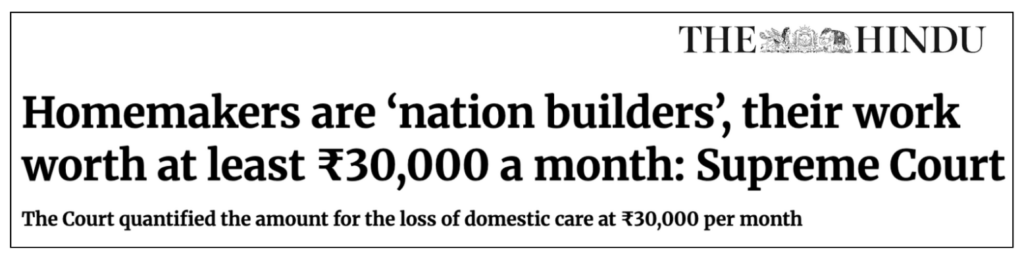
The Supreme Court of India has once more notionally quantified the economic value of a homemaker’s unpaid domestic labour while deciding a compensation claim under the Motor Vehicles Act, 1988.
The Court held that the work a non-earning spouse does at home carries real economic worth, comparable to that of a working spouse, and must be counted when fixing damages for the loss of a homemaker’s life.
The ruling, examined by The Hindu in its explainer on why the Court quantified the labour of homemakers, sits in a long line of judgments insisting that unpaid care work is not charity but a measurable economic contribution that the law and national accounts have long rendered invisible.
- Decided in a motor-accident compensation appeal where the deceased was a homemaker with no salaried income.
- The court rejected the idea that a homemaker’s notional income is negligible or zero.
- Reaffirmed the reasoning of Kirti v. Oriental Insurance (2021), which directed tribunals to attribute a fair notional income to homemakers.
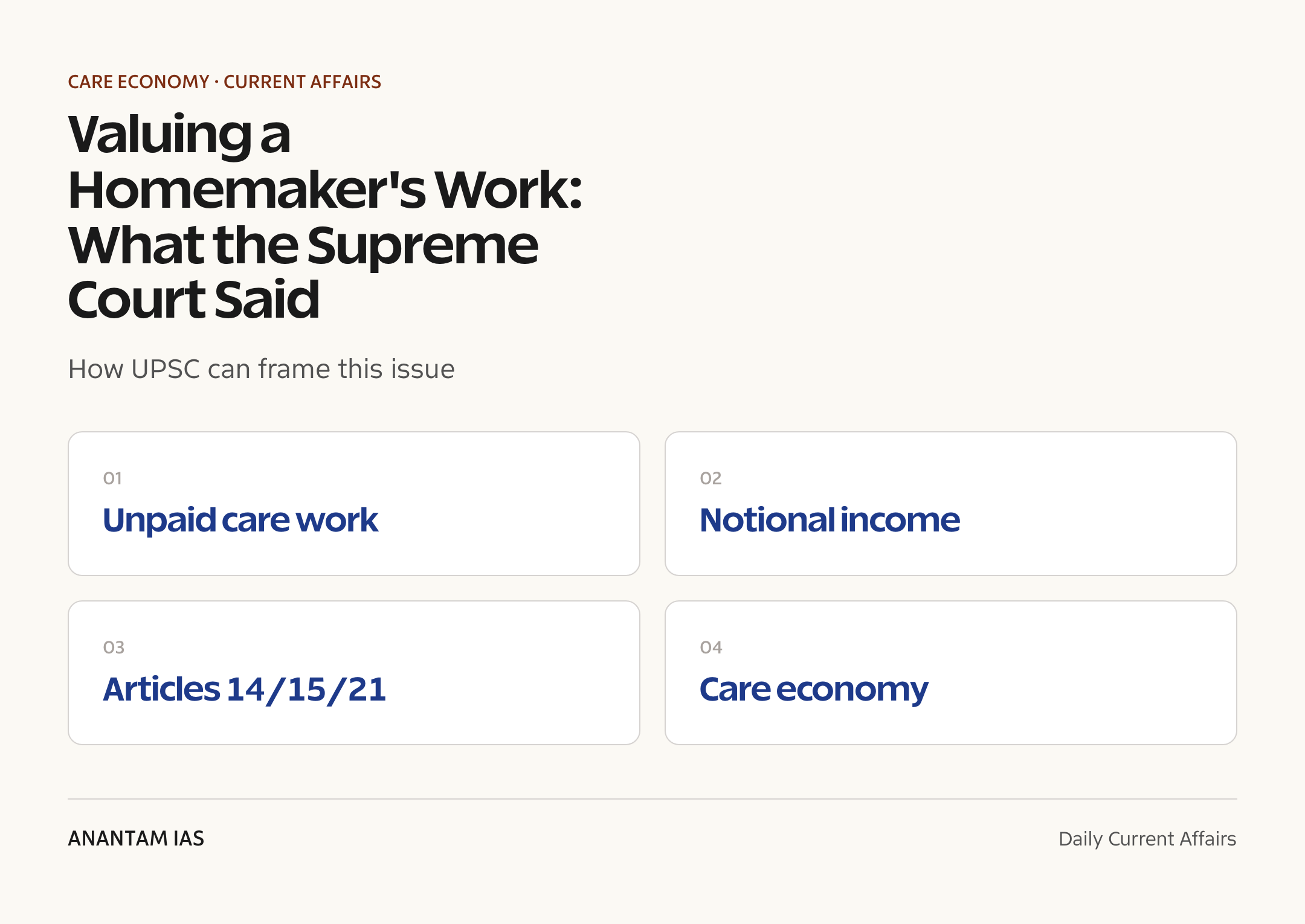
- Linked the issue to constitutional values under Articles 14, 15 and 21 — equality, non-discrimination and dignity of life.
- Flagged that the care economy remains outside the GDP production boundary and so is statistically erased.
The development matters in the context of:
- Matters for crores of women whose full-time domestic and care work is unpaid and uncounted in national income.
- Shapes how Motor Accident Claims Tribunals (MACTs) across India compute compensation, with direct money consequences for bereaved families.
- Feeds the larger policy push to measure unpaid work through the Time Use Survey and to recognise the gendered division of labour.
UPSC Relevance
Prelims Relevance
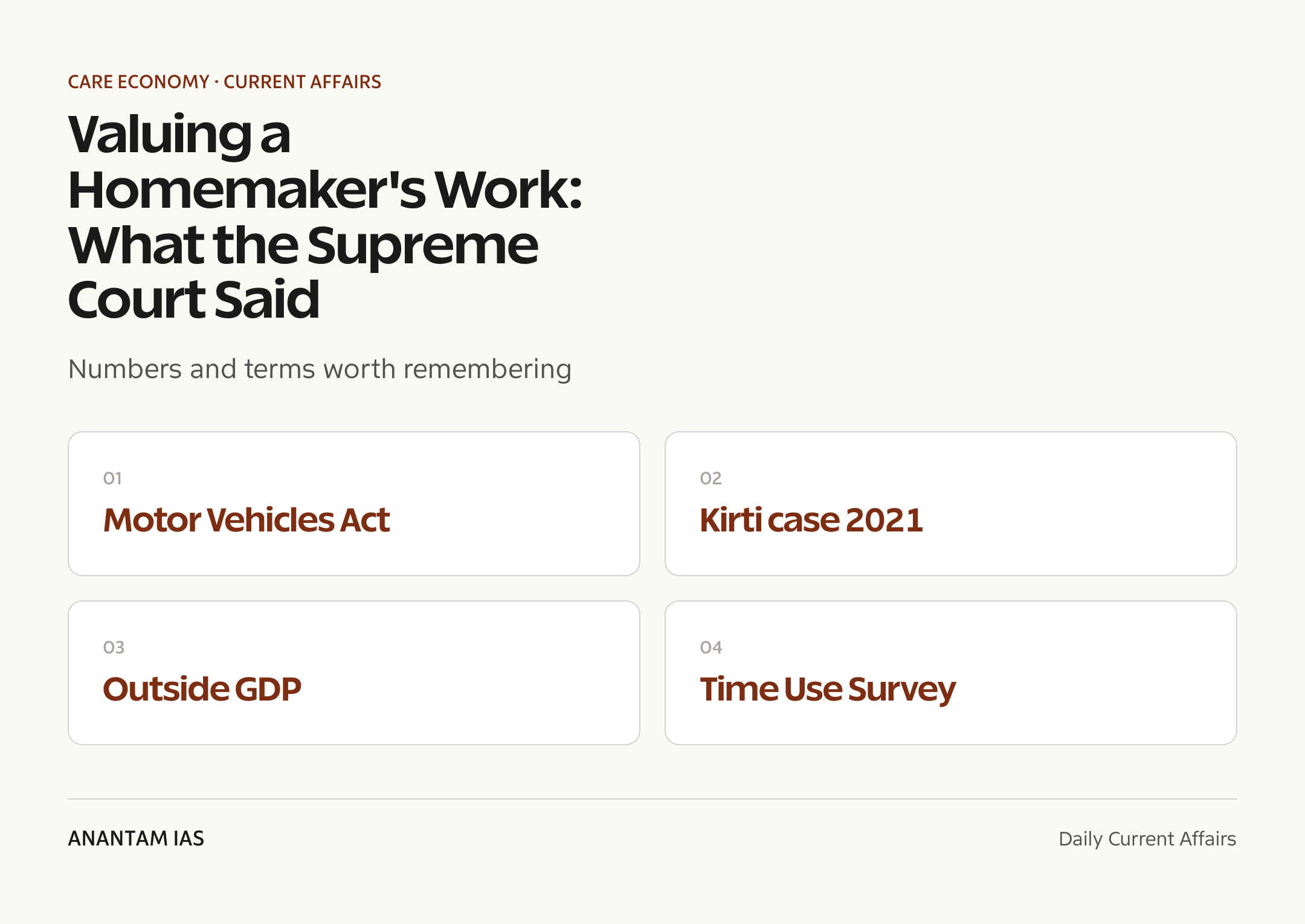
- Motor Vehicles Act, 1988 — basis for accident compensation and the ‘just compensation’ standard.
- Kirti v. Oriental Insurance Co. (2021) — Supreme Court ruling on notional income of homemakers.
- Notional income — imputed earnings assigned to a non-earning person for compensation.
- GDP production boundary in the System of National Accounts — defines what counts as ‘economic’ output.
- Time Use Survey (TUS) — conducted by the National Statistical Office (NSO), 2019 and 2024 rounds.
- Constitutional articles invoked — Article 14 (equality), Article 15 (non-discrimination), Article 21 (life and dignity).
- Unpaid care work and the ‘care economy’ as a development-economics concept.
- Directive Principles — Article 39 on equal right to means of livelihood and equal pay.
Mains Relevance
GS Paper 1
- Role of women and women’s organisations; the gendered division of unpaid domestic and care labour in Indian society.
- Social empowerment and the recognition of women’s invisible work as a development issue.
GS Paper 2
- Issues relating to the development and management of the social sector; mechanisms for the welfare and protection of vulnerable sections.
- Role of the judiciary in advancing substantive equality and dignity through the interpretation of fundamental rights.
GS Paper 3
- Measurement of unpaid work, the care economy, and its place in national income accounting and inclusive growth.
Essay
- The invisible economy: what we do not count, we do not value.
- Dignity of labour cannot stop at the household door.
Background and Context
What the Court actually held
The judgment treats a homemaker’s contribution as quantifiable economic value, not sentiment.
- A homemaker’s services — cooking, cleaning, childcare, eldercare, household management — have a definite economic value that survives her death and must be compensated.
- Where there is no proven income, tribunals must fix a fair notional income rather than treat it as nil.
- The Court drew the analogy that replacing a homemaker’s labour in the market would cost a real wage, so its loss is a real financial loss to the family.
- It rooted the reasoning in the ‘just compensation’ mandate of the Motor Vehicles Act, 1988 and in constitutional equality.
Key Legal Directives from the Judgment:
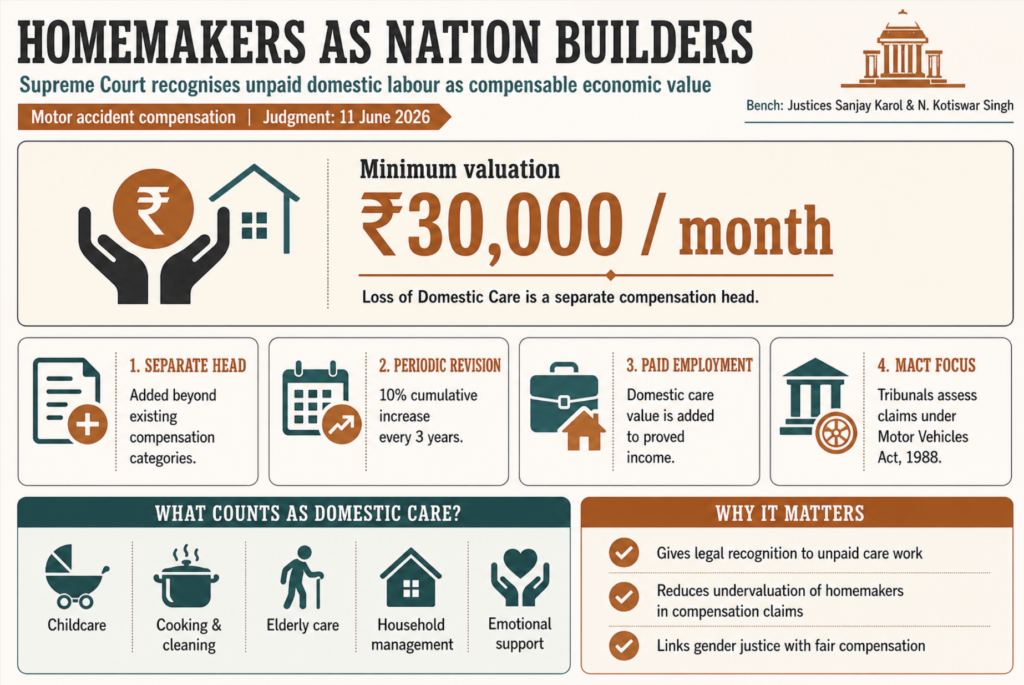
- ₹30,000 Minimum Floor: Motor Accident Claims Tribunals must treat ₹30,000 per month as the baseline notional income for non-earning homemakers.
- Inflation-Linked Revisions: The court directed that this baseline figure must automatically be revised upward by 10% cumulatively every three years.
- Dual-Income Recognition: If a homemaker also holds a paid job, the ₹30,000 for “Loss of Domestic Care” will be paid in addition to her proven professional income.
- Gender-Neutral Application: Though the case involved a deceased woman, the Court purposefully utilised the gender-neutral term “homemaker”, ensuring the precedent applies equally to male homemakers.
The Kirti line of cases
This ruling extends a settled judicial trend rather than breaking new ground.
- Kirti v. Oriental Insurance (2021) held that assigning a low or zero income to homemakers is constitutionally suspect and socially regressive.
- Earlier rulings, such as Arun Kumar Agrawal v. NIC (2010) and Lata Wadhwa v. State of Bihar (2001) had already pushed tribunals to value domestic work.
- The courts have repeatedly criticised the practice of MACTs awarding token amounts for a homemaker’s death.
- The consistent thread: unpaid domestic work is productive labour, and the law must price it fairly.
Why does housework sit outside GDP?
National accounts deliberately exclude most unpaid household production.
- The System of National Accounts draws a production boundary that counts market output but excludes own-account domestic services like cooking and caregiving.
- So a meal cooked at home adds nothing to GDP, while the same meal sold in a restaurant does — a statistical paradox feminist economists have long flagged.
- The result is that the vast labour of mostly women is economically invisible in headline growth numbers, the core puzzle of the care economy.
- Economists distinguish ‘productive’ from ‘reproductive’ labour, arguing that the latter sustains the entire workforce yet goes uncounted.
What does the data tell us?
India’s own surveys confirm a sharply gendered burden of unpaid work.
- The Time Use Survey by the National Statistical Office shows women spending several hours a day on unpaid domestic and caregiving work, far more than men.
- This unpaid burden depresses women’s participation in paid work — India’s female labour force participation rate has long been among the lowest of major economies.
- International estimates have valued unpaid care work at a large share of global output, signalling its macroeconomic weight.
- The gendered division of labour at home, not lack of ability, is a central reason women drop out of the formal workforce.
The constitutional anchor
The Court frames valuation as a question of equality and dignity, not just tort law.
- Article 14 demands equal treatment — valuing a homemaker at zero treats her contribution as worthless (see the fundamental rights and articles).
- Article 15 bars discrimination on grounds of sex, which a gender-blind devaluation of housework effectively perpetuates.
- Article 21‘s guarantee of life with dignity extends to recognising the worth of a person’s life’s work.
- The Directive Principles — Article 39 on equal pay and adequate livelihood — supply the moral backdrop for treating care work as labour.
Why is it contested?
Recognition is one thing; measurement and policy are harder.
- Assigning a single notional income risks both undervaluing and over-standardising widely varying household work.
- Some economists warn that monetising care work could distort the very relationships of love and obligation that sustain it.
- There is no settled method to convert care work into wages — replacement-cost, opportunity-cost and market-substitute methods all give different figures.
- Recognition in a courtroom does not automatically translate into social-security entitlements, pensions, or shared domestic responsibility at home.
Way Forward
Measure it
- Institutionalise regular Time Use Surveys and publish a ‘satellite account’ that estimates the value of unpaid household work alongside GDP.
- Use the data to inform welfare, pension and care-infrastructure policy.
Standardise compensation
- Issue clear guidelines, so MACTs apply a consistent, dignified notional income for homemakers nationwide.
- Train tribunal members and insurers to treat domestic work as a quantifiable loss.
Redistribute the burden
- Expand public care infrastructure — creches, eldercare, affordable services — so unpaid work is lighter and shared.
- Promote paternity leave and shared domestic responsibility to break the gendered division of labour.
Conclusion
By once again putting a number on a homemaker’s labour, the Supreme Court is doing more than fixing a compensation figure. It insists that work, which an entire economy depends on, cannot be priced at zero simply because no salary changes hands.
The harder task lies beyond the courtroom — counting unpaid care in national accounts, building care infrastructure, and sharing domestic work more equally. The judgment names the problem clearly; recognising its full economic weight is the unfinished agenda.
UPSC Practice Questions
Prelims MCQ 1
With reference to the valuation of a homemaker’s work in India, consider the following statements:
- The Supreme Court has held that a homemaker’s domestic labour has a quantifiable economic value for the purpose of compensation.
- Unpaid household services, such as cooking for one’s own family, are counted within the GDP production boundary.
- The Time Use Survey in India is conducted by the National Statistical Office.
How many of the above statements are correct?
(a) Only one (b) Only two (c) All three (d) None
Answer: (b) Only two
Explanation:
Statements 1 and 3 are correct. Statement 2 is wrong: own-account domestic services like home cooking lie OUTSIDE the GDP production boundary and are not counted in national income.
Prelims MCQ 2
Which of the following constitutional provisions is most directly invoked to argue that valuing a homemaker’s work at zero is impermissible?
(a) Article 14 (equality before law)
(b) Article 19 (freedom of speech and expression)
(c) Article 25 (freedom of religion)
(d) Article 32 (right to constitutional remedies)
Answer: (a) Article 14 (equality before law)
Explanation:
Courts root the recognition of unpaid domestic work in Articles 14, 15 and 21 — equality, non-discrimination on grounds of sex, and dignity of life. Article 14 is the most direct equality anchor.
UPSC Mains Questions
- Unpaid care work sustains the economy yet stays outside national income accounts. Critically examine why housework falls outside the GDP production boundary and what reforms could make this invisible labour visible. (250 words)
- The judiciary has repeatedly insisted on assigning economic value to a homemaker’s work. Discuss how this reflects the constitutional commitment to substantive equality and dignity, and the limits of judicial recognition in changing the gendered division of labour. (250 words)
- Examine the role of the care economy in India’s growth and women’s labour force participation. What policy measures can help recognise, reduce and redistribute unpaid care work? (150 words)
Sources: The Hindu and Supreme Court of India.
Frequently Asked Questions
Why did the Supreme Court value a homemaker’s work?
It was deciding a motor-accident compensation claim where the deceased was a homemaker with no salary. The Court held that domestic and care work has real economic value, so the family’s loss must be compensated using a fair notional income rather than treating that work as worth nothing.
What is notional income in this context?
Notional income is an imputed earning figure assigned to a person who has no proven salary, such as a homemaker or a non-earning spouse. Tribunals use it to calculate compensation under the Motor Vehicles Act, ensuring that the loss of unpaid domestic labour is given a realistic monetary value.
Why is housework not counted in GDP?
The System of National Accounts draws a production boundary that includes market output but excludes most unpaid services people produce for their own households, like cooking or childcare. So the same meal counts in GDP if sold in a restaurant but not if cooked at home, making unpaid domestic work statistically invisible.
What is the care economy?
The care economy covers all the paid and unpaid work of caring for people — children, the elderly, the sick — plus household maintenance. In India most of this is unpaid and done by women. It is essential to keeping the workforce healthy and productive, yet it is largely missing from headline economic measures.
What was the Kirti v. Oriental Insurance case?
In Kirti v. Oriental Insurance (2021) the Supreme Court ruled that assigning a low or zero income to homemakers in accident-compensation cases is unfair and discriminatory. It directed tribunals to recognise the economic worth of domestic work, and the current ruling continues this line of reasoning.
How does the Time Use Survey help?
The Time Use Survey, run by the National Statistical Office, records how people spend their day across paid and unpaid activities. Its data reveals how much more unpaid domestic and care work women do than men, providing the evidence base to measure the care economy and design fairer welfare and labour policies.