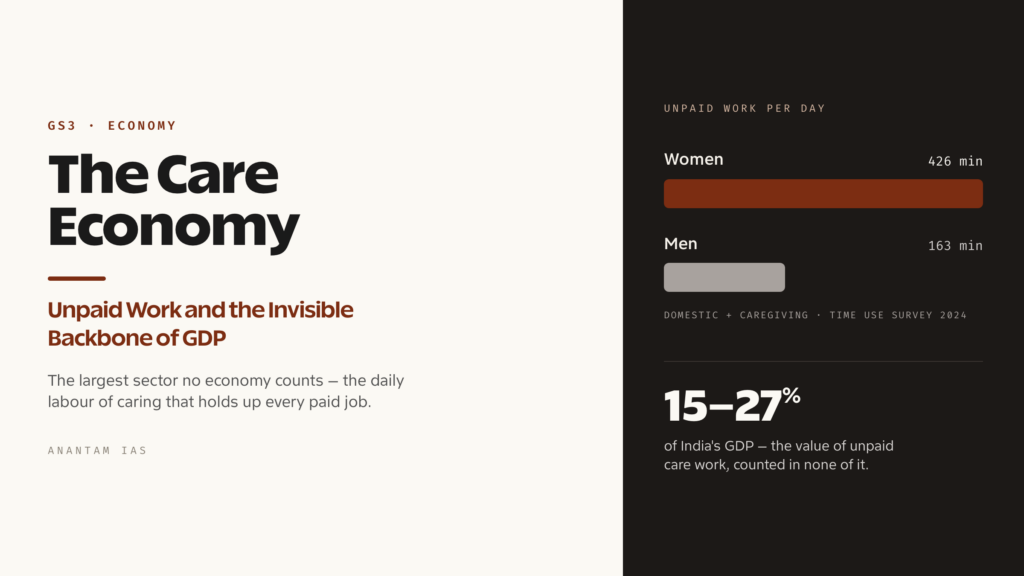
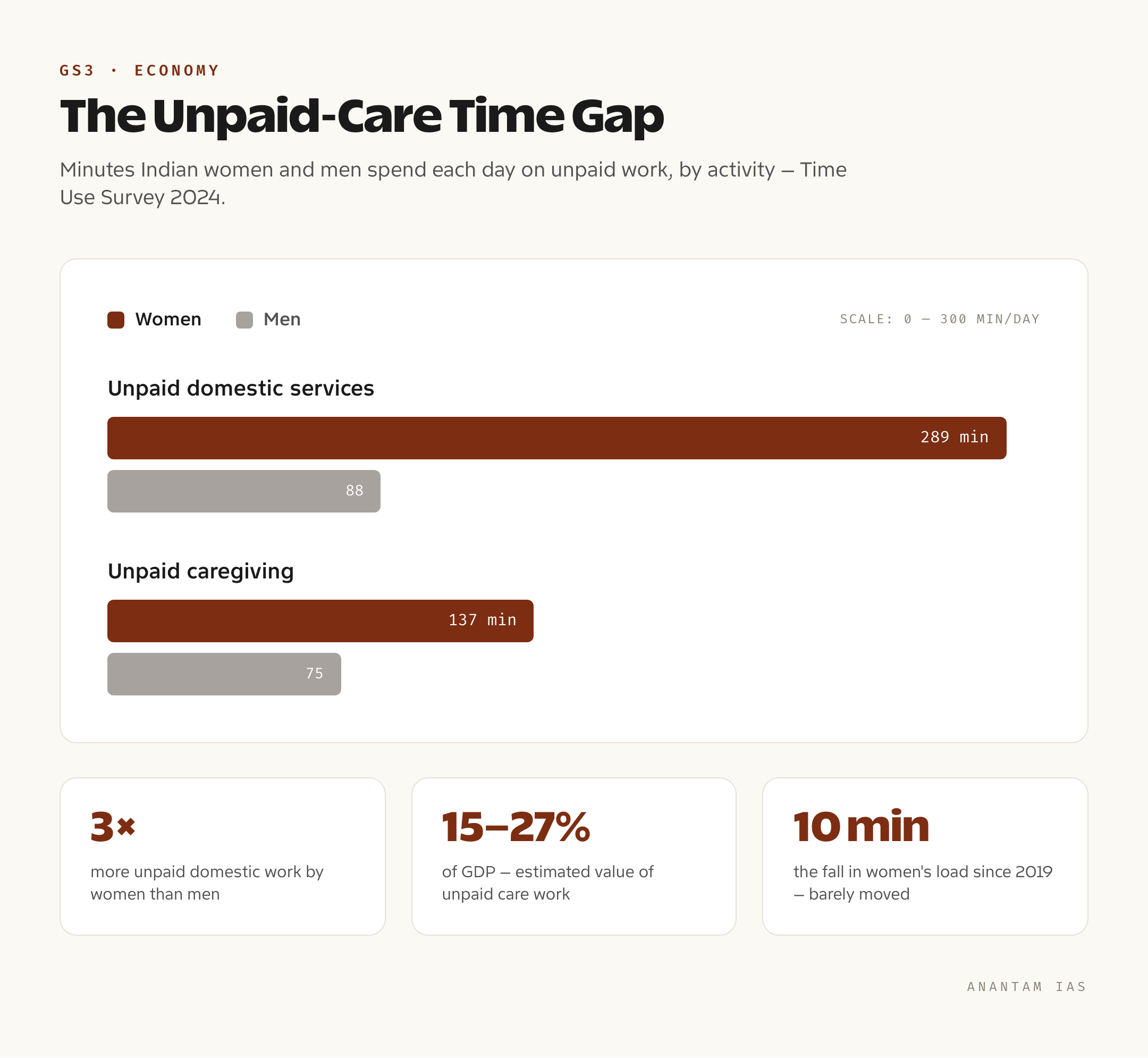
Every economy runs on a second economy that no one pays for. Before a single person leaves for an office or a field, someone has cooked, cleaned, fetched water, dressed a child and checked on an ailing parent — the daily work of keeping human beings alive and able to function. India’s own Time Use Survey 2024 put a number on who does it: women spend 289 minutes a day on unpaid domestic work against men’s 88, and another 137 minutes on caregiving against men’s 75. That is close to five hours of labour, every day, that builds and sustains the workforce the paid economy depends on — and not one minute of it shows up in GDP. This invisible labour has a name. It is the care economy, and once you see it, you cannot un-see how much of the visible economy rests on top of it.
For a UPSC aspirant, the care economy is one of those rare topics that cuts straight across the syllabus — economy, society, women’s empowerment, governance and ethics all at once. It explains why India’s female labour-force participation can rise on paper while women’s lives barely change, why a country can grow fast and still trap half its talent at home, and why “investing in care” has become serious macroeconomic policy rather than a welfare slogan. Get the concept right, attach a few exact figures, and you have a frame that answers a dozen different questions with the same sharp logic.
What the Care Economy Is and Why GDP Ignores It
Start with the definition, because the term is wider than most people assume. The care economy is the whole system of activities that meet people’s physical, psychological and developmental needs — looking after children, the elderly, the sick and the disabled, plus the domestic work of cooking, cleaning and provisioning that households need to function. It has two halves. There is paid care work — nurses, doctors, anganwadi workers, ASHA workers, domestic workers, crèche staff, teachers — people who are employed, however poorly, to provide care. And there is unpaid care work — the same caring and domestic labour done inside the home for no wage, overwhelmingly by women. The two are joined at the hip: when the state or the market doesn’t supply enough paid care, the unpaid half silently absorbs the gap.
The defining feature of unpaid care work is that it is real economic activity that the economy refuses to count. National income is measured using the System of National Accounts, the international rulebook for what goes into GDP, and that rulebook draws a “production boundary” — a line between activities that count as economic output and those that don’t. Most unpaid domestic and care work sits just outside that boundary. So when a woman cooks her family’s meals, GDP records nothing; the moment a restaurant cooks the same meal, it counts. The work is identical; only the wage is missing. This is what economists mean when they call care work invisible — not unimportant, but statistically erased.
And the erasure is enormous. Government analysis cited around the Time Use Survey puts the value of women’s unpaid domestic work at roughly 15 to 17 per cent of India’s GDP. A 2025 study from IIM Indore went further, valuing all unpaid care and household work in India at somewhere between ₹30 trillion and ₹90 trillion a year — anywhere from about 11 to 27 per cent of GDP, depending on how you price an hour of caring — with women generating close to 87 per cent of that value. Put plainly, India runs a hidden sector larger than most of its visible industries, staffed almost entirely by unpaid women, and the national accounts treat it as if it does not exist. The first task of care-economy policy is simply to make this work visible, because what a country doesn’t measure, it rarely funds. This is the same structural blind spot that shows up in the data behind India’s female labour-force participation puzzle, where participation rose without the unpaid second shift shrinking at all.
The Scale of the Gap and Who Carries It
Now the numbers that show how lopsided the load is, because this is where an answer earns its marks. India’s Time Use Survey 2024, run by the National Statistical Office, measured how people actually spend their day, and the gender gap it found is among the widest in the world. Women aged 15 and over spent 289 minutes a day on unpaid domestic services; men spent 88 — more than three times the burden. On caregiving, women logged 137 minutes against men’s 75. Stack the two together and an Indian woman does close to seven hours of unpaid work some days, an entire second job that begins before dawn and ends after everyone else is asleep.
What makes this so stubborn is how little it shifts over time. For women aged 15 to 59, total time on unpaid domestic and care work was 305 minutes a day in 2024 — a marginal decline from 315 minutes in 2019. Five years, ten minutes. So while India’s economy grew, digitised and urbanised across that window, the distribution of care inside the home barely moved. The gap is also a participation gap, not just a time gap: around 41 per cent of women took part in caregiving activities on the survey day against about 21 per cent of men, and the share of women in paid work sat at roughly a quarter against three-quarters of men. The same hours that men spend earning, women spend caring — and only one of those is counted, paid or pensioned.
This is not an Indian peculiarity; it is a global pattern that India shows in an extreme form. The International Labour Organization estimates that in 2023, about 748 million people worldwide were outside the labour force because of care responsibilities — and 708 million of them were women, against just 40 million men. Care work, in other words, is the single biggest reason women globally don’t enter or stay in paid employment. The burden falls hardest on poorer households, where there is no money to outsource care to a crèche, a cook or a nurse, so the woman of the house simply does more. The care economy is not only a gender issue but a class and equity issue, which is exactly why it belongs as much in a social-justice answer as an economic one.
The 5R Framework: From Invisible to Valued
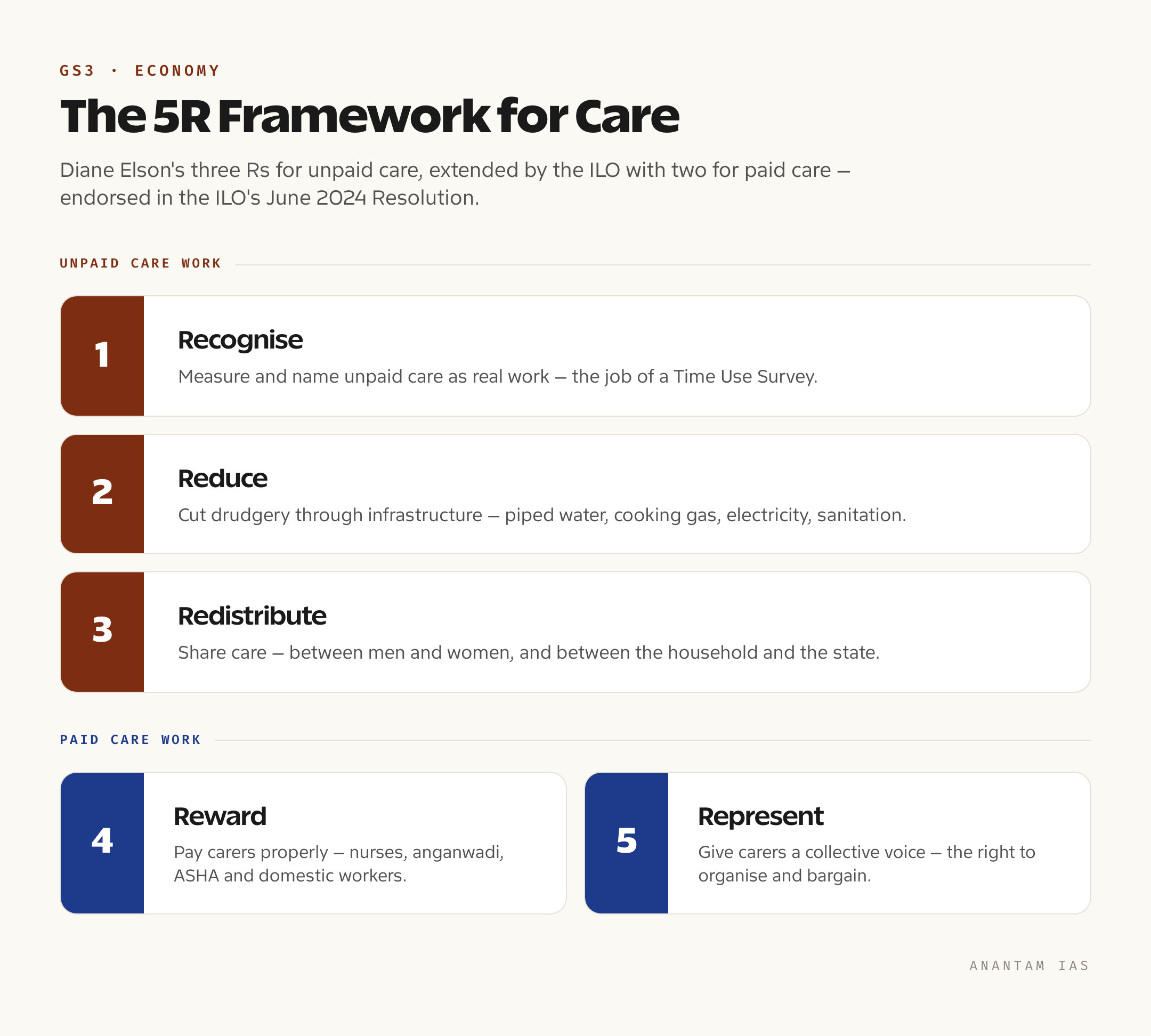
If the problem is that care is unseen, unshared and unpaid, the most useful tool for thinking about the fix is the 5R framework — the closest thing the field has to a syllabus, and a phrase worth memorising exactly. It began as the “3Rs,” set out by the feminist economist Diane Elson: Recognise, Reduce and Redistribute unpaid care work. The ILO later expanded it to five by adding Reward and Represent, aimed at the paid side of care. Together the five Rs walk you from making care visible all the way to giving care workers a political voice, and almost every serious policy on the subject maps onto one of them.
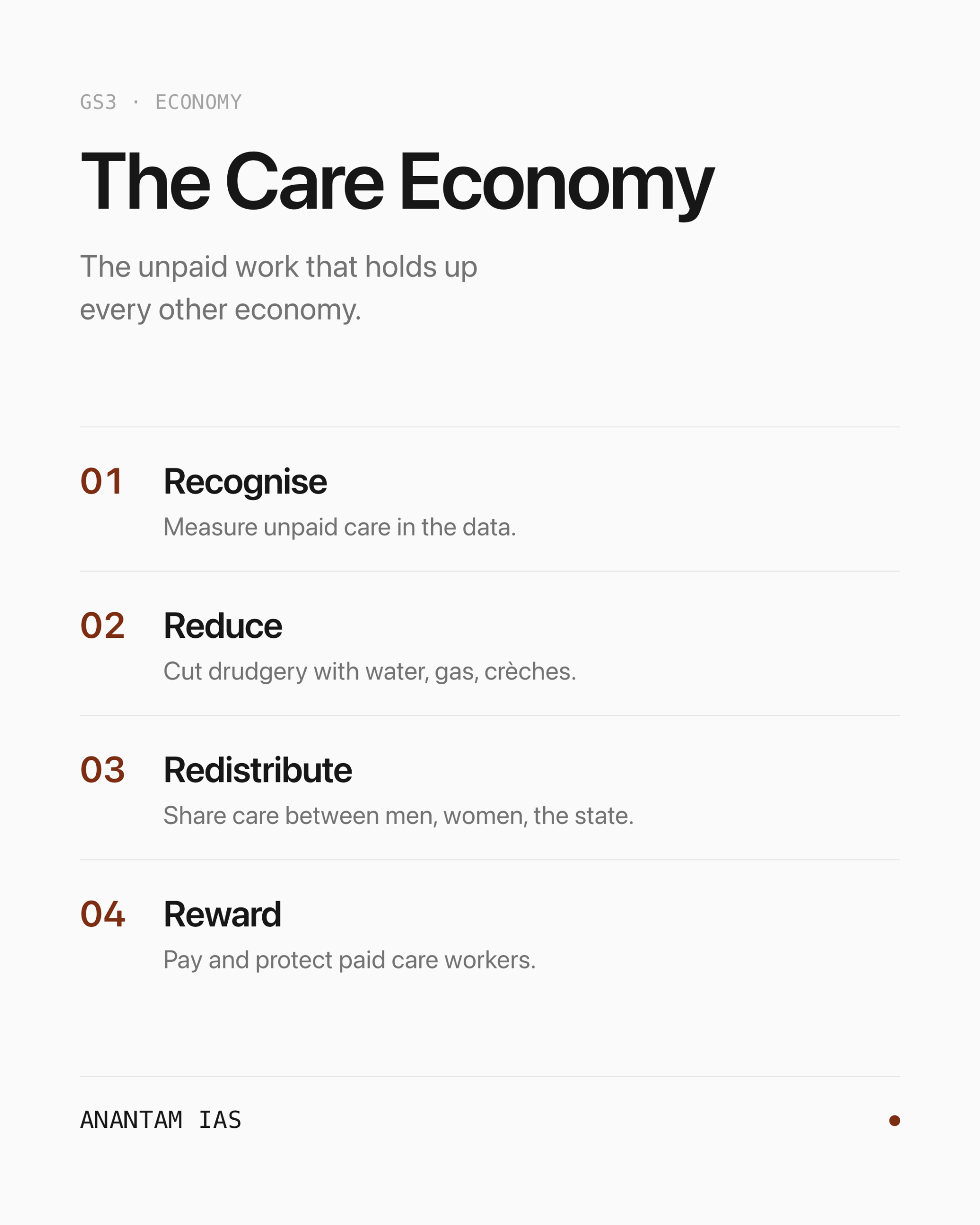
Take them in order. Recognise means measuring and naming unpaid care as work — which is precisely what a Time Use Survey does, and why conducting one is itself a reform. Reduce means cutting the sheer drudgery of care through infrastructure: piped water and cooking gas that end the hours spent fetching and gathering, electricity, better sanitation. Redistribute means moving care off women’s shoulders and sharing it — between men and women through paternity leave and changing norms, and between the household and the state through crèches, schools and eldercare. Reward means paying care workers properly and formally — the nurses, anganwadi and ASHA workers and domestic workers who are chronically underpaid and often outside labour law. And Represent means giving care workers a collective voice, the right to organise and bargain, so the people who hold up the system have a say in how it is run.
The framework stopped being academic in June 2024, when the ILO’s member states, employers and trade unions adopted a Resolution concerning decent work and the care economy — the first time governments, business and labour worldwide had jointly endorsed the 5R approach. The resolution’s logic is blunt and quotable: a well-functioning care economy “not only supports individuals and families, but also contributes to a healthier workforce, creates jobs and enhances productivity.” That single line reframes the whole debate. Care stops being a cost to be minimised and becomes infrastructure to be invested in — as foundational to growth as roads or power, because no roads or power matter if the workforce that uses them was never raised, fed and kept well in the first place. The squeeze on India’s gig and informal workers without social security is the same gap seen from the paid side: care workers, like gig workers, do essential labour with almost none of the protection that “decent work” is supposed to guarantee.
Care Infrastructure, Female Employment and the Indian Policy Response
Here is where the care economy turns from a diagnosis into an investment case, and the link runs through women’s jobs. Because care responsibilities are the main barrier keeping women out of paid work, building care infrastructure — crèches, affordable childcare, eldercare, decent maternity and paternity leave — is one of the most direct ways to raise female labour-force participation. The evidence is striking: the ILO estimates that employment-intensive public investment in childcare, education and long-term care across 82 economies could create close to 299 million jobs by 2035, around 80 per cent of them filled by women, with every dollar spent on closing the childcare gap returning an estimated $3.76 in GDP. Spending on care, in other words, pays for itself twice — once by creating paid care jobs, and again by freeing women to take other jobs.
India’s policy architecture has begun, unevenly, to reflect this. The headline scheme is Palna, the rebuilt National Creche Scheme, now run under the Samarthya pillar of Mission Shakti. Palna provides day-care crèches — increasingly as Anganwadi-cum-Crèche centres that fold childcare into the existing anganwadi network — for children aged six months to six years, and crucially it covers all mothers regardless of whether they are formally employed, open about 7.5 hours a day, 26 days a month. The government has targeted roughly 17,000 such crèches; by early 2025, official figures showed over 11,000 Anganwadi-cum-Crèche centres approved across states, with a smaller number actually operational alongside standalone crèches. On the legal side, the Maternity Benefit (Amendment) Act, 2017 raised paid maternity leave to 26 weeks — among the most generous in the world on paper — and added Section 11A, which requires establishments with 50 or more employees to provide a crèche facility.
But the gap between statute and reality is the part an aspirant must name honestly. Twenty-six weeks of maternity leave applies almost entirely to the formal sector, while over 90 per cent of working women are informal and get none of it. A long, employer-funded maternity entitlement with no matching paternity leave can even backfire, nudging firms to quietly avoid hiring women. Crèche coverage remains thin against the scale of need, and there is still no national paternity-leave law to push redistribution between parents. So India has the right instincts and a scaffolding of schemes, but the care economy it is building is small, formal-sector-tilted and under-funded relative to a hidden care sector worth up to a quarter of GDP. The way forward that scores well is specific: count care through regular Time Use Surveys, expand and fund crèches and eldercare, legislate paternity leave to redistribute the load, extend social security to informal and domestic care workers, and treat care spending as capital investment in human productivity rather than welfare expenditure.
For Your Mains Answer
This is a high-value, cross-cutting topic. Its natural home is GS Paper 3 (Indian economy, growth and employment, mobilisation of resources), but it is equally strong in GS Paper 1 (role of women, social empowerment) and GS Paper 2 (welfare schemes, vulnerable sections, government policies), and it supplies a ready-made data set for the Essay paper on themes of women, work, invisible labour and inclusive growth. The examiner reward is the same one this article models: define the care economy crisply, drop two or three exact figures, and connect the unpaid burden to a concrete policy lever.
How to Build the Answer
Move in a clean chain. Define the care economy and its paid-unpaid split → show why GDP misses the unpaid half (the SNA production boundary) → quantify the gap with Time Use Survey 2024 figures and the GDP-value estimate → explain why it matters: care is the main barrier to women’s labour-force participation → lay out the 5R framework as the solution → land it in the Indian policy context (Palna, Maternity Benefit Act) with an honest note on the formal-informal gap → conclude that care is infrastructure, not welfare. That arc — define, why invisible, scale, why it matters, framework, policy, verdict — fits almost any care or women-and-work question.
Common Mistakes to Avoid
Don’t treat the care economy as only a women’s-empowerment issue — its sharpest framing is economic, as uncounted output and a productivity drag. Don’t confuse paid and unpaid care work; the 5Rs apply differently to each (Recognise/Reduce/Redistribute to unpaid, Reward/Represent to paid). Don’t present 26 weeks of maternity leave as an unqualified success — flag that it covers mainly the formal sector and can deter firms from hiring women. And don’t list schemes without the verdict that they are small against a care sector worth up to a quarter of GDP.
A Compact Answer Spine
Care economy = paid (nurses, anganwadi, ASHA, domestic workers) + unpaid (cooking, cleaning, caregiving at home) → unpaid work sits outside the SNA production boundary, so GDP ignores it → Time Use Survey 2024: women 289 min/day domestic + 137 caregiving vs men 88 + 75; value ≈ 15-27% of GDP → care is the top barrier to women’s work (ILO: 708 mn women globally out of the labour force due to care) → fix = 5R framework (Recognise, Reduce, Redistribute, Reward, Represent), endorsed in the ILO’s June 2024 Resolution → India: Palna crèches, Maternity Benefit Act 26 weeks + Section 11A crèche rule → gap: informal women excluded, no paternity law → verdict: treat care as infrastructure, invest, redistribute.
Diagram or Flowchart Idea
Draw the 5R framework as a simple ladder or wheel — five labelled boxes (Recognise → Reduce → Redistribute → Reward → Represent), with the first three tagged “unpaid care” and the last two “paid care.” Beside it, a tiny two-bar comparison of women’s versus men’s daily unpaid minutes (289 vs 88) makes the problem and the solution legible in one glance.
A Balanced-Conclusion Line
A line that lands the marks: “The care economy asks a simple question of national accounting — if the work of raising and sustaining the workforce is what makes every other kind of work possible, why is it the only work we refuse to count, pay or share? Recognising care as infrastructure, not charity, is the reform that unlocks both women’s potential and the economy’s.”
How to Use Data Without Cramming
You need only four anchors: 289 vs 88 minutes (the daily unpaid-domestic gap, women vs men), 15-27% of GDP (the value of unpaid care), 708 million women (out of the global labour force due to care), and 26 weeks (statutory maternity leave). Attribute them plainly — “as the Time Use Survey 2024 showed,” “by the ILO’s estimate” — and let the four numbers carry the answer.
Frequently Asked Questions
What is the care economy in simple terms?
The care economy is the whole system of work that looks after people — children, the elderly, the sick — plus the domestic work of cooking, cleaning and provisioning that keeps a household running. It has a paid side (nurses, anganwadi and ASHA workers, crèche staff, domestic workers) and an unpaid side (the same caring and domestic labour done at home for no wage, mostly by women). Together they make every other kind of work possible, which is why the care economy is increasingly treated as economic infrastructure rather than private housework.
Why is unpaid care work not counted in GDP?
Because GDP is measured using the System of National Accounts, which draws a “production boundary” around what counts as economic output — and most unpaid domestic and care work falls just outside that line. A meal cooked at home counts as nothing; the same meal sold in a restaurant counts. The work is identical, only the wage is missing, so the labour becomes statistically invisible even though it is genuinely productive.
What is the 5R framework for the care economy?
It is a policy model for valuing care. The economist Diane Elson set out three Rs — Recognise, Reduce and Redistribute unpaid care work — and the ILO added two more, Reward and Represent, for paid care workers. Recognise means measuring it (as a Time Use Survey does); Reduce means cutting drudgery through infrastructure like water and gas; Redistribute means sharing care via crèches, schools and paternity leave; Reward means paying carers properly; Represent means giving them a collective voice. The ILO’s June 2024 Resolution made it the first globally endorsed approach.
How much unpaid care work do Indian women do compared with men?
By the Time Use Survey 2024, women spend about 289 minutes a day on unpaid domestic work against men’s 88, and 137 minutes on caregiving against men’s 75 — more than three times the domestic load. This gap has barely changed since 2019, and government and academic estimates value India’s unpaid care work at anywhere from 15 to 27 per cent of GDP, the bulk of it generated by women.
Practice Questions
Prelims MCQs
- With reference to the care economy, which of the following best describes “unpaid care work”?
(a) Care work done by government employees without overtime pay
(b) Domestic and caregiving labour done within the home for no wage, mostly by women
(c) Voluntary work done by NGOs in disaster relief
(d) Work done by migrant workers without formal contracts
Answer: (b) Unpaid care work is the cooking, cleaning, fetching and caregiving done inside households for no wage, overwhelmingly by women, and falls outside GDP measurement. - Unpaid domestic and care work is generally not counted in GDP because
(a) it is illegal to value such work
(b) it falls outside the “production boundary” of the System of National Accounts
(c) the RBI excludes it from monetary statistics
(d) it is captured separately under the Consumer Price Index
Answer: (b) The System of National Accounts draws a production boundary that places most unpaid household and care work outside the scope of GDP. - The “5R framework” associated with the care economy stands for which set of objectives?
(a) Reduce, Reuse, Recycle, Recover, Restore
(b) Recognise, Reduce, Redistribute, Reward, Represent
(c) Recruit, Retain, Reward, Retrain, Represent
(d) Recognise, Regulate, Reduce, Refund, Reform
Answer: (b) Diane Elson’s three Rs — Recognise, Reduce, Redistribute — were expanded by the ILO with Reward and Represent for paid care work. - As per the Time Use Survey 2024, the daily time spent by Indian women on unpaid domestic work, compared with men, was approximately
(a) about the same
(b) twice as much
(c) more than three times as much
(d) slightly less
Answer: (c) Women spent about 289 minutes a day on unpaid domestic work against men’s 88 minutes, more than three times the burden. - Consider the following about India’s childcare and maternity provisions:
1. The Palna scheme provides crèche facilities only to formally employed mothers.
2. The Maternity Benefit (Amendment) Act, 2017 raised paid maternity leave to 26 weeks.
3. Section 11A of the Act requires certain establishments to provide a crèche facility. Which statements are correct?
(a) 1 and 2 only
(b) 2 and 3 only
(c) 1 and 3 only
(d) 1, 2 and 3
Answer: (b) Palna covers all mothers regardless of employment status, so statement 1 is wrong; the Act raised leave to 26 weeks and Section 11A mandates crèches for establishments with 50 or more employees.
Mains Practice Questions
- “The care economy is the largest sector that no economy counts.” Examine the concept of unpaid care work and explain why it remains invisible in national income accounting. (15 marks, 250 words)
- Discuss the 5R framework (Recognise, Reduce, Redistribute, Reward, Represent) as an approach to valuing paid and unpaid care work, and assess its relevance to India. (15 marks, 250 words)
- “Care responsibilities are the single biggest barrier to women’s participation in the paid labour force.” Critically analyse this statement in the Indian context, using Time Use Survey data. (15 marks, 250 words)
- Evaluate India’s policy response to the care economy, including the Palna scheme and the Maternity Benefit Act, and suggest measures to make it more inclusive of informal-sector women. (10 marks, 150 words)
- “Investment in care infrastructure is not welfare spending but capital investment in human productivity.” Discuss with reference to the link between care services, female employment and economic growth. (15 marks, 250 words)
Tell Google you want more of this.
Add Anantam IAS as a preferred sourceOne tap, and this site shows up more often in your own Top Stories, AI Overviews and AI Mode. Remove it any time.