Sikkim 50 Years of Statehood: From Chogyal Monarchy to India’s 22nd State
The story of Sikkim 50 years statehood is the story of how a Himalayan kingdom of fewer than 250,000 people, ruled by a hereditary Buddhist monarch with a Tibetan title, became a full state of the Indian Union in a 31-day political compression that still raises questions in international law textbooks. May 16, 1975. The 36th Constitutional Amendment received presidential assent. The Chogyal was gone, the kingdom was gone, and Sikkim was India’s 22nd state.
A half-century later, Sikkim is the smallest northeastern state by population, the second-smallest by area in India after Goa, the first organic-farming state in the country, and one of the most prosperous on per-capita income. It also sits on a strategic shelf overlooking the Chumbi Valley, the same wedge of Tibetan territory that triggered the 2017 Doklam standoff. The geography that pulled Sikkim into India in 1975 has not gone anywhere.
The 50-year mark in May 2026 is being observed with state-level celebrations, a special Lok Sabha resolution, and a fresh wave of academic writing on what the integration meant, what it cost, and what lessons it carries for federal India today.
Quick Facts at a Glance
- Statehood date: May 16, 1975 (36th Constitutional Amendment)
- Pre-1975 status: Protectorate of India under the 1950 Indo-Sikkim Treaty; previously a princely kingdom under the Chogyal dynasty since 1642
- Last Chogyal: Palden Thondup Namgyal, who reigned from 1963 until April 1975
- 1975 referendum: Held on April 14, 1975; turnout 59.7%; 97.5% voted to merge with India
- Special provision: Article 371F of the Constitution
- Capital: Gangtok
- Area: 7,096 sq km (smallest after Goa)
- Population: Around 6.1 lakh (2011 Census)
- Strategic borders: Nepal (west), Bhutan (east), China/Tibet (north and east)
- Notable firsts: First fully organic-farming state in India (declared 2016)
Why Sikkim 50 Years Statehood Is in News
The Government of Sikkim has scheduled a year-long commemoration starting May 16, 2026, with a special session of the state Legislative Assembly, a multi-volume oral-history project, and a state-funded documentary film. The Ministry of Home Affairs is releasing declassified files related to the 1975 events under the 50-year disclosure rule. Both Houses of Parliament have passed resolutions marking the occasion.
Sikkim 50 years statehood matters in 2026 for three reasons that have nothing to do with anniversaries. First, India-China relations remain tense after the 2020 Galwan and 2017 Doklam episodes, both fought on or near the Sikkim sector. Second, Article 371F is part of a broader constitutional pattern (371A for Nagaland, 371G for Mizoram, 371H for Arunachal) that is in policy discussion as the centre considers further northeastern reforms. Third, the state’s organic farming model, climate-vulnerable glaciers, and tourism economy have national policy relevance.
Background and Historical Context
From Namgyal Dynasty to Indian Protectorate
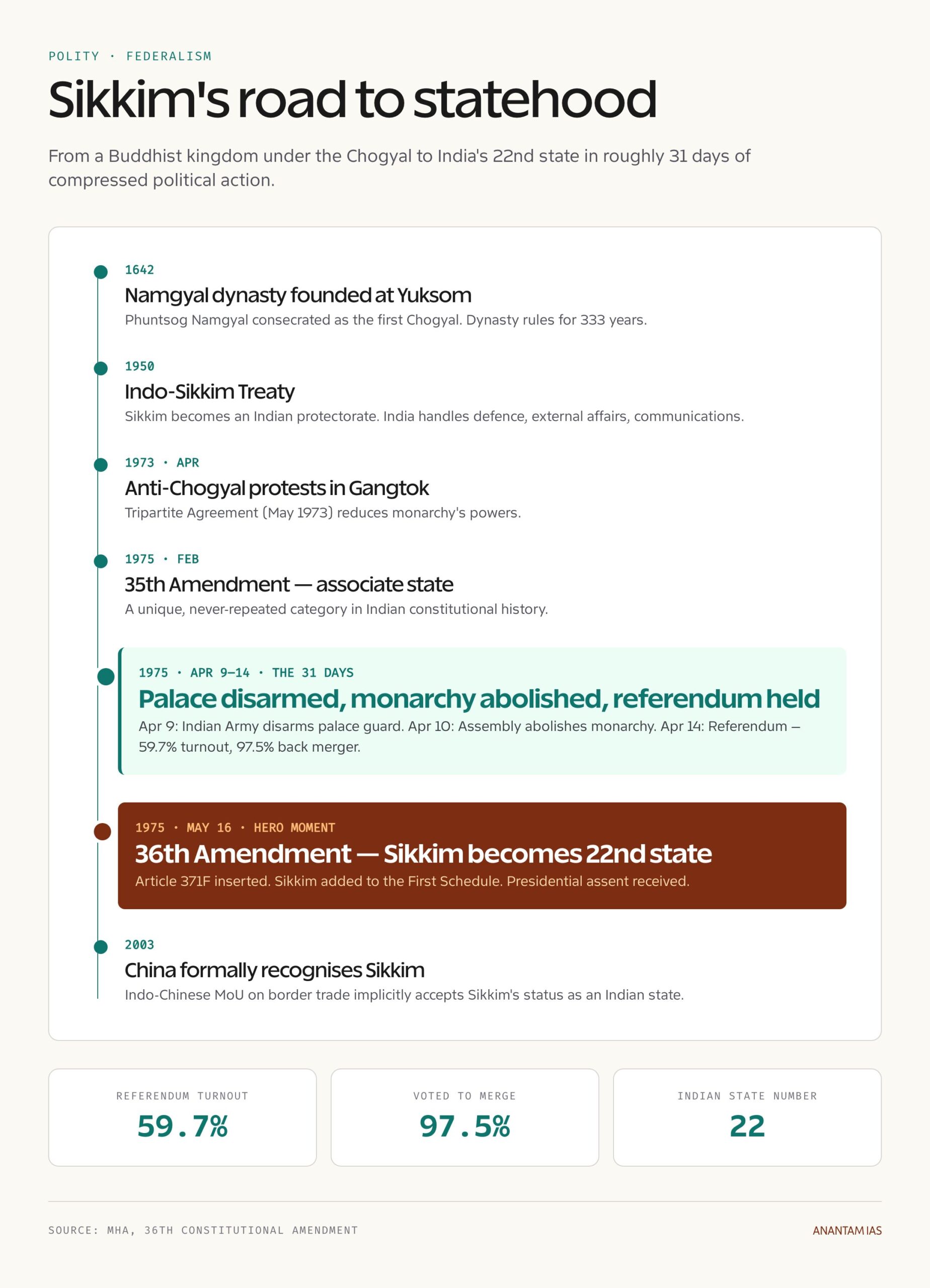
Sikkim’s recorded political history begins in 1642 when Phuntsog Namgyal was consecrated as the first Chogyal at Yuksom. The dynasty ruled, with shrinking territory, for the next 333 years. By the 19th century, the Chogyal was caught between Bhutan, Nepal, and the British, who treated Sikkim as a buffer protecting Darjeeling and the routes to Tibet. The 1890 Anglo-Chinese Convention recognized British paramountcy over Sikkim. By Independence, Sikkim was effectively a British protectorate.
After 1947, India offered the same accession instrument it had offered the other 565 princely states. Chogyal Tashi Namgyal, advised by his English-educated son Palden Thondup, refused full accession but signed the 1950 Indo-Sikkim Treaty, which made Sikkim a protectorate. India handled defence, external affairs, and communications. Sikkim ran everything else. The arrangement lasted 25 years.
Three pressures eroded it. Demographically, ethnic Nepalis had become the majority by the 1960s, outnumbering the Bhutia and Lepcha communities the Chogyal’s regime drew its legitimacy from. Politically, the Sikkim National Congress and the Sikkim Janata Congress demanded democratic reforms the palace was reluctant to grant. Strategically, after the 1962 India-China war and the 1965 India-Pakistan war, Delhi grew uneasy about a semi-independent kingdom on the Chumbi Valley shoulder. The 1962 closure of the Lhasa-Sikkim trade route via Nathu La sealed Sikkim’s economic dependence on India.
The 1975 Sikkim Referendum and the 36th Amendment
The endgame ran fast. April 1973, anti-Chogyal protests erupted in Gangtok. India sent in the Central Reserve Police Force at the Chogyal’s request, then negotiated the May 1973 Tripartite Agreement that reduced the monarchy’s powers. April 1974, elections to the Sikkim Assembly returned a Congress-led majority under Kazi Lhendup Dorji. The new assembly passed the Government of Sikkim Bill 1974, requesting associate-state status with India. The 35th Constitutional Amendment, passed in February 1975, made Sikkim an associate state, the only such category in Indian constitutional history.
April 9, 1975, the Indian Army disarmed the Chogyal’s palace guard. April 10, the Sikkim Assembly passed a resolution abolishing the monarchy. April 14, a referendum was held. Turnout was 59.7%; 59,637 of 61,144 valid votes (97.5%) backed merger with India. April 23, the Lok Sabha passed the 36th Constitutional Amendment Bill. May 15, the Rajya Sabha passed it. May 16, 1975, the President gave assent. Sikkim became India’s 22nd state.
The 36th Amendment inserted Article 371F into the Constitution, repealed the associate-state provisions of the 35th Amendment, and added Sikkim to the First Schedule. China refused to recognize Sikkim’s integration until 2003, when an Indo-Chinese MoU on border trade implicitly accepted Sikkim’s status as a state of India by referring to it accordingly.
Constitutional Provisions: Reading Article 371F
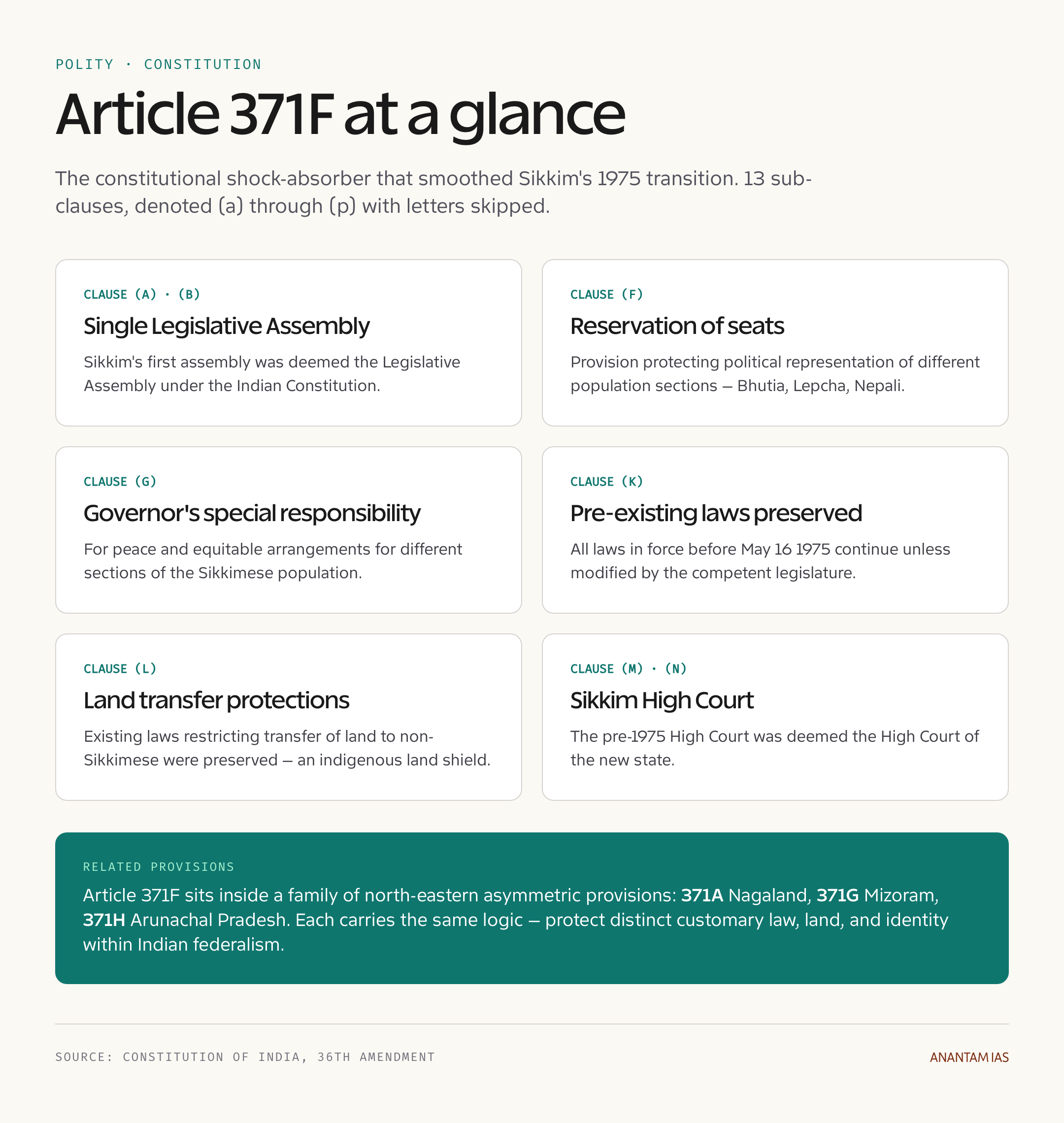
Article 371F is the constitutional shock-absorber that smoothed Sikkim’s transition. It has 13 sub-clauses, denoted (a) through (p) with some letters skipped. The headline provisions:
- Single Legislative Assembly: Sikkim’s first assembly was deemed to be the Legislative Assembly under the Indian Constitution.
- Reservation of seats: Provision was made for protecting the political representation of different sections of the population.
- Governor’s special responsibility: The Governor of Sikkim has special responsibility for peace and equitable arrangements for different sections.
- Pre-existing laws preserved: All laws in force in Sikkim before May 16, 1975, continued unless modified by the competent legislature.
- Land protections: Existing laws restricting the transfer of land to non-Sikkimese were preserved.
- Sikkim High Court: The pre-existing High Court was deemed to be the High Court of the new state.
- Income tax exemption: Sikkim Subjects historically enjoyed exemption from Indian income tax, a provision preserved through Section 10(26AAA) of the Income Tax Act, which was the subject of the Supreme Court’s 2023 ruling clarifying eligibility.
For a deeper grounding, see the related primer on the 42nd Amendment which sits historically close to the Sikkim integration. The pattern of using constitutional special provisions to manage diversity, see Article 370 (now abrogated), 371, 371A through 371J, is one of the more flexible features of Indian federalism.
Why Sikkim 50 Years Statehood Matters
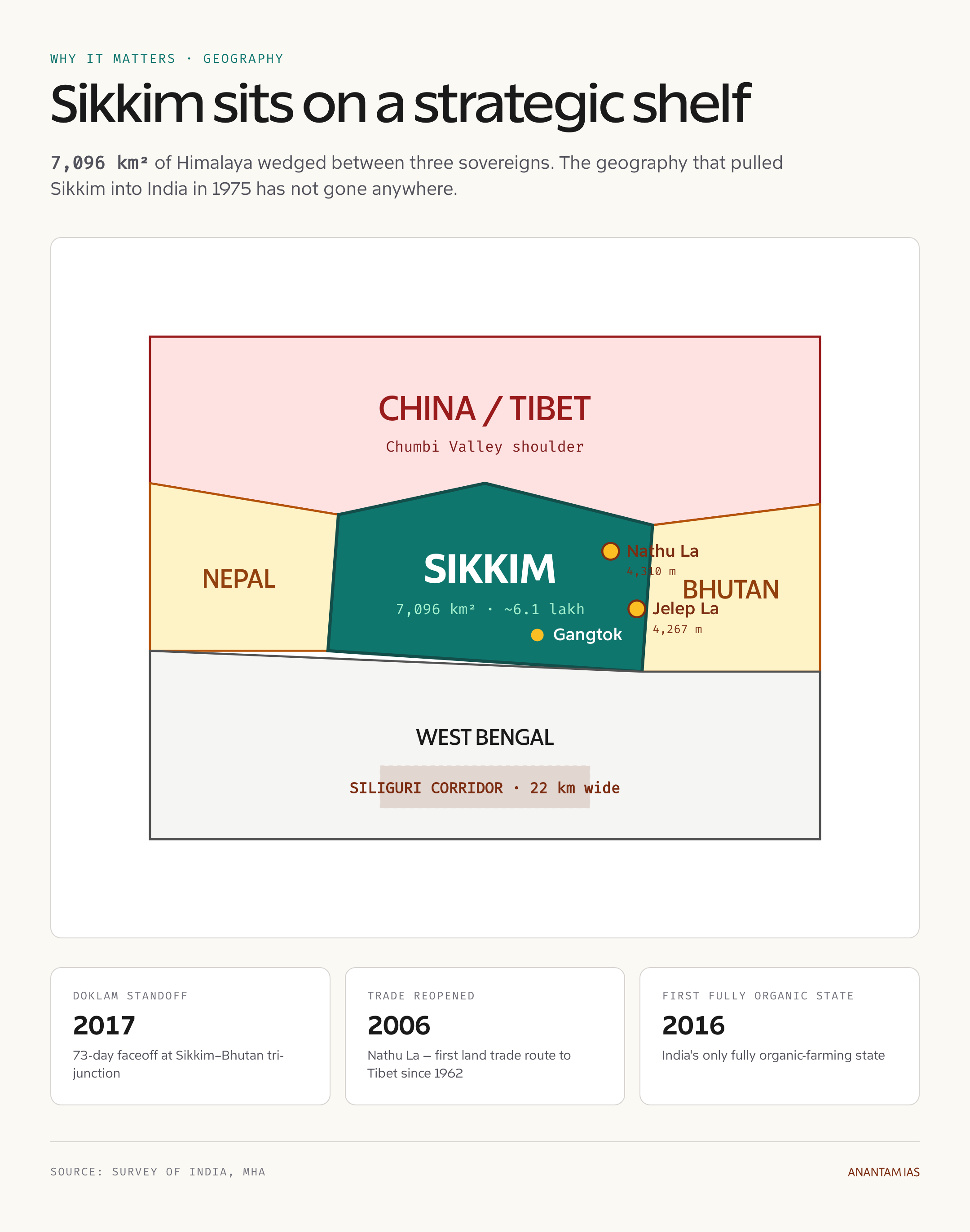
The strategic logic is the easy part. Sikkim sits on a shelf overlooking the Chumbi Valley, a wedge of Tibetan territory that, in turn, points at the Siliguri Corridor, India’s 22-kilometer-wide land bridge to the northeastern states. The 2017 Doklam standoff happened where Sikkim, Bhutan, and Tibet meet. India’s positions on the Sikkim heights overlook Chinese supply lines into the valley. Strategic planners in Delhi consider this geography non-negotiable.
The economic story is a quieter success. Sikkim’s per-capita income is among the highest in the northeast and above the national average. Hydropower, tourism, pharmaceuticals (Sikkim hosts a cluster of pharma units thanks to special tax incentives), and organic farming are the four pillars. The state’s 2016 declaration as the first fully organic-farming state was a bigger deal in agricultural policy circles than the mainstream press recognized.
The democratic legitimacy story is the most contested. Critics, including Sunanda K. Datta-Ray’s Smash and Grab, have argued that the 1975 events were stage-managed and that the referendum’s framing did not give voters a genuine independence option. Defenders point to the lopsided vote and the assembly’s prior resolution. Fifty years on, the population question has settled itself: most living Sikkimese have known only the Indian state.
Detailed Analysis: The Sikkim Model in Indian Federalism
Sikkim’s integration was unique in the post-1947 sequence. It happened decades after the princely-state mergers (1947-49). It happened to a state already a protectorate, not an Indian princely state. It used the otherwise-unused associate-state provision before flipping to full statehood. And it produced a constitutional amendment with a custom-built protective article that has held up for 50 years.
The Sikkim case is studied alongside three others. The 1961 incorporation of Goa, Daman and Diu (military action against Portugal). The 1975 Sikkim integration (referendum and constitutional amendment). The 1987 statehood for Goa, Mizoram, and Arunachal Pradesh (organic state-formation processes). The 2014 bifurcation of Andhra Pradesh to create Telangana (re-organization within the Union). Each used different constitutional pathways and each carries different lessons.
What makes Sikkim 50 years statehood especially relevant in 2026 is that the constitutional mechanism, asymmetric federalism via special-provision articles, is back in policy discussion. The post-2019 reorganization of Jammu and Kashmir, the ongoing debate around Nagaland’s Article 371A, and the proposed reforms in Manipur all touch the same constitutional toolkit Sikkim helped pioneer.
Comparative Perspective: Sikkim Among the Northeast Eight
Sikkim is the smallest of the eight northeastern states by population and area but the most prosperous by per-capita measures. Compared to Mizoram, Manipur, Nagaland, Tripura, Arunachal Pradesh, Meghalaya, and Assam, Sikkim has the lowest crime rate, highest literacy among the smaller states, and one of the lowest poverty headcounts. Its protected-land regime under Article 371F resembles the inner-line permit system in Arunachal, Mizoram, and Nagaland but is constitutionally distinct.
For context on the broader regional canvas, the primer on the Indian states reorganization is less directly relevant than the post-1947 record covered in Indian polity notes. Sikkim’s integration is a chapter that students often skim and examiners often probe.
Challenges and Critiques
Five challenges sit on Sikkim’s 50-year horizon.
Climate vulnerability. Sikkim sits on glacial-fed river systems. The 2023 South Lhonak Lake glacial outburst flood, which killed dozens and damaged the Teesta-III dam, was a wake-up call on glacial lake outburst flood (GLOF) risk.
Demographic pressure on Sikkim Subject status. The income-tax exemption under Section 10(26AAA) and land-purchase restrictions create a two-tier population: Sikkim Subjects with full privileges and others. The 2023 Supreme Court ruling extending exemption to “Old Indian Settlers” was politically contentious.
Border infrastructure with China. The Border Roads Organisation has accelerated road and tunnel construction along the Sikkim-China frontier. Local environmental and seismic risks are non-trivial.
Hydropower-environment trade-offs. Sikkim’s economy depends on hydropower royalties, but downstream West Bengal and Bangladesh have raised water-sharing concerns about the Teesta cascade.
Tourism over-carrying capacity. Iconic destinations like Tsomgo Lake, Nathu La, Yumthang Valley, and Gangtok face seasonal overcrowding that strains fragile mountain ecosystems.
UPSC Prelims Pointers
- Sikkim became the 22nd state of India on May 16, 1975, via the 36th Constitutional Amendment.
- The special provision for Sikkim is Article 371F.
- The 35th Amendment (1975) had earlier made Sikkim an associate state, the only such case in Indian history.
- The 1975 referendum was held on April 14, 1975; 97.5% voted to merge with India.
- The last Chogyal was Palden Thondup Namgyal.
- The 1950 Indo-Sikkim Treaty had earlier established the protectorate.
- China formally recognized Sikkim as part of India in 2003.
- Sikkim’s strategic passes include Nathu La and Jelep La.
- Sikkim was declared India’s first fully organic-farming state in 2016.
- Sikkim’s High Court is among India’s smallest, with its seat at Gangtok.
Mains Practice Questions
- “The integration of Sikkim into the Indian Union in 1975 used a unique constitutional pathway through the 35th and 36th Amendments. Examine the constitutional and political dimensions of the process.” (GS Paper II, 250 words)
- Discuss the role of Article 371F in preserving Sikkim’s distinct identity within the Indian federal structure. How does it compare with other special-provision articles for the northeast? (GS Paper II, 250 words)
- Sikkim’s strategic location makes it central to India’s China policy. Examine the post-2017 Doklam developments in this light. (GS Paper II / III, 150 words)
- Critically evaluate the trade-offs between hydropower-led growth, climate vulnerability, and ecological fragility in Sikkim’s developmental model. (GS Paper III, 250 words)
Way Forward
Sikkim 50 years statehood is, on balance, an Indian federal success story. A small Himalayan kingdom that could have remained a permanent geopolitical irritant became an integrated, prosperous, democratic state. The constitutional engineering held. The special provisions did their job. The local democratic culture has matured.
The next 50 years will pose different questions. Climate adaptation, especially around glacial systems and downstream water-sharing. Border infrastructure that serves security without devastating ecology. A demographic and identity policy that respects the Sikkim Subject framework while accommodating the Indians who have made the state their home. Tourism that sustains rather than degrades the landscape. Hydropower that pays its bills without breaking its rivers.
The 50-year mark is a good time to honor the past and update the framework. The May 16 anniversary should not be a frozen ritual. It should be the start of a public conversation about what asymmetric federalism, the political model Sikkim helped invent, owes its citizens half a century in.
Frequently Asked Questions
Q1. When did Sikkim become a state of India?
Sikkim became India’s 22nd state on May 16, 1975, when the 36th Constitutional Amendment received presidential assent.
Q2. What is Article 371F of the Indian Constitution?
Article 371F is a special-provision article that protects Sikkim’s pre-existing laws, land rights, the role of the Governor, and the Sikkim High Court, preserving features of the pre-1975 administrative system within the Indian constitutional framework.
Q3. Who was the last Chogyal of Sikkim?
Palden Thondup Namgyal was the 12th and last Chogyal of Sikkim. He acceded in 1963 and was deposed by the Sikkim Assembly’s resolution in April 1975.
Q4. What happened in the 1975 Sikkim referendum?
A referendum was held on April 14, 1975, asking voters whether they wanted to abolish the institution of the Chogyal and merge with India. Turnout was 59.7%, and 97.5% of valid votes (59,637 out of 61,144) supported merger.
Q5. Why is Sikkim strategically important to India?
Sikkim sits on the Chumbi Valley shoulder, with passes (Nathu La, Jelep La) that overlook Chinese supply routes. The 2017 Doklam standoff occurred at the Sikkim-Bhutan-Tibet trijunction. The Siliguri Corridor below Sikkim is India’s only land link to the seven northeastern states.
Q6. When did China recognize Sikkim as part of India?
China refused to recognize Sikkim’s integration for nearly three decades. In 2003, an Indo-Chinese MoU on border trade implicitly accepted Sikkim’s status as part of India, and Chinese maps subsequently reflected the change.
Q7. What makes Sikkim’s economy distinctive?
Sikkim is the first fully organic-farming state in India (declared 2016), runs a major hydropower programme, hosts a pharmaceutical cluster supported by special tax incentives, and depends heavily on Himalayan tourism. Per-capita income is among the highest in the northeast.
Q8. What lessons does Sikkim 50 years statehood offer for Indian federalism?
The Sikkim experience shows that asymmetric federalism, special constitutional provisions for distinct regions, can integrate diverse populations without erasing local identity. Article 371F has held up for 50 years and offers a working template for managing similar challenges elsewhere.