Disclosure: this guide contains Amazon affiliate links. As an Amazon Associate, Anantam IAS earns from qualifying purchases — at no extra cost to you.
The amendment 42 of indian constitution is the single most contested constitutional change since 1950. It rewrote the Preamble, swelled Parliament’s power, shrank the Supreme Court’s reach, and tilted the entire scheme towards Directive Principles. Most aspirants memorise the date and miss the politics… and that’s where Mains marks slip. Look, you can’t understand the basic structure doctrine, the Minerva Mills case, or even why we have Fundamental Duties today without first understanding what the 42nd Amendment Act, 1976 actually did. Here’s the complete read — articles affected, the Emergency context, the Swaran Singh Committee, and the parts the Supreme Court later struck down.
What is the 42nd Amendment of Indian Constitution?
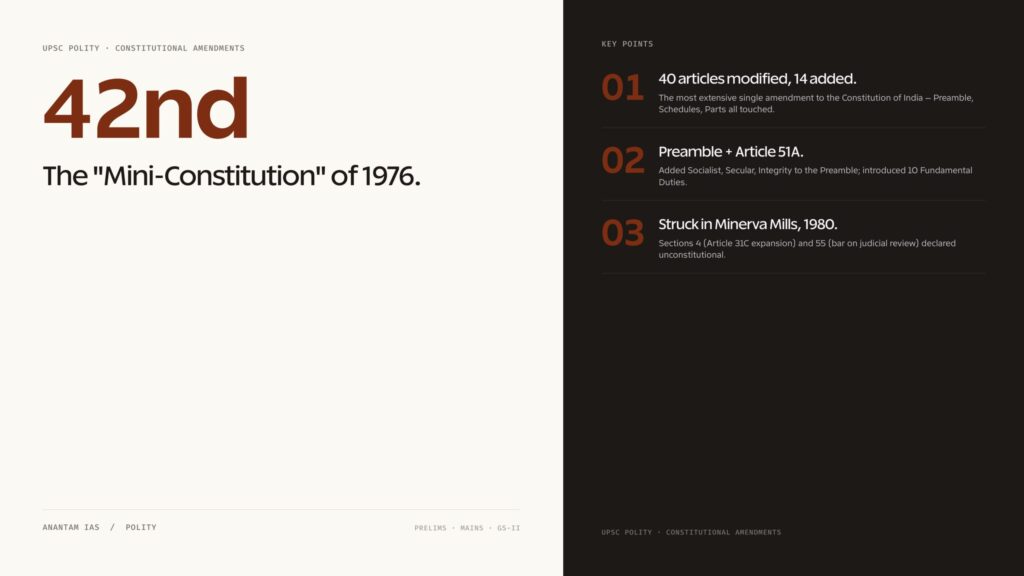
The 42nd Amendment Act, 1976 is the most extensive single amendment to the Constitution of India, enacted during the Emergency under Prime Minister Indira Gandhi. It modified about 40 articles, added 14 new articles, changed the Preamble, and amended the Seventh Schedule — earning it the nickname “Mini-Constitution.” It received Presidential assent from Fakhruddin Ali Ahmed on 18 December 1976.
Three quick factual triples for revision:
- 42nd Amendment — 1976 — added “Socialist, Secular, Integrity” to the Preamble.
- Part IVA — Article 51A — introduced 10 Fundamental Duties (an 11th was added later by the 86th Amendment, 2002).
- Section 4 of the Act amended Article 31C to give Directive Principles precedence over Fundamental Rights — struck down by the Supreme Court in Minerva Mills v. Union of India (1980).
Why was the 42nd Amendment passed? The Emergency context
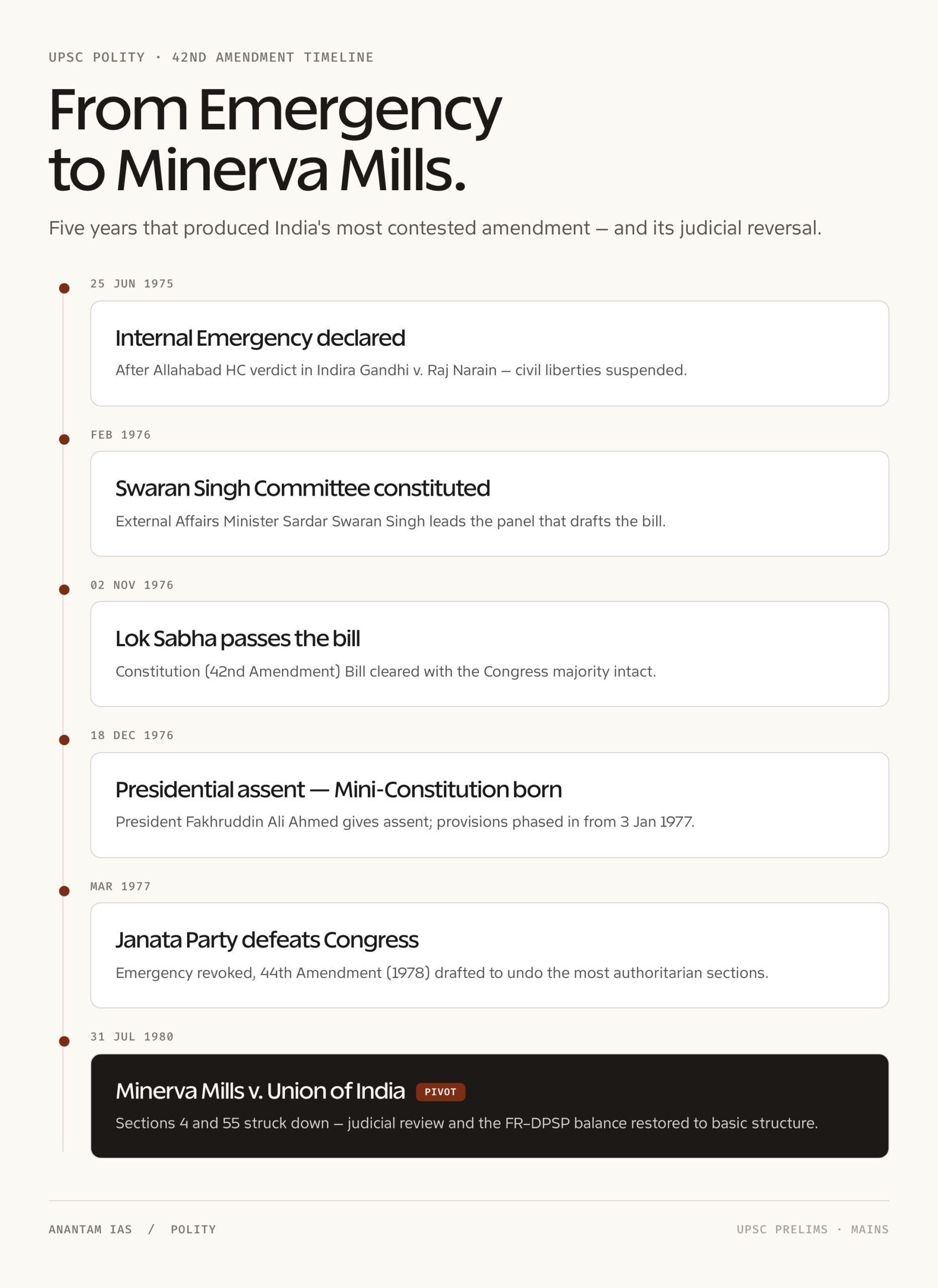
OK, here’s the bit that most coaching notes skim over. The 42nd Amendment didn’t drop out of the sky. It came at the exact midpoint of the Emergency in India (1975-77), which Indira Gandhi had imposed on 25 June 1975 after the Allahabad High Court verdict in Indira Gandhi v. Raj Narain (1975) — a case that set aside her election to the Lok Sabha.
The political logic? The ruling Congress wanted to shield Parliament’s amending power from judicial review and entrench executive control. To give the changes a respectable cover, the government set up the Swaran Singh Committee in February 1976 under External Affairs Minister Sardar Swaran Singh. The committee submitted recommendations, and the resulting bill — the Constitution (Forty-second Amendment) Bill, 1976 — was passed in November 1976 and received Presidential assent on 18 December 1976.
A short timeline:
- 25 June 1975 — Internal Emergency declared.
- February 1976 — Swaran Singh Committee constituted.
- 2 November 1976 — Lok Sabha passes the bill.
- 18 December 1976 — President Fakhruddin Ali Ahmed gives assent.
- 3 January 1977 — Provisions begin to come into force in phases.
- March 1977 — Janata Party defeats Congress in general elections.
- 31 July 1980 — Supreme Court strikes down key sections in Minerva Mills.
What did the 42nd Amendment of Indian Constitution change?
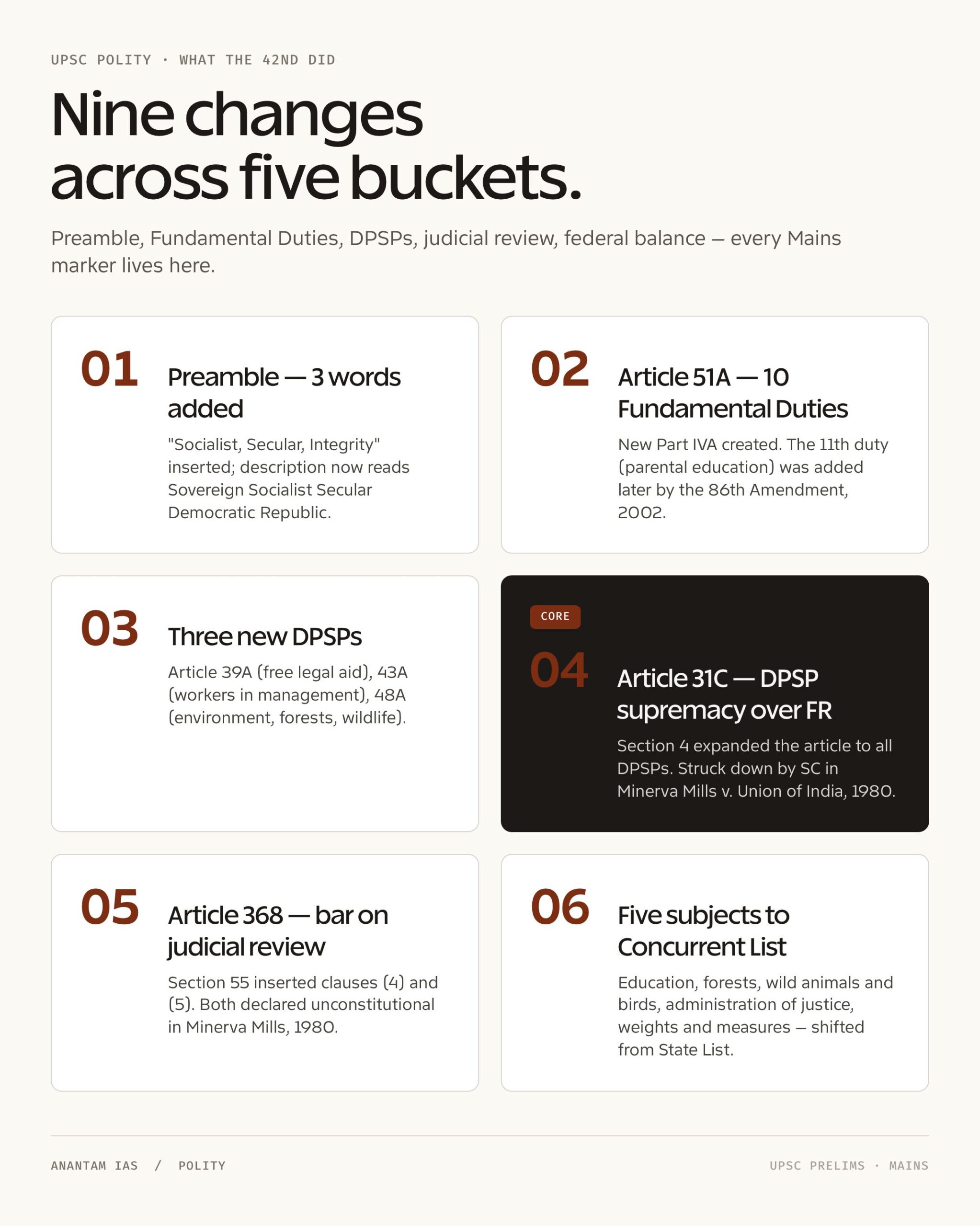
This is the section examiners love. The 42 amendment of indian constitution made changes across five buckets — Preamble, Fundamental Duties, Directive Principles, judicial review, and Centre–State balance. Number every change and you’ll never lose a Mains mark on this.
1. Changes to the Preamble
Three words were added to the Preamble:
- Socialist — describing the economic philosophy.
- Secular — affirming equal treatment of all religions.
- Integrity — added to “unity of the nation,” making it “unity and integrity.”
The full Preamble now reads “Sovereign Socialist Secular Democratic Republic” — the description that every Prelims question on the Preamble tests.
2. Part IVA — Fundamental Duties (Article 51A)
The 42nd Amendment created Part IVA and inserted Article 51A, which originally listed 10 Fundamental Duties for citizens. The 86th Amendment, 2002 added an 11th duty (parental duty to provide education). The full list of Fundamental Duties under Article 51A is now 11 — but on the day the 42nd Amendment was notified, it was 10. Examiners have asked this exact distinction in 2019 and 2024.
3. Directive Principles — three new ones
Three new Directive Principles were added under Part IV:
- Article 39A — Equal justice and free legal aid.
- Article 43A — Workers’ participation in the management of industries.
- Article 48A — Protection and improvement of environment, forests, and wildlife.
This is a useful detail because most aspirants assume DPSPs are frozen at 1950. They aren’t. Read the Directive Principles of State Policy guide for the full Part IV scheme.
4. Article 31C — DPSP primacy over FRs (later struck down)
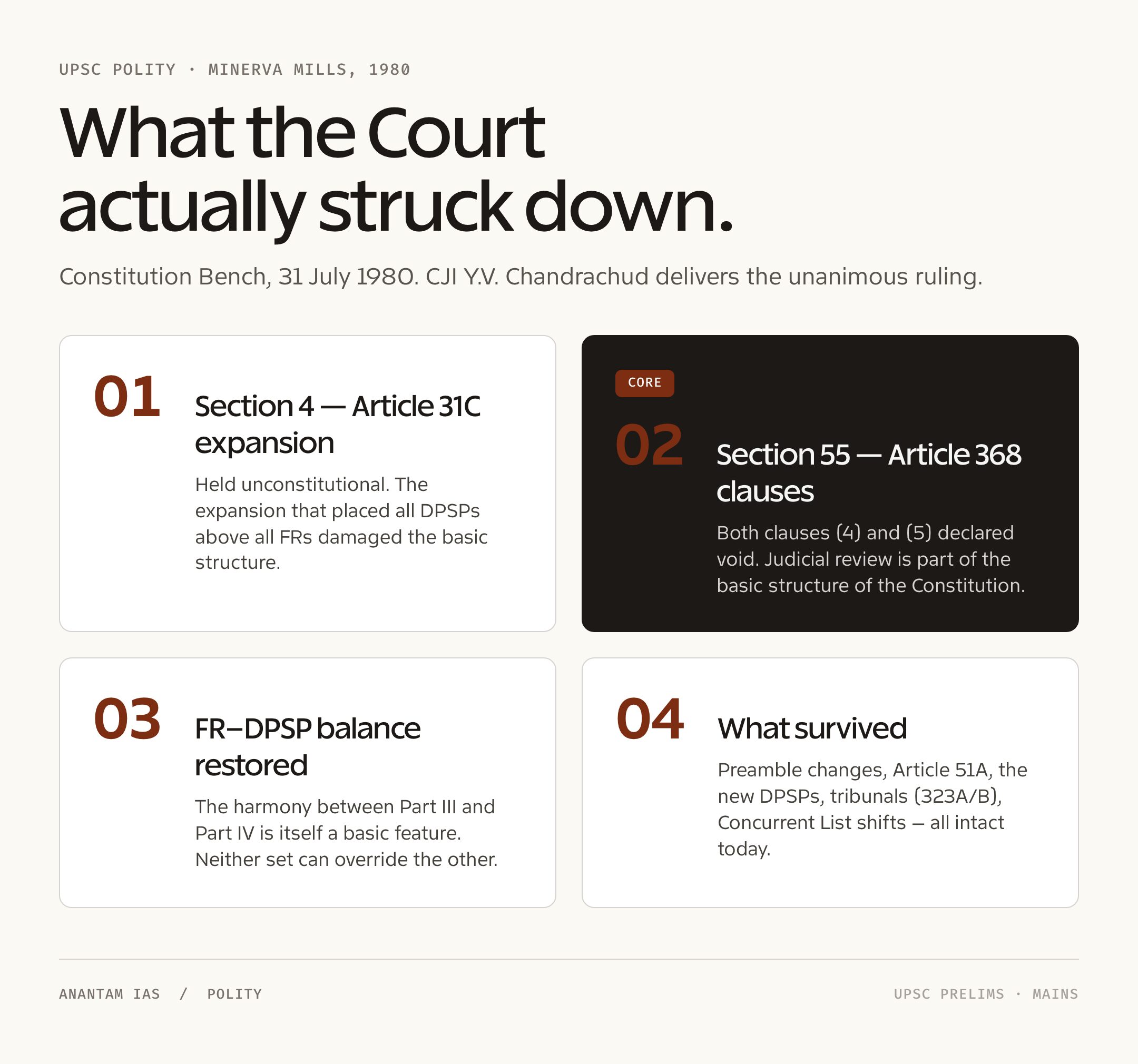
Section 4 of the 42nd Amendment Act expanded Article 31C to say that any law giving effect to any Directive Principle could not be challenged on the ground that it violates Fundamental Rights under Articles 14, 19, or 31. This was the most aggressive single change… it tried to make DPSPs override FRs entirely.
In Minerva Mills v. Union of India (1980), the Supreme Court struck this down. Chief Justice Y.V. Chandrachud ruled that the harmony and balance between Fundamental Rights and Directive Principles is itself a basic feature of the Constitution. So the expanded Article 31C went; the original (limited) version stayed.
5. Article 368 — limits on judicial review
Section 55 of the 42nd Amendment inserted clauses (4) and (5) into Article 368, which together said:
- No constitutional amendment shall be called in question in any court on any ground.
- There shall be no limitation whatever on the constituent power of Parliament to amend the Constitution.
The Supreme Court in Minerva Mills struck both clauses down, holding that judicial review and limited amending power are part of the basic structure laid down in the Kesavananda Bharati Case (1973).
6. Tilt to the Centre — federal structure changes
Five subjects were transferred from the State List to the Concurrent List through changes to the Seventh Schedule:
- Education
- Forests
- Protection of wild animals and birds
- Administration of justice
- Weights and measures
This single change tilted Indian federalism towards the Centre, and many of the post-2014 disputes over education policy and forest law trace back to this 1976 reshuffle. For the bigger picture, see Federalism in India.
7. Tribunals — Articles 323A and 323B
The amendment added Part XIVA, introducing:
- Article 323A — Administrative Tribunals (basis for the CAT).
- Article 323B — Tribunals for other matters (taxation, foreign exchange, industrial disputes).
8. Term of Lok Sabha and State Assemblies
The term of the Lok Sabha and State Assemblies was extended from 5 years to 6 years. The 44th Amendment later reverted this to 5 years.
9. Anti-national activities — Article 31D
A new Article 31D was inserted, giving Parliament power to make laws against “anti-national activities.” This too was repealed by the 44th Amendment.
The Minerva Mills reversal — why it matters
Honestly, the 42nd Amendment is half the story. The other half is Minerva Mills v. Union of India (1980). On 31 July 1980, a Constitution Bench unanimously struck down Sections 4 and 55 of the 42nd Amendment… and that single ruling is what saved the basic structure doctrine from being legislated out of existence.
The ruling did three things:
- Confirmed that judicial review is part of the basic structure.
- Held that Parliament’s amending power under Article 368 is itself limited — Parliament cannot give itself unlimited power.
- Restored the balance between Part III (FRs) and Part IV (DPSPs), settling the long DPSP-vs-FR debate that had simmered since Champakam Dorairajan (1951) and Golaknath (1967).
If you remember one case alongside the 42nd Amendment for Mains, make it Minerva Mills.
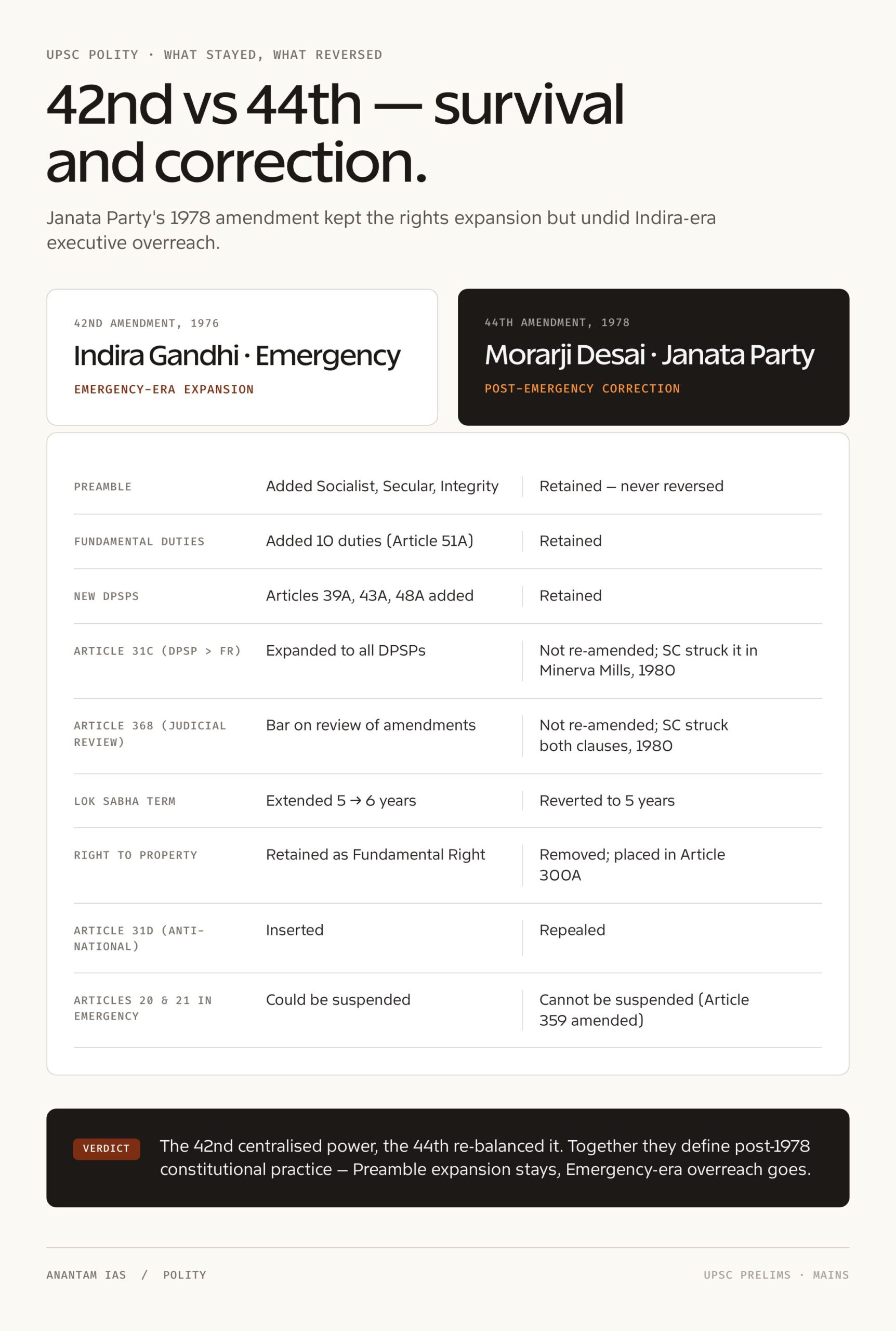
42nd vs 44th Amendment — comparison table
Well, the 44th Amendment Act, 1978 was the Janata government’s correction. Here’s what changed… and what stayed.
| Provision | 42nd Amendment (1976) | 44th Amendment (1978) |
|---|---|---|
| Preamble — “Socialist, Secular, Integrity” | Added | Retained |
| Fundamental Duties (Part IVA) | Added 10 duties | Retained |
| New DPSPs (39A, 43A, 48A) | Added | Retained |
| Article 31C — DPSP supremacy over FRs | Expanded to all DPSPs | Struck by SC in Minerva Mills, not restored |
| Article 368 — bar on judicial review | Inserted clauses (4) and (5) | Struck by SC in Minerva Mills |
| Term of Lok Sabha and State Assemblies | Extended 5 → 6 years | Reverted to 5 years |
| Right to Property (Article 19(1)(f), Article 31) | Retained as FR | Removed from FR; placed in Article 300A as legal right |
| Article 31D — anti-national activities law | Added | Repealed |
| Article 359 — protection of Articles 20 and 21 in Emergency | Could be suspended | Articles 20 and 21 cannot be suspended, even during Emergency |
| Tribunals (323A, 323B) | Added | Retained |
| Five subjects shifted to Concurrent List | Done | Retained |
Why this matters for UPSC
Three exam zones to know cold:
- Prelims — Article numbers, Schedules affected, year of assent (1976), date of assent (18 December 1976). Examiners have asked the assent year directly in CSE Prelims 2018 and 2022.
- Mains GS Paper II — “Discuss whether the 42nd Amendment damaged the basic structure of the Constitution. Refer to Minerva Mills v. Union of India (1980).” Standard 15-marker.
- Essay — “Constitutionalism is more than constitutional rules.” The 42nd Amendment is your ready-made example of what happens when amending power runs ahead of constitutional morality.
I’ve watched aspirants lose marks here for one reason — they treat the 42nd Amendment as a list of changes. It isn’t. It’s a story about how an Emergency-era Parliament tried to rewrite the constitutional balance… and how the Court pulled it back. Tell the story, then list the articles.
Common misconceptions
Myth 1: “The 42nd Amendment added all 11 Fundamental Duties.” Wrong. It added 10 duties under Article 51A. The 11th duty (parental duty to provide education) was added by the 86th Amendment in 2002.
Myth 2: “Minerva Mills struck down the entire 42nd Amendment.” Wrong. Minerva Mills struck down only Sections 4 and 55 — the parts that expanded Article 31C and barred judicial review of amendments. The Preamble changes, Fundamental Duties, new DPSPs, tribunals, and Concurrent List shifts all survived.
Myth 3: “The Preamble cannot be amended.” Wrong. The Preamble can be amended under Article 368 — the 42nd Amendment did exactly that. But it cannot be amended in a way that destroys the basic structure (Kesavananda Bharati, 1973).
Myth 4: “The 42nd Amendment introduced Article 31C.” Wrong. Article 31C was inserted by the 25th Amendment, 1971, well before the Emergency. The 42nd Amendment only expanded it. The 44th Amendment kept the original (narrower) Article 31C, which still survives today.
How to revise this in 30 minutes
Source priority for Mains-grade depth:
- Laxmikanth — *Indian Polity* — the core chapter on amendments. Skim Chapter 11. (Laxmikanth Indian Polity reading guide)
- NCERT — Indian Constitution at Work (Class 11) — for the Emergency context.
- PRS Legislative Brief — for the original act text.
- Indian Express explainers on Minerva Mills anniversaries (most years carry a piece around 31 July).
- The full list of amendments to the Indian Constitution for sequence and cross-reference.
Make a one-page note with: Preamble change, Article 51A, Section 4 (struck), Section 55 (struck), Concurrent List shift, term extension. That’s enough for any 10-marker.
Frequently Asked Questions
When was the 42nd Amendment of Indian Constitution passed?
Parliament passed the 42nd Amendment Bill in November 1976. President Fakhruddin Ali Ahmed gave assent on 18 December 1976. Most provisions came into force on 3 January 1977.
Why is the 42nd Amendment called the Mini-Constitution?
Because it modified about 40 articles, added 14 new articles, changed the Preamble, and altered the Seventh Schedule — the most extensive single amendment ever made to the Constitution of India.
Which articles of the 42nd Amendment were struck down by the Supreme Court?
In Minerva Mills v. Union of India (1980), the Supreme Court struck down Section 4 (which expanded Article 31C to all Directive Principles) and Section 55 (which inserted clauses (4) and (5) into Article 368 limiting judicial review of amendments).
What did the 42nd Amendment add to the Preamble?
Three words: Socialist, Secular, and Integrity — making the Preamble read u0022Sovereign Socialist Secular Democratic Republicu0022 and u0022unity and integrity of the Nation.u0022
Did the 42nd Amendment add Fundamental Duties?
Yes. It inserted Part IVA and Article 51A, listing 10 Fundamental Duties. The 86th Amendment, 2002 added an 11th. The full list of 11 duties is what citizens are bound by today.
Did the 44th Amendment reverse the 42nd?
Partly. The 44th Amendment, 1978 reversed the most authoritarian provisions — the bar on judicial review, the extended legislative term, Article 31D — but kept the Preamble changes, Fundamental Duties, and new DPSPs.
How many subjects were transferred from the State List to the Concurrent List by the 42nd Amendment?
Five — education, forests, protection of wild animals and birds, administration of justice, and weights and measures.
Was the 42th amendment of indian constitution challenged in court?
Yes. It was challenged in Minerva Mills v. Union of India (1980), where Sections 4 and 55 were declared unconstitutional. The remainder of the amendment survived and remains in force.
Tell Google you want more of this.
Add Anantam IAS as a preferred sourceOne tap, and this site shows up more often in your own Top Stories, AI Overviews and AI Mode. Remove it any time.