Solar on the Move: Powering India’s Rail and Road with the Sun
Why in News?
An Indian Express Explained piece set out how solar-integrated rail and road infrastructure can become a quiet workhorse of India’s clean-energy transition — putting solar photovoltaic (PV) generation directly on and along railway land, station roofs, track corridors and highway margins.
The idea, often called Rail- and Road-Integrated Photovoltaics (RIPV), matters because it produces clean power on land the country already owns and uses, sidestepping the single biggest constraint on large utility-scale renewables — competition for scarce, costly land.
- Indian Railways operates one of the world’s largest rail networks and is one of the country’s single biggest electricity consumers, making it a natural anchor for in-house solar generation.
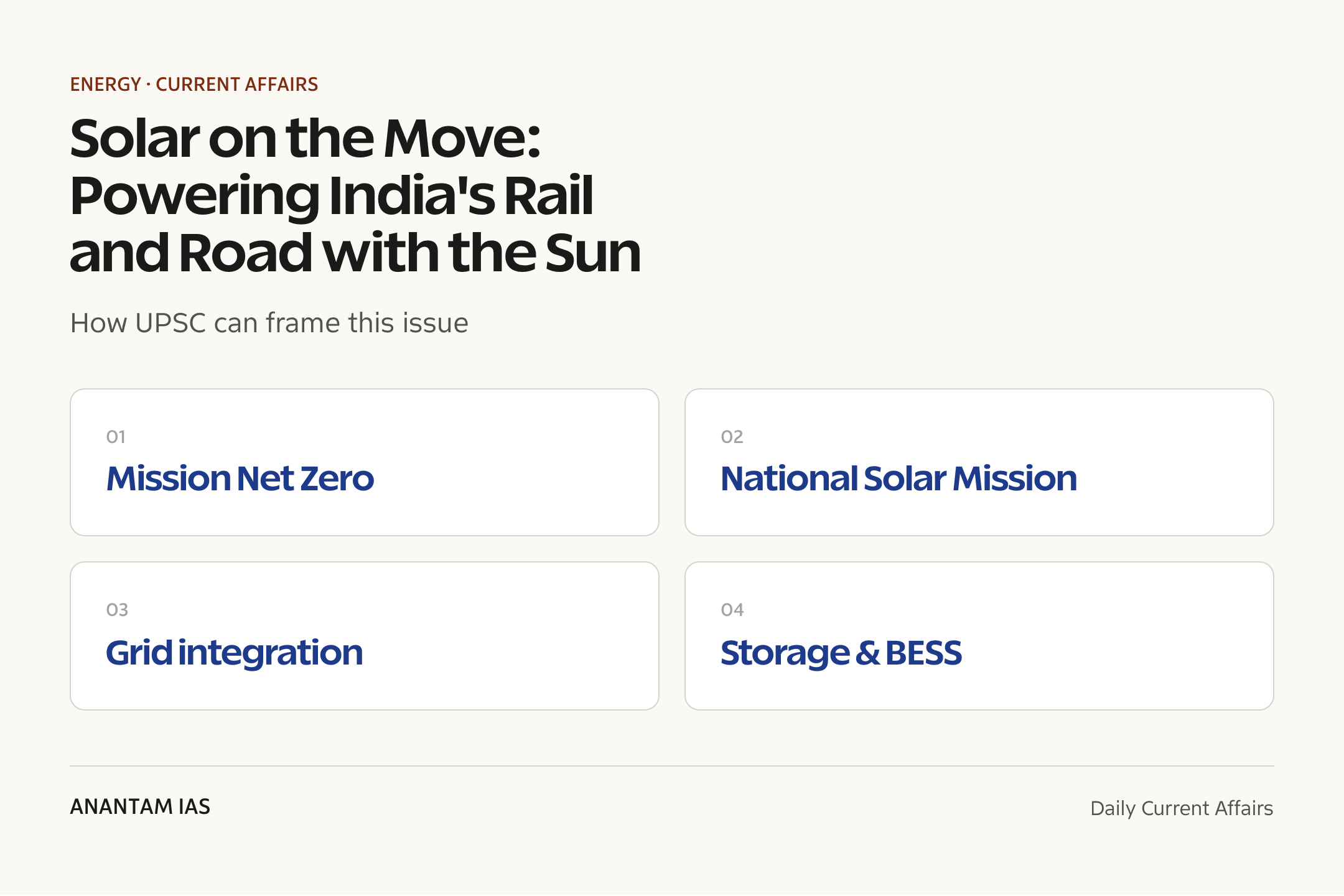
- Railways has committed to becoming a net-zero carbon emitter through its Mission Net Zero, combining full route electrification, solar and wind power, and energy efficiency.
- Station rooftops, workshops, sheds and the long ribbons of land beside tracks and along National Highways offer ready-made, already-acquired space for rooftop and ground-mounted solar.
- The approach aligns with the National Solar Mission and India’s headline target of 500 GW of non-fossil generation capacity by 2030.
The development matters in the context of:
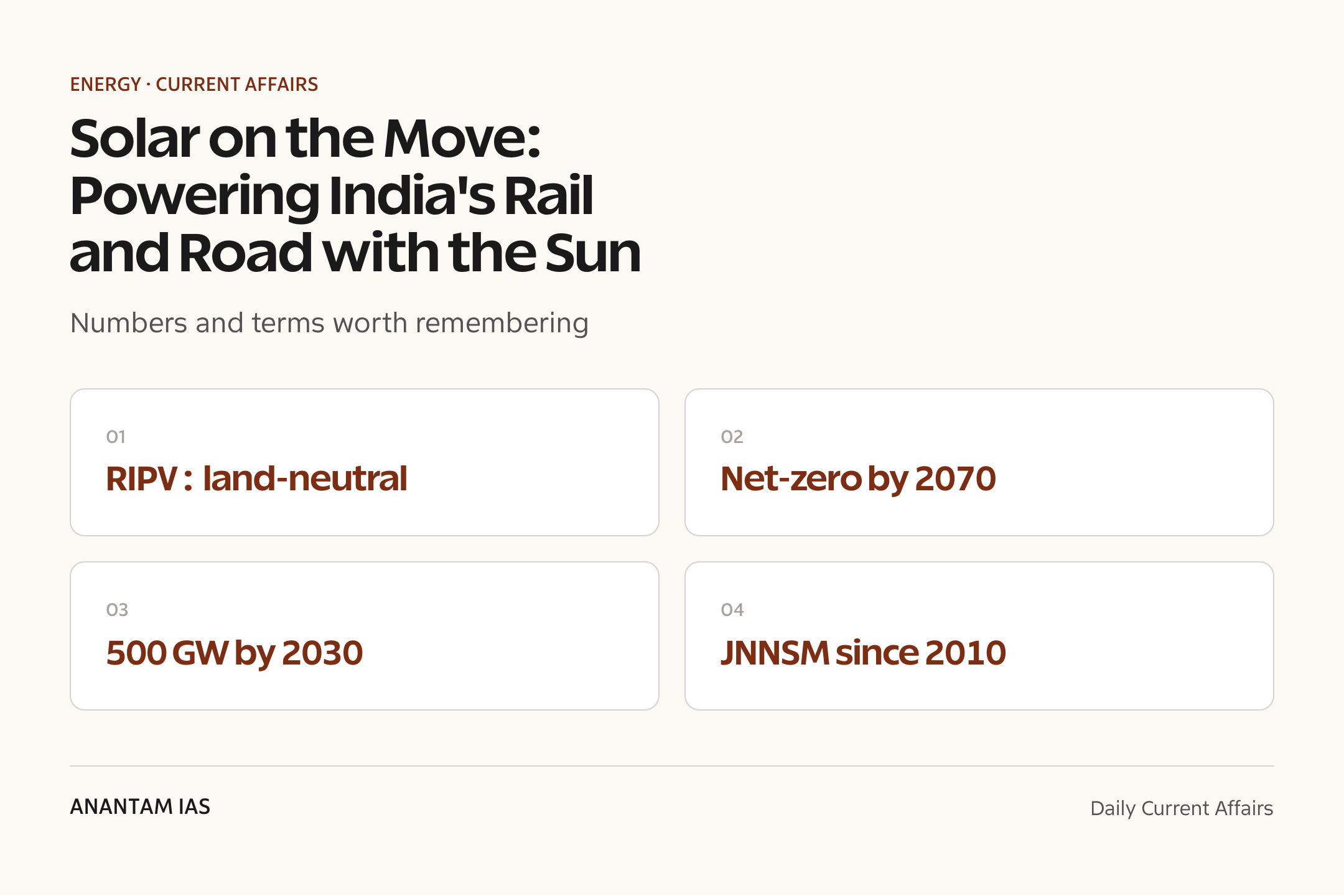
- Why this matters for land: solar’s chief bottleneck is land — RIPV uses railway and highway corridors already in public hands, so it is broadly land-neutral.
- Why this matters for the grid: distributed solar near load centres and traction substations can cut transmission losses and ease grid-integration stress.
- Why this matters for net-zero: greening a transport behemoth like Railways advances India’s net-zero by 2070 goal and its climate pledges.
UPSC Relevance
Prelims Relevance
- National Solar Mission (JNNSM, 2010) — one of the eight missions under the National Action Plan on Climate Change (NAPCC)
- 500 GW non-fossil capacity target by 2030; net-zero by 2070 announced at COP26 (Glasgow)
- Indian Railways Mission Net Zero — carbon-neutral railway via electrification, solar and wind
- Photovoltaic (PV) effect — direct conversion of sunlight to electricity using semiconductor cells
- Rooftop vs utility-scale (ground-mounted) solar; captive generation for own use
- PM-KUSUM — farmer solarisation; relevant to solarising land along corridors and feeders.
- Ministry of New and Renewable Energy (MNRE) — nodal ministry for renewables.
- Grid integration, battery energy storage systems (BESS) and the intermittency of solar.
- Capacity factor — solar runs only in daylight, so nameplate capacity overstates actual generation.
- Domestic Content Requirement and ALMM for solar modules and cells.
Mains Relevance
GS Paper 3
- Land-neutral renewable models: using rail and road corridors to scale solar without fresh land acquisition.
- Greening transport infrastructure and the role of energy efficiency, storage and grid integration in the energy transition.
- Indian Railways’ Mission Net Zero as a case study in decarbonising a large public utility.
GS Paper 2
- Governance and inter-ministerial coordination (Railways, MNRE, MoRTH) for embedding solar in public assets.
- Public infrastructure as a delivery platform for climate commitments and SDG 7 (affordable clean energy).
Essay
- The cheapest land for tomorrow’s energy is the land we already use.
- Decarbonisation begins where the country moves — its roads and its rails.
Background and Context
What is Rail- and Road-Integrated Photovoltaics (RIPV)?
RIPV embeds solar generation into existing transport infrastructure rather than building separate solar parks.
- Definition: mounting solar PV panels on station roofs, workshop and shed rooftops, over parking and platforms, and along the unused margins of railway corridors and highways.
- Core appeal: it generates clean power on land that is already acquired and serviced, so it is broadly land-neutral and avoids fresh acquisition and its social friction.
- Two siting modes: rooftop solar on buildings and structures, and ground-mounted arrays on vacant strips beside tracks and roads.
- Captive use: much of the power can be consumed on-site — by stations, signalling, traction and highway lighting — reducing draw from the grid.
How does Photovoltaic Technology work?
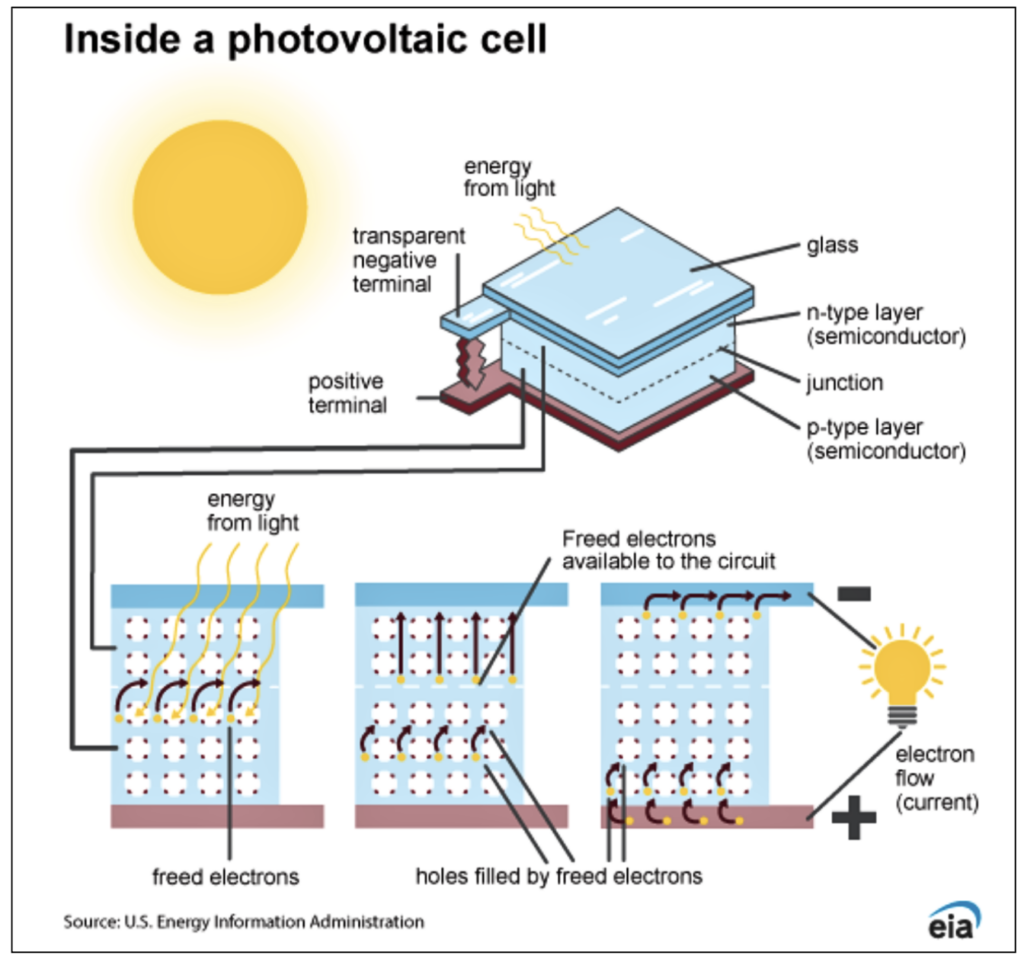
PV technology converts sunlight directly into electricity through the photovoltaic effect, where semiconductor materials in a PV cell absorb photons (particles of energy) from sunlight and release electrons, generating a flow of electricity.
Why land is solar’s binding constraint
Utility-scale solar needs large, contiguous tracts, and land is scarce, costly and contested.
- Land intensity: large solar parks demand vast, level land, often competing with agriculture, grazing, forests and habitation.
- Acquisition friction: assembling land triggers cost, delay, displacement concerns and legal disputes that slow projects.
- Corridor advantage: railway land banks and highway rights-of-way are long, linear and already in public ownership — ideal for distributed solar.
- Dual use: the same parcel keeps serving transport while also producing electricity, a textbook case of multi-use land.
Indian Railways’ Mission Net Zero
Railways aims to become a net-zero carbon emitter by greening both its energy supply and its operations.
- Three pillars: complete route electrification (shifting traction off diesel), sourcing solar and wind power, and improving energy efficiency.
- Massive consumer: as one of the country’s largest single electricity users, Railways can absorb its own solar output and cut its emissions footprint sharply.
- Built-in real estate: thousands of stations, sheds and workshops give Railways a vast in-house rooftop and land base for PV — see Indian Railways.
- Showcase assets: solar-powered stations and a growing fleet of solar installations signal how a public utility can lead decarbonisation.
Highway solarisation and PM-KUSUM links
Roads offer their own ribbons of margin land and a ready electrical demand for lighting and tolls.
- Highway margins: the verges and medians of National Highways can host ground-mounted solar to power lighting, signage, tolls and EV charging.
- Agency fit: Highway authorities can pair solar with road assets as Railways does with its corridors.
- Feeder solarisation: the PM-KUSUM scheme’s logic of placing solar near where power is used maps neatly onto corridor-based generation.
- EV synergy: highway solar can feed charging infrastructure, knitting clean generation to clean mobility.
The National Solar Mission and India’s targets
RIPV is a delivery channel for India’s national solar and net-zero commitments.
- National Solar Mission (JNNSM, 2010): launched under the National Action Plan on Climate Change to scale grid and rooftop solar — see Solar Energy in India.
- 500 GW by 2030: India’s target of 500 GW of non-fossil capacity needs every available siting option, including corridors and rooftops.
- Net-zero by 2070: announced at COP26, Glasgow; greening transport energy is central to the pathway.
- Distributed model: RIPV complements large parks by adding renewable energy close to the load, easing transmission needs.
Technical and policy challenges
Corridor solar is promising but faces engineering, safety and integration hurdles.
- Intermittency: solar generates only by day and varies with weather, so battery energy storage and grid balancing are essential.
- Grid integration: connecting many small, scattered arrays to traction and distribution networks needs careful planning and protection.
- Safety and access: panels near live tracks and high-speed traffic raise maintenance, glare, dust, vibration and security concerns.
- Capacity factor: nameplate capacity overstates output; real generation depends on a modest solar capacity factor, so figures must be read with care.
Way Forward
Map and unlock the corridor land
- Survey and digitise railway land banks and highway rights-of-way to identify viable, safe solar sites.
- Set clear inter-agency rules so Railways, MNRE and highway authorities can deploy rooftop and ground-mounted solar quickly.
Pair generation with storage and the grid
- Co-locate battery energy storage and smart controls to manage intermittency and feed traction loads reliably.
- Strengthen grid-integration standards so distributed corridor solar plugs in safely and efficiently.
Build the ecosystem and learn at scale
- Use captive and PPP models to crowd in investment while keeping power costs low for public assets.
- Run transparent pilots, publish verified generation data, and scale what works under Mission Net Zero and the National Solar Mission.
Conclusion
Solar on the move reframes infrastructure India already owns — its tracks, stations and highways — as a distributed power plant, turning the country’s biggest renewable constraint, land, into an asset.
Done with storage, smart grid integration and rigorous safety, rail- and road-integrated photovoltaics can help Railways hit net-zero, advance the 500 GW goal, and move India a step closer to its 2070 climate promise — proving that the cleanest energy can be generated right where the nation moves.
UPSC Practice Questions
Prelims MCQ 1
With reference to solar power and India’s transport infrastructure, consider the following statements:
- Indian Railways’ Mission Net Zero seeks to make the railways a net-zero carbon emitter through electrification, solar and wind power, and energy efficiency.
- The National Solar Mission was launched as one of the missions under the National Action Plan on Climate Change.
- Solar photovoltaic plants generate power at their full nameplate capacity throughout the day and night.
How many of the above statements are correct?
(a) Only one (b) Only two (c) All three (d) None
Answer: (b) Only two
Explanation:
Statements 1 and 2 are correct: Mission Net Zero combines electrification, solar/wind and efficiency, and the National Solar Mission (JNNSM, 2010) sits under the NAPCC. Statement 3 is wrong — solar PV generates only in daylight and below nameplate capacity, giving a modest capacity factor.
Prelims MCQ 2
The chief advantage of rail- and road-integrated photovoltaics (RIPV) over conventional utility-scale solar parks is that it:
(a) Generates power even at night without storage (b) Uses land that is already acquired and in public use, avoiding fresh land acquisition (c) Eliminates the need for any grid connection (d) Produces electricity at a higher capacity factor than rooftop solar
Answer: (b) Uses land that is already acquired and in public use, avoiding fresh land acquisition
Explanation:
RIPV places solar on station roofs and along corridors and highway margins — land already owned and serviced — making it broadly land-neutral and sidestepping the cost and friction of fresh acquisition, solar’s biggest constraint.
UPSC Mains Questions
- Land scarcity is the single biggest constraint on India’s utility-scale solar expansion. Examine how rail- and road-integrated photovoltaics can deliver land-neutral clean power, and discuss the technical challenges involved. (15 marks, 250 words)
- Discuss Indian Railways’ Mission Net Zero as a model for decarbonising a large public utility. How do route electrification, solar generation and energy efficiency together advance India’s climate goals? (10 marks, 150 words)
- “The cleanest energy can be generated where the nation already moves.” In the light of this statement, assess the potential and limitations of solarising India’s transport corridors for the energy transition. (15 marks, 250 words)
Sources: Ministry of New and Renewable Energy and The Indian Express.
Frequently Asked Questions
What is rail- and road-integrated photovoltaics?
Rail- and road-integrated photovoltaics (RIPV) means generating solar electricity directly on and along transport infrastructure — station roofs, workshops, the margins of railway corridors and the verges of highways. Because this land is already acquired and in public use, RIPV adds clean power without fresh land acquisition, addressing the biggest constraint on large utility-scale solar projects in India.
Why is land a problem for solar power in India?
Utility-scale solar parks need large, level, contiguous tracts of land, which is scarce, expensive and often competes with farming, grazing, forests and settlements. Acquiring such land brings cost, delay, displacement concerns and legal disputes. Using railway and highway corridors already owned by the state sidesteps this, letting the same parcel serve both transport and power generation.
What is Indian Railways’ Mission Net Zero?
Mission Net Zero is Indian Railways’ commitment to become a net-zero carbon emitter. It rests on three pillars: completing route electrification to shift traction off diesel, sourcing solar and wind power, and improving energy efficiency across operations. As one of India’s largest electricity consumers, Railways can absorb much of its own solar output, cutting emissions sharply.
What is the National Solar Mission?
The National Solar Mission, also called the Jawaharlal Nehru National Solar Mission (JNNSM), was launched in 2010 as one of the missions under the National Action Plan on Climate Change. It set out to scale up grid-connected and rooftop solar in India and remains the central policy framework behind the country’s ambitious solar capacity targets.
How does solar on transport corridors help net-zero?
Greening transport energy is central to India’s net-zero-by-2070 pathway. Corridor solar lets a huge consumer like Railways power itself with clean electricity, while highway solar can feed lighting, tolls and EV charging. By adding distributed renewable capacity close to where power is used, it advances both the 500 GW non-fossil target and climate commitments.
What are the main challenges of corridor solar?
The biggest challenges are intermittency, since solar works only in daylight and needs battery storage and grid balancing, and grid integration, as many small scattered arrays must connect safely to traction and distribution networks. Panels near live tracks and fast traffic also raise maintenance, glare, dust and safety concerns that careful engineering must manage.