Special NDPS Courts: Why Nearly Four Lakh Cases Await Trial
Why in News?
The Indian Express reported on 3 August 2026 that the Ministry of Home Affairs had asked States and Union Territories to establish exclusive special NDPS courts amid an estimated nationwide pendency of about 3.96 lakh cases under the Narcotic Drugs.
- The newspaper said the Home Ministry had held multiple meetings with State and UT chief secretaries and home secretaries during the preceding six months.
- A presentation by the Narcotics Control Bureau reportedly stated that only 65 exclusive courts were functioning across India solely for NDPS matters and that 22 States had yet to establish such exclusive courts.
- Reported State-level estimates included about 60,000 pending cases in Punjab, which had no exclusive NDPS court, and about 50,000 in Kerala, which had two.
- States and UTs were asked to send status reports, while officials were asked to engage with registrars of High Courts in jurisdictions carrying large NDPS caseloads.
- The backlog figure is a reported administrative estimate from the meetings, not a live total independently extracted for this note from the National Judicial Data Grid; it should be cited with that qualification.
- The NDPS Act already provides a statutory architecture for Special Courts. The present policy question is whether States have created enough exclusive, adequately staffed capacity for the volume and complexity of cases.
- For the broader prevention track, revise the Nasha Mukt Yuva campaign; for treatment policy, see Punjab’s methadone maintenance approach.
UPSC Relevance
Prelims Relevance
- Under Section 36, the Government may, by Gazette notification, constitute as many Special Courts as necessary for specified areas to provide speedy trial of offences under the Act.
- A Special Court consists of a single judge appointed by the Government with the concurrence of the Chief Justice of the relevant High Court; the appointee must have been a Sessions Judge or Additional Sessions Judge.
- Under Section 36A, offences punishable with imprisonment for more than three years are triable only by the Special Court for the area. The court may take cognizance on a police report or an authorised complaint.
- Under Section 36B, the High Court exercises appeal and revision powers over a Special Court as if it were a Court of Session within its jurisdiction.
- Under Section 36C, the criminal-procedure framework applies unless the NDPS Act provides otherwise; the Special Court is deemed a Court of Session and the person conducting prosecution is deemed a Public Prosecutor.
- Section 37 makes every NDPS offence cognizable and imposes additional bail conditions for offences under Sections 19, 24 and 27A and for offences involving commercial quantity.
Mains Relevance
GS Paper 2
- Judicial governance: court creation must be based on district-wise institution, disposal, age and complexity data rather than uniform numerical targets.
- Federal coordination: the Union can coordinate drug-control policy, while operational court creation requires State action, High Court concurrence and sustained budgetary support.
GS Paper 3
- Internal security: timely adjudication can improve deterrence and accountability in organised trafficking cases, but conviction quality depends on lawful search, seizure, sampling, custody and proof.
- Drug-control strategy: prosecution is one arm of policy and must operate alongside prevention, treatment, rehabilitation, financial investigation and inter-agency intelligence.
Essay
- Justice delayed weakens both liberty and lawful enforcement.
Background and Context
What the reported backlog shows
A national total becomes useful for policy only when it is broken into workload, age, offence and district patterns.
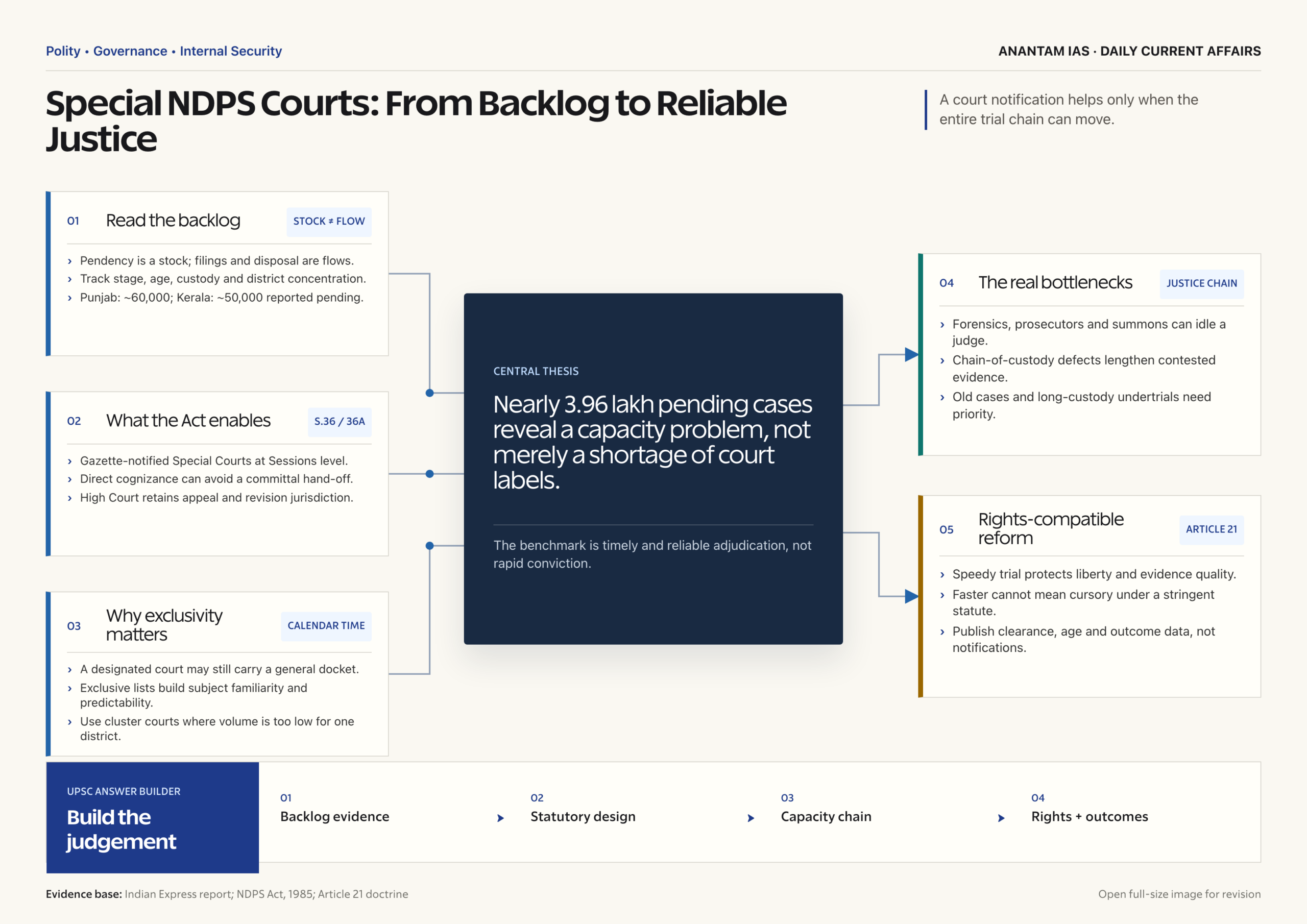
- The reported 3.96-lakh pendency indicates a system-wide capacity problem, but it doesn’t by itself reveal how many cases are at cognizance, charge, evidence, argument or judgment stage.
- Punjab’s reported 60,000 pending matters and Kerala’s roughly 50,000 illustrate why a common national template can misallocate courts; need must be assessed against local docket concentration and existing capacity.
- The same report cited about 17,000 pending cases in Odisha, about 15,000 each in Tamil Nadu and Karnataka, about 14,000 in Madhya Pradesh, and about 11,000 each in West Bengal and Himachal Pradesh. These remain attributed.
- Pendency is a stock, while institution and disposal are flows. A court may dispose of many cases and still see its backlog rise if new filings grow faster.
- A credible monitoring dashboard should show median case age, undertrial custody, stage-wise delay, adjournments, disposal and restoration or appeal outcomes, not only a single pending-case count.
How the NDPS Special Court design works
The statute creates a specialised Sessions-level forum and gives it procedural powers intended to reduce avoidable hand-offs.
- Section 36 authorises the Government to constitute Special Courts for specified areas through a Gazette notification, with judicial appointment requiring concurrence of the Chief Justice of the High Court.
- Section 36A routes offences punishable with more than three years’ imprisonment exclusively to the Special Court and allows direct cognizance on a police report or authorised complaint without a separate committal step.
- The Special Court can also try a connected non-NDPS offence with which the accused may be charged at the same trial, reducing fragmentation of a common factual transaction.
- Section 36B places appeal and revision with the High Court, while Section 36C treats the Special Court as a Court of Session for the applicable criminal procedure.
- Read the operative provisions in the official India Code text of the NDPS Act; a media description should never substitute for the statute.
Why an exclusive court may differ from a court on paper
Special jurisdiction doesn’t automatically produce dedicated hearing time.
- A Sessions Court may be notified or empowered to hear NDPS matters while retaining a large general criminal docket. In that situation, competing case categories still divide the judge’s calendar.
- An exclusive court can create a predictable hearing schedule, concentrate subject familiarity and support prosecutors and staff trained in the NDPS Act’s evidentiary and bail provisions.
- Specialisation must not become an assembly line. Stringent penalties and statutory presumptions make procedural compliance, independent judicial scrutiny and reasoned orders especially important.
- Adding exclusive courts without calculating incoming workload can create uneven utilisation: some courts may remain overloaded while another district lacks enough cases for a full dedicated docket.
- A sound design can use exclusive courts in high-volume districts, cluster arrangements where volumes are lower, and periodic High Court review to reallocate territorial jurisdiction.
Delay is a constitutional and evidentiary problem
Speedy trial protects liberty, but it also protects the reliability of adjudication.
- The Supreme Court has repeatedly treated the right to speedy trial as part of Article 21, applying across investigation and trial and irrespective of whether an accused person is in custody or on bail.
- The concern is acute in serious NDPS cases because Section 37 adds restrictive bail conditions for specified offences and commercial-quantity cases. Long delay can make pre-trial custody carry punishment-like consequences before guilt is established.
- For prosecution, delay can weaken witness memory, make official witnesses harder to coordinate, interrupt documentary chains and complicate the production of seized material and forensic reports.
- For the defence, delay can impair access to witnesses and records needed to test search, seizure, sampling and custody. Faster cannot mean cursory; the objective is timely, fair adjudication.
- The constitutional balance is visible in related criminal-process debates such as written grounds of arrest: effective enforcement and due process reinforce each other when procedure is clear.
Way Forward
Create courts from workload evidence
- Use district-wise NJDG and High Court registry data to calculate pending stock, annual institution, disposal, median age and undertrial custody before choosing exclusive or cluster courts. Review territorial allocation annually as filing patterns change.
- Sanction judges together with court staff, trained prosecutors, legal-aid support, secure records, witness coordination and forensic capacity; a courtroom without timely reports leaves a major dependency unresolved.
- Use early scheduling conferences for trial readiness, consecutive evidence dates and recorded reasons for adjournment, while preserving cross-examination and adequate preparation.
- Prioritise old cases and long-custody undertrials through transparent criteria rather than ad hoc listing.
Conclusion
- The push for exclusive special NDPS courts addresses a real institutional mismatch: a stringent law and expanding enforcement workload require enough judicial time to decide cases fairly.
- Court notifications are only the visible first step.
UPSC Practice Questions
Prelims MCQ 1
With reference to Special Courts under the Narcotic Drugs and Psychotropic Substances Act, 1985, consider the following statements:
- A Special Court consists of a single judge appointed by the Government with the concurrence of the Chief Justice of the relevant High Court.
- A person must have been a Sessions Judge or Additional Sessions Judge immediately before appointment to qualify as its judge.
- Every offence under the NDPS Act, irrespective of its prescribed punishment, is triable only by a Special Court.
How many of the above statements are correct?
(a) Only one (b) Only two (c) All three (d) None
Answer: (b) Only two
Explanation:
Statements 1 and 2 follow Section 36. Statement 3 is incorrect: Section 36A makes offences punishable with more than three years’ imprisonment triable only by the Special Court, while offences punishable with not more than three years may be tried summarily.
Prelims MCQ 2
Which one of the following best distinguishes an exclusive NDPS court from a Sessions Court that has also been notified to hear NDPS matters?
(a) Only an exclusive court can hear an appeal from an NDPS conviction (b) Only an exclusive court can apply the NDPS Act’s bail provisions (c) An exclusive court dedicates its docket to NDPS matters instead of sharing judicial time with a general caseload (d) An exclusive court is outside the administrative control of the High Court
Answer: (c) An exclusive court dedicates its docket to NDPS matters instead of sharing judicial time with a general caseload
Explanation:
Exclusivity describes docket allocation and dedicated capacity. It doesn’t remove High Court supervision, create a separate appellate route or change which statutory bail provisions apply.
UPSC Mains Questions
- The reported backlog of nearly four lakh NDPS cases is as much a judicial-governance challenge as an internal-security concern. Discuss the institutional reforms needed for timely and fair trials.
- Creating special courts does not automatically create speedy justice. Examine this statement with reference to judges, prosecution, forensics, investigation and case management under the NDPS framework.
Sources: The Indian Express and India Code, Ministry of Law and Justice.
Frequently Asked Questions
Why are special NDPS courts in the news?
The Indian Express reported that the Home Ministry asked States and Union Territories to establish exclusive NDPS courts amid an estimated 3.96 lakh pending cases. The meetings focused on jurisdictions with heavy backlogs, status reports from governments and coordination with.
What does Section 36 of the NDPS Act provide?
Section 36 allows the Government to constitute as many Special Courts as necessary for specified areas through Gazette notification. Each court has one judge, appointed with the concurrence of the Chief Justice of the relevant High Court, who must have.
Which NDPS offences are tried only by Special Courts?
Section 36A states that NDPS offences punishable with imprisonment for more than three years are triable only by the Special Court constituted for the area. It also allows that court to take cognizance directly on a police report or an.
What is the difference between a special court and an exclusive NDPS court?
The Act supplies Special Court jurisdiction, but a notified Sessions-level court may still carry other criminal work. An exclusive NDPS court dedicates its docket and hearing time to NDPS cases. That can improve specialisation and scheduling, provided judges, staff, prosecutors.
Why does NDPS case delay raise an Article 21 issue?
The Supreme Court treats speedy trial as part of the fair procedure protected by Article 21. Delay prolongs uncertainty and can be especially serious where restrictive bail conditions apply. It can also weaken both prosecution and defence evidence as witnesses.