Why in News?
On June 26, the International Day Against Drug Abuse and Illicit Trafficking, Punjab Health and Family Welfare Minister Dr Balbir Singh inaugurated six Methadone Maintenance Therapy (MMT) clinics in government hospitals — the state’s first dedicated MMT facilities, the Indian Express reported. Methadone has been available in Punjab since a 2012 pilot, but it was always folded into general de-addiction services rather than run through purpose-built clinics.
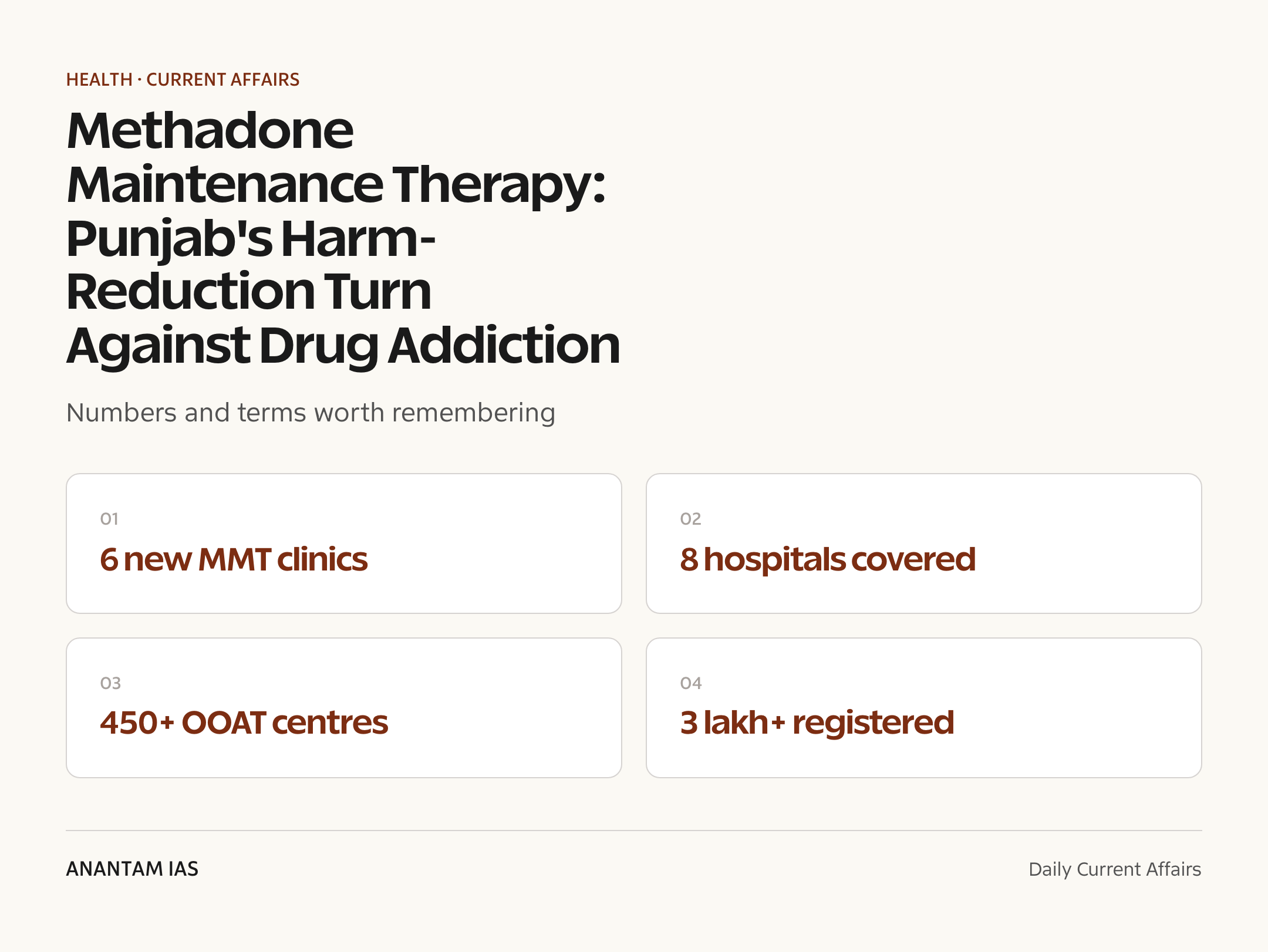
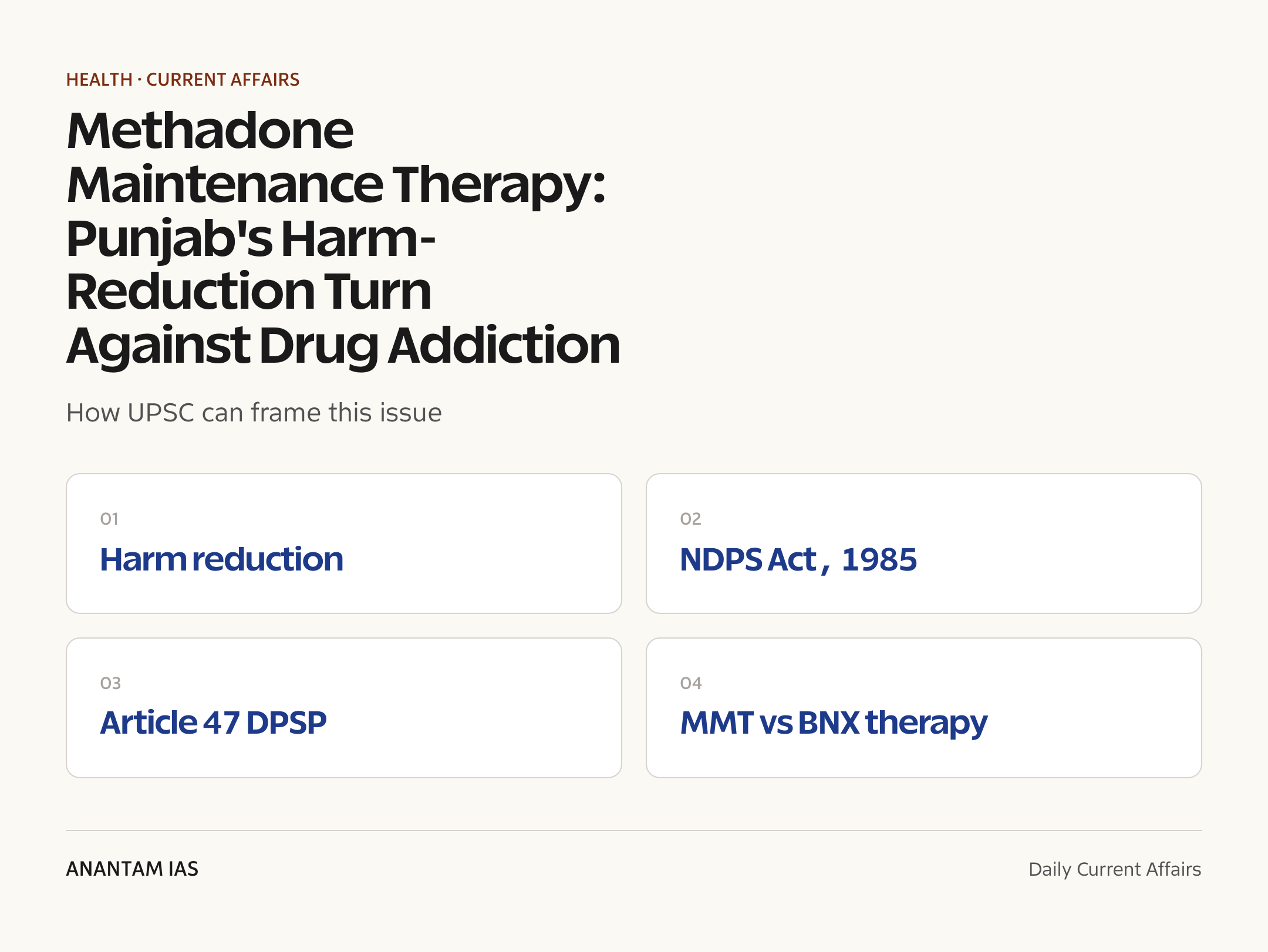
The launch marks a deliberate widening of Punjab’s treatment toolkit. The backbone of the state’s de-addiction programme remains Buprenorphine-Naloxone (BNX) therapy delivered through more than 450 Outpatient Opioid Assisted Treatment (OOAT) centres. Dedicated MMT clinics now give doctors a supervised, second-line option for patients with severe opioid dependence who don’t respond to BNX — a textbook harm-reduction approach that treats addiction as a chronic health condition, not a moral failing.
- A dedicated MMT clinic was inaugurated in person at Civil Hospital, Ludhiana; five more were digitally launched at District Hospitals Jalandhar and Gurdaspur and Government Medical Colleges at Patiala, Mohali and Faridkot.
- With Kapurthala and Bathinda already dispensing methadone since the pilot phase, eight government hospitals in Punjab are now covered under the MMT programme.
- Over 3 lakh people are registered for treatment at the state’s government OOAT centres, according to the Punjab Health Department — enrolled patients, not the total number of drug users in the state.
- MMT is recommended by the World Health Organisation (WHO) and implemented in India under National AIDS Control Organisation (NACO) guidelines.
- Punjab is simultaneously running its first-ever Drug and Socio-Economic Census — a door-to-door survey of around 65 lakh households that began in May — to estimate drug-abuse prevalence and plan future interventions.
The development matters in the context of:
- The move matters for the NDPS Act debate: India’s drug law has historically leaned on deterrence and criminalisation, while public-health evidence increasingly backs opioid agonist treatment as the most effective response to opioid dependence.
- It’s a live case study in cooperative public health — a state health department scaling a therapy that sits inside central frameworks built by NACO, the Health Ministry and the UN Office on Drugs and Crime (UNODC).
- For GS2 answers, Punjab’s shift illustrates the global policy migration from abstinence-only de-addiction to harm reduction — keeping users alive, healthy and functional while dependence is managed medically.
UPSC Relevance
Prelims Relevance
- Methadone — a long-acting opioid agonist; reduces cravings and withdrawal without the intense high of illicit opioids; on the WHO Model List of Essential Medicines.
- Buprenorphine-Naloxone (BNX) — the first-line opioid substitution therapy in India’s OOAT programme; stable patients can get take-home doses of up to 14 days.
- OOAT centres — Outpatient Opioid Assisted Treatment clinics; Punjab runs more than 450 of them.
- Punjab was the first Indian state to introduce MMT — a 2012 pilot at the de-addiction centre of Civil Hospital, Kapurthala, later extended to Bathinda.
- MMT entered India in 2012 through pilots supported by the Ministry of Health and Family Welfare, NACO and UNODC.
- NDPS Act, 1985 — regulates narcotic drugs; the NDPS (Amendment) Act, 2014 created the Essential Narcotic Drugs category (including methadone and morphine) to ease uniform medical access across states.
- Section 71, NDPS Act — empowers the government to establish centres for identification, treatment and rehabilitation of addicts; Section 64A gives addicts who volunteer for treatment immunity from prosecution for small-quantity offences.
- Article 47 (Directive Principles) — directs the State to work for prohibition of intoxicating drinks and drugs injurious to health.
- Nasha Mukt Bharat Abhiyan — the Social Justice Ministry’s flagship de-addiction campaign, launched in 2020 in the most-affected districts.
- International Day Against Drug Abuse and Illicit Trafficking — observed on June 26 every year.
Mains Relevance
GS Paper 2
- Health governance: designing a tiered treatment architecture — first-line BNX at OOAT centres, second-line MMT clinics for severe dependence — as an example of individualised public-health service delivery.
- Policy shift from abstinence-only de-addiction to harm reduction: what it means for the NDPS regime, policing-led responses and the rights of people who use drugs.
- Centre–state interplay: a state health department scaling therapy under NACO guidelines and central drug-control law — vertical programmes vs state innovation.
- Evidence-based welfare: Punjab’s Drug and Socio-Economic Census as a data-for-policy exercise, and the political contestation around survey design.
GS Paper 1
- Drug addiction as a social problem: youth unemployment, agrarian distress, border-state trafficking routes and the social stigma that keeps users away from treatment.
- Role of family and community support systems in recovery — MMT explicitly bundles counselling and psychosocial support with medication.
Essay
- Punishment or treatment? What a society’s response to addiction reveals about its idea of justice.
- Public health succeeds when it meets people where they are — the case for pragmatism over moral perfectionism.
Background and Context
What exactly is Methadone Maintenance Therapy?
MMT is a medically supervised, long-term treatment for people dependent on opioids such as heroin, “chitta” (adulterated heroin), opium and prescription opioid painkillers.
- It uses methadone, a long-acting opioid agonist, to occupy the brain’s opioid receptors — cutting cravings and preventing withdrawal symptoms without producing the intense high of illicit opioid use.
- Medication is only half the design: MMT combines the daily dose with counselling, psychosocial support and regular medical follow-up.
- The goals are concrete: reduce the risk of overdose, relapse and the spread of infections such as HIV and hepatitis among people who inject drugs, and return patients to stable family, social and working lives.
- The therapy is recommended by the WHO — which lists methadone and buprenorphine among essential medicines for opioid dependence — and is run in India under NACO guidelines, since opioid substitution began here as an HIV-prevention strategy. Read the linked primer on NACO and India’s HIV/AIDS programme for that institutional back-story.
- Because methadone is itself a potent opioid, it is dispensed only under strict daily medical supervision at designated clinics — no take-home doses.
From abstinence to harm reduction: the policy shift
Dedicated MMT clinics signal that Punjab is treating opioid dependence as a chronic, relapsing medical condition rather than a failure of willpower.
- Abstinence-only models demand immediate, total cessation — detoxification followed by rehabilitation. Relapse rates are high because untreated cravings and withdrawal push users back to street drugs.
- Harm reduction accepts that some users cannot quit immediately and focuses on cutting the damage — replacing unsafe, illegal, injected opioids with a measured, legal, supervised oral dose.
- International consensus, as doctors quoted by the Indian Express noted, is not that one medication should replace another but that both BNX and methadone should be available so clinicians can individualise treatment.
- The approach dovetails with the constitutional mandate of Article 47 — public health first — and with Section 71 of the NDPS Act, which envisages government-run treatment and rehabilitation centres, not just prosecution.
- Punjab’s wider anti-drug campaign pairs this medical track with enforcement against trafficking — treatment for users, deterrence for suppliers.
MMT vs BNX: how the two therapies compare
Buprenorphine-Naloxone remains the backbone of Punjab’s programme; methadone is the reinforcement for the hardest cases.
- BNX is the first-line treatment for most patients dependent on chitta, opium and similar opioids, delivered through 450+ OOAT centres; it reduces cravings and withdrawal, and stable patients may receive take-home doses up to 14 days.
- Methadone is reserved for selected patients — those with severe opioid dependence or who don’t respond well to BNX, as Dr Rohit Garg of Rajindra Hospital, Patiala, explained to the Indian Express.
- MMT requires a daily clinic visit; patients living within a 4-km radius of a centre are registered, since supervised dosing is non-negotiable.
- Pharmacologically, buprenorphine is a partial agonist with a ceiling effect (safer, harder to overdose on), while methadone is a full agonist — more effective for heavy dependence but demanding tighter control.
- India’s substitution programme initially standardised on buprenorphine because methadone was unavailable and providers grew familiar with BNX; methadone arrived later and still faces stricter licensing, storage and dispensing rules under the NDPS framework, making it harder to scale.
The legal scaffolding: NDPS Act and essential narcotic drugs
Methadone sits at the intersection of medicine and narcotics law, which explains both its promise and its slow rollout.
- The NDPS Act, 1985 controls the production, possession, sale and consumption of narcotic drugs and psychotropic substances — methadone is a controlled opioid under this regime.
- The NDPS (Amendment) Act, 2014 created the category of Essential Narcotic Drugs — including methadone and morphine — replacing a patchwork of state licences with a uniform central framework for legitimate medical use.
- Even after the amendment, methadone dispensing carries heavier compliance — secure storage, records, designated institutions — than BNX, which is why dedicated, hospital-based MMT clinics are the practical delivery model.
- Section 64A of the NDPS Act offers addicts who volunteer for treatment immunity from prosecution for small-quantity offences — the statutory bridge between the criminal-law and public-health tracks.
- The recurring reform question: whether India’s drug law should further decriminalise personal use and consumption, freeing enforcement capacity for traffickers while pushing users toward clinics.
Scale of the challenge: what the data says
Punjab’s registrations and India’s national survey together sketch the size of the opioid problem.
- Over 3 lakh people are registered at Punjab’s government OOAT centres — and officials stress this counts only those enrolled for treatment, not all users.
- Nationally, the Magnitude of Substance Use in India (2019) survey by AIIMS for the Social Justice Ministry estimated roughly 2.26 crore opioid users, with about 77 lakh needing help for opioid-use problems — and Punjab among the worst-affected states.
- Punjab’s first-ever Drug and Socio-Economic Census, covering about 65 lakh households door-to-door since May, aims to estimate prevalence, identify people needing treatment and generate planning data.
- The census has drawn controversy: the Opposition alleges the questionnaire dwells more on the state government’s welfare schemes than on drug abuse itself — a reminder that data exercises carry political stakes.
- Untreated opioid dependence compounds other public-health burdens — overdose deaths, injecting-driven HIV/hepatitis transmission, and the mental-health load discussed in our note on mental health in India.
Institutional architecture: who runs what
Opioid treatment in India is a layered system in which Punjab’s clinics are the newest tier.
- NACO pioneered opioid substitution therapy in India as HIV prevention among people who inject drugs, and its guidelines govern MMT delivery.
- The Ministry of Health and Family Welfare, NACO and UNODC jointly supported the 2012 MMT pilots — Punjab’s Kapurthala pilot made it the first state on board.
- The Ministry of Social Justice and Empowerment runs the demand-reduction track: the Nasha Mukt Bharat Abhiyan (since 2020) and funding for Integrated Rehabilitation Centres for Addicts (IRCAs).
- State health departments operationalise the clinics — Punjab’s OOAT network plus the new eight-hospital MMT footprint (Ludhiana, Jalandhar, Gurdaspur, Patiala, Mohali, Faridkot, Kapurthala, Bathinda).
- The gap the system still struggles with: counsellor shortages, stigma that deters enrolment, and the treatment drop-out that follows when clinics are far away — the very problem the 4-km MMT catchment rule tries to manage. India’s broader mental-health treatment gap shows the same pattern.
Way Forward
Deepen the treatment network
- Expand dedicated MMT clinics beyond eight hospitals so the daily-dosing, 4-km catchment model doesn’t exclude rural patients; consider satellite dispensing under supervision.
- Rationalise NDPS licensing and storage norms for essential narcotic drugs so hospitals can adopt methadone without prohibitive compliance costs.
- Invest in the human layer — trained counsellors, psychiatrists and peer-support workers — since medication without psychosocial support underperforms.
Use data and reduce stigma
- Publish the Drug and Socio-Economic Census methodology and findings transparently so the exercise informs planning rather than political contest.
- Run community campaigns that frame addiction as a treatable health condition, protecting patients from the stigma that keeps them out of clinics.
- Track outcomes — retention in treatment, overdose deaths, relapse rates — and let evidence, not ideology, decide the BNX–methadone mix.
Conclusion
Punjab’s dedicated MMT clinics are a small infrastructure step with a large policy meaning: the state is formally institutionalising harm reduction alongside enforcement. Offering methadone to patients who fail on first-line BNX is what individualised, evidence-based medicine looks like when applied to addiction.
For aspirants, the story ties a current event to durable syllabus anchors — the NDPS Act and its 2014 amendment, Article 47, NACO’s opioid substitution architecture and the abstinence-versus-harm-reduction debate. The test of Punjab’s turn will be measured in retention and recovery rates, not inauguration ribbons.
UPSC Practice Questions
Prelims MCQ 1
With reference to Methadone Maintenance Therapy (MMT) in India, consider the following statements:
- Methadone is a long-acting opioid agonist used to treat dependence on opioids such as heroin and opium.
- Punjab was the first Indian state to introduce methadone maintenance therapy.
- Like buprenorphine-naloxone, methadone can be given as take-home doses of up to 14 days for stable patients.
How many of the above statements are correct?
(a) Only one (b) Only two (c) All three (d) None
Answer: (b) Only two
Explanation:
Statements 1 and 2 are correct — methadone is a long-acting opioid agonist, and Punjab pioneered MMT in India with the 2012 Kapurthala pilot. Statement 3 is wrong: methadone is dispensed only under daily medical supervision at designated clinics; take-home doses apply to BNX, not methadone.
Prelims MCQ 2
The category of ‘Essential Narcotic Drugs’, which eased uniform medical access to substances such as methadone and morphine across India, was created by:
(a) The Drugs and Cosmetics Act, 1940 (b) The NDPS (Amendment) Act, 2014 (c) The Mental Healthcare Act, 2017 (d) The National Health Policy, 2017
Answer: (b) The NDPS (Amendment) Act, 2014
Explanation:
The 2014 amendment to the NDPS Act, 1985 created the Essential Narcotic Drugs category, replacing fragmented state licensing with a uniform central framework so that opioids like morphine, methadone and fentanyl remain accessible for legitimate medical use.
UPSC Mains Questions
- Punjab’s dedicated Methadone Maintenance Therapy clinics mark a shift from abstinence-only de-addiction to harm reduction. Examine the merits and limitations of harm-reduction approaches in India’s drug policy, with reference to the NDPS framework. (250 words)
- Drug addiction is as much a social problem as a medical one. Discuss the socio-economic drivers of the drug crisis in states like Punjab and evaluate the adequacy of the existing institutional response. (250 words)
Source: Indian Express Explained.
Frequently Asked Questions
What is Methadone Maintenance Therapy (MMT)?
MMT is a medically supervised treatment for opioid addiction. Methadone, a long-acting opioid agonist, is given daily under supervision to cut cravings and withdrawal without the high of illicit opioids, combined with counselling and psychosocial support. The WHO recommends it, and NACO guidelines govern its delivery in India.
Why did Punjab open dedicated MMT clinics?
Punjab launched six dedicated MMT clinics on June 26 to give doctors a supervised second-line option for patients with severe opioid dependence who don’t respond to first-line buprenorphine-naloxone therapy. With Kapurthala and Bathinda already dispensing methadone, eight government hospitals now run the programme.
How is MMT different from BNX therapy?
BNX (buprenorphine-naloxone) is the first-line therapy at Punjab’s 450-plus OOAT centres; stable patients can take home up to 14 days of medicine. Methadone is a full opioid agonist reserved for severe or BNX-resistant cases, dispensed only at designated clinics under daily supervision, with patients registered within a 4-km radius.
What are OOAT centres?
Outpatient Opioid Assisted Treatment (OOAT) centres are Punjab government clinics that provide buprenorphine-naloxone therapy, counselling and follow-up for opioid-dependent patients. The state runs more than 450 such centres, and over 3 lakh people are registered for treatment through them.
What is harm reduction in drug policy?
Harm reduction focuses on cutting the damage from drug use — overdose deaths, HIV and hepatitis transmission, crime — rather than demanding immediate total abstinence. Supervised opioid substitution with methadone or buprenorphine replaces unsafe illicit use with a measured legal dose while the patient stabilises.
What is Punjab’s Drug and Socio-Economic Census?
It is Punjab’s first door-to-door survey, begun in May and covering about 65 lakh households, to estimate the prevalence of drug abuse, identify people who need treatment and generate planning data. The Opposition has criticised the questionnaire for focusing heavily on government welfare schemes.
Tell Google you want more of this.
Add Anantam IAS as a preferred sourceOne tap, and this site shows up more often in your own Top Stories, AI Overviews and AI Mode. Remove it any time.