Why in News?
The Prime Minister’s Office said the Prime Minister would launch the Nasha Mukt Yuva for Viksit Bharat Sankalp Abhiyan by video conference at 11 AM on 2 August 2026.
- The campaign is planned for 100 weeks, with public activities scheduled every Sunday across the country.
- The launch programme is expected to connect youth from more than 10,000 locations through virtual participation.
- Participants include MY Bharat volunteers, National Service Scheme volunteers, youth clubs, schools, colleges and universities.
- The official list also includes NGOs, youth wings of industry associations and more than 125 partner spiritual organisations.
- Planned activities include sports events, walkathons, meditation sessions, cultural programmes, awareness drives, street plays, discussion forums and art competitions.
- The campaign makes drug-demand reduction, not seizure or prosecution, its immediate policy entry point: it seeks to prevent initiation and change social behaviour.
- Its youth-led design tests whether peer influence and repeated local activity can turn a central message into sustained community action.
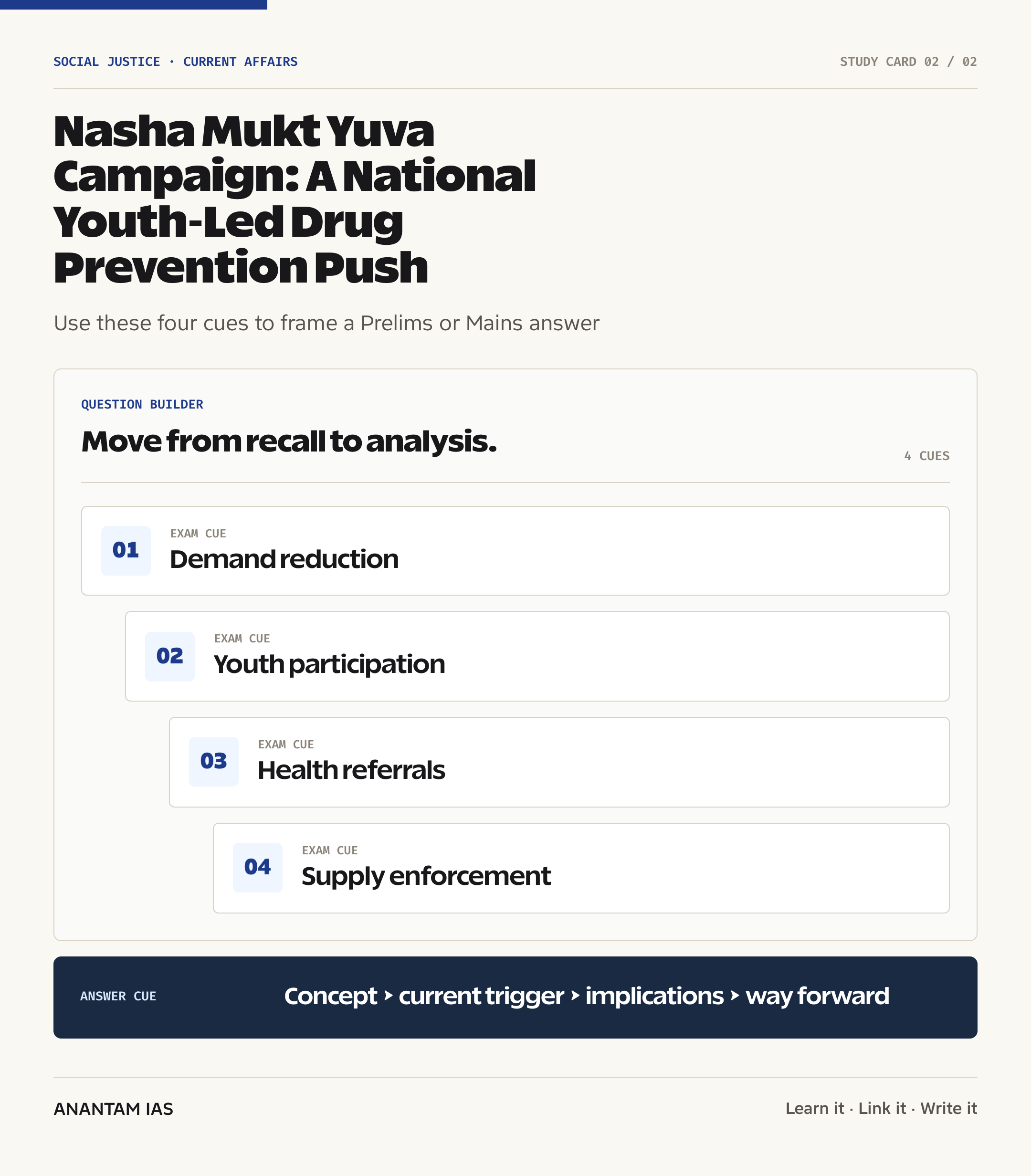
- Drug control requires separate but coordinated tracks: prevention and rehabilitation, clinical treatment, and supply-side enforcement against trafficking networks.
UPSC Relevance
Prelims Relevance
- Nasha Mukt Yuva for Viksit Bharat Sankalp Abhiyan: a 100-week nationwide public-participation campaign announced for launch on 2 August 2026.
- MY Bharat: a national youth platform under the Department of Youth Affairs, Ministry of Youth Affairs and Sports; it mobilises volunteering and youth participation.
- Nasha Mukt Bharat Abhiyaan: launched by the Ministry of Social Justice and Empowerment on 15 August 2020 in 272 identified districts and extended nationwide in August 2023.
- National Action Plan for Drug Demand Reduction: the Social Justice Ministry’s umbrella scheme for prevention, counselling, treatment support, aftercare and rehabilitation.
- Narcotics Control Bureau: the apex coordinating and enforcement agency under the Ministry of Home Affairs for action under the NDPS framework.
- NDPS Act, 1985: prohibits specified activities involving narcotic drugs and psychotropic substances except for medical and scientific purposes, while distributing regulatory and enforcement responsibilities.
Mains Relevance
GS Paper 2
- Social justice: substance dependence can deepen family distress, stigma, school exclusion and loss of livelihood, so prevention must connect people to care rather than moralise their condition.
- Health governance: community awareness works best when referral pathways lead to counselling, de-addiction treatment, aftercare and rehabilitation.
GS Paper 1
- Indian society and youth: peer networks, family environments, educational institutions and community norms can either increase vulnerability or strengthen protective behaviour.
- Social change: cultural forms such as street theatre, sport and creative competitions can carry prevention messages in local languages, but visibility alone doesn’t guarantee access to treatment.
Essay
- A healthy nation is built not only in hospitals but also through everyday social choices.
Background and Context
What the 100-week campaign is designed to do
The new campaign uses repetition and local participation to keep drug prevention in public view.
- Its core mechanism is a calendar of weekly Sunday activities, rather than a single commemorative event.
- Sports, walkathons and meditation frame a drug-free life through healthy alternatives and collective practice.
- Street plays, art competitions, cultural programmes and discussion forums allow the prevention message to travel through local languages and familiar formats.
- Community-engagement programmes seek to turn participants from a passive audience into peer messengers within campuses, youth clubs and neighbourhoods.
- The launch-day reach of more than 10,000 locations is an announced participation footprint; it shouldn’t be treated as a verified impact measure.
Demand reduction is different from supply control
UPSC answers score better when they separate the people-facing health track from the market-facing enforcement track.
- Demand reduction seeks to prevent first use, delay initiation, reduce harmful use, motivate treatment and support recovery and social reintegration.
- Supply reduction targets cultivation, manufacture, diversion, trafficking, illicit finance and distribution through intelligence, policing, customs and prosecution.
- The Ministry of Social Justice and Empowerment leads the national demand-reduction architecture, including outreach, capacity building and rehabilitation support.
- The Ministry of Health and Family Welfare supports clinical treatment through government health institutions and specialist drug-dependence services.
- The Narcotics Control Bureau under the Ministry of Home Affairs coordinates drug-law enforcement and action by central and state agencies under the NDPS framework.
How it fits the Nasha Mukt Bharat architecture
The Sankalp Abhiyan adds a youth-mobilisation layer to an existing national demand-reduction ecosystem.
- The Nasha Mukt Bharat Abhiyaan was launched on 15 August 2020 in 272 identified vulnerable districts.
- It expanded to 372 districts in August 2022 and has been implemented in all districts since 15 August 2023, according to the Social Justice Ministry’s official FAQ.
- NMBA focuses on awareness in schools, universities and communities, identification of people with substance dependence, counselling, treatment linkages and service-provider capacity.
- NMBA sits within the National Action Plan for Drug Demand Reduction, whose scope includes prevention, counselling, de-addiction treatment, aftercare, rehabilitation, training and research.
- The new 100-week initiative should be understood as a current youth participation campaign; the official launch release doesn’t describe it as a substitute for NMBA or as a new enforcement programme.
Why youth participation can matter
Young people can shape the social environments in which substance use is normalised, discouraged or discussed without stigma.
- Peer-led conversations may make prevention messages more credible than one-way official communication, especially in schools, colleges and youth clubs.
- Repeated local activities can create protective routines, belonging and access to trusted adults, all of which matter for early prevention.
- MY Bharat’s platform gives the State a network for registration, volunteering and campaign coordination across public, non-profit and community partners.
- The participation of educational institutions and civil society widens reach, while industry and spiritual groups add organisational networks outside government.
- But peer ambassadors need training on confidentiality, referral and non-stigmatising language; they aren’t counsellors or clinicians.
Way Forward
Connect awareness to care
- Give every event a clear, confidential route to screening, counselling, treatment and rehabilitation through verified local services.
- Train volunteers to recognise warning signs and make safe referrals without diagnosing, shaming or publicly identifying a person.
- Publish a simple monitoring framework separating inputs, reach, referrals and outcomes so event volume isn’t confused with behaviour change.
- Use anonymous baseline and follow-up surveys, while protecting minors and sensitive health data.
Conclusion
- The Nasha Mukt Yuva campaign’s strongest idea is continuity: a 100-week public-participation calendar can keep prevention in campuses and communities long after the launch broadcast ends.
- Its real test is the bridge from awareness to care.
UPSC Practice Questions
Prelims MCQ 1
With reference to India’s drug-control architecture, consider the following statements:
- Drug-demand reduction is primarily handled by the Ministry of Social Justice and Empowerment.
- The Narcotics Control Bureau functions under the Ministry of Home Affairs.
- Article 47 directs the State to work toward prohibiting intoxicating drugs injurious to health, except for medicinal purposes.
How many of the above statements are correct?
(a) Only one (b) Only two (c) All three (d) None
Answer: (c) All three
Explanation:
All three statements are correct. Social Justice leads the demand-reduction track, NCB is under the Home Ministry, and Article 47 supplies the constitutional public-health direction.
Prelims MCQ 2
Which one of the following best describes the immediate focus of the Nasha Mukt Yuva for Viksit Bharat Sankalp Abhiyan?
(a) Licensing the medical use of narcotic drugs (b) Youth-led awareness and public participation against substance abuse (c) Investigation of cross-border narcotics trafficking (d) Regulation of pharmaceutical exports
Answer: (b) Youth-led awareness and public participation against substance abuse
Explanation:
The 100-week campaign centres on weekly youth and community activities for prevention and awareness. It isn’t an enforcement or pharmaceutical-licensing programme.
UPSC Mains Questions
- Drug control is not a choice between public health and law enforcement but a question of assigning each instrument to the right problem. Examine this statement with reference to India’s demand-reduction, treatment and supply-control architecture.
- Youth-led campaigns can expand the reach of preventive health policy, but participation numbers alone don’t prove social impact. Assess the promise and limits of the Nasha Mukt Yuva for Viksit Bharat Sankalp Abhiyan and suggest an outcome-based implementation framework.
Sources: PIB, Prime Minister's Office and Department of Social Justice and Empowerment.
Frequently Asked Questions
What is the Nasha Mukt Yuva campaign?
It is a nationwide youth-led public-participation initiative against substance abuse. The Prime Minister’s Office announced its launch for 2 August 2026. The campaign is planned for 100 weeks, with activities every Sunday to promote awareness, healthy choices and community action.
How long will the campaign run?
The announced duration is 100 weeks. Weekly activities are to be held every Sunday across the country. The design aims to sustain public engagement through sport, walkathons, meditation, culture, street theatre, discussion, art and other community programmes.
Is it the same as Nasha Mukt Bharat Abhiyaan?
No. Nasha Mukt Bharat Abhiyaan is the Social Justice Ministry’s established demand-reduction programme, launched in 2020 and expanded nationwide in 2023. The 2026 Sankalp Abhiyan is a distinct youth-mobilisation campaign; it fits the wider prevention ecosystem but doesn’t replace NMBA.
Who handles drug-demand reduction in India?
The Ministry of Social Justice and Empowerment leads the national demand-reduction track, including awareness, counselling, rehabilitation support and NAPDDR. The Health Ministry supports clinical treatment, while NCB and other enforcement agencies focus on illicit supply and trafficking.
What is MY Bharat’s role?
MY Bharat is the Department of Youth Affairs’ national youth platform. For this campaign, its volunteer and institutional network helps mobilise young people, educational institutions, youth clubs, civil society, industry groups and partner organisations for weekly local action.
Tell Google you want more of this.
Add Anantam IAS as a preferred sourceOne tap, and this site shows up more often in your own Top Stories, AI Overviews and AI Mode. Remove it any time.