Right to Legal Aid: Supreme Court Orders Retrial in Death Penalty Case
Why in News?
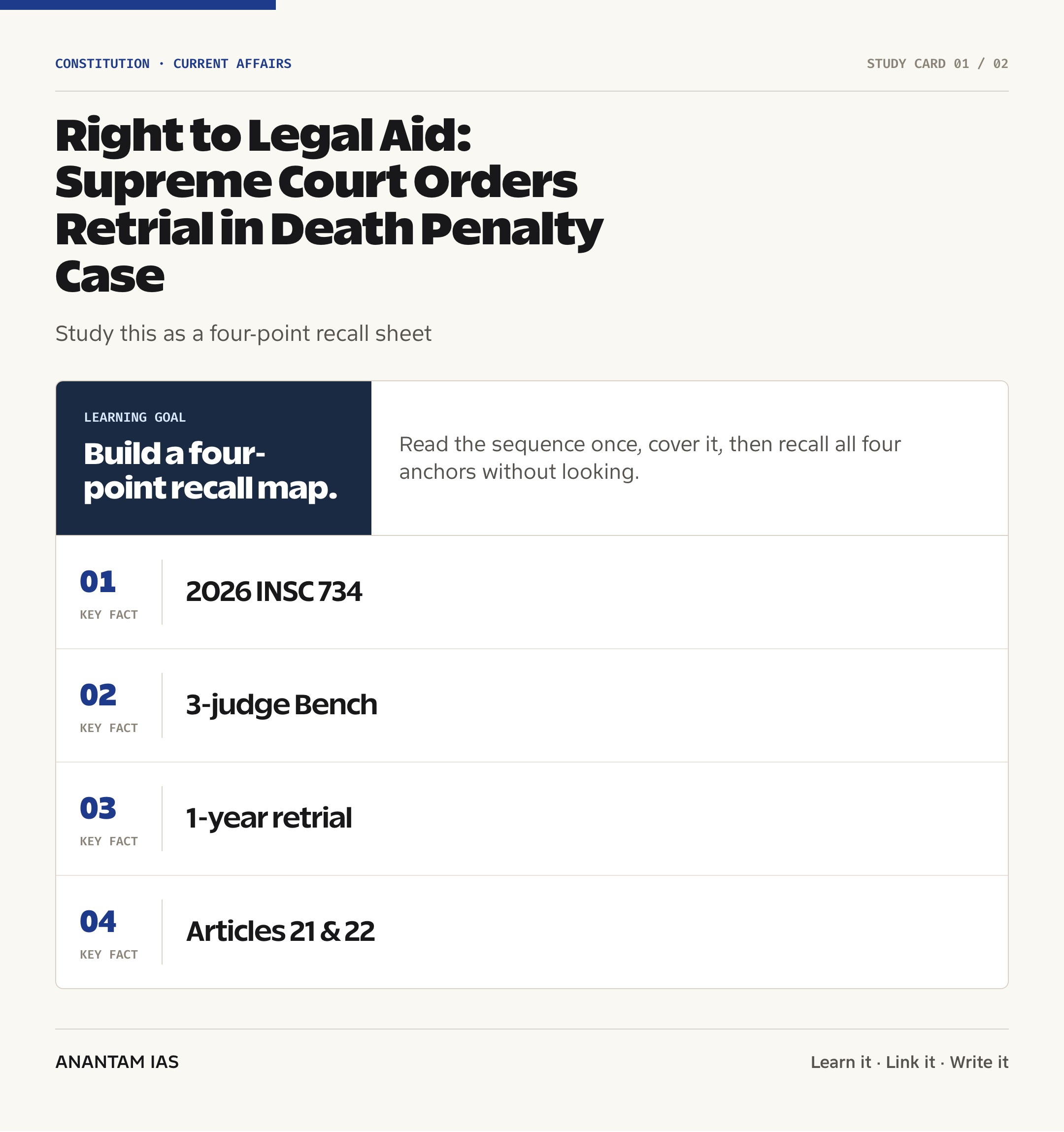
The Supreme Court of India reaffirmed the right to legal aid in Dr. Abdul Hameed v. State of Rajasthan, 2026 INSC 734, delivered on 21 July 2026. It set aside Hameed’s conviction and death sentence in the 1996 Samleti bus-blast case because he had faced the trial without effective legal representation.
The three-judge Bench of Justices Vikram Nath, Sanjay Karol and Sandeep Mehta ordered a de novo trial, meaning a fresh trial from the prosecution-evidence stage. The Court did not pronounce Hameed innocent; it held that a conviction, especially one carrying capital punishment, cannot rest on a process vitiated by denial of a meaningful defence.
- The trial-court record showed that Hameed had no counsel during the evidentiary trial and cross-examined prosecution witnesses himself.
- The case involved voluminous oral, documentary and forensic evidence, identification evidence, alleged confessions and recoveries, making professional defence assistance indispensable.
- The Court directed a Special Court at Jaipur to make every effort to complete the fresh trial within one year of assignment.
- If Hameed cannot engage counsel, the Rajasthan State Legal Services Authority must appoint a lead lawyer with at least ten years’ standing, assisted by a lawyer with at least seven years’ standing.
- The ruling treats fair-trial safeguards as substantive constitutional guarantees, not procedural formalities that can be relaxed because an alleged offence is grave.
The development matters in the context of:
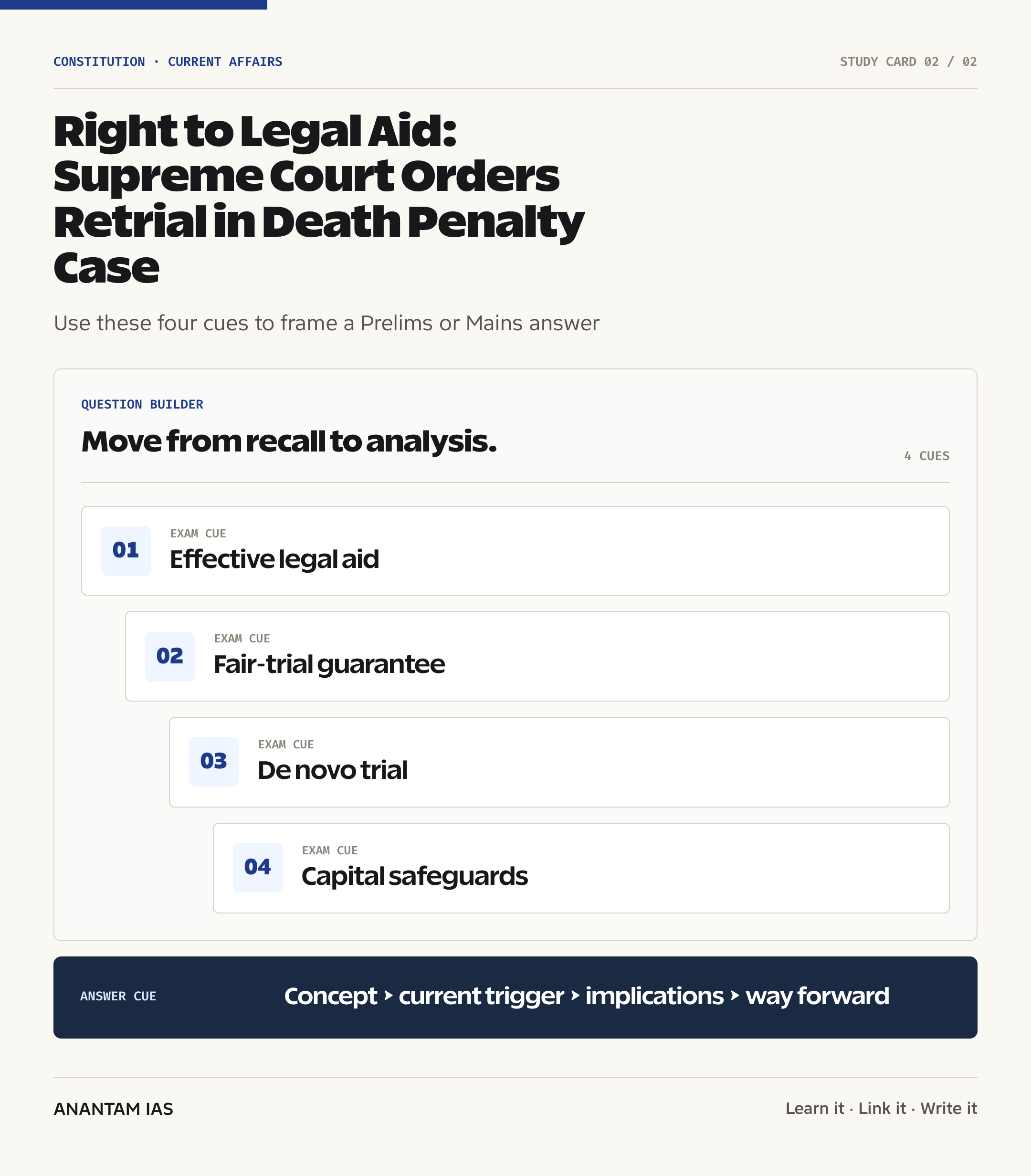
- The judgment connects effective representation with life and personal liberty under Article 21 and the right to consult and be defended by a legal practitioner under Article 22.
- It balances the accused’s rights with the claims of victims and society: the flawed conviction was erased, but prosecution may continue through a constitutionally compliant retrial.
- It is especially important for capital cases, where deficient defence can distort both the finding of guilt and the presentation of mitigating circumstances at sentencing.
UPSC Relevance
Prelims Relevance
- Article 21 protects life and personal liberty except according to procedure established by law; judicial interpretation requires that procedure to be fair, just and reasonable.
- Article 22(1) says an arrested person shall not be denied the right to consult and be defended by a legal practitioner of choice.
- Article 39A, a Directive Principle in Part IV, directs the State to secure equal justice and provide free legal aid so economic or other disabilities don’t deny access to justice.
- Section 303 of the CrPC recognised the right of a person accused before a criminal court to be defended by a pleader of choice.
- Section 304 of the CrPC required a Sessions Court to assign a pleader at State expense when an unrepresented accused lacked sufficient means.
- Section 386(b) of the CrPC empowered an appellate court hearing an appeal from conviction to reverse the finding and sentence and order a retrial.
- Under Section 12 of the Legal Services Authorities Act, 1987, a person in custody is among the categories eligible for legal services; Section 13 governs entitlement.
- A de novo trial is an exceptional remedy used when a fundamental defect makes the earlier trial unsafe; it is not a device for the prosecution to fill ordinary gaps in its case.
- The case citation is 2026 INSC 734, and the appeal was Criminal Appeal Nos. 1827-1829 of 2019.
Mains Relevance
GS Paper 2
- Fundamental rights and due process: how Articles 21 and 22 convert legal representation into an enforceable condition of a fair criminal trial.
- Directive Principles and institutions: Article 39A, the Legal Services Authorities Act and the responsibility of courts and State Legal Services Authorities.
- Judiciary and governance: trial-court vigilance, quality of legal-aid counsel, accountability for procedural failure and time-bound corrective remedies.
GS Paper 4
- Ethics of public institutions: restraint, impartiality and fidelity to process when public outrage creates pressure for swift punishment.
- Justice to all stakeholders: protecting the accused from wrongful conviction without extinguishing the victims’ claim to a lawful adjudication.
Essay
- The legitimacy of punishment depends as much on the fairness of the process as on the result.
- Constitutional safeguards are tested most severely when allegations provoke fear and public anger.
- Equal justice requires capable assistance, not merely formal access to a lawyer.
Background and Context
What the Supreme Court found
The constitutional defect was established from the court record, the accused’s direct response and the absence of any proof of State-provided assistance.
- Hameed told the Supreme Court through video conferencing on 6 March 2025 that he had neither engaged private counsel nor received a legal-aid lawyer during the trial.
- The State did not dispute that no lawyer had been appointed through the legal services authority, and no material showed that the trial court tried to appoint an amicus curiae.
- Proceeding sheets did not show counsel at any stage; witness depositions showed that the accused cross-examined witnesses himself.
- There was no record of a conscious and voluntary waiver after the consequences of proceeding without counsel had been explained to him.
- The Court said physical presence of an accused is insufficient. Representation must be real, effective and meaningful, allowing the accused to understand proceedings, exercise rights and present a defence.
Constitutional foundation of legal aid
India’s legal-aid guarantee is built from enforceable Fundamental Rights, a Directive Principle and statutory duties that operate together.
- Article 21 is the core fair-procedure guarantee. A criminal conviction can be legitimate only when guilt is determined through a fair process, not simply when a court reaches a conclusion on evidence.
- Article 22(1) expressly protects an arrested person’s right to consult and be defended by a legal practitioner of choice. The present judgment assessed observance in substance, not as a paper formality.
- Article 39A instructs the State to secure equal justice and free legal aid. It addresses the risk that poverty, custody, disability or social disadvantage may make nominal equality meaningless.
- The legal-aid system in India works through NALSA, State Legal Services Authorities, High Court and District committees under the Legal Services Authorities Act, 1987.
- The duty is not exhausted by attaching any available lawyer to the file. In a complex capital prosecution, competence, preparation and continuity determine whether assistance is meaningful.
Statutory safeguards in criminal procedure
The Code of Criminal Procedure translated constitutional protection into courtroom duties relevant to the original trial and the ordered retrial.
- Under Sections 303 and 304 of the CrPC, an accused may be defended by a pleader of choice, while an indigent unrepresented accused in a Sessions trial must receive a pleader at State expense.
- The obligation lies on the court. The Supreme Court rejected any attempt to fault the accused for not correcting the trial court’s failure to secure appropriate legal aid.
- Effective cross-examination matters because it tests identification, reliability, contradictions, recoveries, scientific evidence and the chain of circumstances. A later appellate reading cannot recreate opportunities lost when evidence was first recorded.
- Section 386(b) gives an appellate court power to order retrial after reversing a conviction. The Court relied on this remedial logic but stressed that retrial is exceptional and must be required to avert a failure of justice.
- The fresh court may examine the accused under Section 313 CrPC after prosecution evidence and must allow a reasonable opportunity to lead defence evidence.
Why the Court chose retrial
The Bench considered three possible remedies and selected the one that repaired the constitutional injury without prematurely terminating prosecution.
- An appellate reappraisal of the existing record was rejected because that record had been created without effective defence assistance. Affirming guilt from it would preserve the very defect under challenge.
- Immediate acquittal solely for denial of counsel was also rejected because the allegations concerned a grave public-transport bombing. Fairness to society required that the charges be tested lawfully.
- A de novo trial was selected to restore the accused’s opportunity to test prosecution evidence while preserving the prosecution’s chance to establish its case.
- The Court drew on Mohd. Hussain v. State (NCT of Delhi), which treats retrial as rare but permissible when indispensable to avert failure of justice and balance fair-trial rights with public justice.
- It also referred to Suk Das v. Union Territory of Arunachal Pradesh, Tyron Nazareth v. State of Goa and Naveen v. State of Madhya Pradesh on legal assistance and the meaning of a real, impartial trial.
Special safeguards for the fresh trial
The detailed directions turn the constitutional holding into operational safeguards rather than leaving legal aid as an abstract promise.
- The Acting Chief Justice of the Rajasthan High Court must designate a Special Court at Jaipur led by a Rajasthan Higher Judicial Service officer with at least seven years’ Sessions-trial experience.
- The matter restarts from recording prosecution evidence; witnesses must be summoned afresh and Hameed must receive a full opportunity to cross-examine them.
- If privately chosen counsel isn’t available, the Rajasthan State Legal Services Authority must fund an experienced two-lawyer defence team: a lead counsel of ten years’ standing and an assistant of seven years’ standing.
- The defence must receive prosecution documents without avoidable delay and sufficient preparation time; the trial should proceed day to day as far as practicable, with reasons recorded for necessary adjournments.
- Hameed remains in judicial custody but may seek bail on its own merits. The Special Court must remain uninfluenced by findings in the judgments that were set aside.
Capital punishment and heightened procedural care
A death sentence magnifies the cost of every defect because both conviction and sentencing demand searching adversarial scrutiny.
- The Rajasthan High Court had earlier found that death was imposed on the same day as conviction without counsel present at sentencing or a meaningful opportunity to present mitigating circumstances.
- An amicus curiae was appointed only after the High Court remanded the sentencing issue. The Supreme Court found that the deeper problem covered the entire evidentiary trial.
- The ruling complements the rarest of rare doctrine: narrowing capital punishment isn’t enough if the process used to determine guilt lacks a capable defence.
- The Court noted that Hameed had spent almost 29 years in custody and nearly 12 years under the shadow of death, yet delay could not justify sustaining a constitutionally defective conviction.
- Public outrage over a serious offence calls for greater judicial discipline, because the standard of proof and the right to test evidence cannot vary with the popularity of an accusation.
Scope and limits of the ruling
The judgment separates Hameed’s procedural claim from the evidence-based outcomes concerning the other accused.
- The order is case-specific. It does not declare that every defect in representation automatically requires retrial or acquittal.
- Hameed’s conviction and sentence were set aside, but he was not acquitted; the Special Court must decide the case afresh on evidence and law.
- Pappu alias Salim was separately acquitted because the prosecution failed to establish his guilt beyond reasonable doubt, not because his trial lacked counsel.
- The Supreme Court also declined to disturb the High Court’s acquittal of six other accused, applying the reinforced or double presumption of innocence after acquittal.
- The case illustrates remedial proportionality: courts must identify the precise constitutional defect and choose relief that repairs it while respecting the rights of the accused, victims and society.
Evolution of the Supreme Court doctrine
The decision develops a long line of cases that moved free legal aid from charity to a judicially enforceable element of fair procedure.
- In Hussainara Khatoon v. Home Secretary, State of Bihar, the Court connected free legal services with reasonable, fair and just procedure under Article 21, especially for indigent persons facing loss of liberty.
- In Khatri (II) v. State of Bihar, it stressed that the State’s duty is not postponed until trial. Legal assistance must be available when an accused is first produced before a magistrate and at later stages where liberty is at stake.
- In Suk Das v. Union Territory of Arunachal Pradesh, the Court rejected the idea that an uninformed accused had silently waived legal aid. A right cannot be meaningfully waived when the person was never told it existed.
- The present judgment adds an operational test: judges must examine whether representation was competent and meaningful in light of case complexity, possible punishment, access to material and the real opportunity to cross-examine witnesses.
- This evolution shifts institutional focus from the formal question, ‘Was a lawyer named?’ to the constitutional question, ‘Could the accused actually defend against the State’s case?’
Way Forward
Make legal aid effective from the first hearing
- Trial courts should record whether the accused has counsel, needs legal aid or has knowingly waived representation only after receiving a clear explanation in a language the accused understands.
- Legal Services Authorities should maintain trained criminal-defence panels with special experience requirements for murder, terrorism and capital cases.
- Counsel must be appointed early enough to study the record, consult the accused and prepare cross-examination; appointment on the day of evidence is not meaningful assistance.
Monitor quality, continuity and resources
- Courts should use periodic representation checklists covering conferences with the accused, access to documents, preparation time and unexplained changes of counsel.
- State authorities should provide fair fees, investigators, interpreters and expert assistance where complex evidence makes these necessary for an effective defence.
- High Courts can audit capital-case records before confirmation to detect missing counsel, inadequate sentencing hearings or untested evidence before defects become irreversible.
Protect speed without sacrificing fairness
- Day-to-day hearings and limited adjournments can reduce delay, but schedules must preserve adequate defence preparation and meaningful cross-examination.
- Digital case records, timely disclosure and verified witness-contact systems can make old-case retrials more workable without lowering evidentiary standards.
- Legal-aid performance should be evaluated by the quality of representation and case outcomes, not only by the number of lawyers assigned or matters closed.
Conclusion
The Supreme Court’s ruling makes a simple constitutional point with difficult consequences: the State cannot seek the gravest punishment through a trial in which the accused was left to defend himself. Articles 21 and 22 demand a real opportunity to understand, test and answer the prosecution case.
By ordering a fresh trial instead of treating either conviction or acquittal as automatic, the Court protected both individual liberty and public justice. The institutional lesson is that competent legal aid must begin before evidence is recorded; appellate correction decades later is costly for the accused, victims and the credibility of the justice system.
UPSC Practice Questions
Prelims MCQ 1
With reference to constitutional and statutory safeguards for legal representation, consider the following statements:
- Article 22(1) protects an arrested person’s right to consult and be defended by a legal practitioner of choice.
- Article 39A forms part of the Fundamental Rights in Part III of the Constitution.
- Section 304 of the Code of Criminal Procedure required a Sessions Court to assign a pleader at State expense when an unrepresented accused lacked sufficient means.
How many of the above statements are correct?
(a) Only one (b) Only two (c) All three (d) None
Answer: (b) Only two
Explanation:
Statements 1 and 3 are correct. Article 39A is a Directive Principle in Part IV, not a Fundamental Right in Part III.
Prelims MCQ 2
Which one of the following best describes a de novo criminal trial ordered by an appellate court?
(a) Automatic acquittal followed by a new prosecution for the same offence (b) A fresh adjudication ordered exceptionally to cure a fundamental trial defect (c) Reconsideration limited only to the quantum of sentence (d) Review of a conviction exclusively on the existing defective evidence record
Answer: (b) A fresh adjudication ordered exceptionally to cure a fundamental trial defect
Explanation:
A de novo trial is an exceptional corrective remedy. In this case, evidence must be recorded afresh with effective counsel and a full opportunity for cross-examination.
UPSC Mains Questions
- Effective legal aid is not a welfare concession but an essential condition of a fair criminal trial. Discuss with reference to Articles 21, 22 and 39A, statutory safeguards, and the Supreme Court’s reasoning in Dr. Abdul Hameed v. State of Rajasthan. (15 marks, 250 words)
- How should appellate courts balance an accused’s right to fair procedure with victims’ rights and society’s interest when a serious criminal conviction is vitiated by denial of counsel? Examine the constitutional basis and limits of ordering a de novo trial. (15 marks, 250 words)
- Capital punishment demands heightened procedural fairness at both conviction and sentencing. Analyse the duties of trial courts and Legal Services Authorities in ensuring competent, continuous and meaningful defence representation. (10 marks, 150 words)
Sources: Supreme Court of India and The Indian Express.
Frequently Asked Questions
What did the Supreme Court decide?
The Court set aside Abdul Hameed’s conviction and death sentence because his trial lacked effective legal representation. It ordered a fresh trial from the prosecution-evidence stage before a designated Special Court at Jaipur. The ruling did not acquit Hameed or decide the evidence against him on merits.
Why is legal aid part of fair trial?
Counsel helps an accused understand charges, test witnesses, raise legal objections, examine technical evidence and present a defence. Articles 21 and 22 protect fair procedure and representation, while Article 39A directs the State to secure equal justice and free legal aid. A lawyer’s nominal presence alone may not satisfy these duties.
What is a de novo trial?
A de novo trial is a fresh adjudication ordered when a fundamental defect has undermined the earlier process. It is an exceptional remedy, not a routine second chance for the prosecution. Here, prosecution evidence must be recorded afresh so the accused’s lawyers can cross-examine witnesses and present a meaningful defence.
Was Abdul Hameed acquitted?
No. His conviction and sentence were set aside for lack of a constitutionally fair trial, but the allegations remain to be adjudicated afresh. He will remain in judicial custody during the retrial, subject to his right to apply for bail before the Special Court on independent merits.
Which provisions govern free legal aid?
Articles 21, 22(1) and 39A provide the constitutional framework. Sections 303 and 304 of the Code of Criminal Procedure governed defence by counsel and State-funded counsel in Sessions trials. The Legal Services Authorities Act, 1987 establishes NALSA and State, High Court, District and Taluk-level institutions for legal services.
Why does the ruling matter in death cases?
A death sentence is irreversible and requires heightened care in testing guilt and presenting mitigating circumstances. The ruling makes clear that gravity cannot lower fair-trial standards. Courts must proactively ensure experienced, prepared and continuous representation before evidence is recorded and again when sentence is considered.