The Legal Services Authorities Act, 1987 came into force on 9 November 1995, which means the National Legal Services Authority and its sister bodies at the state, district and taluk levels have just completed thirty years of work. The 9th of November is now observed as National Legal Services Day, and the milestone has prompted a fresh round of stocktaking on whether the constitutional promise of free and competent legal aid has been delivered to those for whom it was meant.
The numbers tell a layered story. Through 2024, NALSA and its subordinate authorities had organised more than seventy lakh Lok Adalats and disposed of more than thirty crore cases through them, including pre-litigation matters. The Tele-Law programme, which connects panel lawyers with beneficiaries through the Common Service Centre network, has handled tens of lakhs of consultations. The Legal Aid Defence Counsel System, NALSA’s most ambitious recent reform, is rolling out full-time public defenders in district after district. And yet, the proportion of accused persons in jail who actually receive timely legal representation remains uneven, and the funding base of legal aid in India has stayed roughly flat as a share of total judicial expenditure.
This guide walks through the constitutional foundation of legal aid, the four-tier institutional architecture under the 1987 Act, eligibility under Section 12, the role of Lok Adalats and Gram Nyayalayas, and the recent reforms that NALSA is pushing in its fourth decade.
Quick Facts on Legal Aid in India
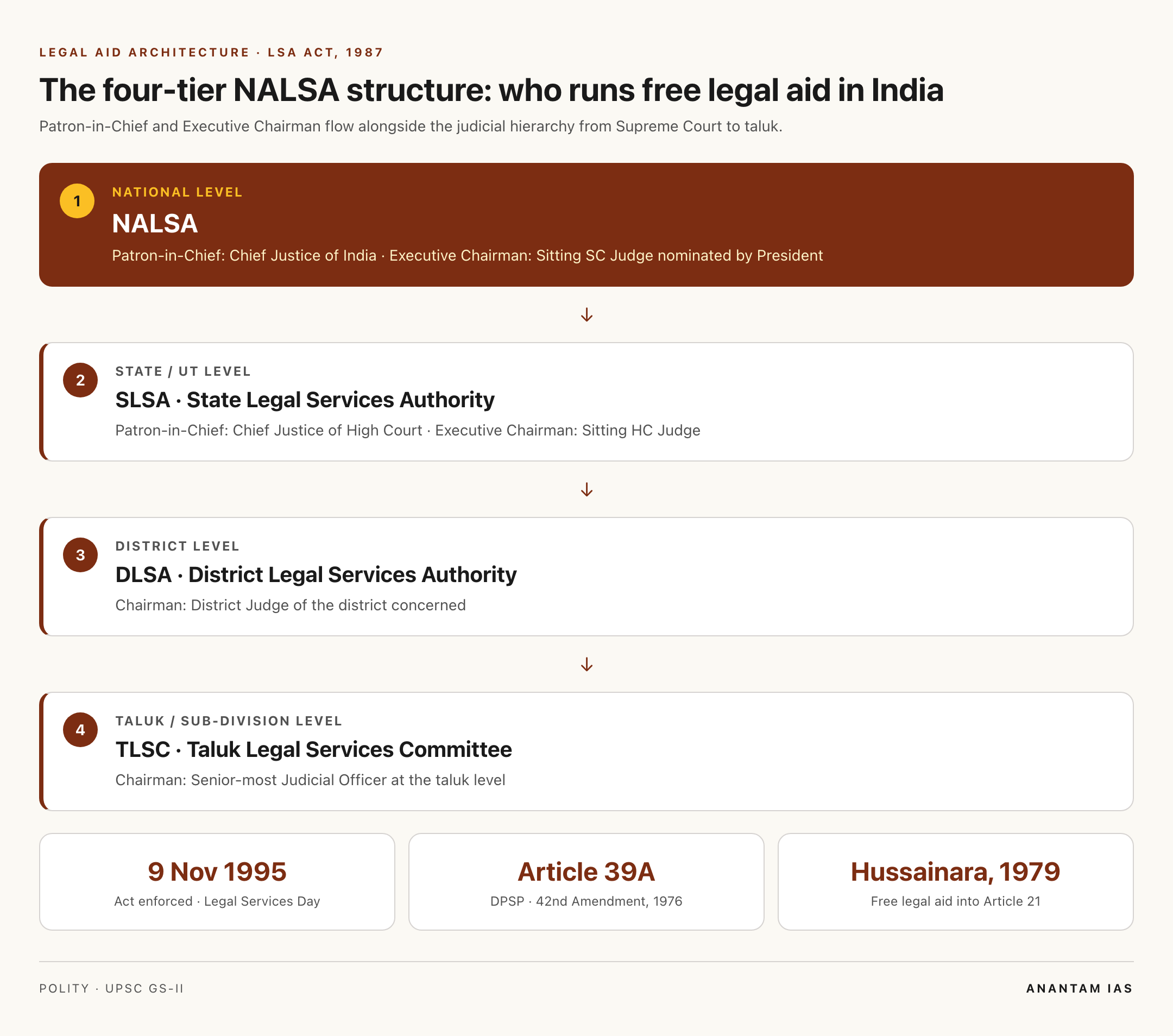
Legal aid in India is anchored in Article 39A of the Constitution, which is a Directive Principle inserted by the 42nd Amendment in 1976. The Legal Services Authorities Act, 1987 came into force on 9 November 1995, which is observed as National Legal Services Day. NALSA is headed by the Chief Justice of India as Patron-in-Chief, with a serving Supreme Court judge as Executive Chairman. Free and competent legal services are provided to eight categories of beneficiaries listed under Section 12, including women, children, SCs and STs, industrial workmen, victims of trafficking, divyangjan, persons in custody, and those below a prescribed income limit. Lok Adalats have statutory status under the 1987 Act, and their awards are deemed to be civil court decrees that are final and binding with no appeal.
What Legal Aid in India Actually Means
Legal aid is the provision of free and competent legal services to people who cannot afford a lawyer or who, by virtue of their social and economic vulnerability, are unlikely to obtain meaningful legal representation through the open market. It includes legal advice, drafting of documents, representation in courts and tribunals, payment of court fees and process fees, and the cost of obtaining certified copies of orders and judgments.
Background and Historical Context
The idea that the state owes free legal services to those who cannot afford them did not emerge fully formed in 1987. It moved through three distinct phases. The first was the Krishna Iyer Committee report of 1973 and the Bhagwati Committee report of 1976, both of which argued that legal aid was a constitutional and moral imperative. The second was the 42nd Constitutional Amendment in 1976, which inserted Article 39A in the Directive Principles, declaring that the state shall ensure that the legal system promotes justice on the basis of equal opportunity and shall provide free legal aid by suitable legislation or schemes.
The third phase came through judicial activism. In Hussainara Khatoon v. State of Bihar in 1979, the Supreme Court held that the right to free legal aid is implicit in Article 21, which guarantees the right to life and personal liberty. Justice P.N. Bhagwati held that a procedure that does not provide for free legal services to a person too poor to afford a lawyer is not reasonable, fair or just. The Court reinforced this in Khatri v. State of Bihar, M.H. Hoskot v. State of Maharashtra, and Suk Das v. Union Territory of Arunachal Pradesh, holding that the state has an obligation to provide a lawyer at its expense and that the absence of such legal aid would vitiate the trial.
The 1987 Act was the legislative response to this judicial pressure. Parliament passed it in 1987, but the law lay dormant for eight years before it was finally brought into force on 9 November 1995, with the establishment of NALSA. State Legal Services Authorities, District Legal Services Authorities and Taluk Legal Services Committees were rolled out over the next several years.
Constitutional Basis: Articles 14, 21 and 39A
Three constitutional anchors hold up the legal aid framework, anchored in the broader scheme covered in our Indian Polity notes and the Constitution of India book guide. Article 14 guarantees equality before the law and equal protection of the laws. Without legal representation, equality before the law becomes a fiction for those who cannot afford it. Article 21 guarantees the right to life and personal liberty, and the Supreme Court has repeatedly held that this includes the right to a fair trial, which in turn requires legal representation. Article 39A, the Directive Principle inserted by the 42nd Amendment, mandates the state to provide free legal aid through suitable legislation. The combination of these three provisions transforms what would otherwise be a welfare measure into a constitutional obligation enforceable through the writ jurisdiction of the High Courts and the Supreme Court, and is part of the post-emergency reform set examined alongside the basic structure doctrine jurisprudence.
Institutional Framework: The Four-Tier Structure
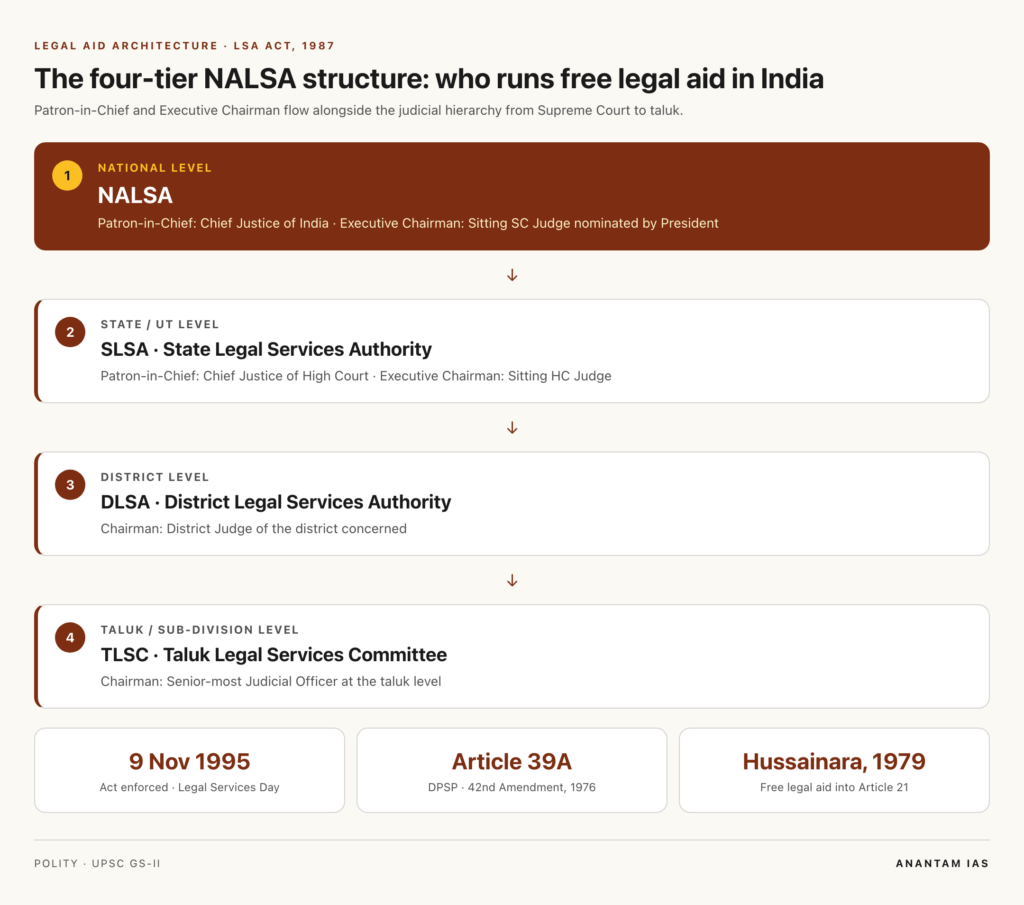
The Legal Services Authorities Act, 1987 sets up a four-tier institutional structure that mirrors the hierarchy of the Indian judiciary. At the apex is the National Legal Services Authority, NALSA, headquartered in Delhi. The Chief Justice of India is its Patron-in-Chief. A sitting Supreme Court judge, nominated by the President in consultation with the CJI, serves as the Executive Chairman who runs the day-to-day operations. NALSA frames the broad policies, designs nationwide schemes, and monitors the work of state authorities.
Below NALSA sits the State Legal Services Authority, SLSA, in each state and Union Territory. The Chief Justice of the High Court is the Patron-in-Chief, and a serving High Court judge nominated by the Governor in consultation with the CJ serves as Executive Chairman. Below the SLSA, in every district, sits the District Legal Services Authority, DLSA, headed by the District Judge as Chairman. Below the DLSA, in every taluk or sub-division, sits the Taluk Legal Services Committee, TLSC, headed by the senior-most judicial officer at that level. There is also a Supreme Court Legal Services Committee that handles cases at the apex court level.
The architecture is administratively neat. The judiciary itself runs the legal aid system, which keeps it insulated from executive interference. The downside is that legal aid carries the limitations of the judicial system in which it is embedded.
Eligibility for Free Legal Aid: Section 12 of the LSA Act
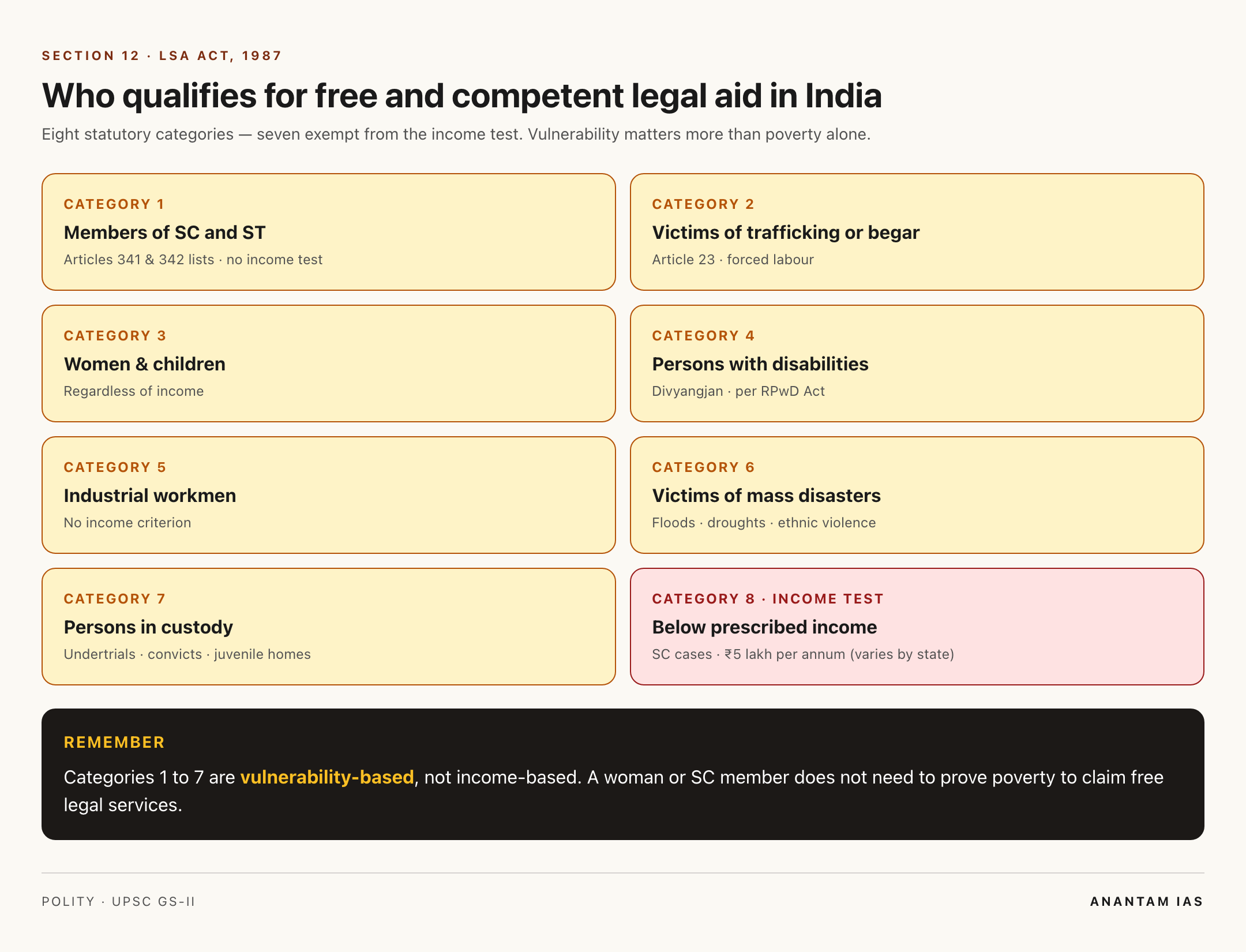
Section 12 of the 1987 Act lists eight categories of persons entitled to free legal services. These are not income-based alone. Five of the categories are based on social vulnerability rather than income, which is a critical distinction that is often missed.
The first category is members of Scheduled Castes and Scheduled Tribes. The second is victims of trafficking in human beings or begar as referred to in Article 23. The third is women and children, regardless of income. The fourth is persons with disabilities, the divyangjan, as defined in the Persons with Disabilities Act. The fifth is industrial workmen. The sixth is victims of mass disasters, ethnic violence, caste atrocities, floods, droughts, earthquakes or industrial disasters. The seventh is persons in custody, including in protective homes, juvenile homes, and psychiatric hospitals. The eighth is persons whose annual income is below the limit prescribed by the appropriate government, which varies by state and case type. For Supreme Court cases, the upper limit is generally 5 lakh rupees per annum.
Critically, the first seven categories are exempt from the income criterion. A woman or child seeking legal aid does not need to prove that she is poor. The shift from a pure poverty test to a vulnerability test was deliberate, recognising that legal disability does not always correlate with economic disability.
Lok Adalats: Statutory ADR Built into Legal Aid
Lok Adalats are the most visible face of the legal aid system in India. The 1987 Act gave statutory status to what had earlier been an informal community dispute resolution mechanism. Today, Lok Adalats are organised at every level by NALSA, SLSAs, DLSAs and TLSCs, and they have become a major decongesting force in Indian courts.
A Lok Adalat is a forum where disputes pending in a court or those at the pre-litigation stage are settled by compromise. The presiding officer is typically a sitting or retired judicial officer, assisted by a member of the legal profession and a social worker. Unlike a regular court, a Lok Adalat is not bound by the Code of Civil Procedure or the Indian Evidence Act. It applies the principles of natural justice and works toward a settlement.
The award of a Lok Adalat is deemed to be a decree of a civil court under Section 21 of the Act. Crucially, no appeal lies against this award in any court of law, because the parties have voluntarily agreed to the settlement. Lok Adalats can take up civil cases of any value and compoundable criminal cases. Permanent Lok Adalats, set up under the 2002 amendment, also handle pre-litigation disputes in respect of public utility services and have the power to decide on merit if the parties fail to reach a settlement, up to a pecuniary limit.
Lok Adalats vs Gram Nyayalayas: A Comparative View
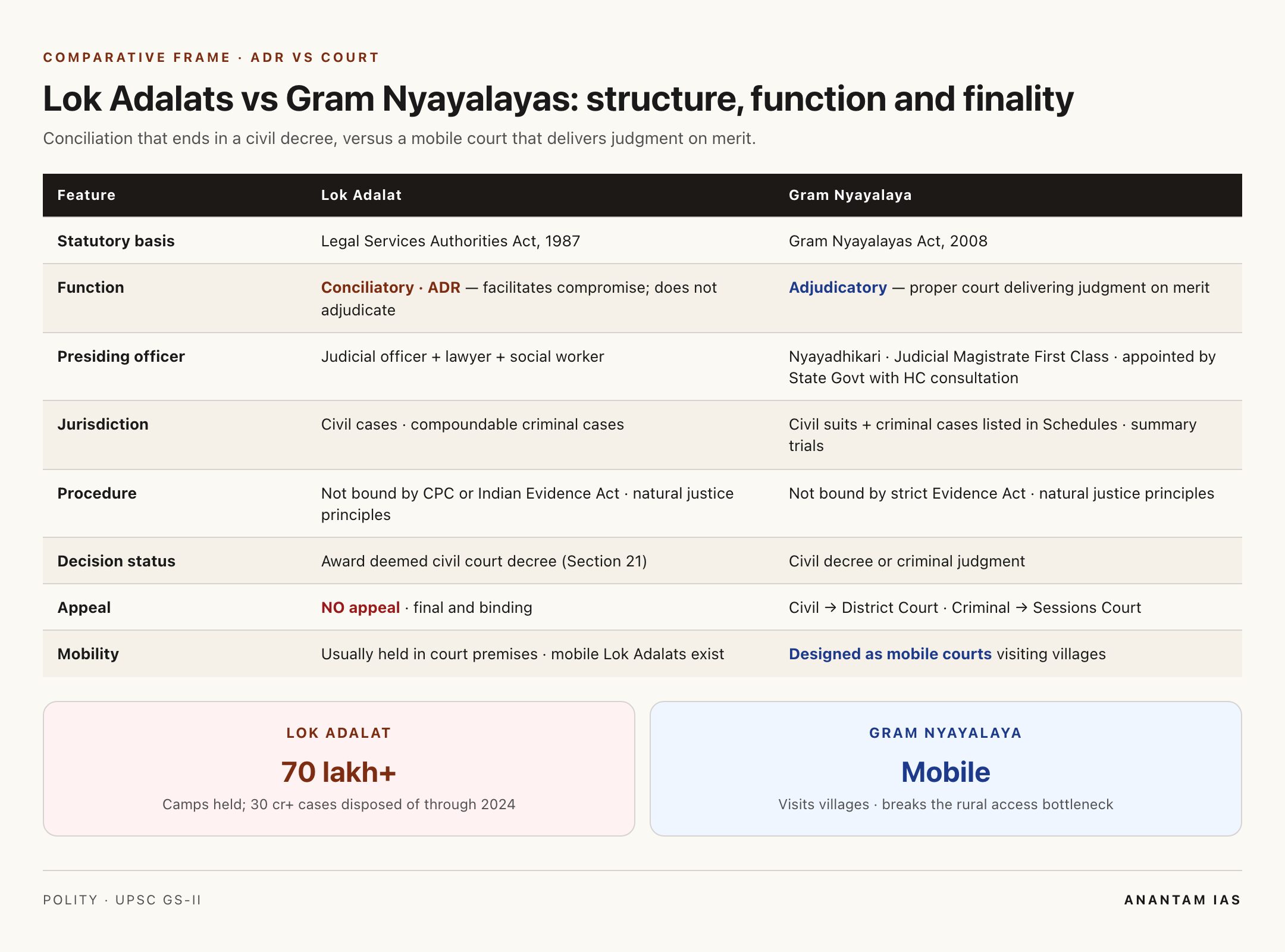
Lok Adalats are often confused with Gram Nyayalayas in MCQ contexts, but the two are structurally different. Lok Adalats are conciliatory bodies under the Legal Services Authorities Act, 1987, while Gram Nyayalayas are adjudicatory courts under the Gram Nyayalayas Act, 2008.
A Lok Adalat does not deliver a judgment on merit; it facilitates a compromise between parties, and its award is deemed to be a civil court decree with no appeal. A Gram Nyayalaya is a regular court of first instance functioning at the village or panchayat level, presided over by a Nyayadhikari who is a Judicial Magistrate First Class appointed by the State Government in consultation with the High Court. Gram Nyayalayas can hear civil suits and criminal cases listed in the schedules of the 2008 Act, conduct summary trials, and deliver judgments. Appeals from Gram Nyayalayas lie to the District Court in civil matters and the Sessions Court in criminal matters. Gram Nyayalayas are also designed as mobile courts that visit villages, while Lok Adalats are usually held in court premises.
Why Legal Aid Matters: The Access to Justice Argument
The case for legal aid rests on three planks. First, the rule of law cannot be selective. If the law applies equally but representation does not, the law applies unequally in practice. Second, undertrial overcrowding in Indian prisons is one of the most chronic crises in the system. As of recent NCRB and prison statistics, undertrials make up over 75 percent of the prison population. A meaningful share of these undertrials do not have legal representation that can secure timely bail or move applications under Section 479 of the Bharatiya Nagarik Suraksha Sanhita, the new provision allowing the release of undertrials who have served half the maximum sentence for the offence. Third, the substantive rights granted by the Constitution and statutes have meaning only if there is an institutional pathway for ordinary citizens to enforce them.
Detailed Analysis: Recent Reforms in NALSA’s Fourth Decade
Three reforms define NALSA’s recent agenda. The first is the Legal Aid Defence Counsel System, LADCS, which is a structural shift from the earlier panel lawyer model to a full-time public defender model. Under the old system, lawyers on a panel were paid case by case and often had limited incentive to invest time in legal aid clients. Under LADCS, full-time defence counsel are appointed at the district level on fixed salaries, with chief, deputy chief and assistant defence counsel positions, modelled loosely on the public defender systems of common law jurisdictions. The system was piloted in 2022 and is being expanded across districts.
The second is Tele-Law, run jointly by the Ministry of Law and Justice and the National Informatics Centre. Tele-Law connects beneficiaries at the village level, through Common Service Centres, with panel lawyers via video conferencing. It has been particularly effective in remote areas where physically reaching a DLSA is difficult.
The third is Nyaya Bandhu, a pro-bono platform that allows registered lawyers across the country to volunteer their time for legal aid clients through a mobile and web application. This is complemented by the DISHA scheme, which is the Ministry of Law and Justice’s umbrella programme for Designing Innovative Solutions for Holistic Access to Justice, integrating Tele-Law, Nyaya Bandhu and other initiatives under one strategic frame.
Comparative International View
Most major democracies have legal aid systems, but the institutional designs differ. The United Kingdom runs the Legal Aid Agency under the Ministry of Justice, with means-tested civil legal aid and criminal legal aid that is largely contracted out to private solicitors. The United States runs a constitutional public defender system at the federal and state level, supplemented by Legal Services Corporation funded civil legal aid. Canada uses a provincial legal aid model with mixed staff and judicare components. India’s model is distinctive in that the judiciary itself runs the legal aid administration through NALSA and its subordinate authorities, which offers institutional independence from the executive but creates capacity bottlenecks because the judiciary is already overstretched with adjudicatory work.
Challenges in the Legal Aid Framework
The legal aid system faces five chronic challenges. The first is funding. Legal aid expenditure in India remains a small fraction of total judicial expenditure, and per capita legal aid spending is among the lowest in the major democracies. The second is quality. Empanelled lawyers are paid modest fees, often per appearance, which provides limited incentive to invest meaningfully in cases. LADCS attempts to address this. The third is awareness. A significant portion of those eligible for free legal aid simply do not know they are entitled, and outreach in rural and tribal areas remains thin. The fourth is data. There is no nationwide real-time dashboard that tracks legal aid cases by stage, outcome and beneficiary category. The fifth is integration with prisons. Despite Article 39A and the 1987 Act, undertrials in jails frequently lack timely legal representation, and prison legal aid clinics function unevenly.
Prelims Pointers
NALSA is constituted under the Legal Services Authorities Act, 1987, which came into force on 9 November 1995. Article 39A was inserted by the 42nd Amendment Act, 1976. The right to free legal aid was first read into Article 21 in Hussainara Khatoon v. State of Bihar in 1979. The CJI is the Patron-in-Chief of NALSA. A sitting Supreme Court judge is the Executive Chairman of NALSA. The Chief Justice of the High Court is the Patron-in-Chief of an SLSA. The award of a Lok Adalat is deemed to be a decree of a civil court and is final and binding with no appeal. Lok Adalats are not bound by the CPC or the Indian Evidence Act. Permanent Lok Adalats, established under a 2002 amendment, can decide pre-litigation disputes regarding public utility services on merit. Gram Nyayalayas are courts under the Gram Nyayalayas Act, 2008. Section 12 of the 1987 Act lists eight categories of beneficiaries. Women and children are entitled to free legal aid regardless of income.
Mains Practice Questions
- “The right to free legal aid is implicit in the right to life under Article 21.” Discuss the evolution of this principle in Indian constitutional jurisprudence and its statutory expression through the Legal Services Authorities Act, 1987. (GS Paper 2, 250 words)
- Examine the four-tier institutional structure of NALSA and assess its effectiveness in delivering access to justice over the last three decades. (GS Paper 2, 250 words)
- Distinguish between Lok Adalats and Gram Nyayalayas in terms of structure, function and finality of decisions. (GS Paper 2, 150 words)
- The Legal Aid Defence Counsel System represents a shift from the panel lawyer model to a public defender model. Critically evaluate this reform. (GS Paper 2, 150 words)
Way Forward
Legal aid in India needs four kinds of reinforcement. First, sustained budgetary increases, ideally tied to the size of the prison population and to the case load of district courts. Second, a credible expansion of the Legal Aid Defence Counsel System into every district, with clear quality standards and supervisory oversight. Third, an integrated digital platform that connects DLSAs, prison legal aid clinics, Tele-Law, Nyaya Bandhu and Lok Adalats so that a beneficiary’s case can move seamlessly across modes. Fourth, a serious investment in awareness campaigns, particularly in tribal districts and among migrant workers, where Section 12 entitlements are barely known.
Thirty years after the 1987 Act came into force, the institutional scaffolding is largely in place. The next decade has to be about depth: better-paid and better-trained legal aid lawyers, faster pathways to bail and remission for undertrials, deeper penetration of Tele-Law into village India, and a sharper focus on outcomes rather than the numbers of cases mechanically disposed of in Lok Adalat melas.
Frequently Asked Questions
What is the Legal Services Authorities Act, 1987?
The Legal Services Authorities Act, 1987 is the parent statute under which the four-tier legal aid system in India is constituted. It came into force on 9 November 1995, the date observed annually as National Legal Services Day. The Act sets up NALSA at the national level, SLSAs at the state level, DLSAs at the district level and TLSCs at the taluk level. It also gives statutory status to Lok Adalats.
Who heads NALSA?
The Chief Justice of India is the Patron-in-Chief of NALSA. A sitting Supreme Court judge, nominated by the President in consultation with the CJI, serves as the Executive Chairman, who handles day-to-day operations. The Member Secretary, drawn from the higher judicial service, runs the secretariat.
Who is eligible for free legal aid in India?
Section 12 of the 1987 Act lists eight categories: members of SCs and STs, victims of trafficking and begar, women and children, persons with disabilities, industrial workmen, victims of mass disasters and ethnic violence, persons in custody, and those with annual income below the prescribed limit. The first seven categories are exempt from the income criterion.
What is the constitutional basis for free legal aid?
The constitutional basis is Article 39A, a Directive Principle inserted by the 42nd Amendment in 1976, supported by Article 14 on equality before the law and Article 21 on the right to life. The Supreme Court in Hussainara Khatoon v. State of Bihar in 1979 read free legal aid as an integral part of the right to life and personal liberty.
Are Lok Adalat awards binding?
Yes. Under Section 21 of the Legal Services Authorities Act, 1987, the award of a Lok Adalat is deemed to be a decree of a civil court. The award is final and binding on all parties, and no appeal lies against it in any court of law because the parties have voluntarily consented to the settlement.
What is the difference between a Lok Adalat and a Gram Nyayalaya?
A Lok Adalat is a conciliatory body under the 1987 Act that facilitates compromise between parties. A Gram Nyayalaya is an adjudicatory court under the Gram Nyayalayas Act, 2008, that delivers judgment on merit. Lok Adalat awards are final with no appeal. Gram Nyayalaya judgments can be appealed to the District Court in civil matters and the Sessions Court in criminal matters.
What is the Legal Aid Defence Counsel System?
The Legal Aid Defence Counsel System, LADCS, is a NALSA initiative launched in 2022 to provide full-time professional defence lawyers to accused persons in criminal cases, replacing the older panel-lawyer model. The system is structured with chief, deputy chief and assistant defence counsel positions at the district level on fixed salaries.
What is Tele-Law?
Tele-Law is a service run jointly by the Ministry of Law and Justice and the National Informatics Centre that connects citizens with legal aid panel lawyers through video conferencing at Common Service Centres. It is particularly useful in rural and remote areas where physically accessing a DLSA is difficult.
Are persons in jail entitled to free legal aid?
Yes. Under Section 12(g) of the 1987 Act, persons in custody are entitled to free legal aid. This includes undertrials, convicts and those in protective homes, juvenile justice homes and psychiatric hospitals. NALSA runs prison legal aid clinics in coordination with state authorities for this purpose.
Has NALSA disposed of a significant number of cases?
Yes. Through 2024, NALSA and its subordinate authorities had organised more than seventy lakh Lok Adalats and disposed of more than thirty crore cases through them, including pre-litigation matters. This makes Lok Adalats one of the largest alternative dispute resolution mechanisms anywhere in the world.
Tell Google you want more of this.
Add Anantam IAS as a preferred sourceOne tap, and this site shows up more often in your own Top Stories, AI Overviews and AI Mode. Remove it any time.