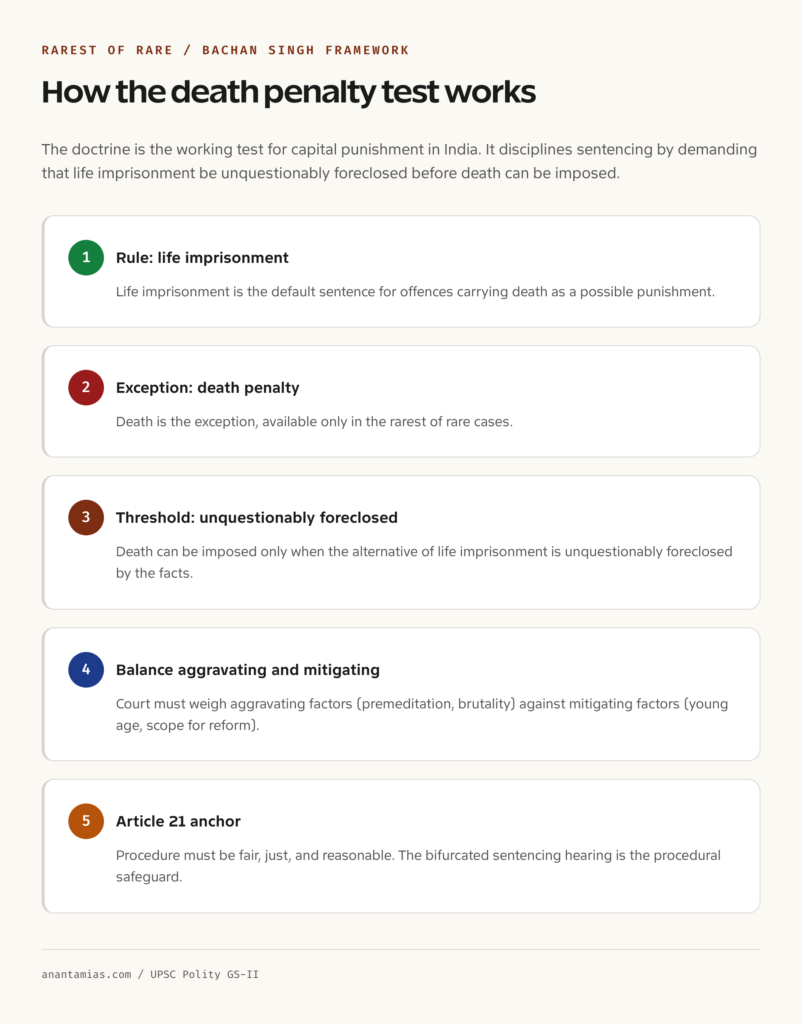
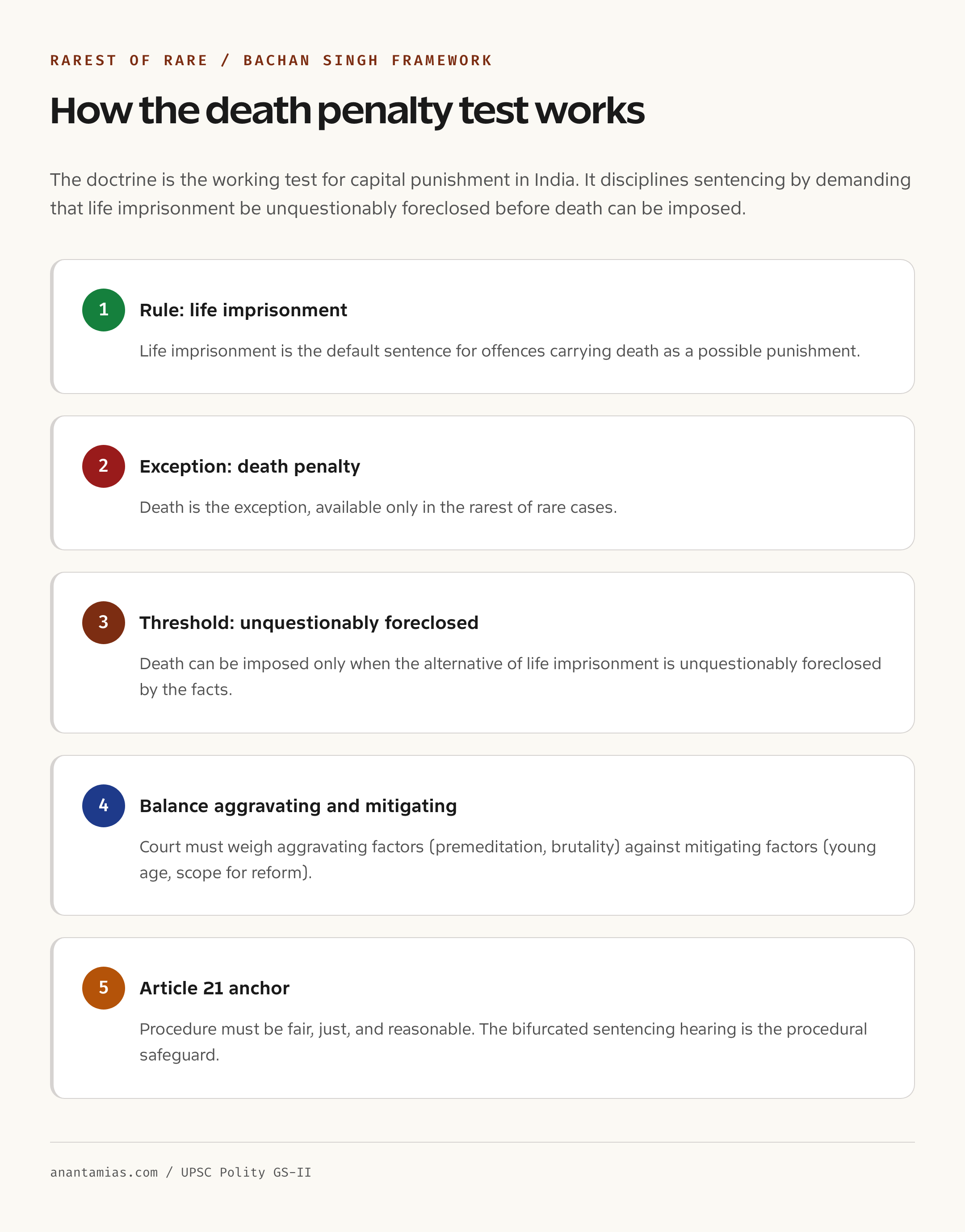
The rarest of rare doctrine is the working test for the death penalty in India. Every time a sessions court imposes capital punishment, every time a High Court confirms it, and every time the Supreme Court hears an appeal, the doctrine surfaces as the central constitutional discipline. It dictates that life imprisonment is the rule and death is the exception, that the exception applies only where life imprisonment is unquestionably foreclosed, and that judges must balance aggravating and mitigating circumstances on the record before reaching such a conclusion.
The doctrine has been in continuous use since 1980. Its source is Bachan Singh v. State of Punjab, decided by a Constitution Bench of the Supreme Court that upheld the constitutionality of the death penalty under Section 302 of the Indian Penal Code while building safeguards into how it can be imposed. Forty years on, with the Bharatiya Nyaya Sanhita, 2023 replacing the IPC, the doctrine continues to govern death penalty sentencing under the new code.
Recent cases keep the doctrine in public view. The Kolkata sessions court verdict in the Sanjay Roy case, where the trial judge convicted the accused for the rape and murder of a trainee doctor but declined to impose the death penalty, was a textbook application. The judge held that while the crime was heinous, it did not satisfy the rarest of rare threshold. This guide unpacks the framework, the line of precedents that built it, the BNS 2023 provisions in which capital punishment now lives, and the way the doctrine fits into the broader fundamental rights architecture.
The Origin: Bachan Singh v. State of Punjab
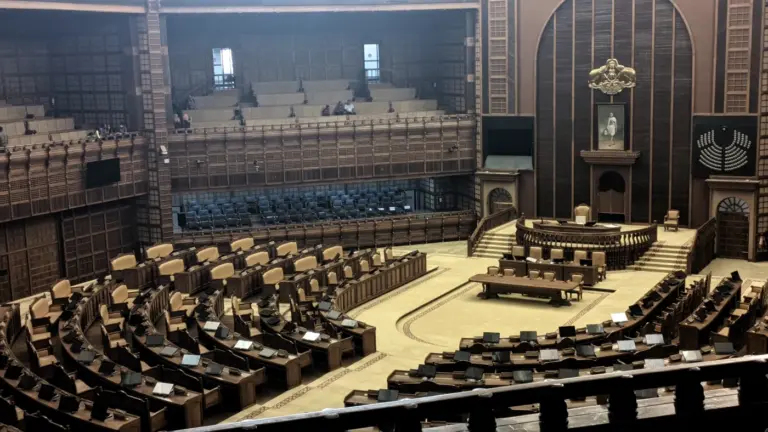
Bachan Singh v. State of Punjab (1980) was decided by a Constitution Bench of five judges, with a 4-1 majority. The case challenged the constitutional validity of the death penalty under Section 302 IPC and the procedural machinery in Section 354(3) of the Code of Criminal Procedure. The petitioners argued that the death penalty was a violation of Article 21 of the Constitution.
The majority upheld the constitutionality of capital punishment but read into the sentencing process a strict discipline. Justice Sarkaria, writing for the majority, framed the central principle in language that has been quoted in nearly every death penalty case since. Life imprisonment is the rule. Death is the exception. The death penalty is to be imposed only in the rarest of rare cases when the alternative option is unquestionably foreclosed.
The case did not freeze a list of factors. It expressly avoided rigid categories. Instead, it asked judges to weigh aggravating and mitigating circumstances and to ask themselves, after that weighing, whether life imprisonment could conceivably serve the ends of justice. If it could, death was off the table. If life imprisonment was so inadequate that the punishment would shock the collective conscience, only then could death be considered.
Building the Framework: Machhi Singh
Three years later, in Machhi Singh v. State of Punjab (1983), a three-judge bench attempted to translate the Bachan Singh principle into more workable categories. The judgment laid down five broad situations in which the rarest of rare threshold could be met. They covered manner of commission, motive, anti-social or socially abhorrent nature of crime, magnitude of crime, and personality of the victim.
The Machhi Singh categorisation was meant to guide rather than confine. Subsequent cases have repeatedly cautioned against treating it as a checklist. The Supreme Court has held that the categories are illustrative and that the underlying test remains the Bachan Singh balancing exercise. But the Machhi Singh structure has nevertheless become the default vocabulary of death penalty hearings, with prosecutors and defence counsel framing arguments around its categories.
The framework also asks judges to consider the question of reform. If the convict is capable of being reformed and rehabilitated, the death penalty is presumptively inappropriate. If reform is shown to be impossible, the State must demonstrate this on the record before death can be imposed. The burden therefore shifts to the prosecution at the sentencing stage in a way it does not at the conviction stage.
The Two-Stage Sentencing Process
The Code of Criminal Procedure, and now the BNSS, requires that the sentencing hearing be separate from the conviction hearing. The bifurcated process is a procedural safeguard built into the statute precisely to give the rarest of rare exercise its proper space. After the court has recorded a conviction, it must hear the accused on sentence. The hearing is not a formality.
The Supreme Court has insisted that mitigating circumstances be brought on the record. In Santosh Kumar Bariyar v. State of Maharashtra (2009), the Court ruled that any death sentence imposed without a meaningful sentencing hearing was suspect. Subsequent cases including Mohd. Mannan v. State of Bihar (2011) and Rajendra Pralhadrao Wasnik v. State of Maharashtra (2018) have reinforced the requirement of a full sentencing inquiry.
Material that the sentencing court must consider includes the convict’s age, social background, prior criminal record, conduct in custody, mental health, family circumstances, and any psychiatric or psychological evaluation. The defence is entitled to present this material through reports, witnesses, and submissions. The court must record reasons addressing each mitigating circumstance before holding that the case still meets the rarest of rare test.
Aggravating and Mitigating Factors
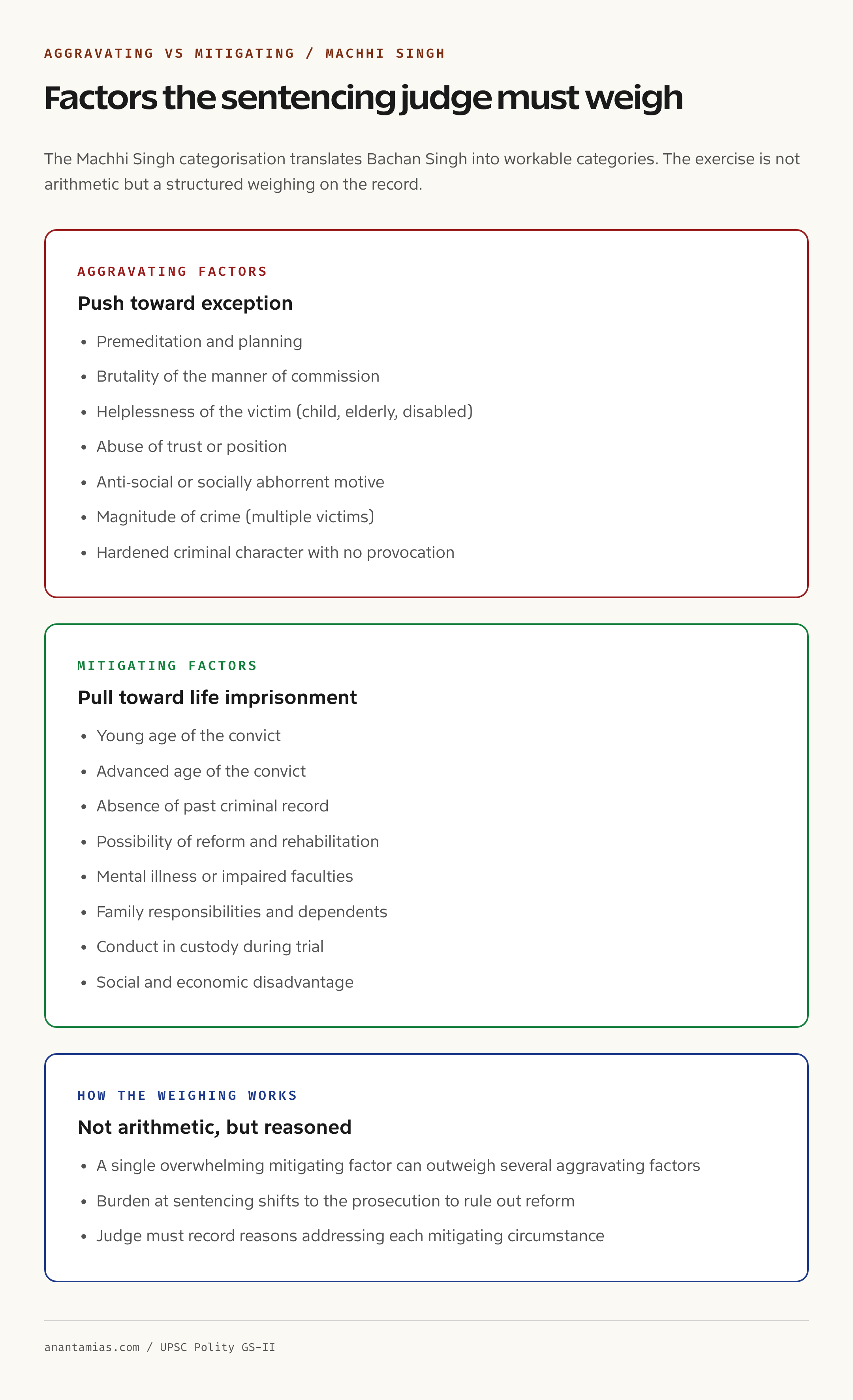
Aggravating factors typically include premeditation, brutality of the manner of commission, abuse of trust, the helplessness of the victim, the gravity of the consequences, evidence of a hardened criminal character, and the absence of any provocation. Mitigating factors include young age, advanced age, absence of past record, the possibility of reform, mental illness or impaired faculties, family responsibilities, conduct in custody, and the convict’s social and economic background.
The exercise is not arithmetic. The Supreme Court has emphasised that judges cannot simply count factors on each side. They must weigh them in the context of the case as a whole. A single overwhelming mitigating factor, such as proven mental illness at the time of the offence, can outweigh several aggravating factors. Equally, an aggravating factor such as evidence of cold premeditation can carry decisive weight even where mitigating factors are present.
The constitutional anchor of this exercise is Article 21. The right to life under Article 21 has been read to require that any deprivation of life through capital punishment must follow a procedure that is fair, just, and reasonable. The rarest of rare exercise is the procedural and substantive embodiment of that requirement.
Death Penalty Under the BNS 2023
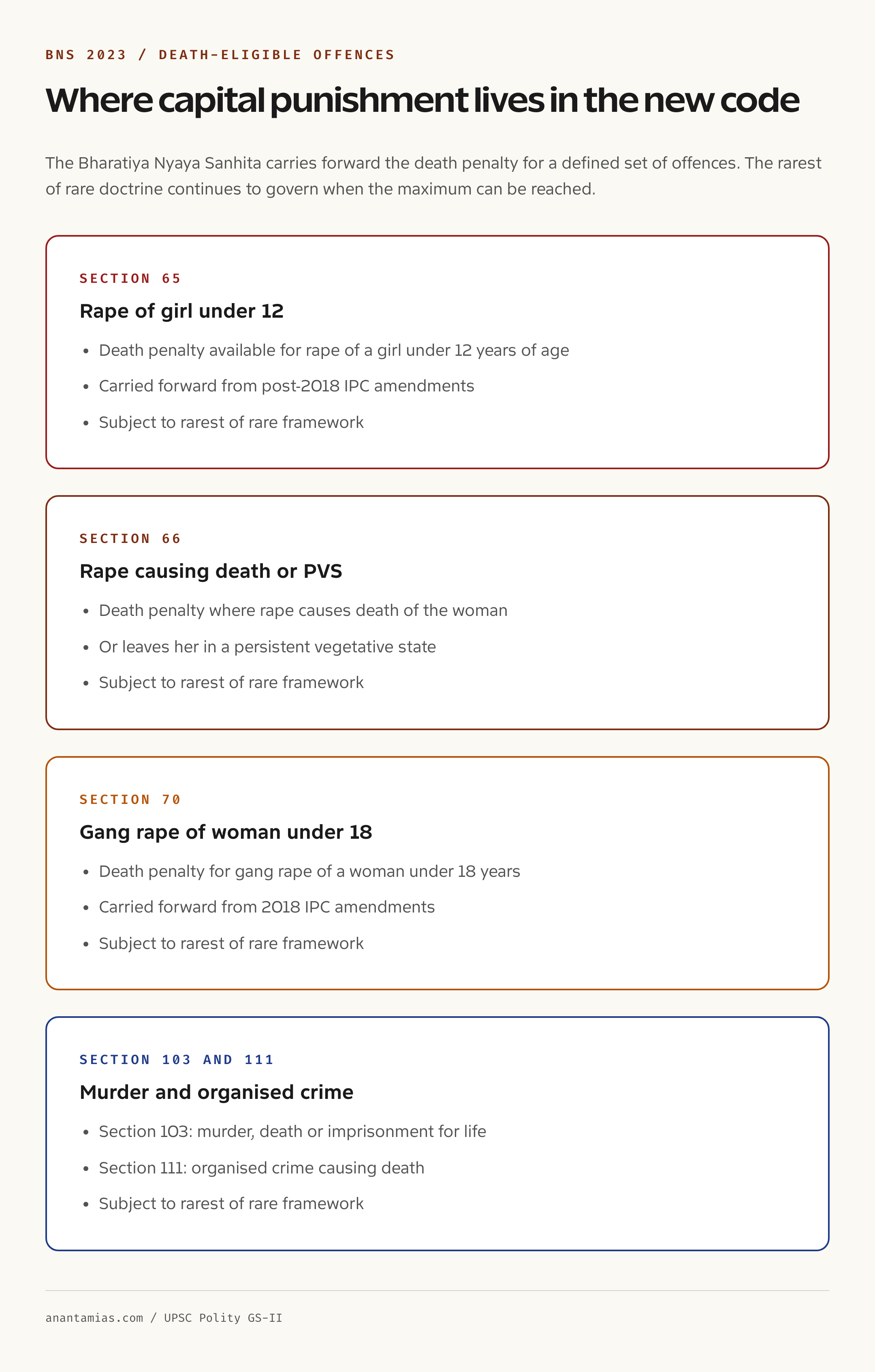
The Bharatiya Nyaya Sanhita, 2023 replaced the Indian Penal Code, 1860 with effect from 1 July 2024. It carries forward the death penalty for a defined set of offences. Section 103 of the BNS punishes murder and prescribes either death or imprisonment for life. Section 111 covers organised crime and provides for death where it results in death of any person. Sections 65, 66, and 70 deal with rape and provide for death penalty in specific aggravated circumstances.
Section 65 provides for the death penalty for rape of a girl under 12 years of age. Section 66 provides for the death penalty where rape causes the death of the woman or leaves her in a persistent vegetative state. Section 70 provides for the death penalty for gang rape of a woman under 18 years of age. These provisions echo and consolidate amendments that had been made to the IPC after the 2012 Nirbhaya case and the 2018 Kathua case.
The BNS does not change the rarest of rare framework. The framework is judge-made and constitutional, and it applies equally to convictions under the new code. A trial judge sentencing a convict under BNS Section 65 still has to apply Bachan Singh and Machhi Singh. The legislative provision merely sets the maximum punishment. The judicial doctrine controls when that maximum can be reached.
The Sanjay Roy Verdict and Doctrinal Application
The Kolkata sessions court verdict in the Sanjay Roy case applied the doctrine to one of the most publicised criminal trials of recent years. The accused was convicted for the rape and murder of a trainee doctor at R G Kar Medical College and Hospital. The prosecution sought the death penalty. The defence opposed it.
The trial judge held that while the offence was heinous and shocked the conscience, it did not meet the rarest of rare threshold. The judgment recorded that the convict had no prior criminal record, that there was scope for reform, and that the alternative of life imprisonment was not unquestionably foreclosed. The convict was sentenced to imprisonment for life.
The verdict drew predictable public criticism. Commentators argued that if a case as horrific as this did not meet the threshold, no case ever would. The legal answer is that the rarest of rare test is not a measure of public outrage. It is a structured judicial exercise. A judge applying the test correctly may reach a conclusion that does not match the public’s instinctive response. The doctrine is designed precisely to discipline that gap between public emotion and judicial reasoning.
Mercy Petition and Post-Conviction Review
A death sentence imposed by a trial court is not the end of the road. The convict can appeal to the High Court, and confirmation by the High Court is mandatory. From there the convict can move the Supreme Court. After the Supreme Court has confirmed the sentence, a curative petition lies. After that, the convict can file a mercy petition under Article 72 of the Constitution to the President of India and under Article 161 to the Governor.
The mercy petition layer sits outside the rarest of rare framework but performs a related function. It allows the executive to take into account considerations that may not have been before the courts, including humanitarian concerns and post-conviction conduct. The Supreme Court has held in Shatrughan Chauhan v. Union of India (2014) that excessive delay in deciding a mercy petition can itself be a ground for commutation, on the basis that prolonged death row uncertainty violates Article 21.
The rarest of rare doctrine and the mercy petition together form the two main checks on the actual execution of a death sentence. The first operates within the judicial process. The second operates within the constitutional executive process. Both are anchored in Article 21.
Comparison With Global Trends
India is one of a small group of large democracies that retain the death penalty. The European Union, the United Kingdom, Australia, and Canada have all abolished it. The United States retains it, with significant State-by-State variation. The United Nations General Assembly has repeatedly passed resolutions calling for a moratorium, with India voting against them.
Within retentionist countries, the rarest of rare doctrine is a distinctively Indian solution. Most retentionist jurisdictions either have a clearer statutory list of death-eligible offences or use jury sentencing with detailed instructions. India’s approach is to rely on a judicial doctrine that applies across all death-eligible offences and that asks judges to do most of the analytical work themselves. It is a high-trust model that depends on judicial training, careful sentencing hearings, and Supreme Court oversight.
UPSC Relevance and Likely Questions
The rarest of rare doctrine is central to GS Paper II questions on the judiciary, criminal justice reform, and constitutional rights. Prelims questions typically test the precedent name (Bachan Singh, year 1980, Section 302 IPC), the threshold phrase, and the BNS sections that allow death. Mains questions can ask candidates to discuss whether the doctrine is too vague, whether it has been consistently applied, or whether the death penalty should be retained.
A strong answer must reference Bachan Singh, the unquestionably foreclosed test, the bifurcated sentencing process, the Machhi Singh categories, and the constitutional anchor in Article 21. Discussion of the BNS provisions adds currency. Reference to the Sanjay Roy case and to the Mohd. Mannan and Santosh Bariyar lines of precedent demonstrates depth. Candidates can also gain marks by linking the doctrine to debates around abolition and reform of the criminal justice system.
Frequently Asked Questions
What is the rarest of rare doctrine?
The rarest of rare doctrine is the judicial test that governs the imposition of the death penalty in India. It holds that life imprisonment is the rule and death is the exception, and that death can be imposed only when the alternative of life imprisonment is unquestionably foreclosed.
Which case established the rarest of rare doctrine?
The doctrine was established by the Supreme Court in Bachan Singh v. State of Punjab (1980), a Constitution Bench decision that upheld the constitutional validity of the death penalty while building procedural and substantive safeguards into its imposition.
What does “unquestionably foreclosed” mean?
The phrase means that the option of life imprisonment is not adequate or appropriate in the case before the court. The judge must be satisfied, after balancing aggravating and mitigating factors, that no sentence short of death can serve the ends of justice.
What are aggravating and mitigating factors?
Aggravating factors include premeditation, brutality, and helplessness of the victim. Mitigating factors include young age, absence of past record, possibility of reform, and mental illness. The judge must weigh both before reaching a conclusion on sentence.
Does the BNS 2023 change the rarest of rare doctrine?
No. The Bharatiya Nyaya Sanhita, 2023 retains death penalty for offences such as murder, organised crime, and aggravated rape. The rarest of rare doctrine continues to apply because it is judge-made and constitutional, anchored in Article 21.
When can the death penalty be imposed for rape under the BNS?
Under the Bharatiya Nyaya Sanhita, 2023 the death penalty is possible for rape causing death or persistent vegetative state under Section 66, rape of a girl under 12 years under Section 65, and gang rape of a woman under 18 years under Section 70.
Tell Google you want more of this.
Add Anantam IAS as a preferred sourceOne tap, and this site shows up more often in your own Top Stories, AI Overviews and AI Mode. Remove it any time.