Syama Prasad Mookerjee: 125th birth anniversary of the Jana Sangh founder
Why in News?
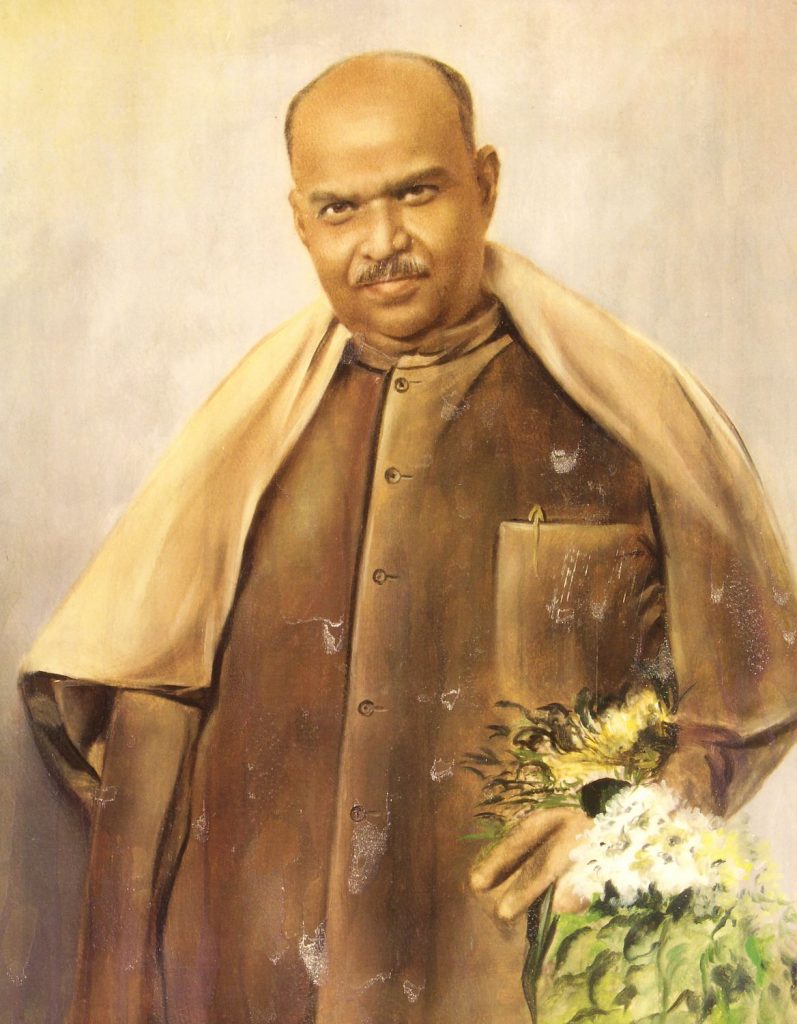
On 6 July 2026, India commemorated the 125th birth anniversary of Dr Syama Prasad Mookerjee (born 6 July 1901, Calcutta) — educationist, parliamentarian, the first Union Minister for Industry and Supply, and founder of the Bharatiya Jana Sangh.
PIB confirmed that the Prime Minister penned an op-ed on Mookerjee’s life and legacy, while Vice President C. P. Radhakrishnan paid floral tributes at Uprashtrapati Bhawan. Both described the 2019 abrogation of Articles 370 and 35A as a tribute to his lifelong campaign for the full integration of Jammu & Kashmir.
- The Prime Minister’s op-ed highlighted Mookerjee’s roles as educationist, Vice-Chancellor, Minister and political leader, and his push for national unity.
- Vice President C. P. Radhakrishnan called him “a distinguished educationist, visionary statesman and nation-builder” and said his sacrifice for unity “will never go unheeded”.
- The commemorations recalled that Mookerjee made the supreme sacrifice in Jammu & Kashmir — he died in detention in Srinagar on 23 June 1953 while agitating for the state’s full integration.
- Both offices framed the removal of Article 370 and Article 35A in 2019 as the fulfilment of his “one Constitution for one country” ideal.
The development matters in the context of:
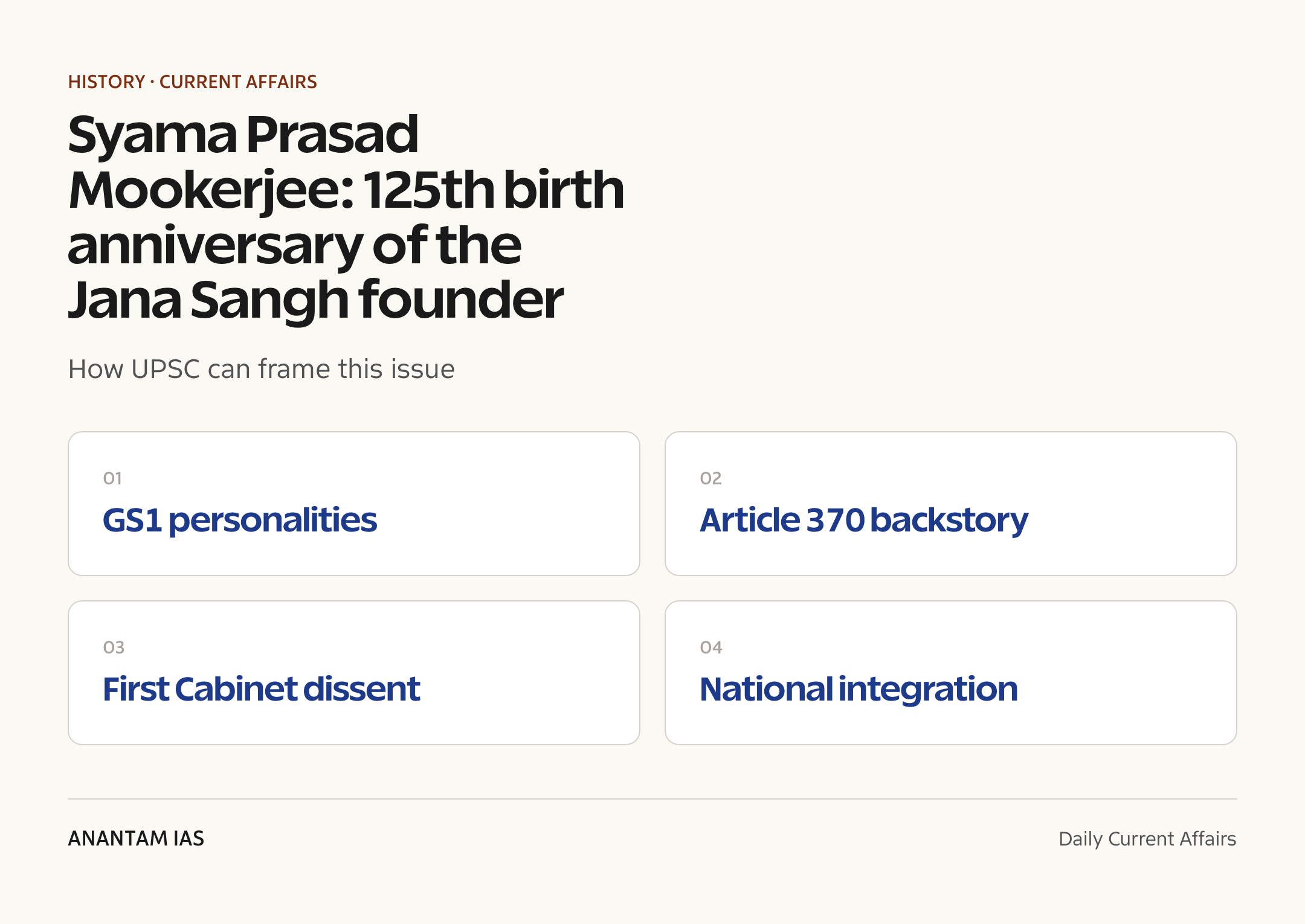
- Mookerjee is a personalities-in-news staple: UPSC regularly tests founders of political-ideological movements, members of the first Cabinet, and figures linked to national integration.
- His career connects three syllabus threads — modern Indian history (Bengal politics, Partition), post-independence consolidation (first Cabinet, J&K), and polity (Article 370 and its 2019 abrogation).
UPSC Relevance
Prelims Relevance
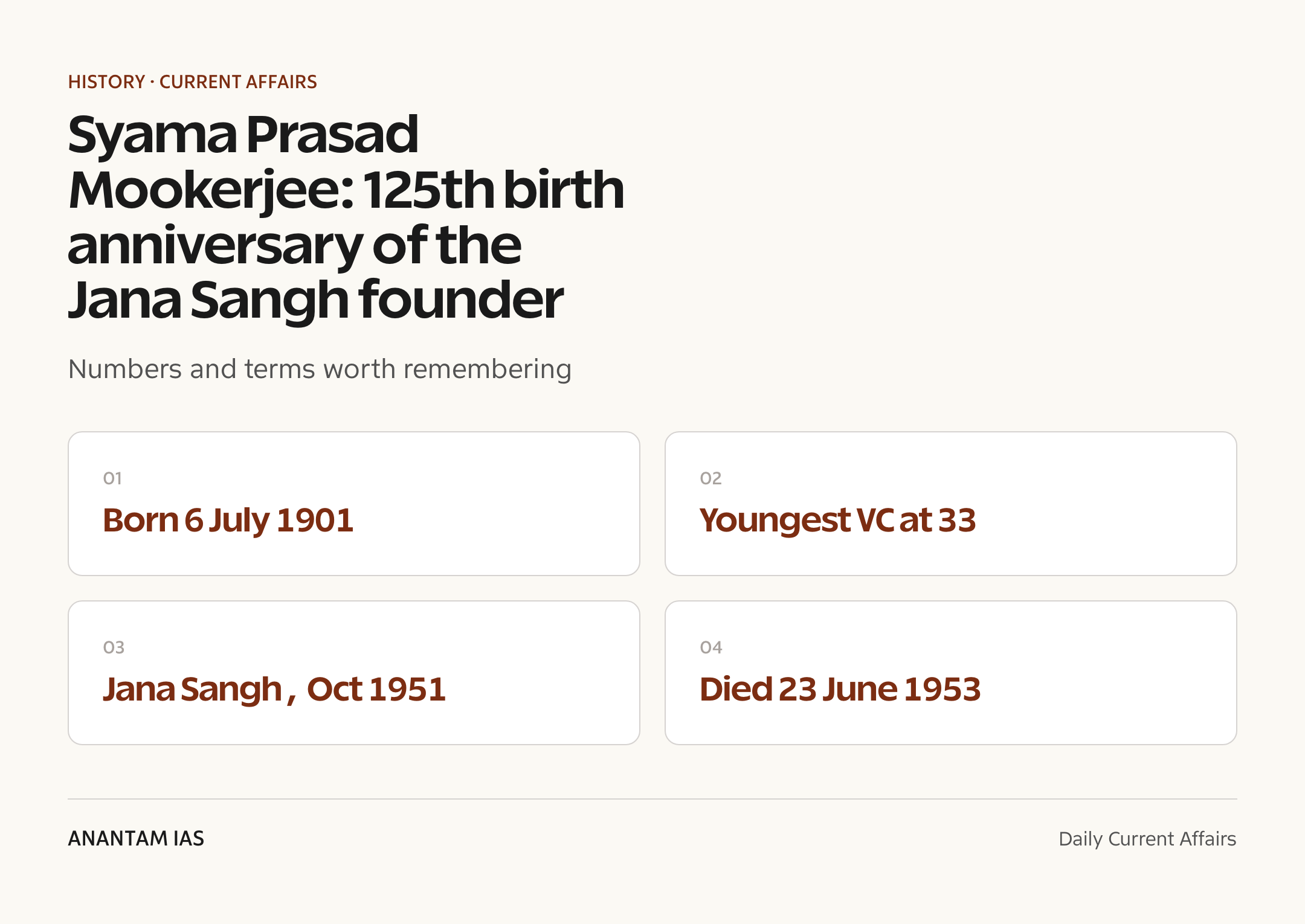
- Born 6 July 1901 in Calcutta; son of Sir Ashutosh Mookerjee, the celebrated judge and Vice-Chancellor of Calcutta University.
- Became the youngest Vice-Chancellor of Calcutta University in 1934, at age 33 (served till 1938).
- Served as Finance Minister of Bengal (1941–42) in A. K. Fazlul Huq’s Progressive Coalition ministry; later led the Akhil Bharatiya Hindu Mahasabha as its president.
- Member of the Constituent Assembly and independent India’s first Minister for Industry and Supply in the Nehru Cabinet.
- The Industrial Policy Resolution, 1948 — India’s first industrial policy, adopting the mixed-economy model — came during his tenure.
- Resigned from the Cabinet in April 1950 in protest against the Nehru–Liaquat Pact (Delhi Pact) on minority protection.
- Founded the Bharatiya Jana Sangh on 21 October 1951 in Delhi and became its first president; the party won 3 Lok Sabha seats in the 1952 elections.
- Gave the slogan “Ek desh mein do Vidhan, do Pradhan aur do Nishan nahi chalenge” against J&K’s separate constitution, premier and flag.
- Entered J&K without the then-mandatory permit; arrested on 11 May 1953; died in detention in Srinagar on 23 June 1953. The permit system was scrapped soon after.
- Legacy markers: Kolkata Port renamed Syama Prasad Mookerjee Port (2020); Shyama Prasad Mukherji Rurban Mission (2016).
Mains Relevance
GS Paper 1
- Personalities of the freedom struggle and post-independence consolidation — Mookerjee’s role in Bengal politics, the 1947 partition of Bengal, and the integration of J&K.
- The evolution of political ideologies in modern India — from the Hindu Mahasabha to the Bharatiya Jana Sangh as an alternative to Congress dominance.
GS Paper 2
- Article 370 and asymmetric federalism — the historical roots of the debate that culminated in the 2019 abrogation and the Supreme Court’s 2023 verdict upholding it.
- The first Cabinet as an experiment in consensus government — non-Congress ministers like Mookerjee and B. R. Ambedkar, and the norms of dissent and resignation.
Essay
- National unity and integrity as the first test of statecraft — “one Constitution, one flag” as an integrative ideal.
- Dissent within democratic institutions: when resignation becomes a form of principled politics.
Background and Context
Early Life and the Education Years
Mookerjee’s first career was academic, and it made him a national figure before politics did.
- Born on 6 July 1901 in Calcutta to Sir Ashutosh Mookerjee — the “Tiger of Bengal”, a Calcutta High Court judge and long-serving Vice-Chancellor of Calcutta University.
- Studied at Presidency College, Calcutta; enrolled as an advocate at the Calcutta High Court in 1924 and was called to the Bar from Lincoln’s Inn, England, in 1927.
- Appointed Vice-Chancellor of Calcutta University in 1934 at age 33 — the youngest in the university’s history — and served till 1938.
- As VC he promoted Bengali as a medium of instruction, examination reform and vernacular scholarship; Rabindranath Tagore delivered the university’s convocation address in Bengali during his tenure — a first.
- He remained a lifelong champion of indigenous education, an angle examiners pair with the National Education Movement of the freedom struggle era.
Bengal Politics: Legislature, Ministry and the Mahasabha
Between 1929 and 1947 Mookerjee moved from Congress-backed legislator to Bengal’s Finance Minister to a leading Hindu Mahasabha voice.
- Entered the Bengal Legislative Council in 1929 from the Calcutta University constituency as a Congress-backed candidate; resigned when Congress boycotted the legislature, and returned as an independent.
- Joined A. K. Fazlul Huq’s Progressive Coalition ministry as Finance Minister of Bengal (1941–42), and resigned within a year, protesting the colonial government’s repression and interference.
- Rose in the Akhil Bharatiya Hindu Mahasabha under V. D. Savarkar’s presidency and later served as the organisation’s president.
- Organised extensive relief work during the Bengal famine of 1943, one of the deadliest famines of colonial India.
- In 1947 he argued for the partition of Bengal so that a Hindu-majority West Bengal would remain with India — a decisive intervention in the province’s fate, read alongside the 1905 partition of Bengal for contrast.
In the First Cabinet: Industry and Supply
Nehru inducted Mookerjee into free India’s first Cabinet as a non-Congress minister — part of the early consensus model of governance.
- Served as a member of the Constituent Assembly that drafted the Constitution (see how representative the Assembly was).
- As the first Minister for Industry and Supply, he presided over the Industrial Policy Resolution of 1948 — the founding document of India’s mixed economy, reserving core sectors for the State while retaining private enterprise.
- Flagship public-sector projects took shape in his tenure, including the Chittaranjan Locomotive Works, the Sindri fertiliser factory and the expansion of Hindustan Aircraft Factory (Bengaluru).
- He resigned on principle in April 1950, rejecting the Nehru–Liaquat Pact, which relied on Pakistan’s assurances to protect minorities in East Bengal after large-scale communal violence and migration.
- The resignation is a classic study in Cabinet dissent: a minister leaving office over policy disagreement rather than office-holding.
Founding the Bharatiya Jana Sangh
Out of the Cabinet, Mookerjee built a new opposition party that would become the ideological ancestor of today’s ruling party.
- After consultations with M. S. Golwalkar of the RSS, he founded the Bharatiya Jana Sangh (BJS) on 21 October 1951 in Delhi and became its first president.
- The party stood for national unity, a single citizenship-and-Constitution framework, and swadeshi economics; a young Deendayal Upadhyaya was among its earliest organisers.
- In the first general elections (1951–52) the BJS won 3 Lok Sabha seats; Mookerjee himself won from Calcutta South-East.
- Inside Parliament he stitched together the National Democratic Party, a small opposition bloc, and earned a reputation as one of the sharpest critics of the treasury benches.
- The BJS merged into the Janata Party in 1977; its successors regrouped as the Bharatiya Janata Party in 1980 — the lineage examiners expect you to know.
Kashmir, Article 370 and the Final Agitation
Mookerjee’s last campaign targeted J&K’s special arrangements — a separate constitution, a separate flag and a ‘Prime Minister’ — under Article 370.
- Article 370 gave Jammu & Kashmir a special status: its own constituent assembly, flag and a head of government styled Prime Minister (Wazir-e-Azam); entry into the state needed a permit.
- Mookerjee backed the Praja Parishad movement in Jammu, led by Prem Nath Dogra, which demanded the state’s full merger with India.
- His slogan — “Ek desh mein do Vidhan, do Pradhan aur do Nishan nahi chalenge” (one country cannot have two constitutions, two premiers and two flags) — became the campaign’s rallying cry.
- On 11 May 1953 he crossed into J&K at Lakhanpur without a permit, courting arrest; he was detained in Srinagar.
- He died in custody on 23 June 1953; the demand for an independent inquiry into his death was never conceded. The permit system was abolished soon after, and the offices of Sadar-i-Riyasat and Prime Minister of J&K were replaced by Governor and Chief Minister in 1965.
- PIB noted that both the Prime Minister and the Vice President now present the 2019 abrogation of Articles 370 and 35A — upheld by the Supreme Court in 2023 — as the completion of his unfinished agenda.
Legacy and Memorialisation
The commemorations sit within a wider official effort to memorialise Mookerjee’s contributions.
- Kolkata Port Trust was renamed Syama Prasad Mookerjee Port in 2020 — one of India’s 12 major ports.
- The Shyama Prasad Mukherji Rurban Mission (SPMRM), 2016 develops rural clusters with urban amenities — a frequently tested scheme name.
- Institutions from research foundations to Delhi’s civic infrastructure carry his name; his birth anniversary is observed with official tributes across ministries.
- For revision, place him in your modern history personalities chart alongside first-Cabinet colleagues like B. R. Ambedkar and Sardar Patel.
Way Forward
How to Study a Personality in News
- Build a five-row snapshot: birth/death dates, offices held, organisations founded, signature policy or slogan, and legacy schemes named after the person.
- Link the personality to durable syllabus anchors — here, Article 370, the Industrial Policy Resolution 1948, the Nehru–Liaquat Pact and post-independence political consolidation.
- Track official commemoration language (PIB op-eds, tributes): it signals the angles — national integration, education, institution-building — that surface in both Prelims statements and Mains value-addition.
For Mains, use Mookerjee sparingly and precisely: as an example of principled Cabinet dissent (GS2), of the integration debate over J&K (GS1/GS2), and of early public-sector institution-building (GS3 economic history). One accurate line beats a paragraph of rhetoric.
Conclusion
Syama Prasad Mookerjee packed several public lives into 51 years — the youngest Vice-Chancellor of Calcutta University, Bengal’s Finance Minister, a Constituent Assembly member, free India’s first Industry and Supply Minister, and the founder of the Bharatiya Jana Sangh.
His 125th jayanti matters for the exam because his biography is a map of early-republic fault lines: minority protection after Partition, the design of industrial policy, and the constitutional status of Jammu & Kashmir. The official framing of the 2019 Article 370 abrogation as his tribute makes the history-polity connection unusually current.
UPSC Practice Questions
Prelims MCQ 1
With reference to Dr Syama Prasad Mookerjee, consider the following statements:
- He was the youngest Vice-Chancellor of Calcutta University.
- He resigned from the Union Cabinet in protest against the Nehru–Liaquat Pact of 1950.
- He founded the Akhil Bharatiya Hindu Mahasabha.
How many of the above statements are correct?
(a) Only one (b) Only two (c) All three (d) None
Answer: (b) Only two
Explanation:
Statements 1 and 2 are correct — he became Calcutta University’s youngest VC in 1934 at 33, and quit Nehru’s Cabinet in April 1950 over the Delhi (Nehru–Liaquat) Pact. Statement 3 is wrong: the Hindu Mahasabha predates him (founded 1915); Mookerjee later served as its president, not founder.
Prelims MCQ 2
The slogan “Ek desh mein do Vidhan, do Pradhan aur do Nishan nahi chalenge” was raised against which of the following arrangements?
(a) The princely states retaining separate armies after accession (b) Jammu & Kashmir’s separate constitution, flag and head of government under Article 370 (c) The continuation of separate electorates after independence (d) The division of India and Pakistan into two dominions
Answer: (b) Jammu & Kashmir's separate constitution, flag and head of government under Article 370
Explanation:
Syama Prasad Mookerjee coined the slogan against J&K’s special arrangements — its own constitution (Vidhan), a ‘Prime Minister’ (Pradhan) and a separate flag (Nishan) — during the Praja Parishad agitation of 1952–53.
UPSC Mains Questions
- Syama Prasad Mookerjee’s public life spanned education, industry and the politics of national integration. Examine his contribution to institution-building in the first decade of the Indian republic. (250 words)
- The first Union Cabinet accommodated ministers from outside the Congress, yet several of them resigned over policy differences. Discuss what these resignations reveal about consensus and dissent in early Indian democracy. (250 words)
Sources: PIB, Prime Minister's Office and PIB, Vice President's Secretariat.
Frequently Asked Questions
Who was Syama Prasad Mookerjee?
An educationist and political leader (1901–1953): the youngest Vice-Chancellor of Calcutta University, Bengal’s Finance Minister, a Constituent Assembly member, independent India’s first Minister for Industry and Supply, and founder of the Bharatiya Jana Sangh in 1951.
Why is 6 July 2026 significant for him?
It marks his 125th birth anniversary. The Prime Minister published an op-ed on his legacy and Vice President C. P. Radhakrishnan paid floral tributes, with PIB releases framing the 2019 Article 370 abrogation as a tribute to his ideals.
Why did Mookerjee resign from Nehru’s Cabinet?
He resigned in April 1950 in protest against the Nehru–Liaquat Pact, which depended on Pakistan’s assurances to protect minorities in East Bengal. He believed the pact offered no credible safeguard after the communal violence and refugee influx of 1950.
What was the Bharatiya Jana Sangh?
A political party Mookerjee founded on 21 October 1951 in Delhi after consulting RSS chief M. S. Golwalkar. It championed national unity and one Constitution for all of India, won 3 Lok Sabha seats in 1952, and is the ideological forerunner of the BJP.
How did Mookerjee die?
He entered Jammu & Kashmir without the then-required permit on 11 May 1953 to protest the state’s special status, was arrested, and died in detention in Srinagar on 23 June 1953. No independent inquiry into his death was held.
What is his connection to Article 370?
He led the national campaign against J&K’s separate constitution, flag and premier under Article 370, coining the slogan ‘Ek desh mein do Vidhan, do Pradhan aur do Nishan nahi chalenge’. The 2019 abrogation is officially presented as the completion of that campaign.