Disclosure: this guide contains Amazon affiliate links. As an Amazon Associate, Anantam IAS earns from qualifying purchases — at no extra cost to you.
You searched for Article 370 of Indian Constitution because you want one place that ties together the 1949 origin, the 2019 abrogation, and the 2023 Supreme Court verdict — without the noise. Most coaching notes still treat Article 370 as a “temporary provision” and stop there… that reading is incomplete, and after In Re: Article 370 (Dec 11, 2023), legally wrong. I’ve watched aspirants lose Mains marks on this because they wrote 2019 facts but missed the SC’s reasoning on Article 370(3). This article fixes that — chronology, provisions, abrogation mechanics, and the basic-structure analysis the bench actually used.
What is Article 370 of the Indian Constitution?
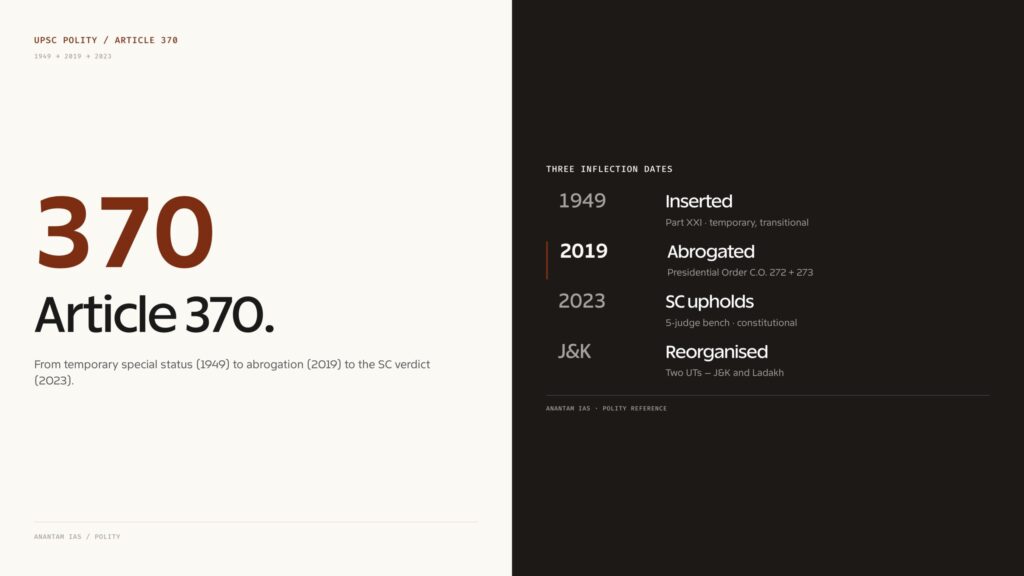
Article 370 was a provision in Part XXI of the Indian Constitution that gave the former state of Jammu & Kashmir special autonomous status — its own constitution, flag, and limited application of central laws. It was added on October 17, 1949 by N. Gopalaswami Ayyangar as a “temporary, transitional, and special” provision. It was abrogated on August 5–6, 2019, and the Supreme Court upheld that abrogation on December 11, 2023 in In Re: Article 370 of the Constitution.
Three quick triples to anchor the rest of this guide:
- Article 370 — Part XXI — temporary, transitional, special provision for J&K (1949).
- Article 370(3) — gave the President power to declare Article 370 inoperative on the recommendation of J&K’s Constituent Assembly.
- In Re: Article 370 (2023) — five-judge bench, unanimous — held that the President’s power survived the dissolution of the J&K Constituent Assembly in 1957.
Constitutional basis — how Article 370 actually worked
Read the bare text first. Article 370 had three operative clauses.
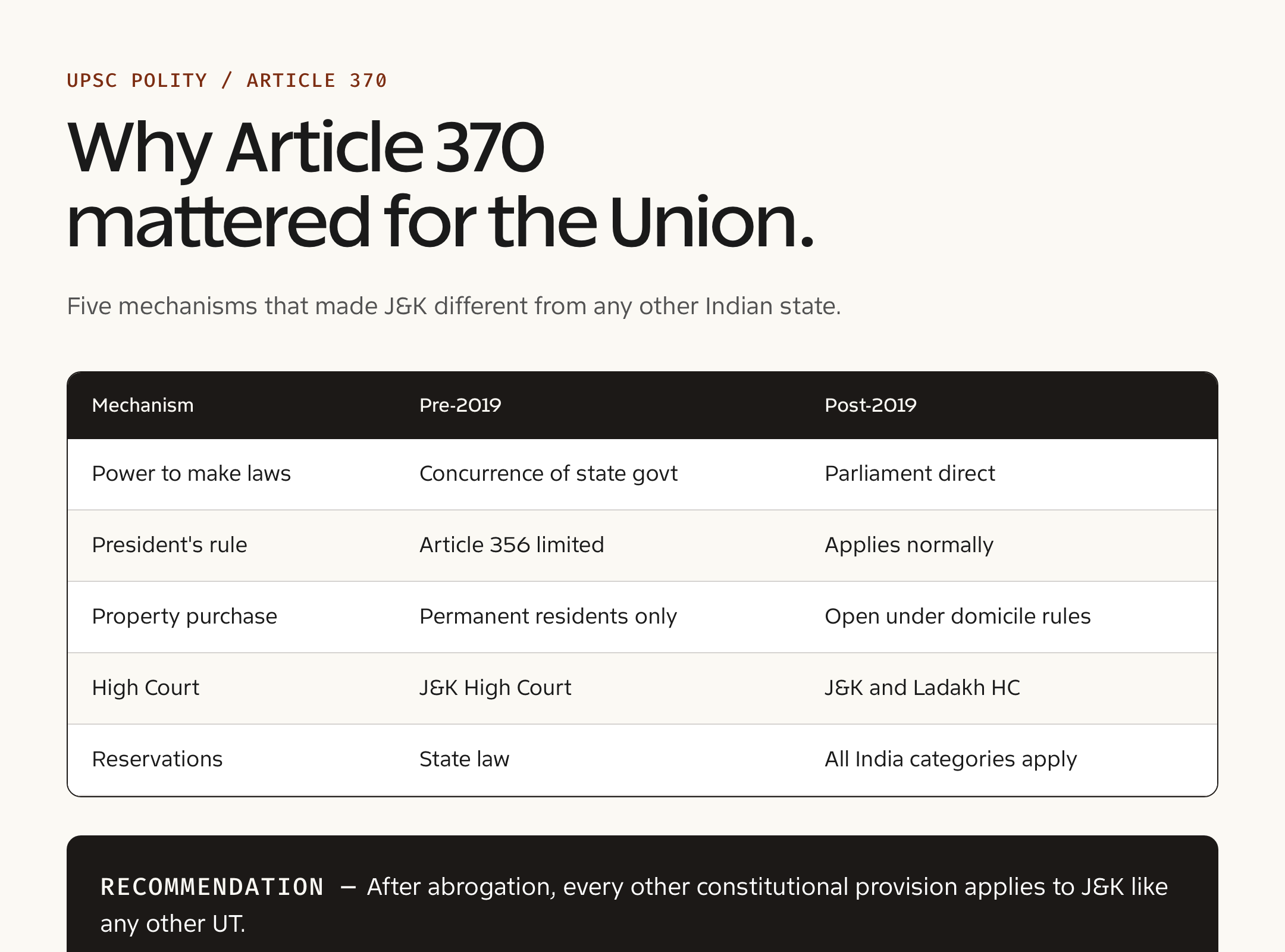
- Article 370(1)(a) — Article 1 (which lists J&K in the First Schedule) and Article 370 itself applied to J&K. Everything else from the Indian Constitution applied only with the President’s order, in consultation or concurrence with the J&K government.
- Article 370(1)(b) — Parliament’s law-making power over J&K was limited to Defence, External Affairs, and Communications (the three subjects in the Instrument of Accession).
- Article 370(3) — The President could, by public notification, declare Article 370 inoperative or operative only with such modifications, on the recommendation of the Constituent Assembly of J&K.
That last clause is the one the 2023 verdict turned on… hold that thought.
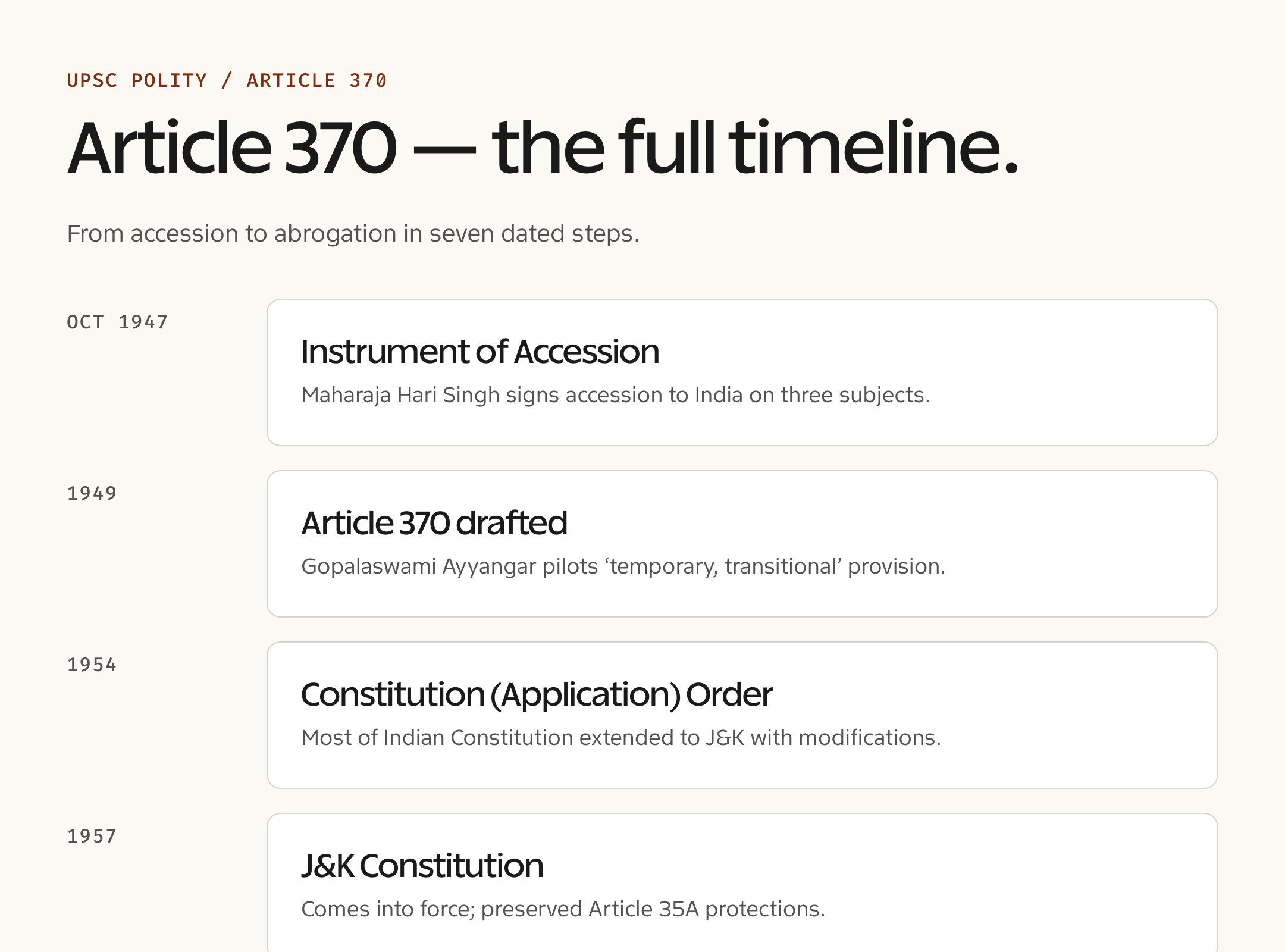
The Maharaja of J&K, Hari Singh, signed the Instrument of Accession on October 26, 1947. Unlike most princely states that signed the standard Instrument and merged unconditionally, J&K’s accession was conditional — only on those three subjects. Article 370 was the constitutional bridge that let J&K integrate at its own pace.
Then came the Constitution (Application to Jammu and Kashmir) Order, 1954 under Article 370(1). This is the order that did the heavy lifting for 65 years. It extended most of the Indian Constitution to J&K with modifications — and it inserted Article 35A, which let the J&K legislature define “permanent residents” and reserve land, jobs, and scholarships for them.
Look — the architecture was simple, really… Article 370 was the door. Presidential orders under 370(1) were the keys. Article 35A and the J&K Constitution (1957) were what walked through that door.
What changed on August 5–6, 2019
Two presidential orders, one resolution, one Act. That’s the whole abrogation in four moves.
- CO 272 (Aug 5, 2019) — Constitution (Application to J&K) Order, 2019. Issued by President Ram Nath Kovind under Article 370(1). It superseded the 1954 Order and applied the entire Indian Constitution to J&K. Crucially, it amended Article 367 (interpretation clause) so that the reference to “Constituent Assembly of J&K” in Article 370(3) would now read “Legislative Assembly of J&K”. Since J&K was under President’s Rule, the Governor stood in for the Legislative Assembly.
- Statutory Resolution (Aug 5, 2019) — Both Houses of Parliament passed a resolution under Article 370(3) recommending that the President declare Article 370 inoperative.
- CO 273 (Aug 6, 2019) — Issued under Article 370(3). It declared that all clauses of Article 370 ceased to operate, except Clause (1) — which was amended to say “all provisions of the Indian Constitution apply to J&K”.
- J&K Reorganisation Act, 2019 — Passed by Parliament. It bifurcated the state into two Union Territories: J&K (with legislature) and Ladakh (without). It came into force on October 31, 2019.
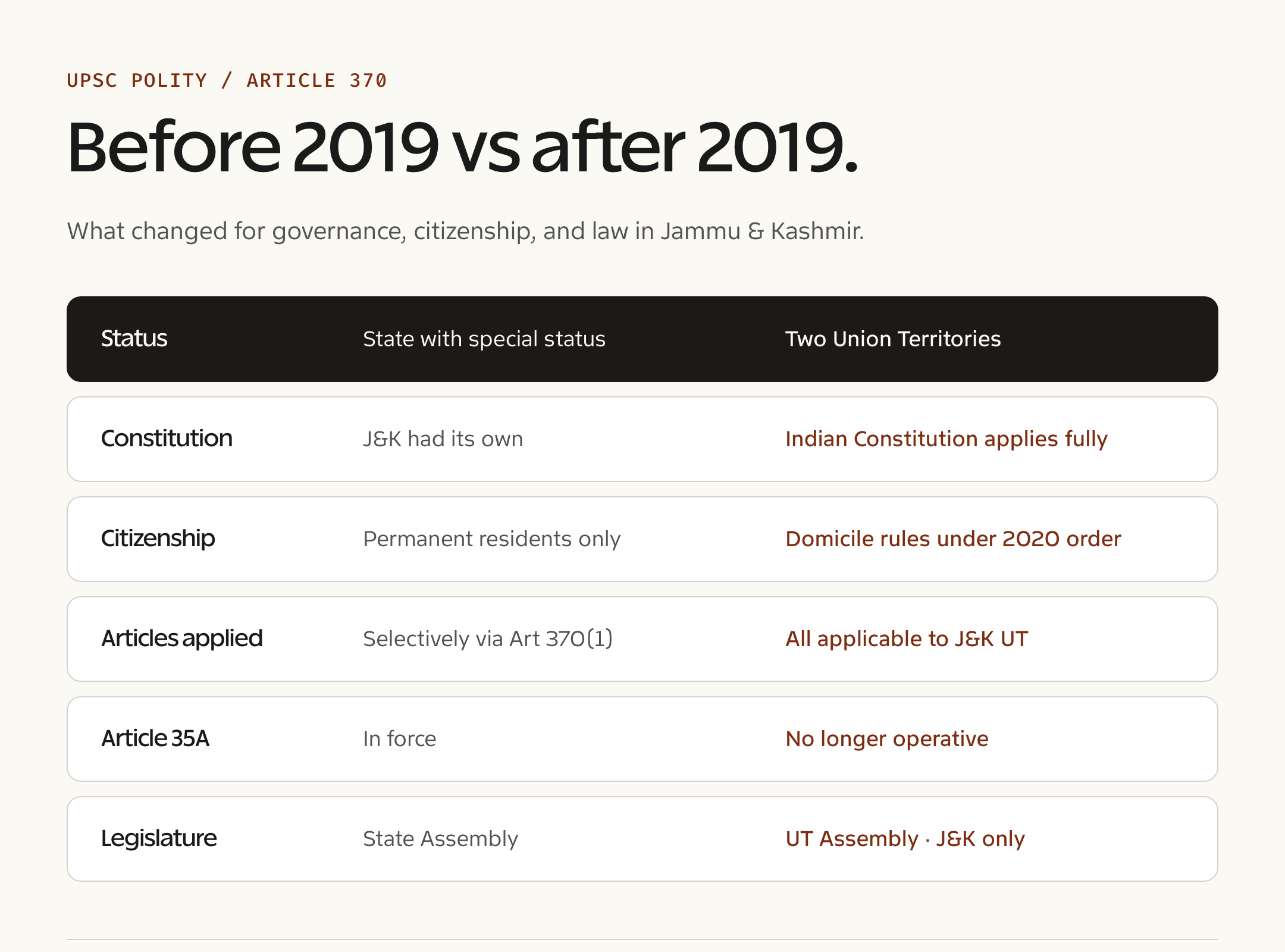
Critics challenged all four moves. They argued: you can’t use Article 370(1) to amend Article 370(3); the J&K Constituent Assembly was dissolved in 1957, so its “recommendation” was forever unavailable, freezing Article 370 in place; bifurcating a state into UTs needs the state legislature’s consultation under Article 3, not the Governor’s say-so during President’s Rule.
Honestly… on a plain reading those arguments aren’t frivolous. Which is why the verdict matters so much.
In Re: Article 370 of the Constitution — what the SC actually held (Dec 11, 2023)
Five judges. CJI D.Y. Chandrachud, Justices S.K. Kaul, Sanjiv Khanna, B.R. Gavai, Surya Kant. Three concurring opinions. Unanimous outcome.
The bench upheld the abrogation. Here’s the reasoning, stripped down:
- No internal sovereignty for J&K. The Maharaja’s Proclamation (Nov 1949) and the J&K Constitution surrendered any residual sovereignty. J&K, post-accession, never had sovereignty independent of India. The “special arrangement” was administrative, not sovereign.
- Article 370 was always temporary. The marginal note says “Temporary Provisions”. Its placement in Part XXI (Temporary, Transitional and Special Provisions) confirms it. The court rejected the petitioners’ argument that the dissolution of the Constituent Assembly made Article 370 permanent.
- Article 370(3) survives the Constituent Assembly. The proviso to 370(3) said the President shall act “on the recommendation” of the Constituent Assembly — but once that body dissolved in 1957, the President’s underlying power (the substantive part of 370(3)) continued. The recommendation requirement became inoperative, not the power itself.
- CO 273 was valid. The President was within power to issue CO 273 declaring Article 370 inoperative.
- CO 272 was problematic but the result stood. The court held that using Article 367 to amend Article 370 (the route CO 272 took) was an impermissible “exercise of power through the back door”. But because CO 273 directly invoked 370(3) and produced the same outcome, the abrogation survived.
- Reorganisation question deferred. The constitutionality of converting a state into UTs under Article 3 was not decided — the court accepted the Solicitor General’s assurance that statehood would be restored “at the earliest”.
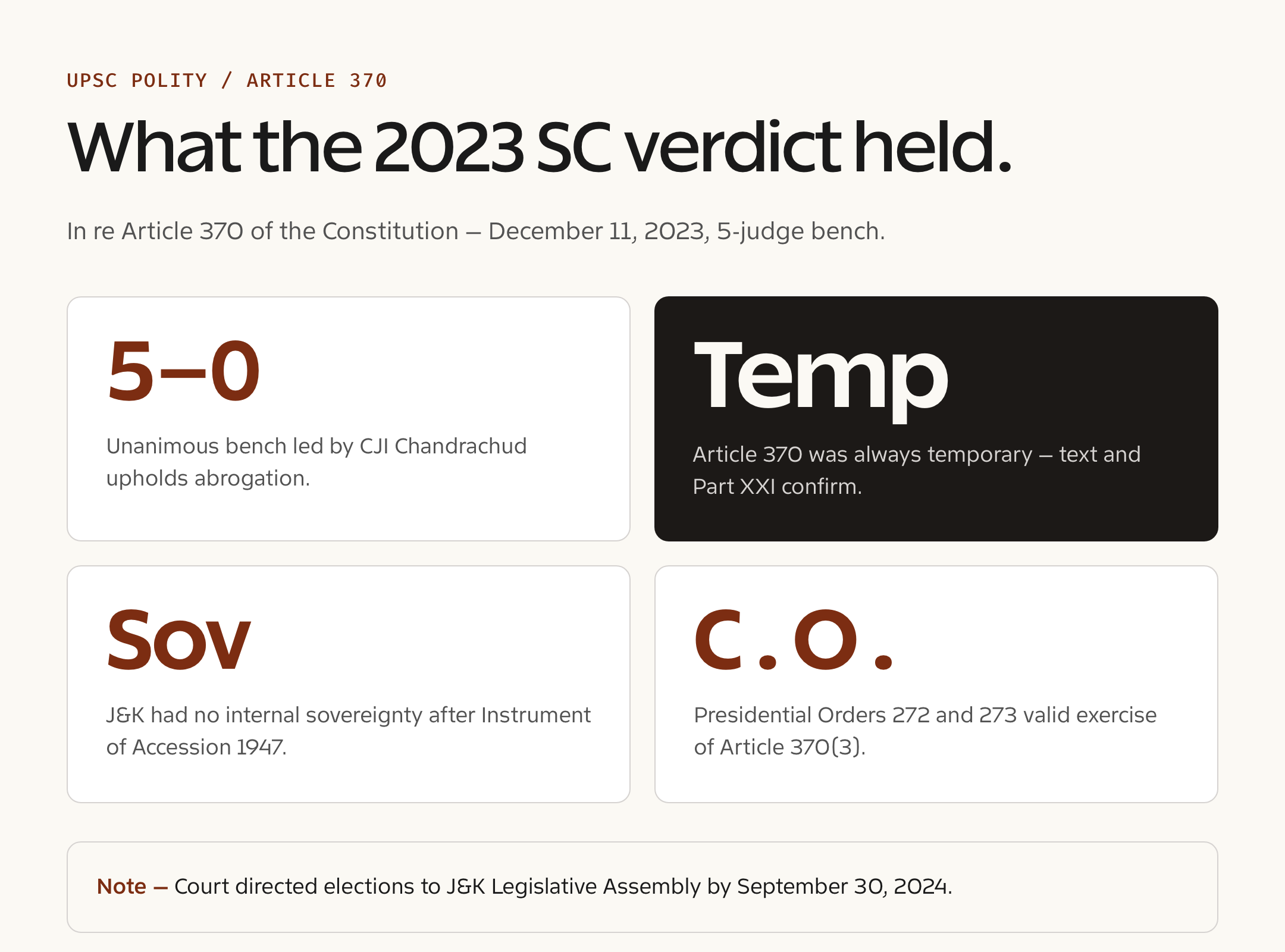
The court also directed the Election Commission to hold J&K Assembly elections by September 30, 2024 — a deadline the ECI met. Polling was held in three phases (Sep 18, Sep 25, Oct 1, 2024) and a coalition government took office on October 16, 2024.
Article 370 vs Article 35A — don’t confuse them
Examiners love this overlap. Two distinct provisions, two different legal effects.
| Feature | Article 370 | Article 35A |
|---|---|---|
| Inserted | 1949 (original Constitution) | 1954 (Presidential Order) |
| Source | Constituent Assembly | Article 370(1)(d) order |
| Function | Special autonomous status for J&K | Defined “permanent residents” + reserved rights |
| Key power | Limited Parliament’s law-making over J&K | Empowered J&K legislature on residency |
| Status post-2019 | Inoperative (except Clause 1) | Repealed via CO 272 |
Why this matters for UPSC
Article 370 shows up in every paper. Be ready for it specifically.
- Prelims — Direct factual MCQs. Year of insertion (1949), Part of Constitution (XXI), date of abrogation (Aug 5–6, 2019), date of SC verdict (Dec 11, 2023). UPSC has asked Article 370 questions in 2019, 2020, and 2024.
- Mains GS-II — Federalism, asymmetric federalism, special status states. Compare with Articles 371, 371A–J. The 2023 verdict is now standard answer material.
- Mains GS-III — Internal security in J&K, post-2019 governance, statehood restoration debate.
- Essay — “Federalism in India” / “Constitution as a living document”.
- Interview — Expect at least one J&K question if you put Polity as an optional anchor.
Common misconceptions
Most coaching notes get one or more of these wrong. Don’t be that aspirant.
- “Article 370 was permanent.” No. The marginal note, the Part XXI placement, and the SC’s 2023 reasoning all confirm temporariness.
- “Article 35A was in the Constitution itself.” No. Article 35A was inserted by a 1954 Presidential Order under Article 370(1)(d) — never debated by Parliament.
- “The 2023 verdict is about whether abrogation was correct.” Not exactly. The court ruled on whether the process was constitutional. It didn’t pronounce on policy wisdom.
- “J&K is now a state.” Not yet. As of April 2026, J&K remains a Union Territory with a Legislative Assembly. Statehood restoration was promised but not enacted.
- “Ladakh was always a separate UT.” No. Ladakh became a separate UT only on October 31, 2019, via the J&K Reorganisation Act.
How to revise this in 30 minutes
Source priority. Use this order, not whatever pops up first on YouTube.
- Laxmikanth (7th ed) — Chapter on “Special Provisions for Some States” + the dedicated J&K section. Read once.
- PRS Legislative Brief on the J&K Reorganisation Act, 2019 — Five pages. Sharpest summary of the four-move abrogation.
- Supreme Court Observer’s Abrogation of Article 370 judgement summary — The cleanest plain-language read of the 2023 verdict.
- Indian Express explainer on the Dec 11, 2023 ruling — For Mains-quality phrasing.
- PIB release on J&K elections (Oct 2024) — For the post-verdict timeline.
Skip the news-channel debates… they confuse the constitutional question with the political one.
Frequently Asked Questions
When was Article 370 added to the Constitution?
Article 370 was added on October 17, 1949, just before the Constitution was adopted on November 26, 1949. It came into force on January 26, 1950.
Was Article 370 a temporary provision?
Yes. Its marginal heading reads u0022Temporary Provisions with respect to the State of Jammu and Kashmiru0022 and it sits in Part XXI titled u0022Temporary, Transitional and Special Provisionsu0022. The Supreme Court reaffirmed this in 2023.
Who abrogated Article 370 and how?
The President of India, on the recommendation of Parliament, used Article 370(3) to issue Constitutional Order 273 on August 6, 2019, declaring Article 370 inoperative.
Did the Supreme Court strike down anything in the 2019 abrogation?
The court held that using Article 367 to amend Article 370 (CO 272’s route) was impermissible — but it didn’t matter, because CO 273 directly invoked Article 370(3) and produced a valid outcome.
Is Jammu and Kashmir still a Union Territory in 2026?
Yes. As of April 2026, J&K remains a Union Territory with a Legislative Assembly. Ladakh remains a UT without a legislature. Statehood restoration is pending.
What happened to Article 35A?
Article 35A was effectively repealed via CO 272 (Aug 5, 2019), since the 1954 order that inserted it was superseded.
What is the basic structure argument against Article 370 abrogation?
Petitioners argued that asymmetric federalism — including J&K’s special status — was part of the basic structure under Kesavananda Bharati. The 2023 bench rejected this, holding J&K never had sovereignty independent of India.
Tell Google you want more of this.
Add Anantam IAS as a preferred sourceOne tap, and this site shows up more often in your own Top Stories, AI Overviews and AI Mode. Remove it any time.