Disclosure: this guide contains Amazon affiliate links. As an Amazon Associate, Anantam IAS earns from qualifying purchases — at no extra cost to you.
Introduction
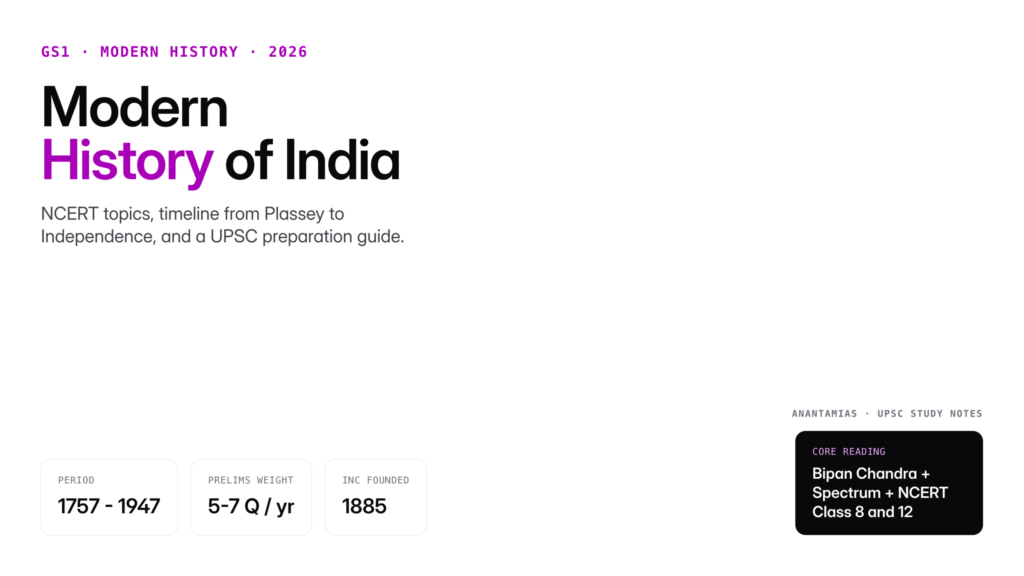
The modern history of India is the story of how a subcontinent stitched together by regional kingdoms, trading corporations, and ancient civilisational memory became a modern nation-state. For the UPSC aspirant, this is the single most examined strand inside GS1, because it carries both Prelims factual weight and Mains analytical depth. From the Battle of Plassey in 1757 to Independence in 1947, almost every Prelims paper since 2013 has pulled between four and seven questions from this window.
Yet modern history is more than dates and viceroys. It is the arc of how extractive colonial economies produced famines, how print capitalism built a vernacular public, how the Indian National Congress evolved from a moderate petitioning body into a mass movement, and how tribal revolts like the Santhal Hool of 1855 punctured the myth that resistance began only with the educated middle class. This guide maps the full syllabus, the NCERT chapters that matter, the must-read sources, and a preparation strategy that moves from chronology to cause-and-effect.
Quick Facts at a Glance
| Aspect | Detail |
|---|---|
| Conventional start year | 1757 (Battle of Plassey) |
| End year | 1947 (Independence and Partition) |
| Governor-General system introduced | 1773 (Regulating Act) |
| Crown rule begins | 1858 (Government of India Act) |
| INC founded | 28 December 1885, Bombay |
| First mass movement | Non-Cooperation, 1920-22 |
| Core NCERT (Class 8) | Our Pasts III, Parts 1 and 2 |
| Core NCERT (Class 12) | Themes in Indian History Part III |
| UPSC weight (Prelims, 2013-23 avg) | 5-7 questions per year |
| Bipan Chandra standard text | India’s Struggle for Independence |
Background and Historical Context
Modern Indian history does not begin in a vacuum. It grows out of the crisis of the late Mughal Empire after the death of Aurangzeb in 1707. Successor states like Hyderabad, Awadh, and Bengal declared fiscal independence while continuing to pay nominal allegiance to Delhi. The Marathas pushed north, the Sikh misls consolidated Punjab, and the European trading companies (Portuguese, Dutch, French, and English) exploited this fragmentation from coastal enclaves.
The decisive turn came with Plassey (1757) and Buxar (1764), which gave the English East India Company the Diwani of Bengal, Bihar, and Orissa. This was not conquest in the Napoleonic sense. It was a tax-farming contract that let a joint-stock company collect revenue from 20 million people. The Permanent Settlement of 1793 under Cornwallis locked rural Bengal into a rent-extractive zamindari system whose scars are visible in land records today.
Parliamentary oversight tightened through the Regulating Act (1773), Pitt’s India Act (1784), and the Charter Acts of 1813, 1833, and 1853. The 1857 Revolt, variously called the Sepoy Mutiny, the First War of Independence, and the Great Uprising, ended Company rule. Under the Government of India Act 1858, the Crown took over. Queen Victoria’s proclamation promised religious neutrality and non-annexation of princely states, setting the template for indirect rule over 562 princely territories.
From the 1870s onwards three currents ran in parallel: socio-religious reform (Brahmo Samaj, Arya Samaj, Aligarh movement), economic critique (Dadabhai Naoroji’s drain theory, R. C. Dutt’s Economic History), and political organisation (Indian National Congress, 1885). These fed the long freedom struggle that climaxed in 1947.
Key Provisions of the Freedom Struggle
Phase 1: Moderate Politics (1885-1905)
The early nationalists under Dadabhai Naoroji, Gopal Krishna Gokhale, and Surendranath Banerjea used petitions, memoranda, and speeches in the British Parliament. Their tool was constitutional argument; their audience was the English liberal. Achievements included the expansion of Legislative Councils (Indian Councils Act 1892) and the simultaneous ICS examination demand.
Phase 2: Extremists and Swadeshi (1905-1919)
The Partition of Bengal in 1905 by Lord Curzon lit the Swadeshi and Boycott movement. Lal-Bal-Pal (Lala Lajpat Rai, Bal Gangadhar Tilak, Bipin Chandra Pal) pushed mass politics. The Surat Split of 1907 formally separated Moderates and Extremists. Parallel revolutionary streams emerged: Anushilan Samiti in Bengal, the Ghadar Party in North America (1913), and the Hindustan Republican Association.
Phase 3: Gandhian Mass Politics (1919-1934)
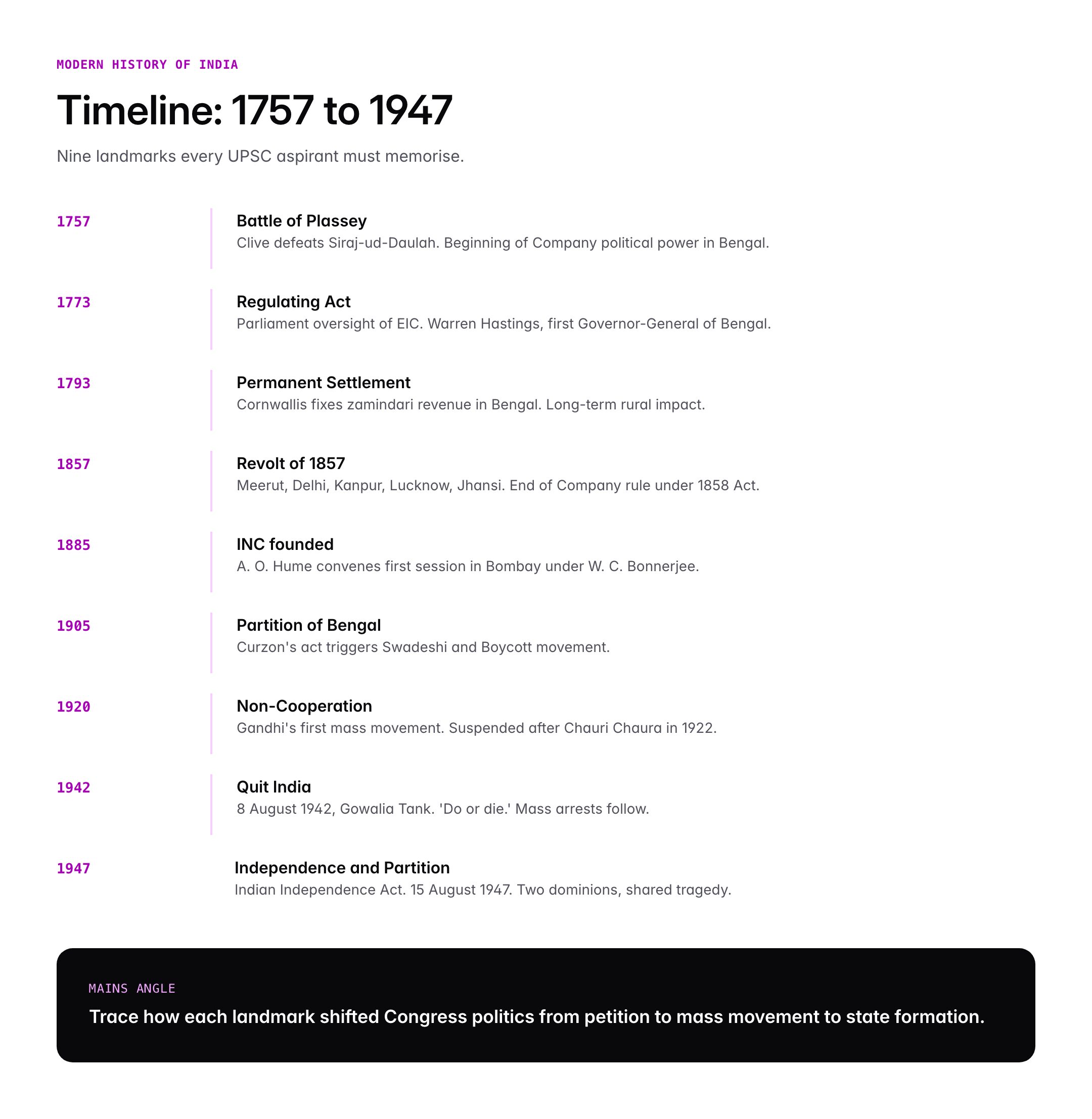
Gandhi’s return from South Africa in 1915 and the Rowlatt Satyagraha of 1919 opened the era of mass civil disobedience. The Non-Cooperation Movement (1920-22) mobilised students, lawyers, and peasants, but was suspended after Chauri Chaura. The Civil Disobedience Movement began with the Dandi March on 12 March 1930, when Gandhi walked 241 miles to break the salt law.
Phase 4: Towards Independence (1935-1947)
The Government of India Act 1935 created provincial autonomy and a federal scheme that never came into force. Congress won seven of eleven provinces in the 1937 elections. The Quit India Movement of 1942 demanded immediate British withdrawal. Subhas Chandra Bose raised the Indian National Army. The Cabinet Mission (1946), Mountbatten Plan (3 June 1947), and Indian Independence Act (18 July 1947) delivered freedom on 15 August 1947, along with Partition.
Parallel Movements Often Missed
The Santhal Hool of 1855, the Indigo Revolt of 1859, the Moplah Rebellion of 1921, the Telangana peasant uprising, and the Royal Indian Navy mutiny of 1946 show resistance was not a monopoly of Congress politics. UPSC has repeatedly tested these tribal and peasant strands.
Significance for UPSC and General Knowledge
- Modern history alone contributes roughly 15-20% of GS1 Prelims in most years, outpacing ancient and medieval combined
- The syllabus overlaps with Indian Society (social reform), Polity (constitutional evolution from 1861 to 1950), and Economy (deindustrialisation debate)
- Mains essay topics frequently draw on Gandhian philosophy, nation-building, and colonial economic critique
- Understanding zamindari, ryotwari, and mahalwari systems is essential for agriculture and land-reform questions in GS3
- Indian Culture questions on Bengal Renaissance, Tagore, and the Bhakti-modern continuity fall in this window
Detailed Analysis: Stage-wise Preparation Strategy
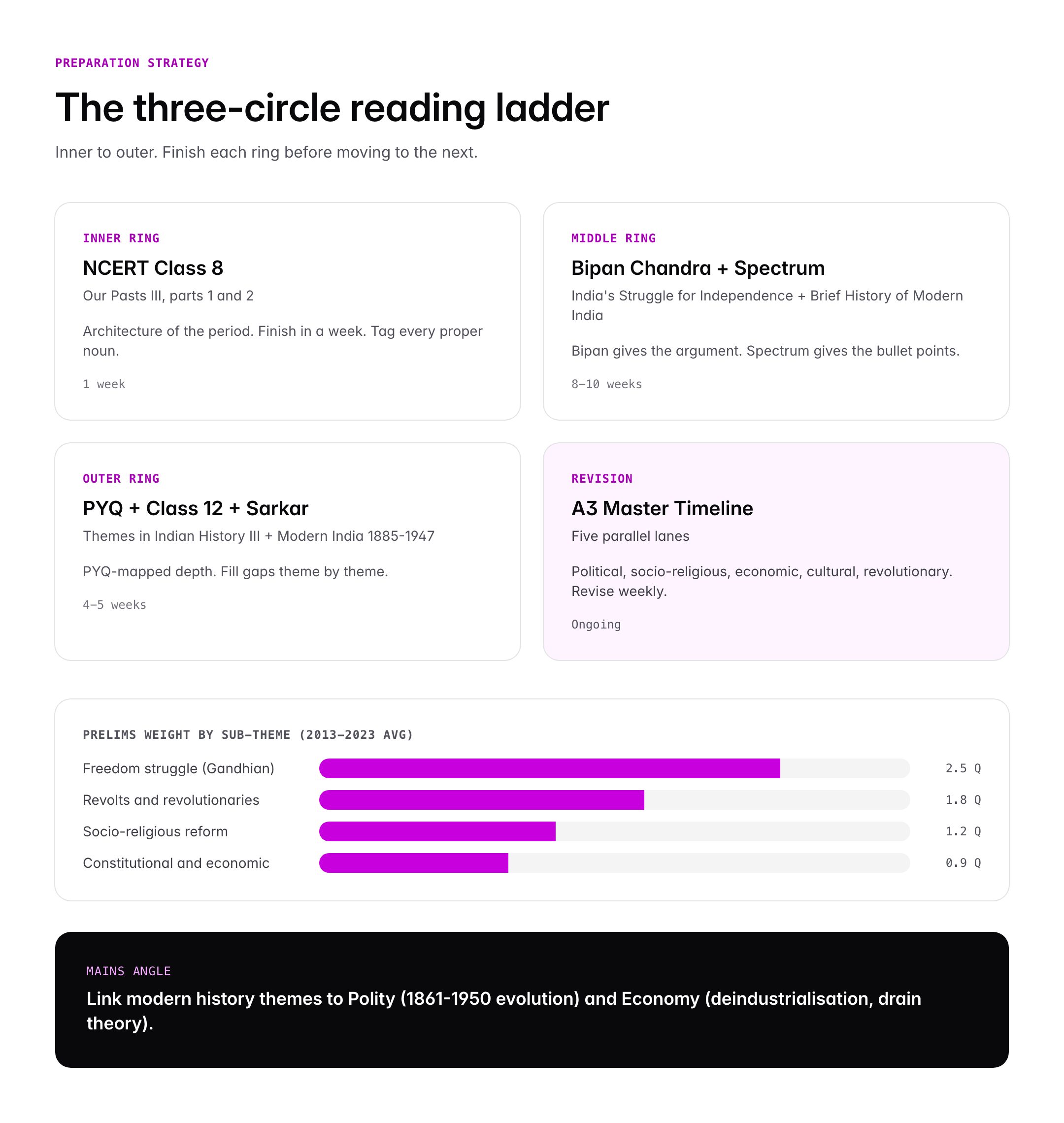
A competitive preparation plan treats modern history as three concentric circles. The innermost circle is NCERT Class 8 (Our Pasts III, both parts). These two slim books give you the architecture: colonialism, rural life, nationalism, and social change. Finish them in a week, take notes by chapter heading, and tag every proper noun you do not already know.
The middle circle is the standard textbook. For most aspirants this means Bipan Chandra’s India’s Struggle for Independence for the freedom movement and Spectrum’s A Brief History of Modern India for the full period. Bipan Chandra gives you the argument; Spectrum gives you the bullet points. Read Bipan first so that when you revise Spectrum the names have faces. Plan eight to ten weeks for a first reading and three weeks for revision.
The outer circle is PYQ-led depth. Pull every modern history Prelims question from 2013 onward, sort by theme (social reform, revolts, Gandhian phase, revolutionary movements, economic history, princely states), and then read Class 12 NCERT (Themes in Indian History Part III) to plug gaps. For Mains, add Sumit Sarkar’s Modern India 1885-1947 for historiographical nuance and Shekhar Bandyopadhyay’s From Plassey to Partition for a one-volume narrative.
Weekly revision is non-negotiable. Memory in modern history fades precisely because dates cluster. Use timelines, not paragraphs, for revision. Build one master timeline on A3 paper with five parallel lanes: political events, socio-religious reform, economic policy, cultural landmarks, and revolutionary activity. This converts prose into visual memory and is examinable at a glance.
World history topics (GS1 optional strand for Mains) should be tackled only after you have closed Indian modern history. The French Revolution, Industrial Revolution, American Revolution, World Wars, decolonisation, and the Russian Revolution are the Mains-focused cluster. NCERT Class 9 and 11 plus Jain and Mathur are enough.
Comparative Perspective
| Era / Source | Scope | Best For | Time Needed |
|---|---|---|---|
| NCERT Class 8 (Our Pasts III) | 1757-1947 foundational | Beginners, Prelims base | 1 week |
| NCERT Class 12 (Themes Part III) | Thematic deep dives | Mains answer writing | 2 weeks |
| Bipan Chandra | Freedom struggle (1857-1947) | Nationalist lens, Mains | 4-5 weeks |
| Spectrum Modern India | Full 1757-1964 | Prelims factual revision | 3 weeks |
| Sumit Sarkar | 1885-1947 critical | Advanced Mains | 4 weeks |
| Shekhar Bandyopadhyay | 1757-1964 single-volume | Balanced overview | 3 weeks |
India’s freedom movement is often compared with other decolonisation struggles. Unlike Algeria (armed struggle) or Ghana (Nkrumah’s positive action), the Indian movement combined mass civil disobedience with constitutional bargaining. Unlike Indonesia’s four-year war of independence against the Dutch (1945-1949), India’s transfer of power was negotiated, though its human cost in Partition exceeded a million lives.
Controversies and Debates
Every major event in modern Indian history is contested in the historiography. The 1857 uprising is called a mutiny by colonial historians (Charles Ball), the First War of Independence by V. D. Savarkar, and a popular revolt by modern scholars (R. C. Majumdar, S. B. Chaudhuri). UPSC expects you to know the debate, not to adjudicate it.
The drain theory of Dadabhai Naoroji and R. C. Dutt argued that Britain extracted roughly 2-4% of Indian GDP annually. Niall Ferguson and revisionist economic historians dispute the magnitude. Utsa Patnaik’s recent estimate (2018) puts the drain at 45 trillion US dollars over 1765-1938.
Gandhian methods have been criticised from the left (B. R. Ambedkar on the Poona Pact), the revolutionary right (Bhagat Singh’s Why I Am an Atheist), and Dalit historiography more broadly. The partition decision of 1947 remains the most debated single event, with responsibility apportioned variously to Jinnah, Nehru, Patel, Mountbatten, and the broader communal polarisation of 1937-46.
Prelims Pointers
- Battle of Plassey: 23 June 1757; Battle of Buxar: 22 October 1764
- Regulating Act 1773 created the post of Governor-General of Bengal (Warren Hastings first)
- Permanent Settlement of Bengal: 1793 under Cornwallis
- Charter Act 1813 ended EIC’s trade monopoly except for tea and China trade
- Charter Act 1833 made Bentinck the first Governor-General of India
- Revolt of 1857 started at Meerut on 10 May 1857
- Queen’s Proclamation: 1 November 1858
- INC founded by A. O. Hume on 28 December 1885; first session presided by W. C. Bonnerjee
- Partition of Bengal: 16 October 1905; revoked in 1911
- Morley-Minto Reforms 1909 introduced separate electorates for Muslims
- Montagu-Chelmsford Reforms 1919 introduced dyarchy in provinces
- Simon Commission: 1927, all-white; boycotted in India
- Poona Pact: 24 September 1932 between Gandhi and Ambedkar
- Government of India Act 1935: federation, provincial autonomy, RBI
- Quit India: 8 August 1942 at Gowalia Tank, Bombay
- Cabinet Mission: March-June 1946; Interim Government: 2 September 1946
Mains Practice Questions
Q1. Evaluate the role of the Indian National Congress in transforming colonial subjects into political citizens between 1885 and 1947. (15 marks, 250 words)
- Pre-1905 moderate phase: petitioning, constitutional argument, expansion of Legislative Councils
- 1905-1919 transition: Swadeshi mobilisation, Home Rule, Lucknow Pact 1916
- Gandhian phase: mass satyagraha, peasant-worker incorporation, constructive programme; concluding with how Congress institutionalised political participation through provincial ministries (1937) and the Constituent Assembly
Q2. “The drain of wealth was both an economic reality and a political weapon.” Discuss. (15 marks, 250 words)
- Statistical estimates: Naoroji, Dutt, Patnaik numbers and methodology
- Mechanisms: home charges, Council Bills, unrequited exports, tribute under Diwani
- Political weaponisation: how early nationalists converted the critique into a constitutional grievance, feeding swadeshi, boycott, and mass politics
Conclusion
Modern Indian history rewards the aspirant who reads it as argument rather than as a calendar. The dates matter, but the interpretive pattern matters more. Why did a trading company become a territorial power? Why did a petitioning assembly become a mass movement? Why did a movement built on non-violence end in Partition violence? Each question opens a subsection of the syllabus and connects it to Polity, Economy, and Society.
For UPSC, sequence your preparation: NCERT Class 8 first, Bipan Chandra and Spectrum next, and PYQ-mapped Class 12 plus Sumit Sarkar for the final layer. Revise through timelines rather than re-reading text. Track the three parallel streams (political, social-religious, economic) together. Done well, modern history is not the most voluminous strand of GS1 but the most rewarding, because the narrative sticks and the marks follow.
Frequently Asked Questions
What is modern history of India?
Modern Indian history is the period from 1757 (Battle of Plassey) to 1947 (Independence), covering the rise of British rule, socio-religious reform movements, the economic drain, the growth of nationalism under the Indian National Congress, revolutionary activity, Gandhian mass movements, and the eventual transfer of power through the Indian Independence Act.
Why is modern history important for UPSC?
Modern history carries five to seven Prelims questions every year and dominates GS1 Mains sections on the freedom struggle, nation-building, and social reform. It also overlaps with Polity (constitutional evolution 1861-1950), Economy (deindustrialisation, drain theory), and Society (caste reform, women’s question).
How is modern history related to NCERT textbooks?
The primary NCERT base is Class 8 (Our Pasts III, both parts) for foundation and Class 12 (Themes in Indian History Part III) for thematic depth. Class 9 and 11 cover world history topics like the French, Industrial, and Russian revolutions that appear in GS1 Mains.
Which are the best books for modern history UPSC preparation?
Bipan Chandra’s India’s Struggle for Independence is the standard nationalist narrative. Spectrum’s A Brief History of Modern India provides Prelims-ready facts. Sumit Sarkar’s Modern India 1885-1947 offers critical historiography, and Shekhar Bandyopadhyay’s From Plassey to Partition gives a balanced single-volume overview.
When did the Indian National Congress begin mass politics?
The Indian National Congress, founded in 1885, shifted from moderate petitioning to mass politics during the Swadeshi movement of 1905-1908. The turn became decisive under Gandhi with the Non-Cooperation Movement of 1920-22, which mobilised students, peasants, and workers for the first time under a single political banner.
What is the drain of wealth theory?
Drain theory, developed by Dadabhai Naoroji and R. C. Dutt in the late 19th century, argued that Britain extracted Indian surplus through unrequited exports, home charges, Council Bills, and tribute. Modern estimates by Utsa Patnaik place the cumulative drain at around 45 trillion US dollars between 1765 and 1938.
What is the history of Santhal tribe?
The Santhals are one of India’s largest tribal groups, concentrated in Jharkhand, West Bengal, and Odisha. Their most famous historical moment is the Santhal Hool of 1855-56, led by Sidhu and Kanhu Murmu against zamindars, moneylenders, and the colonial state. The rebellion preceded 1857 and shaped tribal policy including the later Santhal Parganas Tenancy Act.
What is the history of Nalanda University?
Nalanda was a Mahavihara in present-day Bihar, founded under the Guptas in the 5th century CE and flourishing until the late 12th century when it was destroyed by Bakhtiyar Khilji around 1193 CE. It drew scholars from across Asia, including Xuanzang and Yijing. A modern Nalanda University was re-established in 2014 at Rajgir.
Tell Google you want more of this.
Add Anantam IAS as a preferred sourceOne tap, and this site shows up more often in your own Top Stories, AI Overviews and AI Mode. Remove it any time.