Teesta-VI Tunnel Blast: Hydropower Safety in the Himalayas
Why in News?
At least 15 workers were reported killed after a July 20, 2026 blast about 1.5 km inside Adit-3 of the under-construction Teesta Stage-VI Hydroelectric Project in Sikkim’s Namchi district; rescue work was ongoing.
The Hindu reported that a 2024 technical paper authored by five NHPC engineers had documented earlier releases and fires involving flammable gas in the project’s headrace tunnels. The paper is prior evidence of a known hazard, but it does not establish the cause of the July 20 blast, which remains under investigation.
- NHPC said a sudden burst of suspected methane occurred near a working face and announced a detailed investigation; the Sikkim government constituted a Special Investigation Team.
- About 25 workers were reportedly inside when the blast and associated collapse sealed the tunnel; the casualty and rescue figures were evolving during publication.
- The 2024 paper recorded a November 2009 flammable-gas release at HRT Face 4B that burst into flame during work by the previous developer.
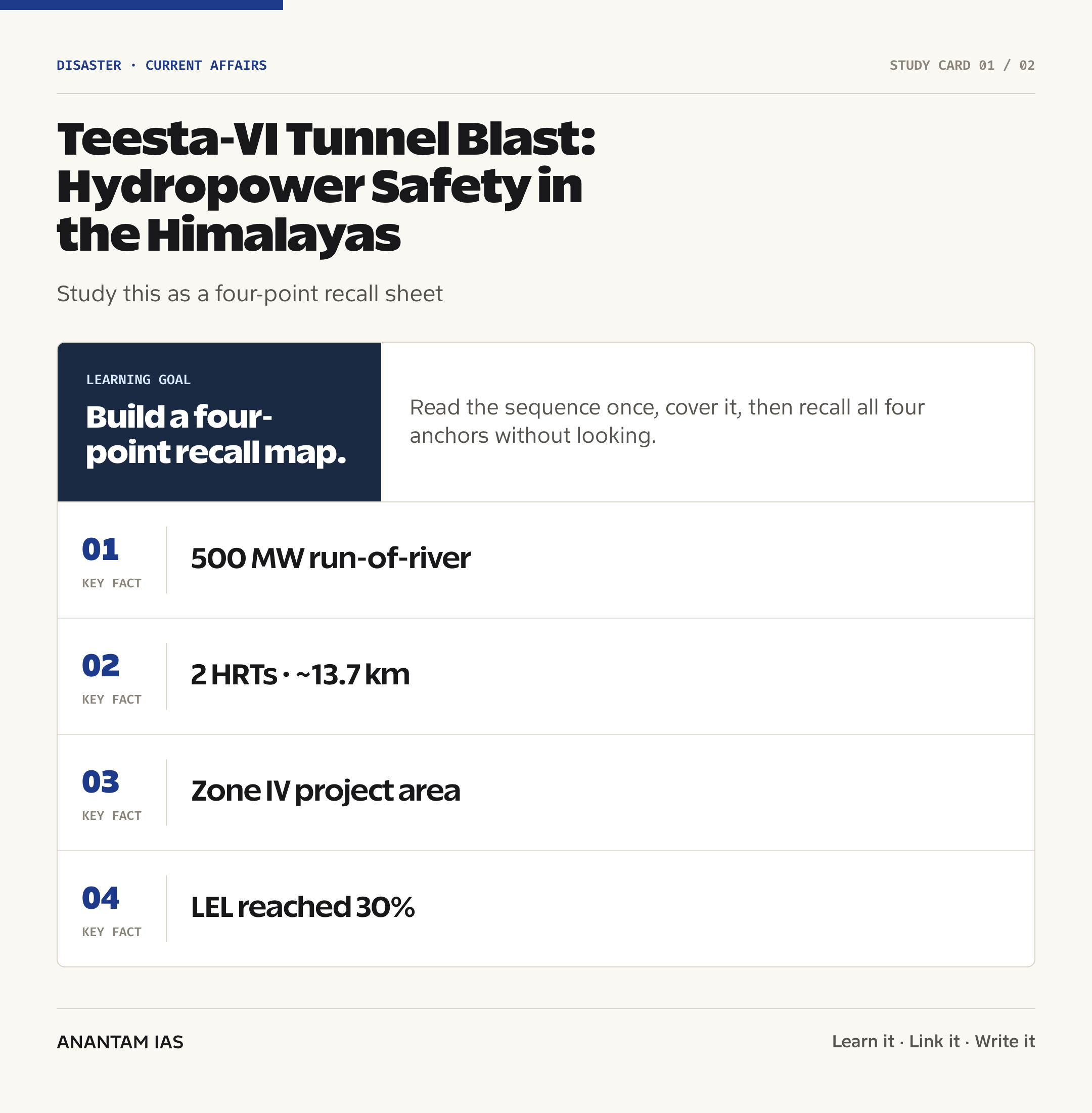
- During later excavation by NHPC, gas released from the arch near HRT Face 4A and a handheld detector recorded up to 30% of the Lower Explosive Limit, followed by a fire at the heading.
- The two earlier faces, 4A and 4B, were accessed through Adit-3, according to The Hindu; this geographical overlap makes the previous records directly relevant to the safety inquiry without proving a common cause.
The development matters in the context of:
- The incident matters in the context of hazard-informed design: a known gas history should shape investigation density, ventilation capacity, ignition control, stop-work thresholds and rescue readiness.
- It also matters in the context of cumulative Himalayan risk, where fractured rock, groundwater, seismicity, landslides, GLOFs and trapped gas interact; see India’s expanding glacial-lake risk and the debate over new hydropower in fragile basins.
UPSC Relevance
Prelims Relevance
- Teesta Stage-VI is a 500 MW, four-unit, run-of-river hydropower project on the Teesta River in Sikkim.
- The project has two headrace tunnels, each about 13.7 km long and 9.8 m in finished diameter; a headrace tunnel conveys diverted water towards the turbines.
- An adit is a supplementary, near-horizontal access passage used to reach a main tunnel for excavation, transport, ventilation or emergency access.
- The Lower Explosive Limit is the lowest concentration of a flammable gas in air at which ignition can propagate; a reading expressed as percentage of LEL is not the same as the gas’s percentage by volume.
- Methane is colourless and highly flammable; oxygen depletion, carbon monoxide and hydrogen sulphide can create additional confined-space hazards even when an explosion does not occur.
- The project paper places the area in Seismic Zone IV and describes intensely folded, faulted and sheared rocks of the Lesser Himalaya.
- IS 4756:1978 is the BIS safety code for tunnelling work, but its scope expressly excludes gassy tunnels, signalling the need for special hazard-specific methods where flammable gas is present or likely.
- The Building and Other Construction Workers Act, 1996 and its Central Rules contain specific safety provisions for excavation and tunnelling, while the Disaster Management Act, 2005 supports coordinated preparedness and response.
Mains Relevance
GS Paper 3
- Disaster management: shift from rescue-centric response to multi-hazard prevention, trigger-based evacuation, redundant communication and tunnel-specific emergency exercises.
- Environment and infrastructure: assess project-level hazards together with basin-wide seismic, landslide, GLOF, sediment and cascade-dam risks.
- Science and technology: combine geological probing with fixed gas sensors, portable detectors, telemetry, forced ventilation and intrinsically safe equipment.
GS Paper 2
- Governance and accountability: examine whether known hazards were translated into enforceable operating controls, contractor supervision, independent audits and transparent incident reporting.
- Labour protection: connect the right to life and safe work with training, protective equipment, medical surveillance, rescue capacity and compensation.
Essay
- Development without risk memory repeats preventable failures: institutional learning must survive changes in contractors, owners and project timelines.
- In fragile mountains, engineering certainty is limited; resilience comes from monitoring, humility, redundancy and accountable decision-making.
Background and Context
What the 2024 Paper Actually Recorded
The EUROENGEO 2024 paper provides project-specific evidence, but its evidentiary limits must remain clear.
- It recorded that flammable gas at HRT Face 4B first caught fire in November 2009 near the contact between competent quartzite or phyllitic quartzite and softer phyllite.
- It separately recorded gas release from the tunnel arch near HRT Face 4A as excavation entered the Kabrey Khola stretch.
- A handheld instrument registered up to 30% LEL at that face, and the paper reported a fire during heading excavation.
- The response described in the paper included stronger ventilation and monitoring, plus two probe holes of roughly 24–30 m in which readings of 1–5% LEL were detected.
- A 30% LEL reading does not mean that methane formed 30% of tunnel air. It means the detector measured 30% of the calibrated lower explosive threshold, a serious warning that requires withdrawal and control before the atmosphere can move into an ignitable range.
- For the inquiry, the paper is a contemporaneous hazard record, not a causal verdict. Investigators must test whether the 2026 release occurred in the same geological contact, whether monitoring detected it, and whether a separate ignition or collapse sequence was involved.
Project Design and Institutional History
A long project history makes risk-memory transfer as important as physical construction.
- The original developer, Lanco Teesta Hydro Power Limited, halted work in December 2012 after financial distress.
- NHPC acquired the company through insolvency proceedings in October 2019 and resumed tunnel excavation in June 2021 after about nine years of inactivity.
- The technical paper said archived geological records were partly missing or deteriorated, adits were flooded, support elements had degraded and several previously excavated stretches had collapsed.
- The governance lesson is to create a single auditable hazard register that follows the asset across insolvency, contractor replacement and handover.
- A restart after prolonged suspension should be treated as a brownfield safety reassessment, not a continuation from the last work certificate. It requires fresh geological mapping, structural inspection, dewatering, atmosphere testing, equipment revalidation and review of old near-miss records.
- Owner and contractor systems must share one permit-to-work architecture. Fragmented records can leave the project proponent aware of a regional hazard while a subcontracted face crew lacks the latest gas map, alarm threshold or evacuation instruction.
Himalayan Geology Creates Compound Hazards
The Sikkim Himalaya combines young tectonics with highly variable rock and water conditions.
- The paper identifies proximity to the Main Central Thrust, a project location in Seismic Zone IV and rock quality that can change sharply over only a few metres.
- At some faces, pressurised groundwater inflows of about 700–1,000 litres per minute were recorded and associated with surface subsidence.
- Carbonaceous or organic-rich strata and fractures can contain trapped combustible gas; excavation may create a migration pathway into a confined tunnel.
- The proper model is multi-hazard interaction: geology controls gas, water and instability, while blasting, electrical equipment, diesel exhaust and ventilation shape exposure and ignition risk.
- Advance probe drilling should test not only rock competence and groundwater but also gas pressure and composition ahead of the face. Results should govern support, excavation, ventilation and re-entry.
- Cumulative risk also includes surface-to-underground pathways: monsoon infiltration, nala crossings, landslide movement and seismic fractures can alter groundwater and gas migration after the original investigation. Baseline studies need periodic revision during construction.
Combustible-Gas and Confined-Space Safety
Gas safety depends on a continuous detect, dilute, isolate and evacuate chain.
- Fixed sensors and calibrated portable meters should track methane, oxygen, carbon monoxide and hydrogen sulphide at the face, roof, return air and refuge or access routes.
- A percentage-of-LEL alarm must trigger predefined controls: stop work, cut ignition sources, withdraw workers, increase ventilation and verify clearance before re-entry.
- Ventilation requires calculated air quantity, backup power, duct integrity and independent verification; simply installing a fan does not prove effective dilution at the face.
- Electrical and communication systems in a gassy zone should be intrinsically safe or explosion-protected, with hot-work permits and ignition-source control.
- Rescuers need self-contained breathing apparatus, atmospheric monitoring, entry logs, lifelines, thermal or night-vision support and time-limited deployment based on measured conditions.
- Sensor placement must reflect gas behaviour and tunnel airflow. Methane can accumulate near the crown, while heavier toxic gases may collect lower; one portable reading at the face cannot represent the entire heading, return airway, machinery bay and escape path.
- Detectors need scheduled bump tests and calibration, logged before every shift. A failed sensor, broken telemetry link or ventilation-power interruption should place the face in a safe state automatically rather than asking workers to continue while maintenance is arranged.
- Re-entry should require a written gas-clearance protocol: readings below the action threshold at multiple points for a specified duration, stable airflow, isolation of suspected ignition sources, supervisor authorisation and communication to every crew member.
Environmental and Disaster-Governance Framework
Project approval and emergency response sit in different legal systems that must operate as one risk-governance chain.
- Under the EIA Notification, 2006, appraisal of a river-valley project should convert baseline geology, environmental impacts and mitigation promises into monitorable clearance conditions.
- A compliance review after the accident should examine the original Environmental Impact Assessment, clearance conditions, later design changes, six-monthly reports and whether emerging gas evidence led to updated management plans.
- The Disaster Management Act, 2005 enables national, state and district authorities to coordinate preparedness, response and relief, but emergency agencies cannot substitute for the project proponent’s prevention duties.
- The 2023 South Lhonak glacial lake outburst flood showed how an upstream shock can cascade through Teesta infrastructure; see the broader Himalayan ecological crisis.
- Appraisal should cover cumulative basin risk, including GLOFs, extreme rainfall, sediment pulses, landslides, seismicity, dam cascades, access disruption and downstream warning.
- An Environmental Management Plan should not remain frozen at clearance. New evidence such as repeated gas fires, major geological departures or changed climate hazards should trigger a documented risk review, revised mitigation and regulatory inspection.
- Project, district and basin plans must use a common credible-worst-case scenario: simultaneous tunnel collapse, toxic atmosphere, power loss, blocked portal access and monsoon disruption. Rescue time, hospital capacity and alternate access should be tested against that scenario.
Worker Protection and the Right to Safe Work
A high-risk tunnel needs protections that are understandable and usable by every worker and subcontractor.
- The BOCW Act, 1996 and Central Rules place safety, health and welfare duties on construction establishments and contain a dedicated excavation-and-tunnelling chapter.
- Rule 36 requires an approved emergency action plan at a construction site employing more than 500 building workers, covering emergencies such as fire, explosion, gas leakage, structural collapse and landslide.
- Every shift should begin with a toolbox briefing on current gas readings, work-face conditions, alarms, evacuation routes, muster points and who may order a stop.
- Workers must be able to invoke stop-work authority without wage loss or retaliation when an alarm sounds, ventilation fails or gas readings exceed the control threshold.
- Contract labour arrangements should not fragment accountability: the principal employer, project proponent and contractors need a common permit-to-work, incident-reporting and rescue system.
- Post-incident duties include medical care, family communication, lawful compensation, preservation of evidence and psychosocial support for survivors and rescue personnel.
- Training must be role-specific and multilingual. A worker should recognise each alarm, know the nearest refuge or exit, understand why engines and switches can ignite gas, and demonstrate the procedure during drills rather than merely sign an attendance sheet.
- Occupational-health protection should include exposure records and medical surveillance for carbon monoxide, hydrogen sulphide, diesel particulate matter and oxygen-deficient atmospheres. Near misses and symptoms must be reportable without affecting employment.
Accountability Without Premature Causation
A credible inquiry must distinguish known hazard, proximate cause and organisational failure.
- Investigators should secure gas-monitor logs, ventilation records, equipment status, shift rosters, blast and hot-work permits, sensor calibration records, CCTV or telemetry and contractor instructions.
- A forensic sequence should establish the gas species and concentration, release pathway, ignition source, blast dynamics, ground failure and whether collapse preceded or followed ignition.
- The inquiry should compare actual controls with the 2024 paper’s documented history, site risk assessments, standard operating procedures and environmental-clearance commitments.
- Prior fires establish foreseeability of a class of hazard, not automatic proof that the same mechanism caused the later disaster or that a particular person was negligent.
- An independent panel should include engineering geologists, tunnel-ventilation specialists, occupational-safety experts and worker representatives. Members should disclose conflicts and publish the evidence supporting material findings.
- Accountability must follow decision authority: who received the warning, who could stop work, who certified ventilation, who accepted residual risk and whether commercial milestones discouraged precaution. Corrective actions need named owners, deadlines and public closure reports.
Way Forward
Build a Dynamic Gas-Hazard Model
- Combine geological logs, probe drilling, gas incidents and sensor trends in a live spatial hazard register for every face, adit and return-air route.
- Require independent review when a new gas-bearing contact, fault, cavity or unexplained LEL excursion appears.
Make Monitoring Fail-Safe
- Install redundant fixed detectors with remote telemetry, calibrated portable meters and automatic power isolation and alarms at defined thresholds.
- Test ventilation under worst-case face geometry and backup-power loss; retain immutable airflow and gas logs for audit.
Put Workers at the Centre
- Standardise multilingual induction, shift briefings, evacuation drills, self-rescuer access and worker-led safety observations across all contractors.
- Link payment and project milestones to verified safety performance, not only excavation progress.
Review the Whole Teesta Cascade
- Update cumulative assessments for GLOF, seismic, landslide, sediment and access risks across interacting projects rather than treating each clearance as a sealed unit.
- Integrate project emergency plans with district authorities, downstream warnings, hospitals and alternative rescue-access routes.
Publish Learning, Not Just Blame
- Release a time-bound independent report with causal findings, control failures, responsibility mapping and corrective-action deadlines.
- Create a national anonymised database of tunnel gas events, collapses and near misses so every Himalayan project benefits from institutional memory.
Conclusion
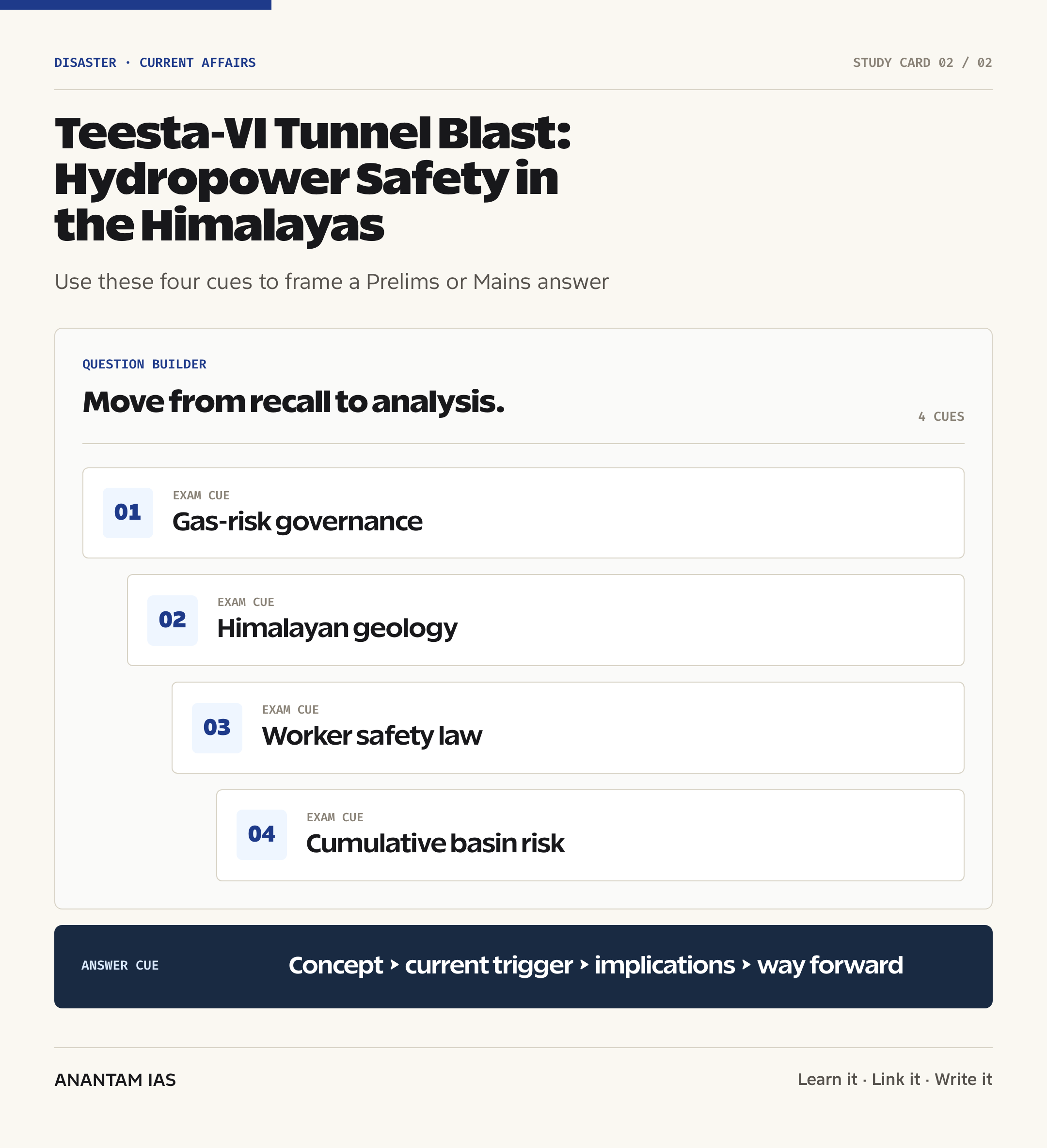
The Teesta-VI accident is not yet a settled story of causation. What is settled is that flammable gas had appeared and ignited in the same tunnel system before, alongside severe geological and groundwater problems. The inquiry must resist both extremes: treating the blast as unforeseeable before testing the prior warnings, or treating the prior fires as automatic proof of the final causal chain.
The policy test is whether that knowledge became stronger design assumptions, measurable controls and worker-centred emergency readiness. Safe Himalayan hydropower requires cumulative risk assessment, continuous monitoring and transparent accountability, not confidence based only on project completion schedules. Every warning must travel from the geological log to the work permit, alarm threshold, evacuation drill and regulator’s compliance record.
UPSC Practice Questions
Prelims MCQ 1
With reference to the Teesta Stage-VI Hydroelectric Project, consider the following statements:
- It is a 500 MW run-of-river project on the Teesta River.
- It uses two headrace tunnels, each approximately 13.7 km long.
- The project paper places the area in Seismic Zone IV.
How many of the above statements are correct?
(a) Only one (b) Only two (c) All three (d) None
Answer: (c) All three
Explanation:
All three statements are correct. NHPC describes Teesta-VI as a 500 MW run-of-river scheme; the two headrace tunnels are roughly 13.7 km each, and the 2024 project paper identifies the area as Seismic Zone IV.
Prelims MCQ 2
A tunnel gas detector reading of 30% LEL most accurately means:
(a) Methane forms 30% of the tunnel air by volume (b) The measured flammable-gas concentration is 30% of its lower explosive threshold (c) Oxygen concentration has fallen to 30% (d) An explosion is impossible until the reading exceeds 100% by volume
Answer: (b) The measured flammable-gas concentration is 30% of its lower explosive threshold
Explanation:
Percentage LEL expresses the detected concentration as a fraction of the minimum concentration capable of propagating combustion. It is not the gas’s percentage by volume; sub-LEL readings still demand controls because concentration may rise or vary across the tunnel.
UPSC Mains Questions
- The Teesta-VI tunnel accident shows why prior knowledge of a hazard is not the same as control of that hazard. Examine the institutional and engineering steps needed to convert geological evidence into safe operating decisions in Himalayan infrastructure.
- Hydropower appraisal in the Himalayas must move from project-wise clearance to cumulative basin-risk governance. Discuss with reference to seismicity, landslides, GLOFs, sediment, cascade effects and emergency-access constraints.
- How can India strengthen accountability for construction disasters without prejudging causation? Propose an inquiry and worker-safety framework that combines forensic independence, transparent records, contractor responsibility and enforceable corrective action.
Sources: The Hindu and EUROENGEO 2024 technical paper and The Hindu Editorial.
Frequently Asked Questions
What happened at the Teesta-VI tunnel?
A blast and collapse occurred on July 20, 2026 inside Adit-3 of the under-construction Teesta-VI project in Sikkim. At least 15 workers were reported killed. NHPC referred to suspected methane, but the precise release, ignition source and responsibility remain under investigation.
Did the 2024 paper prove the blast’s cause?
No. The EUROENGEO 2024 paper documented earlier gas releases and fires at two faces accessed through Adit-3. It establishes a known hazard and raises questions about controls, but does not prove that the same gas pocket, ignition source or failure caused the 2026 accident.
What does 30% LEL mean?
Thirty per cent LEL means the detected gas reached 30% of its lower explosive threshold. It does not mean the air contained 30% methane. The reading is an early warning requiring ventilation, ignition control, withdrawal thresholds and repeat measurements across the work zone.
Why are Himalayan tunnels especially risky?
The young Himalayan rocks are folded, faulted and fractured. Excavation can encounter shear zones, squeezing ground, pressurised water, seismic stress and trapped gas within short distances. Steep terrain and landslides can also obstruct access, power, ventilation and rescue, creating compound emergencies.
Which laws govern tunnel worker safety?
The BOCW Act, 1996 and Central Rules provide the construction-safety framework, including tunnelling provisions. Environmental-clearance conditions apply under the EIA framework, while disaster authorities coordinate response under the Disaster Management Act, 2005. BIS standards assist procedure, but gassy tunnels need special controls.
What should an independent inquiry examine?
It should reconstruct the gas release, ignition and collapse sequence; preserve sensor, ventilation, equipment and permit records; compare controls with past incidents and approved plans; hear workers and contractors; and identify authority at each decision point. Findings should separate evidence from inference and set corrective deadlines.