Why in News?
The Union Government has filed a joint affidavit before the Supreme Court of India stating that it will not permit any new hydroelectric projects (HEPs) in the upper reaches of the Ganga, specifically the Alaknanda-Bhagirathi basin in Uttarakhand.
| UPSC Relevance: GS-1 Geography: Dams, GS-3 Environment and Biodiversity: Conservation Prelims: Upper Ganga Basin, Important hydropower plants. |
Reasons for Rejecting New Projects:
- Geological and seismic fragility: The upper Ganga basin lies entirely within Seismic Zones IV and V. It is prone to landslides, glacial lake outburst floods (GLOFs), avalanches, tunnel collapses, and geodynamic instabilities. Disasters here are described as not episodic but persistent.
- The 1916 Haridwar Agreement: An over-100-year-old agreement between the government, princely states, and civil society mandates a minimum constant and unfettered flow of 1,000 cusecs through the Ganga at Haridwar at all times. Construction of HEPs would jeopardise this commitment.
- Irreplaceable biodiversity: The region hosts endangered and Schedule-I species, critical aquatic habitats, national parks, and a UNESCO World Heritage Site. The Wildlife Institute of India’s cumulative impact assessment identified critical conservation stretches where HEPs would cause irreversible harm.
- Cultural and spiritual significance: The five Prayags (Devprayag, Rudraprayag, Karnaprayag, Nandaprayag, Vishnuprayag) and the Char Dhams lie within this basin. The affidavit states that protection of this region is an obligation arising not only from environmental considerations, but also from the cultural and spiritual heritage of the nation.
- Population dependence: The Ganga basin supports nearly half of India’s population. The Alaknanda-Bhagirathi system is the principal headstream and critical for supplying food, nutrients, and biodiversity inputs to the entire river system.
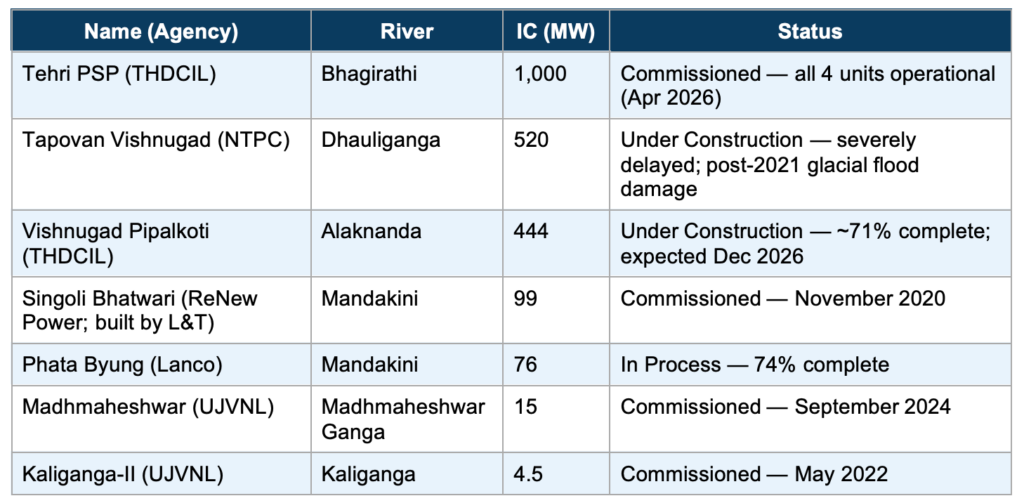
The Seven Permitted Hydroelectric Projects:
Only the following 7 hydroelectric projects, of which four are already commissioned, and three have achieved substantial physical and financial progress. These alone will be permitted to proceed, subject to strict compliance with all applicable safeguards.
This decision comes in the context of an earlier 2015 decision approving 28 projects for the Alaknanda and Bhagirathi basins.
The affidavit explicitly invokes the precautionary principle, a foundational norm of international environmental law enshrined in the Rio Declaration (1992). The principle holds that where scientific uncertainty exists about serious environmental harm, the burden of proof lies with those proposing the activity.
India’s National Environment Policy (2006) and the Environment Protection Act, 1986, recognise this principle. The government’s position that cumulative and cascading impacts were inadequately assessed by previous bodies reflects this principle in action.
Key Facts about the Upper Ganga Basin:
Geography & Hydrology:
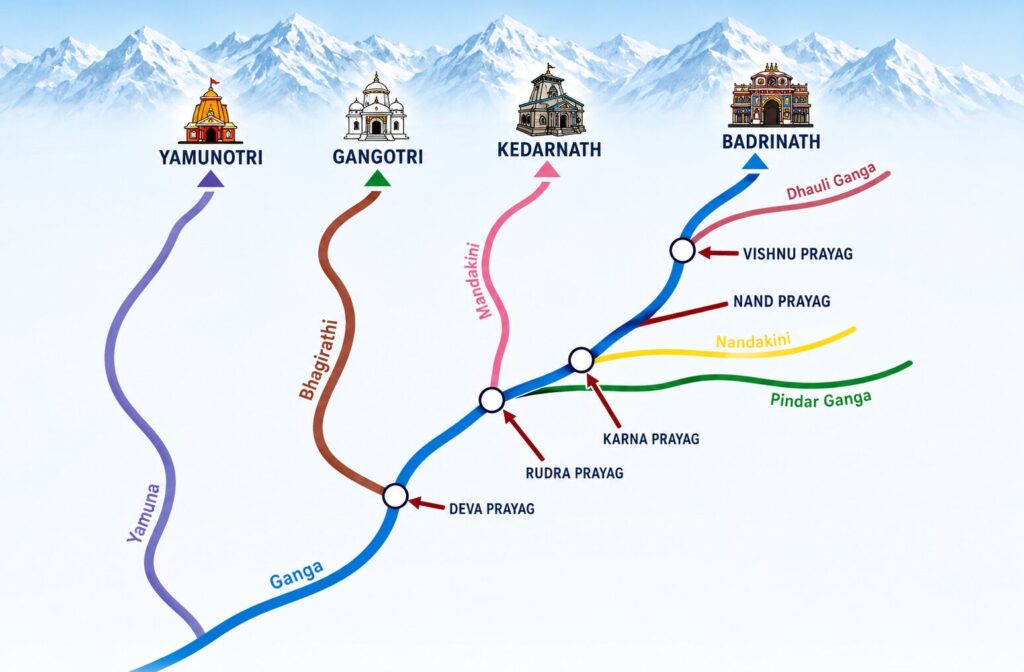
- Located entirely in Uttarakhand. Comprises the Alaknanda-Bhagirathi river system, the principal headstreams of the Ganga. The two rivers merge at Devprayag to form the Ganga River.
- Five Prayags (confluences) lie within the basin: Devprayag, Rudraprayag, Karnaprayag, Nandaprayag, Vishnuprayag
- Four Char Dhams: Yamunotri, Gangotri, Kedarnath, and Badrinath are located here.
Geology & Seismicity:
- Persistent hazards include landslides, GLOFs, avalanches, tunnel collapses, and geodynamic instabilities.
- Falls within Seismic Zones IV and V, the two highest-risk categories in India.
- Crossed by the Main Central Thrust (MCT), a major tectonic boundary, making the region prone to earthquakes and mass wasting. Contains extensive paraglacial zones, recently deglaciated, geologically unstable terrain above the MCT.
Tell Google you want more of this.
Add Anantam IAS as a preferred sourceOne tap, and this site shows up more often in your own Top Stories, AI Overviews and AI Mode. Remove it any time.