U.S.-Iran Doha Talks: Hormuz De-escalation and India’s Energy Security
Why in News?
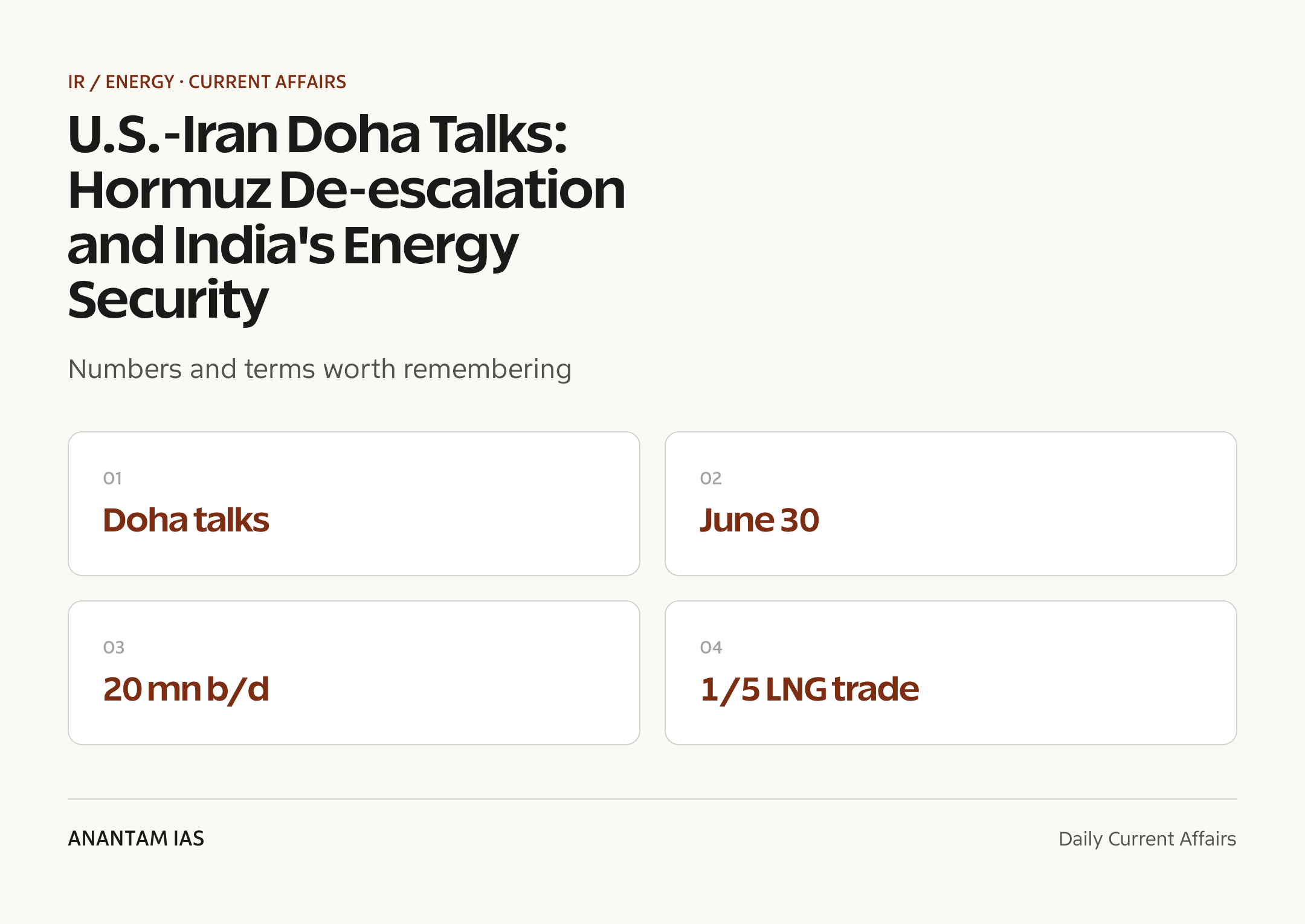
The Hindu reported that the United States and Iran had agreed to stop strikes against each other, with talks expected in Doha, Qatar, on June 30, 2026.
A related report said Iran’s top diplomat warned ships against bypassing Iran’s preferred route through the Strait of Hormuz, keeping the crisis tied to energy security, maritime rights and India’s West Asia diplomacy.
- Doha talks are expected to focus on disputes around the Strait of Hormuz after a reported stand-down between Washington and Tehran.
- Iran warned commercial vessels not to shift away from its preferred Hormuz route, saying such movement could raise tensions.
- The Strait of Hormuz is located between Iran and Oman and connects the Persian Gulf with the Gulf of Oman and the Arabian Sea.
- The U.S. Energy Information Administration says oil flows through Hormuz averaged about 20 million barrels per day in 2024, close to one-fifth of global petroleum liquids consumption.
- For India, the issue links energy imports, Gulf shipping lanes, Indian citizens in West Asia, inflation risks and strategic autonomy.
The development matters in the context of:
- Energy chokepoints convert a regional security event into a global price and supply shock because rerouting options are limited.
- India’s West Asia policy must balance ties with the U.S., Iran, Israel, Gulf monarchies and Qatar without being pulled into bloc politics.
- Maritime security matters because shipping advisories, naval deployments and insurance costs can affect trade even without a formal closure.
- Crisis diplomacy through Doha shows how small and middle powers can provide communication channels during escalation.
UPSC Relevance
Prelims Relevance
- Strait of Hormuz: narrow maritime chokepoint between Iran and Oman.
- Connected waters: Persian Gulf on one side, Gulf of Oman and Arabian Sea on the other.
- Doha: capital of Qatar and a frequent venue for West Asia mediation.
- Chokepoint: a narrow route whose disruption can delay trade and raise costs.
- EIA estimate: about 20 million barrels per day of oil moved through Hormuz in 2024.
- LNG angle: around one-fifth of global liquefied natural gas trade also crossed Hormuz in 2024, mainly from Qatar.
- Transit passage: a key law-of-the-sea idea for international straits used for navigation.
- India angle: crude oil, LNG, shipping insurance, diaspora safety and inflation transmission.
Mains Relevance
GS Paper 2
- International relations: India’s balancing of the U.S., Iran, Israel, Qatar and Gulf partners during West Asia crises.
- Diplomacy: role of mediation venues such as Doha in reducing escalation without a full political settlement.
- Strategic autonomy: avoiding automatic alignment while protecting energy, diaspora and trade interests.
GS Paper 3
- Energy security: vulnerability of crude oil, LNG and fertilizer-linked supply chains to maritime disruption.
- Internal security: evacuation planning, maritime domain awareness and protection of Indian citizens in the Gulf.
- Indian economy: impact of oil-price spikes on inflation, current account deficit and fiscal management.
Essay
- Geography can turn into strategy when narrow seas decide the cost of energy.
- Strategic autonomy is tested most sharply during crises, not during routine diplomacy.
- Energy security is also a question of ports, pipelines, insurance and people.
Background and Context
What the reported stand-down means
The immediate issue is not a final U.S.-Iran settlement, but a pause that creates space for talks.
- The Hindu, citing Reuters, reported that a senior U.S. official said the United States and Iran had agreed to stop strikes against each other.
- Doha talks scheduled for June 30, 2026 are expected to discuss disputes linked to the Strait of Hormuz.
- The stand-down should be read as de-escalation, not normalization; the military, nuclear, sanctions and regional proxy issues remain unresolved.
- For exam purposes, this is a case of crisis management where communication channels matter even when adversaries lack trust.
- It also follows the earlier escalation covered in the current-affairs note on U.S. strikes, Iran and Hormuz closure risks.
Why the Strait of Hormuz is a strategic chokepoint
Hormuz is small in geography but large in strategic impact.
- The Strait of Hormuz sits between Iran and Oman and links the Persian Gulf to the Gulf of Oman and Arabian Sea.
- It is the exit route for a large share of petroleum and LNG exports from Gulf producers, so any disruption can affect Asian importers quickly.
- The EIA’s June 2025 analysis says 20 million barrels per day of oil flowed through Hormuz in 2024, about one-fifth of global petroleum liquids consumption.
- The same official analysis notes that around one-fifth of global LNG trade crossed the strait in 2024, primarily from Qatar.
- Most cargo cannot be shifted immediately because alternate pipelines and ports have limited spare capacity.
- For a geography-first explainer, use Strait of Hormuz geopolitics as the base internal reference.
Iran's shipping-route warning
The route warning matters because it shows how maritime behavior can become political signaling.
- The Hindu’s AFP report said Iran warned ships not to bypass the route it preferred through the Strait of Hormuz.
- The report said some vessels had been traveling on the opposite side of the waterway near the Omani coast, reflecting risk management by shipping operators.
- Shipping firms may respond to crisis signals through route changes, delays, higher insurance, extra security advisories and port-level caution.
- Even when the strait remains physically open, uncertainty can raise freight and insurance costs.
- This is why a UPSC answer should separate closure risk from disruption risk; the second can start before the first occurs.
India's energy and economic exposure
India’s exposure is not only about crude volumes; it includes LNG, shipping costs, inflation and currency pressure.
- India is among the major Asian destinations for crude oil moving through Hormuz, along with China, Japan and South Korea.
- A price spike in Brent crude can feed into retail fuel, transport, fertilizer, electricity and imported inflation with a time lag.
- Higher energy-import bills can widen the current account deficit and add pressure on the rupee.
- LNG supplies matter because Qatar is a key LNG exporter and Hormuz is part of that route.
- Strategic petroleum reserves, diversified suppliers, refinery flexibility and long-term gas contracts reduce risk but can’t remove geography.
- India’s diplomatic balancing is explained further in India-Iran and West Asia autonomy.
Diplomacy: Qatar, mediation and strategic autonomy
Doha’s role highlights the value of trusted diplomatic venues in a polarized region.
- Qatar has often served as a communication channel in difficult West Asia files because it keeps working ties with multiple sides.
- For India, the correct posture is not passive neutrality; it is active risk reduction through contacts with all major stakeholders.
- New Delhi’s interests include energy security, protection of Indian citizens, trade continuity, counter-terror concerns and long-term connectivity with West Asia.
- A balanced answer should avoid treating Iran only through the U.S. lens or the Gulf only through the oil lens.
- The phrase strategic autonomy should be backed by practical instruments: evacuation plans, rupee payment options, naval readiness, diversified imports and quiet diplomacy.
Maritime law and security concepts
The dispute is also a law-of-the-sea and maritime-security issue.
- International straits used for navigation raise questions of transit passage, innocent passage, coastal-state security and freedom of navigation.
- The Strait of Hormuz has Iranian waters on one side and Omani waters on the other, so ship routing can be legally and politically sensitive.
- Naval signaling must avoid miscalculation because crowded shipping lanes leave little room for error.
- For India, the response toolkit includes maritime domain awareness, coordination with friendly navies, advisories to shipping and consular preparedness.
- The UPSC hook is to connect geography, law, economics and foreign policy in one answer.
How to frame the issue in answers
A strong answer should avoid alarmism and show layered thinking.
- Start with the immediate news: reported U.S.-Iran stand-down, Doha talks and Iran’s warning to ships.
- Move to geography: Hormuz as the key route from the Persian Gulf to the Arabian Sea.
- Add the economic layer: oil, LNG, inflation, rupee pressure and insurance costs.
- Add the diplomatic layer: Qatar’s mediation and India’s need to speak to all sides.
- Close with resilience: diversification, reserves, naval readiness, diaspora protection and a rules-based maritime order.
Way Forward
Keep diplomatic channels active
- India should maintain quiet communication with the U.S., Iran, Qatar, Oman, Saudi Arabia, the UAE and Israel.
- Public messaging should support de-escalation, freedom of navigation and respect for international law without making India a party to the confrontation.
- Embassies in the Gulf should keep updated contingency plans for Indian citizens, shipping crews and workers.
Build energy resilience
- Use supplier diversification, strategic petroleum reserves and flexible refinery sourcing to reduce single-route exposure.
- Track crude, LNG, fertilizer feedstock and shipping-insurance costs together, since energy shocks move across sectors.
- Coordinate early with oil marketing companies, ports and shipping firms instead of waiting for a physical closure.
Strengthen maritime preparedness
- Expand maritime domain awareness with information sharing, satellite inputs and shipping advisories.
- Use naval presence for reassurance and protection of Indian interests, while avoiding steps that look escalatory.
- Prepare for rerouting, convoy guidance and emergency communication with Indian-flagged and Indian-crewed vessels.
Use the crisis as a policy test
- Treat Hormuz as a stress test for India’s energy transition, not only as a short-term import problem.
- Improve demand-side efficiency, domestic storage, gas-market planning and port-level emergency protocols.
- In foreign policy, keep strategic autonomy measurable through outcomes: stable supplies, citizen safety, lower panic and credible partnerships.
Conclusion
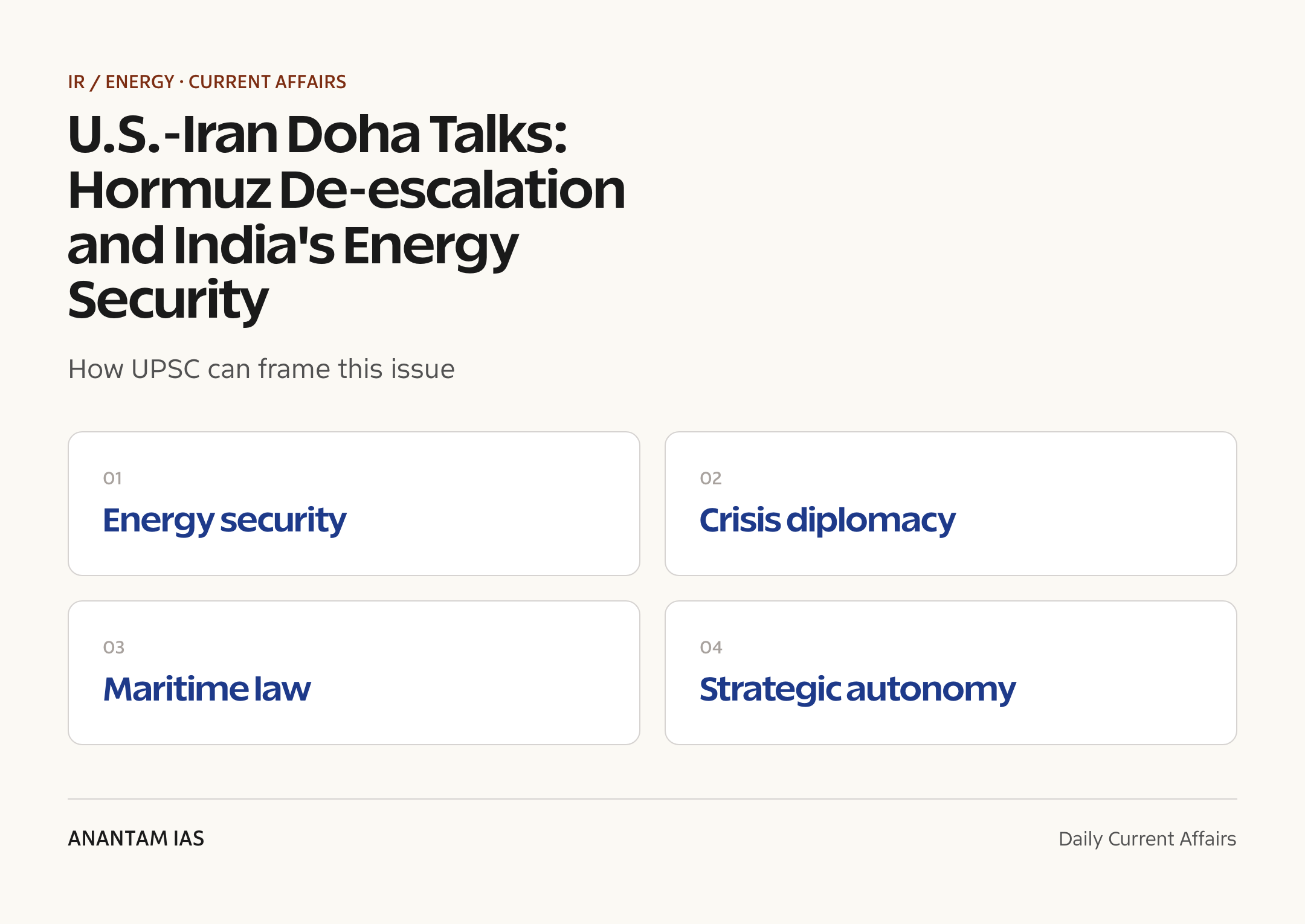
The reported U.S.-Iran stand-down and planned Doha talks are positive signals, but they do not remove the structural risk around the Strait of Hormuz. For India, the strait is a geography lesson, an energy-security problem and a diplomacy test at the same time.
The best UPSC framing is to move from event to concept: chokepoint geography, crisis diplomacy, maritime law, inflation risk and strategic autonomy. A good answer should neither exaggerate an imminent closure nor ignore the economic cost of even a fragile disruption.
UPSC Practice Questions
Prelims MCQ 1
With reference to the Strait of Hormuz, consider the following statements:
- It connects the Persian Gulf with the Gulf of Oman and the Arabian Sea.
- It lies between Iran and Oman.
- In 2024, all global seaborne oil trade passed through this strait.
How many of the above statements are correct?
(a) Only one (b) Only two (c) All three (d) None
Answer: (b) Only two
Explanation:
Statements 1 and 2 are correct. Statement 3 is incorrect because Hormuz is a major chokepoint, but not all global seaborne oil trade passes through it.
Prelims MCQ 2
Which of the following best explains why a disruption in the Strait of Hormuz matters for India?
(a) It is India’s only route for exports to Europe. (b) It can affect crude oil, LNG, shipping insurance and inflation. (c) It controls all traffic between the Indian Ocean and Pacific Ocean. (d) It is governed only by the domestic law of Qatar.
Answer: (b) It can affect crude oil, LNG, shipping insurance and inflation.
Explanation:
India’s exposure comes from energy imports, shipping costs, Gulf trade and wider price transmission. Hormuz is not India’s only export route, and it is not an Indo-Pacific-only passage.
UPSC Mains Questions
- The Strait of Hormuz crisis shows how geography can shape India’s foreign policy choices. Discuss with reference to energy security, diaspora safety, maritime law and India’s strategic autonomy in West Asia.
- Crisis diplomacy in West Asia often depends on trusted mediators and informal channels. Examine the significance of Doha talks in reducing escalation between adversarial states, and assess the lessons for India’s diplomatic posture.
- Energy security is not limited to finding suppliers; it also includes routes, insurance, storage and domestic resilience. Analyze this statement in the context of India’s exposure to maritime chokepoints.
Sources: The Hindu (Reuters) and The Hindu (AFP).
Frequently Asked Questions
What happened in Doha talks?
The Hindu reported that the United States and Iran had agreed to stop strikes and were expected to meet in Doha on June 30, 2026. The talks are important because they shift the issue from open escalation toward crisis diplomacy, though they do not settle the wider U.S.-Iran dispute.
Why is Hormuz important?
The Strait of Hormuz connects the Persian Gulf with the Gulf of Oman and the Arabian Sea. It carries a large share of oil and LNG trade from Gulf producers. Any disruption can affect global prices, shipping insurance, energy imports and inflation in major Asian economies including India.
Why did Iran warn ships?
Iran warned ships not to bypass its preferred route through the strait, saying such movement could raise tensions. The warning matters because shipping behavior can become strategic signaling during crises. Even route shifts near the Omani coast can affect insurance, naval monitoring and market confidence.
How does this affect India?
India’s exposure includes crude oil imports, LNG supplies, Gulf trade, shipping crews, workers in West Asia and domestic inflation. A Hormuz disruption can raise import bills and pressure the rupee. It also tests India’s ability to speak to all sides without abandoning strategic autonomy.
Is Hormuz closed now?
The available reports do not say the Strait of Hormuz is closed. The key point is disruption risk, not confirmed closure. Shipping warnings, rerouting, insurance costs and military signaling can still create economic pressure even when vessels continue to pass through the waterway.
What should India do?
India should keep diplomatic channels open, coordinate with Gulf partners, prepare consular plans, monitor shipping risks and strengthen energy resilience. Strategic petroleum reserves, diversified suppliers, maritime domain awareness and calibrated naval readiness are practical tools for managing a Hormuz-linked crisis.