Yavarí-Tapiche Corridor: The 16-Million-Hectare Amazon Refuge Now Under Triple Threat
The Yavarí-Tapiche corridor is one of those geographies most UPSC aspirants have never heard of, and that is partly the point. Stretching across roughly 16 million hectares along the borders of Peru, Brazil, and Colombia, the corridor is home to some of the last Indigenous groups on Earth living in voluntary isolation. They have no contact with outside society. Their existence is recorded mostly through indirect signs, footprints, abandoned camps, flyovers showing settlement clearings, and occasional contact with neighbouring communities that act as intermediaries.
In early May 2026, the United Nations issued a renewed warning about the corridor, flagging accelerating pressure from oil exploration, illegal logging, and organized crime networks pushing into territory long considered too remote to exploit. The warning matters for two reasons that go beyond the Amazon itself. First, the corridor sits at the intersection of biodiversity protection and Indigenous rights, two areas where international law has thickened over the past decade but enforcement on the ground has not kept pace. Second, the threats facing Yavarí-Tapiche mirror the threats facing tropical forest landscapes globally, including India’s own forest frontiers, where the politics of consent, livelihood, and resource extraction follow remarkably similar logic.
This piece walks through what the corridor is, who lives there, why the threats have intensified, and what the realistic response options look like for the global community and for India as it shapes its own forest and tribal-rights frameworks.
Quick Facts at a Glance
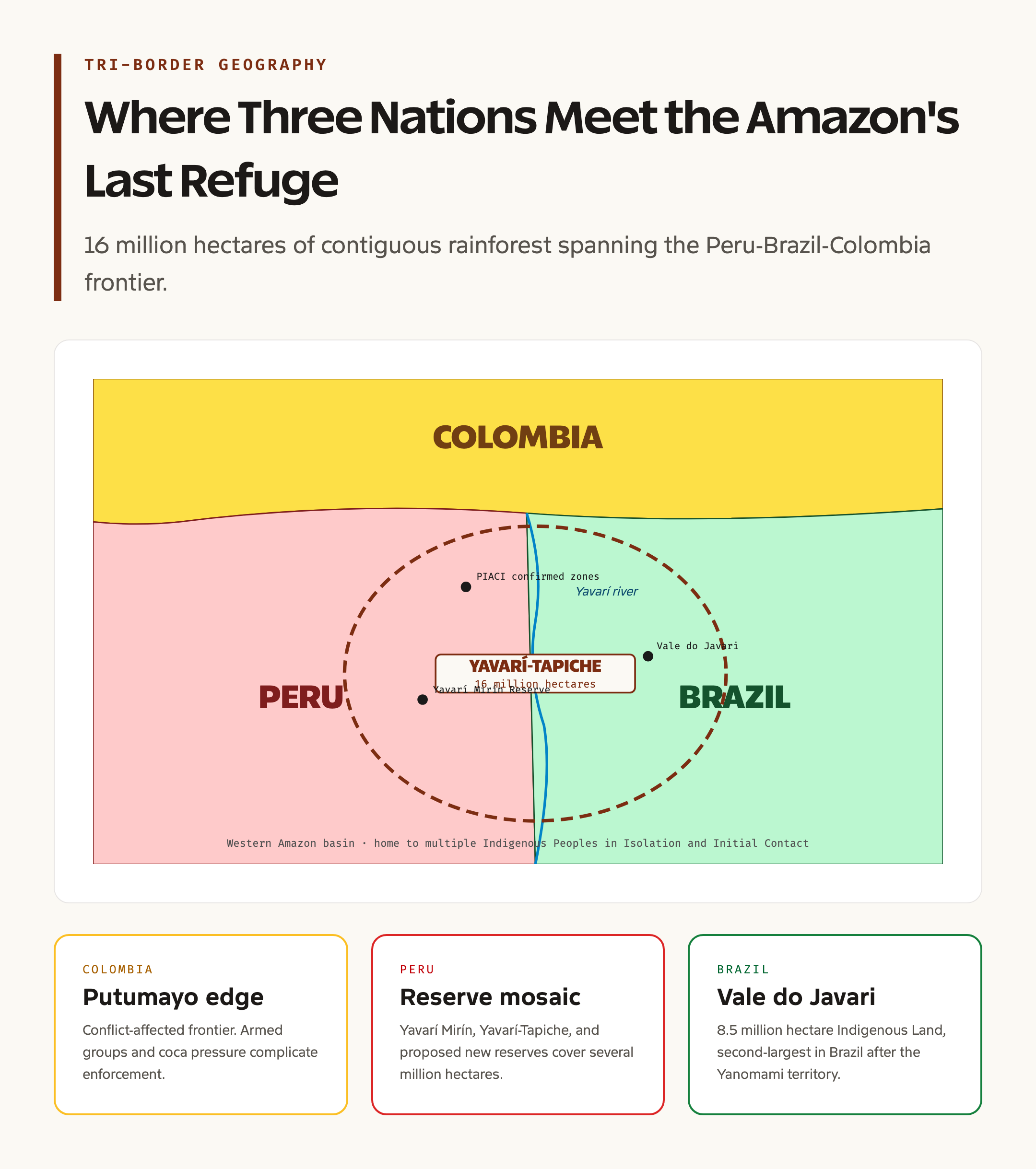
- Region: Yavarí-Tapiche Indigenous Corridor, western Amazon basin
- Approximate area: 16 million hectares straddling Peru, Brazil, and Colombia
- Inhabitants: Multiple groups of Indigenous peoples in voluntary isolation and initial contact (PIACI)
- Key river systems: Yavarí (Brazil-Peru border river) and Tapiche
- Protected status: Mosaic of reserves including Yavarí Mirín Indigenous Reserve and Yavarí-Tapiche Indigenous Reserve (Peru)
- Primary threats: Illegal logging, oil and gas exploration, narcotics trafficking, illegal gold mining
- Recent UN concern: Renewed warning issued in early May 2026
- Governance gap: Limited state presence across all three national jurisdictions
What Just Happened
The United Nations Permanent Forum on Indigenous Issues and special rapporteurs working on Indigenous rights flagged escalating pressure on the Yavarí-Tapiche corridor in early May 2026, after a sequence of incidents and reports showing accelerating encroachment. The triggers included satellite-detected deforestation in the Brazilian Vale do Javari Indigenous Land, reports of armed loggers moving deeper into Peruvian reserves, and confirmation that organized crime networks tied to narcotics trafficking are using forest cover to move people and product across the tri-border.
The UN response asked the three governments to coordinate enforcement, accelerate creation of new protected territories on the Peruvian side, and provide adequate funding to the Brazilian agencies responsible for monitoring isolated Indigenous groups. The pressure has been building for years. What changed in 2026 was a coincidence of accelerants. Higher commodity prices for tropical hardwoods, expanded mining markets, and shifting drug-trafficking routes after enforcement crackdowns elsewhere in South America have pushed pressure outward into peripheral geographies like Yavarí-Tapiche.
Background and Historical Context
The Amazon basin contains the largest concentration of Indigenous peoples in voluntary isolation anywhere on Earth. The term used by the UN and Inter-American Human Rights System is PIACI, which stands for Indigenous Peoples in Isolation and Initial Contact. Estimates put the total population of such groups across the Amazon at several thousand individuals, spread across more than a hundred distinct groups, most of them in the western Amazon along the Peru-Brazil-Bolivia and Peru-Brazil-Colombia frontiers.
The Yavarí-Tapiche corridor came into focus in the 1990s as Brazil began formalising the Vale do Javari Indigenous Land, which alone covers more than 8.5 million hectares and is the second-largest Indigenous reserve in Brazil after the Yanomami land. On the Peruvian side, the Yavarí Mirín and Yavarí-Tapiche Indigenous Reserves were created in the 2000s and 2010s, partly in response to mounting evidence of isolated groups whose territories spanned the border.
The threats are not new. Rubber tappers, missionaries, and prospectors pushed into these forests across the twentieth century, each contact event devastating Indigenous communities through diseases for which they had no immunity. The 2017 massacre of an isolated group by gold miners along the Jandiatuba River in Brazil was a stark reminder that contact is rarely peaceful. What is new in 2026 is the convergence of multiple extractive pressures with weakened state enforcement and the entry of organised crime as a structural actor.
Key Features of the Yavarí-Tapiche Corridor
The corridor is best understood as a transboundary mosaic rather than a single contiguous protected area. Several characteristics define it:
Hydrography: The Yavarí river forms part of the Peru-Brazil border. The Tapiche, Galvez, and Curuca rivers thread through the corridor, providing the only practical movement corridors in dense rainforest.
Biodiversity: The corridor sits in the part of the Amazon with the highest recorded mammal and amphibian diversity. Jaguars, giant otters, pink river dolphins, harpy eagles, and dozens of primate species inhabit the region. Forest cover is largely intact in the core, fragmented at the edges.
Indigenous groups: Confirmed and suspected presence of multiple PIACI groups including Korubo, Matsés (some sub-groups in initial contact, others isolated), Marubo, Mayoruna, and several unidentified groups whose linguistic affiliation has not been established.
Governance overlay: The three national jurisdictions operate distinct legal regimes for Indigenous rights and forest protection. Coordination occurs sporadically through bilateral agreements and Amazon Cooperation Treaty Organization channels rather than a single tri-national authority.
Buffer zones: Most reserves carry buffer zones intended to restrict resource concessions but in practice have been repeatedly violated by logging concessions and informal land claims.
Why the Yavarí-Tapiche Corridor Matters
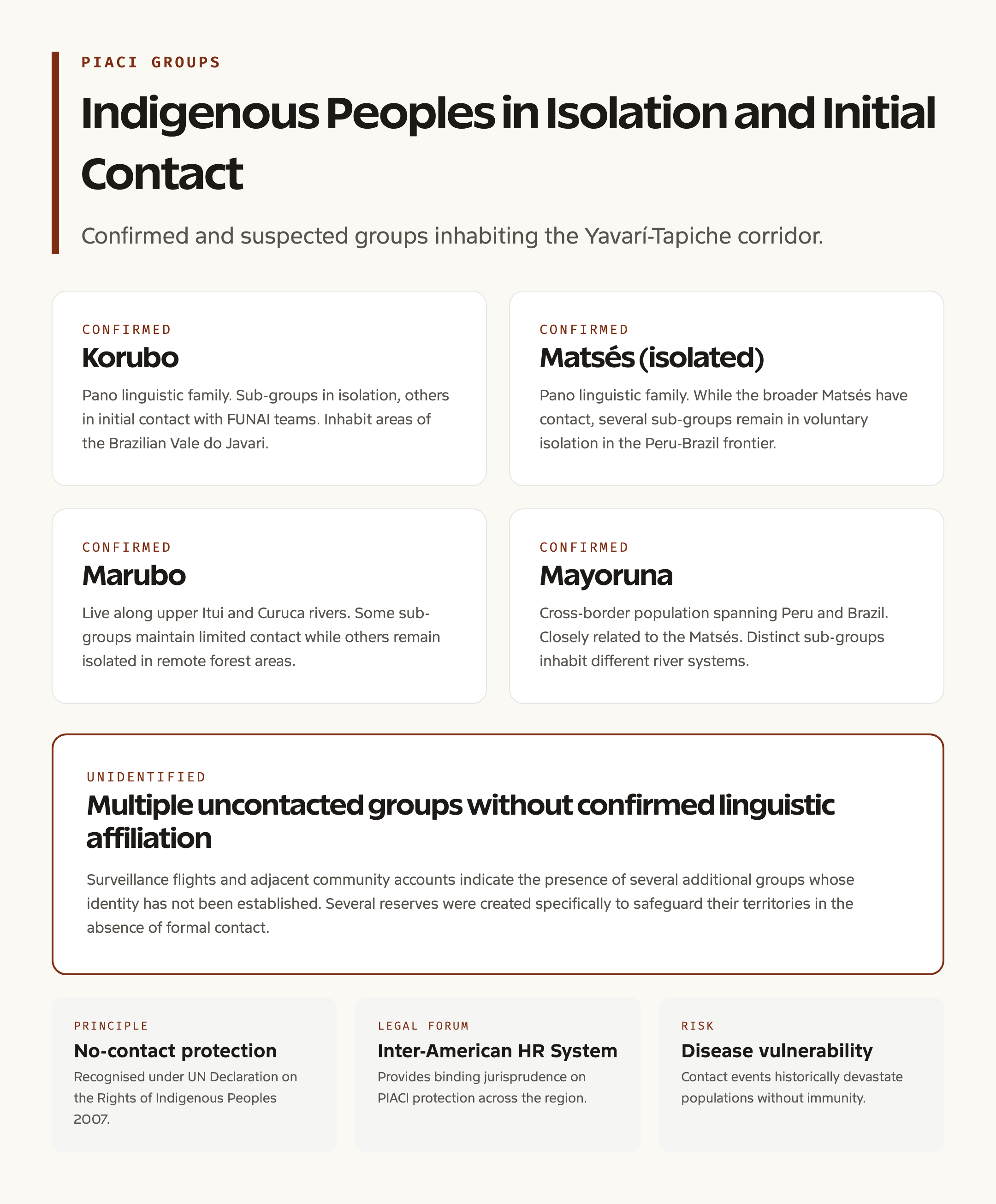
The corridor matters because it is one of the few large landscapes left on the planet where Indigenous peoples continue to live entirely on their own terms, by their own choices, without external contact. Their right to that life is enshrined in the UN Declaration on the Rights of Indigenous Peoples (2007), in the American Convention on Human Rights as interpreted by the Inter-American Court, and in domestic Peruvian, Brazilian, and Colombian statutes. The principle of “no contact” is the operational consequence of those rights.
Beyond the human rights frame, the corridor is climate-relevant. The Amazon biome is approaching a hypothesized tipping point where deforestation, fire, and warming could push significant portions from rainforest into savanna-like vegetation. Intact corridors like Yavarí-Tapiche are climate buffers. They store carbon, support water-cycle regulation across the Amazon, and maintain biodiversity that would otherwise be lost.
There’s an India angle worth drawing out. India’s forest rights framework under the FRA 2006 recognizes individual and community forest rights for Scheduled Tribes and other traditional forest dwellers. The challenges India faces, including weak ground-level enforcement, conflicting development pressures, and disputes over consent procedures, are structurally similar to what the Amazon countries face with PIACI protection. The South-South comparison is not perfect, but the policy lessons travel in both directions.
The biodiversity dimension also ties into India’s submissions to the Convention on Biological Diversity and the global 30×30 target of protecting 30 percent of land and sea area by 2030. Transboundary corridors like Yavarí-Tapiche are exactly the high-priority landscapes that the 30×30 framework was designed to safeguard.
Detailed Analysis
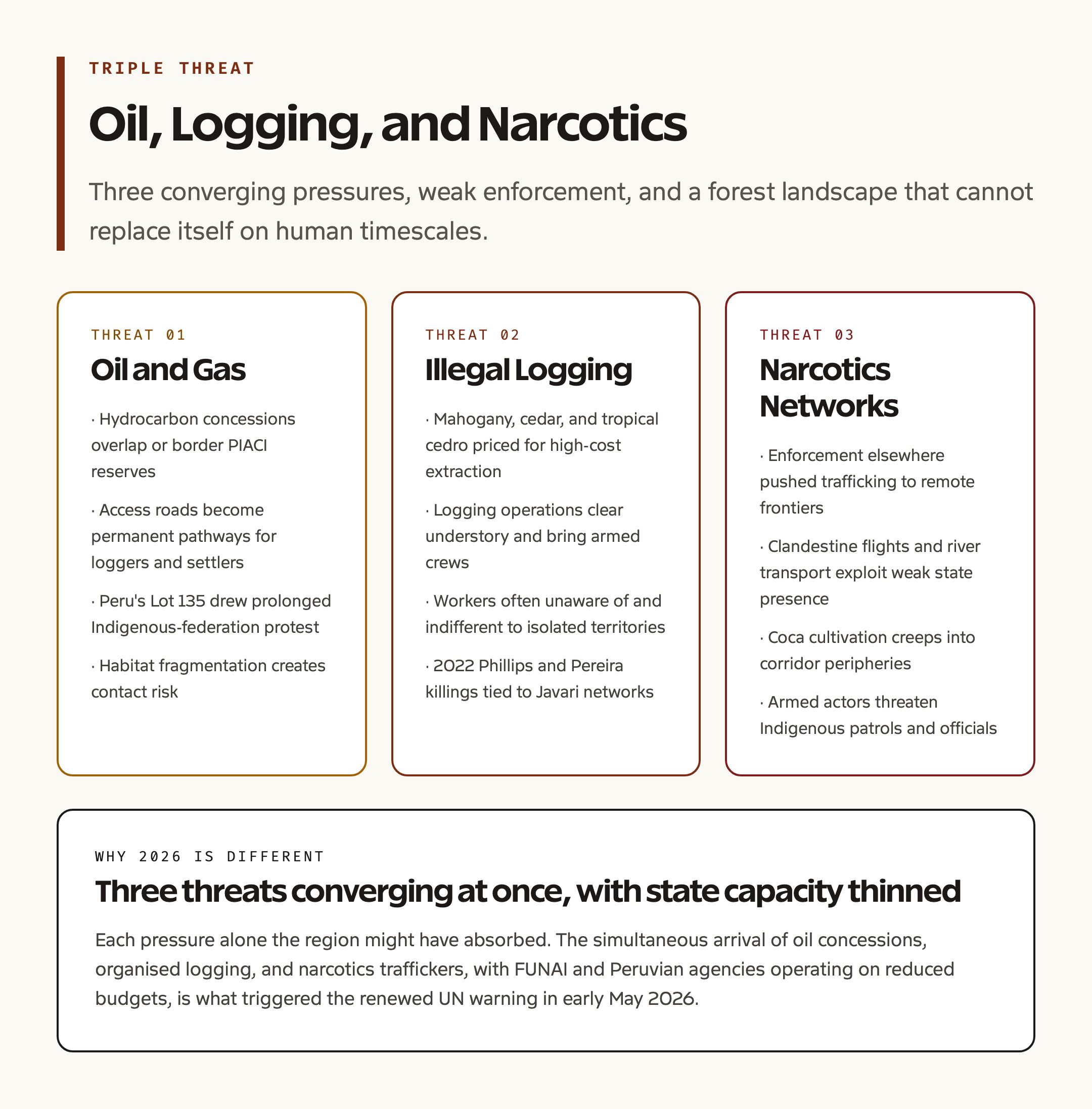
The triple threat facing Yavarí-Tapiche, oil, logging, and narcotics, each operates on a different logic but reinforces the others.
Oil and gas: Peruvian and Brazilian governments have historically issued hydrocarbon concessions covering portions of the corridor or its buffer zones. Lot 135 and adjacent concessions in Peru’s Loreto region have drawn sustained protest from Indigenous federations. When oil access roads cut through forest, they create permanent pathways for loggers, hunters, and settlers, fragmenting habitat and creating contact risk.
Illegal logging: Tropical hardwoods, including mahogany, cedar, and tropical cedro, fetch prices that justify the high logistics cost of extracting them from remote Amazon stands. Logging operations clear understory, build winch trails, and bring in workers who often have no knowledge of and no incentive to respect isolated Indigenous territories. The 2022 murder of British journalist Dom Phillips and Indigenous expert Bruno Pereira in the Javari Valley was widely linked to illegal fishing and trafficking networks operating in the area, and the underlying lawlessness has not been resolved.
Narcotics trafficking: As Colombia and Peru tightened enforcement in established trafficking corridors, networks shifted toward remoter frontiers. The Yavarí-Tapiche region, with its weak state presence and dense forest cover, became attractive for clandestine flights, river transport, and coca cultivation in periphery zones. Narcotics actors arrive armed and have repeatedly threatened or attacked Indigenous patrols and government officers.
The compounding effect is what makes the situation in 2026 distinct from earlier decades. Each threat alone the region might have withstood. Three converging threats with limited state capacity to respond is a different problem.
Comparative Perspective
| Region | Country | Approximate Area | Primary Threats | Enforcement Strength |
|---|---|---|---|---|
| Vale do Javari | Brazil | 8.5 million ha | Logging, fishing mafia, gold mining | Weak after FUNAI capacity cuts |
| Yavarí Mirín / Yavarí-Tapiche Reserves | Peru | Several million ha (combined) | Oil concessions, logging, narcotics | Patchy, dependent on federations |
| Putumayo Reserves | Colombia | Smaller scale | Armed groups, coca, deforestation | Conflict-affected, mixed |
| Madre de Dios | Peru | Smaller scale | Illegal gold mining | Mixed |
| Niyamgiri | India (Odisha) | Smaller scale | Mining, displacement | Strong post-Supreme Court verdict, contested |
The Indian comparison illustrates that even well-known cases involve persistent conflict between extraction, tribal rights, and conservation. The Niyamgiri case under the FRA framework is a useful reference for understanding how community consent mechanisms can work when judicial backing is strong.
Challenges and Concerns
The principal challenge in Yavarí-Tapiche is enforcement capacity. Funding for Brazil’s FUNAI, the agency responsible for monitoring isolated groups, has been thin for years. Peru’s enforcement capacity is similarly limited and depends heavily on Indigenous federations doing the on-ground work. Colombia’s frontier with the region is influenced by post-conflict dynamics and the presence of dissident armed groups.
A second challenge is contradictory state policy. National governments simultaneously protect Indigenous land and issue resource concessions in or near it. The legal architecture exists. Implementation conflicts undercut it.
A third challenge is climate change itself, which is altering rainfall patterns across the Amazon, drying parts of the basin, and increasing fire frequency. Even without direct human pressure, the corridor’s ecological integrity faces stress.
For India, the watching brief is that similar contradictions appear in its own forest landscape, particularly in tribal-majority districts where mining, infrastructure, and forest rights regularly collide. The Forest Conservation Amendment Act 2023 reshaped the boundaries of forest protection and triggered debate about the balance between conservation and development. The Amazon experience is a long-form case study in why getting that balance right matters.
Prelims Pointers
- The Yavarí-Tapiche corridor straddles Peru, Brazil, and Colombia in the western Amazon basin
- The corridor is approximately 16 million hectares in extent
- PIACI is the term for Indigenous Peoples in Isolation and Initial Contact
- The Vale do Javari is the second-largest Indigenous land in Brazil after the Yanomami land
- The UN Declaration on the Rights of Indigenous Peoples was adopted in 2007
- Amazon Cooperation Treaty Organization (ACTO) is the inter-governmental body for Amazon basin cooperation
- The Yavarí River forms part of the Peru-Brazil border
- The corridor is among the highest-biodiversity zones in the Amazon, with significant mammal and amphibian endemism
Mains-Style Questions
- GS-I (Geography): Discuss the geomorphic and ecological significance of the Amazon basin with reference to the Yavarí-Tapiche Indigenous corridor. (250 words)
- GS-III (Environment): Analyse the contemporary threats to tropical rainforest landscapes inhabited by Indigenous peoples, drawing on the Yavarí-Tapiche case. Suggest a framework for transboundary conservation. (250 words)
- GS-II (International Relations): Examine the role of international bodies such as the United Nations and the Inter-American Court of Human Rights in protecting the rights of Indigenous peoples in transboundary contexts. (150 words)
- GS-I (Society): Compare the protection regimes for vulnerable forest-dwelling communities in India under the Forest Rights Act with the PIACI framework in the Amazon basin. (150 words)
Way Forward
The path forward for Yavarí-Tapiche runs through three reinforcing layers. The first is tri-national coordination. ACTO has the mandate but not the operational teeth. A dedicated joint mission with shared satellite monitoring, exchange of intelligence on trafficking networks, and synchronised patrolling along the shared rivers would multiply the impact of each country’s individual enforcement.
The second is funding for Indigenous federations themselves. Indigenous organisations such as Brazil’s UNIVAJA, Peru’s AIDESEP, and Colombia’s OPIAC have demonstrated that community-led monitoring works when adequately supported. Donor governments, including India in its modest role through South-South cooperation, can channel resources to these federations rather than building parallel external structures.
The third is legal and political support for buffer-zone integrity. National courts in all three countries have issued decisions backing Indigenous claims. The harder battle is ensuring that resource concession policies and infrastructure projects respect those decisions in practice. Strengthening prior, free, and informed consent procedures is the operational mechanism, and it’s an area where India’s forest rights jurisprudence offers useful comparative material.
Frequently Asked Questions
What is the Yavarí-Tapiche corridor?
The Yavarí-Tapiche corridor is a roughly 16-million-hectare transboundary region of the Amazon basin straddling Peru, Brazil, and Colombia. It is home to multiple Indigenous peoples in voluntary isolation and initial contact, and it contains some of the most biodiverse remaining rainforest on the planet.
Who are PIACI groups?
PIACI stands for Indigenous Peoples in Isolation and Initial Contact, the term used by the UN and Inter-American Human Rights System for groups that have chosen to avoid sustained contact with outside society. Several PIACI groups inhabit the Yavarí-Tapiche corridor, including Korubo, isolated Matsés sub-groups, and others whose identity has not been formally established.
What are the main threats to the corridor?
Illegal logging of tropical hardwoods, oil and gas concessions, narcotics trafficking networks, and illegal gold mining are the four principal threats. They reinforce each other because each opens forest access that the next exploits, and weak state enforcement across the three national jurisdictions allows the pressures to compound.
Why did the UN warn about the corridor in 2026?
A combination of accelerating deforestation in the Brazilian Javari valley, armed encroachment by loggers into Peruvian reserves, and the deeper penetration of narcotics trafficking into the tri-border area triggered a renewed UN warning in early May 2026. The agencies involved asked the three governments to coordinate response and increase enforcement funding.
How does the corridor compare with India’s forest protection regime?
India’s Forest Rights Act 2006 recognises individual and community forest rights for Scheduled Tribes and other traditional forest dwellers. The structural challenges, including weak ground-level enforcement, conflicting development pressures, and disputed consent procedures, parallel those facing PIACI protection in the Amazon. The legal architectures differ but the implementation problems rhyme.
What is ACTO and what role does it play?
The Amazon Cooperation Treaty Organization is an inter-governmental body of the eight Amazon basin countries that promotes coordination on environmental and social issues. ACTO’s role in Indigenous protection is advisory rather than enforcement, and strengthening its operational mandate is one of the policy options under discussion.
Are isolated Indigenous groups legally protected?
Yes. The right to voluntary isolation is recognised under the UN Declaration on the Rights of Indigenous Peoples, the Inter-American Human Rights System, and domestic statutes in Peru, Brazil, and Colombia. The principle of no contact is the operational consequence. Implementation is uneven because enforcement capacity has not kept pace with the threats.
How does the corridor connect to global climate goals?
The Amazon biome is approaching a hypothesised tipping point where deforestation, fire, and warming could shift significant portions from rainforest to drier vegetation. Intact corridors like Yavarí-Tapiche store carbon, regulate water cycles, and buffer biodiversity loss. Protecting them is directly aligned with global 30×30 conservation targets and Paris Agreement temperature objectives.