Dark Sky Reserves: Hanle, Pench, the Bortle Scale, and India’s Push to Protect the Night Sky
A complete UPSC GS-III explainer on Dark Sky Reserves and Dark Sky Parks. Covers the IDA framework, Hanle Dark Sky Reserve in Ladakh, Pench Tiger Reserve in Maharashtra, the Bortle scale, light pollution, astrotourism, and the policy implications for science, conservation, and culture.
For most of human history, the night sky was a shared inheritance. Every village, every coastline, every desert had the same canopy of stars overhead, and the Milky Way ran through it as a clear band of light. That has changed. Roughly four out of five people on Earth now live under a sky bright enough to wash out the Milky Way, and the proportion is rising. Light pollution doubles in many regions every decade. The global night, once the most universal thing humans had, is becoming a privilege of geography and altitude.
Dark sky reserves are an attempt to push back. They are protected zones where outdoor lighting is regulated, the night sky is monitored, and the surrounding landscape is enrolled in keeping the darkness. The idea began in North America in the 1990s, became formal under the International Dark-Sky Association, and has now spread to every inhabited continent, including India, where Hanle in Ladakh and Pench in Maharashtra hold the country’s first two designations.
For UPSC purposes, dark sky reserves cut across space technology, conservation, public health, and tourism. They also touch on India’s astronomy infrastructure and the wider question of how a developing country balances economic growth with environmental and scientific values. This article explains what a reserve is, why Hanle and Pench were chosen, how the Bortle scale works, and what comes next.
Quick Facts on Dark Sky Reserves
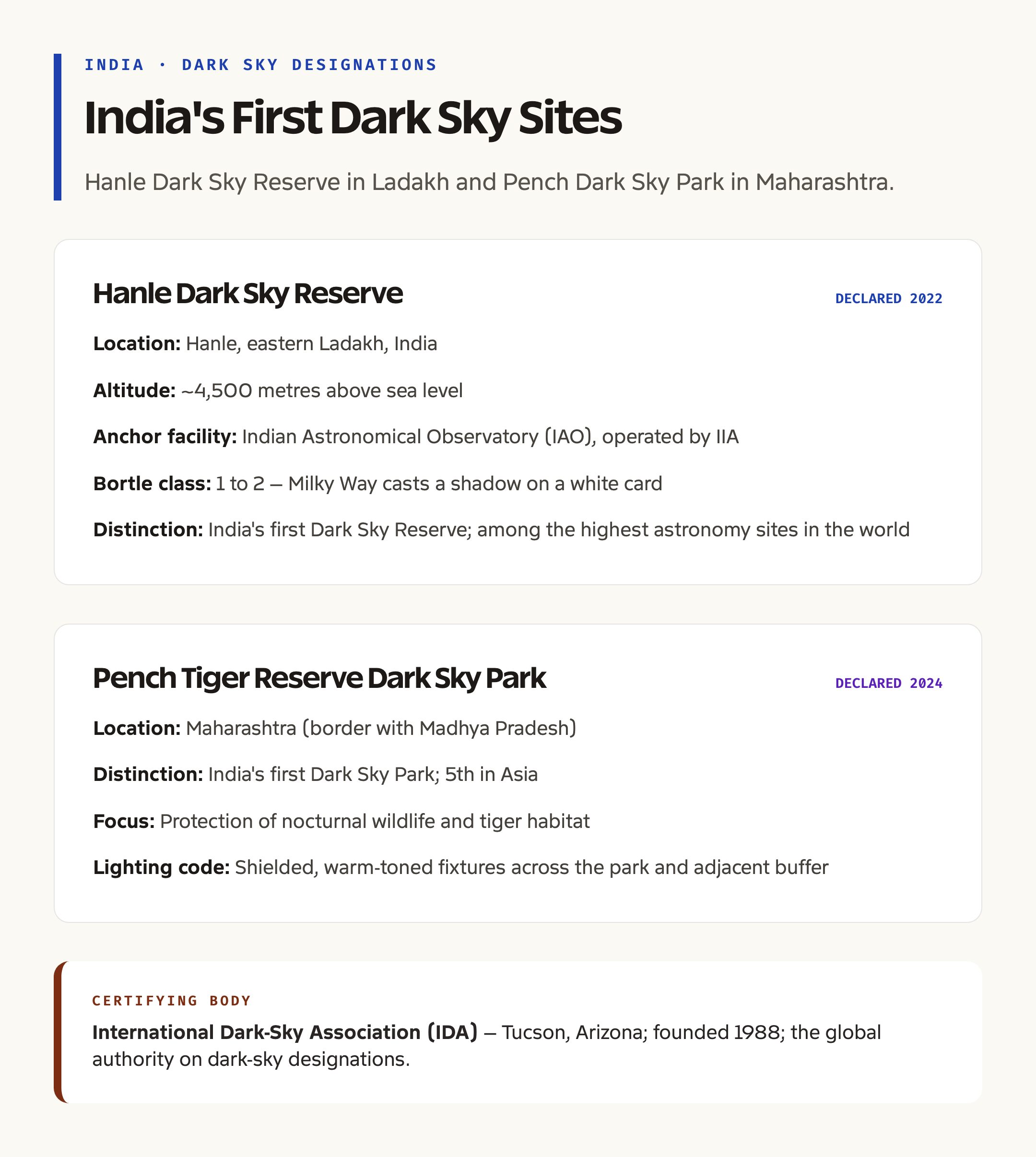
A dark sky reserve is a designation given to a public or private land area that has an exceptional quality of starry nights and a nocturnal environment, and that is protected for its scientific, natural, educational, cultural, and heritage value. The certifying body is the International Dark-Sky Association, IDA, a non-profit registered in the United States that has emerged as the de facto global authority on the subject.
Every reserve consists of two zones. A core area meets the strictest sky-quality and natural-darkness criteria and prohibits white light. A peripheral or buffer zone supports the core, allows limited lighting, and enforces strict rules on the kind of fixtures used, typically downward-facing warm-coloured lights with full shielding.
India has two major designations on the map. Hanle Dark Sky Reserve in Ladakh, declared in 2022, is the country’s first reserve, centred on the Indian Astronomical Observatory at an altitude of about 4,500 metres. Pench Tiger Reserve in Maharashtra became India’s first Dark Sky Park in 2024, the fifth in Asia, with a focus on protecting nocturnal wildlife rather than astronomy infrastructure. Other Indian sites, including Nubra Valley and parts of Spiti, are under early consideration.
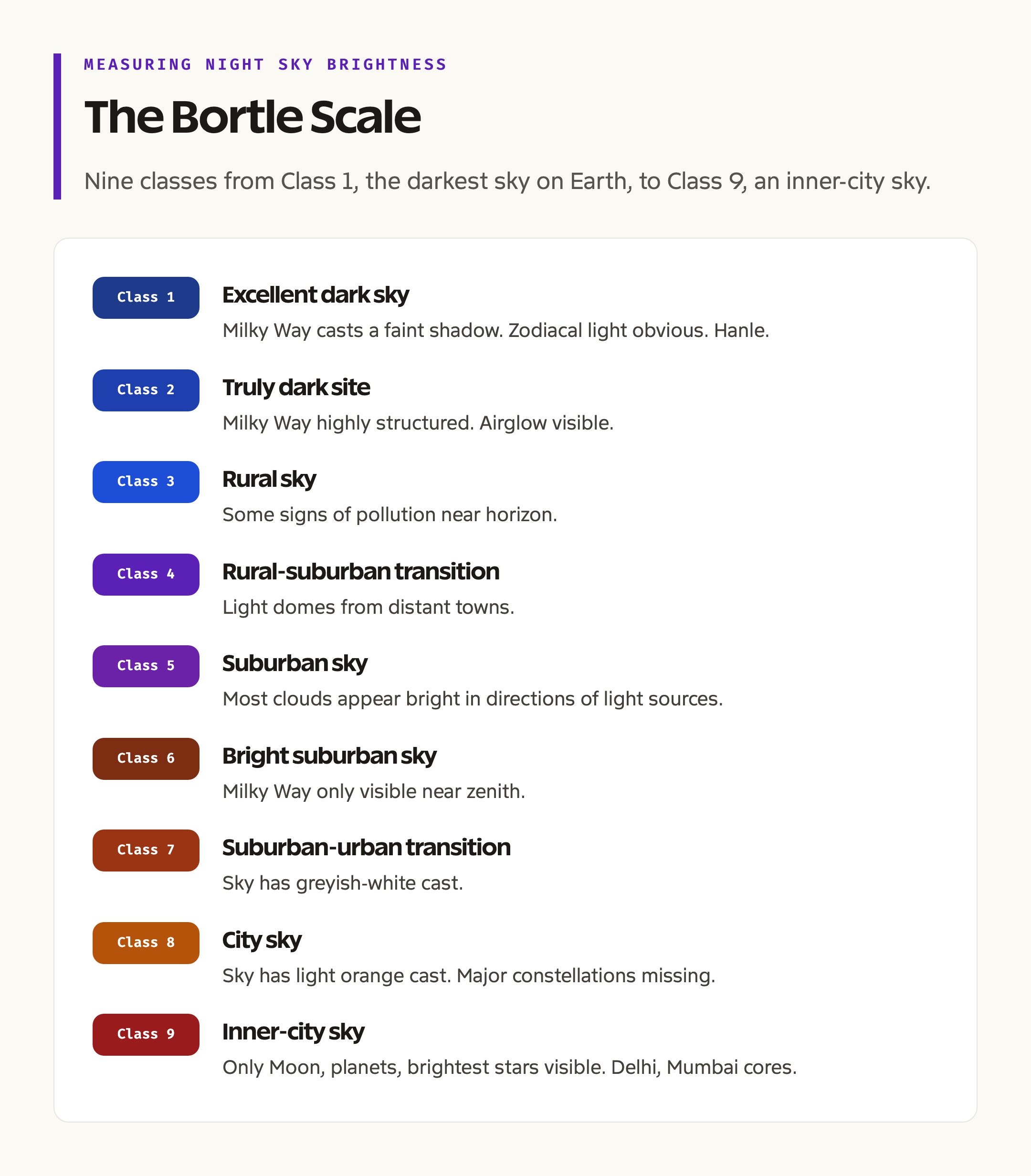
The reference instrument for measuring sky darkness is the Bortle scale, a nine-class system from Class 1, the darkest skies on Earth, to Class 9, an inner-city sky where only the brightest objects survive the glow. Hanle is consistently a Class 1 to 2 site. The cores of most Indian metros are Class 8 to 9.
What a Dark Sky Reserve Actually Protects
The point of a reserve is not nostalgia. It is a working measure to preserve scientific access to the cosmos, to protect ecosystems that depend on natural night, and to safeguard a cultural inheritance that has anchored human ritual and storytelling for millennia.
Astronomy is the most direct beneficiary. Optical telescopes are sensitive to the brightness of the sky background. Each magnitude of sky glow erases a band of faint objects from view. The faintest galaxies, the deepest exoplanet transits, and the slowest-moving outer solar system bodies can only be observed where the sky is genuinely dark. Modern observatories therefore concentrate at high altitude in dry, low-population areas, and a formal reserve gives the surrounding region a legal and social framework to keep light away.
Ecology is the second beneficiary. Night light disorients migratory birds, suppresses sea turtle hatchling navigation to the surf, depresses moth populations that pollinate night-blooming plants, and disrupts predator-prey timing for nocturnal mammals. A dark reserve, particularly one centred on a tiger reserve like Pench, protects the working night that wildlife depends on.
Public health and energy efficiency are the third group. Excessive blue-rich outdoor lighting suppresses melatonin production in nearby residents and is associated, in growing literature, with sleep disruption and downstream health risks. Poorly designed lights also waste large amounts of electricity by sending photons sideways and upward where they serve no purpose. A reserve’s lighting code typically saves municipal energy as a side benefit.
Background and Historical Context
The push to formally protect dark skies began in North America in the late twentieth century. The International Dark-Sky Association was founded in 1988 in Tucson, Arizona, by astronomers and lighting professionals who saw observatories around the world losing their best skies to growing cities. Tucson itself became a model municipality, adopting one of the earliest dark-sky lighting codes in the United States.
The first International Dark Sky Park, Natural Bridges National Monument in Utah, was certified in 2007. The first International Dark Sky Reserve, Mont-Megantic in Quebec, followed in 2007, and Aoraki Mackenzie in New Zealand and the Brecon Beacons in Wales joined soon after. By the early 2020s, the global tally of certified dark sky places had crossed two hundred.
India’s serious engagement began with high-altitude astronomy. The Indian Astronomical Observatory at Hanle, set up in 2001 on a mountaintop in Ladakh, hosts the Himalayan Chandra Telescope and a growing cluster of optical and gamma-ray instruments. By the late 2010s, the Indian Institute of Astrophysics, the Union Territory of Ladakh, and the Department of Science and Technology began coordinating to formalise dark-sky protection around the observatory. The Hanle Dark Sky Reserve was announced in late 2022, with a six-radius buffer covering villages and graziers.
Pench’s designation came two years later. Where Hanle was driven by science, Pench was driven by wildlife. The reserve straddles Madhya Pradesh and Maharashtra, hosts a tiger population, and supports a complex nocturnal community of leopards, owls, civets, and small mammals. The IDA’s Dark Sky Park category fit better than the Reserve category because the focus was protecting habitat, not supporting a research telescope.
Key Features of the Indian Sites
Hanle Dark Sky Reserve sits in the cold high desert of eastern Ladakh, near the Indian-Tibetan plateau border. The altitude of 4,500 metres places it above most of the Earth’s atmospheric water vapour. The annual count of clear nights is among the highest in the world, comparable to the best Chilean and Hawaiian observatory sites. The Hanle village panchayat and the surrounding hamlets have agreed to a lighting code that uses warm, downward-shielded lights, switches off non-essential illumination after a fixed hour, and allows astrotourism only with red-filtered torches.
Pench Tiger Reserve takes a different approach. The lighting concerns are less about a single observatory and more about the perimeter villages, the highway that bisects part of the buffer, and the seasonal tourist lodges. The Maharashtra side of Pench, where the dark sky park is centred, has retrofitted lights at field stations and has begun working with adjacent villages to shift street lighting to fully shielded fixtures.
Several other Indian sites are early candidates. Nubra Valley, also in Ladakh, hosts smaller observatories and a vast natural buffer. Pangong Tso has darkness but logistical challenges. Spiti has both altitude and terrain. Astrotourism operators in Uttarakhand have proposed sites in the upper Garhwal region, although light from religious centres limits options. Inland Maharashtra and Madhya Pradesh, where Pench sits, have potential for further park designations.
Why Dark Sky Reserves Matter for India
India’s astronomy programme depends on optical access to the sky. The Hanle site complements the radio telescopes of the Giant Metrewave Radio Telescope near Pune, the X-ray observations from AstroSat and XPoSat, and India’s emerging participation in the Thirty Meter Telescope project. A formal reserve gives the Hanle infrastructure long-term protection against future growth in surrounding villages and from possible road or military installations.
Tourism and rural livelihoods are a second reason. Astrotourism in Ladakh has grown sharply since 2019, with home-stays in Hanle, Tso Moriri, and adjacent villages drawing visitors who specifically want a Bortle-1 sky. The reserve framework formalises this. It gives villages an economic stake in keeping the night dark.
Wildlife, again, is the third strand. Night light spills well beyond the immediate source. Studies in Indian protected areas show that highway lighting and tourist resorts can shift the activity patterns of leopards, sloth bears, and small carnivores by hours. A park-grade designation creates a framework for monitoring and remediation.
Cultural identity is the fourth, and most under-discussed, reason. Indian astronomy has a long history, from the observations of the Indian Astronomical Tradition to the Jantar Mantar instruments. The night sky is a shared cultural heritage that connects modern India to its ancient observers. Protecting it is a form of intangible heritage conservation, even if it does not show up in the standard policy categories.
The Bortle Scale and Light Pollution Metrics
The Bortle scale, named after amateur astronomer John Bortle, is the most widely used qualitative scale for night sky brightness. Class 1 is an excellent dark sky, where the Milky Way casts a faint shadow on a white card, and the zodiacal light is obvious. Class 2 is a typical truly dark site, where the Milky Way is highly structured. Class 3 is a rural sky. Class 4 is rural-suburban. Class 5 is suburban. Class 6 to 7 are bright suburban and suburban-urban. Class 8 is city sky. Class 9 is inner-city sky, where only the moon, the bright planets, and a few first-magnitude stars survive the glow.
Quantitatively, sky brightness is measured in magnitudes per square arc second. Hanle records values around 21.7 to 22.0 magnitudes per square arc second on good nights, comparable to the best world sites. Delhi and Mumbai cores typically register around 17 to 18, which means the sky is roughly fifty to a hundred times brighter than at Hanle.
Sky-quality meters, or SQMs, are the standard handheld device for these measurements. They are inexpensive, citizen-science friendly, and deployable across a reserve. The annual reporting required of an IDA-certified site uses SQM data and supplementary photographic imaging to confirm that the buffer is being kept dark.
Comparative View: Reserve, Park, Sanctuary, Community
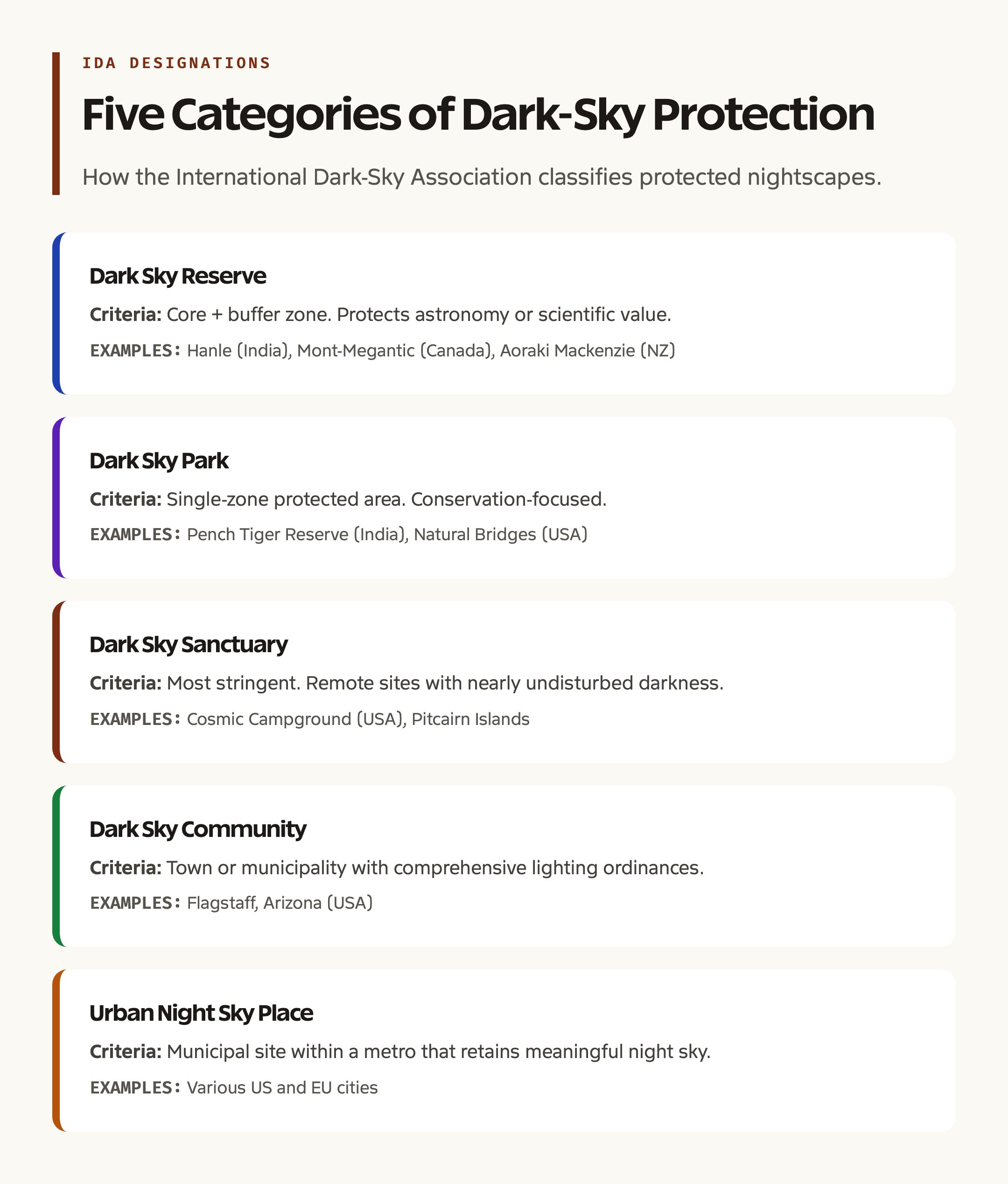
The IDA recognises five main designations, each with different criteria. A Dark Sky Reserve is a public or private land area that has an exceptional quality of starry nights and a defined buffer zone whose policies and lighting controls are designed to protect the core. Mont-Megantic, Aoraki Mackenzie, and Hanle are reserves.
A Dark Sky Park is a public or private land area whose lands are designated for natural conservation, where dark skies are part of the experience offered to visitors. Pench is a park.
A Dark Sky Sanctuary is the most stringent designation, applied to land in remote regions with nearly undisturbed darkness and minimal threats from light pollution. The Cosmic Campground in New Mexico and the Pitcairn Islands are sanctuaries.
A Dark Sky Community is a town or municipality that has adopted comprehensive outdoor lighting ordinances and educates residents on dark-sky values. Flagstaff in Arizona was an early example.
A fifth category, Urban Night Sky Place, recognises municipal sites within a metropolitan area that maintain a meaningful experience of the night sky despite their setting.
Challenges Facing the Programme in India
Light pollution in India is rising fast. The Atlas of the World’s Artificial Night Sky Brightness has documented sharp increases over the past decade, particularly along the Gangetic plain, the western coast, and the Deccan urban corridor. Villages near reserves face pressure from highway expansion, mobile-tower lighting, and the standard upgrade from low-pressure sodium streetlights to bright cool-white LEDs that are cheaper but worse for the night sky.
Awareness is uneven. Most Indian municipal lighting authorities procure fixtures based on lumen output and cost, with no specification on shielding, colour temperature, or curfew control. The result is widespread skyglow even in moderate-sized towns. Building a national lighting code that requires shielded, warm-toned fixtures for outdoor use would do more for dark skies than any number of new reserves.
Enforcement around existing sites is the second challenge. Hanle’s buffer depends on the cooperation of village panchayats and the Ladakh administration. Pench depends on coordination across two state governments. Both are workable but require continuous effort and clear central guidance, which India does not yet have.
Finally, climate change is altering the high-altitude conditions that make sites like Hanle scientifically valuable. Increased dust transport from regional sources, changing snow and humidity patterns, and possible shifts in atmospheric stability will all need to be tracked over decades.
Prelims Pointers
The International Dark-Sky Association is a US-based non-profit, not a UN body. Hanle Dark Sky Reserve is in Ladakh, not in Himachal Pradesh, and is centred on the Indian Astronomical Observatory operated by the Indian Institute of Astrophysics. Pench Tiger Reserve, designated India’s first Dark Sky Park, straddles Madhya Pradesh and Maharashtra, with the dark sky designation centred on the Maharashtra side. The Bortle scale runs from Class 1, darkest, to Class 9, brightest, not the other way round. Sky brightness in scientific units is measured in magnitudes per square arc second, with higher values indicating darker skies. A reserve has a core and a buffer; a park is single-zone but conservation-focused; a sanctuary is the most stringent.
Mains Practice Questions
- Examine the scientific, ecological, and cultural rationale for protecting dark skies. How does the Indian designation of Hanle and Pench fit within this framework? (250 words)
- Light pollution is an under-recognised environmental hazard in India. Discuss its sources, its effects on biodiversity and human health, and the policy measures available to mitigate it. (250 words)
- Astronomy infrastructure depends on dark, dry, high-altitude sites. Evaluate the role of Hanle within India’s space and astronomy strategy and suggest ways to make Indian astronomy more competitive globally. (250 words)
Way Forward
A national outdoor lighting code, modelled on the IDA’s standards but adapted to Indian conditions, would be the single most useful policy step. It would specify shielding requirements, maximum colour temperature, curfew rules for non-essential illumination, and procurement defaults for municipal and highway lighting.
Expanding the network of reserves, parks, and sanctuaries should follow. Nubra, Spiti, parts of Uttarakhand, and inland Madhya Pradesh are plausible candidates. Each new designation should be paired with citizen-science monitoring using sky-quality meters and a clear local economic strategy linking astrotourism to village livelihoods.
Strengthening the institutional base is the final step. The Department of Science and Technology, the Indian Institute of Astrophysics, the Ministry of Environment, Forest and Climate Change, and the relevant state governments need a standing coordination mechanism so that astronomy, conservation, and tourism interests do not pull a reserve in three different directions. India’s first decade with formal dark sky designations has gone well. The next decade is where the framework will be tested.
Frequently Asked Questions
What is a Dark Sky Reserve?
A Dark Sky Reserve is a designation given by the International Dark-Sky Association to a public or private land area that has an exceptional quality of starry nights and a nocturnal environment, and that is protected for its scientific, natural, educational, cultural, and heritage value. Each reserve consists of a core area with the strictest darkness criteria and a buffer zone with regulated lighting.
Where is India’s first Dark Sky Reserve?
India’s first Dark Sky Reserve is Hanle, in eastern Ladakh, declared in late 2022. It is centred on the Indian Astronomical Observatory at an altitude of about 4,500 metres and operated by the Indian Institute of Astrophysics.
What is the difference between a Dark Sky Reserve and a Dark Sky Park?
A Dark Sky Reserve has a core area and a regulated buffer, designed primarily to protect a research-grade astronomy or scientific value. A Dark Sky Park is a single-zone protected area where dark skies are part of the conservation and visitor experience. Hanle is a reserve, Pench Tiger Reserve is India’s first Dark Sky Park.
What is the Bortle scale?
The Bortle scale is a nine-class system that classifies the night sky from Class 1, an excellent dark sky where the Milky Way casts a shadow, to Class 9, an inner-city sky where only the moon and a few bright objects are visible. Hanle is consistently Class 1 to 2; Indian metro cores are typically Class 8 to 9.
Who certifies dark sky reserves?
The International Dark-Sky Association, a non-profit founded in 1988 in Tucson, Arizona, is the global certifying body for dark sky reserves, parks, sanctuaries, communities, and urban night sky places.
What is special about Hanle?
Hanle sits at about 4,500 metres altitude in the cold high desert of Ladakh, with one of the highest counts of clear nights of any astronomy site on Earth. It hosts the Indian Astronomical Observatory and the Himalayan Chandra Telescope, and has the cooperation of surrounding villages on a dark-sky lighting code.
Why was Pench chosen as India’s first Dark Sky Park?
Pench was chosen because it combines a major tiger habitat with a working framework for buffer-zone management. The Dark Sky Park designation protects nocturnal wildlife from light intrusion and gives the reserve a tool to coordinate lighting across adjacent highways, villages, and tourist lodges.
Does light pollution affect human health?
A growing body of research links excessive blue-rich nighttime lighting with melatonin suppression, sleep disruption, and downstream health effects. The case for warm, shielded outdoor lighting is therefore as much about public health as about astronomy or ecology.
How can ordinary citizens contribute to dark sky preservation?
Use shielded, warm-coloured outdoor lights at home, avoid sky-pointing decorative lighting, support municipal lighting reform, and contribute citizen-science data using sky-quality meters or apps that report sky brightness from a smartphone. Visiting and supporting designated reserves also reinforces the local economic case for keeping skies dark.
Are there plans for more dark sky designations in India?
Yes. Nubra Valley and Spiti in the Himalayan belt, parts of inland Maharashtra and Madhya Pradesh, and pockets of Uttarakhand are all in early discussion. Whether new designations come through depends on local administration interest, surrounding lighting conditions, and the willingness of state governments to commit to a buffer-zone framework.