Determinants of Ethicality of an Action — Six Tests + Real-Life Interaction (UPSC GS IV)
Six determinants that decide whether an action is ethical — deliberate action, purpose, object, circumstances, consequence, means — and how they overlap, vary or contradict in real life.
When a civil servant signs a file, she is performing an action. Whether that action is ethical depends on more than her good intentions. UPSC GS-IV expects an aspirant to know the six determinants of ethicality and — equally — how those determinants overlap, vary, or contradict in lived administrative reality. This guide consolidates the compass extracts on Determinants of Ethics and Relation between Various Determinants in Real Life into one shippable Mains resource.
Editorial note — merge. This article merges the compass chapters Determinants of Ethics/Ethicality of an Action by an Agent (57 words) and Relation between Various Determinants in Real Life (64 words). The two are sister stubs — the second simply applies the first — and merging produces a coherent argument rather than two padded shells.
What Makes an Action Ethical?
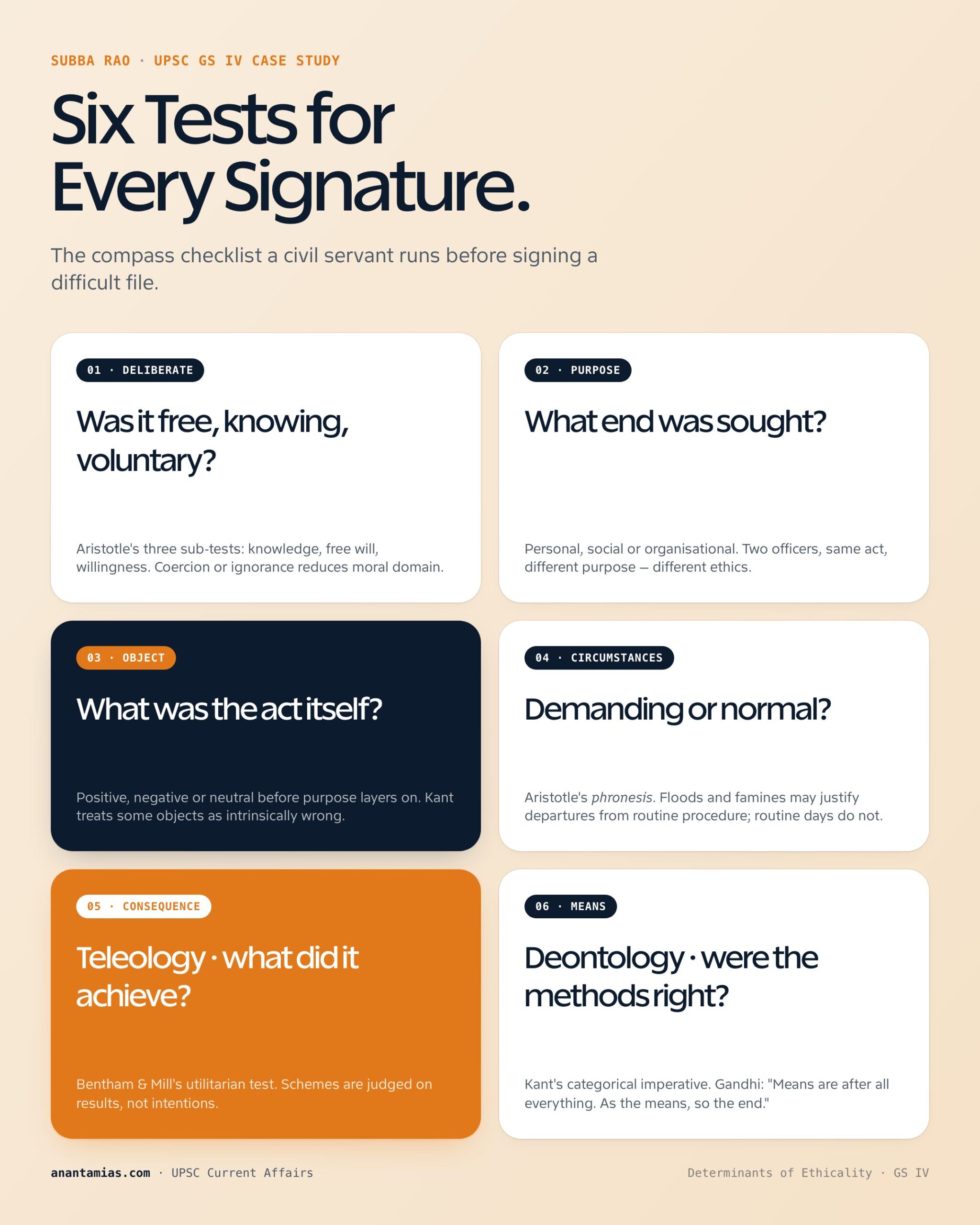
An action is ethical when it survives a structured test on six dimensions. Borrowed from Catholic moral theology, refined by Subba Rao in his GS-IV textbook, and echoed in Lewis Vaughn's Doing Ethics, these six determinants give a candidate a reusable analytical instrument.
| Determinant | The Test It Asks |
|---|---|
| Deliberate human action | Was it free, knowing, voluntary? |
| Purpose | What end was sought? |
| Object | What kind of act was it intrinsically? |
| Circumstances | What were the surrounding facts? |
| Consequence / End | What did it actually achieve? |
| Means | Were the methods themselves ethical? |
If even one determinant fails, the overall ethicality of the action is compromised.
1. Deliberate Human Action
The most basic precondition. An action is eligible for ethical evaluation only if three sub-conditions hold:
- Knowledge — the agent knew what she was doing.
- Free will / option — the agent could have done otherwise.
- Voluntariness / willingness — the agent chose to act.
A reflex action, an act under coercion, or an act done in genuine ignorance is not in the moral domain. Aristotle's Nicomachean Ethics makes this point by separating voluntary, involuntary and non-voluntary action.
"A man is the source of his actions; deliberation is about the things he himself can do." — Aristotle, Nicomachean Ethics, Book III
For administrators this matters in three places.
- A young officer forced under duress by a politically powerful figure has reduced moral culpability — but is not absolved if she could have resisted at acceptable cost.
- An officer who did not know of an irregularity she signed off on is judged by should she have known?
- An officer who acted unwillingly but did not exit the role retains responsibility for the role's actions.
2. Purpose (Intention)
Purpose answers why did the agent do it? Purpose can be personal, social or organisational.
- Personal purpose — keeping one's job, advancing one's career, protecting one's family.
- Social purpose — securing public welfare, protecting the marginalised.
- Organisational purpose — meeting a target, executing a scheme, safeguarding institutional reputation.
Two officers may perform the same external action with different purposes — and the ethics differ. A whistle-blower exposes corruption to clean the system (social purpose) vs. to settle a personal score with a senior (personal purpose). The act looks identical from outside; the ethical weight is different.
"A good intention clothes itself with sudden power." — R.W. Emerson
3. Object (Nature of the Act Itself)
The object is the act considered in itself, before purpose and consequence are layered on. It can be:
- Positive — saving a life, telling the truth, paying wages owed.
- Negative — killing the innocent, lying, stealing.
- Neutral — reading a file, making a phone call, attending a meeting.
Some ethical traditions — notably Kantian deontology — hold that certain objects are intrinsically wrong (lying, murder, breaking a promise) regardless of purpose or consequence. Others — utilitarianism — deny intrinsic wrongness and weigh objects only by consequence. Indian dharma takes a context-sensitive middle path.
For a civil servant, the operating rule is: the object of the action must be at least neutral, and ideally positive, before the other determinants can rescue it.
4. Circumstances
The same object, performed in different circumstances, can be ethical or unethical.
- Demanding circumstances — emergencies, scarce resources, time pressure, life-at-stake — may justify departures from routine procedure (e.g., commandeering vehicles during a flood).
- Normal circumstances — fully resourced, routine, unhurried — give no such justification; routine procedure is the standard.
Aristotle calls this practical wisdom (phronesis) — the situational judgement that knows when and how to apply general rules.
A poor man stealing bread to feed his starving children operates under demanding circumstances; a granary clerk diverting PDS rations under no such pressure operates under normal circumstances. The objects are similar; the ethics are not.
5. Consequence / End — The Teleological Test
Teleology (from Greek telos, end) asks: did the action produce good outcomes? It is the utilitarian test — the greatest happiness for the greatest number — most fully developed by Jeremy Bentham and John Stuart Mill.
"Actions are right in proportion as they tend to promote happiness; wrong as they tend to produce the reverse of happiness." — John Stuart Mill, Utilitarianism
In administration the consequence test is unavoidable: schemes are evaluated by outcomes, not intentions. Aadhaar, PMJDY, Swachh Bharat, the Aspirational Districts Programme — each is judged on results.
The danger of pure teleology is that it can justify unjust means if the outcome is good. Hence the need for the next determinant.
6. Means — The Deontological Test
Deontology (from Greek deon, duty) asks: were the means themselves right? It is most fully developed by Immanuel Kant.
"Act only according to that maxim by which you can at the same time will that it should become a universal law." — Immanuel Kant, Groundwork of the Metaphysics of Morals
Kant's categorical imperative demands that we treat persons always as ends in themselves, never merely as means.
For Indian aspirants, Gandhi's position is the best Indian articulation:
"They say means are after all means. I would say means are after all everything. As the means, so the end." — M.K. Gandhi, Young India (1924)
A scheme that delivers food to the poor by humiliating them in queues fails the means test even if it passes the consequence test.
How the Determinants Relate in Real Life
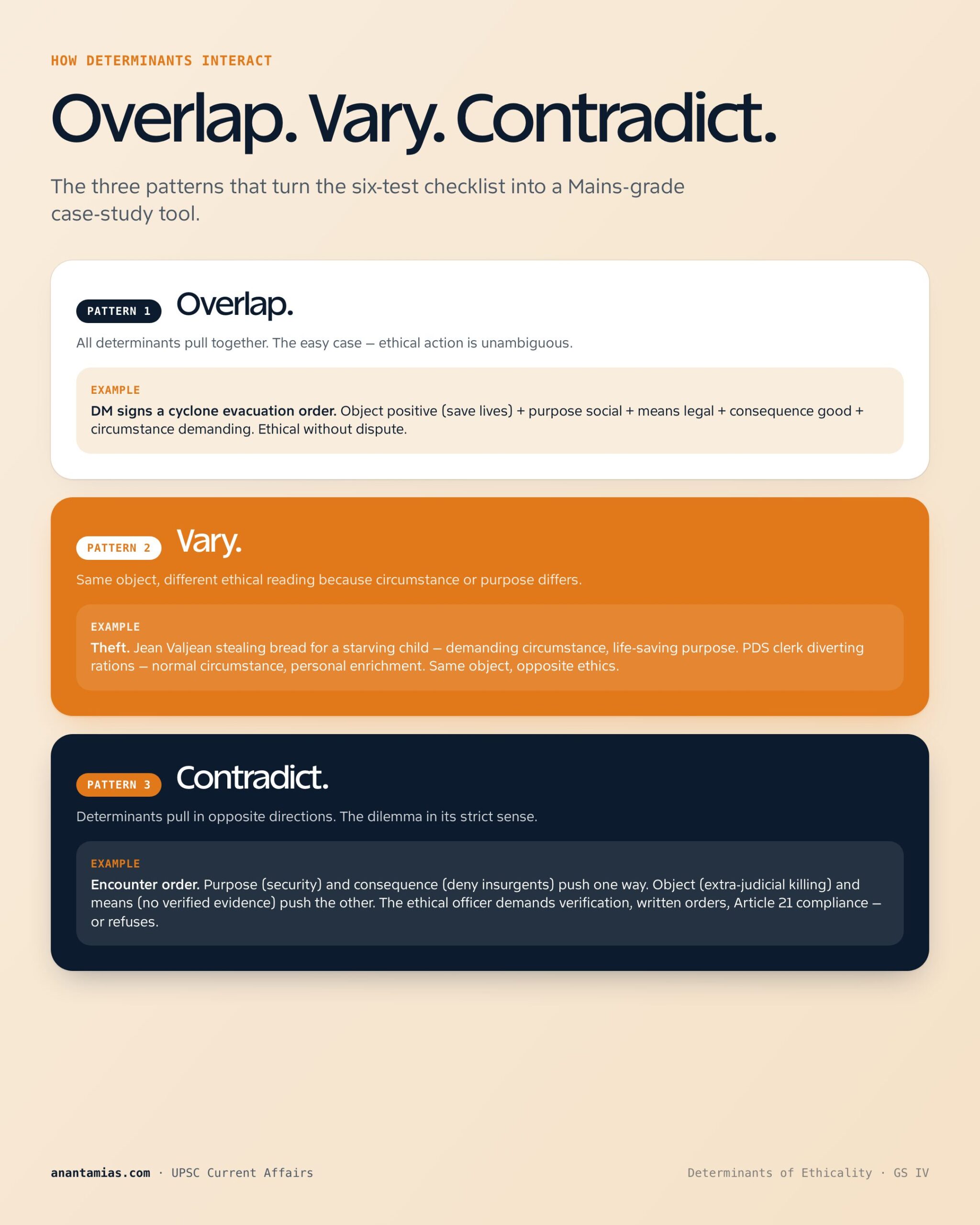
The compass extract on Relation Between Various Determinants in Real Life identifies three patterns: overlap, variation, and contradiction.
Pattern 1 — Overlap
Two or more determinants operate at the same time and pull together. This is the easy case.
- A district magistrate signs an evacuation order during a cyclone. Object (positive — save lives) + Purpose (social welfare) + Consequence (lives saved) + Means (procedurally legitimate) + Circumstance (genuinely demanding) all align. The act is unambiguously ethical.
- An honest officer registers an FIR against a politically connected accused. Object (uphold law), Purpose (justice), Means (legal due process), Consequence (deterrence) all overlap. Ethical, even if costly.
The compass example is striking: the duty to follow procedural guidelines while implementing a government scheme may overlap with the compassion within a civil servant. When duty and conscience align, action is uncomplicated.
Pattern 2 — Variation
The same object produces a different ethical reading because circumstances or purposes differ.
- Theft of food by a starving father to feed a dying child — the object (theft) is wrong, but circumstance (demanding), purpose (preserving life) and consequence (life saved) tilt the ethical reading toward forgiveness, even if not approval. Jean Valjean in Hugo's Les Misérables dramatises this case.
- Theft under PDS by an official — the object is the same (theft), but circumstance (normal), purpose (personal enrichment), means (abuse of office) and consequence (harm to the poor) tilt the reading toward unambiguous condemnation.
For UPSC, this is the prototype for case-study answers: identify which determinant is doing the moral work in the given situation.
Pattern 3 — Contradiction
Determinants pull in opposite directions. This is the ethical dilemma in its strict sense.
- Saving the life of the king (purpose) by sacrificing the lives of soldiers (means). The purpose is positive; the means are deeply problematic. Indian epics — Mahabharata's Yudhishthira in the Drona episode — confront precisely this.
- Trolley problem in modern ethics: divert a runaway tram to save five lives at the cost of one — purpose and consequence point one way; means (using a person as a means) point the other.
- Bhopal gas tragedy and the question of extradition — the consequence (justice for victims) and the means (international legal due process) have struggled against each other for forty years.
When determinants contradict, the reflective civil servant asks: which determinant is most important in this case, and why? — and is prepared to publicly defend her answer.
Two Indian Case Studies
Case 1 — The Health Officer During COVID-19
A District Health Officer in 2021 had to decide whether to divert oxygen cylinders from a private hospital with empty beds to a government hospital with patients dying. The object (commandeering private property) was problematic; circumstance (demanding) was extreme; purpose (saving lives) was unambiguously social; means (Disaster Management Act, 2005, and DM's executive order) were legally available; consequence (lives saved) was high. The determinants overlapped. The act was ethical.
Case 2 — The IAS Officer and the Encounter Order
An officer is asked, during anti-Naxal operations, to authorise an unverified intelligence-based action that may result in deaths. Purpose (security) and consequence (denial of insurgent operations) push one way. Object (potential extra-judicial killing) and means (action without verified evidence) push the other. Determinants contradict. The ethical officer demands verification, written orders through proper hierarchy, and rules of engagement that respect Article 21. If the system cannot supply these, the officer's duty is to refuse — through proper channels — and accept the personal cost.
UPSC Syllabus Relevance
GS-IV Section A asks about ethical issues in private and public relationships; human values; ethical decision-making. The six determinants give a candidate a structured analytical frame for case studies in Section B.
Past-Year Prompts
- "What is meant by 'environmental ethics'? Why is it important to study? Discuss any one environmental issue from the viewpoint of environmental ethics." — 2015.
- "There is a heavy ethical responsibility on the public servants because they occupy positions of power, handle huge amounts of public funds, and their decisions have wide-ranging impact on society and environment. What steps have you taken to improve your ethical competence to handle such responsibility?" — 2014.
- "Without commonly shared and widely entrenched moral values and obligations, neither the law, nor democratic government, nor even the market economy will function properly." — 2017 (case-study, requires determinants framework).
- "Discuss the contribution of teleological and deontological theories to ethical reasoning in public administration." — 2020.
Mains Answer-Writing Tips
- Open with the six-determinant frame — examiner sees structured thinking immediately.
- For case studies, identify which determinants overlap, vary, or contradict in the case at hand.
- Quote Gandhi on means and ends if the case has a means-vs-ends edge.
- Quote Kant's categorical imperative if the case raises whether persons are being treated as means.
- Conclude with a position — examiner penalises fence-sitting in GS-IV.
Prelims Pointers
- Teleology — Greek telos — consequence-focused — Bentham, Mill.
- Deontology — Greek deon — duty / means-focused — Kant.
- Phronesis — Aristotle's practical wisdom — judgement in particulars.
- Subba Rao, Ethics, Integrity and Aptitude for Civil Services Main Examination — standard Indian textbook on the six determinants.
- Disaster Management Act, 2005 — frequently the legal frame for "demanding circumstances" cases.
FAQ
Are the six determinants exhaustive?
For most administrative cases, yes. Some scholars add agent-character (virtue ethics) as a seventh determinant. UPSC answers can mention virtue ethics as a supplement.
What if the consequence is good but the means are bad?
The action fails the means test even if it passes the consequence test. Gandhi's position is the standard Indian view: ethical means cannot be sacrificed to ethical ends; the means are the end in formation.
What if the means are good but the consequence is bad?
Most thinkers consider the action ethically permissible even if practically regrettable. The agent did her best with reliable methods; the world did not cooperate. Kant goes further — once the means is right, the consequence is morally irrelevant. Aristotle and the Indian tradition are gentler — do good and trust the result.
Can an action with negative object ever be ethical?
Only when circumstances are extremely demanding and purpose is unambiguously social, and even then the agent retains a residue of responsibility. This is the Lesser Evil principle — used in just-war theory and in disaster ethics.
How does a young officer apply this in practice?
Before signing a difficult file, run the six tests in your head — knowledge, purpose, object, circumstances, consequence, means. If any one fails, document the decision in writing, escalate, or refuse. Written record is the civil servant's best ethical insurance.
The six determinants are not philosophy-class ornament. They are the operating checklist through which an officer keeps her actions ethically defensible — to herself, to her colleagues, to a court of inquiry, and to the citizen on whose behalf she signs.
The six determinants are not philosophy-class ornament. They are the operating checklist through which an officer keeps her actions ethically defensible — to herself, to her colleagues, to a court of inquiry, and to the citizen on whose behalf she signs.