
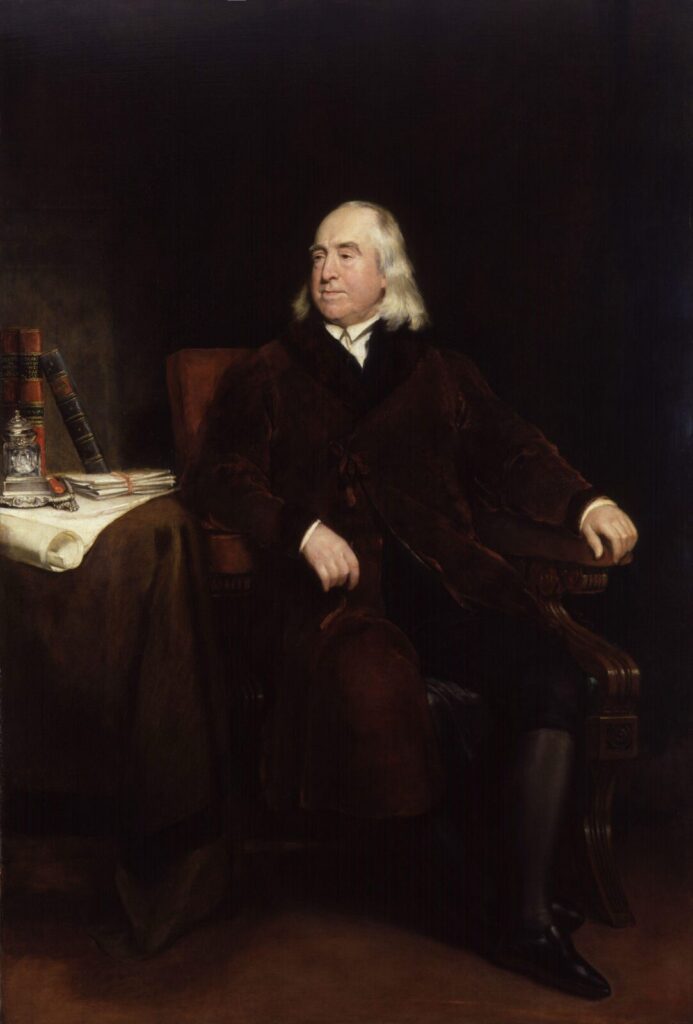
Utilitarianism Bentham is the moral philosophy that an action is right if it produces the greatest happiness of the greatest number, and wrong if it produces the opposite. Articulated by Jeremy Bentham in An Introduction to the Principles of Morals and Legislation (1789), it is the founding statement of modern consequentialism — a tradition that judges acts purely by outcomes rather than motives, rules, or character. For UPSC GS Paper IV, utilitarianism is one of the three reference frames every aspirant must hold ready: a thinker can support, reject, or modify it, but cannot ignore it.
Bentham (1748–1832), a London-born jurist trained at Queen’s College Oxford, wrote utilitarianism into existence as a tool of legal reform. He was not building an abstract ethical system; he was attacking the cruelty of 18th-century English law — capital punishment for petty theft, debt prisons, sodomy statutes — and needed a principle that could measure good legislation. His answer: count pleasure, count pain, subtract one from the other, and let the larger sum decide.
The Greatest Happiness Principle
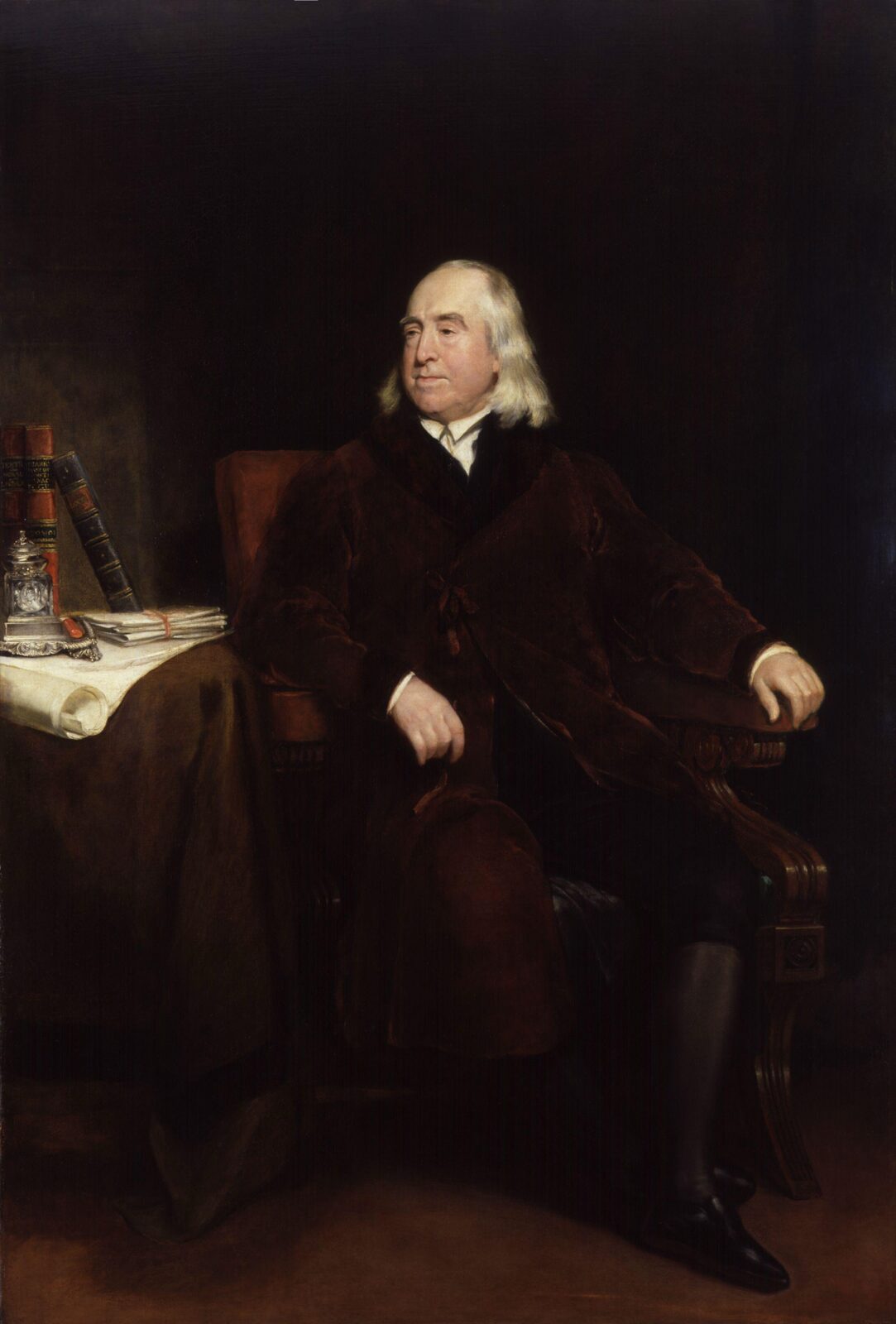
The greatest happiness principle is the single axiom of utilitarianism Bentham defends. In his words: “It is the greatest happiness of the greatest number that is the measure of right and wrong.” Two ideas are bundled here. First, happiness is the only intrinsic good — every other thing humans value (wealth, knowledge, freedom, virtue) is instrumental, useful only because it produces pleasure or reduces pain. Second, everyone counts equally. Bentham wrote that “each is to count for one and nobody for more than one.” The pleasure of a peasant weighs the same as the pleasure of a peer in the moral calculation.
This egalitarian premise made utilitarianism politically radical in its time. It justified extending the franchise, abolishing slavery, reforming prisons, and decriminalising homosexual acts (Bentham’s unpublished 1785 essay on the subject was suppressed for 200 years). The principle cuts across class, race, gender, and even species — Bentham extended moral consideration to animals on the ground that “the question is not, Can they reason? nor, Can they talk? but, Can they suffer?”
Hedonism as the moral ground
Bentham’s utilitarianism rests on psychological hedonism: the empirical claim that humans are governed by two sovereign masters, pleasure and pain. From this descriptive premise he derives a normative one — ethical hedonism — that pleasure is therefore what we ought to maximise. Critics have always pointed out the jump from “is” to “ought,” but Bentham was untroubled. For him, building ethics on observable human motivation was the whole point; metaphysical accounts of duty were “nonsense upon stilts.”
Felicific Calculus: Measuring Pleasure and Pain
The most concrete contribution of utilitarianism Bentham gives the moral philosopher is the felicific calculus (also called the hedonic calculus or utility calculus) — a seven-dimension scoring system for any prospective action. To decide whether an act is right, weigh the pleasure it produces along these axes, weigh the pain the same way, and compare totals.
| Dimension | What it measures |
|---|---|
| Intensity | How strong is the pleasure or pain? |
| Duration | How long will it last? |
| Certainty | How sure are we it will occur? |
| Propinquity | How soon will it occur? |
| Fecundity | Will it produce further pleasure? |
| Purity | Will it be followed by opposite sensations (pain after pleasure)? |
| Extent | How many people will be affected? |
Bentham took the calculus seriously enough to design tables and weights. He believed legislators, judges, and policymakers could apply it to draft punishments proportioned to the harm a crime caused — neither under-deterring nor wasting the offender’s suffering. The Panopticon prison design, his most famous architectural proposal, was an attempt to engineer institutions whose costs and benefits could be precisely measured.
In practice, the calculus is an imperfect heuristic — pleasures and pains do not come in commensurable units, and predicting fecundity or extent for any policy collapses into guesswork. But as a structured reasoning device, it remains useful. UPSC ethics case studies often reward candidates who explicitly list stakeholders, weigh probable harms and benefits, and acknowledge uncertainty — a recognisably Benthamite procedure even when not labelled.
Act Utilitarianism vs Rule Utilitarianism
The first refinement of utilitarianism Bentham left to his successors is the act–rule distinction, articulated most clearly in 20th-century Anglo-American moral philosophy.
Act utilitarianism judges each individual action by its own consequences. Faced with a choice, you calculate the utility of each option and pick the one that maximises happiness in this specific case. Bentham’s original formulation is closest to this.
Rule utilitarianism judges actions by whether they conform to rules whose general adoption would maximise happiness. You do not ask “what produces the most utility right now?” but “what rule, if followed by everyone, would produce the most utility?” Then you obey the rule even in cases where breaking it might produce more local good.
The distinction matters because act utilitarianism produces counter-intuitive results. If a sheriff in a town can prevent a riot by framing an innocent man, act utilitarianism may demand the frame-up. Rule utilitarianism rejects it: a general rule permitting frame-ups would, over time, destroy more happiness than it creates by undermining trust in justice. Civil servants encountering ethics in public administration often find rule utilitarianism more useful because public institutions need stable, predictable principles — not case-by-case maximisation that erodes legitimacy.
John Stuart Mill’s Refinement: Higher and Lower Pleasures
John Stuart Mill, Bentham’s intellectual heir and son of his closest collaborator James Mill, reformulated utilitarianism in Utilitarianism (1861) to answer the most damaging critique of the original — that it reduced human good to “swinish” sensual pleasure.
Mill insisted that pleasures differ in quality, not only quantity. Some pleasures — intellectual, aesthetic, moral — are intrinsically higher than bodily pleasures. His test: a pleasure is higher if competent judges, having experienced both, prefer it even when it brings less quantitative satisfaction. “It is better to be a human being dissatisfied than a pig satisfied,” Mill wrote; “better to be Socrates dissatisfied than a fool satisfied.”
This move rescued utilitarianism from caricature but introduced a problem: how does the calculus accommodate qualitative differences? Mill never fully resolved the tension. Critics argued he had smuggled in non-utilitarian values (the dignity of intellectual life, for instance) and that the “competent judges” test was elitist. Yet for civil services aspirants, Mill’s hierarchy is suggestive — it explains why we honour public servants who choose duty over comfort, the connection running through foundational values of civil services where Mill’s higher pleasures align with constitutional morality and integrity.
The harm principle
Mill’s second great contribution, in On Liberty (1859), is the harm principle: the only purpose for which power can rightfully be exercised over any member of a civilised community against their will is to prevent harm to others. This translates utilitarianism into a doctrine of individual liberty and remains the philosophical foundation of modern liberal democracies — including India’s constitutional protections of expression, conscience, and personal autonomy.
Critiques of Utilitarianism
Utilitarianism Bentham has attracted serious objections for more than two centuries. The strongest, summarised:
- Tyranny of the majority. If only aggregate happiness matters, the suffering of a small group can be morally outweighed by the joy of a larger one. Slavery could be justified if enslavers vastly outnumbered the enslaved. Bentham’s own egalitarianism resists this conclusion, but the logic of utility maximisation does not rule it out.
- Justice and rights. Utilitarianism has no in-built respect for individual rights. A person can be sacrificed — silenced, framed, harvested for organs — whenever the math says so. John Rawls built his entire theory of justice as an alternative to this feature; see Rawls’ theory of justice for the contrast.
- Calculation problem. No one can reliably predict the long-term consequences of complex policies, so the calculus often reduces to guesswork dressed as science.
- Demandingness. Strict utilitarianism requires you to give until your sacrifice equals the benefit to others — leaving no room for personal projects, family loyalty, or moral relaxation.
- Integrity objection (Bernard Williams). Utilitarianism may demand that I betray my deepest commitments — kill an innocent, abandon a friend — because the sum total of happiness so requires. This makes morality alien to the agent’s own life.
- Repugnant conclusions (Derek Parfit). Maximising total utility can favour a world of vastly many barely-worth-living lives over a world of fewer, flourishing ones.
A serious utilitarian responds: most of these objections strike act utilitarianism but leave rule utilitarianism or two-level utilitarianism (R.M. Hare) intact. Two-level utilitarians use everyday moral rules (don’t lie, don’t kill innocents) for routine choices and reserve calculus for genuine moral emergencies — a posture similar to how most thoughtful administrators actually behave. This dovetails with Kant’s deontology which rejects utilitarian sacrifice on principle.
Utilitarianism in Indian Public Policy
Utilitarianism Bentham shapes Indian public policy more than most students realise. Cost–benefit analysis in environmental clearances, welfare economics in budget allocation, the entire framework of “greatest good of the greatest number” invoked to justify large dams and infrastructure displacing tribal populations — all are recognisable applications. The Supreme Court has cited utilitarian reasoning in cases balancing development against displacement, public health against personal liberty (vaccine mandates, lockdowns), and free speech against public order.
The danger is the one Bentham’s critics flagged: utilitarian arithmetic can drown minority voices. Indian constitutionalism partly addresses this by entrenching fundamental rights as side constraints — protections that cannot be traded away even for large utility gains. This combination — utilitarian policy assessment + deontological rights floor — is closer to Mill’s mature view than to Bentham’s pure aggregation.
Utilitarianism in UPSC Case Studies
For GS Paper IV case studies, utilitarianism is the natural lens when:
- A policy choice affects many people and the harms are measurable (subsidies, infrastructure, public health).
- Resources are scarce and must be rationed (vaccine allocation, organ transplants).
- The candidate is asked to weigh aggregate welfare against vested interests.
Avoid pure utilitarian reasoning when:
- Individual rights or human dignity are at stake (custodial violence, surveillance).
- Procedural justice matters more than outcome (free trial, due process).
- The cost falls disproportionately on a vulnerable minority.
The strongest answers blend utilitarian impact analysis with Kantian or Rawlsian constraints — showing the examiner you can use multiple ethical frames rather than dogmatically applying one. The same ethical multilingualism shows up in modern psychology of leadership; see emotional intelligence (Goleman) for how empathy and self-regulation complement utilitarian calculation in real decisions.
Frequently Asked Questions
What is utilitarianism in simple words?
Utilitarianism is the moral view that the right action is the one producing the greatest happiness for the greatest number of people. Jeremy Bentham developed it in late 18th-century England as a tool to reform cruel and irrational laws.
Who is the father of utilitarianism?
Jeremy Bentham (1748–1832) is the founder of modern utilitarianism. His Introduction to the Principles of Morals and Legislation (1789) gave the doctrine its first systematic statement. John Stuart Mill later refined it.
What is the felicific calculus?
The felicific calculus is Bentham’s seven-dimension method to measure pleasure and pain from any action: intensity, duration, certainty, propinquity, fecundity, purity, and extent. A policy or act is right if the pleasures outweigh the pains across all seven.
What is the difference between act and rule utilitarianism?
Act utilitarianism judges each action by its own consequences; rule utilitarianism judges actions by conformity to rules whose general adoption would maximise happiness. Rule utilitarianism better protects justice and trust because it forbids one-off violations even when they look locally beneficial.
How did John Stuart Mill change utilitarianism?
Mill argued that pleasures differ in quality, not just quantity. Intellectual and moral pleasures are intrinsically higher than bodily ones. His harm principle in On Liberty (1859) made utilitarianism the foundation of liberal individual rights.
What is the strongest critique of utilitarianism?
The justice and rights critique — utilitarianism can in principle sacrifice an individual for aggregate welfare. John Rawls developed his theory of justice partly to answer this defect. Bernard Williams’s integrity objection and Derek Parfit’s repugnant conclusion are also widely cited.
How is utilitarianism relevant to UPSC GS-IV?
Utilitarianism is one of the three core ethical frames examiners expect aspirants to know (alongside deontology and virtue ethics). Case studies often involve weighing aggregate welfare against individual harms — utilitarian calculation provides one structured lens, to be balanced with rights and duties.
Did Bentham support animal rights?
Yes. Bentham extended moral consideration to animals on the ground that the morally relevant question is whether a being can suffer, not whether it can reason or speak. This argument is the philosophical seed of modern animal welfare and animal rights movements.
Tell Google you want more of this.
Add Anantam IAS as a preferred sourceOne tap, and this site shows up more often in your own Top Stories, AI Overviews and AI Mode. Remove it any time.