Difficulties in Practising Probity in Governance: Indian Challenges and Reform Pathways (UPSC GS IV)
Difficulties in practising probity in governance for UPSC GS IV — Gunnar Myrdal's soft state, corruption, criminalisation, low capacity, with Indian case studies and reform proposals.
Probity is the disposition of strict honesty, integrity and uprightness in public action. It goes beyond avoiding corruption — it requires the active cultivation of conduct that the public can trust without verification. The difficulty is that probity, while easy to describe, is hard to sustain across the institutions of a vast, diverse, developing country. Where the Nordic state struggles with whether to require disclosure of a public official's foreign-tour expenses, the Indian state struggles to ensure that the lowest-level field officer is not extracting petty bribes for routine services.
This article works through the structural and contextual difficulties of practising probity in Indian governance, the diagnostic insight of Gunnar Myrdal's "soft state," the major implementation challenges, and the reform pathways that have been proposed.
What probity in governance means
Probity is integrity-in-action — the demonstrable, verifiable presence of honesty, ethical conduct and trustworthiness in public office. The 2nd ARC defines probity as adherence to the highest standards of conduct, the strict observance of rules and procedures, and the active resistance to corruption in any form.
Probity has three layers.
- Personal probity — the individual officer's honesty.
- Institutional probity — the office, department or agency's collective integrity.
- Systemic probity — the broader public sphere's resistance to corruption.
A failure at any layer compromises the others. Personally honest officers in a corrupt institution are isolated and demoralised; ethical institutions in a corrupt system fight a losing battle; clean systems with corrupt individuals quickly degrade.
Gunnar Myrdal's diagnosis: the "soft state"
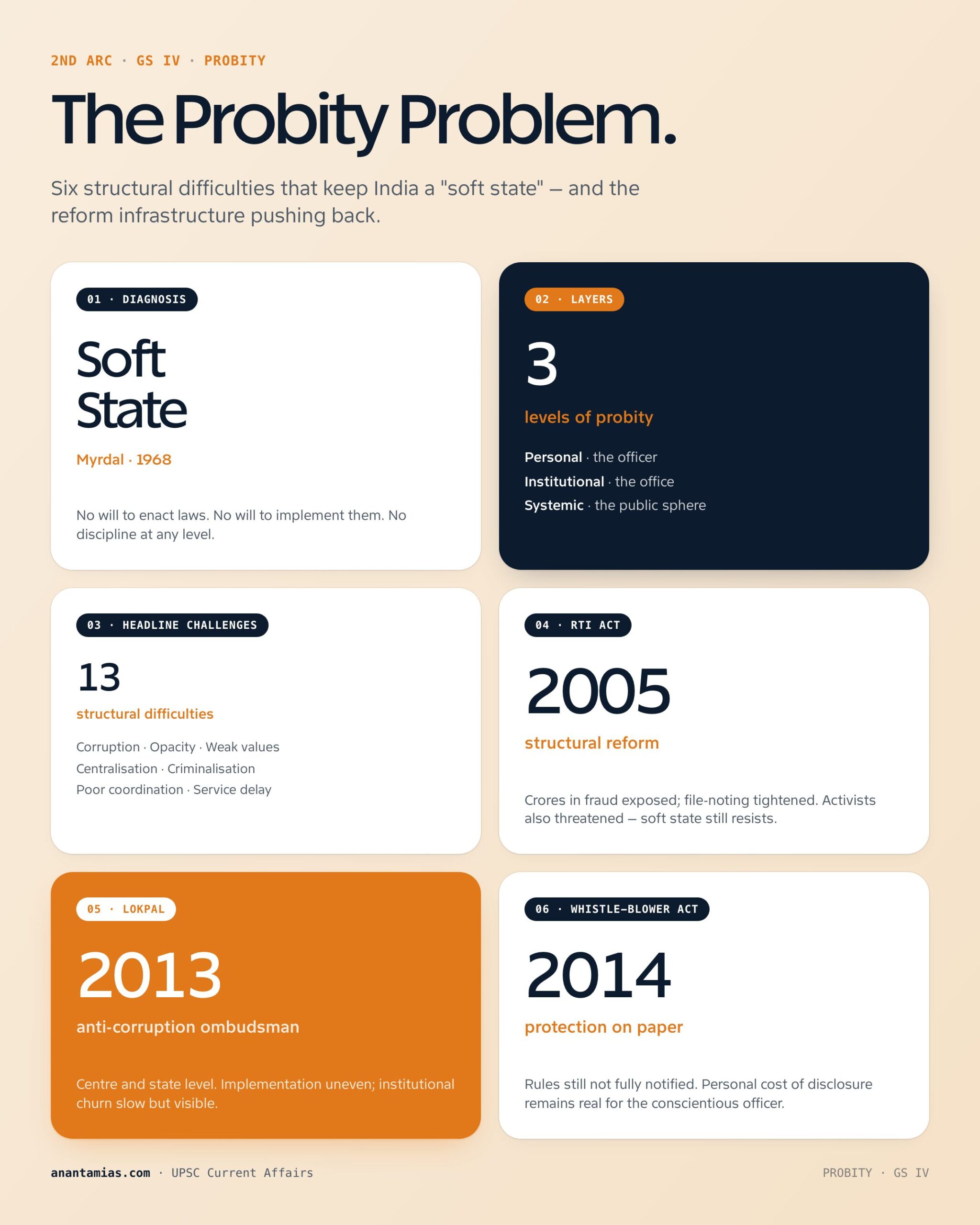
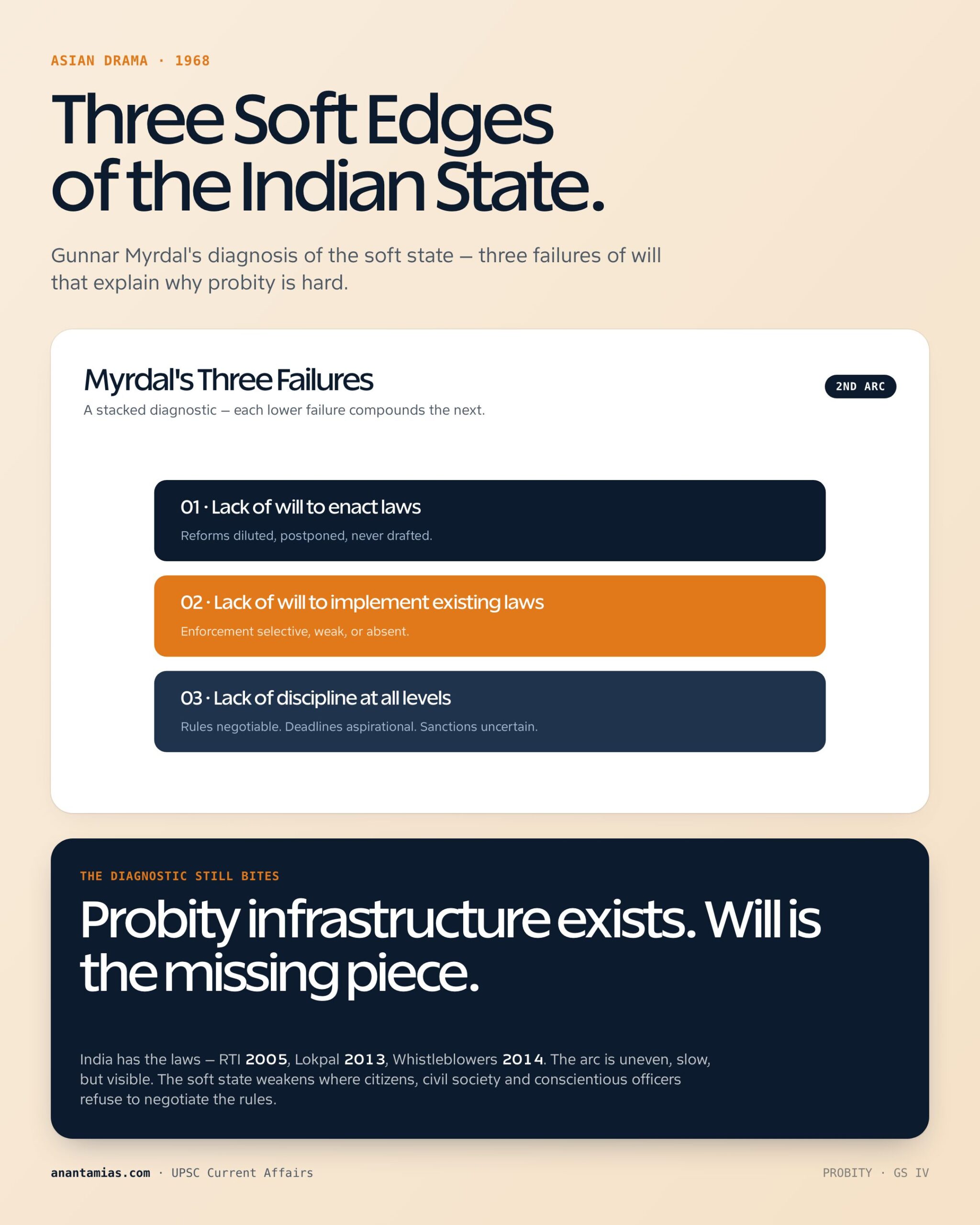
The Scandinavian economist-sociologist Gunnar Myrdal, in his three-volume Asian Drama: An Inquiry into the Poverty of Nations (1968), described India as a "soft state." The term has stuck because it captures something diagnostic about the Indian probity problem.
Myrdal's soft state is characterised by three features.
- Lack of will to enact laws necessary for progress and development. Where the political consensus needed for hard reform is missing, laws are diluted, postponed or never drafted.
- Lack of will to implement even the existing laws. Where laws do exist, enforcement is selective, weak or absent.
- Lack of discipline at all levels — including the administration and the structures of governance. Rules are negotiable; deadlines are aspirational; sanctions are uncertain.
"The Indian state, like other Asian states, possesses extensive policy ambitions but a limited capacity for sustained, disciplined enforcement of its own commitments."
The diagnosis remains acute decades later. Many of the difficulties of practising probity trace back to the soft-state pattern.
Major implementation challenges
The 2nd ARC and subsequent commentary identify a recurring list of challenges to probity in Indian governance.
1. Corruption
The most direct challenge. Corruption ranges from petty (the field clerk's small "speed money") to grand (the multi-crore allocation scam) to systemic (entire procurement systems captured). The corrosive effect is not just the rupees lost but the trust destroyed and the talent driven out.
2. Opacity and discretion without transparency
Where decisions are made without recorded reasons, where files cannot be accessed, where discretion is wide and accountability narrow — corruption follows. The RTI Act has helped; many administrative decisions still remain opaque despite the Act.
3. Poor and ambiguous value system
Where the surrounding social culture treats public office as an opportunity for personal enrichment rather than as a trust, individual probity becomes a counter-cultural achievement. Schools, families, professional training, media coverage all contribute to the ambient value culture.
4. Lack of incentives, inefficiency, lack of accountability
Civil-service reward structures often do not distinguish the probity-driven officer from the average. Promotions follow seniority and political acceptability more than performance. Without clear consequences for both honest excellence and dishonest practice, behaviour drifts.
5. Centralisation of power at various levels
Concentrated power, exercised with limited supervision, is a structural risk to probity. Decentralisation — done well — distributes power and creates more checkpoints. Done badly, it creates more capture points.
6. Criminalisation of politics
Candidates with serious criminal records contesting and winning elections degrades the entire probity ecosystem. The Association for Democratic Reforms data shows the trend has worsened over decades. Legislators with criminal records are less likely to support stringent anti-corruption legislation, less likely to scrutinise executive action, and more likely to require administrative compliance with their personal interests.
7. Violation of human rights
Where rights violations are tolerated — custodial torture, illegal detention, encounter killings — probity is not just absent but actively reversed. The institutional culture that tolerates rights violation produces officers comfortable with other forms of unaccountability.
8. Weak legislators
Legislators with weak knowledge of policy issues, low education levels and limited capacity for legislative oversight produce poor laws and poorer scrutiny. Parliamentary committees, the strongest oversight mechanism, are only as good as the members who staff them.
9. Lack of people's participation, especially of the poor
Where the poor cannot meaningfully participate in development processes — through inadequate Gram Sabha activation, weak public hearing mechanisms, low information access — corruption goes unchallenged because its primary victims have no voice.
10. Less active civil society and weak grassroots institutions
Vibrant civil society is the third pillar of probity (alongside state and market). Where civil-society space is constrained or under-resourced, accountability weakens. Grassroots institutions — Panchayats, ward committees, mohalla sabhas — when active, are the front line of probity.
11. Lack of coordination among political, administrative and community-level institutions
Probity failures often occur in the gaps between agencies. Police and judiciary; revenue and forest; PWD and municipality. Coordinated corruption requires coordinated counter-action.
12. Delays in service delivery
Delay is the petri dish of petty corruption. The citizen who needs a certificate today and faces a six-month wait will pay to jump the queue. Reducing delay is a probity reform in disguise.
13. Poor participation of marginalised sections
Decision-making that excludes Dalits, Adivasis, women, religious minorities and persons with disabilities loses both legitimacy and probity. Inclusive decision-making is harder but produces decisions that are harder to corrupt.
Two Indian case studies
Case study 1 — Right to Information Act and the structural improvement of probity
The RTI Act of 2005 directly addressed several of the challenges above — opacity, lack of accountability, weak citizen voice. Its impact on probity has been mixed but real. Many crores in fraudulent welfare claims have been exposed, file-noting practices have improved, and administrators now anticipate that decisions will face public scrutiny. The Act also exposed the resistance of the system — RTI activists have been threatened and in some cases killed, indicating how much the soft state still resists transparency. The case shows both the power of structural reform and the fragility of that power without sustained protection.
Case study 2 — the criminalisation of politics and Lok Prahari litigation
The Association for Democratic Reforms and Lok Prahari have pursued sustained litigation to require disclosure of criminal records by candidates, fast-track courts for cases against legislators, and disqualification on conviction. The Supreme Court's 2018 directions on criminal candidates and the 2020 directions on disclosure of reasons for choosing candidates with criminal records illustrate the slow institutional churn through which the soft state is being pushed toward firmer probity. Implementation remains incomplete.
Reform pathways
A working list of probity reforms.
- Statutory backing for foundational values. Public Service Bill, Code of Ethics for civil servants.
- Strengthened anti-corruption agencies. Lokpal and Lokayuktas (active, well-resourced); CBI, CVC, ED with operational independence.
- Whistleblower protection. Notification and effective enforcement of the 2014 Act.
- Electoral reforms. State funding of elections, fast-track courts for criminal cases against politicians, life-time disqualification on conviction.
- Civil society strengthening. Predictable funding regime, protection from arbitrary closure, support for grassroots organisations.
- Decentralisation done well. 73rd and 74th Amendments fully implemented, local capacity built, transfer of subjects with funds and functionaries.
- Citizen-centric service delivery. Right to Public Service Acts in states, time-bound service delivery, online tracking.
- Cultural reform. School curricula on civic ethics, professional codes for media, public awards for probity.
UPSC past-year question references
- 2014 GS IV: "Probity is essential for an effective civil service." Discuss.
- 2017 GS IV: case study on petty corruption and the temptation to comply.
- 2018 GS IV: discussion of criminalisation of politics as a probity challenge.
- 2020 GS IV: institutional reforms for probity in governance.
Mains answer hook
Practising probity in Indian governance is structurally difficult. Gunnar Myrdal's diagnosis of India as a "soft state" — lacking will to enact necessary laws, will to implement existing laws, and discipline at all levels — captures the systemic background. Specific challenges include corruption at multiple scales, opacity and unchecked discretion, ambiguous value culture, weak incentives, centralisation, criminalisation of politics, weak legislators, low participation of the poor and marginalised, fragile civil society, weak grassroots institutions, poor inter-agency coordination, and chronic service delay. The reform agenda must address all layers — personal, institutional, systemic — with sustained political will. Probity is not a one-time achievement; it is a daily discipline of state and society together.
Prelims pointers
- Gunnar Myrdal — Asian Drama (1968); "soft state" diagnosis.
- 2nd Administrative Reforms Commission — Ethics in Governance.
- Right to Information Act, 2005.
- Lokpal and Lokayuktas Act, 2013.
- Whistleblowers Protection Act, 2014.
- Association for Democratic Reforms — criminal-records disclosure.
FAQ
What is the difference between integrity and probity?
Integrity is the broader virtue of consistency between values and action; probity is integrity specifically in public action — strict honesty in office, observance of rules, demonstrable trustworthiness.
Is the u0022soft stateu0022 diagnosis still accurate?
The diagnosis has weakened in some areas (RTI, GST implementation, digital identity, vaccine rollout) and held up in others (criminalisation of politics, judicial delay, regulatory capture). The pattern remains diagnostic for many parts of administration.
Can probity be enforced through laws alone?
No. Laws are necessary but insufficient. Without supportive institutional culture, public participation, and individual character, even the best laws are evaded.
What can a young civil servant do in a non-probity environment?
Build personal practice — record reasons, refuse petty corruption, maintain transparent files, mentor juniors. Engage institutional mechanisms — vigilance, RTI, internal audit. Avoid heroics that produce isolation; build coalitions with similarly minded peers.
Why does criminalisation of politics matter for probity?
Because legislators draft, fund and oversee the laws and institutions that constitute the probity infrastructure. Legislators with criminal records are unlikely to strengthen anti-corruption agencies that may eventually examine them.
The difficulties of practising probity are real but not insurmountable. India's probity infrastructure is stronger than it was a generation ago. The arc is uneven and slow but visible. The civil servant who joins the system today inherits both the difficulties and a meaningful set of tools to address them — if she chooses to use them.