A ramp built to the wrong gradient is not access. A government website a blind user can’t read with a screen reader is not inclusion. And a law that promises a 4% job quota means little to someone who can’t get on the bus to reach the interview. On 8 November 2024, the Supreme Court said the quiet part out loud: in Rajive Raturi v. Union of India, it held that accessibility isn’t a favour the State grants when it’s convenient. It’s a fundamental right. The Court told the Centre to frame binding, mandatory accessibility rules within three months. So that should have settled things.
It didn’t. More than a year later, on 11 February 2026, the same Court sat for a compliance hearing and found the gaps still there: weak enforcement, the entire burden dumped on one department, draft rules that say nothing about who polices a non-compliant website, and empty chairs in the very offices meant to enforce disability rights. The Centre asked for four more months. That single sequence, a fundamental right declared, then deferred, is the whole story of disability in India. The law is ahead of the country. The country keeps asking for an extension.
The Issue, Framed
The argument here isn’t whether India cares about persons with disabilities. On paper, it cares more than most countries at its income level. The argument is about the distance between the page and the pavement, and who falls into that gap.
Let’s fix the vocabulary first, because this topic is built on terms people use loosely. A person with disability isn’t defined by a medical chart alone. The Rights of Persons with Disabilities Act, 2016, the RPwD Act, defines disability through the social model, the idea that an impairment becomes a disability mainly because the world is built with barriers. A wheelchair user isn’t disabled by the wheelchair. They’re disabled by the staircase. That’s the shift the Act makes: away from the old medical model, which treated the person as the problem to be fixed or pitied, toward a rights model that treats the environment as the thing to be changed.
Two tools follow from that shift. Universal design means building things, ramps, signage, websites, exams, so they work for the widest range of people from the start, instead of bolting on a special-needs fix later. Reasonable accommodation means the specific adjustment one person needs to participate equally, a sign-language interpreter, extra time, a screen reader, as long as it doesn’t impose a “disproportionate burden.” Together they’re the difference between an afterthought and a default.
The RPwD Act sits on a treaty foundation. India ratified the UN Convention on the Rights of Persons with Disabilities (UNCRPD) on 1 October 2007, and the 2016 law is how that commitment came home. The nodal body is the Department of Empowerment of Persons with Disabilities (DEPwD) under the Ministry of Social Justice and Empowerment, and enforcement runs through a Chief Commissioner at the Centre and State Commissioners below.
So the frame is this. A modern, rights-based law exists. A treaty backs it. A court calls its core promise a fundamental right. And yet the bus is still 8.73% accessible. The question for your answer is why a good law keeps failing the people it was written for.
What the Data Says
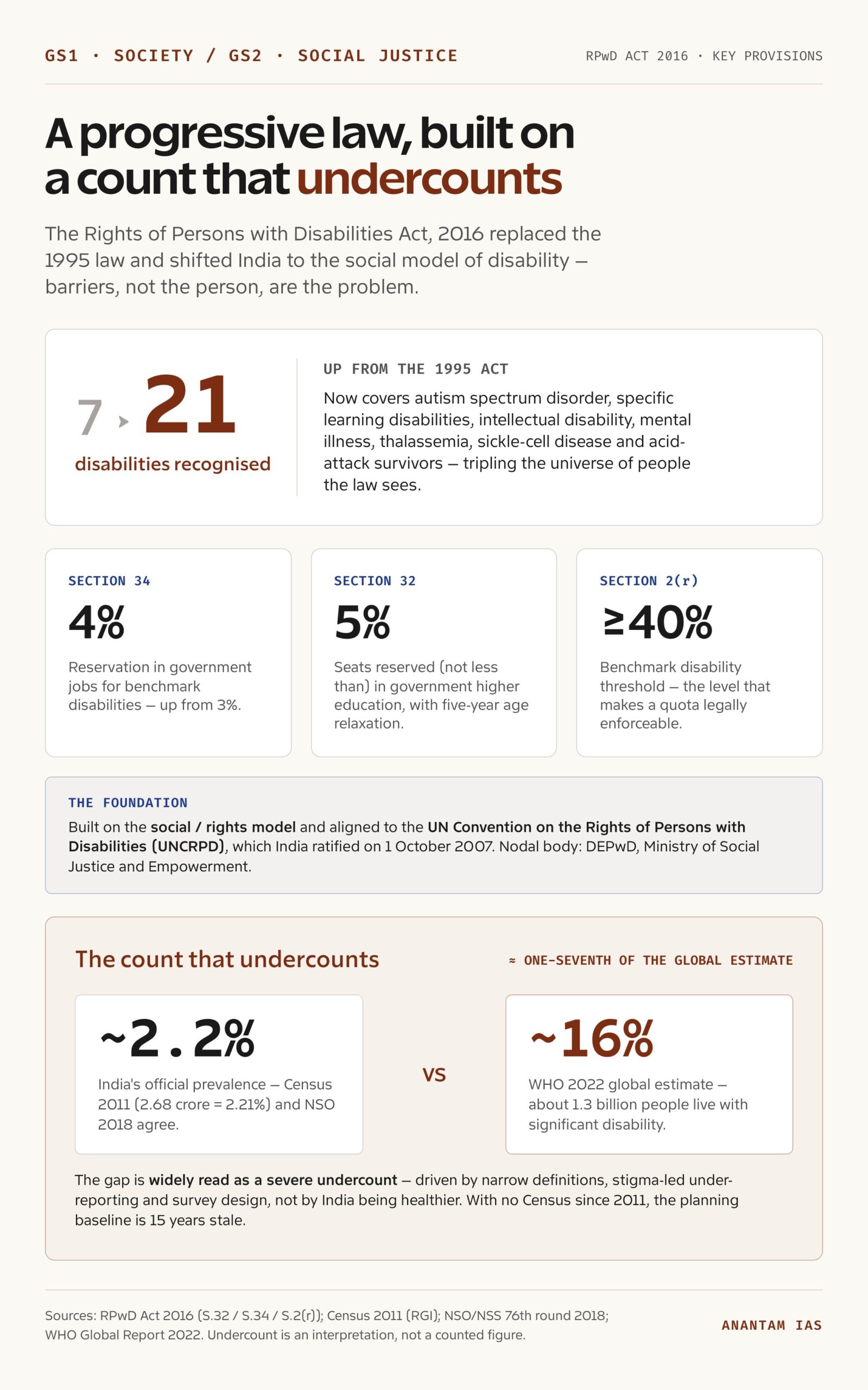
Start with the most important number, because it’s the one that quietly shapes every other failure. India officially counts persons with disabilities at about 2.2% of the population. Census 2011 put it at 2.68 crore people, 2.21%. The National Statistical Office‘s NSS 76th round in 2018 landed at 2.2% too. So the two domestic instruments agree with each other.
But they don’t agree with the world. The World Health Organization’s 2022 global report estimates that about 1.3 billion people, 16% of humanity, live with significant disability. India’s official figure is roughly one-seventh of that global benchmark. Read that again. Either Indians are extraordinarily healthier than the rest of the planet, or the count is wrong.
It’s the count. The gap is widely read as a severe undercount, driven by narrow definitions, stigma that pushes families to under-report, and survey design, not by India somehow escaping a universal human condition. And here’s why it matters more than a footnote: if you only count 2.68 crore people, you only budget, plan, and build for 2.68 crore. The undercount isn’t a statistical quirk. It’s the first act of exclusion, because you can’t include people you’ve decided not to see. The last full enumeration was Census 2011. That’s now 15 years stale, with no fresh Census done.
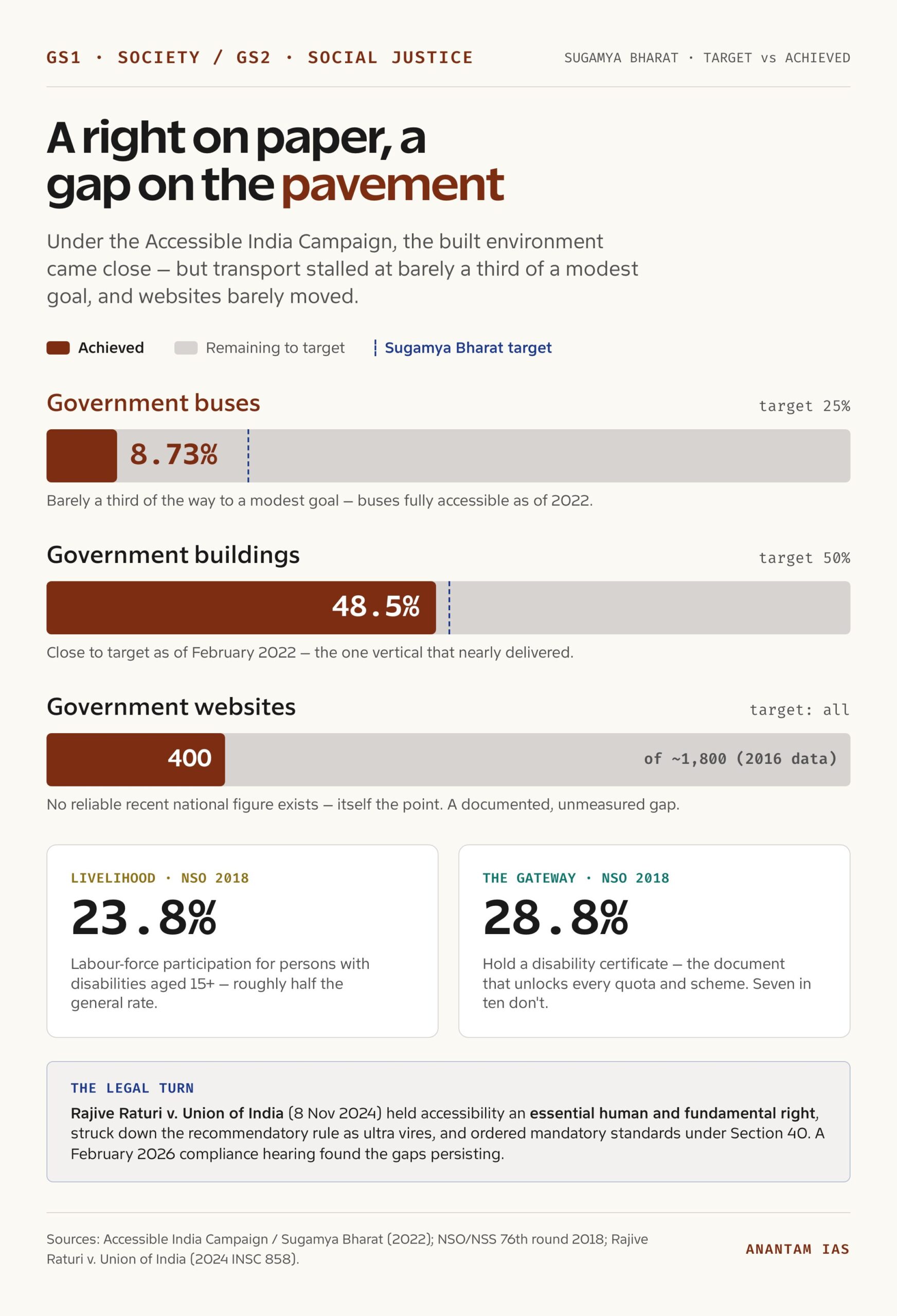
Now the participation numbers, and this is where the law-versus-life gap turns brutal. The labour-force participation rate for persons with disabilities aged 15 and over is 23.8%. The general rate in that period was above 50%. So a person with disability is roughly half as likely to be in the workforce. Worse, 57.2% of those who’d been working before the onset of disability lost that work afterward. The job didn’t accommodate. The person was let go.
Then the gateway problem. Only 28.8% of persons with disabilities hold a disability certificate, the single document that unlocks every quota, scheme, and concession the law promises. So more than seven in ten can’t even access the entitlements written for them. And 76.4% reported receiving no support at all, no aid, no appliance, no scheme. A right you can’t document is a right you don’t have.
Education tells the same story earlier in the life cycle. Literacy among persons with disabilities was about 55% in Census 2011, against roughly 73% general literacy. And 54% of children with multiple disabilities, plus half of children with mental illness, never attended any educational institution at all. Exclusion compounds: no school, then no certificate, then no job.
The Case For
Here’s what an honest answer has to concede first: India’s disability framework is genuinely progressive, and pretending otherwise would be lazy. So let’s state the case at full strength.
Start with the law itself. The RPwD Act 2016 replaced the old Persons with Disabilities Act of 1995 and expanded recognised disabilities from 7 to 21, adding conditions the old law ignored entirely, autism spectrum disorder, specific learning disabilities, intellectual disability, mental illness, thalassemia, sickle-cell disease, acid-attack survivors, and more. That’s not a tweak. That’s tripling the universe of people the law sees. And it did this through the social model, aligning Indian law with the UNCRPD it had ratified back in 2007.
The quotas have teeth, not just sentiment. Section 34 reserves 4% of government jobs for persons with benchmark disabilities, up from 3% under the 1995 Act. Section 32 reserves not less than 5% of seats in government and government-aided higher-education institutions, with a five-year age relaxation. A benchmark disability means at least 40% of a specified condition, the threshold that makes the quota legally enforceable rather than aspirational.
The State built digital rails too. The Unique Disability ID (UDID) creates a single national database and one nationally valid Swavlamban card to replace the maze of state-issued certificates. Over 1.1 crore UDID cards had been generated as of mid-2024, rising past 1.3 crore since. There’s a scheme skeleton behind it, ADIP for aids and appliances, DDRS for rehabilitation, SIPDA for accessibility, scholarships, and National Institutes. And the Accessible India Campaign (Sugamya Bharat Abhiyan), launched on 3 December 2015, was the country’s first national accessibility programme, targeting the built environment, transport, and ICT together.
And the judiciary has been the most assertive ally of all. In Rajive Raturi (2024), the Supreme Court read accessibility as a fundamental right and struck down a weak rule. In March 2025, in the visually-impaired judicial-services case, it held that no candidate can be barred from judicial service on the ground of disability alone. So the courts aren’t holding the State back. They’re dragging it forward.
Put together, India has a rights-based statute, hard quotas, a national ID, a scheme architecture, and a court that treats inclusion as constitutional. That’s more than many richer democracies can claim.
The Case Against
Now the part the brochure skips. A law is judged not by what it promises but by what reaches the person at the bottom. On that test, the promises keep deferring.
Take accessibility, the most concrete test there is. Under Sugamya Bharat, the target was 25% of government public-transport vehicles made accessible. The achievement: 8.73% of buses fully accessible, barely a third of a modest goal. Government buildings did better, 48.5% against a 50% target, close enough. But websites barely moved, only 400 of around 1,800 government websites were made accessible as of 2016, and no reliable recent national figure exists, which is itself the point. The campaign’s deadlines slipped from 2017 to 2019 to 2020 to 2022 and past. This is exactly why the Court in Rajive Raturi declared the accessibility rule ultra vires, beyond the law’s authority, because it had framed mandatory standards as toothless “self-regulatory guidelines.”
Then the count that hides the people. Official prevalence of 2.2% against the WHO’s 16% isn’t a rounding error, it’s a system that plans for one-seventh of the likely population. And with no Census since 2011, the planning baseline is a decade and a half old.
The jobs cliff is the sharpest indictment. A statutory 4% quota sits next to a real-world labour-force participation rate of 23.8%, with 57.2% losing their work after disability onset. The quota exists on paper. The participation doesn’t exist in practice. A reserved post means nothing if the workplace has no ramp, no screen reader, and no intention of making a reasonable accommodation.
Paperwork locks the door from the inside. Only 28.8% hold a disability certificate. So the law reserves seats and jobs for people who, in the majority, can’t produce the one document needed to claim them. The entitlement and the access to the entitlement live in different worlds.
Money tells you the priority. DEPwD asked for ₹1,704.87 crore for 2025-26 and got ₹1,275 crore, about 0.025% of the Union Budget, a figure advocates call token. And even that isn’t spent well: a parliamentary panel flagged that under 40% of SIPDA’s revised 2024-25 allocation was used, and that only 74 of 325 planned District Disability Rehabilitation Centres are functional. Under-budgeted, then under-spent.
And the enforcement machinery is hollow where it counts. At the February 2026 compliance hearing, the Court itself noted vacant State Disability Commissioner posts in Delhi, Haryana, and Rajasthan. The offices built to enforce disability rights are sitting empty. That’s the social model still stuck as an aspiration.
The Deeper Structural Read
Step back from the scheme list, and a clearer fault line shows up. India’s disability problem isn’t a missing law. It’s a missing default. The State treats inclusion as a special add-on, requested case by case, instead of a baseline built into everything from the start. And that single design choice explains nearly every number above.
Watch how it cascades. Because accessibility is an add-on, the bus gets bought first and the lift gets debated later, so transport stalls at 8.73%. Because participation is an add-on, the job is reserved but the workplace isn’t adapted, so 57.2% lose work after disability. Because identity is an add-on, the certificate is a hurdle to clear rather than a right delivered, so only 28.8% hold one. The same structural flaw, treat the disabled person as an exception to plan around rather than a citizen to plan for, reproduces itself at every stage.
The undercount is where this becomes self-fulfilling. If your data says 2.2% and the truth is closer to 16%, your budgets, targets, and infrastructure are all sized for a fraction of the real population. Then the under-provision “proves” demand is low, which justifies the next undercount. It’s a loop. Counting people properly isn’t a survey footnote. It’s the precondition for treating them as a constituency that policy must serve, rather than a category it can defer.
This is also why the Rajive Raturi reasoning matters beyond the headline. By calling accessibility a fundamental right and striking down “recommendatory” standards as ultra vires, the Court did something structural, not symbolic. It moved accessibility from the language of welfare, where the State helps if it can afford to, into the language of rights, where the State must comply because the citizen is entitled. That reframing is the whole social model in legal form. The trouble is that a court can declare the default. It can’t, by itself, build it. That takes mandatory rules with penalties, funded retrofitting, staffed enforcement offices, and a count that sees everyone.
There’s a federal seam underneath too. The law is central, but schools, transport, and buildings are largely run by states and local bodies. So a mandate framed in Delhi dissolves into a thousand procurement decisions where accessibility is the line item cut first. Universal design fails not because anyone votes against it, but because no single official is accountable when it quietly disappears from a tender.
And here’s the part that should sit with you as a future administrator. Every excluded person is a productive citizen the economy locks out. A 23.8% participation rate isn’t only an injustice to the individual. It’s a country choosing to leave a large share of its own people outside the workforce, and then wondering why its human-capital numbers lag. Inclusion isn’t charity the State can defer in a tight year. It’s infrastructure the State can’t afford to keep deferring.
What Should Be Done
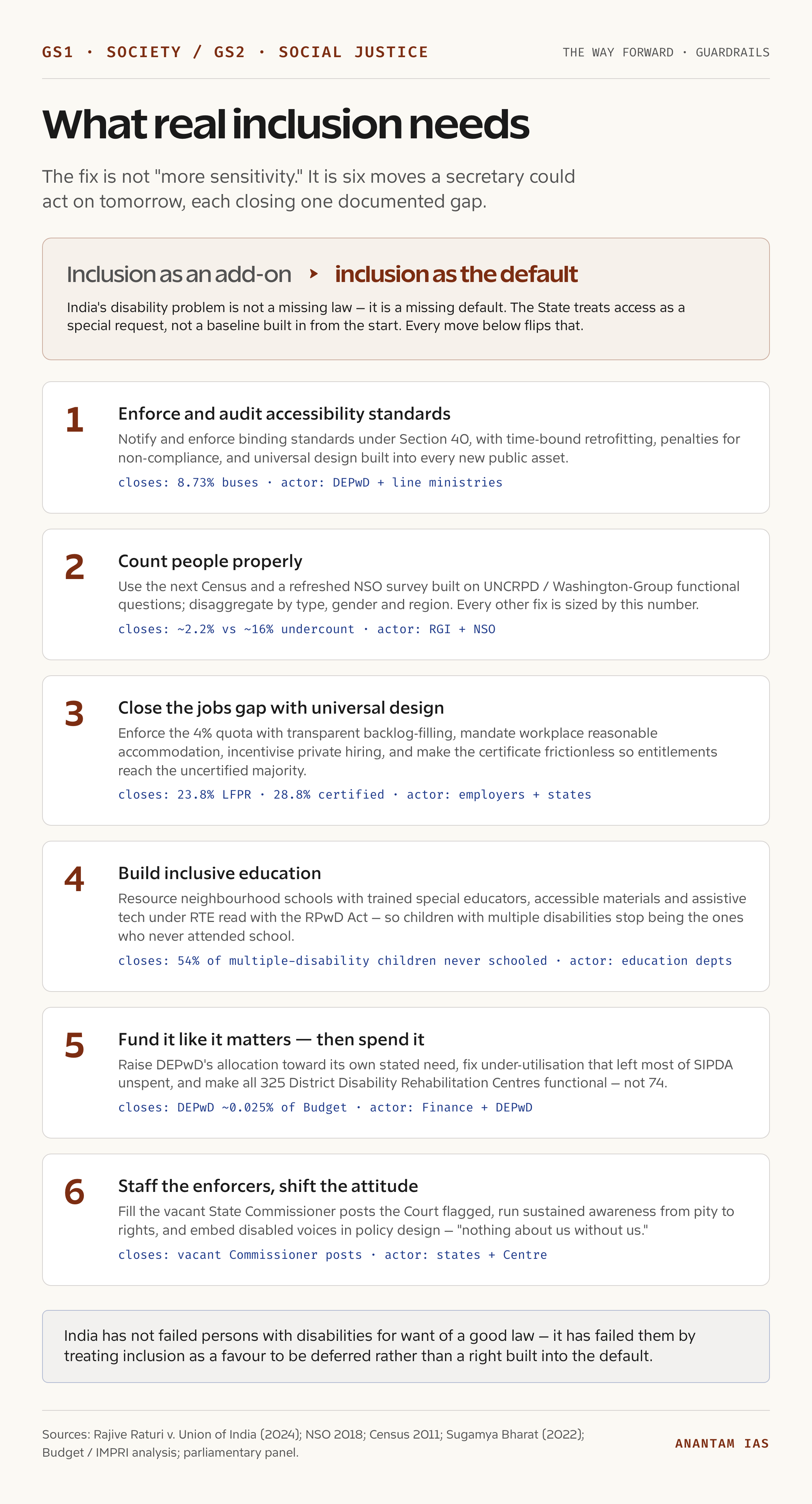
So what turns a progressive law into a lived right? Not a vague call for “more sensitivity,” but a set of moves you could hand a secretary tomorrow. Seven of them, each closing one of the gaps above.
- Make accessibility mandatory, audited, and penalised. Notify and actually enforce binding standards under Section 40, exactly as Rajive Raturi ordered, with time-bound retrofitting of buildings, transport, and websites, plus penalties for non-compliance. Build universal design into every new public asset from day one, so the country stops creating fresh barriers while slowly fixing old ones. The reform agenda runs alongside broader work on welfare schemes for vulnerable sections.
- Count people properly. Use the next Census and a refreshed NSO survey built on UNCRPD and Washington-Group functional questions, which ask what a person can actually do rather than relying on a narrow disability label. Disaggregate by type, gender, and region. End the undercount, because every other fix is sized by this number.
- Close the jobs gap, not just the quota. Enforce the 4% reservation with transparent backlog-filling, mandate workplace reasonable accommodation, incentivise private-sector hiring, and expand skilling. Move from a reserved post on paper to a person actually at the desk.
- Make the certificate frictionless. Drive UDID and disability-certificate coverage toward universal through camps and online assessment, so entitlements reach the roughly 71% who currently hold no certificate. A right that needs a document everyone lacks isn’t a right yet.
- Fund it like it matters, then spend it. Raise DEPwD’s allocation toward its own stated need, and fix the under-utilisation that left most of SIPDA unspent. Make all 325 District Disability Rehabilitation Centres functional, not 74. This sits inside the wider question of social justice and the rights of the marginalised.
- Build inclusive education, not parallel exclusion. Resource neighbourhood schools with trained special educators, accessible materials, and assistive technology under the Right to Education read with the RPwD Act, so children with multiple disabilities and mental illness stop being the ones who “never attended school.”
- Staff the enforcers and centre the people. Fill the vacant State Commissioner posts the Court flagged, run sustained awareness to shift attitudes from pity to rights, and embed disabled voices in policy design, the principle disability movements summarise as “nothing about us without us.”
Every one of these moves accessibility from a favour to a default. And that, not another scheme launch, is what turns the inclusion India keeps deferring into the inclusion it finally delivers.
For Your Mains Answer
This topic is a bridge between two papers, and that’s exactly why examiners like it. It lets you show society and governance in one frame.
GS paper mapping: GS1 (Indian Society): vulnerable sections, social empowerment, the effects of social barriers and stigma. GS2 (Social Justice): welfare schemes for vulnerable sections and their performance, mechanisms and laws to protect the vulnerable, statutory bodies, and the judiciary’s rights-expanding role.
Likely question frames:
- “A progressive disability law has not produced a proportionate gain in participation.” Examine in light of the RPwD Act 2016 and recent data.
- The Supreme Court has read accessibility as a fundamental right. Discuss the gap between this recognition and ground-level compliance in India.
- Critically analyse why India’s official disability prevalence diverges so sharply from global estimates, and what this means for policy.
Quotable data points:
- RPwD Act 2016 expanded recognised disabilities from 7 to 21, with 4% job and 5% higher-education reservation.
- India counts persons with disabilities at about 2.2% (Census 2011: 2.68 crore; NSO 2018: 2.2%) against the WHO’s global ~16%, roughly one-seventh.
- Labour-force participation of persons with disabilities is 23.8%, about half the general rate; 57.2% lost work after disability onset (NSO 2018).
- Only 28.8% hold a disability certificate; 76.4% receive no support (NSO 2018).
- Government buses just 8.73% accessible against a 25% target (Sugamya Bharat, 2022).
- DEPwD got ₹1,275 crore, about 0.025% of the Union Budget; under 40% of SIPDA spent in 2024-25.
- Rajive Raturi v. Union of India (2024 INSC 858): accessibility is a fundamental right; mandatory rules ordered under Section 40.
- Over 1.1 crore UDID cards generated (mid-2024).
Keywords to use: social model of disability, universal design, reasonable accommodation, benchmark disability, accessibility, disability certificate, labour-force participation, inclusive education, data undercount.
Syllabus linkages: vulnerable sections and social empowerment, welfare schemes and their performance, statutory bodies and commissioners, judicial review and rights, government policies and interventions.
Balanced conclusion line: India hasn’t failed persons with disabilities for want of a good law; it has failed them by treating inclusion as a favour to be deferred rather than a right to be built into the default, and the fix is to make accessibility ordinary, counting honest, and enforcement staffed.
How to Build the Answer
Open with the gap, not a definition. The sharpest first line states the paradox: India has one of the more progressive disability laws in the developing world, yet bus accessibility sits at 8.73% and participation at 23.8%. That single contrast tells the examiner you’ve grasped both the achievement and the failure. Define the RPwD Act and the social model in the second sentence, not the first.
Bring data in early, but make each number do a job. A strong opening body paragraph can carry the 2.2%-versus-16% undercount, the 23.8% participation rate, and the 28.8% certificate figure, then say what they prove together: that the law sees, reserves for, and funds only a fraction of the real population. UPSC rewards the move from figure to inference.
Steelman the State before you criticise it. Credit the 7-to-21 expansion, the quotas, the UDID rails, and the assertive judiciary first. An answer that only attacks reads like a rant; an answer that concedes the genuine progress and then shows the gap reads like judgment.
Group the way forward; don’t scatter it. Cluster the reforms under clear heads, enforce accessibility, count properly, close the jobs gap, frictionless certificate, fund and spend, inclusive education, staff the enforcers, and attach an actor to each. Use the topic’s own vocabulary, social model, universal design, reasonable accommodation, so the answer sounds like governance analysis.
Close on the structural insight, not a summary. The last line should show that you understand the real problem is inclusion-as-add-on versus inclusion-as-default. Don’t echo the introduction.
Common Mistakes to Avoid
- Don’t recite the Act and stop. Listing Sections 32, 34, and 40 isn’t analysis. The marks are in linking the law to why it underperforms.
- Don’t treat the 2.2% as fact. Frame it as a likely undercount against the WHO’s 16%, and explain why the undercount itself causes exclusion.
- Don’t go one-sided. This topic has a real positive case. Concede the progressive law before showing the gap.
- Don’t end on a slogan. “Inclusion is everyone’s responsibility” earns nothing. Close on a structural principle or a constitutional value.
- Don’t forget the person. Name the wheelchair user who can’t board the bus, the worker who lost a job after disability, the child who never reached school. UPSC rewards answers that show who bears the cost.
A Compact Answer Spine
- Introduction: State the law-versus-life paradox in one sentence; define the RPwD Act and the social model in the next.
- Evidence: Use the undercount, the 23.8% participation rate, and the 28.8% certificate figure, each tied to an implication.
- Arguments: The case for a progressive framework, then the case against deferred delivery. Keep both fair.
- Structural diagnosis: Inclusion treated as an add-on, not a default; the undercount as a self-fulfilling loop.
- Way forward: Grouped guardrails, each with a clear actor, DEPwD, courts, states, Commissioners.
- Conclusion: Adapt the balanced conclusion line to the exact question wording.
Diagram or Flowchart Idea
For a 15-marker, draw one causal chain rather than a decorative map. The cleanest here: undercount (2.2% vs 16%) → under-budgeting and under-planning → barriers in transport, jobs, schools → low certificate coverage and 23.8% participation → exclusion “proves” low demand → back to the undercount. That loop shows the examiner you see the system, not just the symptoms.
For a 10-marker, skip the diagram and use a two-column table instead, “On paper” (4% quota, 5% seats, fundamental-right ruling) against “On the ground” (8.73% buses, 23.8% participation, 28.8% certificates). It does more work and is faster to mark.
Ethics and Governance Angle
Add one ethical line even in a GS2 answer. The deeper issue is dignity: the social model itself is an ethical claim, that the barrier, not the person, is the problem to fix. Naming that shift, from pity to rights, signals you understand the values under the policy.
Then convert the empathy into design. Don’t just say “be more inclusive.” Say how: accept the IDs and assessments people can actually obtain, mandate reasonable accommodation at work, staff the Commissioner offices, and build universal design into new infrastructure. That’s the move from moral language to administrative maturity.
A useful sentence pattern travels across welfare topics: “The objective is legitimate and the law is sound; the failure is in enforcement, financing, and counting.” It credits the State’s intent without handing it a blank cheque, which is exactly what a balance question wants.
How to Use Data Without Sounding Mechanical
Use fewer numbers than you know. Three well-explained figures beat ten scattered ones. Lead with the undercount (2.2% vs 16%) for scale, follow with participation (23.8%) for the lived gap, and use the certificate figure (28.8%) to show why entitlements don’t reach people. One scale figure, one outcome figure, one access figure is usually enough.
Never leave a statistic standing alone. Follow each with “This means…” or “The policy implication is…”. That tiny move turns a fact sheet into analysis. In Mains, the figure is raw material and the inference is the mark.
Finish with one test: can a tired examiner follow this in a single pass? If a line sounds impressive but does no work, cut it and replace it with a fact, a cause, a consequence, or a reform. Clarity isn’t a lower standard than depth. For UPSC, clarity is how depth becomes visible.
FAQ
What is the RPwD Act 2016 and how is it different from the 1995 law?
The Rights of Persons with Disabilities Act, 2016 replaced the 1995 Act and expanded recognised disabilities from 7 to 21. It adopts the social model, treating barriers rather than the person as the problem, raises government-job reservation to 4% and higher-education reservation to not less than 5%, and aligns Indian law with the UN Convention on the Rights of Persons with Disabilities that India ratified in 2007.
What did the Supreme Court hold in Rajive Raturi v. Union of India?
On 8 November 2024, the Court held that accessibility is an essential human and fundamental right, struck down a rule that framed accessibility standards as merely recommendatory as ultra vires the Act, and ordered the Centre to frame binding, mandatory rules under Section 40 within three months. At a February 2026 compliance hearing it found persistent gaps, including vacant State Commissioner posts, and granted four more months.
Why is India’s disability count seen as an undercount?
India’s official prevalence is about 2.2% (Census 2011 and NSO 2018), while the WHO’s 2022 global estimate is around 16%, roughly seven times higher. The gap is widely attributed to narrow definitions, stigma-driven under-reporting, and survey design, not to India being genuinely healthier. The undercount matters because budgets and infrastructure get sized to the smaller number.
How big is the employment gap for persons with disabilities?
The NSO 2018 survey put labour-force participation for persons with disabilities aged 15 and over at 23.8%, roughly half the general rate, and found that 57.2% of those employed before the onset of disability lost their work afterward. The 4% statutory job quota exists on paper, but low workplace accommodation and the fact that only 28.8% hold a disability certificate keep participation far below the law’s promise.
Tell Google you want more of this.
Add Anantam IAS as a preferred sourceOne tap, and this site shows up more often in your own Top Stories, AI Overviews and AI Mode. Remove it any time.