DNA vs RNA: Structure, Function, and Differences Explained
DNA vs RNA explained for UPSC: structure, function, base pairing, replication vs transcription, and the role of mRNA in vaccines. Side-by-side comparison and exam pointers.
DNA and RNA differ on four counts: sugar, bases, strands and job. DNA uses deoxyribose, the bases A-T-C-G and a stable double helix to store the genetic blueprint; RNA uses ribose, swaps thymine (T) for uracil (U), is usually a short-lived single strand, and reads and translates that blueprint into proteins. Everything else — mRNA vaccines, RNA viruses, DNA forensics — follows from those four differences, summarised in the comparison table below.
DNA vs RNA is one of those foundational comparisons every biology student meets early and every UPSC aspirant revisits because it underpins everything from sickle cell disease to mRNA vaccines. The two molecules look superficially similar. Both are nucleic acids, both carry information in sequences of four bases, and both were unknown to science until the late 19th century. The differences, though, are what make life work.
DNA stores the genetic blueprint. RNA reads it, carries it, and helps translate it into proteins. The sugar is different, the bases are nearly the same except for one swap, the structure is double-stranded versus single-stranded, and the lifetime in the cell is wildly different. The DNA vs RNA distinction also explains why some viruses store their genome in RNA, why mRNA vaccines work, and why DNA forensics relies on a remarkably stable molecule.
This explainer breaks down DNA vs RNA from the molecular level to the medical and biotech applications. We’ll walk through the sugar difference, the base pairing rules, the three main types of RNA, the replication and transcription processes, and the historical milestones from Friedrich Miescher’s first isolation of nucleic acids in 1869 to the COVID-19 mRNA vaccines that rewrote vaccinology in 2020.
Quick Facts on DNA vs RNA
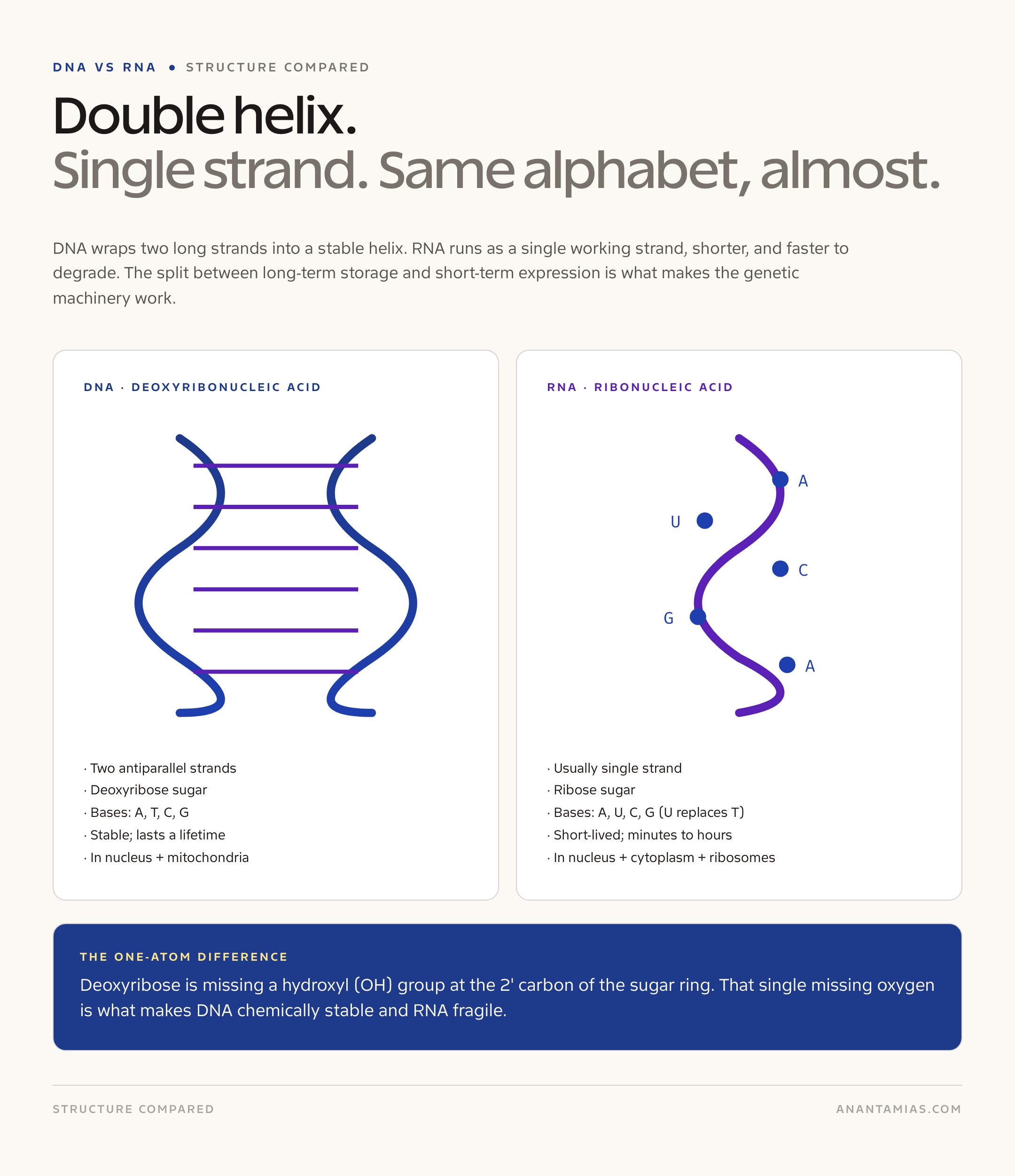
- Full forms. DNA = deoxyribonucleic acid; RNA = ribonucleic acid.
- Sugar. DNA contains deoxyribose; RNA contains ribose.
- Bases. DNA uses A, T, C, G; RNA uses A, U, C, G (uracil replaces thymine).
- Strand. DNA is double-stranded helix; RNA is usually single-stranded.
- Location. DNA mostly in nucleus and mitochondria; RNA in nucleus and cytoplasm.
- Stability. DNA is chemically stable; RNA is short-lived and easily degraded.
- Function. DNA stores genetic information; RNA expresses it.
- Types of RNA. mRNA, tRNA, rRNA, plus regulatory RNAs.
- First isolated. DNA by Friedrich Miescher in 1869 from pus cells.
- Structure described. DNA double helix by Watson, Crick, and Franklin in 1953.
What Is DNA
DNA, deoxyribonucleic acid, is the molecule that stores the genetic blueprint in every cellular organism and in many viruses. It was first isolated by the Swiss physician Friedrich Miescher in 1869 from pus cells, where he called it nuclein. Its structure as a double helix was published by James Watson and Francis Crick in 1953, building on the X-ray diffraction work of Rosalind Franklin and Maurice Wilkins.
A DNA molecule consists of two long polymer chains made of repeating nucleotides. Each nucleotide has three parts: a deoxyribose sugar, a phosphate group, and one of four nitrogenous bases (adenine, thymine, cytosine, guanine). The two strands run antiparallel, meaning one runs 5′ to 3′ while the other runs 3′ to 5′, and they are held together by hydrogen bonds between complementary base pairs.
The base pairing rule in DNA is strict. Adenine (A) pairs with thymine (T) via two hydrogen bonds. Cytosine (C) pairs with guanine (G) via three hydrogen bonds. This complementarity is what allows DNA to be copied faithfully during replication.
The human genome contains approximately 3.2 billion base pairs distributed across 23 chromosome pairs in each somatic cell. If unwound, the DNA in a single human cell would stretch about two metres. The total length of DNA in all the cells of an adult human body, if stretched end to end, would cover several light years.
What Is RNA
RNA, ribonucleic acid, is the working copy of the genetic message. It is usually single-stranded, much shorter than DNA, and built from nucleotides that use ribose sugar instead of deoxyribose. The base set is A, U, C, G; uracil replaces thymine.
RNA is the molecule that takes the genetic instruction from DNA and turns it into actual proteins. Without RNA, the DNA blueprint would sit useless in the nucleus. RNA molecules are also catalytic in some cases. Ribozymes, discovered in the 1980s by Thomas Cech and Sidney Altman, are RNA molecules that catalyse chemical reactions, hinting that RNA may have predated DNA in the origin of life. This is the RNA world hypothesis.
There are three principal classes of RNA in protein synthesis:
- Messenger RNA (mRNA). Carries the genetic code from DNA to the ribosome. The sequence of mRNA codons determines the amino acid sequence of the protein. mRNA is short-lived; in human cells, most mRNAs last from minutes to a few hours before being degraded.
- Transfer RNA (tRNA). Brings the correct amino acid to the ribosome based on the codon being read. Each tRNA has an anticodon loop that base-pairs with the mRNA codon, and a 3′ end that carries the matching amino acid.
- Ribosomal RNA (rRNA). Forms the structural and catalytic core of the ribosome. The ribosome is roughly two-thirds rRNA and one-third protein. The peptide bond formation between amino acids is catalysed by rRNA, making the ribosome itself a ribozyme.
There are also several regulatory RNAs (microRNA, small interfering RNA, long non-coding RNA) that fine-tune gene expression. These were largely invisible to biology until the 1990s and are now a major area of research.
DNA vs RNA: Side by Side
A clean comparison table is the fastest way to internalise the DNA vs RNA differences.
| Feature | DNA | RNA |
|---|---|---|
| Full form | Deoxyribonucleic acid | Ribonucleic acid |
| Sugar | Deoxyribose | Ribose |
| Bases | A, T, C, G | A, U, C, G |
| Strands | Double-stranded helix | Usually single-stranded |
| Stability | Chemically stable | Short-lived, easily degraded |
| Location | Nucleus, mitochondria, chloroplasts | Nucleus, cytoplasm, ribosomes |
| Function | Genetic information storage | Information transfer and protein synthesis |
| Size | Very long (millions to billions of bases) | Short (tens to thousands of bases) |
| Replication | Self-replicates via DNA polymerase | Synthesised from DNA via RNA polymerase |
| Base pairing | A-T (2 H-bonds), C-G (3 H-bonds) | A-U (2 H-bonds), C-G (3 H-bonds) |
| Genome carrier | All cellular organisms, DNA viruses | RNA viruses (HIV, SARS-CoV-2, influenza) |
The single sugar difference, the loss of an oxygen at the 2′ position to make deoxyribose, is what makes DNA more stable than RNA. RNA’s 2′ hydroxyl group makes it more prone to hydrolysis. That instability is a feature, not a bug. mRNA is supposed to be short-lived so the cell can update protein production quickly.
The Sugar Difference
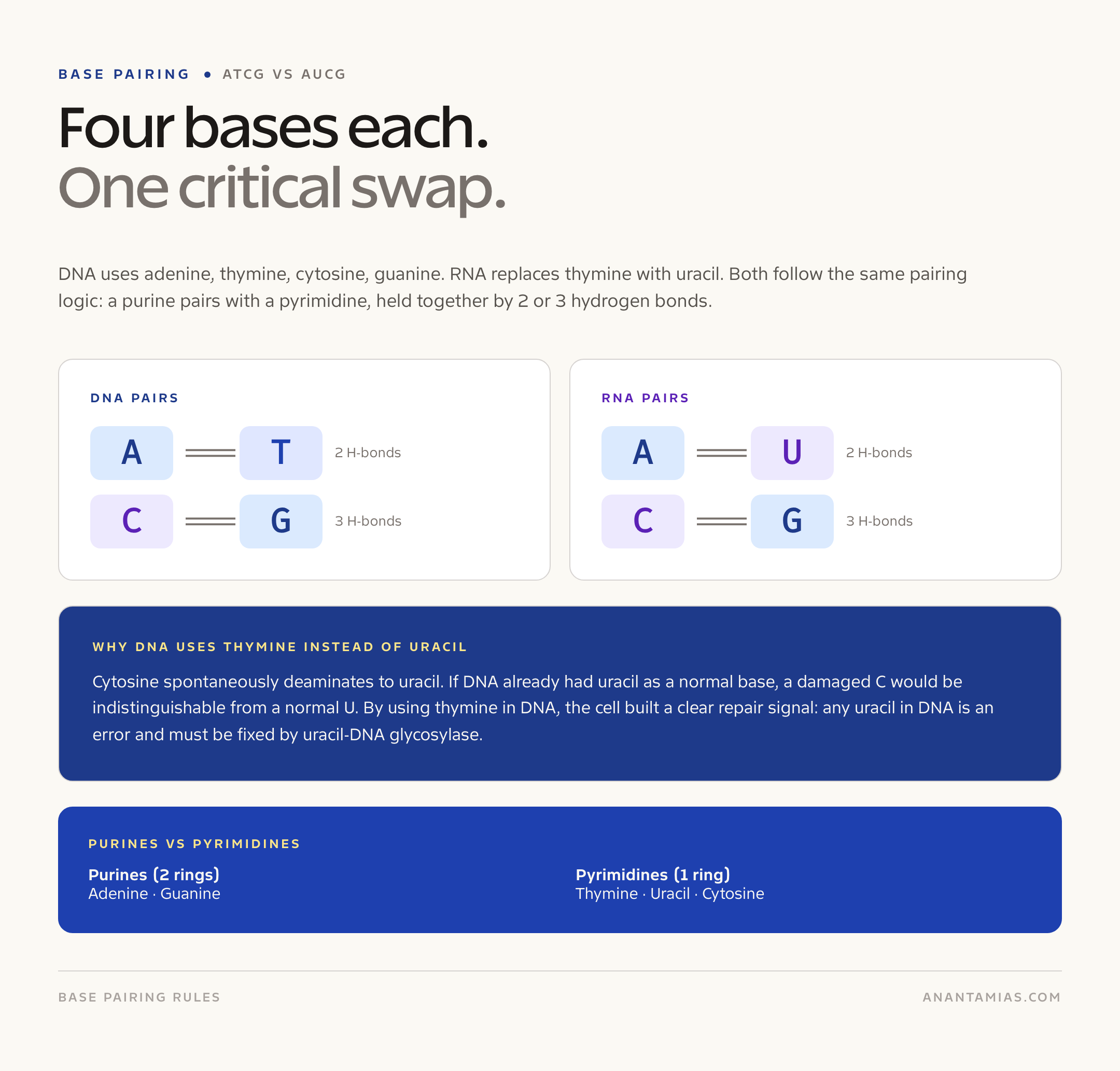
The “deoxy” in deoxyribonucleic acid refers to the absence of a hydroxyl (OH) group at the 2′ carbon of the sugar ring. Ribose has an OH at 2′; deoxyribose has only an H. This single atomic difference has large consequences.
The 2′ OH on ribose makes RNA susceptible to alkaline hydrolysis. RNA can be broken down by simply raising the pH. DNA is far more resistant. That is why DNA can be recovered from bones thousands of years old, from frozen mammoths, even from Neanderthal remains, while RNA is rarely preserved in ancient samples without exceptional conditions.
The same instability is what makes RNA easier for the cell to clean up. Once a protein has been synthesised, the cell does not need to keep the mRNA around. RNase enzymes degrade unwanted RNA rapidly. DNA, by contrast, has to last a lifetime; in long-lived neurons, the DNA in the nucleus must remain stable for decades.
Bases: ATCG vs AUCG
DNA and RNA use almost the same alphabet. Both contain adenine, cytosine, and guanine. They differ on the fourth base.
- DNA uses thymine (T), a pyrimidine.
- RNA uses uracil (U), also a pyrimidine, but lacking the methyl group that thymine carries.
The reason DNA evolved to use thymine instead of uracil comes down to error correction. Cytosine can spontaneously deaminate to form uracil. If RNA’s base set already includes uracil, the cell can still tolerate the loss of a cytosine because the uracil signal is normal. In DNA, however, a deaminated cytosine becomes uracil, which is then recognised as an error and repaired by uracil-DNA glycosylase. By using thymine instead of uracil in DNA, the cell created a clear signal for repair enzymes. This is one of the elegant accidents of molecular evolution.
Base pairing rules:
- In DNA: A-T (2 hydrogen bonds), C-G (3 hydrogen bonds).
- In RNA: A-U (2 hydrogen bonds), C-G (3 hydrogen bonds).
- In a DNA-RNA hybrid (during transcription): A in DNA pairs with U in RNA, T in DNA pairs with A in RNA.
The number of hydrogen bonds affects melting temperature. DNA regions rich in G-C content require more energy to separate the strands than A-T rich regions.
Replication vs Transcription
DNA replication and RNA transcription are the two core copying processes in molecular biology.
DNA replication is the process by which a cell duplicates its entire DNA before dividing. The enzyme DNA polymerase reads each parent strand and builds a complementary daughter strand. The result is two identical DNA molecules, each containing one original and one new strand. This is called semi-conservative replication, proven by Matthew Meselson and Franklin Stahl in 1958 using nitrogen isotope labelling.
Key features of replication:
- Begins at origins of replication.
- Requires DNA polymerase, helicase, primase, ligase, and several other enzymes.
- Both strands are copied simultaneously, one continuously (leading strand) and one in short fragments (lagging strand, Okazaki fragments).
- Proofreading is built in; DNA polymerase has 3′ to 5′ exonuclease activity that corrects mismatched bases.
RNA transcription is the process by which an RNA molecule is synthesised using a DNA template. The enzyme RNA polymerase reads one strand of DNA and builds an RNA molecule complementary to it. Only the specific gene being expressed is transcribed; the rest of the DNA stays unread for that moment.
Key features of transcription:
- Begins at promoter regions upstream of a gene.
- RNA polymerase does the work, with help from transcription factors.
- Produces a primary transcript that is then processed (5′ capping, 3′ polyadenylation, splicing) in eukaryotes to produce mature mRNA.
- No proofreading mechanism as rigorous as in DNA replication; RNA transcription has a higher error rate, which is acceptable because mRNA is short-lived.
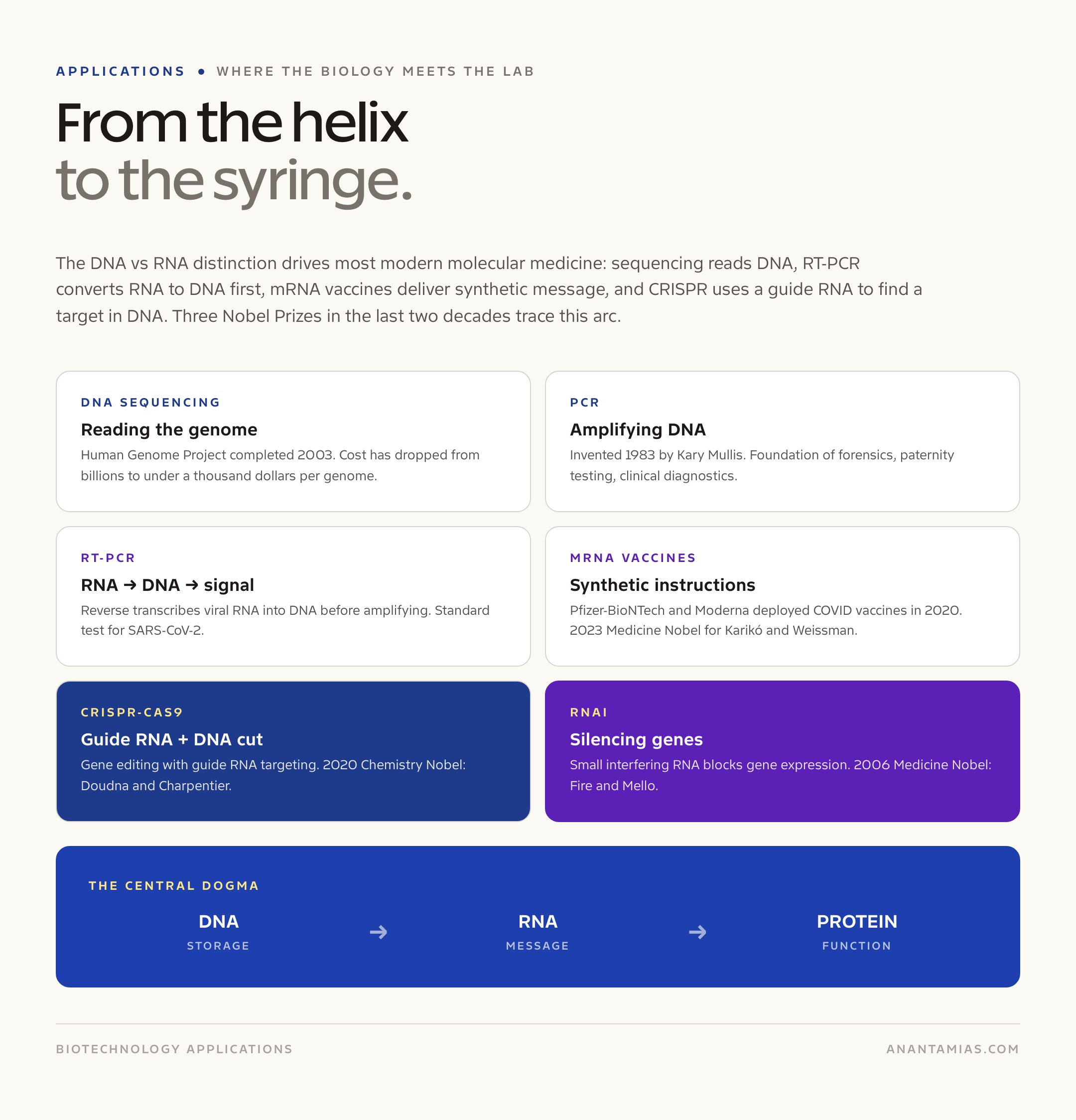
After transcription, mRNA leaves the nucleus and is translated into protein at the ribosome. Translation is the third major process in the central dogma of molecular biology: DNA → RNA → Protein.
RNA Viruses and the COVID-19 Lesson
Some viruses use RNA, not DNA, as their genetic material. The list includes HIV, influenza, hepatitis C, rabies, polio, and the coronaviruses including SARS-CoV-2. RNA viruses generally have higher mutation rates than DNA viruses because their replication machinery lacks the proofreading found in DNA polymerases.
The high mutation rate of SARS-CoV-2 led to the rapid emergence of variants: Alpha, Beta, Gamma, Delta, Omicron, and many sub-lineages. This same mutational tempo also means that flu vaccines have to be redesigned every year.
The COVID-19 pandemic also brought messenger RNA vaccines into the mainstream. Pfizer-BioNTech and Moderna both developed mRNA vaccines in 2020 using the SARS-CoV-2 spike protein gene sequence published by Chinese researchers in January 2020. The vaccines deliver a synthetic mRNA encoding the spike protein, which the body’s cells then translate, triggering an immune response. The 2023 Nobel Prize in Physiology or Medicine went to Katalin Karikó and Drew Weissman for the foundational work on modified nucleosides that made mRNA vaccines possible.
Applications of the DNA vs RNA Distinction
The DNA vs RNA distinction underlies a wide range of biotech and medical applications:
- DNA sequencing. Reads the order of bases in a DNA molecule. Used in genome projects, forensic identification, and disease diagnosis.
- PCR (Polymerase Chain Reaction). Amplifies specific DNA segments. Foundation of forensic testing, ancestry testing, and clinical diagnostics.
- RT-PCR. Reverse transcribes RNA to DNA first, then amplifies. Used for SARS-CoV-2 detection.
- mRNA therapeutics. Synthetic mRNA delivered to cells to produce a therapeutic protein. COVID-19 vaccines are the prominent example; mRNA cancer vaccines are in trials.
- CRISPR-Cas9. Uses a guide RNA to target a specific DNA sequence for editing. The 2020 Nobel Prize in Chemistry went to Jennifer Doudna and Emmanuelle Charpentier for this.
- DNA fingerprinting. Uses repetitive DNA sequences for forensic identification. Developed by Alec Jeffreys in 1984.
- Gene therapy. Inserts or edits DNA in patient cells to treat disease. Indian and global trials cover sickle cell anaemia, thalassaemia, certain cancers.
- RNA interference (RNAi). Uses small interfering RNA to silence specific genes. The 2006 Nobel Prize in Physiology or Medicine went to Andrew Fire and Craig Mello.
This list is also why biotechnology and molecular biology questions in UPSC have moved well beyond the textbook structure of DNA into therapeutic applications.
Where DNA and RNA Live in the Cell
In eukaryotic cells, DNA is primarily housed in the nucleus, packaged into chromosomes. There is also a smaller circular DNA in the mitochondria (mitochondrial DNA, inherited maternally) and in plant chloroplasts.
RNA is found in both the nucleus, where it is transcribed, and the cytoplasm, where most translation occurs. Ribosomal RNA is part of the ribosome, which sits in the cytoplasm and on the rough endoplasmic reticulum. Transfer RNA also moves between the nucleus and the cytoplasm.
In prokaryotes (bacteria and archaea), there is no nucleus. DNA is a single circular chromosome in the cytoplasm, often with smaller plasmids. RNA is also in the cytoplasm. Transcription and translation can occur simultaneously in prokaryotes; in eukaryotes, transcription happens in the nucleus and translation in the cytoplasm.
Common Confusions
A few common DNA vs RNA confusions worth clearing.
- DNA is not always in chromosomes. Mitochondrial DNA and chloroplast DNA are separate, circular, and present in multiple copies per organelle.
- Not all RNA is mRNA. mRNA is only one type. tRNA, rRNA, miRNA, siRNA, lncRNA, and others have distinct functions.
- RNA can be double-stranded. Some viruses, like rotavirus, carry double-stranded RNA genomes. Double-stranded RNA in a human cell is also a signal that triggers antiviral defences.
- DNA does not directly make protein. The genetic information flows DNA → RNA → Protein. RNA is the essential intermediary.
- Histone proteins package DNA, not RNA. The DNA in a eukaryotic chromosome is wrapped around histone proteins to form nucleosomes. RNA is not packaged the same way.
Prelims and Mains Pointers for UPSC
For Prelims:
- DNA has deoxyribose, double helix, ATCG bases; RNA has ribose, usually single strand, AUCG bases.
- Three main RNA types: mRNA, tRNA, rRNA.
- Watson, Crick, and Franklin described the DNA double helix in 1953.
- mRNA vaccines won the 2023 Medicine Nobel (Karikó, Weissman).
- CRISPR-Cas9 won the 2020 Chemistry Nobel (Doudna, Charpentier).
- Some viruses use RNA as their genome (HIV, influenza, SARS-CoV-2).
For Mains:
- Discuss the significance of mRNA technology for vaccine development with reference to the COVID-19 response and ongoing cancer vaccine research.
- Evaluate the ethical and regulatory framework needed for CRISPR-based gene editing in humans, citing the He Jiankui case (2018) as a cautionary example.
- Analyse the role of biotechnology and molecular biology in India’s National Biotechnology Development Strategy and the BioE3 Policy of 2024.
Conclusion
DNA and RNA are the two complementary information molecules of life. DNA holds the long-term blueprint; RNA carries the working messages, builds the proteins, and increasingly drives modern medicine through vaccines, gene therapies, and editing tools. The differences come down to a single oxygen on the sugar, a single base swap, and a deep functional split between storage and expression.
For UPSC, remember the structural differences (sugar, bases, strands), the functional differences (storage vs expression), and the application list (mRNA vaccines, CRISPR, DNA fingerprinting, RT-PCR). The DNA vs RNA comparison is one of those topics that appears in prelims fact form and in mains as the molecular foundation of biotechnology questions.
Frequently Asked Questions
What is the main difference between DNA and RNA?
The main difference between DNA and RNA is in sugar, bases, structure, and function. DNA uses deoxyribose, has bases ATCG, is double-stranded, and stores genetic information. RNA uses ribose, has bases AUCG (U instead of T), is usually single-stranded, and expresses genetic information by helping make proteins.
Why does RNA have uracil instead of thymine?
RNA evolved to use uracil because uracil is biochemically cheaper to make than thymine. DNA later evolved to use thymine because cytosine can spontaneously deaminate into uracil; using thymine in DNA gives repair enzymes a clear way to spot and fix such errors.
What are the three main types of RNA?
The three main types of RNA are messenger RNA (mRNA), which carries the genetic code from DNA to the ribosome; transfer RNA (tRNA), which delivers the correct amino acids; and ribosomal RNA (rRNA), which forms the catalytic core of the ribosome.
Do all viruses use DNA?
No. Many viruses use RNA as their genetic material, including HIV, influenza, hepatitis C, polio, rabies, and the coronaviruses such as SARS-CoV-2. RNA viruses tend to mutate faster than DNA viruses because their replication enzymes lack rigorous proofreading.
What is an mRNA vaccine?
An mRNA vaccine delivers a synthetic messenger RNA encoding a specific antigen, such as the SARS-CoV-2 spike protein. The body’s cells translate the mRNA into the antigen protein, which triggers an immune response. The Pfizer-BioNTech and Moderna COVID-19 vaccines were the first widely deployed mRNA vaccines.
Who discovered the structure of DNA?
The double helix structure of DNA was published by James Watson and Francis Crick in 1953. They built on the X-ray diffraction work of Rosalind Franklin and Maurice Wilkins. The Nobel Prize in Physiology or Medicine 1962 went to Watson, Crick, and Wilkins; Franklin had died in 1958 and the Nobel rules at the time did not permit posthumous awards.
Why is DNA more stable than RNA?
DNA is more stable because deoxyribose lacks the 2′ hydroxyl group that ribose has. The 2′ hydroxyl in RNA makes it susceptible to alkaline hydrolysis. RNA’s short lifespan is functionally useful because the cell can quickly adjust protein production, while DNA needs to remain intact for a lifetime.