For nearly a century, vaccines worked by a simple trick. You took a pathogen, weakened it or killed it or chopped it into pieces, mixed it with an adjuvant and injected it into the arm. The immune system, fooled into thinking it had encountered a real infection, learned to recognize and destroy that pathogen the next time it appeared. The trick was robust and remarkably effective. The smallpox eradication campaign, the polio drive, the measles vaccine, the Indian Covaxin programme all used variants of this approach.
The mRNA vaccine inverts the trick. It does not contain the pathogen at all. It contains an instruction manual, a short strand of messenger RNA, encoding only the viral protein that the immune system needs to recognize. Once injected, the mRNA is taken up by cells, read by their normal protein-making machinery, and the cells themselves manufacture the viral protein. The immune system sees this protein on cell surfaces, treats it as foreign, and trains itself accordingly. The mRNA itself is fragile. Within hours to days, enzymes break it down. It never enters the cell nucleus and cannot alter your DNA.
This sounds elegant in retrospect. It took four decades of patient work, much of it by Hungarian-American biochemist Katalin Karikó and American immunologist Drew Weissman, to make it actually work in humans. Their key insight, called nucleoside base modification, finally cracked the problem in 2005, but the platform did not enter mainstream medicine until the COVID-19 vaccines from Pfizer-BioNTech and Moderna in late 2020. Karikó and Weissman shared the 2023 Nobel Prize in Physiology or Medicine. India’s own first indigenous mRNA vaccine, GEMKOVAC, was approved in 2022 and brings a thermostable formulation that does not need ultra-cold chains.
This guide walks through the mechanism, the historical context, the comparison with traditional vaccines, India’s GEMKOVAC story and the policy implications for pandemic preparedness.
Quick Facts: mRNA Vaccines at a Glance
- What they contain: A short strand of messenger RNA encoding a viral protein, packaged inside a lipid nanoparticle
- 2023 Nobel in Physiology or Medicine: Awarded to Katalin Karikó and Drew Weissman for nucleoside base modification of mRNA
- First approved mRNA vaccines: Pfizer-BioNTech BNT162b2 and Moderna mRNA-1273, both for COVID-19, late 2020
- Storage of Pfizer original formulation: Minus 70 degrees Celsius
- Storage of GEMKOVAC: Plus 2 to 8 degrees Celsius, ordinary fridge temperature
- GEMKOVAC developer: Gennova Biopharmaceuticals, Pune, supported by the Department of Biotechnology
- GEMKOVAC approval: Emergency use authorization for primary series in June 2022, GEMKOVAC-OM for the Omicron variant in 2023
- Cellular site of mRNA action: Cytoplasm, never the nucleus, so DNA is not altered
What Is an mRNA Vaccine?
To understand an mRNA vaccine you need to understand what mRNA already does inside every one of your cells. Your DNA, locked in the nucleus, contains the master blueprint of your body. When a cell needs to make a particular protein, it does not send the original DNA out into the cell. Instead, it makes a working copy of the relevant gene, a short piece of messenger RNA, and sends that copy out to the ribosomes, the protein-making machines that float in the cytoplasm. The ribosomes read the mRNA, three letters at a time, and assemble the protein. Once the job is done, enzymes chew up the mRNA. It is a transient instruction, not a permanent change.
An mRNA vaccine borrows this normal cellular process. The vaccine contains a synthetic mRNA molecule that encodes a single viral protein, typically the spike protein of the SARS-CoV-2 virus. The mRNA is wrapped in a tiny ball of fats called a lipid nanoparticle, which protects it from the enzymes in the bloodstream and helps it slip into your cells through the cell membrane. Once inside the cytoplasm, the mRNA is read by your ribosomes just like any other mRNA. They produce the spike protein, which is then displayed on the surface of the cell.
Your immune system spots this foreign protein, recognizes it as a threat and mounts a response. B cells produce antibodies that latch onto the spike protein. Helper T cells coordinate the response. Killer T cells learn to destroy any cell displaying that protein. Over the next few weeks, memory B cells and memory T cells settle into the lymph nodes. If the actual virus shows up later, these memory cells launch a fast and powerful response.
The mRNA itself disappears within hours to days, broken down by normal cellular enzymes. It does not enter the nucleus. It cannot integrate into your DNA, because that would require an enzyme called reverse transcriptase that human cells do not possess. The vaccine is, in this sense, the most temporary of medicines. It teaches the immune system to remember, then it vanishes.
Background and Historical Context
The history of mRNA vaccines is a textbook case of how decades of unfashionable research can suddenly become essential. In the 1960s, scientists worked out the basic principles of how mRNA carries genetic information from DNA to ribosomes. By the 1980s, researchers had figured out how to make synthetic mRNA in the laboratory. The first attempt at using mRNA as a therapy came in 1989, when researchers showed that mRNA wrapped in lipid particles could be expressed in cells.
The big problem was that mRNA injected into the body triggered an enormous inflammatory response. The immune system saw the foreign mRNA as a danger signal and attacked it. By the late 1990s, most vaccine companies had given up on mRNA as a platform. Katalin Karikó, working at the University of Pennsylvania for low pay and limited career security, kept at it. Drew Weissman joined the lab in 1997. In a series of papers from 2005 onward, Karikó and Weissman showed that if you replaced one of the four nucleoside building blocks with a chemically modified version, called pseudouridine, the synthetic mRNA looked enough like natural mRNA that it slipped past the immune system’s danger detectors. This was the breakthrough.
The Karikó-Weissman approach was licensed to two new companies, BioNTech and Moderna. Through the 2010s they refined the technology, mostly aimed at cancer therapy and infectious diseases like rabies and Zika. When SARS-CoV-2 emerged in early 2020, both companies pivoted within weeks. The genetic sequence of the virus was published on 11 January 2020. By 13 January, Moderna had designed an mRNA vaccine. The first human trial started on 16 March, just over two months later. Both vaccines reported around 95 percent efficacy in late 2020 and were authorized for emergency use within days of each other.
The 2023 Nobel Prize in Physiology or Medicine to Karikó and Weissman was a recognition of how a quiet, careful biochemistry experiment turned out to be the foundation of one of the most consequential medical interventions of the 21st century. Our coverage of biotechnology and DNA types places this within the wider revolution in molecular medicine.
How mRNA Vaccines Work: A Closer Look at the Mechanism
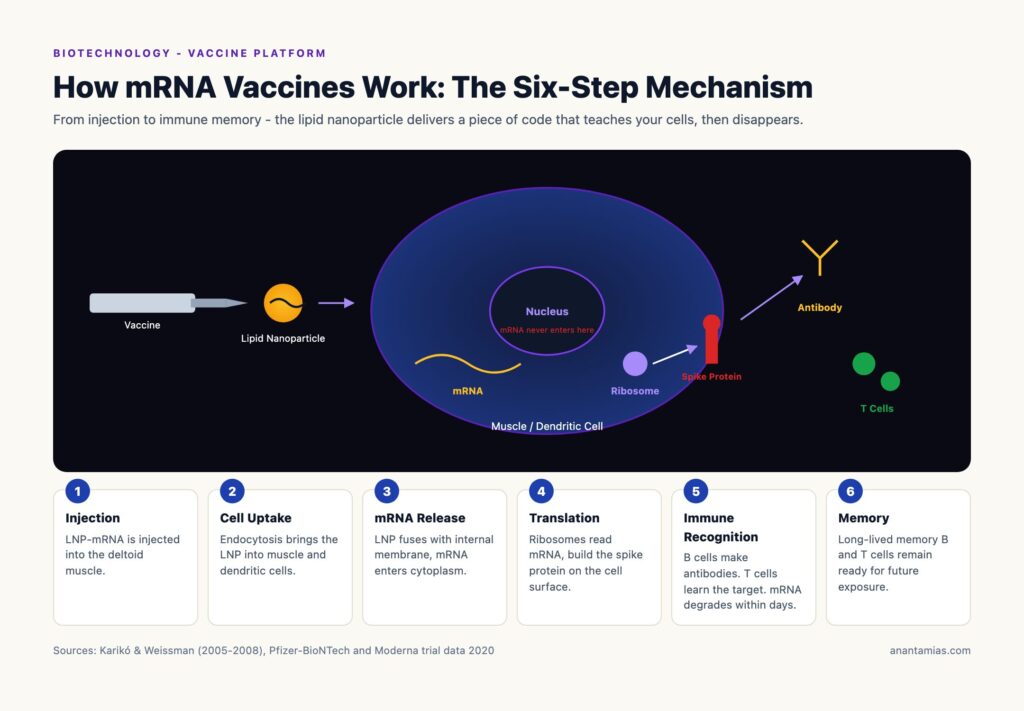
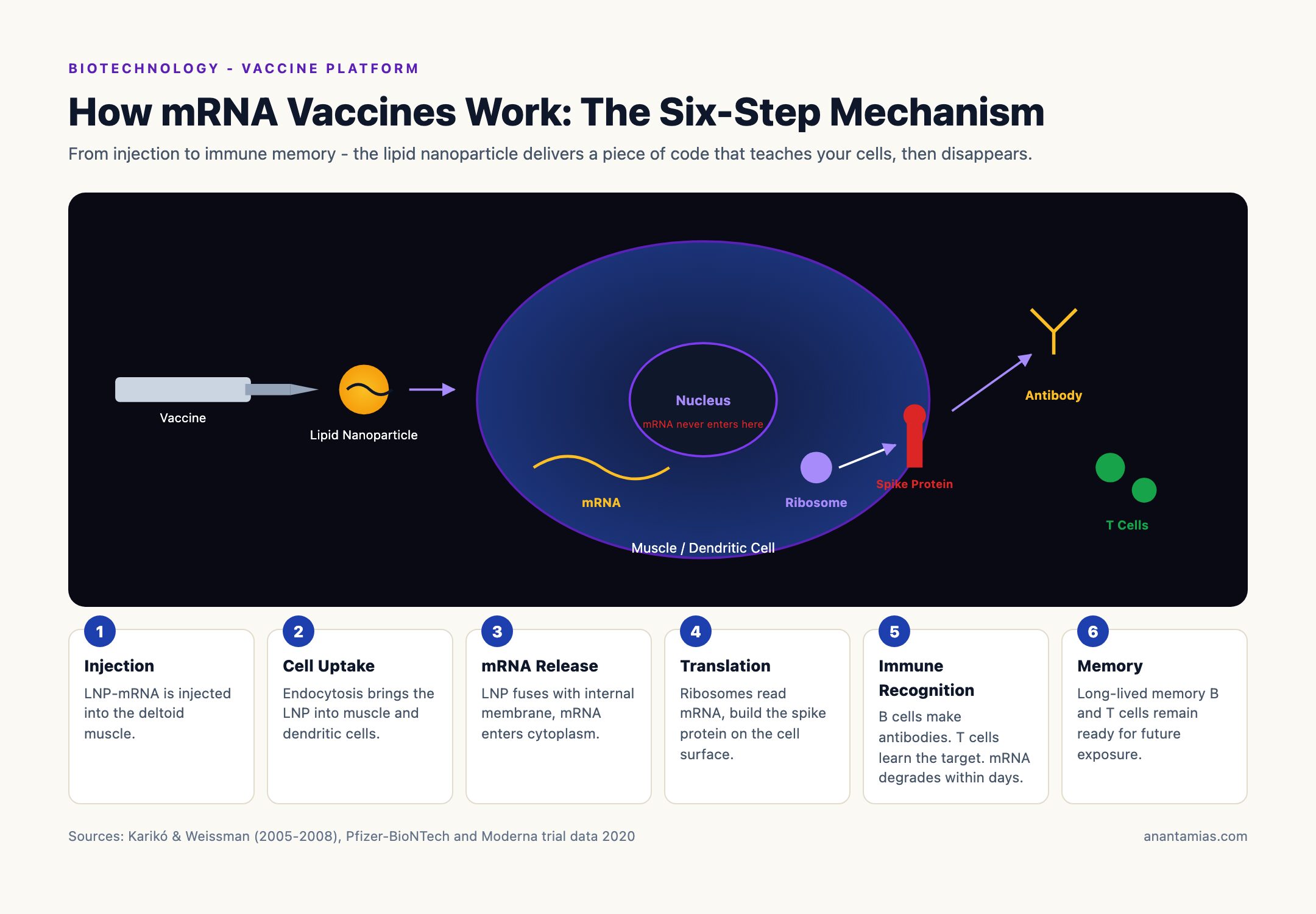
The journey of an mRNA vaccine inside the body has six broad steps. Step one is injection and uptake. The vaccine is injected intramuscularly, usually in the deltoid. The lipid nanoparticles, each carrying many mRNA strands, are taken up by muscle cells and by antigen-presenting cells like dendritic cells through endocytosis.
Step two is release. Once inside the cell, the lipid nanoparticle fuses with internal membranes and releases the mRNA into the cytoplasm. Step three is translation. Ribosomes find the mRNA and read it, building the encoded viral protein. For COVID-19 vaccines, this is the spike protein of the SARS-CoV-2 virus. The protein is expressed on the cell surface or released into the extracellular space.
Step four is immune recognition. Antigen-presenting cells display fragments of the spike protein on their surface, on molecules called MHC class I and class II. T cells circulating through lymph nodes encounter these displays. Some T cells recognize the spike fragments and begin to multiply. B cells, the antibody-makers, also bind to the spike protein and start producing anti-spike antibodies.
Step five is degradation. The mRNA itself, as a single-stranded RNA molecule in the cytoplasm, is broken down by ribonuclease enzymes within hours to a few days. The synthetic spike protein is itself transient. The immune training, however, persists.
Step six is memory. Some of the activated B cells and T cells become long-lived memory cells. They sit in lymph nodes ready for years. If the real SARS-CoV-2 virus shows up, these memory cells produce antibodies and killer T cells within hours rather than weeks. That is the difference between a primed immune system and a naive one.
GEMKOVAC: India’s Indigenous mRNA Vaccine
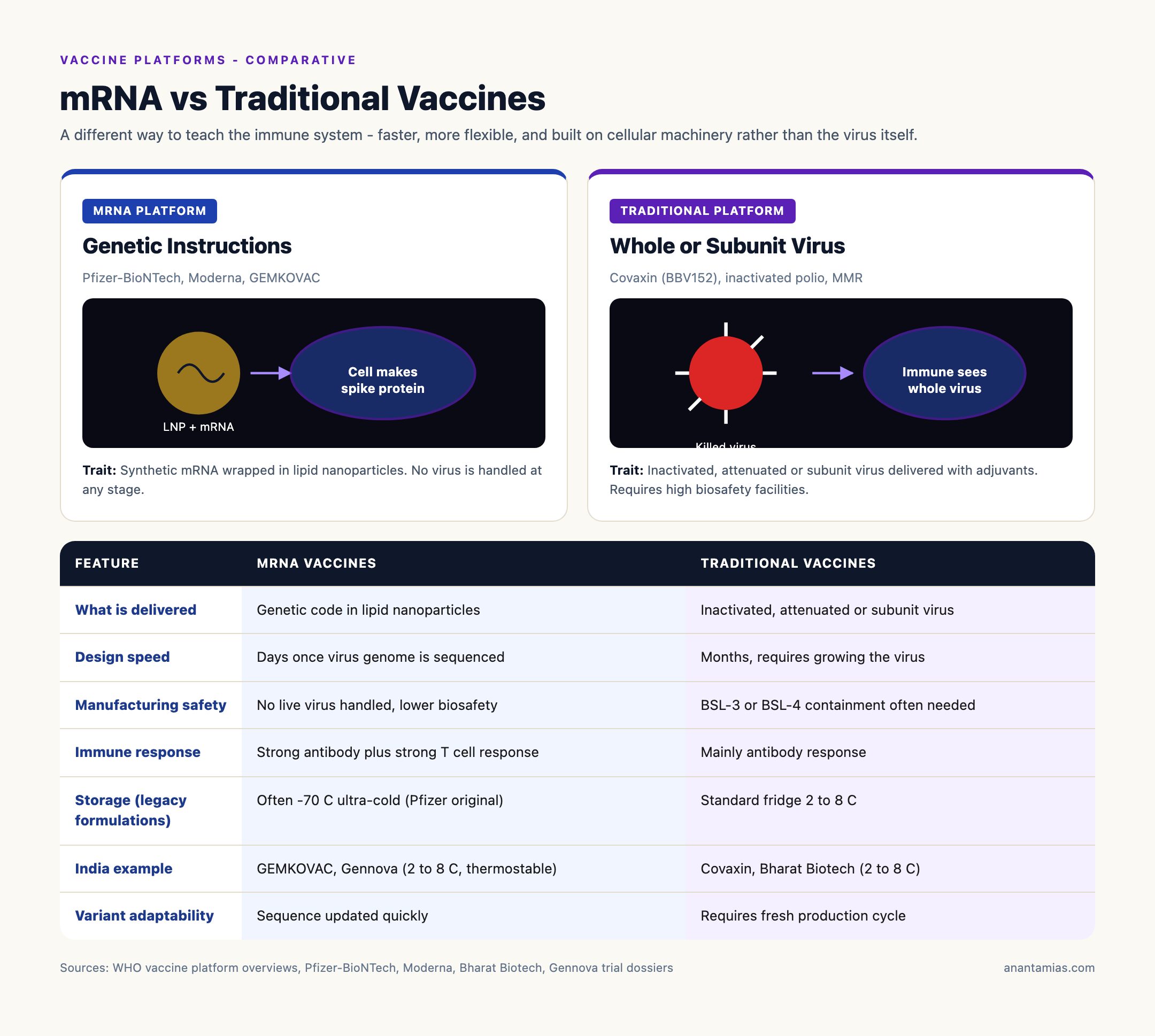
GEMKOVAC-19 is the first mRNA vaccine developed in India. It was created by Gennova Biopharmaceuticals, a Pune-based subsidiary of Emcure Pharmaceuticals, with research support from the Department of Biotechnology and the Biotechnology Industry Research Assistance Council. The vaccine received emergency use authorization from the Drug Controller General of India in June 2022 for primary series administration. A booster version, GEMKOVAC-OM, targeting the Omicron variant, was authorized in 2023.
The most important feature of GEMKOVAC is its thermostability. The original Pfizer-BioNTech formulation required ultra-cold storage at minus 70 degrees Celsius and special freezers, which made distribution in tropical countries with weak cold chains very difficult. GEMKOVAC is stable at standard refrigeration temperatures of plus 2 to 8 degrees Celsius, the same as routine vaccines like the measles vaccine and the rotavirus vaccine. This is achieved through a different lipid nanoparticle composition optimized for tropical conditions.
The strategic significance is twofold. First, it builds Indian capability in a platform technology that will be central to future pandemic responses, cancer vaccines and other applications. Second, it gives India and partner countries a vaccine that can be deployed through existing immunisation infrastructure without a special cold chain. For a country with thousands of primary health centres, this matters more than the headline efficacy numbers.
GEMKOVAC also matters as part of a broader Indian biotech ecosystem that includes biosimilar manufacturing, genome sequencing initiatives and the DBT supported BIRAC programme. The vaccine is one of the most visible outputs of the Mission COVID Suraksha programme launched in 2020.
Comparative: mRNA vs Traditional Vaccines
| Feature | mRNA Vaccines | Traditional Vaccines (e.g. Covaxin) |
|---|---|---|
| What is injected | Genetic instructions inside lipid nanoparticles | Inactivated or attenuated whole virus, or viral subunit |
| Speed of design | Days once the genetic code is known | Months, requires culturing the virus |
| Manufacturing biosafety | Low, no live virus in the process | High containment needed for live virus handling |
| Immune response | Strong antibody plus strong cellular T cell response | Mainly antibody response |
| Storage in original formulation | Often ultra-cold (minus 70 C) | Standard fridge (2 to 8 C) |
| Indian example | GEMKOVAC, Gennova, 2022 | Covaxin, Bharat Biotech |
| Adaptability to variants | Sequence can be updated quickly | Requires a fresh batch and new clinical work |
Beyond COVID-19: What mRNA Platforms Could Do Next
The mRNA platform is not limited to COVID-19. The basic logic, of teaching the body to make a target protein for the immune system to recognize, applies to many diseases. Several lines of research are advancing rapidly.
For seasonal influenza, mRNA vaccines could be designed and updated faster than the current egg-based and recombinant protein vaccines, potentially improving the match between the vaccine and the dominant circulating strain. For HIV, where the virus mutates very rapidly, mRNA platforms allow researchers to test multiple antigen designs quickly. For tuberculosis, malaria and respiratory syncytial virus, mRNA candidates are in clinical development.
Cancer vaccines are perhaps the most exciting frontier. The idea is to sequence a patient’s tumour, identify mutations that produce abnormal proteins, design an mRNA encoding fragments of these mutated proteins and inject it as a personalized therapeutic vaccine. Early-stage clinical trials, particularly in melanoma and pancreatic cancer, have produced encouraging results, though larger trials are still in progress.
Therapeutic mRNA, where the goal is not vaccination but to make a missing protein in the patient’s own body, is also under study for genetic diseases like cystic fibrosis. The same delivery technology that enables vaccines could in principle deliver corrective genetic instructions for inherited disorders.
Challenges, Concerns and Misconceptions
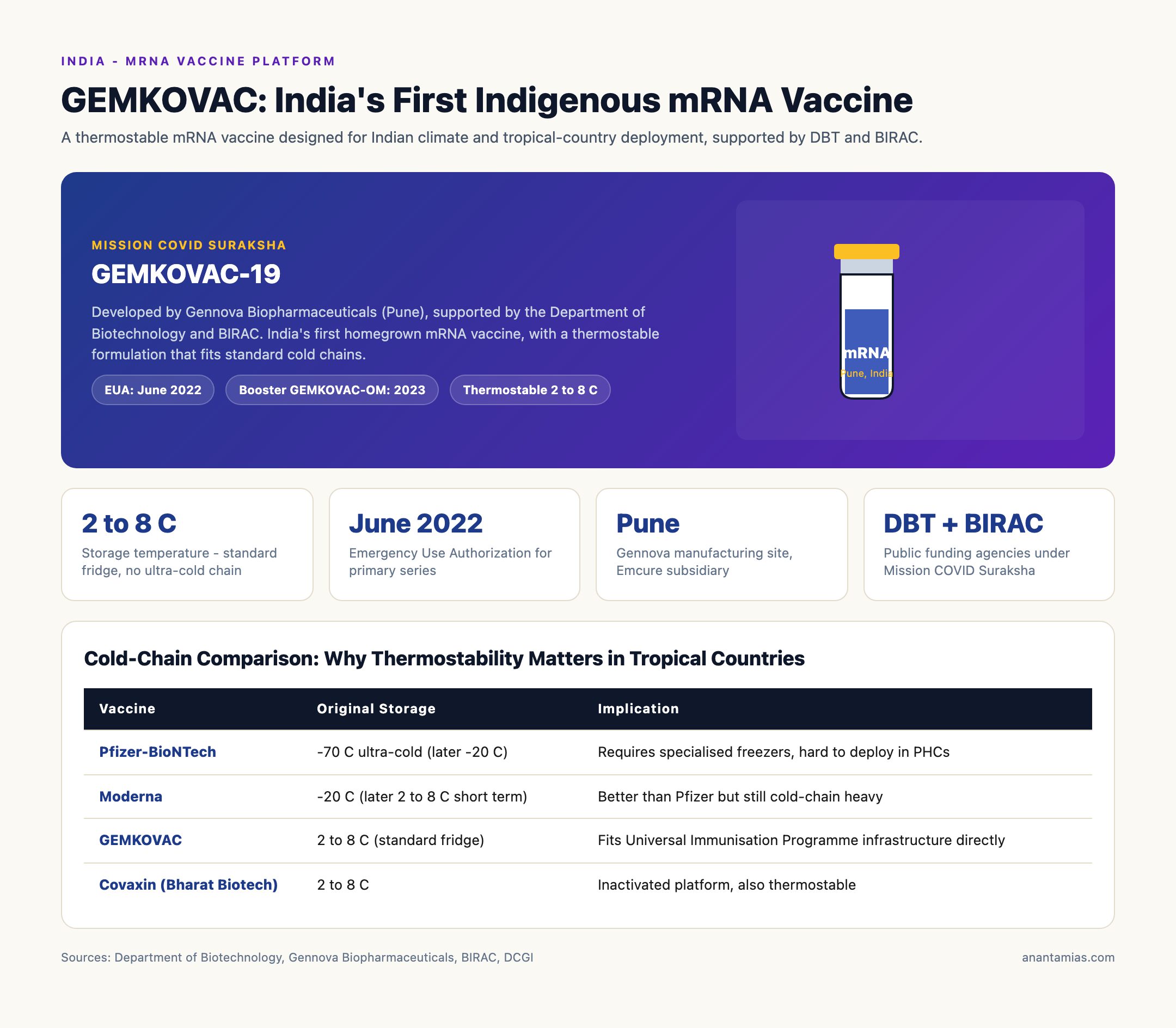
The biggest practical challenge for mRNA vaccines remains delivery. The lipid nanoparticles that protect the mRNA are still relatively expensive and complex to manufacture at scale. Cold-chain requirements vary across formulations and remain a constraint in low-resource settings, though GEMKOVAC and similar thermostable products have started to bridge this gap.
A persistent public concern is whether mRNA vaccines alter human DNA. They do not. The mRNA stays in the cytoplasm, never enters the nucleus and is degraded within days. Human cells lack the reverse transcriptase enzyme that would be needed to copy mRNA into DNA, and there is no integration mechanism. The scientific consensus on this is settled.
Side effects, mostly mild and short-lived, include injection site soreness, fatigue and fever for a day or two. Rare cases of myocarditis, particularly in young men, have been studied carefully and the risk-benefit ratio remains favourable for the populations in which the vaccine is recommended. Long-term surveillance through national pharmacovigilance programs continues.
Regulatory and equity challenges also remain. Patent landscapes around mRNA technology are complex, and access for lower-income countries depends on technology transfer agreements, voluntary licensing and on platforms like GEMKOVAC that build indigenous capability. Read our coverage of compulsory licensing and intellectual property rights for the broader IPR backdrop.
Prelims Pointers
- mRNA vaccines contain a synthetic strand of messenger RNA encoding a viral protein, packaged inside lipid nanoparticles.
- The 2023 Nobel Prize in Physiology or Medicine was awarded to Katalin Karikó and Drew Weissman for nucleoside base modification of mRNA.
- The mRNA stays in the cytoplasm and never enters the nucleus, so it cannot alter human DNA.
- The first approved mRNA vaccines were Pfizer-BioNTech BNT162b2 and Moderna mRNA-1273 for COVID-19 in late 2020.
- GEMKOVAC-19 is India’s first indigenous mRNA vaccine, developed by Gennova Biopharmaceuticals, Pune.
- GEMKOVAC received emergency use authorization in June 2022, with GEMKOVAC-OM for Omicron approved in 2023.
- GEMKOVAC is thermostable at 2 to 8 degrees Celsius, unlike the original Pfizer formulation that needed minus 70 C.
- The Department of Biotechnology and BIRAC supported GEMKOVAC under Mission COVID Suraksha.
- Lipid nanoparticles deliver the mRNA across the cell membrane and protect it from degradation in the bloodstream.
- mRNA platforms induce both humoral (antibody) and cellular (T cell) immune responses.
Mains Practice Questions
- Discuss the working mechanism of mRNA vaccines and explain why the platform represents a paradigm shift in vaccine technology. (250 words)
- India’s GEMKOVAC vaccine is a milestone in indigenous biotechnology. Critically examine its significance for pandemic preparedness in tropical countries. (250 words)
- Compare mRNA vaccines with traditional inactivated and attenuated vaccines on dimensions of speed, safety and immunogenicity. (150 words)
- Beyond COVID-19, what are the most promising applications of mRNA platforms? Discuss the policy and regulatory questions that India must address. (250 words)
Way Forward
The mRNA story is at an early stage even after the COVID-19 pandemic. India’s path forward needs three connected investments. First, scale up Indian mRNA manufacturing capacity. GEMKOVAC has shown that an Indian biotech firm can develop a functional mRNA vaccine, but commercial scale production of mRNA, especially the lipid nanoparticle components, is still concentrated in a few global facilities. The Department of Biotechnology should support a national mRNA manufacturing platform, possibly as a public-private partnership, that can serve domestic needs and export to partner countries.
Second, broaden the disease portfolio. Indian research consortia should pursue mRNA candidates for tuberculosis, dengue, chikungunya, rabies and seasonal influenza, in addition to cancer immunotherapy programmes through institutions like AIIMS, ACTREC and the Tata Memorial Centre. The platform’s strength is rapid iteration. India should be able to use that strength.
Third, build the regulatory and procurement infrastructure for the next pandemic. The Drug Controller General of India should publish a clear adaptive pathway for variant-updated mRNA vaccines, similar to the model used for annual influenza updates. The National Centre for Disease Control should integrate mRNA vaccine surveillance into routine pharmacovigilance. The Universal Immunisation Programme should be ready to absorb mRNA candidates as they mature, beginning with thermostable formulations like GEMKOVAC that fit into existing cold chains.
Underlying all of this is the human capital question. Indian universities and IIT-class institutions need dedicated programmes in RNA biology, lipid nanoparticle engineering and immunology. The biotech ecosystem then has the talent it needs to take the platform forward.
Frequently Asked Questions
What is an mRNA vaccine in simple terms?
An mRNA vaccine contains a piece of genetic instruction, called messenger RNA, that teaches your own cells to make a small piece of a virus, usually a surface protein. Your immune system then learns to recognize and destroy any cell or virus showing that protein, training itself for a real infection.
Can mRNA vaccines change human DNA?
No. The mRNA stays in the cell’s cytoplasm and never enters the nucleus where DNA is stored. Human cells also lack the enzyme reverse transcriptase that would be needed to copy mRNA into DNA, so integration into the genome is not possible.
Who won the 2023 Nobel Prize for mRNA vaccines?
Katalin Karikó and Drew Weissman shared the 2023 Nobel Prize in Physiology or Medicine for their discovery of nucleoside base modification, which allowed synthetic mRNA to escape destruction by the immune system and made effective mRNA vaccines possible.
What is GEMKOVAC and how is it different from Pfizer or Moderna?
GEMKOVAC is India’s first indigenous mRNA vaccine, developed by Gennova Biopharmaceuticals in Pune with support from the Department of Biotechnology. The most important difference is that it is thermostable at 2 to 8 degrees Celsius, unlike the original Pfizer formulation that required minus 70 degrees Celsius.
How long does the mRNA stay in the body after vaccination?
The synthetic mRNA is broken down by normal cellular enzymes within a few hours to a few days. The viral protein it produced lasts a few days more. The immune memory the vaccine creates can last for months to years.
Are mRNA vaccines safer than traditional vaccines?
Both classes are safe when properly tested and approved. mRNA vaccines have a manufacturing safety advantage because no live virus is handled, but they have not yet been studied for as many decades as traditional vaccines. Real-world surveillance from over a billion COVID-19 doses confirms a strong safety profile.
Why did the original COVID-19 mRNA vaccines need ultra-cold storage?
The mRNA molecule is fragile and can degrade at warmer temperatures. The original Pfizer-BioNTech and Moderna formulations used lipid nanoparticles that required deep freezing for stability. Newer formulations, including GEMKOVAC and updated boosters, use modified lipids and stabilizers that allow ordinary refrigeration.
Can mRNA technology be used for diseases other than COVID-19?
Yes. Clinical trials are under way for influenza, RSV, tuberculosis, malaria, rabies, HIV and several types of cancer including melanoma and pancreatic cancer. The platform is also being studied for treating genetic disorders by delivering corrective protein instructions.
What role did India’s Department of Biotechnology play in GEMKOVAC?
The Department of Biotechnology and BIRAC funded the research and development of GEMKOVAC under the Mission COVID Suraksha programme. They provided grants for preclinical and clinical work, helped coordinate regulatory engagement and supported manufacturing scale-up.
Are mRNA vaccines suitable for India’s climate and infrastructure?
The original ultra-cold mRNA vaccines were difficult to deploy widely in India. GEMKOVAC has changed that. Its 2 to 8 degrees Celsius storage means it fits into the existing cold chain used for routine vaccines under the Universal Immunisation Programme, making it suitable for tropical conditions.
Tell Google you want more of this.
Add Anantam IAS as a preferred sourceOne tap, and this site shows up more often in your own Top Stories, AI Overviews and AI Mode. Remove it any time.