DRDO Full Form: Defence Research and Development Organisation
DRDO full form is Defence Research and Development Organisation. Learn about DRDO's establishment in 1958, 52 labs, major projects like Agni, Tejas, ASAT, Prithvi, its chairman, and India's defence self-reliance mission for UPSC.
DRDO Full Form: Defence Research and Development Organisation
DRDO stands for Defence Research and Development Organisation. It’s India’s premier defence R&D agency — the organisation behind India’s missiles, combat aircraft, electronic warfare systems, armoured vehicles, naval weapons, and dozens of critical military technologies.
When India tests a ballistic missile, the scientists behind it are almost certainly from DRDO. When Indian Air Force jets fly with domestically made avionics or when the Army fields locally built artillery, that’s DRDO’s work embedded in steel and silicon.
DRDO Full Form and Establishment
DRDO was formally established on 1 January 1958 by merging the existing technical departments of the Army and the Defence Science Organisation. The unified agency was placed under the Ministry of Defence.
| Particulars | Details |
|---|---|
| Full form | Defence Research and Development Organisation |
| Established | 1 January 1958 |
| Headquarters | DRDO Bhawan, New Delhi |
| Parent ministry | Ministry of Defence, Government of India |
| Head | Chairman, DRDO (also Scientific Adviser to Raksha Mantri) |
| Number of labs | ~52 laboratories and establishments |
| Employees | ~30,000 (scientists, engineers, support staff) |
DRDO’s Chairman holds the dual role of Secretary, Department of Defence R&D and Scientific Adviser to the Defence Minister. This gives the position direct policy access at the highest level.
Early History and Cold War Context
DRDO was born in the shadow of the Cold War. India had recently gained independence, the Korean War had just ended, and the superpowers were developing increasingly sophisticated weapons. India’s political leadership understood that depending entirely on foreign suppliers for weapons would compromise strategic autonomy.
Dr. D.S. Kothari, India’s first Scientific Adviser, laid the foundation. Early work focused on scientific instruments, explosives, and basic military R&D. The real leap came in the 1970s and 1980s when India committed to developing ballistic missiles.
DRDO’s 52 Laboratories: Organisation
DRDO operates approximately 52 laboratories and establishments spread across India, each specialising in specific domains:
| Cluster | Key Labs | Focus Areas |
|---|---|---|
| Missiles & Strategic | DRDL (Hyderabad), ASL (Hyderabad), RCI (Hyderabad) | Ballistic missiles, aeronautics, re-entry vehicles |
| Aeronautics | ADE (Bengaluru), CEMILAC (Bengaluru), GTRE (Bengaluru) | Unmanned aircraft, certification, jet engines |
| Electronics & Radar | LRDE (Bengaluru), DARE (Bengaluru), DEAL (Dehradun) | Radar, EW systems, communications |
| Armaments | ARDE (Pune), HEMRL (Pune), TBRL (Chandigarh) | Guns, explosives, ballistics |
| Life Sciences | DIPAS (Delhi), DIBER (Haldwani), DFRL (Mysuru) | High-altitude physiology, food tech |
| Naval | NPOL (Kochi), NSTL (Visakhapatnam) | Sonar, naval weapons |
| Materials | DMRL (Hyderabad), NML (Jamshedpur) | Advanced alloys, composites |
| CBW Defence | DRDE (Gwalior), INMAS (Delhi) | Nuclear, biological, chemical defence |
Key Institutions Under DRDO
Defence Institute of Advanced Technology (DIAT), Pune: A deemed university offering M.Tech and PhD programmes in defence technologies. It produces the next generation of defence scientists.
Institute of Technology Management (ITM), Mussoorie: Manages technology transfer from DRDO to industry.
Centre for Airborne Systems (CABS), Bengaluru: Develops Airborne Early Warning and Control Systems (AEW&CS) — India’s “eye in the sky.”
Major DRDO Projects: Missiles
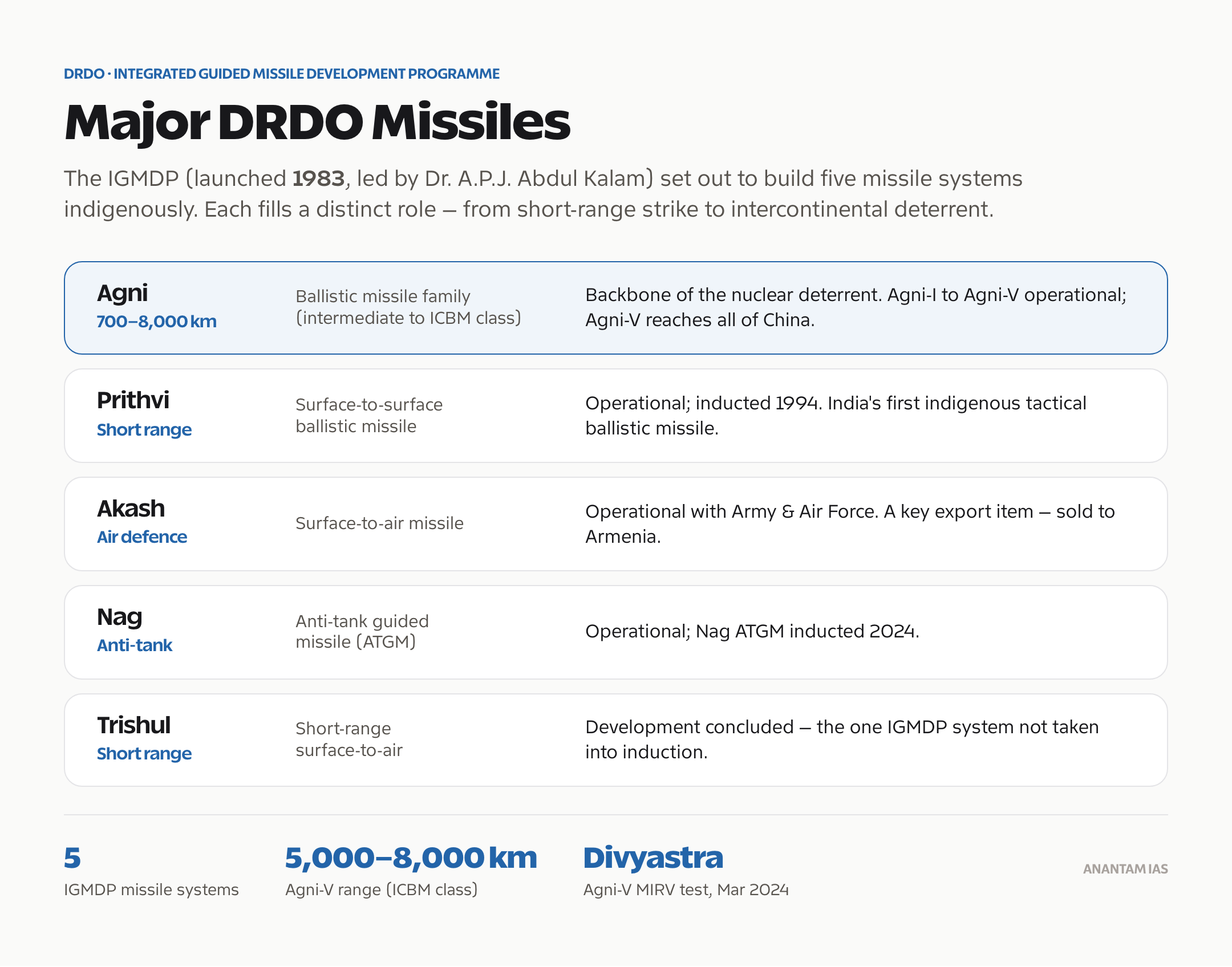
Integrated Guided Missile Development Programme (IGMDP)
Launched in 1983, the IGMDP was India’s most ambitious defence programme. Led by Dr. A.P.J. Abdul Kalam, it aimed to develop five missile systems indigenously:
| Missile | Type | Status |
|---|---|---|
| Prithvi | Surface-to-surface ballistic missile (short range) | Operational (inducted 1994) |
| Agni | Intermediate/Intercontinental ballistic missiles | Operational (Agni-I to Agni-V) |
| Akash | Surface-to-air missile (air defence) | Operational (Army & Air Force) |
| Trishul | Short-range surface-to-air | Development concluded |
| Nag | Anti-tank guided missile | Operational (Nag ATGM inducted 2024) |
The IGMDP is considered India’s most successful defence indigenisation initiative. Dr. Kalam’s leadership of the programme made him a national hero — he later became President of India.
Agni Missile Family
Agni is India’s family of ballistic missiles — the backbone of its nuclear deterrent.
| Variant | Range | Type | Status |
|---|---|---|---|
| Agni-I | 700–1,200 km | Short-range ballistic | Operational |
| Agni-II | 2,000–3,500 km | Medium-range ballistic | Operational |
| Agni-III | 3,000–5,000 km | Intermediate-range | Operational |
| Agni-IV | 4,000 km+ | Intermediate-range | Operational |
| Agni-V | 5,000–8,000 km | Intercontinental (ICBM class) | Operational |
| Agni-P | 1,000–2,000 km | Canister-launched; new generation | Testing |
Agni-V is India’s most potent missile — capable of reaching all of China. Its MIRV (Multiple Independently targetable Re-entry Vehicle) test in March 2024 (Operation Divyastra) placed India among a very small group of countries with this capability (USA, Russia, China, UK, France).
Major DRDO Projects: Combat Aircraft
Tejas Light Combat Aircraft (LCA)
Tejas is India’s indigenously developed 4th generation light combat aircraft. It’s produced by HAL (Hindustan Aeronautics Limited) but the design, avionics, and key systems came from DRDO’s Aeronautical Development Agency (ADA).
| Variant | Role | Status |
|---|---|---|
| Tejas Mk 1 | Multi-role fighter | In service with IAF (2 squadrons) |
| Tejas Mk 1A | Enhanced with AESA radar, IRST, refuelling probe | Ordered (83 aircraft); production ongoing |
| Tejas Mk 2 | More powerful, bigger airframe | Development phase |
| AMCA (Advanced Medium Combat Aircraft) | 5th generation stealth fighter | Development begun 2024 |
Tejas is a milestone — but it took over 35 years from inception (1983) to operational service (2016). The delays exposed gaps in India’s defence industrial ecosystem and drove the Aatmanirbhar Bharat push.
Rustom/TAPAS UAV
DRDO developed the TAPAS (Tactical Airborne Platform for Aerial Surveillance) — a medium-altitude long-endurance (MALE) unmanned aerial vehicle. India currently relies heavily on Israeli Heron and US-origin drones; TAPAS is intended to reduce this dependence.
Anti-Satellite Technology (ASAT): Mission Shakti
On 27 March 2019, India conducted Mission Shakti — its first Anti-Satellite (ASAT) missile test. A DRDO-developed missile destroyed an Indian satellite (Microsat-R) in Low Earth Orbit at approximately 300 km altitude.
India became only the fourth country to demonstrate ASAT capability, after the USA, Russia, and China.
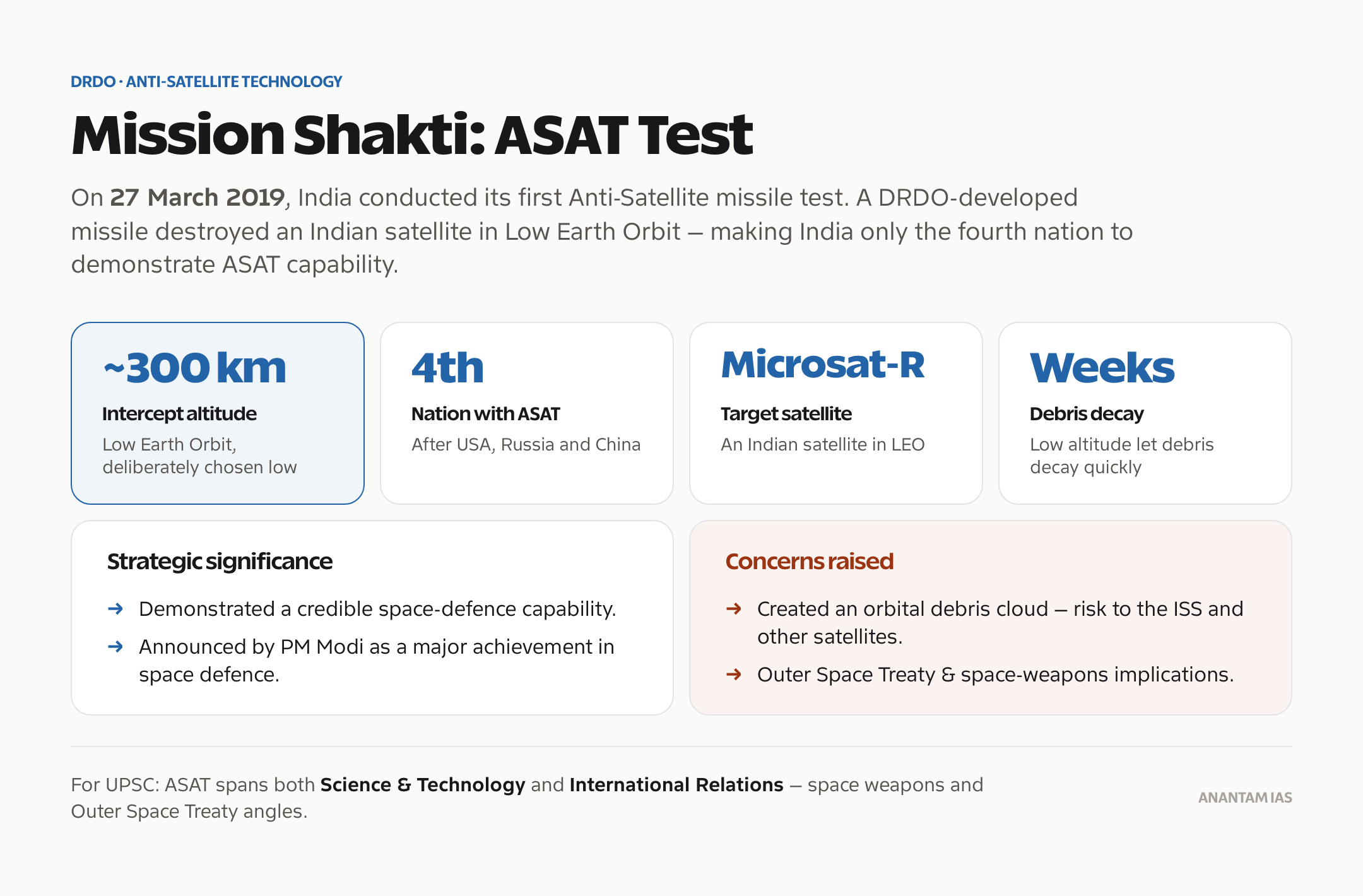
PM Modi announced it as a major achievement in space defence. But the test also drew criticism — the debris created a debris cloud in orbit, raising concerns for the International Space Station and other satellites. The debris largely decayed within weeks due to the low altitude chosen — deliberately.
For UPSC: ASAT is tested under both Science & Technology and International Relations angles (space weapons, Outer Space Treaty implications).
DRDO and Aatmanirbhar Bharat in Defence
PM Modi’s Aatmanirbhar Bharat (self-reliant India) initiative placed defence indigenisation at its centre. DRDO is pivotal to this:
Positive Indigenisation Lists: The Ministry of Defence has published multiple lists of items that cannot be imported and must be sourced domestically. DRDO must develop the technology; Indian industry must produce it.
iDEX (Innovations for Defence Excellence): While not strictly DRDO, iDEX funds defence startups. DRDO’s technology transfer to private industry is integral to making iDEX innovations production-ready.
Technology Development Fund (TDF): DRDO runs TDF to fund private sector and academia in developing defence technologies — acknowledging that DRDO alone cannot develop everything.
Defence Exports: India set a target of ₹35,000 crore ($5 billion) in defence exports by 2025. DRDO-designed platforms like Akash missiles, Tejas, and advanced radars are key export items. India has already sold Akash air defence systems to Armenia.
Critical Technology Gaps
DRDO’s challenges are real. Key gaps include:
Jet engines: India still depends on imported engines for most combat aircraft. The Kaveri engine (DRDO’s indigenous effort) failed to meet Tejas requirements. India is now partnering with GE (for LM-F414 engines) and separately developing a new engine with foreign collaboration.
Semiconductors and advanced electronics: India’s defence electronics rely on imported chips.
Submarines: India’s Arihant nuclear submarine ballistic missile system is DRDO work, but conventional submarine construction capability lags.
Current Chairman and Leadership
The current DRDO Chairman is Dr. Samir V. Kamat (appointed 2022), who is also Secretary, Department of Defence R&D and Scientific Adviser to the Defence Minister.
Notable past DRDO leaders:
- Dr. A.P.J. Abdul Kalam (1992–1999): Led IGMDP; became “Missile Man of India”; later President of India
- Dr. V.K. Saraswat (2009–2013): Oversaw DRDO’s entry into space and cyber domains
ISRO Full Form: Indian Space Research Organisation
QUAD: Quadrilateral Security Dialogue and India
Frequently Asked Questions
What is the full form of DRDO?
DRDO stands for Defence Research and Development Organisation. It’s India’s premier defence R&D agency under the Ministry of Defence, established on 1 January 1958.
How many labs does DRDO have?
DRDO operates approximately 52 laboratories and establishments spread across India, each specialised in specific domains — missiles, aeronautics, electronics, armaments, naval systems, life sciences, and materials.
What is DRDO’s role in the Agni missile programme?
DRDO developed all variants of the Agni ballistic missile — India’s strategic nuclear deterrent. Agni missiles range from 700 km (Agni-I) to over 5,000 km (Agni-V). The Agni-V with MIRV capability was tested in March 2024 under Operation Divyastra.
What is Mission Shakti?
Mission Shakti was India’s first Anti-Satellite (ASAT) missile test, conducted on 27 March 2019. A DRDO missile destroyed an Indian satellite at 300 km altitude, making India the fourth country with demonstrated ASAT capability.
What is DRDO’s role in Aatmanirbhar Bharat?
DRDO is central to India’s Aatmanirbhar Bharat defence initiative. It develops technologies for the Positive Indigenisation List — items banned from import — and transfers technologies to private industry. Its platforms like Tejas and Akash are also part of India’s growing defence export programme.