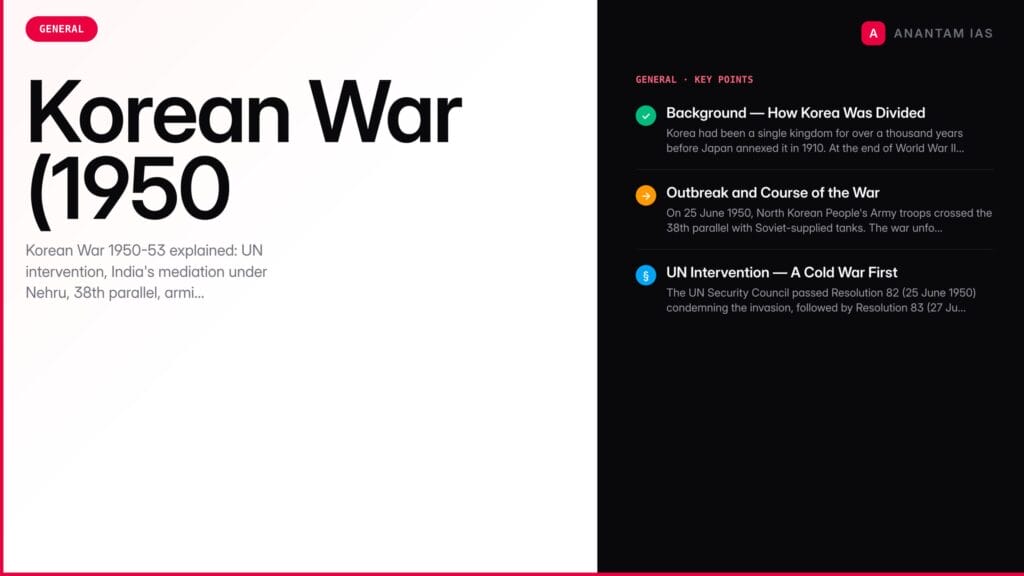
The Korean War was the first major armed conflict of the Cold War and the first test of the United Nations' collective security apparatus. It began on 25 June 1950 when North Korean forces crossed the 38th parallel into South Korea. Three years of bitter fighting later, an armistice — not a peace treaty — was signed at Panmunjom on 27 July 1953. The war killed an estimated three million people, entrenched the Korean peninsula's division, and thrust newly independent India into its first major test of non-alignment.
Background — How Korea Was Divided
Korea had been a single kingdom for over a thousand years before Japan annexed it in 1910. At the end of World War II, the Soviet Union and the United States agreed to jointly occupy the peninsula to accept the Japanese surrender.
| Year | Event |
|---|---|
| 1910 | Japan annexes Korea |
| August 1945 | USSR and US divide Korea at 38th parallel for occupation |
| 1947 | UN calls for all-Korea elections; USSR refuses in its zone |
| May 1948 | South holds elections; Republic of Korea proclaimed under Syngman Rhee |
| Sept 1948 | North proclaims Democratic People's Republic of Korea under Kim Il-sung |
| 1949 | US and Soviet troops withdraw; both Koreas claim the whole peninsula |
The 38th parallel was meant to be a temporary administrative line. It hardened into an international frontier.
Outbreak and Course of the War
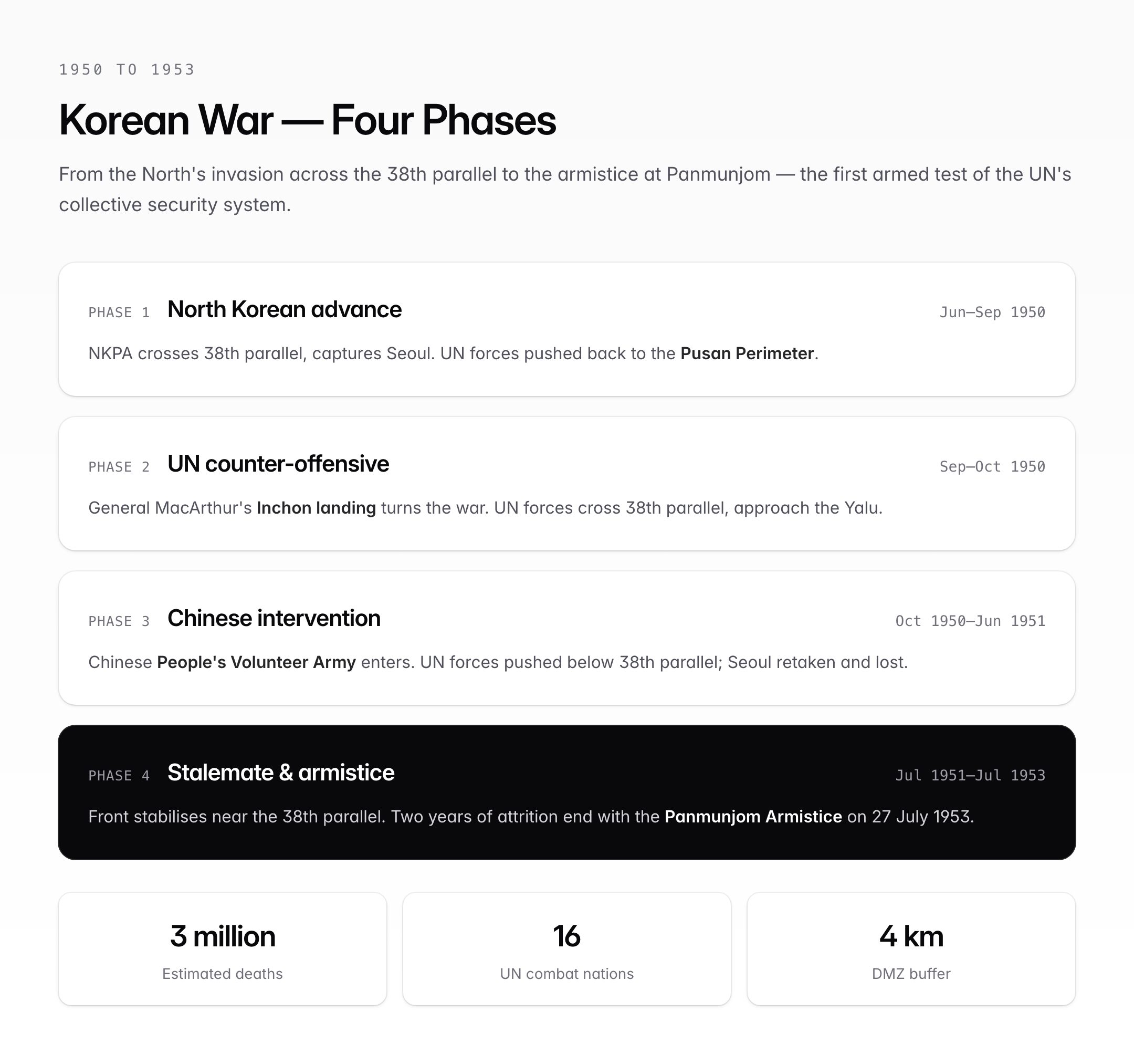
On 25 June 1950, North Korean People's Army troops crossed the 38th parallel with Soviet-supplied tanks. The war unfolded in four phases.
| Phase | Dates | Key events |
|---|---|---|
| 1. North Korean advance | Jun–Sep 1950 | NKPA captures Seoul; UN forces pushed back to Pusan Perimeter |
| 2. UN counter-offensive | Sep–Oct 1950 | Inchon landing (Gen. MacArthur); UN forces cross 38th parallel, approach Yalu |
| 3. Chinese intervention | Oct 1950 – Jun 1951 | Chinese People's Volunteer Army enters; UN forces pushed below 38th parallel; Seoul retaken and lost |
| 4. Stalemate | Jul 1951 – Jul 1953 | Front stabilises near 38th parallel; two years of attritional fighting and negotiation |
UN Intervention — A Cold War First
The UN Security Council passed Resolution 82 (25 June 1950) condemning the invasion, followed by Resolution 83 (27 June) recommending member states assist South Korea. The Soviet Union was boycotting the Council over the PRC’s exclusion and was absent for the vote — a diplomatic blunder that let the resolutions pass.
- 16 UN member states contributed combat troops
- Five more sent medical units
- United States provided the majority of forces
- UN Command established under US General Douglas MacArthur
- It was the first time the UN authorised armed collective action against an aggressor
The Korean War established the pattern — and the limits — of UN collective security for the remainder of the Cold War.
India's Role — The Non-Aligned Mediator
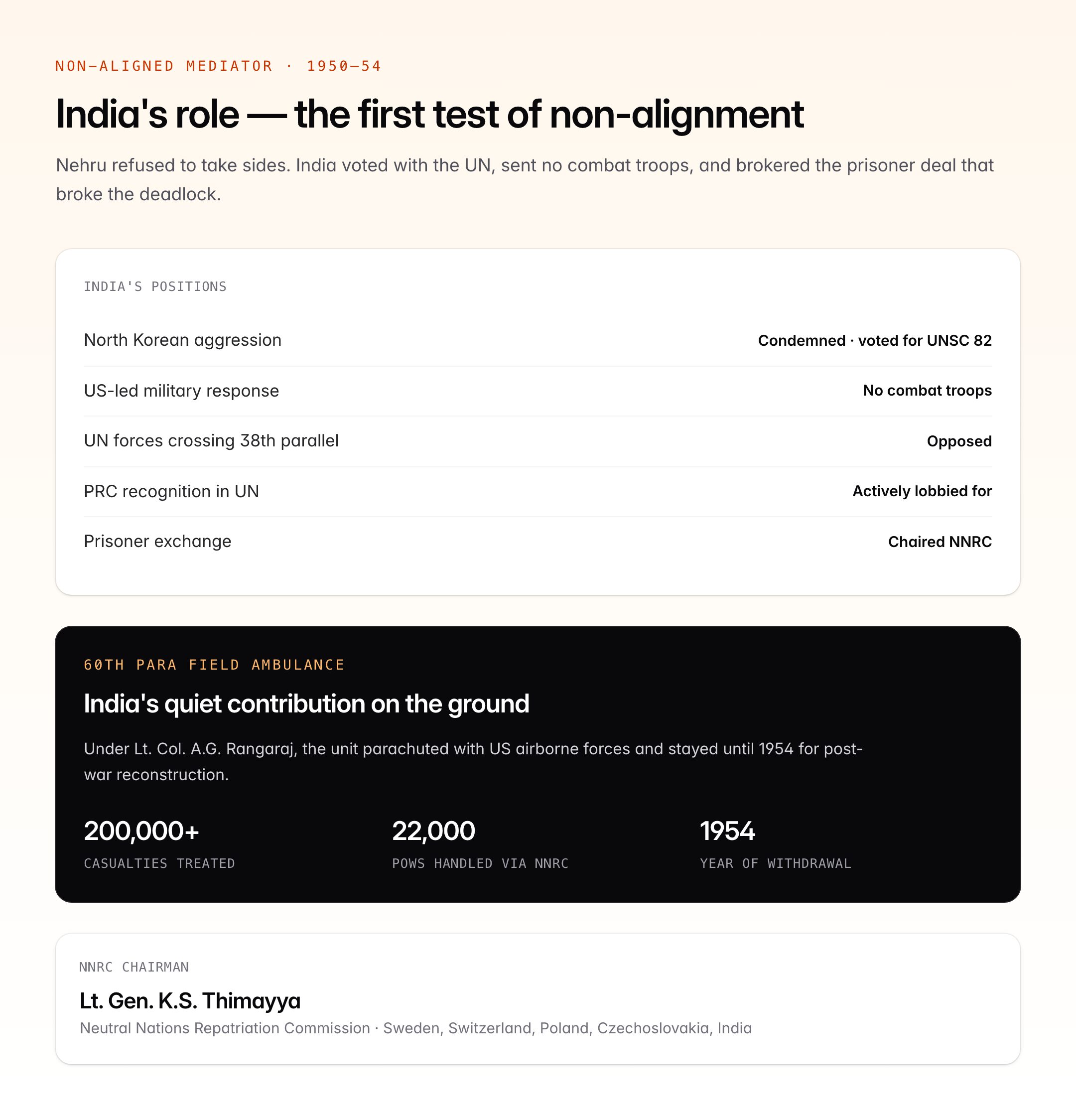
Newly independent India, under Prime Minister Jawaharlal Nehru, refused to take sides in the conflict. This was the first major stage on which India’s doctrine of non-alignment was tested.
India's Positions
| Issue | India's stance |
|---|---|
| North Korean aggression | Condemned; voted for UNSC Resolution 82 |
| US-led military response | Voted for Resolution 83 but declined to send combat troops |
| Crossing 38th parallel by UN forces | Opposed; warned of Chinese entry |
| Recognition of PRC in UN | Actively lobbied for China's inclusion |
| Prisoner exchange | Led the Neutral Nations Repatriation Commission |
The 60th Para Field Ambulance
India's direct contribution was humanitarian. The 60th Para Field Ambulance of the Indian Army Medical Corps, under Lt. Col. A.G. Rangaraj, served in Korea throughout the war. It:
- Treated over 200,000 UN and civilian casualties
- Parachuted into combat zones with US airborne units
- Remained in Korea until 1954 for post-war reconstruction
- Earned the Presidential Unit Citation from the Republic of Korea
Mediation and the POW Deadlock
Peace talks began in July 1951 but stalled over prisoner-of-war (POW) repatriation. Many Chinese and North Korean prisoners refused to return home; the communist side demanded forced repatriation.
India proposed a solution through the UN General Assembly in December 1952. The framework — that POWs be held by a neutral commission and allowed time to decide — became the basis of the final armistice.
- Neutral Nations Repatriation Commission (NNRC) chaired by India's Lt. Gen. K.S. Thimayya
- Included Sweden, Switzerland, Poland, Czechoslovakia
- Handled 22,000 prisoners during 1953–54
Nehru's role earned India diplomatic stature disproportionate to its material power — and became a template for Indian mediation (later echoed in the Suez Crisis, 1956).
The Armistice Agreement (1953)
Negotiations resumed in April 1953 after Stalin's death in March loosened the Soviet position. The Korean Armistice Agreement was signed on 27 July 1953 at Panmunjom.
| Provision | Detail |
|---|---|
| Signatories | UN Command, North Korea, China; South Korea did not sign |
| Military Demarcation Line | Near the original 38th parallel |
| Demilitarized Zone (DMZ) | 4 km wide buffer along the front |
| Prisoner repatriation | Voluntary, under NNRC supervision |
| Future peace | To be resolved by political conference — never held |
The war ended in ceasefire, not peace. Technically, North and South Korea remain at war today.
Consequences — A Frozen Conflict
The Korean War's effects outlived the Cold War itself.
- Permanent division of the Korean peninsula
- US–South Korea Mutual Defence Treaty (1953) — basis of continued US troop presence
- Sino-American hostility hardened for two decades
- Japan emerged as a major US rear base; its economy recovered under war procurement
- NATO militarisation accelerated worldwide
- The United Nations demonstrated both its use and its structural limits
- Nuclear brinkmanship became a feature of the peninsula through the 1990s and 2000s
Current North-South Tensions
The peninsula remains one of the most militarised zones on earth.
| Dimension | Status |
|---|---|
| Political relations | Intermittent dialogue; frequent breakdowns |
| DMZ | Still 4 km wide, heavily fortified; Panmunjom remains symbolic |
| DPRK nuclear programme | Six nuclear tests since 2006; ICBM capability demonstrated |
| Summits | Kim–Moon (2018, Panmunjom); Kim–Trump (2018 Singapore, 2019 Hanoi) |
| Peace treaty | Never signed; technical state of war continues |
| 2024 declaration | North Korea declared South a "hostile state"; removed unification goal |
India–South Korea ties have grown into a Special Strategic Partnership under Modi and successive ROK administrations, while India maintains a small diplomatic presence in Pyongyang — one of few democracies to do so.
UPSC Relevance
The Korean War sits at the crossroads of Modern History, International Relations, and World Geography.
- Prelims: Dates (1950–53), 38th parallel, Panmunjom armistice, UN Resolutions 82 and 83, 60th Para Field Ambulance, NNRC chair (Lt. Gen. K.S. Thimayya)
- Mains GS Paper II: India's non-alignment in action, UN collective security record, India–Korea relations today
- Mains GS Paper I: Cold War origins and spread to Asia, decolonisation context
- Essay: "Frozen conflicts in international politics" or "Non-alignment — then and now"
- Current affairs: DPRK nuclear tests, Moon–Kim summits, Quad implications for Korean peninsula, India's Indo-Pacific stance
Candidates should remember the war ended in armistice, not a peace treaty, and that India's participation — though non-combatant — set the template for subsequent peacekeeping roles. The Korean War is often paired with the Suez Crisis (1956) and the Congo Crisis (1960) as case studies of early Indian diplomacy.
Tell Google you want more of this.
Add Anantam IAS as a preferred sourceOne tap, and this site shows up more often in your own Top Stories, AI Overviews and AI Mode. Remove it any time.