El Nino & La Nina: Impact on Indian Monsoon
Complete guide to El Nino, La Nina, and ENSO — mechanisms, impact on Indian monsoon, Walker Circulation, and IOD. Essential for UPSC Geography.
El Nino & La Nina: Impact on Indian Monsoon
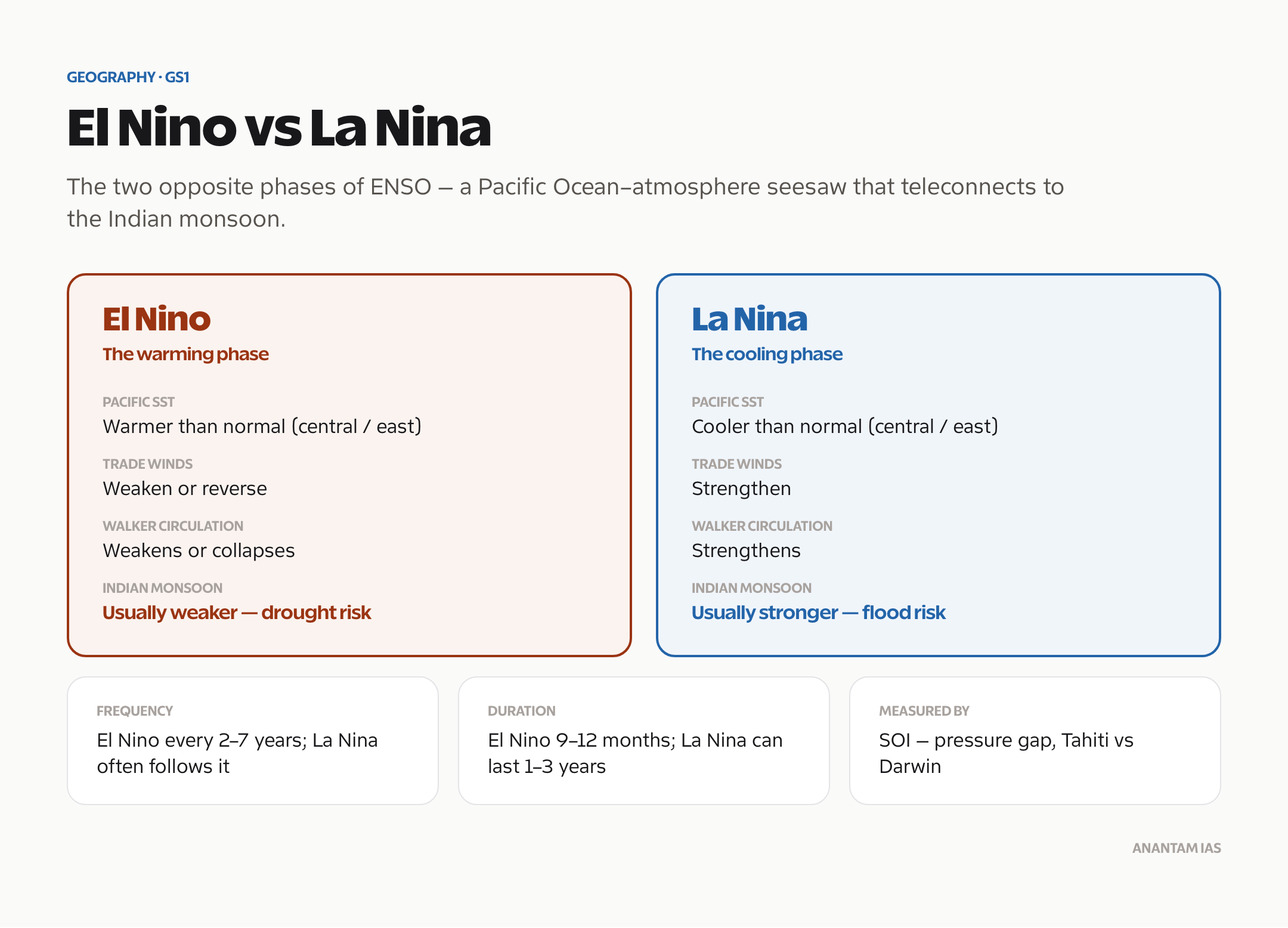
El Nino and La Nina are opposite phases of the El Nino-Southern Oscillation (ENSO), a periodic fluctuation in sea surface temperature and air pressure across the tropical Pacific Ocean. El Nino — the warming phase — typically weakens the Indian monsoon, while La Nina — the cooling phase — tends to strengthen it. For UPSC, understanding the ENSO mechanism, its teleconnection with the Indian monsoon, and the role of the Indian Ocean Dipole is critical for Geography papers and environmental studies.
Understanding ENSO
ENSO is a coupled ocean-atmosphere phenomenon with three components:
- El Nino — anomalous warming of sea surface temperatures (SST) in the central and eastern Pacific
- La Nina — anomalous cooling of SST in the same region
- Southern Oscillation — the atmospheric pressure seesaw between the eastern and western Pacific
Normal Conditions in the Pacific
Under normal conditions:
- Trade winds blow from east to west across the tropical Pacific
- Warm water accumulates in the western Pacific (near Indonesia/Australia)
- Cold, nutrient-rich water upwells along the South American coast
- Walker Circulation — a large-scale atmospheric circulation cell — maintains this pattern
The Walker Circulation was identified by Sir Gilbert Walker in the 1920s while studying Indian monsoon failures. It connects Pacific Ocean conditions to Indian weather patterns.
El Nino: The Warming Phase
During El Nino:
- Trade winds weaken or reverse
- Warm water shifts eastward toward central/eastern Pacific
- Cold water upwelling off Peru weakens or stops
- Atmospheric convection (rising air, clouds, rain) shifts eastward
- Walker Circulation weakens
El Nino Characteristics
| Parameter | Normal Year | El Nino Year |
|---|---|---|
| Eastern Pacific SST | Cool (upwelling) | Warm (suppressed upwelling) |
| Western Pacific SST | Warm (warm pool) | Cooler than normal |
| Trade Winds | Strong east-to-west | Weak or reversed |
| Walker Circulation | Strong | Weak or collapsed |
| Rainfall — South America | Dry (west coast) | Floods in Peru/Ecuador |
| Rainfall — Indonesia/Australia | Wet | Drought |
| Indian Monsoon | Normal | Often weaker |
How El Nino Affects India
El Nino weakens the Indian monsoon through several mechanisms:
- Shifted convection: Rising air and cloud formation move toward the central Pacific, away from the Indian Ocean
- Weakened pressure gradient: The land-sea temperature contrast that drives monsoon winds is reduced
- Upper-level circulation changes: Altered jet stream patterns affect monsoon progression
- Reduced moisture transport: Weakened Walker Cell means less moisture convergence over India
Historical El Nino-drought correlation:
| El Nino Year | Monsoon Rainfall | Drought? |
|---|---|---|
| 1972 | -24% below normal | Severe drought |
| 1982 | -14% below normal | Drought |
| 1987 | -19% below normal | Drought |
| 1997 | +2% above normal | No drought (exception) |
| 2002 | -19% below normal | Drought |
| 2009 | -22% below normal | Drought |
| 2015 | -14% below normal | Drought |
| 2023 | -6% below normal | Mild deficit |
The 1997 El Nino — one of the strongest ever — did NOT cause drought in India. This exception is explained by the simultaneous occurrence of a positive Indian Ocean Dipole (IOD), which countered El Nino’s suppressive effect.
La Nina: The Cooling Phase
During La Nina:
- Trade winds strengthen
- Cold water upwelling intensifies along the South American coast
- Warm water is pushed further westward
- Walker Circulation strengthens
- Convection intensifies over the western Pacific and Indian Ocean region
La Nina Effects on India
| Impact | Detail |
|---|---|
| Monsoon Rainfall | Generally above normal; excess rainfall in many years |
| Floods | Increased risk, especially in eastern India and northeast |
| Agriculture | Generally positive for kharif crops; risk of waterlogging |
| Cyclones | More cyclone formation in Bay of Bengal |
| Winter | Colder winters in north India during La Nina years |
| Global | Drought in southern US; floods in Australia, Southeast Asia |
Notable La Nina years and Indian monsoon:
| La Nina Year | Monsoon Rainfall | Impact |
|---|---|---|
| 1988 | +20% above normal | Widespread floods |
| 2010 | +2% above normal | Above normal; floods in several states |
| 2020 | +9% above normal | Good monsoon |
| 2022 | +6% above normal | Above normal |
El Nino vs La Nina: Comparison
| Feature | El Nino | La Nina |
|---|---|---|
| Pacific SST | Warmer than normal (central/east) | Cooler than normal (central/east) |
| Trade Winds | Weaken | Strengthen |
| Walker Circulation | Weakens | Strengthens |
| Indian Monsoon | Usually weaker | Usually stronger |
| Peruvian Fisheries | Decline (warm water, no upwelling) | Flourish (strong upwelling) |
| Australian Rainfall | Below normal (drought) | Above normal (floods) |
| Global Temperature | Slightly warmer | Slightly cooler |
| Frequency | Every 2-7 years | Often follows El Nino |
| Duration | 9-12 months typically | Can last 1-3 years |
Southern Oscillation Index (SOI)
The Southern Oscillation Index measures the atmospheric pressure difference between Tahiti (eastern Pacific) and Darwin, Australia (western Pacific).
- Negative SOI → El Nino conditions (lower pressure in eastern Pacific)
- Positive SOI → La Nina conditions (higher pressure in eastern Pacific)
Gilbert Walker first identified this oscillation while studying why the Indian monsoon fails in certain years. His work laid the foundation for modern monsoon prediction.
Indian Ocean Dipole (IOD)
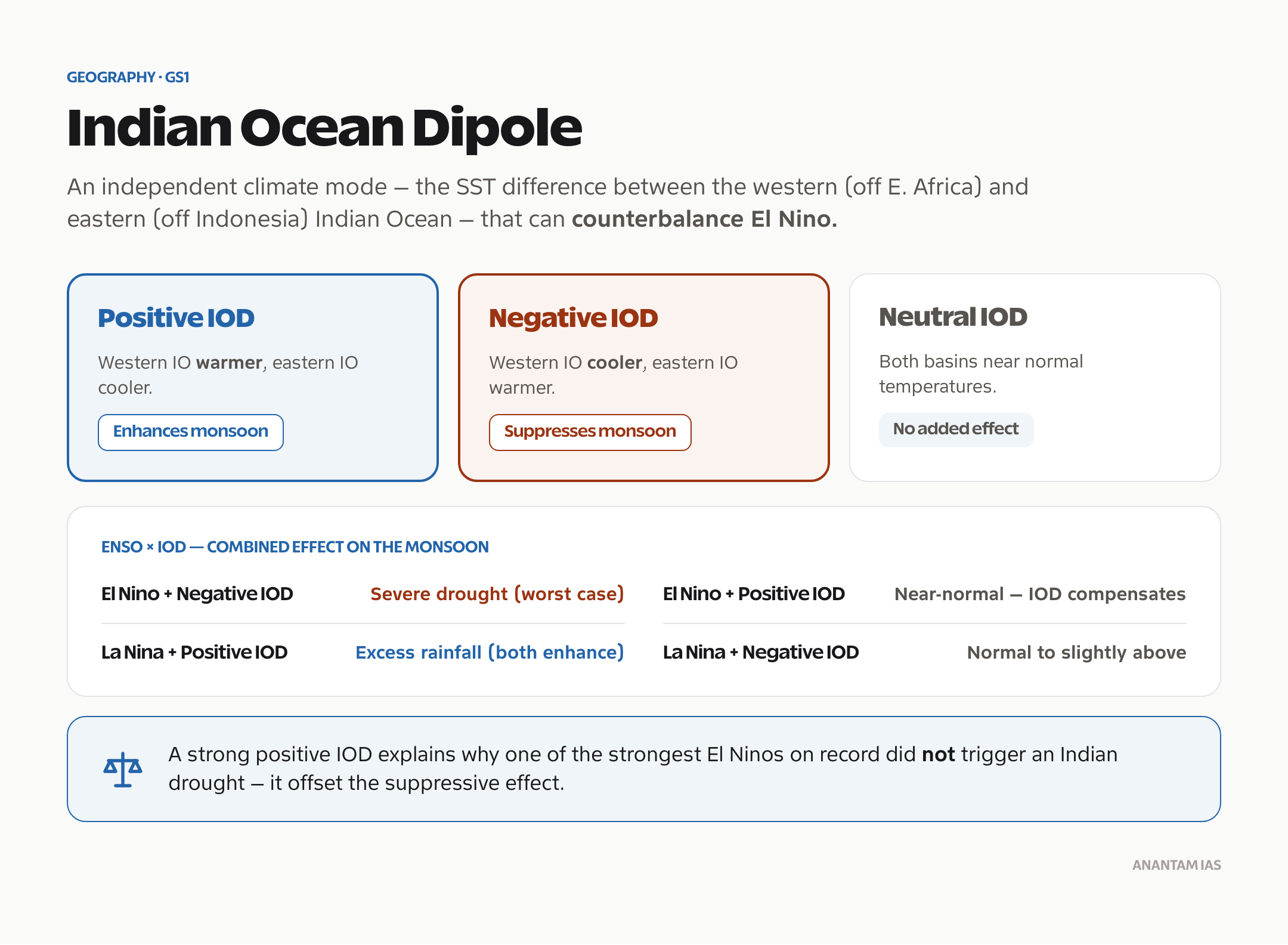
The Indian Ocean Dipole is an independent climate mode that modulates El Nino’s effect on the Indian monsoon.
What Is IOD?
IOD measures the temperature difference between the western Indian Ocean (off East Africa) and the eastern Indian Ocean (off Indonesia).
| Phase | Western IO SST | Eastern IO SST | Effect on Indian Monsoon |
|---|---|---|---|
| Positive IOD | Warmer | Cooler | Enhances monsoon rainfall |
| Negative IOD | Cooler | Warmer | Suppresses monsoon rainfall |
| Neutral IOD | Normal | Normal | No additional effect |
IOD as a Counterbalance
A positive IOD can counteract El Nino’s negative impact on the monsoon. This explains why the 1997 El Nino didn’t cause drought — a strong positive IOD compensated for El Nino’s suppressive effect.
Conversely, a negative IOD combined with El Nino creates the worst-case scenario for the Indian monsoon — as seen in 2002 and 2015.
| Combination | Monsoon Impact |
|---|---|
| El Nino + Negative IOD | Severe drought (worst case) |
| El Nino + Positive IOD | Near-normal rainfall (IOD compensates) |
| La Nina + Positive IOD | Excess rainfall (both enhance) |
| La Nina + Negative IOD | Normal to slightly above |
ENSO and Climate Change
Climate change is altering ENSO behaviour in complex ways:
- Extreme El Nino events may become more frequent (IPCC AR6)
- The Indian Ocean is warming faster than other tropical oceans, potentially changing IOD dynamics
- Compound events — El Nino combined with other climate anomalies — may increase in severity
- Monsoon prediction uncertainty increases as the relationship between ENSO and the monsoon evolves
Monsoon Prediction in India
IMD uses ENSO status as a primary predictor in its seasonal monsoon forecast model. The prediction framework includes:
- Statistical models — correlating ENSO, IOD, and other indices with historical monsoon data
- Dynamical models — computer simulations of atmosphere-ocean interactions
- Multi-model ensembles — combining multiple prediction systems for better accuracy
Despite improvements, monsoon prediction remains challenging because:
- ENSO alone explains only about 30-40% of monsoon variability
- IOD, Eurasian snow cover, soil moisture, and other factors also play roles
- Regional and monthly distribution is harder to predict than seasonal totals
Indian Ocean: Geography, Significance & UPSC Notes Monsoon in India
Frequently Asked Questions
What is El Nino in simple terms?
El Nino is an abnormal warming of the central and eastern Pacific Ocean that occurs every 2-7 years. It weakens trade winds, disrupts normal ocean circulation, and shifts global weather patterns. For India, El Nino typically weakens the southwest monsoon, leading to below-normal rainfall and increased drought risk.
How does La Nina differ from El Nino?
La Nina is the opposite of El Nino — the central and eastern Pacific Ocean cools below normal. Trade winds strengthen, pushing warm water further westward. For India, La Nina generally enhances monsoon rainfall, sometimes causing floods. La Nina events often follow El Nino and can last 1-3 years compared to El Nino’s 9-12 months.
What is the Indian Ocean Dipole and how does it affect India?
The IOD measures the temperature difference between the western and eastern Indian Ocean. A positive IOD (warmer west, cooler east) enhances Indian monsoon rainfall and can counter El Nino’s negative effects. A negative IOD suppresses the monsoon. The 1997 El Nino didn’t cause drought in India because a strong positive IOD offset its impact.
Does El Nino always cause drought in India?
No. While there’s a strong statistical correlation — El Nino years tend to have below-normal monsoon rainfall — exceptions exist. The 1997 El Nino, one of the strongest on record, didn’t cause drought because a concurrent positive IOD compensated. Other factors like Eurasian snow cover and local SST patterns also influence outcomes.
What is the Walker Circulation?
The Walker Circulation is a large-scale atmospheric circulation cell over the tropical Pacific. Air rises over the warm western Pacific (Indonesia), flows eastward at upper levels, descends over the cool eastern Pacific (Peru), and returns westward as trade winds. El Nino weakens this circulation; La Nina strengthens it. It was named after Sir Gilbert Walker.