Emergency Provisions in India: Articles 352, 356, 360
Complete guide to Emergency Provisions in India — National Emergency (Art 352), President's Rule (Art 356), Financial Emergency (Art 360), proclamation process, effect on Fundamental Rights, 44th Amendment safeguards, and 1975 Emergency history.
Emergency Provisions in India: Articles 352, 356, 360
Emergency provisions are among the most consequential — and most examined — parts of the Indian Constitution. They allow the federal structure to be transformed into a near-unitary state in times of crisis. Part XVIII of the Constitution (Articles 352–360) covers three distinct types of emergencies: National Emergency, State Emergency (President’s Rule), and Financial Emergency. Each has different triggers, procedures, and effects on rights and federalism.
Why Emergency Provisions? The Constitutional Logic
The framers of the Indian Constitution drew heavily from the Government of India Act, 1935, which had similar emergency provisions. They recognised that a large, diverse, newly-independent country needed a safety valve — a way for the Centre to step in during existential threats. But they also built in safeguards, particularly after the 1975–77 Emergency showed how easily these powers could be misused.
Dr. B.R. Ambedkar justified emergency provisions in the Constituent Assembly debates — but insisted they must never become a tool of executive convenience. The 44th Amendment of 1978 was Parliament’s correction of the misuse seen in 1975.
Type 1: National Emergency — Article 352
Grounds for Proclamation
The President can proclaim a National Emergency when the security of India or any part thereof is threatened by:
- War
- External aggression
- Armed rebellion (called “internal disturbance” before the 44th Amendment changed it)
The 44th Amendment, 1978 replaced “internal disturbance” with “armed rebellion” — a much higher threshold. This change was deliberate: the 1975 Emergency was proclaimed partly on grounds of “internal disturbance” from a political movement (JP movement), which the framers of the 44th Amendment considered an abuse.
Proclamation Process
- Written recommendation of the Cabinet — the President cannot act alone. The recommendation must be from the Cabinet as a whole (not just the PM). This requirement was inserted by the 44th Amendment.
- President issues the proclamation
- Must be approved by Parliament within one month by a special majority — 2/3rd of members present and voting AND majority of total membership of each House
- If Lok Sabha is dissolved when proclamation is issued, Rajya Sabha must approve, and Lok Sabha must approve within 30 days of its reconstitution
Continuation
After initial approval, a National Emergency continues for 6 months and can be renewed every 6 months by the same special majority indefinitely — until revoked.
Revocation
- President can revoke at any time (Art 352(2))
- Lok Sabha can pass a resolution disapproving the proclamation by a simple majority — forcing revocation. This was a crucial 44th Amendment addition. If 1/10th of Lok Sabha members give written notice of intent to move such a resolution, a special sitting must be called within 14 days.
Effects of National Emergency
On Centre-State Relations
The Centre’s legislative power expands dramatically. Parliament can make laws on State List subjects (normally reserved for states). The executive power of the Centre extends to giving directions to states on any matter.
On Fundamental Rights
- Article 19 (freedoms of speech, movement, assembly, etc.) stands automatically suspended during emergencies caused by war or external aggression (NOT armed rebellion)
- Articles 20 and 21 (right against self-incrimination and right to life) cannot be suspended ever — 44th Amendment guarantee
- The President can under Article 359 suspend the right to move courts for enforcement of other Fundamental Rights (except Art 20 and 21)
On Parliament’s Duration
Parliament can extend its term by one year at a time during a National Emergency. State Assemblies can similarly be extended. But this extension cannot continue beyond 6 months after the Emergency ends.
History of National Emergencies in India
| Proclamation | Year | Grounds | Duration |
|---|---|---|---|
| First | 1962 | Chinese aggression | 1962–1968 |
| Second | 1971 | Pakistani aggression | 1971–1977 |
| Third | 1975 | Internal disturbance | 1975–1977 |
The 1975–77 Emergency is the most significant — and most controversial. Prime Minister Indira Gandhi proclaimed it citing the Allahabad High Court judgment setting aside her election and JP Narayan’s mass movement. Civil liberties were suspended, opposition leaders were jailed, press censorship was imposed, and elections were delayed. The 44th Amendment in 1978 was Parliament’s direct response to this misuse.
Type 2: State Emergency / President’s Rule — Article 356
Grounds for Proclamation
Under Article 356, the President can impose President’s Rule in a state if satisfied that the constitutional machinery has broken down — the state government cannot be carried on in accordance with the Constitution. This is called President’s Rule or State Emergency or Constitutional Emergency.
The typical triggers in practice:
- Government loses majority and no alternative ministry is possible
- Breakdown of law and order beyond the state’s capacity
- Governor’s report that constitutional governance is impossible
- Results of elections leading to hung assemblies
The Governor’s Role
The Governor plays a crucial — and often controversial — role. A proclamation under Art 356 typically follows the Governor’s report to the President recommending imposition of President’s Rule. The Sarkaria Commission (1988) recommended that President’s Rule should be imposed only as a last resort, after all alternatives (including floor test) are exhausted.
The Bommai judgment transformed the landscape.
S.R. Bommai v. Union of India (1994): The Landmark Case
This is the most important case on Article 356. The Supreme Court (9-judge bench) held:
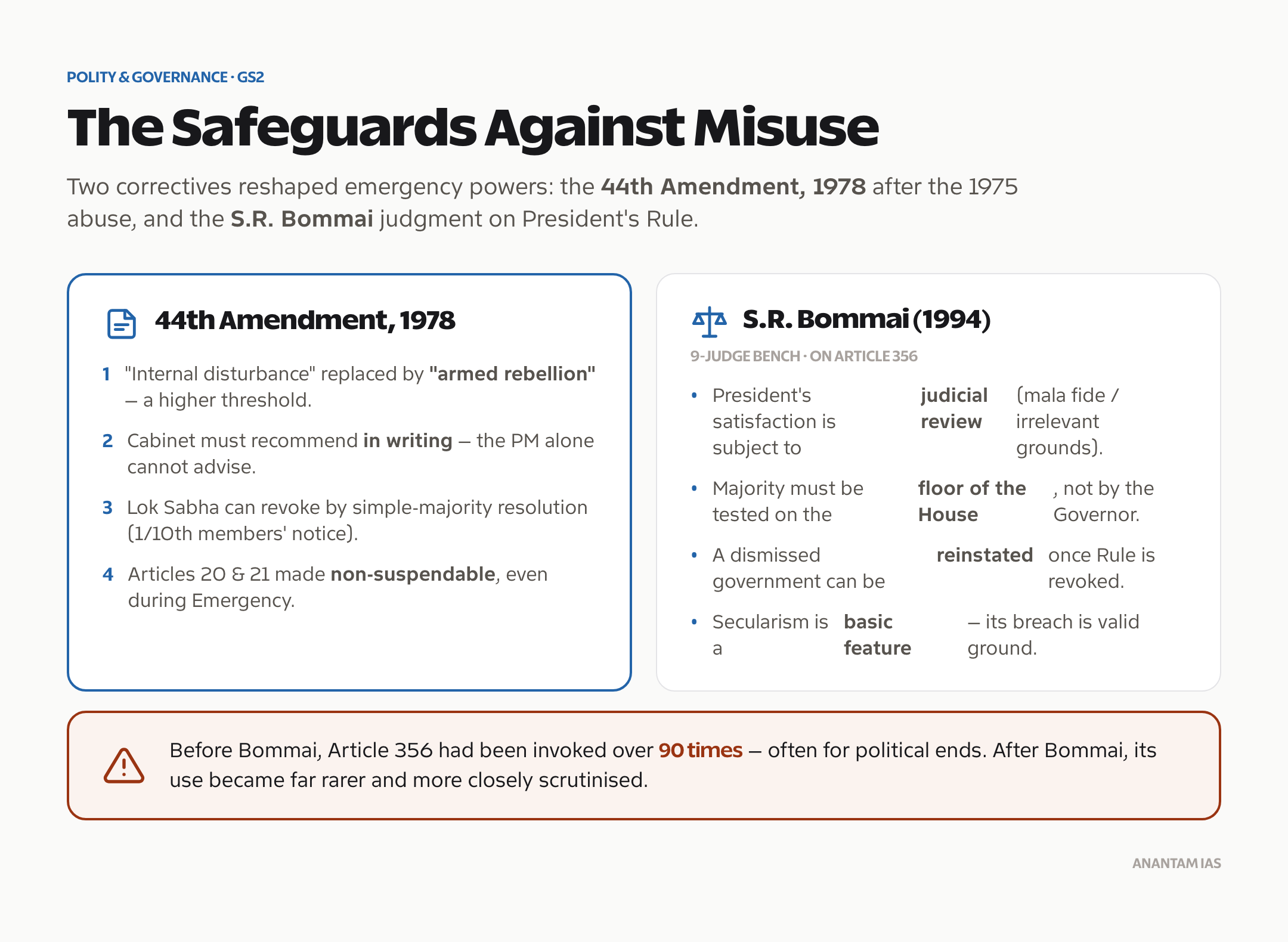
- The President’s satisfaction under Art 356 is subject to judicial review on grounds of mala fide or based on wholly irrelevant grounds
- The strength of the government must be tested on the floor of the House — not through the Governor’s subjective assessment
- Once President’s Rule is revoked, the dismissed government can be reinstated
- Secularism is a basic feature — a state government that acts against secularism provides valid grounds for Art 356
The Bommai judgment dramatically curtailed arbitrary dismissal of state governments. Before Bommai, Art 356 had been invoked over 90 times — often for political purposes. After Bommai, usage became much rarer and more scrutinised.
Parliamentary Approval
President’s Rule must be approved by Parliament within 2 months by a simple majority (no special majority needed — unlike National Emergency). It continues for 6 months and can be renewed for a maximum of 3 years — but extensions beyond 1 year require:
- The National Emergency must be in operation in that state, OR
- The Election Commission certifies that elections cannot be held
Effects of President’s Rule
- State Legislative Assembly is dissolved or kept in suspended animation
- President administers the state through the Governor
- Parliament can legislate on state subjects
- The Council of Ministers ceases to exist
Type 3: Financial Emergency — Article 360
Grounds
The President can proclaim a Financial Emergency if satisfied that the financial stability or credit of India or any part thereof is threatened.
Proclamation Process
Same as National Emergency initially:
- Cabinet recommendation (written)
- Presidential proclamation
- Parliamentary approval within 2 months by simple majority
- Continues until revoked
Effects of Financial Emergency
- The Centre can direct states to observe canons of financial propriety
- All Money Bills of states require Presidential reservation
- The President can direct reduction of salaries of all government employees — including Supreme Court and High Court judges
- The President can direct states to reduce salaries
Never Proclaimed
Financial Emergency has never been proclaimed in India — not even during the 1991 balance of payments crisis. This is a useful exam fact.
Comparison: Three Types of Emergency
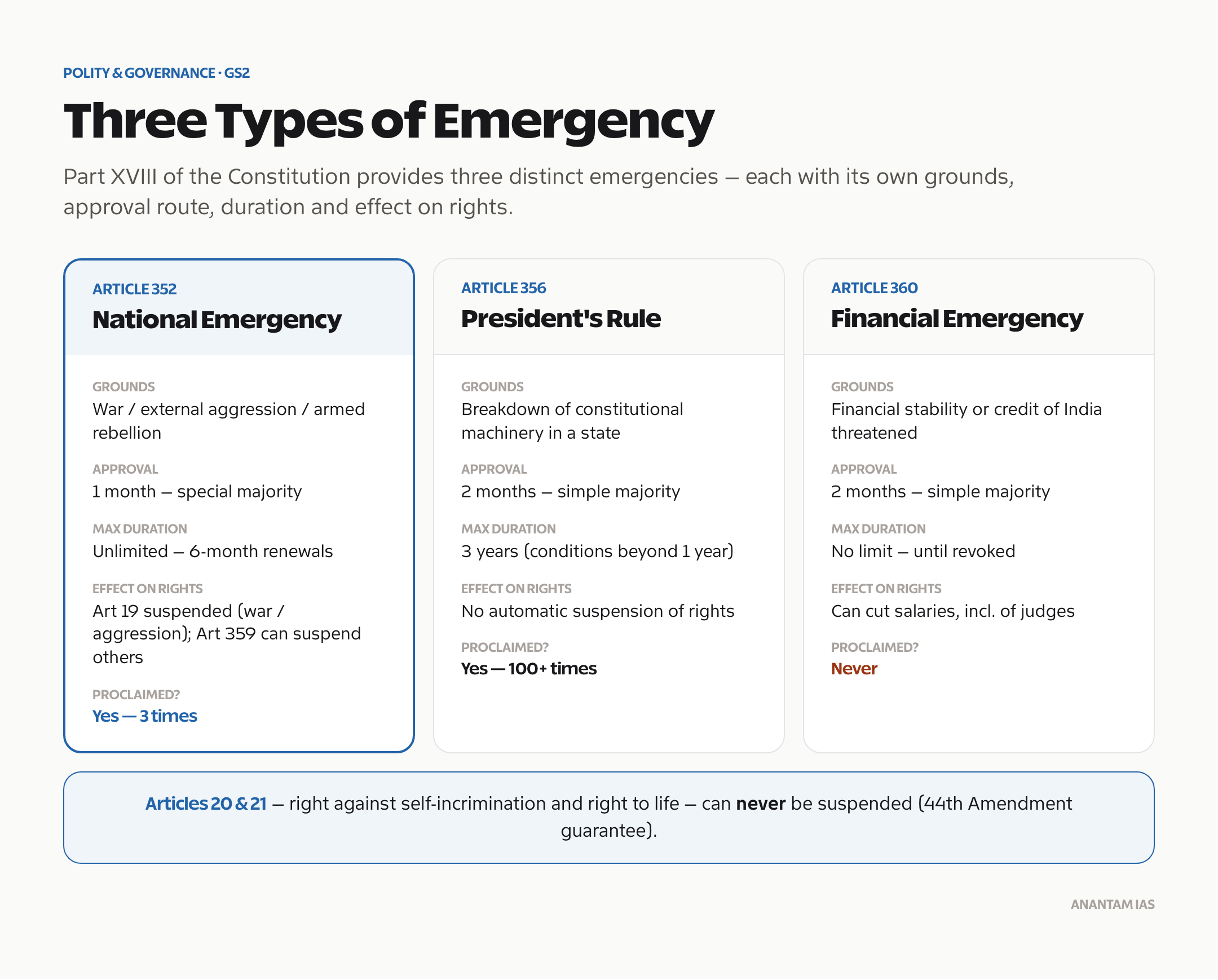
| Feature | National Emergency (352) | President’s Rule (356) | Financial Emergency (360) |
|---|---|---|---|
| Grounds | War/External Aggression/Armed Rebellion | Constitutional machinery breakdown | Financial stability threatened |
| Parliamentary approval | 1 month (special majority) | 2 months (simple majority) | 2 months (simple majority) |
| Duration (initial) | 6 months | 6 months | 6 months |
| Maximum duration | Unlimited (6-month renewals) | 3 years (conditions apply beyond 1 year) | No limit |
| Effect on FR | Art 19 suspended (war/aggression); Art 359 can suspend others | No automatic FR suspension | No automatic FR suspension |
| Art 20/21 suspension | Never | Never | Never |
| Proclaimed? | Yes (3 times) | Yes (100+ times) | Never |
44th Amendment, 1978: The Safeguards
The 44th Amendment was Parliament’s direct response to the 1975 Emergency abuse. Key changes:
- “Internal disturbance” replaced by “armed rebellion” — higher threshold
- Cabinet must recommend in writing — PM alone cannot advise
- Lok Sabha can pass simple majority resolution to revoke Emergency (with 1/10th member request mechanism)
- Articles 20 and 21 made non-suspendable even during Emergency
- Right to life and liberty under Art 21 includes procedure established by law — and that procedure must be fair, just, reasonable (Maneka Gandhi principle cannot be bypassed during Emergency)
UPSC Exam Focus Points
High-frequency Prelims facts:
- 352 (National): special majority (2/3rd present + voting AND majority of total); 1 month for approval
- 356 (President’s Rule): simple majority; 2 months for approval; max 3 years
- 360 (Financial): simple majority; 2 months; never proclaimed
- National Emergency 1975: internal disturbance ground — now requires “armed rebellion”
- Bommai case (1994): Art 356 subject to judicial review; floor test required
- Art 19 suspended during National Emergency (war/aggression, not armed rebellion)
- Art 20 and 21 can NEVER be suspended — 44th Amendment
- Cabinet must give written recommendation — not PM alone
- Lok Sabha can revoke Emergency: simple majority, after 1/10th members’ notice
- Post-emergency: Art 358 (Art 19 auto-suspension) and Art 359 (President’s order suspending FR enforcement) are different
Frequently Asked Questions
What are the three types of emergencies in India?
India’s Constitution provides for three types of emergencies: National Emergency under Article 352 (threats from war, external aggression, or armed rebellion), State Emergency or President’s Rule under Article 356 (failure of constitutional machinery in a state), and Financial Emergency under Article 360 (threat to financial stability of India). National Emergency requires a special majority in Parliament; the other two require a simple majority.
What happened during the 1975 Emergency in India?
Prime Minister Indira Gandhi proclaimed the Emergency on June 25, 1975, citing u0022internal disturbanceu0022 as the ground — triggered by the Allahabad High Court setting aside her election and JP Narayan’s mass movement. Fundamental Rights were suspended, opposition leaders including Jayaprakash Narayan and Atal Bihari Vajpayee were jailed, press censorship was imposed, and elections were delayed. The Emergency was lifted in 1977 after the Congress lost elections. The 44th Amendment was Parliament’s response to prevent such misuse.
What is the significance of the S.R. Bommai case?
The S.R. Bommai v. Union of India (1994) judgment by a 9-judge Supreme Court bench fundamentally changed the application of Article 356. The court held that presidential satisfaction under Art 356 is subject to judicial review, the government’s majority must be tested on the floor of the House rather than through the Governor’s report, and secularism is a basic feature whose violation can justify President’s Rule. The judgment sharply reduced arbitrary dismissal of state governments.
Can Fundamental Rights be suspended during an Emergency?
Article 19 freedoms are automatically suspended during National Emergency proclaimed on grounds of war or external aggression (not armed rebellion). The President can additionally suspend, under Article 359, the right to move courts for other Fundamental Rights. But Articles 20 (protection against self-incrimination) and 21 (right to life) can NEVER be suspended — this protection was explicitly added by the 44th Amendment, 1978.
Why has Financial Emergency never been proclaimed in India?
No Financial Emergency under Article 360 has ever been proclaimed, even during severe economic crises like 1991. The 1991 crisis was addressed through IMF bailout, economic reforms, and gold pledging — not Emergency powers. The constitutional threshold requires a threat to u0022financial stability or credit of India,u0022 which is a high bar, and political considerations make such a proclamation extremely sensitive since it involves potential salary cuts for judges and government employees.