


The Sarkaria Commission was set up by the Government of India in 1983 to examine the working of the relationship between the Union and State governments and to recommend measures for improving Centre-State relations. Chaired by Justice Ranjit Singh Sarkaria, a retired Supreme Court judge, the Commission submitted its report in 1988 with 247 recommendations. For UPSC, this is one of the most important topics under Indian Polity, particularly for Mains GS-II.
Background: Why the Commission Was Set Up
By the late 1970s and early 1980s, India's federal structure faced severe strain.
| Factor | Description |
|---|---|
| Rise of regional parties | Non-Congress parties came to power in several states in 1967 and 1977; friction with the Centre increased |
| Misuse of Article 356 | President's Rule was imposed multiple times to dismiss non-Congress state governments |
| Fiscal disputes | States demanded greater share of central taxes and grievances over Planning Commission allocations |
| Role of the Governor | Controversial decisions by Governors (e.g., in Karnataka, Andhra Pradesh) raised questions about their impartiality |
| All-India Services | Tensions over control and cadre management |
| Anandpur Sahib Resolution (1973) | The Akali Dal's demand for greater state autonomy; eventually, widespread debate on federalism |
| Rajamannar Committee (Tamil Nadu, 1969) | Earlier state-level committee that recommended sweeping changes favouring state autonomy |
Against this backdrop, the Central Government constituted the Sarkaria Commission on Centre-State Relations on 9 June 1983.
Composition of the Commission
| Member | Role |
|---|---|
| Justice Ranjit Singh Sarkaria | Chairperson |
| Shri B. Sivaraman | Member (former Cabinet Secretary) |
| Dr. S. R. Sen | Member (economist) |
| Rama Subramaniam | Member-Secretary |
Terms of Reference
The Commission was asked to examine:
- The working of existing arrangements between the Union and States.
- Legislative, executive, and financial relations.
- The role of All-India Services, Governor, and President's Rule.
- Deployment of Union armed forces in states.
- Language policy and media administration.
- Planning and development relations.
- Suggestions for constitutional, legislative, and administrative reforms.
Note: The Commission was explicitly instructed not to alter the basic structure of the Constitution.
Key Recommendations
On Legislative Relations
| Recommendation | Detail |
|---|---|
| No major transfer of subjects | The existing division of powers under the Seventh Schedule (Union, State, and Concurrent Lists) was largely satisfactory and should not be substantially altered. |
| Prior consultation on Concurrent List | Before enacting laws on Concurrent List subjects, the Centre should consult states. |
| Residuary powers | Should remain with Parliament (as per Article 248) but used sparingly. |
On Article 356 (President's Rule)
This was among the most significant areas of the report.
| Recommendation | Detail |
|---|---|
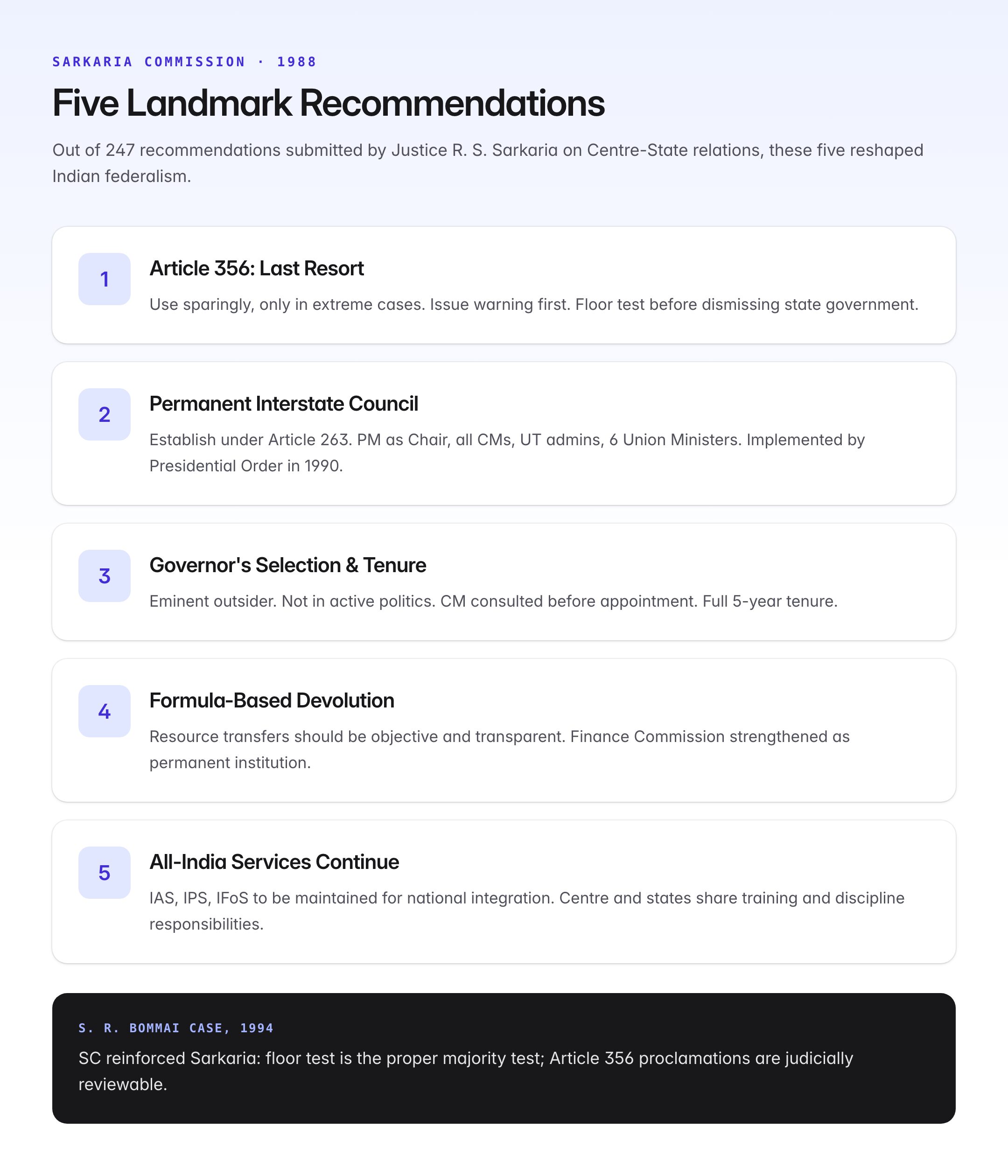
| Extreme caution | Article 356 should be used very sparingly, in extreme cases, as a measure of last resort |
| Warning before imposition | A warning should be issued to the errant state before invoking Article 356 |
| Alternative courses first | All alternative means of bringing the state government to constitutional norms should be exhausted |
| Reasons to be communicated | Reasons for imposing President's Rule should be communicated to the state |
| Report of the Governor | Should be a speaking document with all relevant facts; should be made public when Parliament discusses it |
| Floor test | Before dismissing a state government, the Governor should call for a floor test in the Assembly |
On the Role of the Governor
| Recommendation | Detail |
|---|---|
| Selection criteria | Should be an eminent person from outside the state; not actively involved in politics recently (preferably not in the past few years) |
| Consultation with CM | The Chief Minister of the state should be consulted before appointing the Governor |
| Fixed tenure | Governors should generally serve the full 5-year tenure; should not be removed except for compelling reasons |
| Discretion of the Governor | Should be used sparingly and within constitutional norms |
| Appointment of Chief Minister | The leader of the largest pre-poll alliance should be invited first; if none has a majority, the single largest party; then a post-poll alliance |
On the Interstate Council (Article 263)
| Recommendation | Detail |
|---|---|
| Permanent Interstate Council | A permanent Interstate Council should be established under Article 263 |
| Composition | PM (Chairman), all CMs, UT administrators, and six Union Ministers |
| Purpose | Discuss and recommend on matters of Centre-State common interest |
| Status | Deliberative and advisory (not decision-making) |
Result: The Interstate Council was set up through a Presidential Order in 1990, directly implementing this recommendation. It complements the statutory Zonal Councils, the older regional forums for Centre-State and inter-state coordination.
On Financial Relations
| Recommendation | Detail |
|---|---|
| Resource transfers | Devolution should be formula-based, objective, and transparent |
| Finance Commission's role | Should be strengthened; should be a permanent institution with a secretariat |
| Consolidated Fund | Corporation tax and consignment tax should be shareable with states |
| Planning Commission | Should consult states meaningfully; allocations should be need-based |
| Centrally Sponsored Schemes (CSS) | Should be minimised; states should have flexibility in implementation |
On All-India Services
| Recommendation | Detail |
|---|---|
| AIS should continue | All-India Services (IAS, IPS, IFoS) should be maintained as they promote national integration |
| Training and discipline | Centre and states should share responsibility; disputes should be resolved amicably |
| More AIS cadres | Creation of additional AIS for engineering, medical, and educational services should be considered |
On Deployment of Armed Forces
| Recommendation | Detail |
|---|---|
| Consultation with states | Before deploying Union armed forces in a state (Article 257), the state should be consulted, except in emergencies |
| Brief and specific purposes | Deployment should be for specific, defined purposes |
On Language and Communication
| Recommendation | Detail |
|---|---|
| Three-language formula | Should continue to be promoted |
| Hindi imposition | No forced imposition of Hindi on non-Hindi states |
| All India Radio/Doordarshan | Should have more regional content; states' views should be accommodated |
Implementation of Sarkaria Recommendations
| Recommendation | Status |
|---|---|
| Interstate Council | Implemented (1990) |
| Limited use of Article 356 | Reinforced by S. R. Bommai v. Union of India (1994) — SC made President's Rule judicially reviewable and floor test mandatory |
| Devolution formula | Strengthened; later refined by 15th Finance Commission and 14th FC (increased states' share to 42%) |
| Governor's role | Partially implemented; controversies persist |
| Planning Commission reform | Eventually, Planning Commission abolished (2014); replaced by NITI Aayog which brings CMs into its Governing Council |
S. R. Bommai Case (1994): Judicial Reinforcement
The Supreme Court in S. R. Bommai v. Union of India (1994) laid down:
- Floor test is the proper test for majority, not the Governor's subjective satisfaction.
- Judicial review is available over Presidential proclamations under Article 356.
- Federalism is a basic feature of the Constitution.
- Secularism is a basic feature; states cannot be dismissed for secular reasons.
This judgment incorporated many Sarkaria principles into binding constitutional doctrine.
Punchhi Commission (2007-2010)
A successor to Sarkaria, the Punchhi Commission was set up under former Chief Justice of India Madan Mohan Punchhi in 2007 and submitted its report in 2010.
Key Punchhi Recommendations (vs Sarkaria)
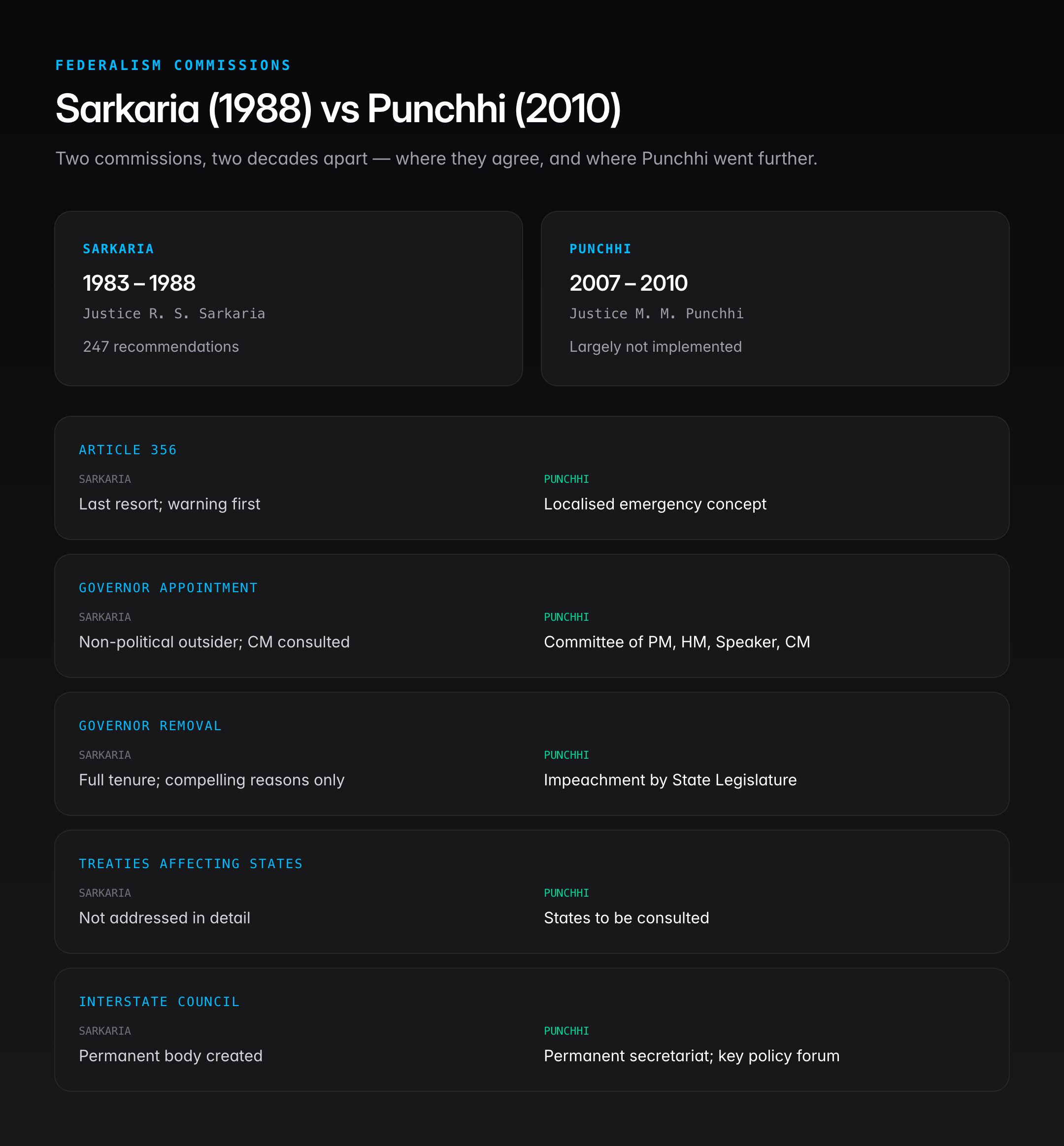
| Issue | Sarkaria Commission (1988) | Punchhi Commission (2010) |
|---|---|---|
| Article 356 | Last resort; warning first | Localised emergency suggested (Article 355 should be amended to allow for state or district-level intervention) |
| Governor's appointment | Non-political outsider; CM to be consulted | Added: committee of PM, HM, Speaker of Lok Sabha, and CM to select Governor |
| Governor's removal | Full tenure; removal for compelling reasons | Impeachment by State Legislature for proved misbehaviour |
| Interstate Council | Permanent body | Strengthen further; make it a permanent secretariat and a key policymaking forum |
| Treaty-making powers | Not addressed in detail | States should be consulted before treaties affecting state list subjects |
| Emergency under Article 352 | Not detailed | Recommended localised emergency provisions |
| Concurrent List | Prior consultation | Mandatory consultation via Interstate Council |
Comparison Table: Sarkaria vs Punchhi
| Aspect | Sarkaria (1988) | Punchhi (2010) |
|---|---|---|
| Timeframe | 1983-1988 | 2007-2010 |
| Chairperson | Justice R. S. Sarkaria | Justice M. M. Punchhi |
| Primary focus | Centre-State relations broadly | Centre-State and inter-state relations, with greater focus on contemporary issues |
| Key innovation | Interstate Council | Concept of localised emergency; treaty consultation with states |
| Status of implementation | Partially implemented | Largely not implemented |
UPSC Relevance
| Paper | How It Appears |
|---|---|
| Prelims (GS) | Year of establishment, chairperson, key recommendations, Interstate Council Article (263) |
| Mains GS-II (Polity) | Centre-State relations, federalism, role of Governor, Article 356 |
| Essay | Cooperative federalism, competitive federalism, Indian federal experiment |
Key terms to remember: Sarkaria Commission 1983, 247 recommendations, Justice R. S. Sarkaria, Article 356, Interstate Council (Article 263), S. R. Bommai case 1994, Rajamannar Committee, Anandpur Sahib Resolution, Punchhi Commission 2007, floor test, Governor's discretion.
Previous Year Questions (Themes)
- Discuss the recommendations of the Sarkaria Commission on Centre-State relations. (GS-II)
- Compare the Sarkaria and Punchhi Commissions' recommendations on the role of Governor. (GS-II)
- “Federalism in India is facing new challenges.” Discuss with reference to Centre-State relations. (GS-II / Essay)
The Sarkaria Commission remains the gold standard reference for any discussion on Indian federalism. Its recommendations have shaped both constitutional practice (Interstate Council, judicial review of Article 356) and ongoing debates on cooperative federalism in India.
Tell Google you want more of this.
Add Anantam IAS as a preferred sourceOne tap, and this site shows up more often in your own Top Stories, AI Overviews and AI Mode. Remove it any time.






