Energy Security Needs Systems, Not Just Citizen Austerity
A UPSC Mains editorial on why India's energy security cannot rest on voluntary fuel-saving appeals alone, and why import dependence, public transport, electrification, storage and price realism matter more.
A fuel-saving appeal can be useful in a crisis, but it should make us uncomfortable if it becomes the whole energy policy. India’s problem is not that citizens refuse to switch off a light or skip one car trip. The harder problem is that a fast-growing economy still runs too much of its mobility, freight, industry and household comfort on fuels whose prices and supply chains are shaped outside India.
The Issue, Framed
The issue is not whether citizens should conserve energy. They should. A society that wastes fuel during a price shock is paying a voluntary tax on its own future. But voluntary austerity is the thinnest layer of energy security. It works when the shock is brief, when public trust is high, and when alternatives already exist. It does not build alternatives by itself.
For UPSC, the useful frame is simple: energy security is not only about supply. It is about affordable access, resilience, import exposure, clean transition, and the ability of the state to protect vulnerable households without hiding the real cost of energy. That means the debate belongs equally to economy, environment, governance and internal resilience.
My view is clear: India should welcome citizen conservation, but it should not romanticise it. The deeper answer lies in systems – public transport that actually works, electricity grids that can absorb renewable power, storage that can manage intermittency, and prices that signal scarcity while protecting the poor.
What the Data Says
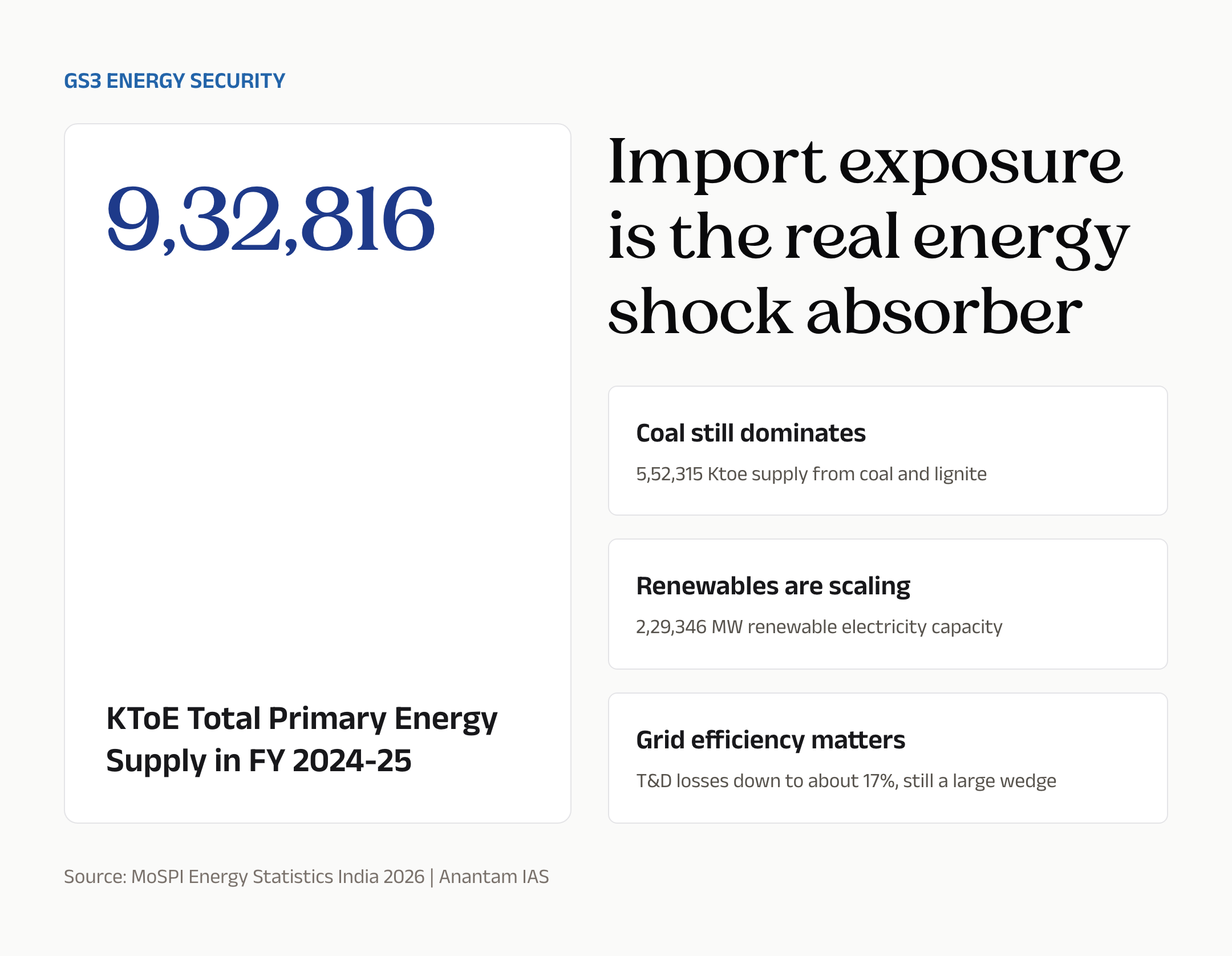
The hard numbers show why the problem is structural. The MoSPI Energy Statistics India 2026 press release puts India’s Total Primary Energy Supply at 9,32,816 KToE in FY 2024-25, up 2.95% over the previous year. This is not a small system that can be nudged into security through moral messaging. It is the energy base of a continent-sized economy.
There is good news. Renewable electricity capacity, including utility and non-utility sources, rose from 90,134 MW on 31 March 2016 to 2,29,346 MW on 31 March 2025. Gross renewable electricity generation rose from 1,89,314 GWh in FY 2015-16 to 4,16,823 GWh in FY 2024-25. Those numbers matter because they show that the transition is no longer a slogan. It is a material part of the power system.
But the old system has not disappeared. MoSPI records coal and lignite supply rising from 3,87,761 Ktoe in FY 2015-16 to 5,52,315 Ktoe in FY 2024-25. Transmission and distribution losses fell from about 22% to about 17% over the same broad period, but 17% is still a large leak in an economy trying to electrify transport and industry.
The import-dependence question is even sharper for oil and gas. Final publishing should verify the exact current year from PPAC, but the pattern is stable enough for analysis: India’s crude oil dependence is high, and transport demand turns every external oil shock into a domestic inflation, fiscal and current-account issue. That is why this is not just an energy story. It is macroeconomic governance.
The Case For
The case for citizen austerity is stronger than many critics admit. In a shock, demand reduction is the fastest source of supply. You do not need a new refinery to avoid an unnecessary car trip. You do not need a new transmission line to raise the thermostat by one degree in a government office. Small actions, multiplied across millions, can flatten peak demand and reduce import bills at the margin.
There is also an ethical argument. Energy is not merely a commodity; it carries public cost. Imported fuel affects the current account. Coal affects air quality. Peak electricity demand affects grid stability. If citizens demand cheap, abundant energy while refusing efficiency, the state is forced into subsidies, emergency imports and delayed environmental repair.
And appeals can prepare society for harder reforms. A government that asks citizens to conserve can use the moment to explain why public transport, rooftop solar, efficient appliances and clean cooking are not elite hobbies. They are national resilience tools.
The Case Against
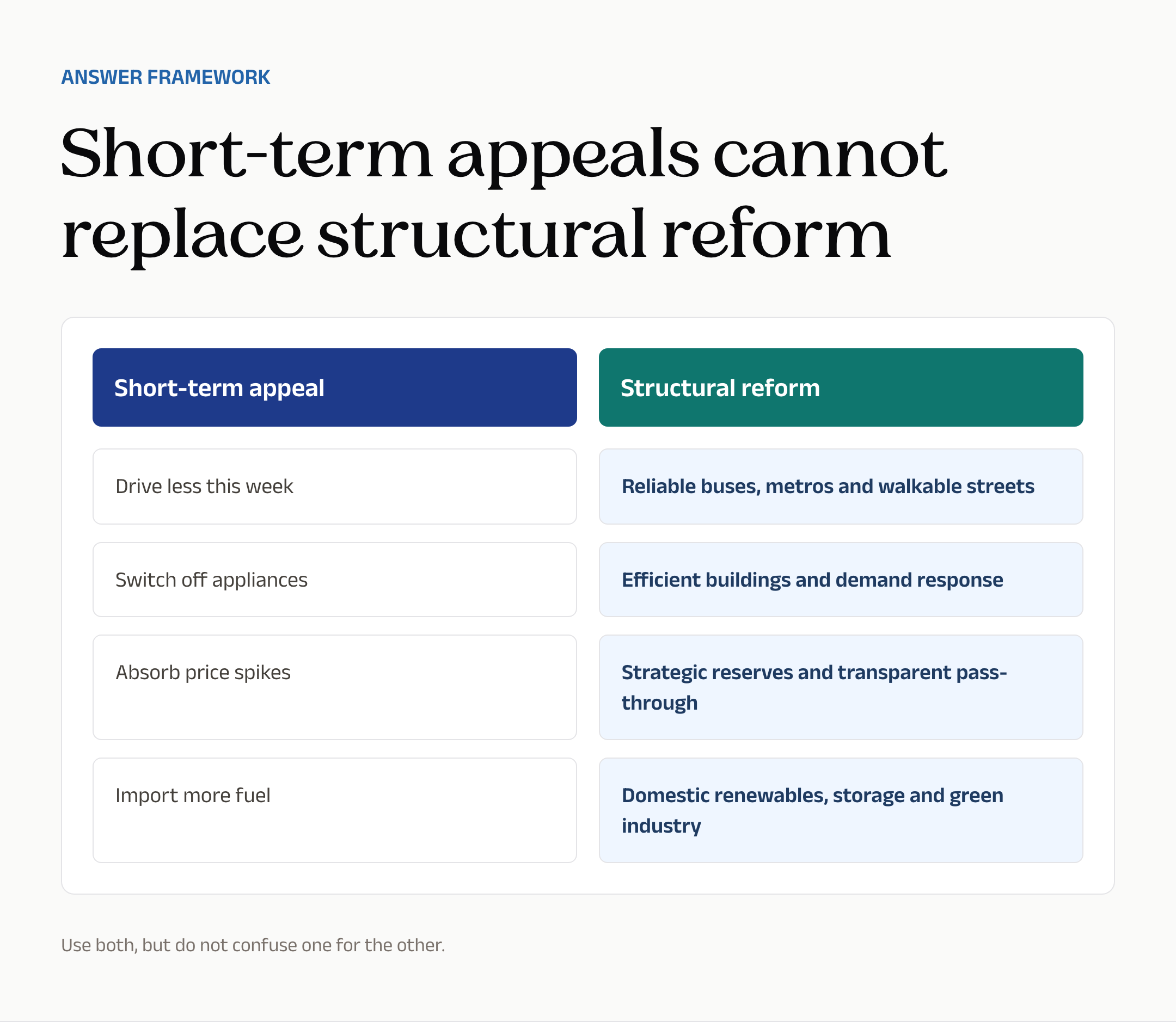
The case against relying on appeals is also strong. Moral messaging can easily become a substitute for state capacity. Telling citizens to save fuel is easy; redesigning a bus network, fixing distribution companies, building storage and pricing energy transparently is harder. If the appeal is not followed by system reform, it becomes a performance of concern.
It can also be unfair. A middle-class household may reduce discretionary driving. A delivery worker, a farmer running a pump, or a commuter in a city without reliable buses may not have the same choice. Conservation rhetoric often assumes that citizens have options. Many do not.
There is a political risk too. When energy prices rise, governments often hide scarcity through tax cuts, subsidies or delayed price pass-through. That may be necessary for poor households, but across-the-board cushioning weakens the signal to reduce waste and invest in alternatives. Price realism is unpopular, yet without it energy policy becomes a cycle of panic and relief.
The Deeper Structural Read
The deeper structural read is that India is trying to do three energy transitions at once. First, it must provide more energy per person because development still requires power, mobility, cooling and industrial heat. Second, it must reduce the external vulnerability of imported fuels. Third, it must decarbonise without slowing growth or making energy unaffordable.
That is why the usual binary – fossil fuels versus renewables – is too shallow. The real question is sequencing. Renewables help, but only if the grid can absorb them. Electric vehicles help, but only if public charging, battery supply chains and power generation improve. Green hydrogen helps, but not if it remains a brochure technology with no cost discipline.
Look at transport. India’s oil vulnerability is not solved by asking citizens to drive less during a shock. It is solved when a daily commuter can choose a reliable bus, metro, cycle path or shared electric mobility option without sacrificing dignity or time. The energy debate then becomes an urban governance debate.
The same is true for households. Telling people to reduce cooling demand is reasonable, but a heat-stressed city with poor ventilation, dark roofs and weak power supply will push families toward inefficient private cooling. Energy security is hidden inside building codes, local planning, appliance standards and distribution reform.
What Should Be Done
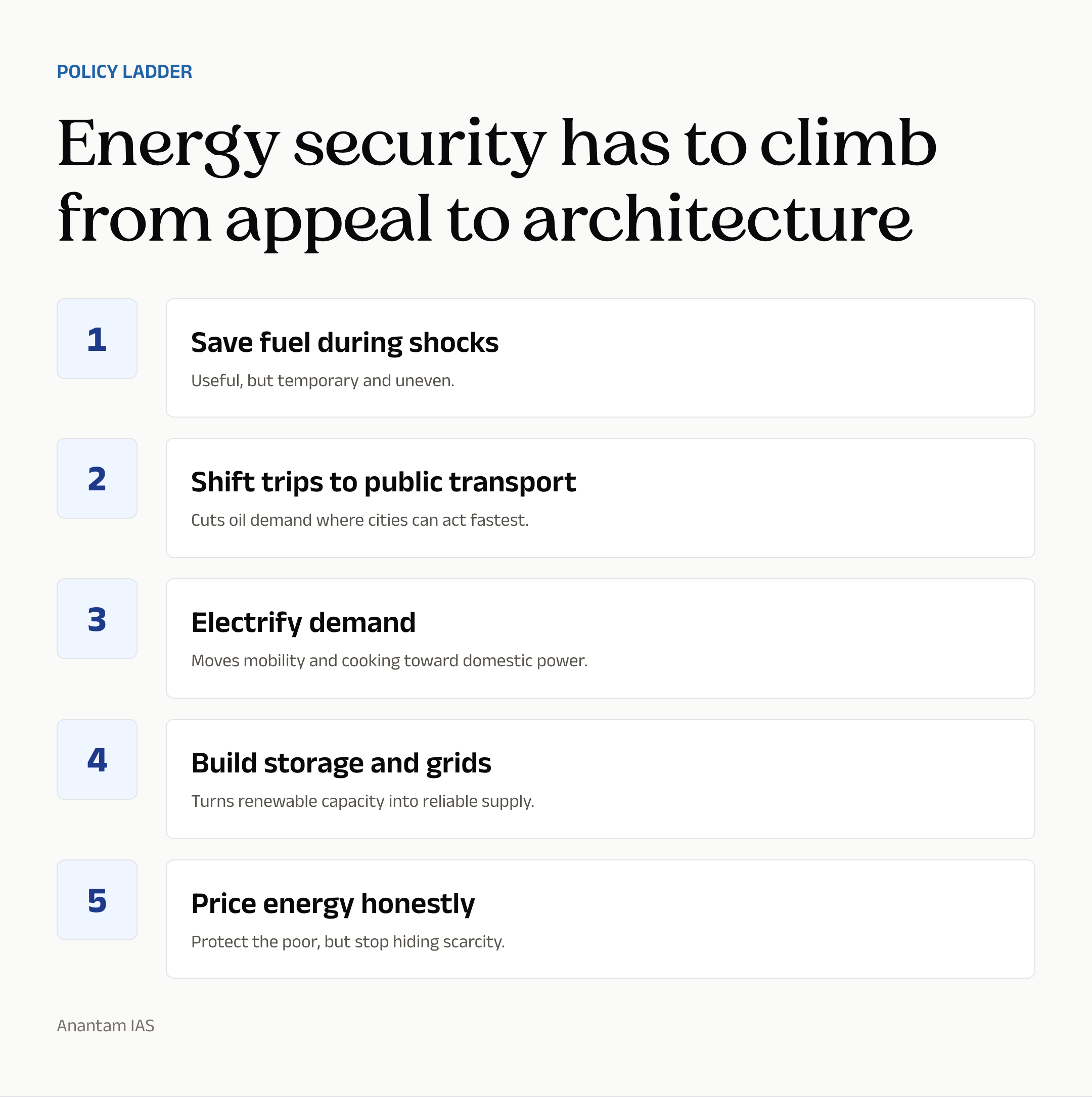
First, India needs a sharper oil-demand strategy. The fastest durable gains will come from public transport, freight rail, coastal shipping, better logistics and electric two-wheelers. Private EVs are useful, but buses and two-wheelers carry more social return per rupee of policy attention.
Second, grid reform should be treated as energy security, not only as power-sector accounting. A cleaner generation mix without reliable transmission, storage and distribution-company finances will create a fragile transition. The energy sector debate has to move from installed capacity to delivered reliability, and the renewable energy debate has to move from capacity addition to firm supply.
Third, price policy needs honesty. Poor households need protection through targeted transfers, lifeline tariffs and clean-cooking support. Richer consumers do not need hidden subsidies on waste. A price that hides scarcity eventually reappears as fiscal stress, pollution or supply insecurity.
Fourth, India should link domestic manufacturing to clean energy supply chains without pretending that import substitution is automatic security. Solar modules, batteries, critical minerals and grid equipment all need strategy. But strategy means quality, scale and cost, not only production-linked incentives.
Finally, citizen conservation should be framed as participation, not blame. The state must say: save where you can, and we will build the alternatives that make saving easier. That is the bargain. Without that bargain, austerity becomes advice. With it, austerity becomes the first step in resilience.
For Your Mains Answer
GS paper mapping: GS3: energy security, infrastructure, economy, environment; GS2: governance and urban service delivery.
Likely question frames: – Energy conservation campaigns are useful but insufficient for India’s energy security. Discuss with reference to import dependence and urban mobility. – How can India reconcile rising energy demand with the goals of affordability, resilience and decarbonisation? – Public transport is an energy-security instrument, not only an urban convenience. Examine.
Quotable data points: – TPES: 9,32,816 KToE in FY 2024-25. – Renewable electricity capacity: 90,134 MW in March 2016 to 2,29,346 MW in March 2025. – Renewable generation: 1,89,314 GWh in FY 2015-16 to 4,16,823 GWh in FY 2024-25. – T&D losses: about 22% to about 17% over FY 2015-16 to FY 2024-25. – Coal and lignite supply: 5,52,315 Ktoe in FY 2024-25. – Total final energy consumption: 608,578 Ktoe in FY 2024-25.
Keywords to use: energy security, import dependence, demand-side management, price realism, public transport, storage, distribution reform.
Syllabus linkages: Infrastructure: energy, Indian economy and planning, Environmental pollution and degradation, Urbanisation.
Balanced conclusion line: A secure energy system is built when citizens conserve, markets signal scarcity, and the state creates alternatives that make conservation practical.
How to Build the Answer
Start with the central tension, not a textbook definition. For this topic, the tension is: Energy conservation campaigns are useful but insufficient for India’s energy security. Discuss with reference to import dependence and urban mobility. That opening immediately tells the examiner that you understand both the policy problem and the value conflict. A definition can come in the second or third sentence. The first sentence should frame the debate.
Use data early, but do not dump data. A good first body paragraph can carry three numbers: TPES: 9,32,816 KToE in FY 2024-25. Renewable electricity capacity: 90,134 MW in March 2016 to 2,29,346 MW in March 2025. Renewable generation: 1,89,314 GWh in FY 2015-16 to 4,16,823 GWh in FY 2024-25. Then explain what those numbers prove. UPSC rewards the move from fact to inference. The number is the anchor; the inference is the mark-scoring part.
The second body paragraph should handle the other side fairly. If your stance supports reform, first admit why the existing approach has a rationale. If your stance criticises a policy, first say what problem the policy was trying to solve. This is how an answer becomes balanced without becoming vague.
The way forward should be grouped, not scattered. Use headings such as institutional reform, fiscal design, citizen impact, federal coordination and technology. Use the topic’s own vocabulary: energy security, import dependence, demand-side management, price realism, public transport. These words help the answer sound like governance analysis rather than a newspaper summary.
Close by returning to the syllabus link: Infrastructure: energy, Indian economy and planning, Environmental pollution and degradation. The last line should not repeat the introduction. It should show judgment. One useful pattern is: ‘The goal is not X alone, but X with Y.’ That pattern lets you balance reform with rights, growth with equity, and security with liberty.
Common Mistakes to Avoid
- Do not write only the newspaper argument. Editorials are starting points. Mains answers need constitutional, economic, administrative or ethical structure.
- Do not overuse adjectives. Words like serious, grave, historic and transformative do not earn marks unless tied to evidence.
- Do not make the answer one-sided. Every topic in this batch has a real counter-argument. Steelman it in two or three lines before giving your final view.
- Do not end with a slogan. End with an implementable principle, a measurable reform, or a constitutional value.
- Do not forget the citizen. UPSC likes policy, but it rewards policy that names who gains, who loses and who needs protection.
A Compact Answer Spine
- Introduction: Open with the conflict in one sentence and define the key term in the next sentence.
- Evidence: Use two or three data points from the dossier and connect each to a policy implication.
- Arguments: Present the case for the current policy or trend, then the case against it. Keep both fair.
- Structural diagnosis: Explain the deeper administrative, economic, social or constitutional reason the issue persists.
- Way forward: Give four to five grouped reforms with clear actors: Union government, state government, regulator, court, market, municipality or citizen.
- Conclusion: Use the balanced conclusion line from this section and adapt it to the question wording.
Diagram or Flowchart Idea
Use one small diagram if the question is a 15-marker. Do not draw a decorative mind map. Draw a causal chain. The cleanest format is: problem trigger -> institutional gap -> citizen impact -> reform response. This works because the examiner can read the logic in five seconds.
For a 10-marker, skip the diagram unless it is genuinely simple. A table with two columns, ‘case for’ and ‘case against’, usually works better. The aim is not to show artistic effort. The aim is to make the answer easy to evaluate under time pressure.
Ethics and Governance Angle
Add one ethical line even in a GS2 or GS3 answer. Most current-affairs editorials are not only about efficiency. They also ask who bears the cost of policy failure. A migrant voter, an undertrial, an outdoor worker, a small exporter, a low-income commuter or an elderly citizen is often sitting silently inside the issue. Naming that citizen makes the answer sharper.
The governance angle should then convert empathy into design. Do not merely say ‘protect vulnerable groups’. Say how: targeted transfers, legal aid, local health surveillance, simplified compliance, public transport, transparent dashboards, or periodic judicial review. This is where many answers move from moral language to administrative maturity.
A useful sentence pattern is: ‘The policy is legitimate in aim, but its legitimacy depends on procedure, proportionality and capacity.’ This line works across many topics because it accepts the state’s objective without giving the state a blank cheque. It is especially useful for questions where the examiner expects balance.
How to Use Data Without Sounding Mechanical
Use fewer numbers than you know. Three well-explained data points beat ten scattered facts. Put the most important number near the beginning, use the second number to show contrast, and use the third number to justify the way forward. For example, one national number, one state or sector contrast, and one implementation gap is usually enough.
Never leave a statistic alone. Follow it with a sentence beginning with ‘This means…’ or ‘The policy implication is…’ That tiny move turns data into analysis. It also keeps the answer from reading like a fact sheet. In Mains, facts are raw material. Judgment is the finished answer.
End revision by asking one question: can this answer be understood by a tired examiner in one pass? If the answer needs rereading, simplify the structure. Keep the introduction short, give the data early, mark the two sides cleanly, and place the way forward in grouped points. Clarity is not a lower standard than depth. For UPSC writing, clarity is how depth becomes visible.
One final check: remove any line that sounds impressive but does no work. Replace it with a fact, a cause, a consequence or a reform. That habit is small, but it is the difference between an answer that feels informed and an answer that feels memorised.
Write for marks, not for noise. Every sentence should earn its place. Always be specific.
FAQ
Why is energy security important for UPSC?
Because it links infrastructure, inflation, fiscal policy, foreign trade, climate action and welfare. A strong Mains answer should treat energy security as a governance problem, not only as fuel supply.
Is renewable capacity enough to reduce import dependence?
No. Renewable capacity helps, but import dependence falls only when transport, industry, storage, grids and demand patterns change together.
What is price realism in energy policy?
Price realism means energy prices should reflect scarcity and cost while vulnerable households get targeted protection. It avoids waste without abandoning welfare.
What is the best Mains conclusion?
India needs conservation, but conservation must sit inside a larger architecture of clean supply, reliable grids, efficient mobility and honest pricing.