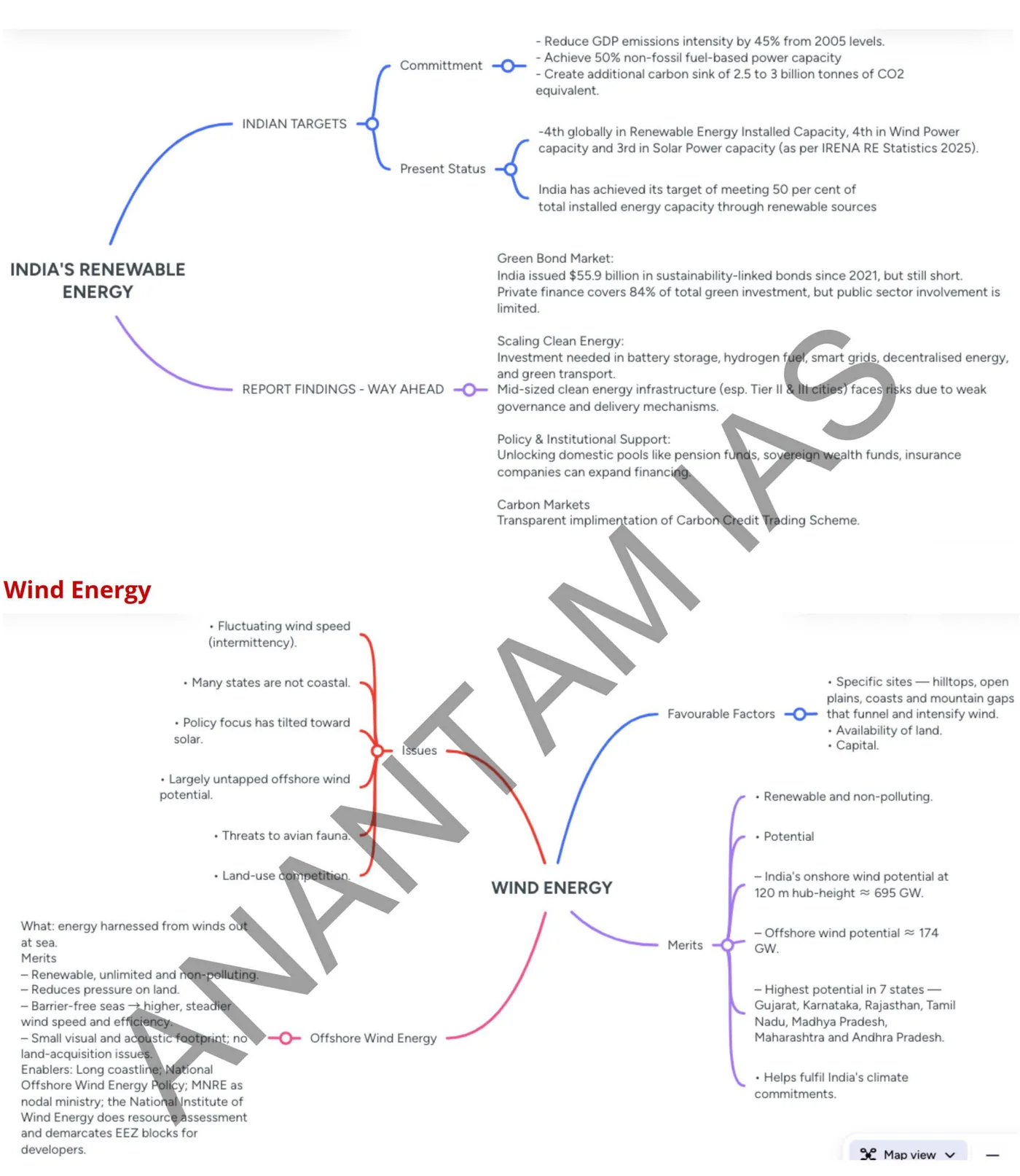
India is the world's third-largest electricity consumer and the third-largest emitter of greenhouse gases. So when India commits to 500 GW of non-fossil fuel capacity by 2030, it isn't just a climate pledge — it's an infrastructure challenge of extraordinary scale. Getting there requires adding roughly 40-50 GW of renewable capacity every single year. Some years, India has managed it. Many years, it hasn't.
This guide covers everything UPSC asks about renewable energy: the targets, the programmes, the institutions, the technologies, and the hard questions about whether India can actually get there.
India's Renewable Energy Targets
| Target | Commitment | Status (2024) |
|---|---|---|
| 500 GW non-fossil fuel capacity | By 2030 (NDC commitment) | ~195 GW renewable installed |
| 50% electricity from non-fossil fuels | By 2030 (NDC commitment) | ~45% in some months |
| Net Zero emissions | By 2070 (COP26 commitment) | Long-term pathway |
| 1 million tonnes green hydrogen | By 2030 (National Green Hydrogen Mission) | Early stage |
| 40% installed capacity from non-fossil fuels | NDC target | Already achieved ahead of schedule |
India's installed renewable energy capacity (excluding large hydro) crossed 190 GW in 2024. Including large hydro (~47 GW), total non-fossil fuel capacity is approximately 200+ GW — but this is still far short of the 500 GW target needed by 2030.
Solar Energy in India
India has the potential to generate far more solar power than it will ever consume. The country receives solar radiation equivalent to over 5,000 trillion kWh per year — more than total global energy consumption. The challenge isn't solar availability; it's installation pace, grid integration, financing, and land.
Installed Solar Capacity
India's solar power trajectory:
- 2010: ~20 MW (negligible)
- 2015: ~4,000 MW
- 2020: ~35,000 MW
- 2022: ~61,000 MW
- 2024: ~90,000 MW (approx.)
- 2030 target: 280 GW solar
India is currently the fourth-largest solar market globally (after China, USA, and Germany).
National Solar Mission (Jawaharlal Nehru National Solar Mission)
Launched in 2010 under the National Action Plan on Climate Change (NAPCC), the National Solar Mission went through three phases:
- Phase 1 (2010–13): 1,000–2,000 MW target; exceeded
- Phase 2 (2013–17): 4,000 MW
- Phase 3 (2017–22): Revised upward to 100 GW by 2022 (not fully achieved)
The mission created the regulatory framework for large-scale solar parks and competitive bidding for solar tariffs.
Major Solar Parks
| Solar Park | State | Capacity | Notes |
|---|---|---|---|
| Bhadla Solar Park | Rajasthan | 2,245 MW | World's largest single solar park |
| Pavagada Solar Park | Karnataka | 2,050 MW | Built on leased farmland |
| Kurnool Solar Park | Andhra Pradesh | 1,000 MW | Ultra Mega Solar Park |
| Rewa Solar Park | Madhya Pradesh | 750 MW | Pioneered direct supply to Delhi Metro |
| NP Kunta | Andhra Pradesh | 900 MW |
Rajasthan and Gujarat dominate solar capacity because of high direct normal irradiance (DNI) and available wasteland.
PM KUSUM Scheme
Pradhan Mantri Kisan Urja Suraksha Evam Utthaan Mahabhiyan (PM-KUSUM) was launched in 2019 to bring solar energy to the agricultural sector.
Three components:
- Component A: 10,000 MW of decentralised solar power plants (0.5–2 MW) on barren/fallow farmland; farmer leases land to DISCOM
- Component B: 20 lakh standalone solar pumps replacing diesel pumps
- Component C: 15 lakh grid-connected agriculture pumps solarised; farmers can sell surplus power to grid
PM-KUSUM is significant for UPSC because it addresses three problems simultaneously: reducing farmer input costs (diesel), creating income from land leases, and expanding renewable capacity — while reducing agricultural sector carbon emissions.
Rooftop Solar
PM Surya Ghar Muft Bijli Yojana (launched February 2024, replacing earlier Rooftop Solar Phase II) aims to install rooftop solar on 1 crore households by March 2026.
Key features:
- Subsidy: ₹30,000 per kW for first 2 kW, ₹18,000 per kW for 2–3 kW
- Families can earn from net metering (selling surplus to grid)
- Targeted particularly at middle-income households with high electricity bills
Earlier programme: Rooftop Solar Phase II aimed at 40 GW rooftop solar by 2022 — India reached only ~11 GW. PM Surya Ghar is an attempt to restart this momentum.
International Solar Alliance (ISA)
The International Solar Alliance (ISA) was jointly launched by India and France at COP21 in Paris in November 2015. It's India's most significant multilateral initiative in the energy space.
Headquarters: Gurugram, India Members: 124 countries (as of 2024) — mostly tropical, sun-rich countries Mission: Mobilise $1 trillion in solar investment by 2030; deploy 1,000 GW of solar globally
The ISA Secretariat became a treaty-based international organisation in 2017. It's significant in UPSC essays because it represents India's "climate leadership from the developing world" narrative — offering solar solutions to countries that have abundant sun but lack financing and technology.
Related: Climate Change Impact on India
Wind Energy in India
India is the fourth-largest wind power market globally with approximately 46 GW of installed capacity (2024), after China, USA, and Germany.
Onshore Wind
The best onshore wind resources are in:
- Tamil Nadu — India's leading wind state (>10 GW installed); Muppandal wind farm
- Gujarat — Second largest; large Kutch wind farms
- Rajasthan, Maharashtra, Karnataka, Andhra Pradesh — significant capacity
2030 target: 140 GW of wind (onshore + offshore)
The challenge: India's best onshore wind sites are increasingly congested. The next frontier is offshore.
Offshore Wind
India has approximately 70 GW of offshore wind potential in the Arabian Sea and Bay of Bengal. The government has set a target of 30 GW offshore wind by 2030.
Viability Gap Funding (VGF) of ₹6,853 crore was approved in 2023 for the first 1 GW of offshore wind in Gujarat, recognising that offshore costs (~₹9–10/unit) are not yet commercially viable without support.
Key challenge: India has no offshore wind installation experience, no domestic supply chain for offshore towers and foundations, and challenging weather conditions (cyclone-prone east coast, rough waters in Arabian Sea west coast).
National Green Hydrogen Mission
The National Green Hydrogen Mission was approved by the Cabinet in January 2023. It’s India’s most ambitious new energy initiative.
What is Green Hydrogen?
Hydrogen produced by splitting water (electrolysis) using renewable electricity is called green hydrogen. It's essentially a zero-carbon fuel. Burning hydrogen produces only water.
Conventional hydrogen (grey hydrogen) is made from natural gas via steam methane reforming — which produces CO₂. Blue hydrogen is the same process but with carbon capture.
Green hydrogen costs: Currently ~$4–6 per kg (target: below $1 per kg by 2030 for India to be globally competitive).
Mission Targets
| Target | By 2030 |
|---|---|
| Green hydrogen production | 5 million metric tonnes per year |
| Electrolyser manufacturing capacity | 5 GW per year |
| Export potential | Significant (Middle East, Europe) |
| CO₂ reduction | ~50 million tonnes per year |
| Investment | ₹8 lakh crore (~$96 billion) |
| Employment | ~6 lakh jobs |
Strategic Importance
India sees green hydrogen as a potential export commodity to energy-importing nations in Europe and the Gulf, where governments are paying premium prices to decarbonise steel, fertiliser, and shipping sectors. Green hydrogen is also a way to decarbonise India's own fertiliser industry (urea manufacturing is heavily dependent on natural gas).
SIGHT (Strategic Interventions for Green Hydrogen Transition) programme under the mission provides financial incentives for electrolyser manufacturing and green hydrogen production.
Small Hydro, Bioenergy and Other Sources
Small Hydro
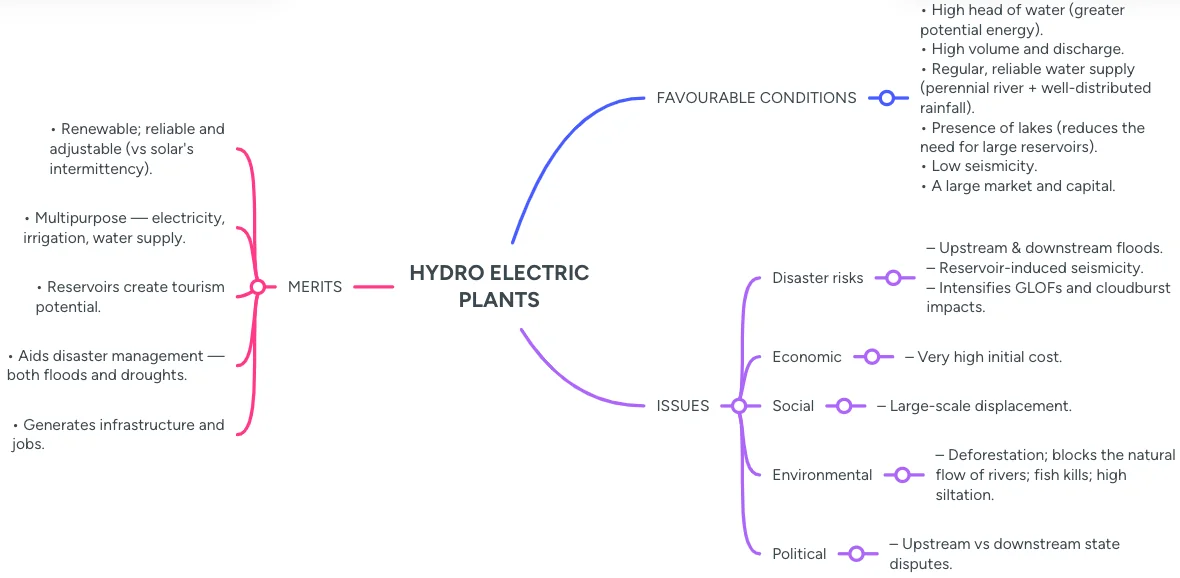
India has approximately 5 GW of installed small hydro capacity (plants below 25 MW) and a potential of ~21 GW. It's renewable but has geographic constraints — limited to hilly river regions.
Biomass and Bioenergy
India's National Biomass Programme and biogas/CBG (Compressed Biogas) initiatives under SATAT (Sustainable Alternative Towards Affordable Transportation) target 5,000 CBG plants by 2025.
Bioenergy installed capacity: ~10 GW from various biomass, biogas, and bagasse cogeneration sources.
Waste-to-Energy
India's municipal solid waste problem is a massive untapped energy resource. The National Bioenergy Programme and urban local body mandates are slowly scaling waste-to-energy plants, but progress remains slow against the volume of waste generated.
IREDA: The Financing Arm
The Indian Renewable Energy Development Agency (IREDA) is a Mini Ratna government enterprise under MNRE that provides financial assistance for renewable energy and energy efficiency projects.
Key facts:
- Established in 1987
- Provides project loans, bridge loans, and credit lines for RE projects
- Listed on NSE and BSE (IPO in November 2023)
- Loan book: ~₹60,000 crore (2024)
- Partners with international development banks (World Bank, KfW Germany, ADB) to channel concessional finance
IREDA's relevance for UPSC: it exemplifies the "green finance" ecosystem India is building — domestic development finance for domestic energy transition.
Grid Integration Challenges
Building renewable capacity is one challenge. Connecting it to the grid and using it when people need electricity is another.
The Intermittency Problem
Solar generates power only when the sun shines (typically 6–8 hours of peak generation). Wind is variable. India's peak electricity demand is in the evening — when solar generation drops to zero. This creates:
- Duck curve problem: Grid operators face a surplus in midday and a steep ramp-up in the evening
- Curtailment: States sometimes can't absorb all the solar being generated
- Grid stability issues: High renewable penetration affects grid frequency
Solutions
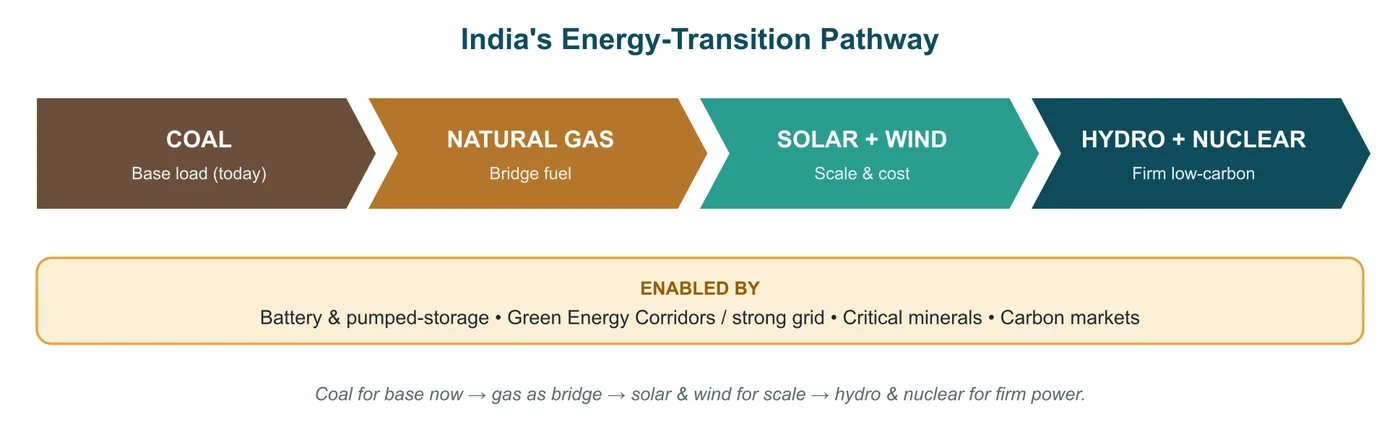
- Battery Energy Storage Systems (BESS): The government has tendered 4 GWh of BESS in 2023 with VGF support; long-term target of 51 GWh by 2030
- Pumped Hydro Storage: India plans 50 GW of pumped hydro by 2031–32
- Green Hydrogen: Can serve as long-duration storage (convert excess renewable electricity to hydrogen)
- Inter-state transmission: Building more high-capacity transmission corridors between RE-rich and demand-heavy states
Transmission Infrastructure
The Green Energy Corridor (Phase I and II) is a dedicated transmission network being built to evacuate renewable power from RE-rich states (Rajasthan, Gujarat, Tamil Nadu, Andhra) to demand centres. Phase II covers 10,750 km of transmission lines.
National Policy Architecture
| Policy/Programme | Ministry | Key Feature |
|---|---|---|
| National Solar Mission | MNRE | 100 GW solar target framework |
| National Wind-Solar Hybrid Policy (2018) | MNRE | Promotes co-located wind+solar plants |
| Renewable Purchase Obligation (RPO) | MoP / State ERCs | States must buy minimum % RE from DISCOMs |
| Production Linked Incentive (PLI) for Solar PV | MNRE | ₹24,000 crore PLI for domestic solar module manufacturing |
| PM Surya Ghar Muft Bijli Yojana | MNRE | 1 crore rooftop solar homes |
| National Green Hydrogen Mission | MNRE | 5 MMT green hydrogen by 2030 |
| SATAT | MoPNG | Compressed biogas from agricultural waste |
UPSC Key Points
- Ministry: Ministry of New and Renewable Energy (MNRE) is the nodal ministry
- Regulator: Central Electricity Regulatory Commission (CERC) for interstate; State ERCs for intrastate
- India's RPO (Renewable Purchase Obligation) mandates DISCOMs to purchase a rising percentage of power from renewable sources
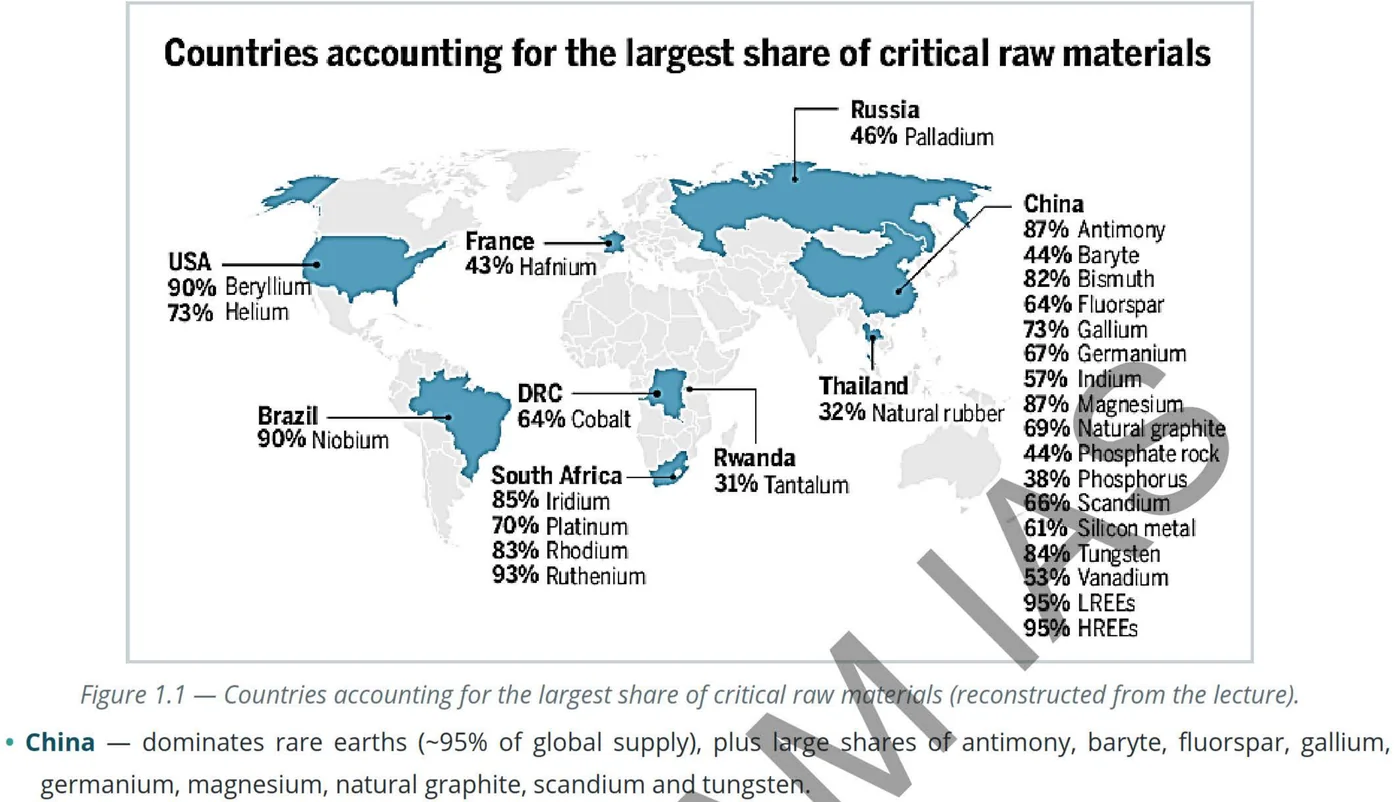
- PLI for Solar Modules: ₹24,000 crore to reduce import dependence on Chinese solar cells/modules — India currently imports ~80% of solar equipment from China
- One Sun, One World, One Grid (OSOWOG): India's vision for a global renewable energy grid — connect solar-rich regions with demand centres across time zones
Related: Forest Conservation in India
Frequently Asked Questions
Q1. What is India's 500 GW renewable energy target and is it achievable?
India committed to achieving 500 GW of non-fossil fuel installed capacity by 2030 as part of its updated Nationally Determined Contributions (NDCs) under the Paris Agreement. As of 2024, India has approximately 195–200 GW of renewable capacity installed, leaving a gap of about 300 GW. Achieving the target requires adding roughly 50 GW per year — India has managed this pace in recent years for solar but faces challenges in grid integration, financing, land acquisition, and manufacturing capacity. Most analysts consider the target aspirational but achievable with strong policy execution.
Q2. What is the International Solar Alliance and who started it?
The International Solar Alliance (ISA) was jointly launched by India and France at COP21 in Paris in November 2015 (announced by PM Modi and French President Hollande). It is a treaty-based international organisation headquartered in Gurugram, India, with 124 member countries. Its mission is to mobilise $1 trillion in solar investment and deploy 1,000 GW of solar globally by 2030, with a focus on developing countries in the tropical "Solar Belt." The ISA is India's flagship multilateral initiative in the clean energy space.
Q3. What is the National Green Hydrogen Mission?
Approved in January 2023, the National Green Hydrogen Mission targets producing 5 million metric tonnes of green hydrogen annually by 2030 and creating 5 GW per year of electrolyser manufacturing capacity. Green hydrogen is produced by splitting water using renewable electricity (zero carbon emissions). India aims to use it to decarbonise fertiliser production, heavy industry, and shipping, and potentially export it to Europe and the Middle East. The government is providing incentives under the SIGHT programme and has set a production cost target of below $1/kg by 2030.
Q4. What is PM KUSUM and how does it help farmers?
PM-KUSUM (Pradhan Mantri Kisan Urja Suraksha evam Utthaan Mahabhiyan), launched in 2019, has three components: solar power plants on barren farmland (Component A), standalone solar pumps for irrigation (Component B), and solarisation of grid-connected pumps with net metering (Component C). It helps farmers by replacing expensive diesel pumps with free solar power, generating rental income from leasing fallow land for solar plants, and allowing them to sell surplus electricity to the grid. The scheme also reduces agricultural carbon emissions and improves energy access in remote rural areas.
Q5. What are the main challenges facing India's renewable energy expansion?
Key challenges include: grid integration (solar and wind are intermittent — peak solar generation is at noon but peak demand is in the evening); transmission infrastructure gaps (RE-rich states like Rajasthan and Gujarat are far from major demand centres); financing (many DISCOMs are financially stressed and slow to pay RE developers); land acquisition for large solar parks; import dependence (India imports ~80% of solar modules from China, creating both trade and supply chain risks); and slow progress on energy storage (batteries and pumped hydro) needed to make renewable power reliable around the clock.
Tell Google you want more of this.
Add Anantam IAS as a preferred sourceOne tap, and this site shows up more often in your own Top Stories, AI Overviews and AI Mode. Remove it any time.