Hydrogen is the simplest element in the universe, and it may turn out to be the most useful tool India has for cleaning up the parts of its economy that electricity alone cannot reach. Steel mills cannot run on rooftop solar. Long-haul trucks cannot wait for a battery to charge. Fertilizer plants cannot be electrified end to end. For all these sectors, often called hard-to-abate, green hydrogen is the leading contender as a carbon-free energy carrier and as a chemical feedstock.
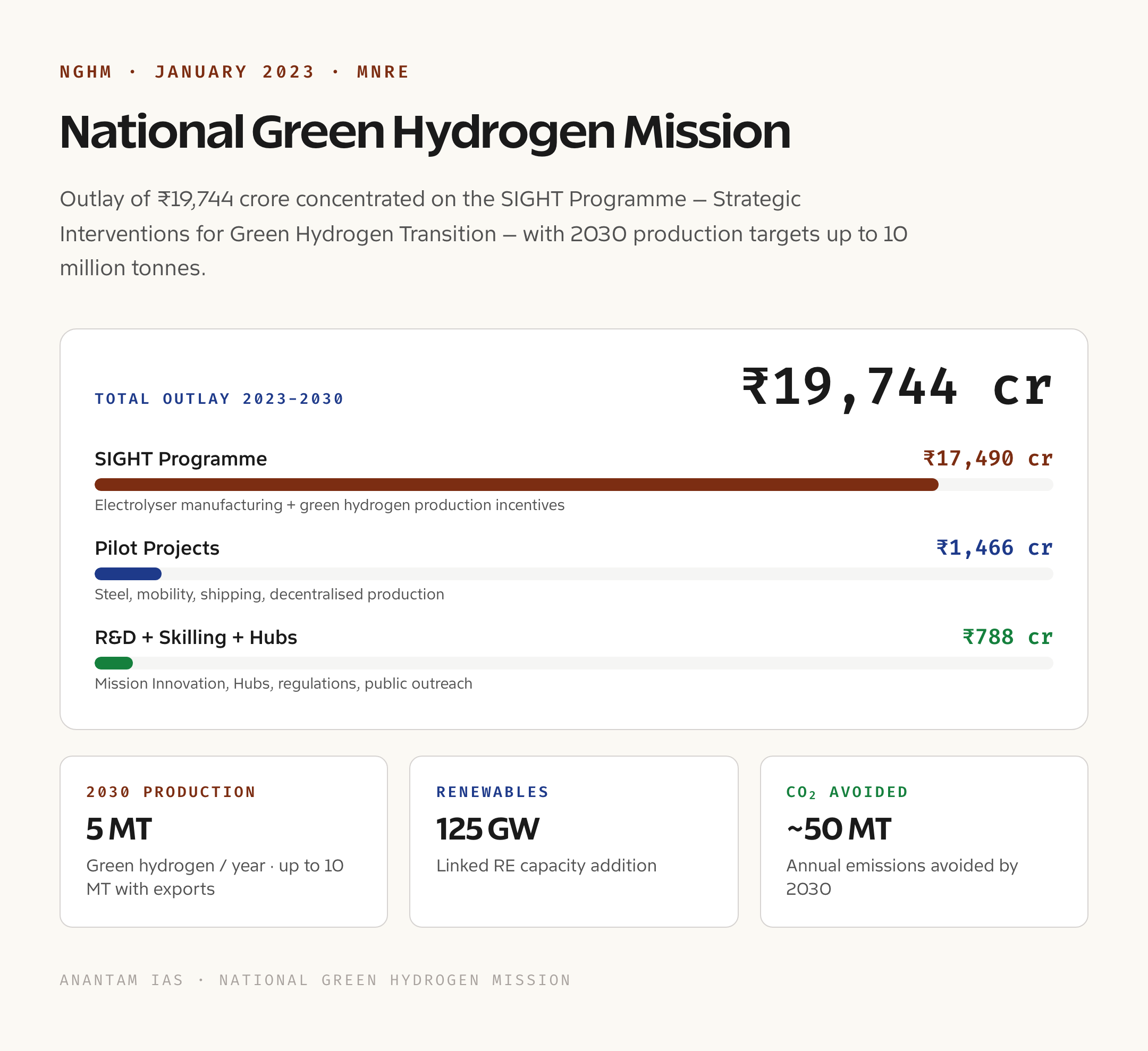
The National Green Hydrogen Mission, launched in January 2023 with an outlay of Rs 19,744 crore, is India’s bet that hydrogen will become a strategic export industry as well as a domestic decarbonisation tool. For UPSC GS-III, hydrogen energy is now a regular feature in both prelims and mains, with the colour spectrum, the SIGHT Programme architecture, and the H-CNG question among the most common framings.
Quick Facts on Hydrogen Energy
Hydrogen has roughly three times the energy density per kilogram of petrol but only about a tenth of the energy density per cubic metre at atmospheric pressure, which is why storage and transport are central engineering challenges. The only by-product when hydrogen burns or reacts in a fuel cell is water vapour, which makes it a zero-emission fuel at the point of use.
The National Green Hydrogen Mission targets 5 million tonnes of green hydrogen production per year by 2030, with the potential to reach 10 million tonnes if export demand develops. The mission is implemented by the Ministry of New and Renewable Energy. The two main components are the SIGHT Programme, which provides incentives for electrolyser manufacturing and green hydrogen production, and the Green Hydrogen Hubs, which identify regions for large-scale production clusters.
What Hydrogen Energy Is
Hydrogen exists in nature almost entirely in compounds, primarily water and hydrocarbons. Producing hydrogen as a fuel means separating it from those compounds, which takes energy. The carbon footprint of hydrogen depends entirely on where that separation energy comes from. If it comes from renewable electricity splitting water through electrolysis, the hydrogen is effectively zero-carbon. If it comes from steam reforming of natural gas with no carbon capture, the hydrogen carries a heavy emissions tail.
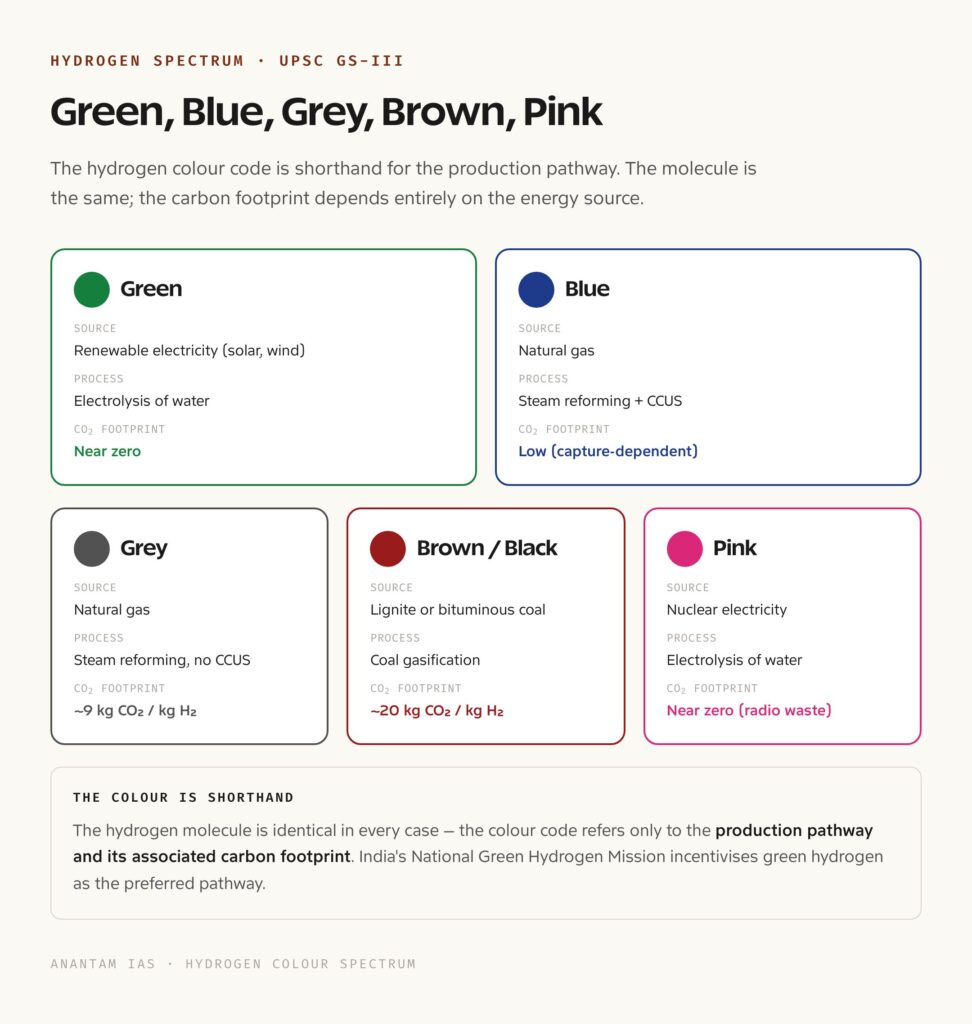
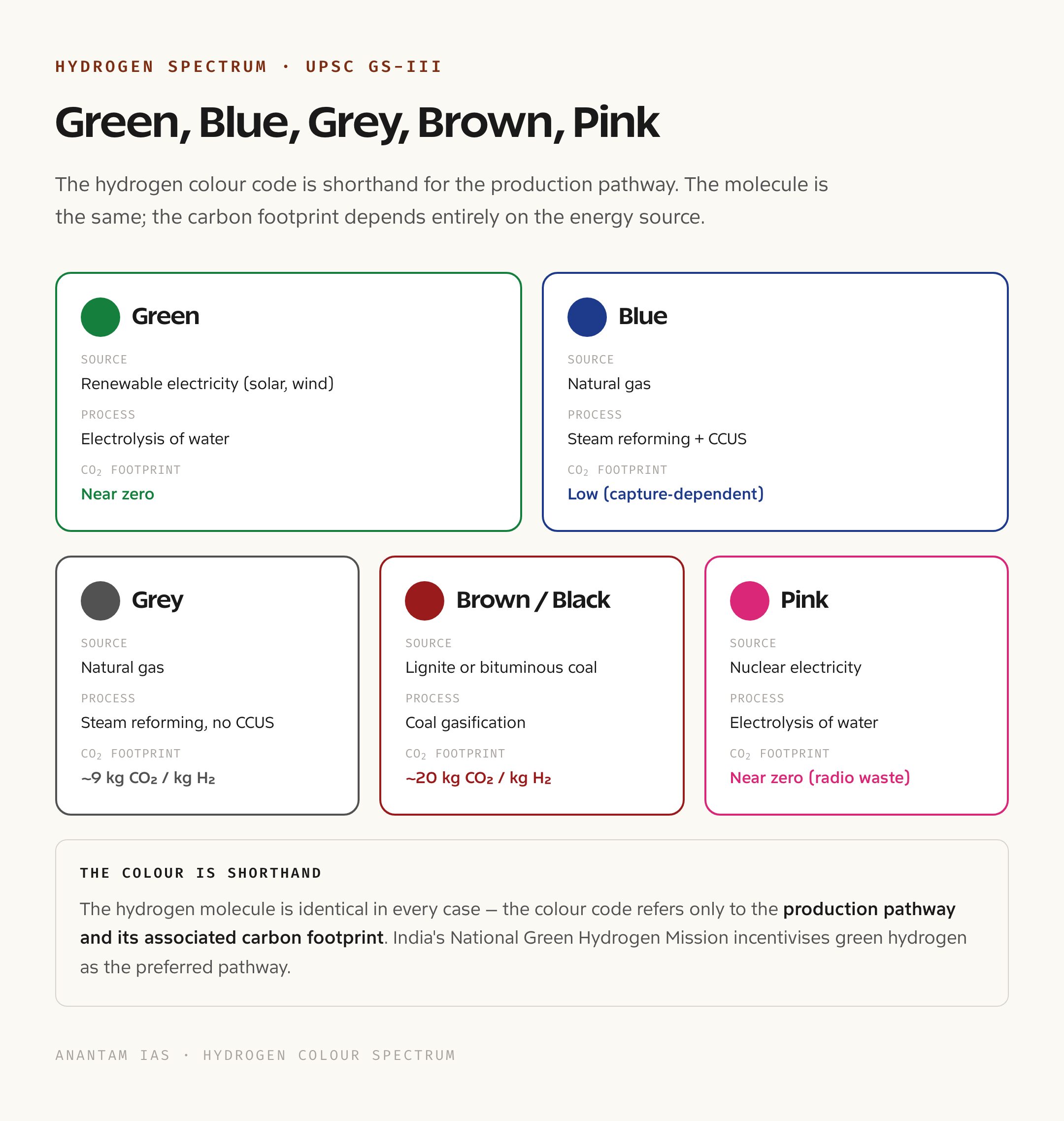
This is why the international literature uses a colour code. The colour does not refer to anything physical about the hydrogen itself, since the gas is identical in all cases. The colour is a shorthand for the production pathway and the associated carbon footprint. India’s policy framework explicitly aligns with this colour spectrum and incentivises green hydrogen as the preferred pathway.
Background and Historical Context
Hydrogen has been used as an industrial feedstock for a century, mainly in fertilizer manufacturing where it reacts with atmospheric nitrogen in the Haber-Bosch process to make ammonia. Globally, around 70 to 100 million tonnes of hydrogen are produced each year, almost all of it grey hydrogen made from natural gas or brown hydrogen from coal gasification. India consumes about 6 million tonnes of hydrogen annually, primarily in refineries and fertilizer plants.
The shift toward hydrogen as a clean energy carrier began in the 2010s, when the falling cost of renewable electricity made electrolytic green hydrogen plausible at scale. The European Union published its hydrogen strategy in 2020. Japan, South Korea, and Australia followed with their own roadmaps. India announced the National Hydrogen Mission in the 2021 Independence Day address and formalised it as the National Green Hydrogen Mission in January 2023.
The mission is part of a wider push that includes the Production Linked Incentive scheme for electrolyser manufacturing, the Green Energy Open Access Rules of 2022, and the carbon credit trading scheme being developed under the 2022 Energy Conservation Amendment Act. It also dovetails with India’s broader renewable energy build-out, since green hydrogen is, in effect, a way of storing and transporting renewable electricity.
Key Provisions of the Hydrogen Colour Spectrum
Green hydrogen is produced by electrolysing water using electricity from renewable sources, primarily solar, wind, or hydro. The process splits water molecules into hydrogen and oxygen using an electrolyser. Because the electricity is renewable, the lifecycle emissions are close to zero. Green hydrogen is the gold standard but is currently the most expensive route, costing roughly Rs 300 to 400 per kilogram in India today, though prices are projected to drop to Rs 100 to 150 per kilogram by 2030.
Blue hydrogen is produced from natural gas through steam methane reforming, with the resulting carbon dioxide captured and stored underground or used in industrial processes. The carbon capture and storage component reduces the lifecycle emissions to about 5 to 10 percent of grey hydrogen, depending on capture efficiency. Blue hydrogen is positioned as a transition fuel in countries with abundant natural gas.
Grey hydrogen is the conventional industrial hydrogen made from natural gas through steam methane reforming without any carbon capture. It is currently the cheapest, at roughly Rs 150 per kilogram in India, but it carries a high carbon footprint of about 10 kilograms of carbon dioxide per kilogram of hydrogen produced.
Brown or black hydrogen is produced from coal gasification, which is the most carbon-intensive route at roughly 18 to 20 kilograms of carbon dioxide per kilogram of hydrogen. India has historically produced limited brown hydrogen, but several integrated steel plants use coal-based syngas that is a close cousin.
Pink hydrogen is produced by electrolysis powered by nuclear electricity. Because nuclear power is essentially zero-carbon, pink hydrogen has a very low lifecycle emissions footprint, comparable to green hydrogen. India’s nuclear energy programme makes pink hydrogen a plausible option, though it is not yet commercially active.
There are also less common categories. Turquoise hydrogen is made through methane pyrolysis, which produces solid carbon rather than carbon dioxide. White or natural hydrogen refers to hydrogen found in geological formations, an emerging area of exploration. Yellow hydrogen sometimes refers to hydrogen from grid-mix electrolysis, though terminology varies.
Why Hydrogen Matters for India
India has three structural reasons to bet on hydrogen. First, decarbonising hard-to-abate sectors. Steel, fertilizer, refining, and long-haul transport account for roughly 30 percent of India’s energy-related carbon emissions. None of these can be easily electrified. Hydrogen, particularly green hydrogen, can serve as both a fuel and a chemical feedstock in these sectors.
Second, energy security. India imports more than 85 percent of its crude oil and a substantial share of its natural gas. Domestic green hydrogen, produced from solar and wind generated within the country, would substitute imported fossil fuels in refineries, fertilizer plants, and eventually in transport. This is a genuine strategic argument, not just an environmental one.
Third, export potential. Japan, South Korea, and parts of Europe have committed to large hydrogen import programmes but lack the renewable energy resources to produce green hydrogen domestically at competitive cost. India, with abundant solar and wind potential, can produce green hydrogen at among the lowest costs globally and export it as ammonia or as direct-shipped hydrogen. The Green Hydrogen Hubs component of the mission is built around this export logic.
Detailed Analysis of the National Green Hydrogen Mission
The mission has four major components, each with its own implementation track. The SIGHT Programme, which stands for Strategic Interventions for Green Hydrogen Transition, is the largest component. It has two sub-tranches. SIGHT Component I provides incentives for the domestic manufacturing of electrolysers, with a target of 60 to 100 GW of electrolyser manufacturing capacity by 2030. SIGHT Component II provides per-kilogram production incentives for green hydrogen producers, modelled on the production-linked incentive scheme for solar manufacturing.
The Green Hydrogen Hubs component identifies regions capable of supporting large-scale green hydrogen production, typically near port infrastructure for export. Identified candidates include Gujarat’s coastal industrial belt, Andhra Pradesh’s port cluster, Tamil Nadu’s Tuticorin region, and Odisha’s Paradip area. These hubs will receive concessional infrastructure support and dedicated renewable energy supply.
The third component is on research and development. The mission allocates roughly Rs 400 crore for the Strategic Hydrogen Innovation Partnership, focused on next-generation electrolysers, fuel cells, and storage technologies. The fourth component covers public awareness, skill development, and pilot projects in sectors such as hydrogen-blended natural gas networks, hydrogen-fuelled buses, and ammonia bunkering at ports.
The total mission outlay is Rs 19,744 crore through 2029 to 2030. The mission also sets a target of 125 GW of additional renewable energy capacity dedicated to green hydrogen production, which is in addition to the existing renewable energy targets.
Comparative View: Hydrogen Production Pathways
A useful way to compare pathways is to look at three variables: lifecycle emissions, current cost, and projected 2030 cost. Green hydrogen has near-zero lifecycle emissions, costs around Rs 300 to 400 per kilogram today in India, and is projected to fall to Rs 100 to 150 per kilogram by 2030 as electrolyser costs and renewable electricity prices both decline.
Blue hydrogen has lifecycle emissions of about 1 to 1.5 kilograms of carbon dioxide per kilogram of hydrogen, costs around Rs 200 to 250 per kilogram today, and is unlikely to fall significantly because the cost is dominated by natural gas prices and carbon capture infrastructure. Grey hydrogen has high lifecycle emissions, costs around Rs 150 per kilogram today, and rises with natural gas prices.
Pink hydrogen is roughly comparable to green hydrogen on emissions and cost, with the additional consideration that it provides round-the-clock generation, which can simplify electrolyser operations compared to intermittent renewables. Brown hydrogen is the highest-emission pathway and has limited future relevance in a decarbonising economy.
Applications Across Sectors
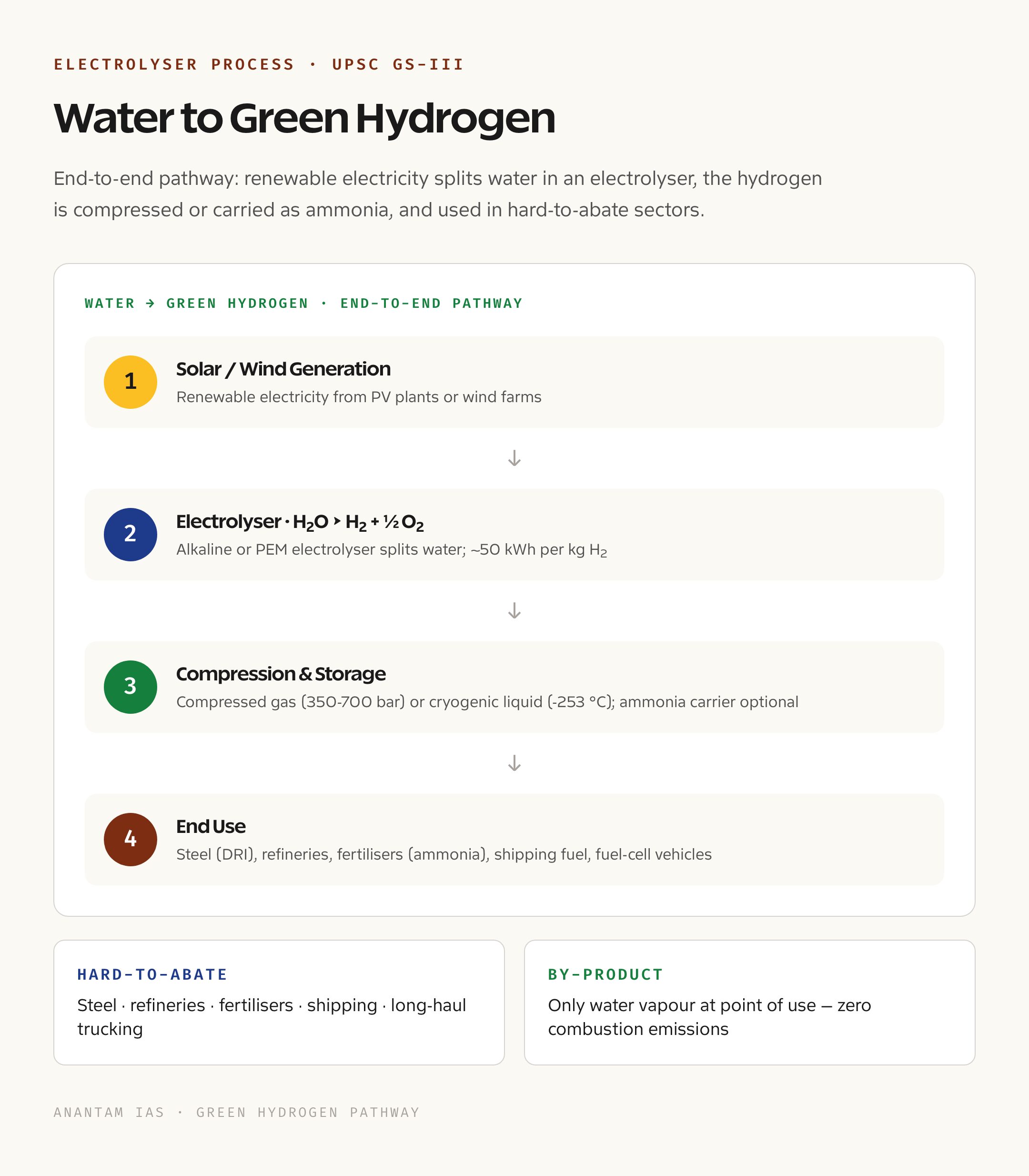
Steelmaking is one of the largest potential users. Direct reduced iron made with green hydrogen substitutes for coal-based blast furnace operations and can cut emissions by 90 percent or more. India’s steel industry currently produces about 130 million tonnes of crude steel annually with roughly 2.5 tonnes of carbon dioxide per tonne of steel. Green hydrogen-based steel would change that profile dramatically.
Fertilizer is the second largest user. Green ammonia, produced by reacting green hydrogen with atmospheric nitrogen, would replace grey ammonia in urea production. Refineries are the third largest, where hydrogen is used in hydroprocessing of crude oil. Replacing grey hydrogen with green hydrogen in refineries cuts emissions without changing the refining process itself.
Transport is a longer-horizon application. Hydrogen fuel cell electric vehicles work well for heavy long-haul trucks, buses, and trains where battery weight is a constraint. Indian Railways has begun pilot programmes on hydrogen-fuelled trains. The H-CNG framework for buses is another application, in which up to 18 to 20 percent hydrogen by volume is blended with compressed natural gas.
Challenges and Criticisms
The hydrogen economy faces real engineering and economic obstacles. The first is the cost gap. Green hydrogen is currently two to three times more expensive than grey hydrogen at the well, and the gap is wider on a delivered-cost basis after transport and storage. Closing this gap depends on continued cost declines in electrolysers and renewable electricity, neither of which is guaranteed at the projected pace.
The second challenge is infrastructure. Pure hydrogen is difficult to transport in existing natural gas pipelines beyond a 10 to 20 percent blend, because hydrogen embrittles steel and leaks through joints. Building a dedicated hydrogen pipeline network, or shipping hydrogen as ammonia and converting it back at destination, are both capital-intensive options.
The third challenge is end-use adoption. Steelmakers, fertilizer producers, and refiners are unlikely to switch from grey to green hydrogen unless the cost gap narrows or a carbon price makes grey hydrogen economically unattractive. The carbon credit trading scheme being developed under the environmental laws in India is the policy mechanism intended to push this transition.
The fourth challenge is water. Producing one kilogram of green hydrogen by electrolysis requires roughly nine litres of water, plus additional water for cooling. Scaling to 5 million tonnes per year means an additional 45 to 50 billion litres of water annually, which is not negligible in water-stressed regions and intersects with the groundwater crisis in India. The mission encourages seawater desalination and treated wastewater as feedstocks for coastal hydrogen hubs.
Prelims Pointers on Hydrogen Energy
The National Green Hydrogen Mission was approved in January 2023 with an outlay of Rs 19,744 crore. The 2030 production target is 5 million tonnes of green hydrogen per year. The implementing ministry is the Ministry of New and Renewable Energy. The SIGHT Programme has two components: electrolyser manufacturing incentives and green hydrogen production incentives. The mission targets 125 GW of additional renewable energy capacity for hydrogen production. Green hydrogen is produced through electrolysis of water using renewable electricity, with zero direct emissions. Pink hydrogen uses nuclear electricity. Blue hydrogen uses natural gas with carbon capture. Hydrogen has roughly three times the energy density per kilogram of petrol.
For the H-CNG question that has appeared in UPSC prelims, the correct elements are that H-CNG can reduce carbon monoxide emissions if combustion is more complete, that it reduces carbon dioxide and hydrocarbon emissions because hydrogen is carbon-free, and that the typical blend ratio is up to about 18 to 20 percent hydrogen by volume.
Mains-Level Questions
A standard mains question might ask whether green hydrogen can decarbonise India’s hard-to-abate sectors at scale. A strong answer would cover the National Green Hydrogen Mission targets, the SIGHT Programme architecture, the cost gap, and the carbon credit trading scheme as the demand-side push.
Another framing asks about the strategic case for India as a green hydrogen exporter. Here the answer can build on India’s renewable energy resource base, the Green Hydrogen Hubs component of the mission, the comparative advantage versus Australia and the Middle East, and the diplomatic dimension of supplying Japan and the European Union.
Way Forward
India’s hydrogen strategy needs four reinforcing pieces. First, accelerate electrolyser manufacturing through the SIGHT Programme to cut the import dependence that currently constrains green hydrogen production. Second, build a coherent demand-pull policy, including green steel and green ammonia mandates that require a rising share of hydrogen-based production. Third, integrate hydrogen into the carbon credit trading scheme so that the economic case for switching from grey to green is strengthened by a carbon price.
Fourth, address the water and land questions early. Hydrogen hubs should be located where seawater desalination, treated wastewater, or low-conflict groundwater is available, and the renewable energy land footprint should be planned alongside agricultural and ecological constraints. International partnerships, particularly the India-EU Green Hydrogen Partnership and the Japan-India Hydrogen Cooperation, can both supply capital and lock in long-term offtake commitments that make the domestic investment case more bankable.
Frequently Asked Questions
What is hydrogen energy?
Hydrogen energy refers to the use of hydrogen gas as a fuel or energy carrier. When hydrogen is combusted or used in a fuel cell, the only by-product is water vapour, making it a zero-emission fuel at the point of use. The carbon footprint of hydrogen depends on how it is produced.
What are the different colours of hydrogen?
Hydrogen is classified by production pathway into colours that reflect its carbon footprint. Green hydrogen comes from electrolysis using renewable electricity and is essentially zero-emission. Blue hydrogen comes from natural gas with carbon capture. Grey hydrogen comes from natural gas without capture. Brown or black hydrogen comes from coal gasification. Pink hydrogen comes from electrolysis using nuclear electricity. Turquoise hydrogen comes from methane pyrolysis.
What is the National Green Hydrogen Mission?
The National Green Hydrogen Mission is India’s flagship programme to establish the country as a global hub for green hydrogen production, use, and export. It was approved in January 2023 with an outlay of Rs 19,744 crore and targets 5 million tonnes of green hydrogen production per year by 2030.
What is the SIGHT Programme?
SIGHT stands for Strategic Interventions for Green Hydrogen Transition. It is the largest component of the National Green Hydrogen Mission and has two sub-tranches. Component I incentivises domestic manufacturing of electrolysers. Component II incentivises green hydrogen production through per-kilogram payments to producers.
Why is green hydrogen important for India?
Green hydrogen offers a way to decarbonise hard-to-abate sectors like steel, fertilizer, and refining, where direct electrification is difficult. It also reduces dependence on imported fossil fuels and creates an export industry, since India’s renewable resource base allows green hydrogen to be produced at globally competitive cost.
How is green hydrogen produced?
Green hydrogen is produced by electrolysing water using electricity from renewable sources. An electrolyser splits water molecules into hydrogen and oxygen. The process is energy-intensive but emission-free when the electricity is sourced from solar, wind, or hydro generation.
What are the main applications of hydrogen?
The largest applications today are in fertilizer manufacturing through ammonia, in petroleum refining, and in steelmaking. Emerging applications include long-haul trucking, buses, trains, shipping fuels in the form of green ammonia, and energy storage paired with renewable generation.
What is H-CNG?
H-CNG is a blend of hydrogen and compressed natural gas, typically with up to 18 to 20 percent hydrogen by volume. It is used in public transport buses to reduce carbon dioxide and hydrocarbon emissions. The blend is compatible with most existing CNG bus engines with minor modifications.
What is the cost of green hydrogen in India?
Green hydrogen currently costs roughly Rs 300 to 400 per kilogram in India, depending on the renewable electricity source and electrolyser type. The cost is projected to fall to Rs 100 to 150 per kilogram by 2030 as electrolyser manufacturing scales up and renewable electricity prices continue to decline.
Which countries are major players in hydrogen?
The major players are Germany and the wider European Union as importers and project developers, Japan and South Korea as importers, Australia as an exporter, the United States with its hydrogen production tax credits, and now India as a low-cost producer with both domestic decarbonisation and export ambitions.
Tell Google you want more of this.
Add Anantam IAS as a preferred sourceOne tap, and this site shows up more often in your own Top Stories, AI Overviews and AI Mode. Remove it any time.