Environment Impact Assessment (EIA) in India: Process, Issues and UPSC Notes (UPSC Environment)
UPSC guide to Environment Impact Assessment in India: EIA 2006 notification, screening and scoping, public hearing, draft EIA 2020, and reform agenda.
Environment Impact Assessment is the legal and technical process through which the likely environmental consequences of a proposed project are identified, predicted and evaluated before the project is approved. In India, EIA is enforced under the Environment (Protection) Act, 1986 and the EIA Notification of 14 September 2006. It touches almost every large infrastructure, mining, energy and industrial decision in the country, which is why it is a staple of UPSC GS Paper III questions on environment and development.
What is EIA
EIA has four core objectives:
- Identify likely environmental impacts of a proposed activity.
- Examine alternatives, including the no-action option.
- Incorporate mitigation measures into project design.
- Involve the public and decision-makers through a transparent process.
Internationally, EIA was pioneered by the US National Environmental Policy Act of 1969 and embedded in Principle 17 of the 1992 Rio Declaration. India first introduced EIA through an Office Memorandum in 1994, replaced by the far more comprehensive 2006 Notification.
Structure of the EIA process in India
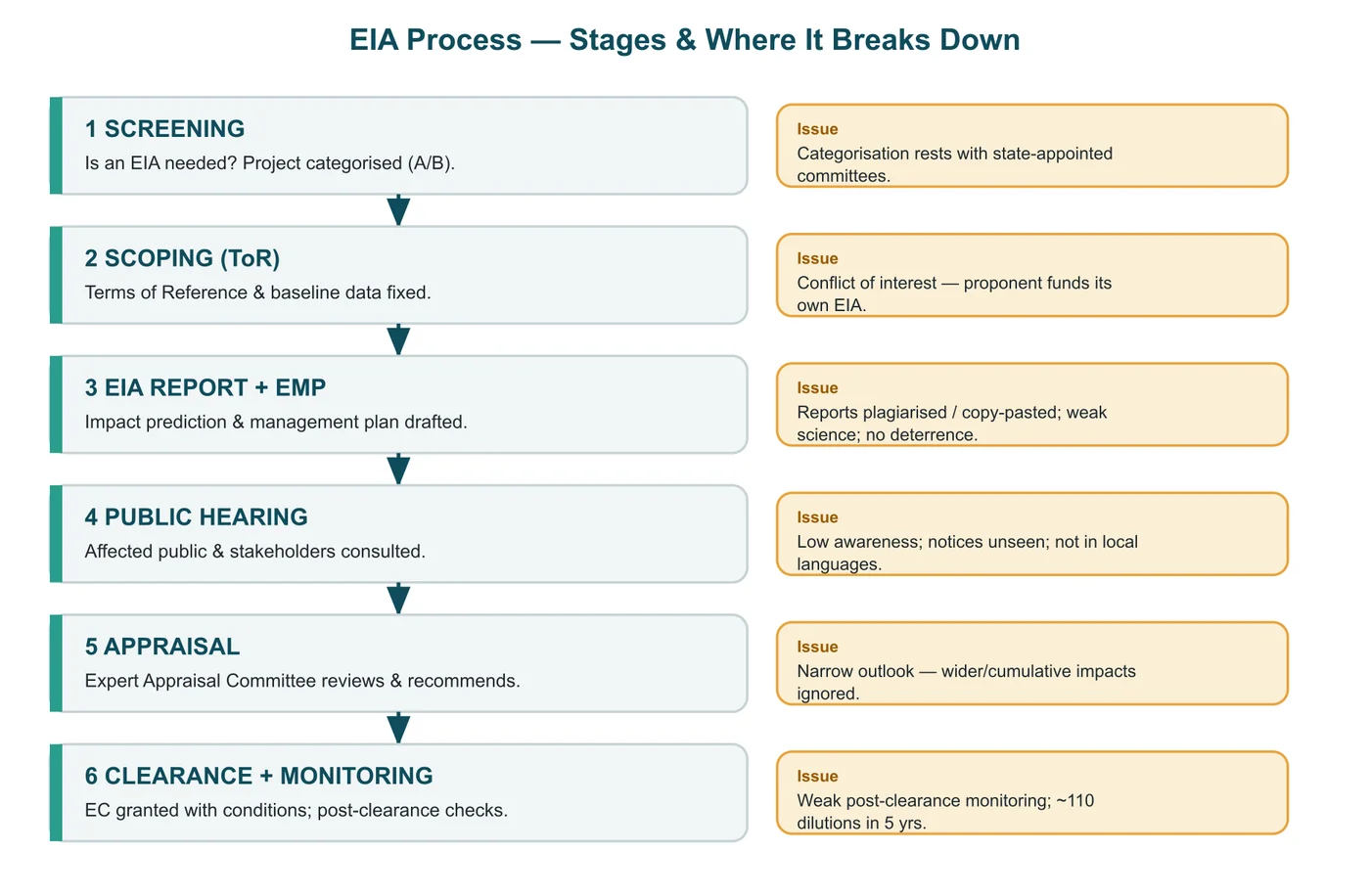
The 2006 Notification classifies projects into Category A (cleared by the Ministry of Environment, Forest and Climate Change) and Category B (cleared by State Environment Impact Assessment Authorities, or SEIAAs). The process runs through four stages.
Screening
Category B projects are screened by State Expert Appraisal Committees to decide whether they need a full EIA (B1) or just environmental management plans (B2).
Scoping
The EAC or SEAC prepares Terms of Reference specifying the studies, data and analyses required. The scoping stage is often criticised for being cursory, particularly for linear projects.
Public consultation
- A public hearing must be held by the State Pollution Control Board at the site, with at least 30 days' notice.
- A draft EIA report must be available in English and in the regional language.
- Written objections from the public can also be received in parallel.
Appraisal
The Expert Appraisal Committee examines the draft EIA, public hearing minutes and responses from the project proponent, and recommends approval or rejection with conditions. The final decision rests with the regulator.
Major issues with the EIA process
Conflict of interest
The EIA is funded by the same project proponent that seeks clearance. Since the consultant's next assignment depends on the proponent, incentives tilt toward obtaining clearance rather than ensuring scientific rigour.
Discretion in categorisation
Categorisation of projects lies with state-level committees, which are constituted by state governments. This creates room for political pressure, regulatory capture and inconsistent outcomes across states.
Poor-quality and plagiarised reports
Several media investigations and NGT orders have exposed EIA reports copied and pasted from other projects, sometimes with the wrong geography retained. With no statutory punishment for fraudulent reporting, deterrence is weak.
Professional capacity gaps
The Quality Council of India accredits EIA consultants, but the pool of specialists in biodiversity, hydrogeology, air quality modelling and social assessment is shallow. Junior staff often write critical sections without domain expertise.
Public hearing dysfunction
- Communities often learn of hearings through obscure local newspapers, not gram sabha notice.
- EIA reports are not always available in the regional language in plain-language summaries.
- Objections raised at the hearing are rarely reflected in the final report, and there is no statutory requirement to address them substantively.
- Several hearings have been conducted in locations far from the affected communities.
Narrow scope
EIAs focus on project-level impacts and rarely examine cumulative or landscape-level impacts. Dams in a cascade, or coal blocks in a cluster, are assessed independently, missing the aggregate stress on the ecosystem.
Post-clearance non-compliance
Monitoring of conditions after clearance is weak. Regional offices of MoEFCC have limited staff, and penalties for non-compliance are modest.
The EIA rating controversy
In 2022, MoEFCC proposed to rank and incentivise SEIAAs based on how quickly they issue environmental clearances. Critics argued that the rating system would:
- Create perverse incentives for quick approvals over rigorous scrutiny.
- Penalise agencies that ask for additional seasonal data, which is scientifically necessary in biodiversity-rich areas.
- Generate artificial competition between states and trigger a race to the bottom.
- Further tilt EIA toward facilitating industry rather than protecting ecology.
The government clarified that the ranking targets timeliness rather than speed of approval alone, but the proposal remained contested through 2024.
Draft EIA 2020
The 2020 draft attempted the most comprehensive overhaul since 2006. Key changes proposed:
- Post-facto clearance for projects that started without environmental clearance.
- Strategic projects exempted from public hearing.
- Shortened public consultation period from 30 to 20 days.
- Reduced frequency of compliance reports from six-monthly to yearly.
- Expansion of B2 category that skips full EIA.
The draft attracted over 17 lakh public comments and sharp judicial scrutiny. The Karnataka, Delhi and Madras High Courts directed translation into regional languages. As of 2026, the draft has not been finalised, and its provisions remain under debate.
Way forward
Independent EIA authority
An autonomous body not funded by proponents should conduct or audit EIAs. Sectoral EIAs, covering an entire coalfield or river basin rather than single mines or dams, would capture cumulative impacts.
Strengthened applicability
All projects with substantial ecosystem impacts should undergo environmental clearance, including those currently exempt. No development activity should be allowed in ecologically sensitive areas without comprehensive assessment.
Public hearing reform
- All categories of projects should hold public hearings.
- EIA reports must be available in plain regional language at least 45 days in advance.
- Each objection raised must be responded to, on record, in the final decision.
Clarity on clearances
Site clearance should not be confused with full environmental clearance. The notification must clearly distinguish between the two.
Expert committee composition
Executive-heavy committees should give way to balanced panels including independent experts in environment, health, sociology and local knowledge systems.
Compliance and penalties
Automatic withdrawal of clearance for non-compliance, stricter penalties, and citizen redressal mechanisms should be built in. The NGT should be strengthened with more judicial members and dedicated environmental benches.
Capacity building
Civil society, local communities and panchayats need training to use EIA as a participatory tool, not just an administrative formality.
Latest developments (2024-26)
- Draft EIA 2020 remains unfinalised as of 2026, with most states and the judiciary resisting several provisions.
- Forest (Conservation) Amendment Act 2023 narrowed the definition of "forest" and exempted several categories of land from the Forest Conservation Act, which has ripple effects on EIA processes for linear and border-area projects.
- The Supreme Court in the T.N. Godavarman proceedings (2024) reiterated the 1996 broad definition of forest, creating legal uncertainty for recent exemptions.
- PARIVESH 2.0, the digital EIA clearance portal, was fully operationalised in 2024, bringing most clearances online.
- NGT orders in 2024 and 2025 cancelled environmental clearances for several infrastructure projects on grounds of inadequate cumulative assessment, strengthening the case for landscape-level EIAs.
- COP29 commitments: India's updated NDCs emphasise climate-resilient infrastructure, which will require EIAs to incorporate climate risk assessment systematically.
- BBNJ Treaty signed by India in September 2024 imposes EIA obligations for activities in areas beyond national jurisdiction, connecting domestic EIA reform to the high seas framework.
UPSC Relevance
Prelims focus
- Legal anchor: Environment (Protection) Act, 1986 and EIA Notification, 14 September 2006.
- Categories: A (MoEFCC), B1 (SEIAA with EIA), B2 (SEIAA without EIA).
- Stages: Screening, Scoping, Public Consultation, Appraisal.
- Authorities: Expert Appraisal Committee, SEIAA, SEAC, QCI accreditation.
- PARIVESH portal and post-clearance monitoring.
Mains focus (GS III)
Frequent question framings evaluate the adequacy of the EIA regime, the impact of the Draft EIA 2020 on environmental governance, the conflict between ease of doing business and ecological safeguards, and the need for cumulative or landscape-level assessments. Answers should cite the 2006 notification, draft 2020 controversies, the Forest (Conservation) Amendment Act 2023 and NGT judgements.
Linkages
EIA connects to Article 48A and 51A(g) of the Constitution, the Precautionary Principle (Vellore Citizens Welfare Forum judgment), the Forest (Conservation) Amendment Act 2023, the Biological Diversity Amendment Act 2023, the Wildlife (Protection) Amendment Act 2022, and the BBNJ High Seas Treaty.