The Quality Council of India is one of those institutions that most citizens never hear of but interact with every day. The diagnostic laboratory that processed your blood test, the hospital that admitted your relative, the certification on the helmet you bought, the school that tested in standardised assessments, the small enterprise that made the bolts in your bridge: all of them, somewhere in the chain, are likely to have been touched by an accreditation issued by a board that sits under the QCI. The Council is the apex body in India’s quality and accreditation ecosystem, and it operates through a public-private partnership model that makes it constitutionally distinctive.
Most of the public discussion of the QCI today is anchored on its newer initiatives, particularly the Surajya Recognition and Ranking Framework that ranks states and Union Territories on quality parameters across education, health and prosperity. The framework links ZED certification for MSMEs, NABH accreditation for hospitals, NABL accreditation for laboratories and NABET accreditation for educational and training institutions to a single state-level scoreboard. Underneath the new initiatives, however, is a quarter-century of institutional history that explains why a non-statutory, non-constitutional society has come to wield so much practical authority in Indian governance.
This guide walks through the constitutional and legal status of the QCI, its five constituent boards, its historical evolution, the major initiatives in 2024 and 2025, and the prelims and mains preparation angles for the UPSC and state services examinations.
Quick Facts on the QCI
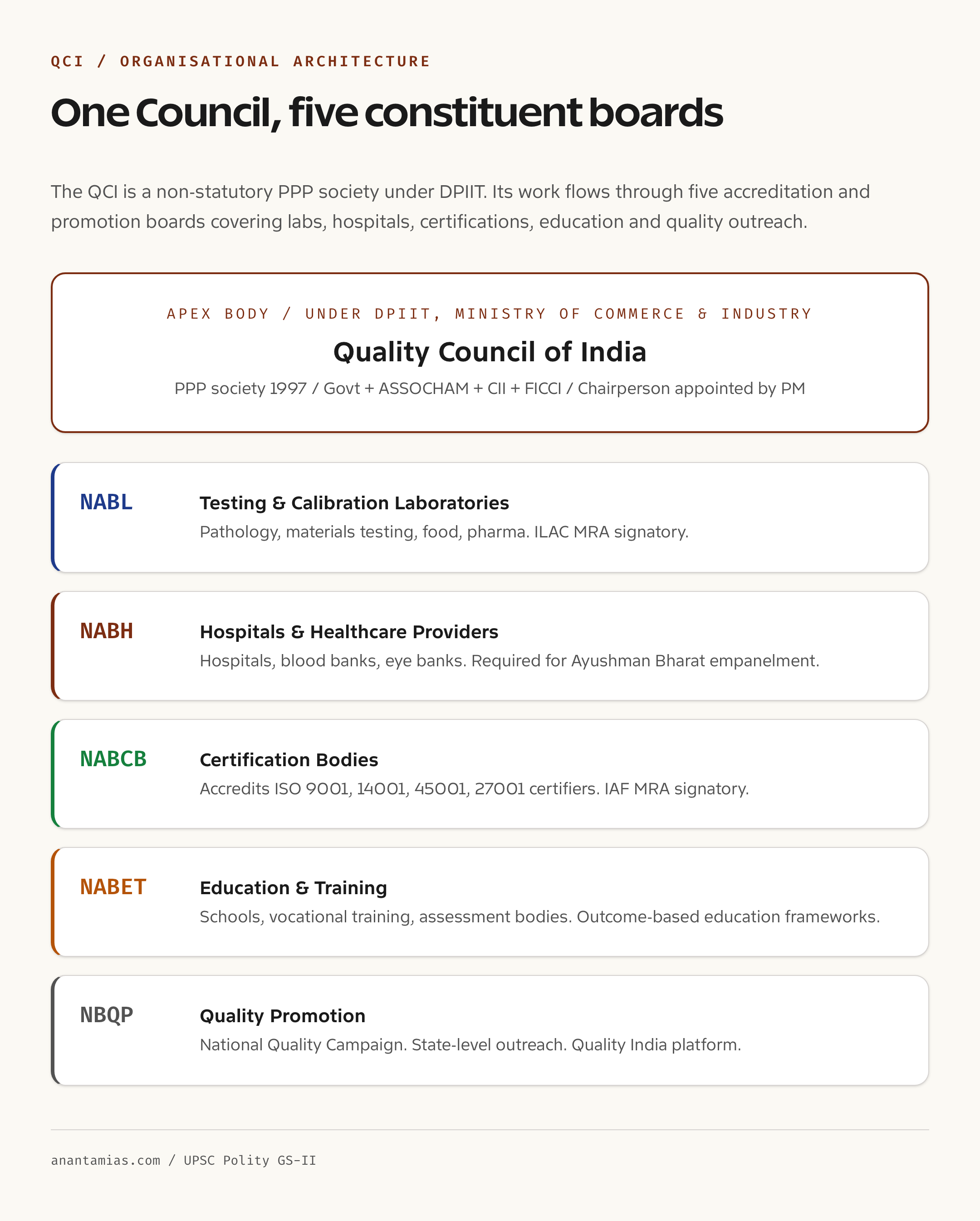
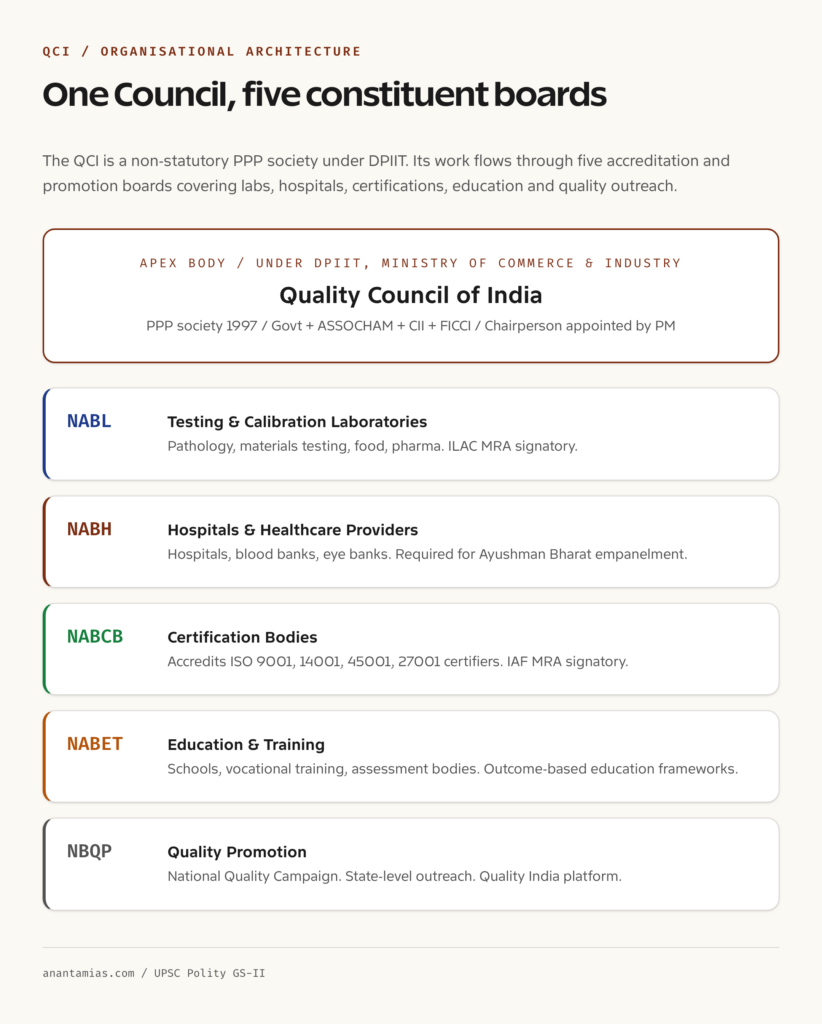
The Quality Council of India was established in 1997 as a non-profit autonomous body, registered under the Societies Registration Act, 1860. It is not a statutory body and not a constitutional body. It functions on a public-private partnership model, with the Government of India and three industry associations (ASSOCHAM, CII and FICCI) as joint promoters. The nodal ministry is the Department for Promotion of Industry and Internal Trade, DPIIT, under the Ministry of Commerce and Industry. The Chairperson of the QCI is appointed by the Prime Minister of India on the recommendation of industry. The QCI Governing Council has 38 members with representation drawn equally from the Government, industry and other stakeholders. The QCI operates through five Constituent Boards: NABL, NABH, NABCB, NABET and NBQP. Recent initiatives include the Surajya Recognition and Ranking Framework, Gunvatta Sankalp pledges, and Sarpanch Samvaad.
What the QCI Is
The QCI is the apex national body for accreditation in India. Accreditation, in its technical meaning, is the formal recognition of competence; it is the process by which an authoritative body certifies that a laboratory, hospital, certification agency, or training institution meets defined standards of quality and process integrity. Once accredited, the entity can in turn certify or test products, services and processes for end-users, with the accreditation lending credibility to the certification.
Importantly, the QCI is neither a statutory body nor a constitutional body. It is registered under the Societies Registration Act, 1860, with the legal status of a non-profit society. This is unusual for a body that in practice exercises wide influence over health, industry and education quality regimes. The legal architecture is deliberate: it lets the Council operate with industry participation, escape some of the bureaucratic constraints of a statutory body, and align with international accreditation bodies that prefer to deal with non-governmental national counterparts under the International Accreditation Forum and the International Laboratory Accreditation Cooperation arrangements.
Background and Historical Context
The QCI was set up in 1997 against the backdrop of India’s post-1991 liberalisation and the corresponding need for an internationally credible quality and accreditation regime. Indian exporters in sectors such as pharmaceuticals, engineering goods and textiles found themselves competing in markets that demanded ISO certifications, internationally recognised laboratory test reports, and supplier audits conducted by accredited certification bodies. India did not have a single national accreditation framework that could plug into the international system. Several existing bodies, such as the National Accreditation Board for Testing and Calibration Laboratories that had been set up earlier, were brought together under the QCI umbrella.
The PPP model was a deliberate design choice. The Government of India had the legitimacy and the policy reach. The industry associations, ASSOCHAM, CII and FICCI, had the technical depth, the international networks, and the willingness to fund operational costs. The structure also helped distance the accreditation function from direct governmental administration, which made the QCI’s certifications more credible to international bodies that were wary of government-controlled accreditation regimes.
In its first decade, the QCI focused on building technical capacity in its constituent boards and on signing mutual recognition arrangements with international bodies. NABL became a signatory to the ILAC Mutual Recognition Arrangement, which meant that NABL-accredited laboratory test reports were accepted across major economies without further verification. NABH developed standards aligned with the Joint Commission International accreditation regime for hospitals. NABCB joined the International Accreditation Forum’s mutual recognition arrangements. By the mid-2010s, India had a nationally consistent, internationally recognised accreditation framework anchored in the QCI.
For the wider judicial reforms in India and the National Medical Commission primer, the existing explainers offer useful institutional context about how non-statutory bodies operate alongside statutory regulators in Indian governance.
The Five Constituent Boards
The QCI operates through five Constituent Boards, each with a defined mandate.
NABL, the National Accreditation Board for Testing and Calibration Laboratories, accredits testing and calibration laboratories that perform analytical and metrological work. NABL accreditation covers a vast spectrum from medical diagnostic laboratories that perform pathology tests to industrial testing laboratories that test materials, chemicals, food and pharmaceuticals. NABL is a signatory to the ILAC mutual recognition arrangement, which gives NABL accreditation international weight.
NABH, the National Accreditation Board for Hospitals and Healthcare Providers, accredits hospitals, blood banks, eye banks, ophthalmology centres, dental clinics and other healthcare facilities. NABH accreditation is a major credibility marker in Indian healthcare and is required for empanelment in central health schemes including Ayushman Bharat. The standards cover patient rights, infection control, medication management, human resource quality and outcome measurement.
NABCB, the National Accreditation Board for Certification Bodies, accredits the certification agencies that issue ISO 9001, ISO 14001, ISO 45001, ISO 27001 and similar internationally recognised certifications. The architecture is one step removed from end-users; NABCB does not certify products, but it certifies the certifiers. NABCB is a signatory to the IAF mutual recognition arrangement.
NABET, the National Accreditation Board for Education and Training, accredits educational and training institutions, including schools, vocational training centres and assessment bodies. NABET accreditation is increasingly tied to outcome-based education frameworks and to skill development programmes.
NBQP, the National Board for Quality Promotion, focuses on promotional and outreach work rather than accreditation. It runs the National Quality Campaign, organises quality conclaves, supports state-level quality movements, and operates the Quality India platform that links the various quality and accreditation initiatives across sectors.
Composition and Appointment Process
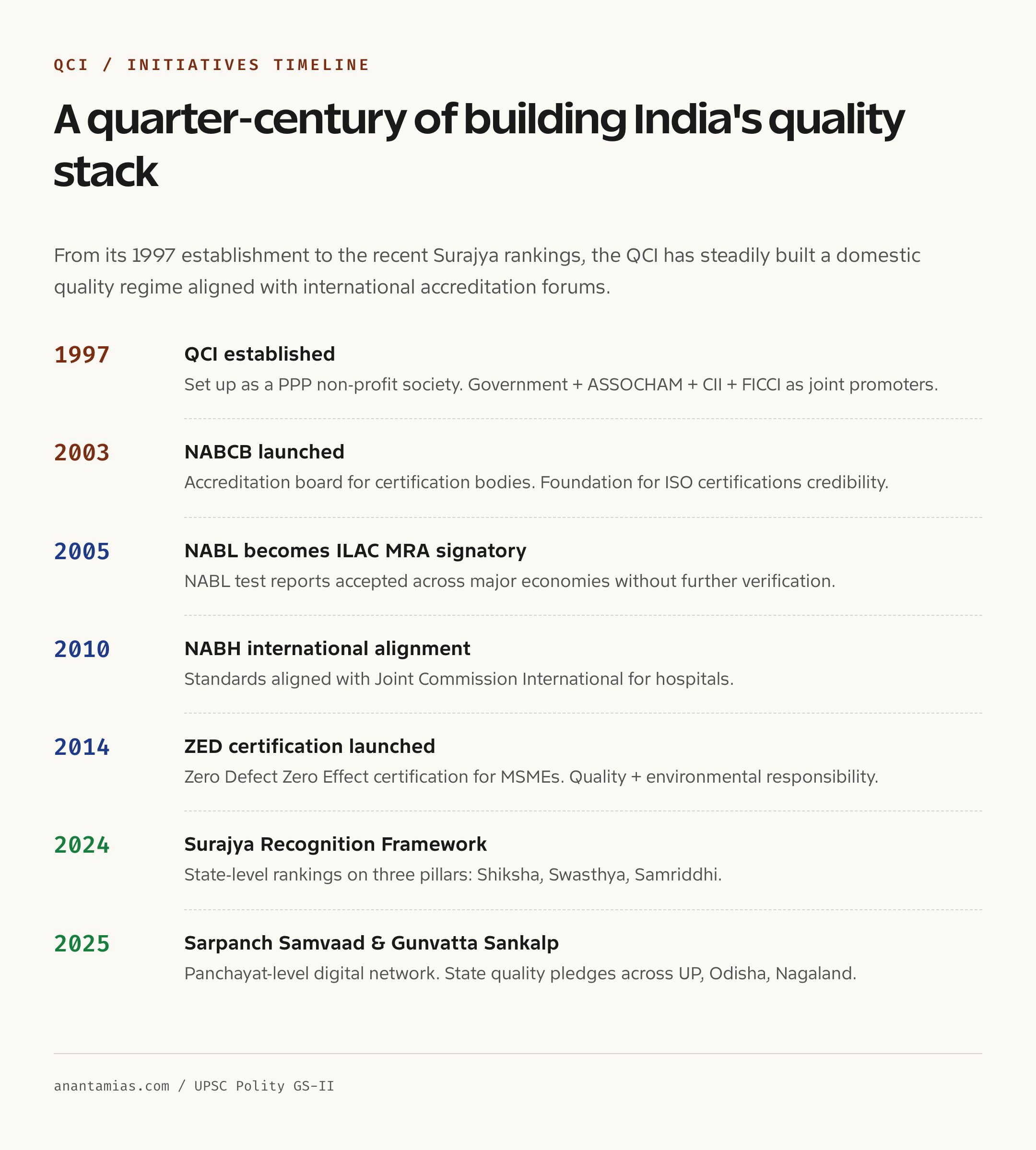
The QCI Chairperson is appointed by the Prime Minister of India on the recommendation of the industry associations that are joint promoters. The process is consultative; the industry forwards a panel of names to the Government, and the Prime Minister makes the appointment. The Secretary General of the QCI runs the day-to-day administration and reports to the Chairperson and the Governing Council.
The Governing Council has 38 members with equal representation from the Government, the industry and other stakeholders. The government representatives include senior officers from DPIIT, the Bureau of Indian Standards, the Ministry of Health and Family Welfare, the Ministry of Education, and other ministries with stakes in accreditation outcomes. The industry representatives are drawn from ASSOCHAM, CII, FICCI and sectoral industry bodies. Other stakeholders include consumer organisations, accredited bodies, technical experts and representatives from state quality councils.
This balanced composition is a key feature of the PPP model. It prevents any one constituency, government, industry or technical experts, from dominating the Council. It also creates a forum where quality policy can be negotiated across the public and private sectors before being implemented.
Recent Initiatives, 2024 and 2025
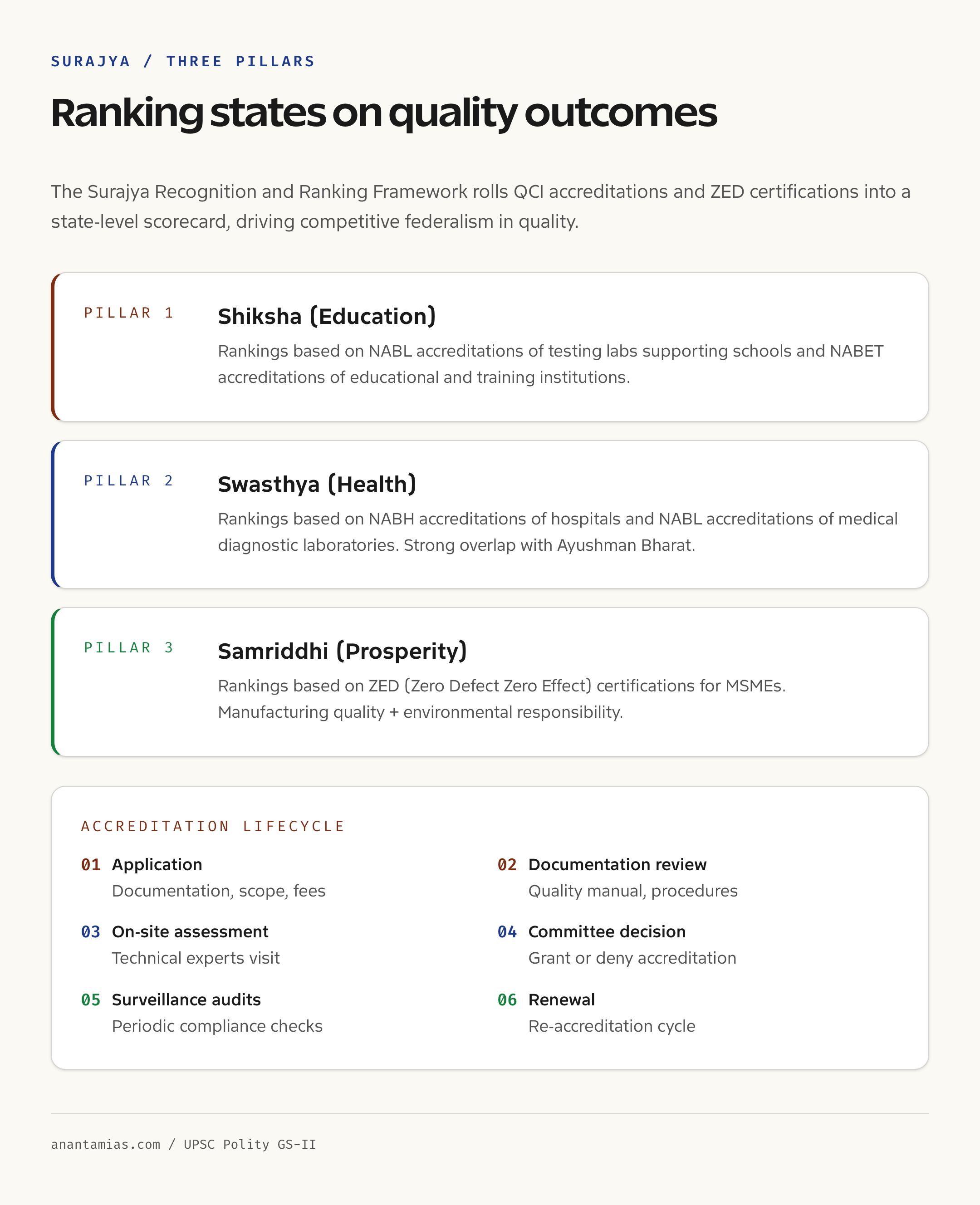
The Surajya Recognition and Ranking Framework is the QCI’s flagship recent initiative. Surajya, meaning “good governance,” is a quality scoreboard for States and Union Territories built on three pillars. The Shiksha pillar measures education quality based on NABL accreditations of testing laboratories supporting schools and on NABET accreditations of educational and training institutions. The Swasthya pillar measures health quality based on NABH accreditations of hospitals and NABL accreditations of medical diagnostic laboratories, with a strong overlap with the Ayushman Bharat ecosystem. The Samriddhi pillar measures prosperity based on ZED, Zero Defect Zero Effect, certifications of MSMEs. State and UT performance across these three pillars feeds into a composite ranking, intended to drive a competitive federalism dynamic in quality.
Gunvatta Sankalp is a state-level quality pledge programme. The QCI has organised Gunvatta Sankalp events in Uttar Pradesh, Odisha, Nagaland and other states, bringing together state government representatives, industry, certification bodies and civil society to commit to specific quality goals over defined timelines. The pledges range from increasing the share of NABL-accredited laboratories in the state to setting time-bound targets for ZED certification of MSMEs.
Sarpanch Samvaad is a digital platform launched to create a network of Sarpanchs across India for sharing best practices on quality at the panchayat level. The platform connects rural local government leaders with QCI’s accreditation and quality promotion architecture, recognising that primary-level service delivery in rural India runs through panchayat institutions.
Why It Matters: Quality, Trade and the Federal Architecture
The QCI matters for three reasons. First, it is the connective tissue that links India’s domestic quality regime to the international quality and trade architecture. NABL test reports are accepted across the OECD, NABCB certifications are accepted in international supply chains, and NABH accreditations are increasingly recognised in international medical tourism. The QCI’s mutual recognition arrangements directly support Indian exports and the broader external trade story.
Second, it is the institutional bridge between government policy and industry practice. The PPP model gives the Council a procedural flexibility that pure governmental bodies do not enjoy, while keeping the policy steering with the Government of India. This has allowed the Council to evolve faster than a typical statutory regulator, adopting new quality frameworks as they emerge in the international system.
Third, it is increasingly an instrument of federal cooperation through the Surajya framework. The state-level rankings encourage a competitive federalism dynamic in which states benchmark themselves against each other on quality outcomes in education, health and prosperity. This is a softer but powerful mechanism for raising standards, complementing the Finance Commission devolution and the centrally sponsored schemes.
Detailed Analysis: The PPP Model and Institutional Choices
The QCI’s PPP society structure is unusual in Indian institutional architecture, where most apex bodies are either statutory regulators or fully governmental authorities. The closest cousin is perhaps the Quality Council architecture in the public-sector commission space and the autonomous society model used by some scientific establishments. Three institutional choices define the QCI.
The choice of a society over a statutory body keeps the QCI legally light and operationally agile. The Council can update its standards, sign international arrangements, and reorganise its constituent boards without legislative amendment. The trade-off is that the Council’s decisions do not directly carry statutory force; they operate through credibility and through the willingness of governmental and private institutions to recognise QCI accreditations.
The choice of a PPP funding model brings industry expertise and resources into the Council’s work. ASSOCHAM, CII and FICCI fund a significant share of operations and provide technical expertise drawn from member companies. The trade-off is the perception that industry participation could compromise the independence of accreditation; the Council manages this risk through governance separation between policy and accreditation decisions and through strict conflict-of-interest protocols.
The choice of separate constituent boards for laboratories, hospitals, certification bodies, education and quality promotion creates a layered architecture that mirrors international best practice. The trade-off is occasional fragmentation across boards, which the QCI manages through cross-board committees and through the National Quality Campaign that runs across sectors.
Comparative View: India and the International System
India’s QCI architecture aligns with international peers in most respects. The United Kingdom Accreditation Service, UKAS, is the national accreditation body for the UK and operates as a non-profit company. The American National Standards Institute, ANSI, plays a similar role in the United States. Germany’s DAkkS is a private non-profit. The international convergence around non-governmental, non-statutory accreditation bodies reflects the international practice that accreditation gains credibility precisely when it is one step removed from direct governmental control.
The Indian distinctiveness lies in the explicit PPP composition with named industry associations as joint promoters and in the Prime Minister’s role in appointing the Chairperson. The first feature gives Indian industry a structural voice that is unusual internationally. The second feature gives the Council a level of high-level political backing that is also unusual; in the UK and the US, the heads of the accreditation bodies are appointed by their boards, not by the head of government.
Challenges, Concerns and the Road Ahead
The QCI faces five enduring challenges. The first is the legal status concern; as a non-statutory body, the Council’s accreditations rely on credibility rather than law, which can be a vulnerability when its decisions are challenged. The second is the cross-sector coordination challenge; with five constituent boards working across diverse sectors, internal coordination is non-trivial. The third is the state capacity bottleneck; the Surajya framework requires substantial data flows from state governments, and not all states have the administrative capacity to sustain consistent reporting. The fourth is the industry-perception risk; as the PPP model evolves, the Council must continue to demonstrate that its accreditation decisions are technically driven and free from member-company influence. The fifth is the international competition challenge; as Asian peers strengthen their own accreditation regimes, India must keep evolving the QCI to stay technically at par.
Prelims Pointers
The QCI was set up in 1997. It is not a statutory body and not a constitutional body; it is registered as a non-profit society under the Societies Registration Act, 1860. The nodal ministry is the Department for Promotion of Industry and Internal Trade, DPIIT, under the Ministry of Commerce and Industry. The Chairperson is appointed by the Prime Minister of India on the recommendation of industry. The Governing Council has 38 members with equal representation from Government, industry and other stakeholders. The five Constituent Boards are NABL (laboratories), NABH (hospitals), NABCB (certification bodies), NABET (education and training) and NBQP (quality promotion). The Surajya Recognition Framework has three pillars: Shiksha, Swasthya and Samriddhi. ZED stands for Zero Defect Zero Effect.
Mains Practice Questions
- “The Quality Council of India is a study in institutional design: a non-statutory PPP society wielding outsized influence over Indian quality and trade.” Discuss the strengths and limits of this institutional architecture. (15 marks, 250 words)
- Examine the role of the Surajya Recognition and Ranking Framework in promoting cooperative and competitive federalism in India. (10 marks, 150 words)
- The QCI’s accreditation regime supports Indian exports and the broader external trade story. Explain with reference to the mutual recognition arrangements signed by NABL and NABCB. (10 marks, 150 words)
Way Forward
The QCI’s next decade should follow three trajectories. The first is statutory underpinning for critical accreditation domains, especially in healthcare, where NABH-related decisions increasingly affect public health outcomes and Ayushman Bharat empanelment. A statutory backstop would not require giving up the PPP society model; the existing architecture can be preserved while specific accreditation domains gain a statutory anchor. The second is digital transformation of the accreditation lifecycle, with assessment, surveillance and renewal moving fully online and integrated with state-level dashboards under Surajya. The third is deeper international integration, with Indian accreditation increasingly recognised in regional trade agreements and technical barriers to trade negotiations. The Council’s PPP design has carried it well through the first quarter-century. The next stage requires statutory reinforcement, digital depth, and global ambition.
Frequently Asked Questions
Is the Quality Council of India a statutory body?
No. The Quality Council of India is not a statutory body and not a constitutional body. It is a non-profit autonomous body registered under the Societies Registration Act, 1860, with a public-private partnership structure between the Government of India and three industry associations: ASSOCHAM, CII and FICCI.
Which ministry does the QCI come under?
The QCI’s nodal ministry is the Department for Promotion of Industry and Internal Trade, DPIIT, under the Ministry of Commerce and Industry. The placement under DPIIT reflects the Council’s role in supporting Indian industry and exports through internationally recognised accreditation arrangements.
How is the QCI Chairperson appointed?
The QCI Chairperson is appointed by the Prime Minister of India on the recommendation of the industry associations that are joint promoters. The industry forwards a panel of names to the Government, and the Prime Minister makes the appointment. The process reflects the PPP architecture of the Council.
What are the five Constituent Boards of the QCI?
The five Constituent Boards are NABL (National Accreditation Board for Testing and Calibration Laboratories), NABH (National Accreditation Board for Hospitals and Healthcare Providers), NABCB (National Accreditation Board for Certification Bodies), NABET (National Accreditation Board for Education and Training) and NBQP (National Board for Quality Promotion).
What does NABL accreditation mean for a laboratory?
NABL accreditation is a formal recognition that a testing or calibration laboratory meets internationally accepted standards of competence, integrity and process quality. NABL is a signatory to the ILAC Mutual Recognition Arrangement, which means that NABL-accredited laboratory test reports are accepted across major economies without further verification, making the accreditation a credibility marker for both domestic and international users.
What is the Surajya Framework?
The Surajya Recognition and Ranking Framework is a state-level quality scoreboard launched by the QCI. It ranks States and Union Territories on three pillars: Shiksha (education quality based on NABL/NABET accreditations), Swasthya (health quality based on NABH/NABL accreditations) and Samriddhi (prosperity based on ZED certifications of MSMEs). The framework is intended to drive competitive federalism in quality.
What is ZED certification?
ZED, or Zero Defect Zero Effect, is a certification scheme for Micro, Small and Medium Enterprises that recognises manufacturing quality (zero defect) combined with environmental responsibility (zero effect). ZED certification is used as a Samriddhi pillar input in the Surajya Framework and is supported by the Ministry of MSME and the QCI.
Is QCI accreditation legally mandatory?
QCI accreditation is not always legally mandatory, but it is required for several governmental schemes and procurement processes. NABH accreditation is required for empanelment in Ayushman Bharat. NABL accreditation is required for many central and state procurement processes that depend on test reports. NABCB accreditation is widely accepted as the basis for ISO certifications used in supply chains. Beyond these specific cases, the credibility of QCI accreditation drives voluntary uptake.
What is Sarpanch Samvaad?
Sarpanch Samvaad is a digital platform launched by the QCI to create a network of Sarpanchs across India for sharing best practices on quality at the panchayat level. The platform connects rural local government leaders with the QCI’s accreditation and quality promotion architecture, recognising that primary-level service delivery in rural India runs through panchayat institutions.
Tell Google you want more of this.
Add Anantam IAS as a preferred sourceOne tap, and this site shows up more often in your own Top Stories, AI Overviews and AI Mode. Remove it any time.