Fighter Jets of India: Su-30MKI, Rafale, Tejas, MiG-29, Mirage 2000, Jaguar
A complete UPSC GS-III explainer on the fighter jets of the Indian Air Force and Navy. Covers the Su-30MKI, Rafale, Tejas Mk1A, MiG-29UPG, Mirage 2000I, Jaguar DARIN III, MiG-29K, and the AMCA fifth-generation programme, with role, generation, and procurement context.
The Indian Air Force is built around a fighter fleet that mixes Russian, French, British, and Indian aircraft across four generations. No other major air force runs this many origins or this many platforms in parallel, and the choice has been deliberate. India’s procurement approach has tried to keep multiple supply lines open, build indigenous capability through licence production, and back this with sovereign design programmes that are now reaching maturity in the Tejas family and the Advanced Medium Combat Aircraft.
For UPSC GS-III, the fighter fleet is a compact case study in defence procurement, technology absorption, indigenous design, and the choice between off-the-shelf imports and home-grown platforms. It also connects to broader debates on squadron strength, the cost-versus-capability trade, and the strategic implications of supply lines from a partner that is itself in extended conflict.
This article walks through the seven main fighter platforms in service in 2026, the planned future inductions including the Tejas Mk2, the AMCA, and the long-pending Multi-Role Fighter Aircraft, the squadron-strength challenge, and the strategic choices that lie ahead. We’ve also covered the related question of fighter generations and what 4.5 vs 5.0 actually means for capability and procurement.
The Sukhoi Su-30MKI: The Backbone
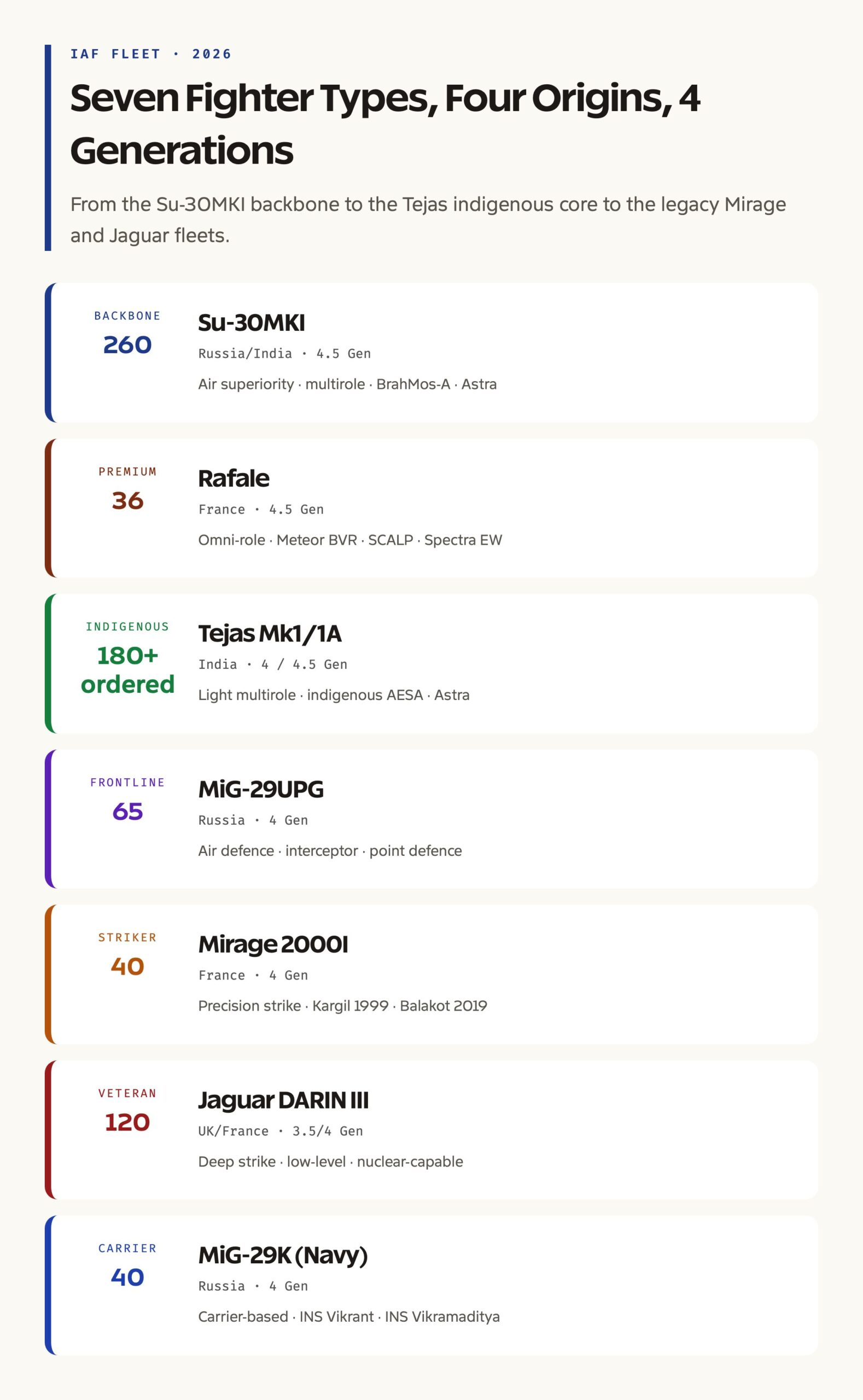
The Su-30MKI is the largest single platform in the IAF and the operational backbone of the fighter fleet. The aircraft is a 4.5-generation, twin-engine, two-seat heavy fighter built by Hindustan Aeronautics Limited at Nashik under licence from Russia’s Sukhoi.
India operates around 260 Su-30MKIs in 2026, the majority of which were licence-produced at HAL Nashik between 2004 and the present. The MKI suffix denotes Modernizirovannyi Kommercheskii Indiski, the Russian and Indian designation for the aircraft variant. The MKI is unique to India and integrates Russian airframe and engine, French and Israeli electronics, and Indian-developed weapons.
The aircraft is multirole and excels at air superiority, deep strike, and maritime strike. Its primary armament includes the BrahMos-A air-launched cruise missile, the Astra Mk1 indigenous beyond-visual-range air-to-air missile, the R-77 BVR missile, and a range of guided bombs and stand-off weapons. The aircraft has been deployed for the BrahMos system’s air-launched variant, which was first integrated on the MKI in 2017.
The current modernisation programme, called the Super Sukhoi, will upgrade roughly 84 aircraft with new radar, electronic warfare, communications, and weapons integration. The upgrade was approved by the Cabinet Committee on Security in 2023 and is being executed in stages through HAL.
The Dassault Rafale: The Premium Multirole
The Rafale is the IAF’s premium 4.5-generation, twin-engine, omni-role fighter, acquired through the 2016 inter-governmental agreement with France for 36 aircraft. The aircraft was inducted in two squadrons at Ambala and Hashimara between 2020 and 2022.
The Rafale is the most capable fighter in the IAF inventory in 2026, with a long-range Meteor BVR air-to-air missile, the SCALP cruise missile for deep strike, the Hammer precision-guided modular munition, and the Spectra electronic warfare suite that gives the aircraft its distinctive low observability and self-protection capability.
The Indian Navy ordered 26 Rafale-Marine carrier-based fighters in 2025, replacing the MiG-29K as the primary carrier-based aircraft on INS Vikrant and INS Vikramaditya. The Rafale-M induction is the first time France has supplied a carrier-based variant outside its own navy.
The Rafale’s induction was politically contested through 2018 to 2020 over price and procurement procedure, but the operational performance of the aircraft has been widely acknowledged. The Meteor missile, the Spectra suite, and the radar performance of the active electronically scanned array RBE2-AA have given the Rafale a clear edge in mountain operations along the northern borders.
HAL Tejas: The Indigenous Light Fighter
The Tejas is India’s indigenous 4 to 4.5-generation light multirole fighter, designed by the Aeronautical Development Agency and produced by HAL at Bangalore. The programme began in 1983 as the Light Combat Aircraft project and reached initial operational clearance in 2013, after a development cycle longer than originally planned but central to indigenous fighter capability.
The Tejas Mk1 reached initial operational clearance in 2013, final operational clearance in 2019, and equipped two front-line squadrons by 2024. The Mk1A is an upgraded variant with an indigenous AESA radar, an advanced electronic warfare suite, in-flight refuelling probe, beyond-visual-range missile capability, and improved maintainability. The IAF ordered 83 Tejas Mk1A aircraft in 2021 and a further 97 in 2025, taking the total Mk1A order book past 180.
The Tejas Mk2, also called the Medium Weight Fighter, is a heavier upgrade with a more powerful General Electric F414 engine, longer range, higher payload, and additional hardpoints. The first prototype is targeted for first flight in 2026, with operational clearance in the late 2020s. The Mk2 is positioned to replace the Mirage 2000 and the Jaguar fleet.
The Tejas family is the central piece of the indigenous fighter strategy. It validates the design, integration, certification, and production capabilities that India has built up over four decades, and provides the technology base on which the AMCA programme is being developed.
MiG-29UPG: The Frontline Interceptor
The MiG-29UPG is a 4-generation, twin-engine, single-seat interceptor and air-defence fighter, originally inducted in the 1980s and upgraded through the 2000s and 2010s. The IAF operates around 65 aircraft in three squadrons in 2026.
The UPG suffix stands for upgraded, and the modernisation included new radar, glass cockpit, in-flight refuelling, and weapons integration with the R-77 and Kh-31 missiles. The aircraft is primarily based at the Adampur and Jamnagar bases and tasked with air defence, point defence, and short-range strike.
The MiG-29 fleet is approaching its planned retirement window in the late 2020s, with the Tejas Mk1A and the MRFA winner expected to be the replacements.
The Indian Navy operates a separate carrier-based variant called the MiG-29K and the trainer MiG-29KUB, totalling around 40 aircraft. The MiG-29K has been in operational service since 2009 and equipped INS Vikramaditya and INS Vikrant. Serviceability and accident-rate concerns have driven the decision to acquire Rafale-M as the future carrier fighter.
Mirage 2000I: The Precision Striker
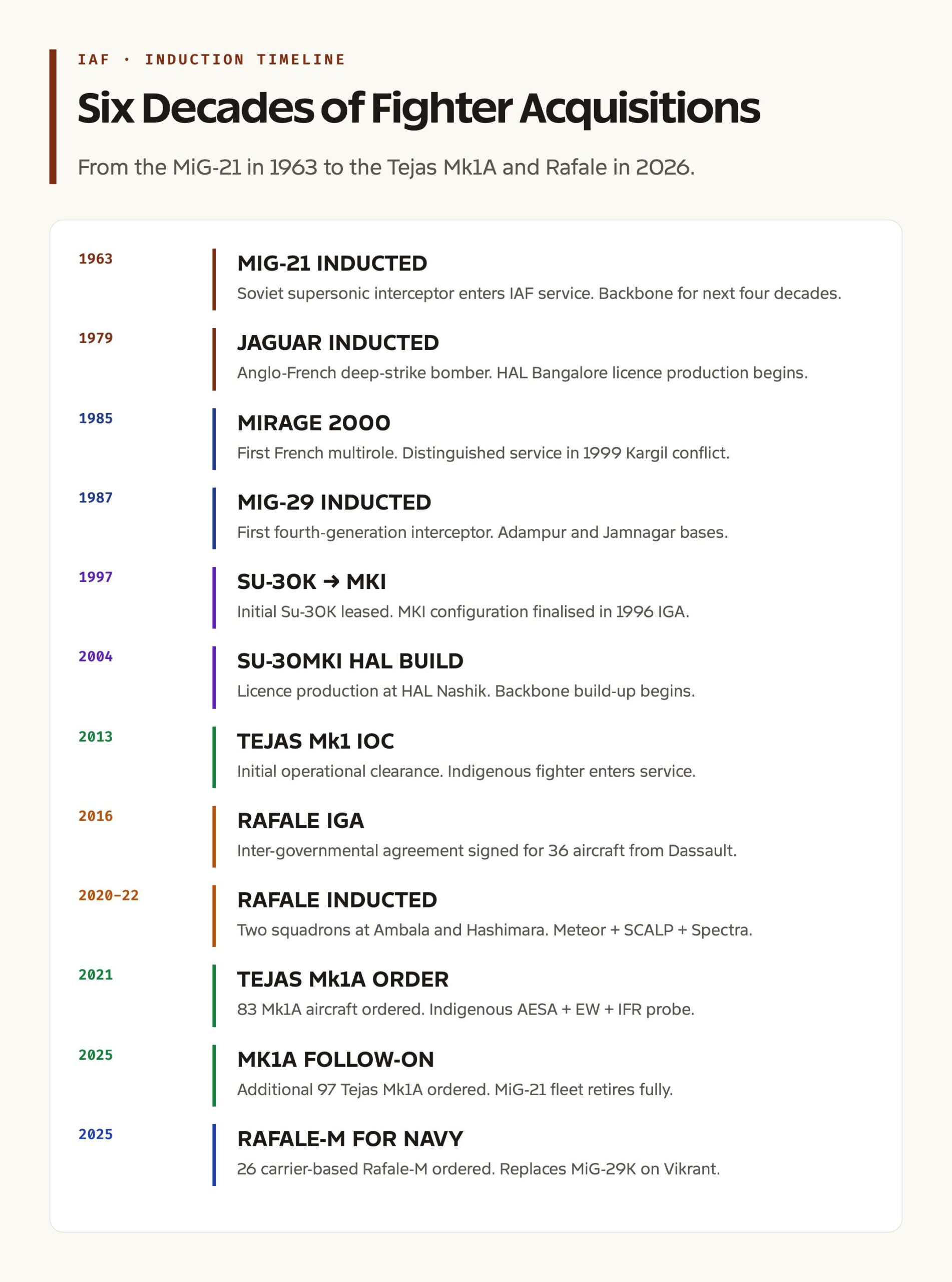
The Mirage 2000I is a 4-generation, single-engine, single-seat multi-role fighter built by Dassault and inducted by the IAF from 1985 onwards. The IAF operates around 40 Mirage 2000I and Mirage 2000TI aircraft in 2026, organised in two squadrons.
The Mirage 2000 distinguished itself in the 1999 Kargil conflict, when laser-guided bomb deliveries against high-altitude targets demonstrated a capability the rest of the IAF could not match at the time. The aircraft was again in the news in February 2019, when it carried out the Balakot air strike on a militant facility across the Line of Control.
The Mirage fleet underwent a mid-life upgrade contracted in 2011, which extended its operational service to around 2030 to 2035. The aircraft is the IAF’s most capable precision-strike platform after the Rafale and is heavily used in strike training.
SEPECAT Jaguar DARIN III: The Deep Striker
The SEPECAT Jaguar is a 3.5 to 4-generation, twin-engine, single-seat ground-attack and deep-strike aircraft, originally a joint Anglo-French design from the 1960s and 1970s. India inducted the Jaguar from 1979 onwards and built up to around 120 aircraft, organised in six squadrons.
The DARIN III standard is the latest Indian upgrade, with new mission computer, displays, navigation, and weapons integration. The aircraft is uniquely equipped for low-level deep strike at high subsonic speeds, including over rugged mountain and high-altitude terrain. The Jaguar has long been the IAF’s nuclear-strike-capable platform, paired with the country’s gravity weapons and stand-off systems.
The Jaguar is one of the oldest aircraft still in front-line service anywhere in the world. Engine availability has been a chronic issue, with the original Rolls-Royce Adour engine production line long since closed. Several proposals to re-engine the Jaguar with the Honeywell F125IN engine were studied but not pursued. The fleet is now in the retirement window, with phasing out planned through the late 2020s.
The Squadron Strength Challenge
The IAF’s sanctioned squadron strength is 42, but the actual front-line squadrons in 2026 number around 30. The shortfall is the central operational concern that has shaped procurement decisions for the past decade.
The drawdown has been driven by the retirement of MiG-21 squadrons over the past decade, with the last MiG-21 Bison squadron retiring in 2025, and the slow induction tempo of replacement aircraft. Tejas Mk1 production at HAL ramped up slower than planned. Rafale numbers were limited to two squadrons. Mirage 2000 and MiG-29 fleets are stable but not growing.
The Multi-Role Fighter Aircraft programme, also called MRFA, is the open tender for around 114 medium multi-role fighters intended to fill the gap. The competition includes the Rafale, the F-15EX, the F-21 (a Lockheed Martin Indian variant of the F-16), the Eurofighter Typhoon, the Saab Gripen E, the Su-35, and the MiG-35. As of 2026, the procurement decision has been long pending, with the contract value estimated at over 20 billion US dollars and the production model expected to require Make in India build at HAL or a private partner.
The Tejas Mk2 will plug some of the gap from the late 2020s. The AMCA, India’s fifth-generation fighter, is in the design and prototyping phase with a stated first flight target in the early 2030s.
AMCA: The Fifth-Generation Programme
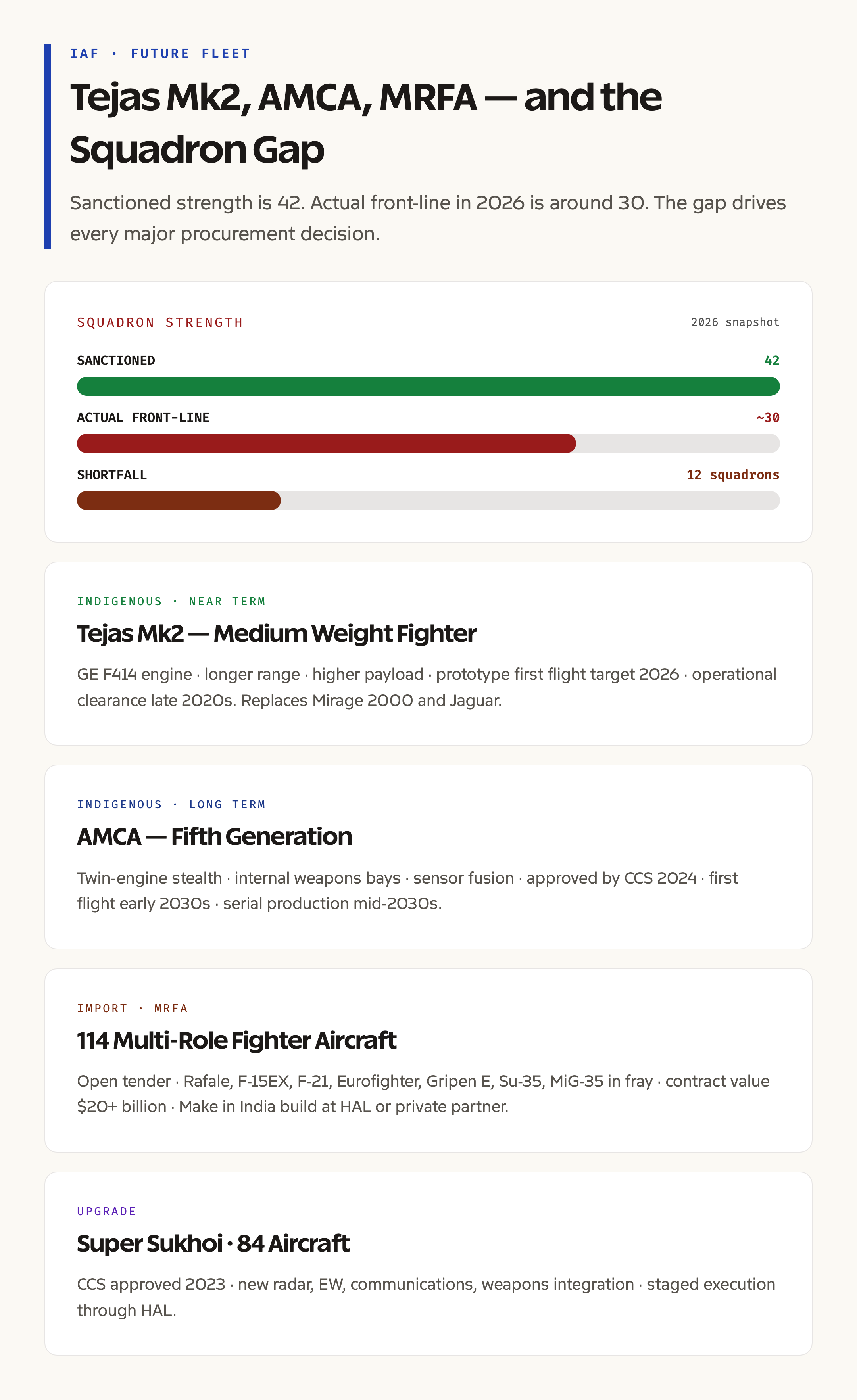
The Advanced Medium Combat Aircraft is India’s fifth-generation fighter programme, designed to replace the Mirage 2000 and Jaguar fleets and to operate alongside the Su-30MKI and Rafale. The aircraft is being designed by the Aeronautical Development Agency with HAL and increasingly with private sector partners.
The AMCA is a twin-engine, stealth-shaped multi-role fighter with internal weapons bays, an advanced sensor fusion suite, an indigenous AESA radar, and an electronic warfare suite. The Mk1 will use the General Electric F414 engine, the same as Tejas Mk2, while the Mk2 is intended to use a domestically developed engine being co-developed with an international partner. The first flight is targeted for the early 2030s and serial production from the mid-2030s.
The AMCA programme was approved by the Cabinet Committee on Security in 2024 with execution under the Defence Acquisition Council framework. The recent shift towards greater private sector participation in defence production, including in airframe assembly and avionics, is reflected in the AMCA execution model.
Procurement and the Strategic Frame
The fighter fleet’s procurement story sits inside a broader defence procurement architecture. The Defence Acquisition Council, chaired by the Defence Minister, sets capital procurement priorities. The Defence Acquisition Procedure 2020 is the procedural rulebook. The Ministry of Defence and the Department of Defence Production handle execution.
The strategic context for fighter procurement has been the need to maintain a credible deterrent against China and Pakistan, the desire to reduce dependence on any single source country, the push for indigenous capability under Atmanirbhar Bharat, and the budget envelope set by the defence budget constraints.
For UPSC, the right way to remember the fighter fleet is as a multi-tier, multi-origin force in the middle of a generational transition. The current fleet rests on the Su-30MKI and Rafale top end, the Tejas indigenous core, and the legacy fleets that are being replaced. The future fleet will be Tejas Mk1A and Mk2, AMCA, the MRFA winner, and an evolved Su-30 fleet through the Super Sukhoi upgrade. The transition will define IAF capability into the 2040s.
Frequently Asked Questions
What are the main fighter aircraft of the Indian Air Force in 2026?
The IAF operates seven primary fighter types in 2026. The Su-30MKI is the backbone with around 260 aircraft. The Rafale equips two squadrons with 36 aircraft. The Tejas Mk1 and Mk1A are the indigenous frontline fighter, with over 180 aircraft on order. The MiG-29UPG, Mirage 2000I, and Jaguar DARIN III are the legacy fleets that are being upgraded or replaced. The Indian Navy adds the MiG-29K and the upcoming Rafale-M for carrier operations.
What is the difference between the Su-30MKI and the Rafale?
The Su-30MKI is a 4.5-generation Russian-origin twin-seat heavy fighter that is the IAF’s largest fleet, with around 260 aircraft licence-produced by HAL. The Rafale is a 4.5-generation French-origin omni-role fighter with only 36 aircraft. The Rafale offers superior radar, the long-range Meteor missile, the Spectra electronic warfare suite, and a smaller logistics footprint. The Su-30MKI offers larger payload, longer range, two-pilot capability, and the BrahMos cruise missile that the Rafale does not carry.
What is the Tejas Mk1A and how is it different from Mk1?
The Tejas Mk1A is an upgraded variant of the indigenous Tejas Mk1 light fighter with an indigenous AESA radar, an advanced electronic warfare suite, an in-flight refuelling probe, beyond-visual-range missile capability, and improved maintainability. The Mk1A also fixes weight and serviceability issues identified in early Mk1 service. The IAF ordered 83 Mk1A aircraft in 2021 and an additional 97 in 2025.
What is the AMCA and when will it fly?
The Advanced Medium Combat Aircraft is India’s fifth-generation, twin-engine, stealth-shaped fighter programme. It is being designed by the Aeronautical Development Agency with HAL and private sector partners. The Mk1 will use the General Electric F414 engine; the Mk2 is intended for an indigenous engine co-developed with a foreign partner. The first flight is targeted for the early 2030s, with serial production from the mid-2030s.
Why does the IAF have a squadron shortfall?
The IAF’s sanctioned strength is 42 squadrons, but actual front-line squadrons in 2026 number around 30. The drawdown was driven by the retirement of MiG-21 squadrons over the past decade and a slower-than-planned induction tempo for replacements. Tejas Mk1 production at HAL ramped up slowly. Rafale numbers were capped at two squadrons. The MRFA tender for 114 additional fighters has been pending for years. Tejas Mk1A, Mk2, and the AMCA are the planned replacements.
What is the Jaguar’s role in the IAF and why is it being retired?
The SEPECAT Jaguar DARIN III is a deep-strike aircraft that is the IAF’s traditional nuclear-strike-capable platform. It is uniquely capable at low-level penetration over high-altitude terrain. The aircraft entered Indian service in 1979 and is now one of the oldest fighters still in front-line use globally. Engine production has long been closed and serviceability has become difficult. The fleet is being phased out through the late 2020s and replaced by Tejas Mk2 and other newer platforms.