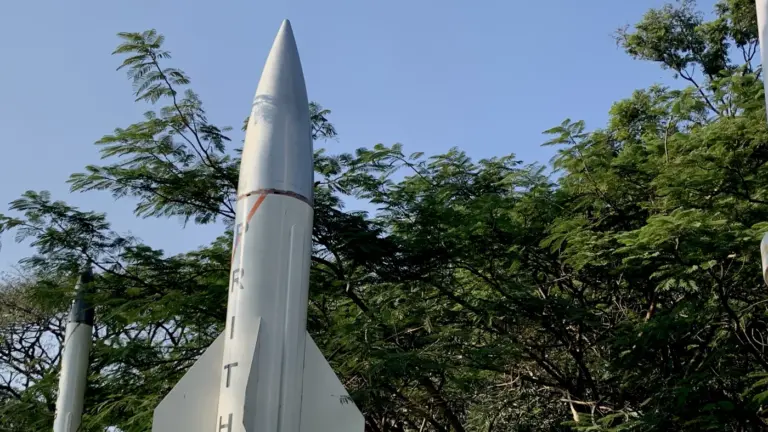
A fighter jet is an integrated weapons system, not just an aircraft. The label of “generation” is shorthand for a particular bundle of technologies, doctrines and design philosophies that define what the aircraft can do in combat. The boundaries between generations are not crisp. There is no committee that certifies when a generation begins. But the categories of 4th, 4.5 and 5th generation are widely used by industry, militaries and analysts because they capture real differences in capability that affect combat outcomes.
For UPSC, fighter generations matter for three reasons. They are central to questions about defence modernisation, technology choice and indigenous capability. India’s current air force operates a mix of 4th-generation MiG-29s, 4.5-generation Rafales, Su-30 MKIs and Tejas Mk1A, with the indigenous 5th-generation Advanced Medium Combat Aircraft under development. The exam often asks about specific aircraft characteristics, the difference between an AESA and a mechanically scanned radar, or the strategic implications of stealth.
This explainer walks through the three generations in order, covers the underlying technologies (fly-by-wire, AESA, supercruise, sensor fusion, very low observable design), and connects them to the Indian Air Force’s current and future fleet.
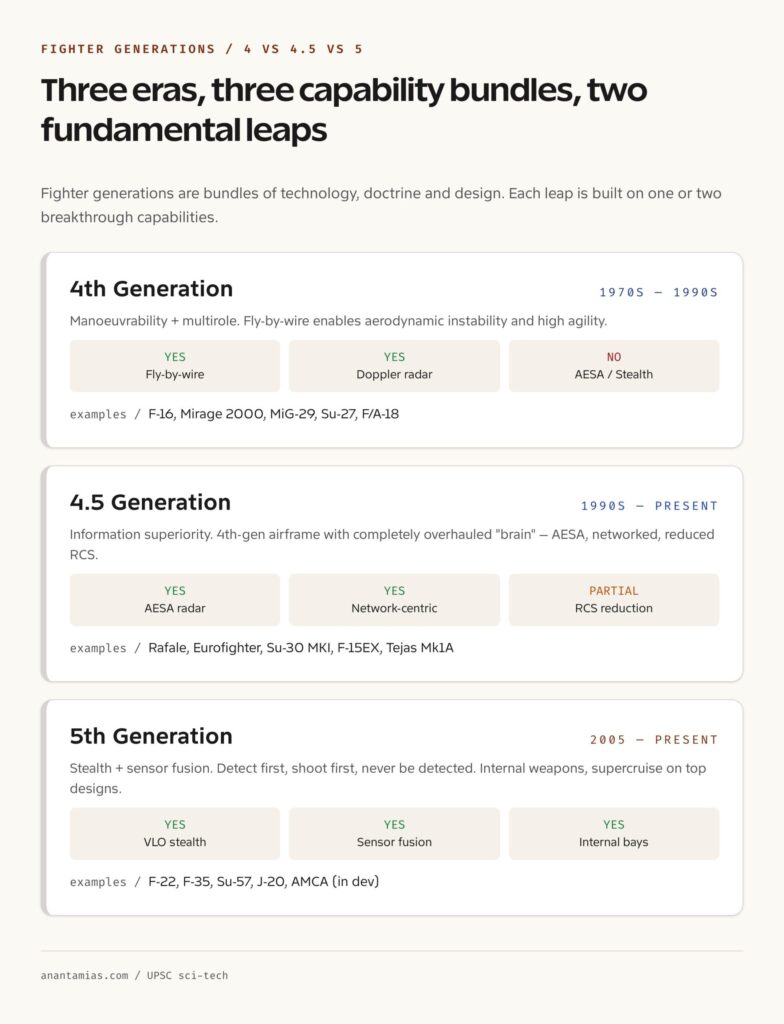
Quick Facts: Fighter Generations at a Glance
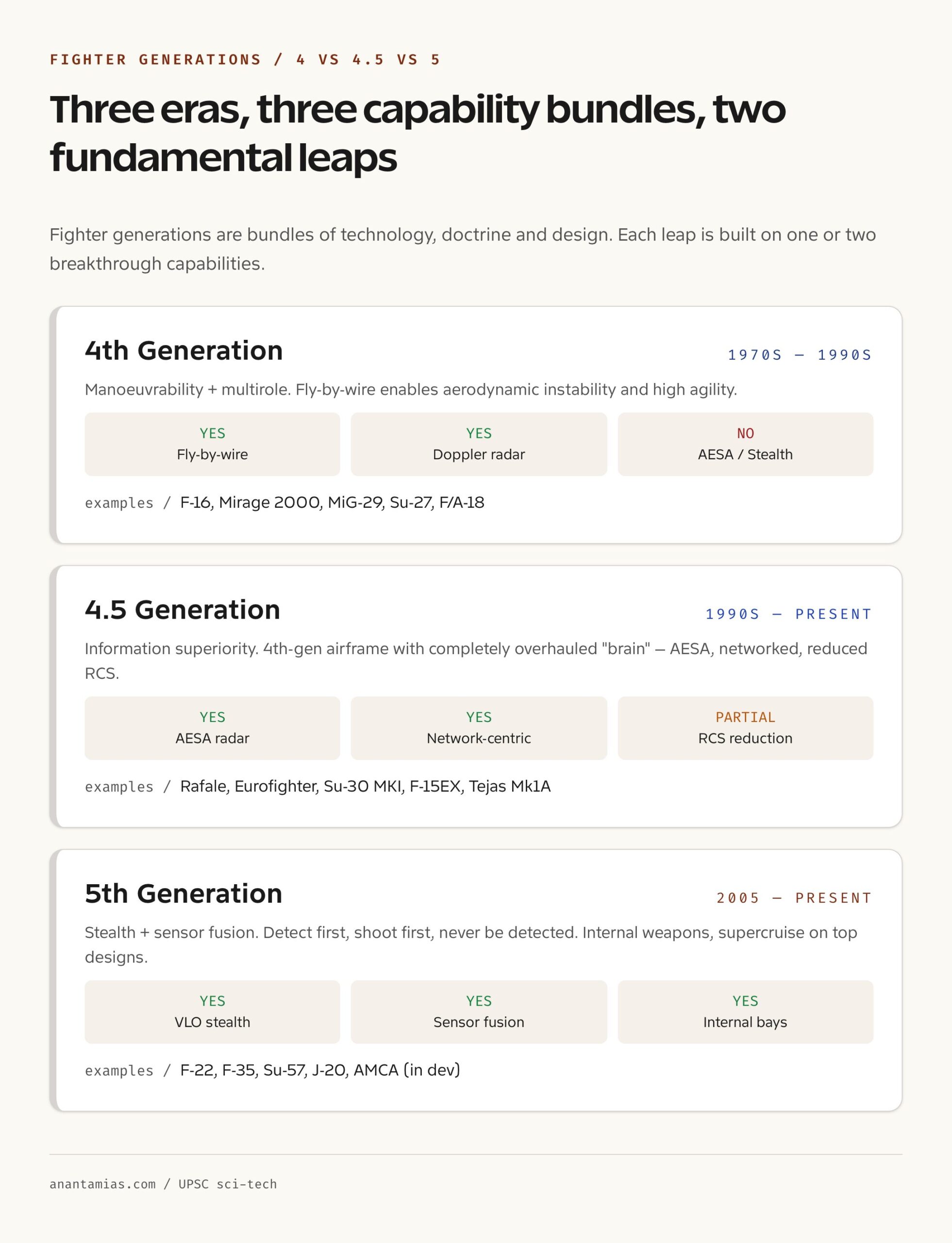
- 4th generation: 1970s-1990s, multirole, fly-by-wire, doppler radar
- 4th gen examples: F-16, Mirage 2000, MiG-29, Su-27, F/A-18 Hornet
- 4.5 generation: 1990s-present, AESA radar, reduced radar cross-section, network-centric
- 4.5 gen examples: Rafale, Eurofighter Typhoon, Su-30 MKI, F-15EX, Gripen E, Tejas Mk1A
- 5th generation: 2005-present, stealth (VLO) and sensor fusion, internal weapons bays
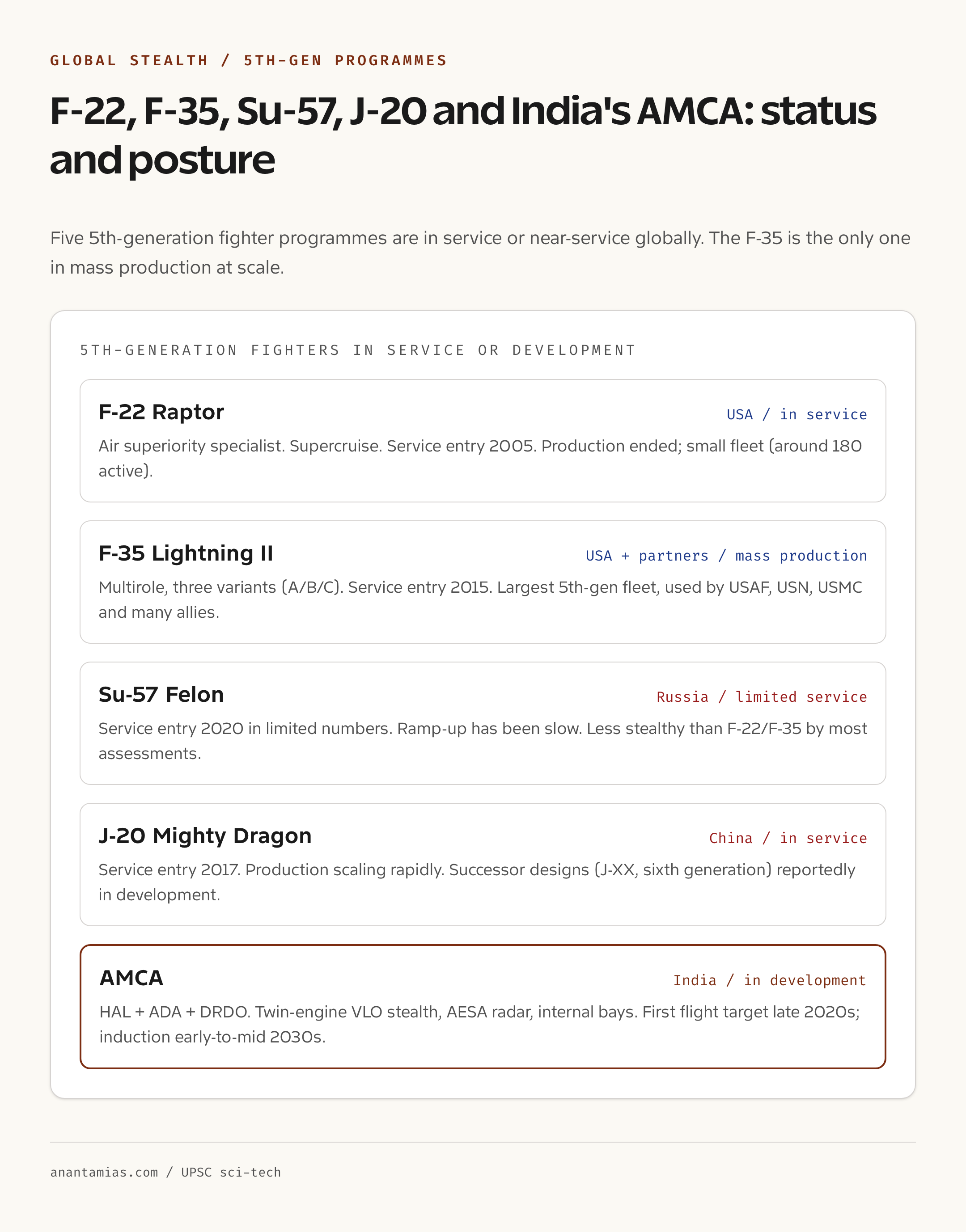
- 5th gen examples: F-22 Raptor (USA), F-35 Lightning II (USA), Su-57 Felon (Russia), J-20 Mighty Dragon (China)
- India’s planned 5th gen: AMCA (Advanced Medium Combat Aircraft), under development by HAL, DRDO and ADA
- Stealth principle: Angular shaping + radar-absorbent materials + internal weapons bays to minimise radar cross-section
- Supercruise: Sustained supersonic flight without afterburners (e.g., F-22, Eurofighter Typhoon)
- AESA radar: Active Electronically Scanned Array, electronic beam-steering, multi-target tracking, jam-resistant
- Sensor fusion: Multiple sensor inputs combined into one display picture for the pilot
What Are Fighter Generations?
A fighter generation is a label for a set of capabilities and design choices that define what the aircraft can do in combat. The categories are not formal categories with strict definitions, but they are widely used because they correlate with real combat outcomes. A 4th-generation fighter, all else equal, will be at a disadvantage against a 5th-generation fighter, because the 5th-gen aircraft can typically detect, target and engage first while remaining undetected itself.
The generation is determined by a combination of factors. Aerodynamics and airframe design determine manoeuvrability and stealth. Engines determine speed, range and the ability to supercruise. Avionics, especially radar and sensor systems, determine what the aircraft can see and how far. Weapons determine what the aircraft can engage. Networking and connectivity determine how the aircraft cooperates with others. The generations correspond loosely to which of these were the dominant innovation of the period.
The generations are not strictly sequential in service. A modern F-15EX is a 4.5-generation aircraft built in the 2020s. The F-22 is a 5th-generation aircraft that entered service in 2005. Many air forces operate multiple generations simultaneously, sometimes intentionally because each fills a different role.
Background and Historical Context
The taxonomy of generations emerged in the 1970s and 1980s as a way to describe the rapid technological change in fighter aircraft after the Vietnam War. Early generation labels (1, 2, 3) were applied retrospectively to first-generation jets like the Korean War-era F-86 and MiG-15, second-generation jets like the F-104 and MiG-21 with supersonic speed and early air-to-air missiles, and third-generation jets like the F-4 Phantom and Mirage III with multirole capability and advanced radar. These earlier generations are largely retired or in second-line service.
The 4th generation began in the 1970s with the introduction of fly-by-wire flight controls, which replaced mechanical linkages between cockpit and control surfaces with electronic ones. Fly-by-wire allowed designers to build aircraft that were aerodynamically unstable and therefore highly manoeuvrable, with the computer compensating for instability in real time. The F-16, which entered service in 1978, is the canonical 4th-gen aircraft. Multirole capability, in which a single aircraft could perform both air-to-air combat and ground attack, became standard.
The 4.5 generation emerged in the 1990s and 2000s as the underlying airframe of 4th-gen aircraft was upgraded with significantly better avionics. AESA radars replaced mechanically scanned radars, weapons became more capable, and aircraft were networked into combat clouds. The Rafale, Eurofighter Typhoon, Su-30, F/A-18E/F and the latest F-15s are examples. The label is somewhat informal but reflects a real intermediate step before full 5th-gen capability.
The 5th generation took shape with the F-22 programme in the United States, which began in the 1980s and resulted in service entry in 2005. The F-22 introduced very low observable (stealth) shaping, internal weapons bays, supercruise, and integrated sensor fusion. The F-35, despite being slower and less manoeuvrable than the F-22, extended 5th-gen capabilities to a multirole platform produced in much larger numbers. China’s J-20 and Russia’s Su-57 are the other 5th-gen aircraft in service or near-service. India’s AMCA is under development. For broader context on Indian defence, see our pieces on the defence budget, internal security and border management.
4th Generation Fighters
A 4th-generation fighter is defined by the introduction of fly-by-wire flight controls, doppler radar with look-down/shoot-down capability, and the maturity of multirole roles. The era runs roughly from the late 1970s through the 1990s.
Fly-by-wire changed the geometry of fighter design. Earlier aircraft had to be aerodynamically stable so that a pilot could fly them safely. With fly-by-wire, the aircraft can be deliberately unstable, and a flight-control computer makes thousands of small adjustments per second to keep it under control. Instability translates to high manoeuvrability. The F-16 was the first aircraft fully designed around this principle.
Doppler radar allowed the aircraft to detect targets against ground clutter. Earlier radars could not distinguish a low-flying aircraft from the ground because both returned similar echoes. Doppler radars detect the frequency shift caused by target motion, separating moving targets from stationary clutter. This made low-altitude air combat possible.
Multirole capability meant a single aircraft type could perform both air-to-air combat and ground attack with appropriate weapons loadouts. Earlier fighters specialised; 4th-gen fighters generalised. This reduced fleet complexity and increased flexibility.
Examples include the F-16 Fighting Falcon (USA, 1978), the Mirage 2000 (France, 1984), the MiG-29 Fulcrum (USSR, 1983), the Su-27 Flanker (USSR, 1985), and the F/A-18 Hornet (USA, 1983). India’s MiG-29 fleet is in this class, as were the older Mirage 2000s before recent upgrades.
4.5 Generation Fighters
The 4.5 generation is essentially a 4th-generation airframe with a generation’s worth of avionics, sensors and weapons upgrades. The label is somewhat informal but captures a real intermediate step. The era runs from the late 1990s into the present.
The defining technology is the AESA radar (Active Electronically Scanned Array). Instead of a single transmitter and a mechanically rotating antenna, an AESA uses many small transmit-receive modules in a flat panel, with the beam steered electronically by adjusting the phase of each module. AESA radars scan faster, track many targets simultaneously, can search for one target while maintaining track on others, and resist jamming better than older radars. The Rafale’s RBE2-AA, the Eurofighter’s Captor-E, and the Tejas Mk1A’s DRDO Uttam (and the EL/M-2052 in earlier Mk1) are AESA examples.
Reduced radar cross-section in 4.5-gen fighters is achieved through the application of radar-absorbent materials and modest shape adjustments, but without the comprehensive stealth design of true 5th-generation aircraft. The result is harder to detect than a 4th-gen but not stealthy in the strict sense.
Network-centric warfare is the other defining feature. 4.5-gen fighters share data with other aircraft, ships and ground systems through encrypted data links, building a shared situational picture. The Link 16 standard and its national equivalents are central to this.
Examples include the Rafale (France), Eurofighter Typhoon (UK/Germany/Italy/Spain), Su-30 MKI (Russia/India), Su-35 (Russia), F-15EX (USA), F/A-18E/F Super Hornet (USA), Saab Gripen E (Sweden), and the Tejas Mk1A (India). The Indian Air Force operates four 4.5-gen types: Rafale, Su-30 MKI, MiG-29UPG (upgraded), and Tejas Mk1A.
5th Generation Fighters
The 5th generation is defined by very low observable (VLO) stealth, integrated sensor fusion, supercruise (in some designs) and internal weapons carriage. Service entry began with the F-22 Raptor in 2005.
VLO stealth is achieved through a combination of techniques. The airframe is shaped with angular surfaces and serrated edges that scatter radar waves away from the source rather than reflecting them back. Inlets are S-shaped to hide engine compressor blades, which are otherwise strong radar reflectors. Surfaces are coated with radar-absorbent materials. Weapons are carried internally, so that wing-mounted missiles do not break the smooth radar profile. The result is a radar cross-section orders of magnitude smaller than a 4th-gen aircraft of similar size.
Sensor fusion is the integration of inputs from radar, infrared search and track, electro-optical sensors, electronic warfare receivers and external data links into a single coherent display for the pilot. Earlier aircraft presented separate displays for each sensor. The 5th-gen pilot sees a single, fused picture in the helmet-mounted display, often with computer-generated tracks and threat assessments overlaid. The pilot’s workload is reduced, and decisions are faster.
Supercruise is the ability to fly at sustained supersonic speed without using fuel-guzzling afterburners. The F-22 is the canonical supercruise aircraft. The F-35 does not supercruise in the strict sense. Supercruise extends combat radius at high speed and improves missile range when launched at higher speed.
Internal weapons bays are required for stealth, because external weapons defeat the radar profile. The trade-off is reduced weapons capacity. The F-35’s weapons bays are smaller than the external pylon capacity of a 4.5-gen fighter, but in a stealth configuration, only internal weapons are used.
Examples include the F-22 Raptor (USA, 2005), F-35 Lightning II (USA, 2015), Su-57 Felon (Russia, 2020 limited service), and J-20 Mighty Dragon (China, 2017). The F-35 is produced in three variants (A for conventional take-off, B for short take-off and vertical landing, C for carrier operations). India is developing the AMCA, with first flight targeted for the late 2020s and induction in the 2030s.
Comparative Capabilities
A 4th-generation fighter and a 5th-generation fighter, all else equal, will not have an even contest. The 5th-gen aircraft will detect the 4th-gen at long range and engage from outside the 4th-gen’s detection envelope. The 4th-gen aircraft, if it survives the initial engagement, may close to within visual range, where the manoeuvrability advantages of the 4.5-gen Su-30 MKI’s thrust vectoring or the Rafale’s fly-by-wire can compete. But the trend in modern air combat is towards beyond-visual-range engagements, where stealth and sensor fusion dominate.
The 4.5-generation aircraft is the cost-effective compromise. A Rafale or Tejas Mk1A is far cheaper than an F-35, with most of the avionics capability and a known cost trajectory. For air forces that cannot afford a fleet entirely composed of 5th-generation aircraft, a high-low mix of 4.5-gen and a small number of 5th-gen is a common solution. The US operates a mix of F-22, F-35 and 4.5-gen F-15EX and Super Hornet. India is on a similar trajectory.
The transition to 5th gen is not just about the aircraft. It requires investment in supporting infrastructure: hardened shelters with controlled environments for radar-absorbent materials, specialised maintenance training, secure data links, and a tanker fleet that can support long-endurance operations. The full lifecycle cost of a 5th-gen fleet is much higher than the unit cost suggests.
India’s Fighter Roadmap
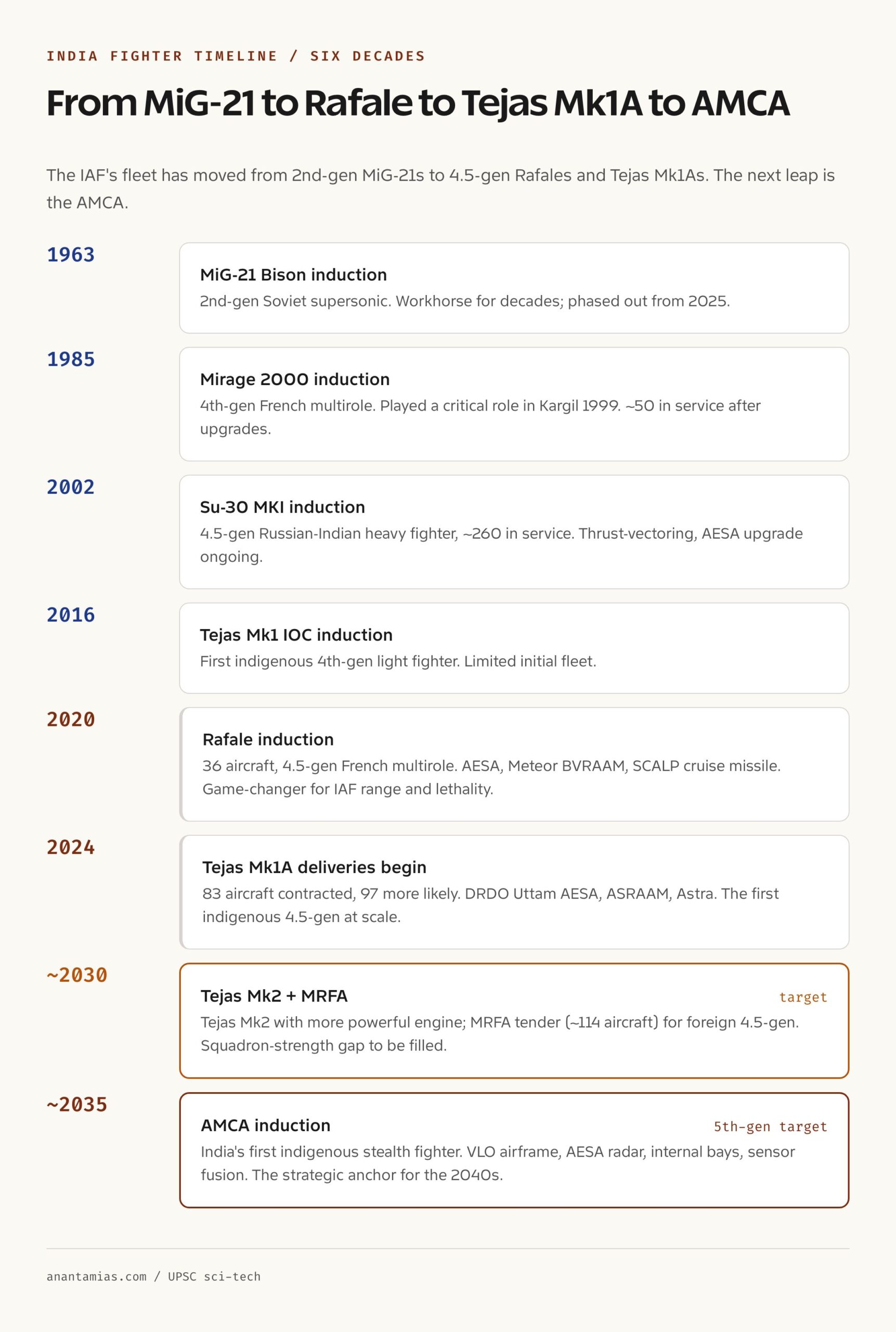
India’s current air force is a heterogeneous fleet, with around 31 fighter squadrons against a sanctioned strength of 42. The mix includes Rafale (4.5 gen, 36 aircraft), Su-30 MKI (4.5 gen, around 260 aircraft), Mirage 2000 (4 gen upgraded, around 50), MiG-29UPG (4 gen upgraded, around 60), Jaguar (legacy strike, around 120) and Tejas Mk1/Mk1A (4.5 gen, growing). The Tejas Mk1A induction is accelerating, with HAL contracted for 83 aircraft in the first batch and an additional order for 97 likely.
The Tejas Mk2 is in development, expected to be a more capable 4.5-gen aircraft with a more powerful engine and longer range. The MRFA (Multi-Role Fighter Aircraft) tender, which has been long delayed, is intended to procure around 114 4.5-gen aircraft, with several international competitors including the Rafale F4, Eurofighter Typhoon, F-15EX, F/A-18 Block III and Gripen E.
The flagship indigenous 5th-generation programme is the Advanced Medium Combat Aircraft (AMCA), a stealth fighter being developed by Hindustan Aeronautics Limited, the Aeronautical Development Agency and the Defence Research and Development Organisation. The first flight is targeted for the late 2020s, with induction in the early to mid-2030s. The AMCA is intended to be a twin-engine VLO aircraft with internal weapons bays, AESA radar and sensor fusion. Engine choice is between an indigenous Kaveri 2.0 derivative and a foreign engine, possibly developed in partnership with GE or Safran. Without AMCA, India’s only path to 5th-generation capability would be foreign procurement, which has political and strategic costs.
Challenges
India faces several challenges in moving up the generation ladder. Production rates for the Tejas have been below targets, with the Mk1A induction running behind schedule due to engine deliveries from GE. Maintenance and operational availability of the Su-30 MKI fleet has been a persistent issue. The MRFA tender’s delay leaves a capability gap that affects the IAF’s combat-readiness.
For the AMCA, the engineering challenges are real. Stealth design is technically demanding and requires capabilities India is still building. Sensor fusion and the underlying mission-system software are complex and have caused delays even for established aerospace nations. The engine question, in particular, is a long-running issue: an indigenous engine in the 110 kN thrust class has not yet been demonstrated.
Strategically, the comparison with neighbours is unfavourable. China operates the J-20 in increasing numbers and is developing successor designs. Pakistan is acquiring Chinese platforms and reportedly considering 5th-gen options. The window in which India can maintain a qualitative edge with 4.5-gen aircraft is closing.
UPSC Prelims Pointers
- 4th gen: fly-by-wire, doppler radar, multirole; examples F-16, Mirage 2000, MiG-29
- 4.5 gen: AESA radar, reduced RCS, network-centric; examples Rafale, Su-30 MKI, Tejas Mk1A
- 5th gen: VLO stealth, sensor fusion, internal bays; examples F-22, F-35, J-20
- F-22 Raptor entered USAF service in 2005
- F-35 Lightning II entered service in 2015, three variants: F-35A, F-35B, F-35C
- Russia’s 5th-gen aircraft is the Su-57 Felon
- China’s 5th-gen aircraft is the J-20 Mighty Dragon
- India’s planned 5th-gen aircraft is AMCA, developed by HAL, ADA and DRDO
- AESA = Active Electronically Scanned Array
- Supercruise = sustained supersonic flight without afterburners (e.g., F-22, Eurofighter)
- Tejas Mk1A is the IAF’s first Indian-made 4.5-gen fighter
- India operates Rafale, Su-30 MKI, Mirage 2000, MiG-29, Jaguar, Tejas
UPSC Mains Practice Questions
- Distinguish between 4th, 4.5 and 5th generation fighter aircraft. With reference to the Indian Air Force, discuss what each generation contributes to combat capability.
- Examine the rationale, design philosophy and current status of the Advanced Medium Combat Aircraft (AMCA). What challenges does the programme face?
- “Stealth has changed the geometry of air combat.” Discuss with reference to 5th-generation fighters and the implications for India’s air-power strategy.
- Critically evaluate India’s fighter modernisation roadmap. Should India procure foreign 5th-gen aircraft as an interim measure while AMCA is developed?
Way Forward
India’s path on fighter aviation runs along three tracks. First, the Tejas Mk1A and Mk2 production must accelerate to fill the squadron-strength shortfall. HAL has scaled up its Bengaluru and Nashik facilities, and the next few years should see deliveries match plans. Second, the MRFA decision can no longer be deferred indefinitely; a 4.5-gen procurement is needed to plug the immediate gap and to bring critical mass to the second-tier types in service. Third, the AMCA must be funded and resourced for steady progress, including resolving the engine question through either a successful indigenous programme or a credible foreign partnership. Without AMCA, India’s air-power posture in the 2040s is at risk.
For students, fighter generations are a clean lens on how technology compounds. Each generation is built on the one before, with one or two breakthrough technologies (fly-by-wire, AESA, stealth) defining the leap. Memorising aircraft names is a first step; understanding why a J-20 is harder to detect than a Su-27 is the deeper goal.
Frequently Asked Questions
What is a 4th generation fighter?
A 4th-generation fighter is a combat aircraft, typical of the 1970s through the 1990s, defined by fly-by-wire flight controls, doppler radar, and multirole capability. Examples include the F-16, Mirage 2000, MiG-29, Su-27 and F/A-18. They are characterised by high manoeuvrability, the ability to perform both air-to-air and ground-attack missions, and look-down/shoot-down capability against low-flying targets.
What is a 4.5 generation fighter?
A 4.5-generation fighter is essentially a 4th-generation airframe upgraded with later-generation avionics, particularly an AESA radar, reduced radar cross-section, and network-centric data links. Examples include the Rafale, Eurofighter Typhoon, Su-30 MKI, F-15EX, Saab Gripen E and India’s Tejas Mk1A. These aircraft are not stealthy but offer a substantial capability improvement over 4th-gen.
What is a 5th generation fighter?
A 5th-generation fighter is defined by very low observable (VLO) stealth, integrated sensor fusion, internal weapons bays and, in some designs, supercruise. The F-22 Raptor was the first, entering service in 2005, followed by the F-35 Lightning II (2015), Russia’s Su-57 (2020 limited service) and China’s J-20 (2017).
What is AESA radar and why does it matter?
AESA stands for Active Electronically Scanned Array. It uses many small transmit-receive modules in a flat panel, steering the radar beam electronically rather than mechanically. AESA radars scan faster, track many targets simultaneously, and resist jamming better than older mechanically scanned radars. They are a defining feature of 4.5- and 5th-generation aircraft and are central to modern beyond-visual-range air combat.
What is stealth and how is it achieved?
Stealth is the practice of designing an aircraft to minimise its radar cross-section and infrared signature, making it harder to detect. It is achieved through angular shaping that scatters radar waves away from the source, S-shaped engine inlets that hide compressor blades, radar-absorbent material coatings, and internal weapons bays so that missiles do not break the smooth radar profile. Together, these can reduce radar cross-section by orders of magnitude compared to a non-stealth aircraft of similar size.
What is supercruise?
Supercruise is sustained supersonic flight without using afterburners. Most fighters can briefly exceed Mach 1 only by lighting afterburners, which consume fuel rapidly. A supercruising aircraft uses dry thrust alone to maintain supersonic speed, extending combat radius and improving missile launch performance. The F-22 is the most prominent supercruise aircraft. The F-35 does not supercruise in the strict sense.
What is the AMCA?
The Advanced Medium Combat Aircraft (AMCA) is India’s planned 5th-generation fighter, being developed jointly by Hindustan Aeronautics Limited, the Aeronautical Development Agency and DRDO. It is intended to be a twin-engine VLO stealth aircraft with internal weapons bays, AESA radar and sensor fusion. First flight is targeted for the late 2020s, with induction in the early to mid-2030s.
Which fighters does the Indian Air Force currently operate?
The IAF operates Rafale (4.5 gen), Su-30 MKI (4.5 gen), Mirage 2000 (4th gen, upgraded), MiG-29UPG (4th gen, upgraded), Jaguar (legacy strike) and Tejas Mk1/Mk1A (4.5 gen). The IAF currently has around 31 fighter squadrons against a sanctioned strength of 42, with the Tejas Mk1A induction expected to fill some of the gap.
Why is the F-35 considered 5th generation despite being slower than F-22?
Generation is defined by capability bundle, not by raw speed. The F-35 is slower and less manoeuvrable than the F-22 but offers superior sensor fusion, multirole capability and electronic warfare integration. Its VLO stealth, internal weapons, AESA radar and helmet-mounted display make it a true 5th-generation aircraft despite the speed difference. The F-35 was also designed for export production and shared development with allies, which the F-22 was not.
Will India buy F-35s?
There has been speculation but no decision to procure F-35s. Major considerations include cost (the F-35 has a higher per-unit and lifecycle cost than current Indian fighters), strategic alignment (operating American 5th-gen aircraft alongside Russian Su-30s creates compatibility and security questions), and the priority given to indigenous AMCA development. The MRFA tender is for 4.5-gen aircraft. A decision on F-35 procurement, if it happens, would be separate.
Tell Google you want more of this.
Add Anantam IAS as a preferred sourceOne tap, and this site shows up more often in your own Top Stories, AI Overviews and AI Mode. Remove it any time.