Five Year Plan of India — 1951–2017, Objectives, Achievements, End (UPSC Economy)
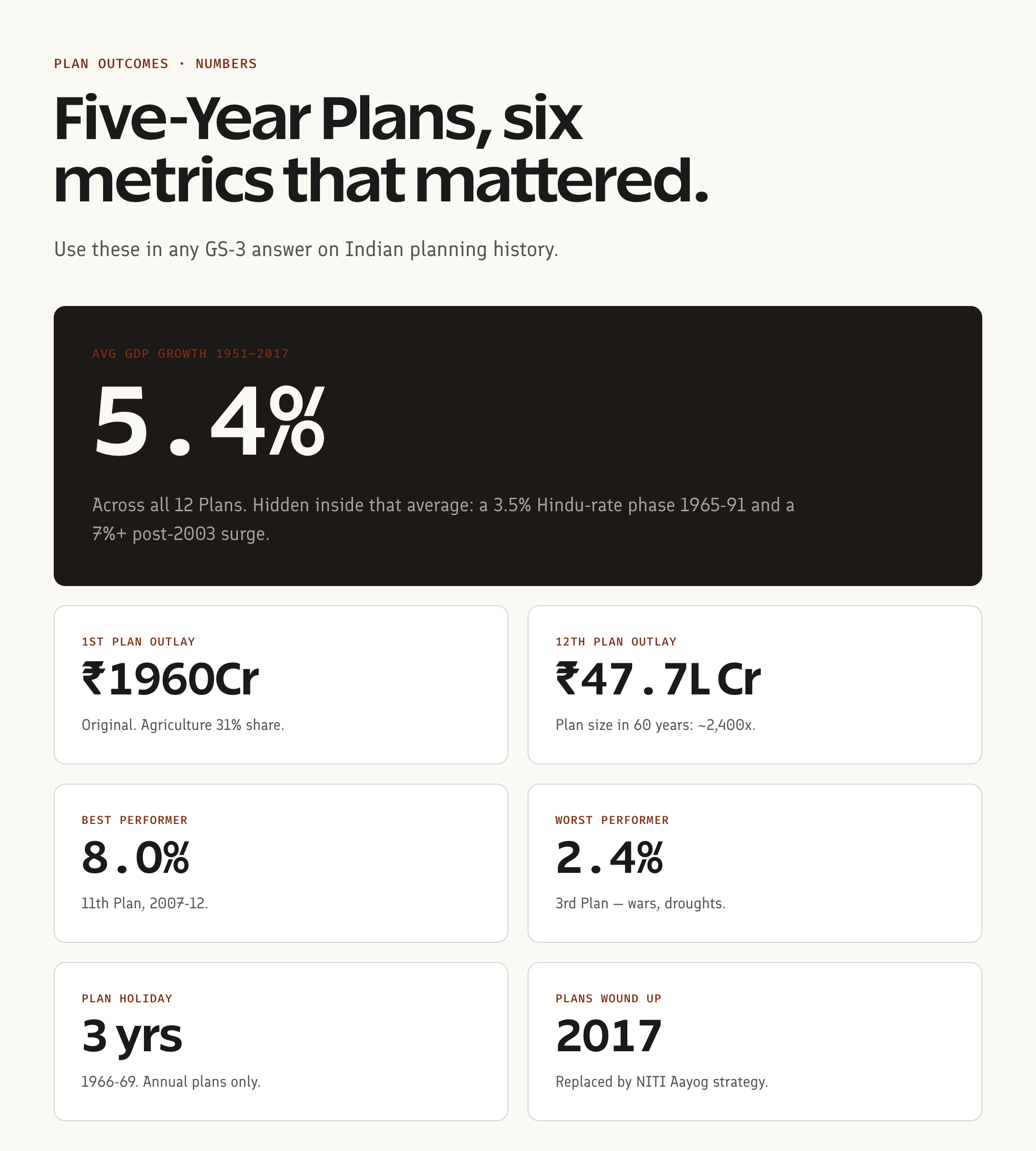
The five year plan of India ran for 66 years — from April 1951 to March 2017 — and produced a clear pattern.
The five year plan of India ran for 66 years — from April 1951 to March 2017 — and produced a clear pattern. Plans set ambitious targets. India hit some, missed most. Then in January 2015, the Modi government scrapped the Planning Commission and replaced it with NITI Aayog. The 12th Plan (2012–17) became the last. There has been no 13th Five-Year Plan, and there won't be. If you've ever wondered why aspirants still memorise plan-by-plan targets in 2026 — when planning itself has formally ended — it's because Prelims still asks the dates and Mains still asks "what worked, what didn't." This explainer walks through every single plan, its theme, target, achievement, and the 2015 transition to action plans and visions.
What is the Five Year Plan of India?
The Five Year Plan of India was the central economic planning instrument from 1951 to 2017, drafted by the Planning Commission (set up March 15, 1950) and approved by the National Development Council. Each plan set five-year sectoral targets for GDP growth, agriculture, industry, infrastructure, education, and poverty reduction. Twelve plans were executed; the 12th Plan (2012–17) was the last. NITI Aayog (constituted January 1, 2015) replaced the Planning Commission and substituted three-year action plans, seven-year strategy papers, and a 15-year vision document.
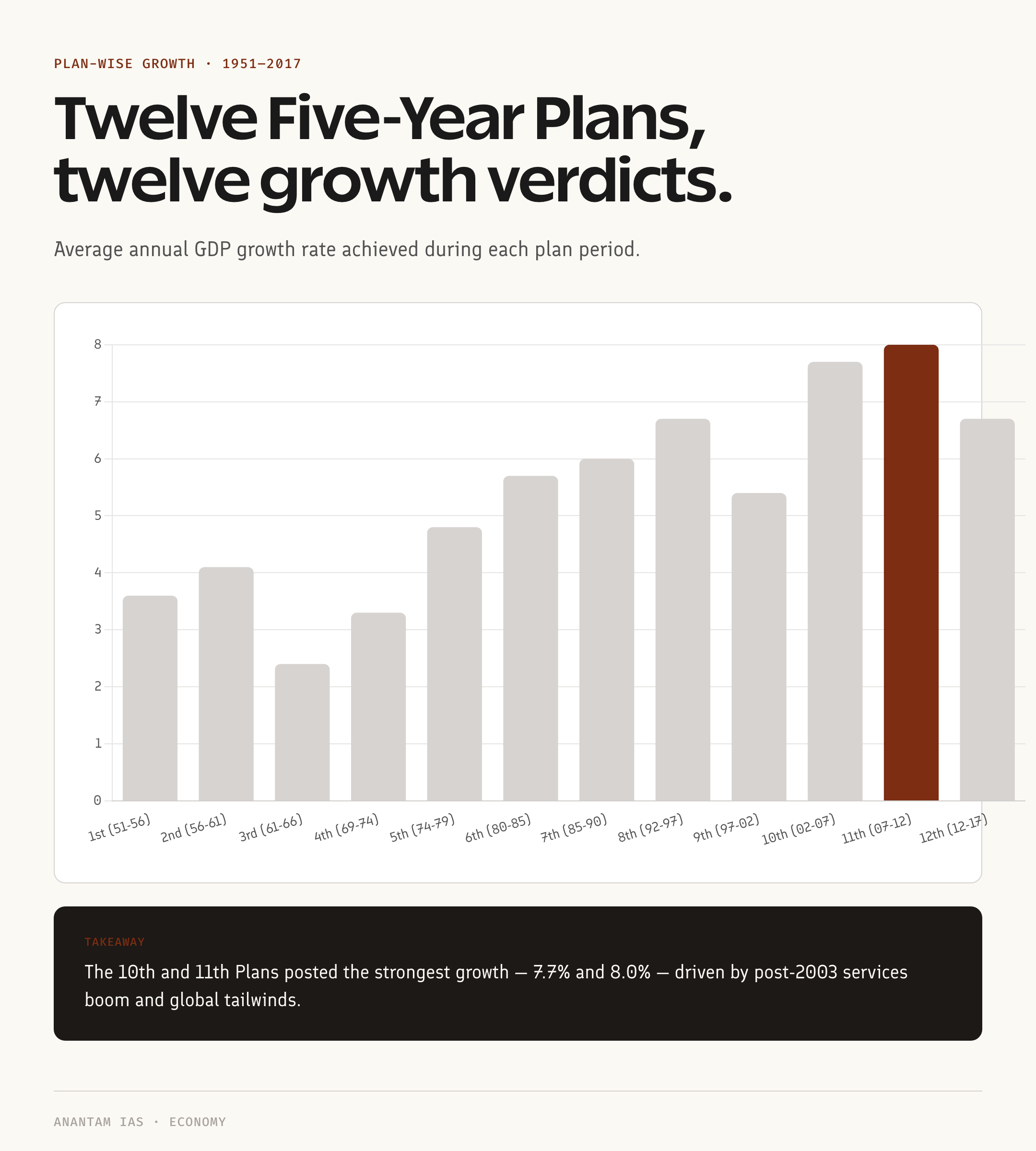
- First FYP — 1951–1956 — Harrod-Domar model — focus on agriculture and irrigation — target 2.1% growth, achieved 3.6%.
- Last FYP — 12th — 2012–2017 — theme "Faster, More Inclusive and Sustainable Growth" — target 8% growth, achieved ~6.7%.
- Replacement — NITI Aayog from 1 January 2015; three-year action plans, seven-year strategy, 15-year vision.
Birth of planning — the Bombay Plan and Mahalanobis
Planning didn't start with the government. The Bombay Plan (1944) was drafted by eight Indian industrialists — JRD Tata, GD Birla, Purshottamdas Thakurdas, Lala Shri Ram, AD Shroff, Kasturbhai Lalbhai, Ardeshir Dalal, John Mathai. They proposed a 15-year, ₹10,000 crore industrialisation roadmap.
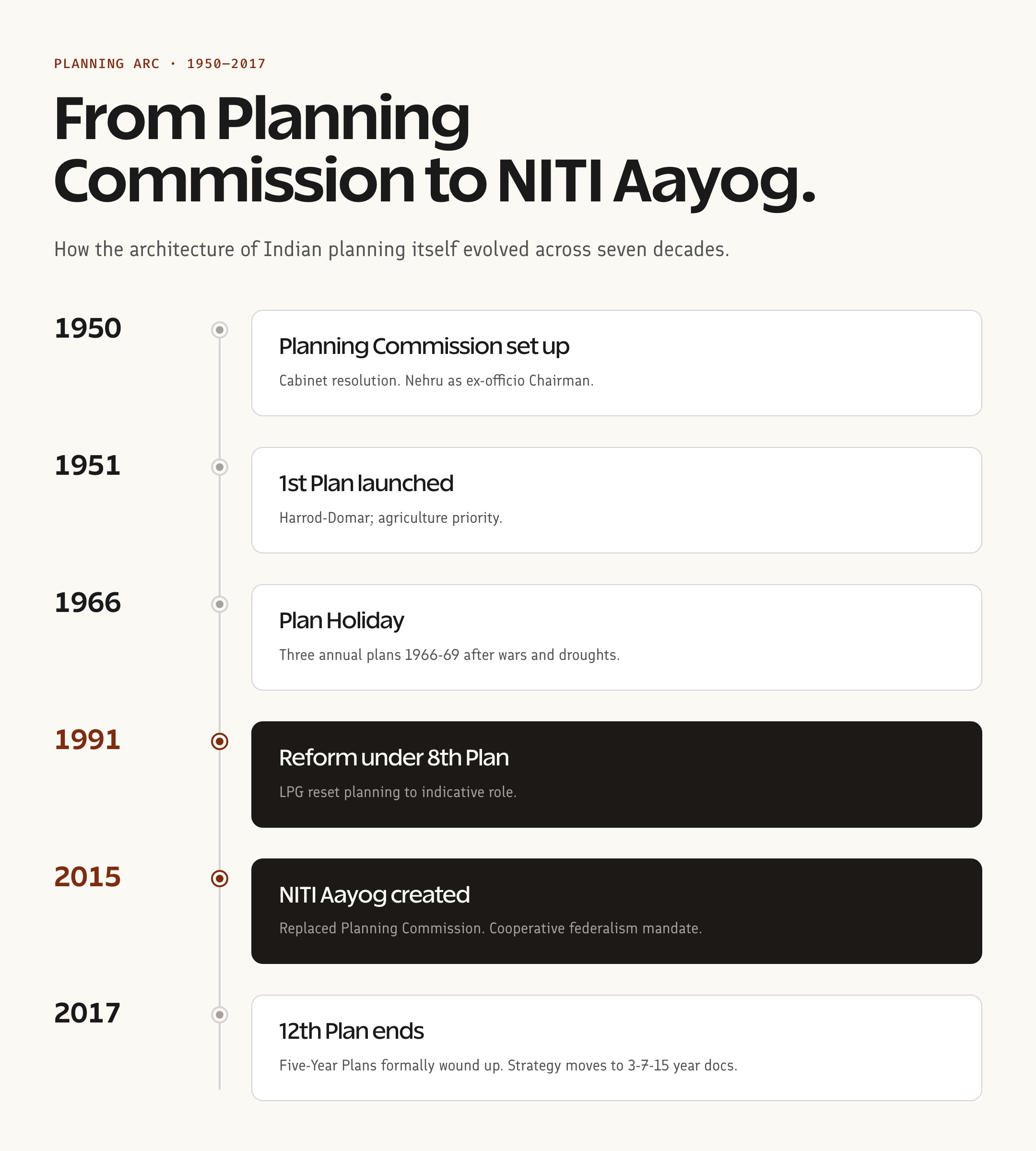
The Planning Commission was set up by Government Resolution on March 15, 1950. It was an extra-constitutional, advisory body — never a statutory entity. The PM was its ex-officio Chairperson. Read evolution of planning in India for the institutional history.
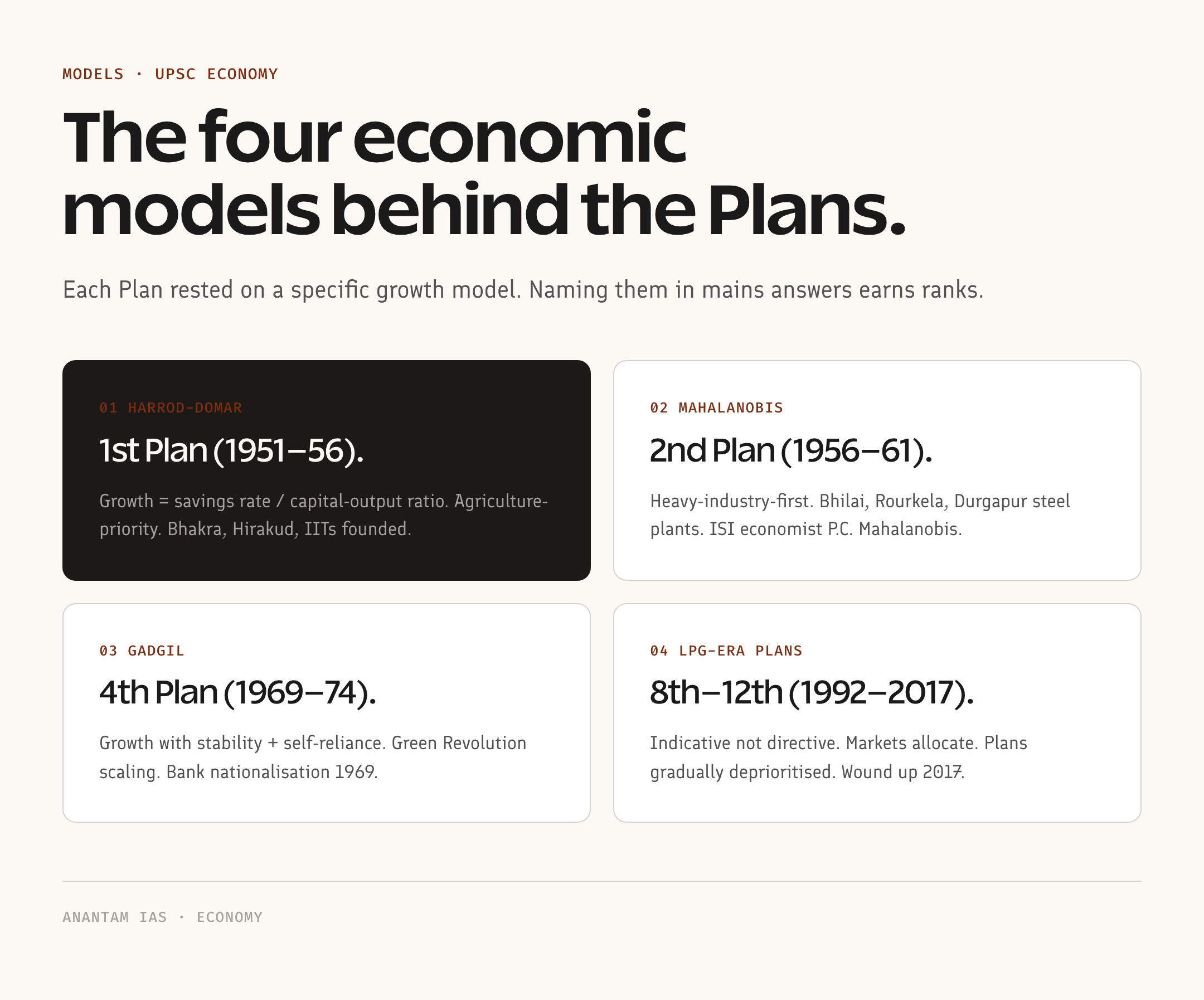
The architect of the model — Prasanta Chandra Mahalanobis (statistician, ISI Calcutta founder) — designed the Mahalanobis four-sector model: heavy industry, consumer goods, services, and household. The 2nd Plan put it into practice.
Each plan, in one paragraph each
I'll keep these tight. Memorise the theme, the model, the target vs achievement.
1st Plan (1951–1956). Harrod-Domar model. Agriculture and irrigation focus. Bhakra Nangal, Hirakud, Damodar Valley dams launched. Target: 2.1%. Achieved: 3.6%. Easy hit because base was so low.
2nd Plan (1956–1961). Mahalanobis model. Heavy industry priority. Bhilai, Durgapur, Rourkela steel plants. IIT Kharagpur expanded; IITs Bombay, Madras, Kanpur set up. Target: 4.5%. Achieved: 4.1%. Industrial Policy Resolution 1956 reserved 17 industries for the state.
3rd Plan (1961–1966). Sukhamoy Chakravarty inputs. Self-reliance theme. Disrupted by Sino-Indian War 1962, Indo-Pak War 1965, two droughts. Target: 5.6%. Achieved: 2.8%. Massive failure. Plan holiday followed… and the planning model itself was questioned for the first time.
Plan Holiday (1966–1969). Three annual plans. Green Revolution preparation — HYV seeds introduced. Major rupee devaluation (June 1966). Read Green Revolution for the agricultural transformation it sparked.
4th Plan (1969–1974). Garibi Hatao. Indira Gandhi era. Bank nationalisation (July 19, 1969 — 14 banks). Bangladesh War 1971. Oil shock 1973. Target: 5.7%. Achieved: 3.3%.
5th Plan (1974–1979). Removal of poverty + self-reliance. Twenty Point Programme launched. Cut short to 4 years by Janata Party in 1978. Target: 4.4%. Achieved: 4.8%.
Rolling Plan (1978–1980). Janata Party introduced annual rolling plans. Scrapped when Indira Gandhi returned in 1980.
6th Plan (1980–1985). Modernisation, increase in productivity. Integrated Rural Development Programme (IRDP) launched. Bank nationalisation second round (1980). Target: 5.2%. Achieved: 5.7%.
7th Plan (1985–1990). Food, work, productivity. Jawahar Rozgar Yojana integration. Liberalisation began under Rajiv Gandhi. Target: 5%. Achieved: 6%.
Plan Holiday (1990–1992). Two annual plans during the BoP crisis and LPG transition.
8th Plan (1992–1997). First post-LPG plan. Manmohan Singh as Finance Minister. Theme: human resource development. Target: 5.6%. Achieved: 6.8%. Read analysis of 1991 LPG reforms for the reform context.
9th Plan (1997–2002). Growth with social justice and equity. Asian Financial Crisis. Pokhran-II nuclear tests. Kargil War. Target: 6.5%. Achieved: 5.4%.
10th Plan (2002–2007). Doubling per-capita income in 10 years. Sarva Shiksha Abhiyan. NREGA (2005). Right to Information (2005). Target: 8%. Achieved: 7.6%. The dream-run plan.
11th Plan (2007–2012). "Towards Faster and More Inclusive Growth." Bharat Nirman, RTE Act 2009, Aadhaar started, Goods and Services Tax planning. Target: 9%. Achieved: ~8% (revised).
12th Plan (2012–2017). "Faster, More Inclusive and Sustainable Growth." Target: 8% (initially 9%). Achieved: ~6.7%. The last Five-Year Plan of India.
Plan-by-plan: targets vs achievements table
This is the table CBSE and UPSC examiners love.
| Plan | Period | Target Growth | Achieved | Theme/Model |
|---|---|---|---|---|
| 1st | 1951-56 | 2.1% | 3.6% | Harrod-Domar, agri |
| 2nd | 1956-61 | 4.5% | 4.1% | Mahalanobis, heavy industry |
| 3rd | 1961-66 | 5.6% | 2.8% | Self-reliance (failed) |
| 4th | 1969-74 | 5.7% | 3.3% | Garibi Hatao |
| 5th | 1974-79 | 4.4% | 4.8% | Poverty removal |
| 6th | 1980-85 | 5.2% | 5.7% | Modernisation |
| 7th | 1985-90 | 5.0% | 6.0% | Food, work, productivity |
| 8th | 1992-97 | 5.6% | 6.8% | Human resource development |
| 9th | 1997-02 | 6.5% | 5.4% | Growth + equity |
| 10th | 2002-07 | 8.0% | 7.6% | Inclusive growth |
| 11th | 2007-12 | 9.0% | ~8.0% | Faster inclusive growth |
| 12th | 2012-17 | 8.0% | ~6.7% | Faster, sustainable, inclusive |
End of the Five Year Plan of India — January 2015
The Modi government dissolved the Planning Commission via Cabinet decision on August 13, 2014, and constituted NITI Aayog (National Institution for Transforming India) on January 1, 2015. Read the full breakdown at dismantling of the Planning Commission and Planning Commission vs NITI Aayog.
The reasons cited:
- Top-down planning had outlived its utility — markets now allocate most resources.
- One-size-fits-all — states' diverse needs required cooperative, not directive, planning.
- Lack of statutory backing — Planning Commission was an executive body with no constitutional or statutory base.
- Plan vs Non-Plan distinction was misleading — abolished from FY18 budget.
The 12th Plan (2012–17) completed its term and was not replaced by a 13th. Instead, NITI Aayog introduced a three-tier framework:
- 15-year Vision Document (2017–32) — long-term aspirations.
- 7-year Strategy — medium-term targets.
- 3-year Action Agenda (2017–20) — short-term, sector-specific.
NITI Aayog also runs Aspirational Districts Programme, SDG India Index, Health Index, and the Atal Innovation Mission. Read NITI Aayog for functions and composition.
Achievements of 66 years of planning — what the FYPs delivered
Honestly, the verdict is mixed but not negative… look at the contrast with countries that didn't plan at scale.
- Self-sufficiency in foodgrains — from 50 MT (1950) to ~332 MT (FY26). Green Revolution + irrigation expansion.
- Industrial base — steel, cement, fertilisers, defence equipment, space, nuclear.
- Higher education infrastructure — IITs (1951 onward), IIMs (1961), AIIMS (1956).
- Banking — bank nationalisation (1969, 1980) extended credit to rural areas.
- Poverty reduction — from ~55% (1973-74, Tendulkar) to ~12% (2024 estimates).
- Life expectancy — 32 years (1947) to 70 years (2025).
- Literacy — 18% (1951) to 77.7% (NSO 2023-24).
Failures and missed targets
- Growth targets — exceeded only in 1st, 5th, 6th, 7th, 8th plans. Most plans missed.
- Manufacturing share — never crossed 18%. Targeted 25% in 2011 NMP.
- Inequality — top 1% income share rose from 6% (1990) to 22.6% (2022-23).
- Regional disparities — BIMARU states lagged consistently.
- Public sector inefficiency — many PSUs became loss-making.
Why Five Year Plans matter for UPSC
For Prelims, expect direct fact questions:
- Years and themes of each plan
- Models used (Harrod-Domar, Mahalanobis, Sukhamoy Chakravarty, Gadgil)
- Plan holidays and rolling plans
- Date of Planning Commission setup and dissolution
- NITI Aayog constitution date
For Mains GS3, write on:
- "Did Five-Year Plans serve their purpose? Critically examine."
- "Compare top-down planning with cooperative federalism."
- Role of planning in poverty reduction, agriculture, industry.
For Essay, "From Planning Commission to NITI Aayog — a paradigm shift" is a stock prompt.
Common misconceptions
Myth 1 — "Planning Commission was a constitutional body." No. It was set up by a Cabinet resolution in 1950. Never had constitutional or statutory status.
Myth 2 — "There were 13 Five-Year Plans." No. Twelve Five-Year Plans plus six annual plans (during plan holidays). The 12th was the last.
Myth 3 — "Mahalanobis designed the First Plan." No. K.N. Raj drafted the First Plan based on the Harrod-Domar growth model. Mahalanobis came in for the Second Plan (1956).
Myth 4 — "Plans were abolished because they failed." Partially. They were also rendered obsolete by markets, federalism, and the need for sectoral specificity that five-year horizons couldn't deliver.
Myth 5 — "NITI Aayog also makes Five-Year Plans." No. NITI Aayog publishes a 3-year action agenda, 7-year strategy, and 15-year vision — none of them are Five-Year Plans.
Well, here's a small cautionary footnote — some state governments still call their planning documents "Five-Year Plans" colloquially, but at the Union level the format ended in 2017… permanently, as far as anyone in policy can tell.
How to revise Five Year Plans in 30 minutes
- Ramesh Singh — Indian Economy — Chapter 5 (Economic Planning) and Chapter 6 (Planning in India).
- NCERT Class 11 — Indian Economic Development — Chapter 1 covers planning.
- Niti.gov.in archive — original 12th FYP volumes I, II, III.
- One-page table with 12 plans, periods, themes, target/achievement growth rates, key schemes.
- PRS India explainer on NITI Aayog vs Planning Commission.
Look, the trap most aspirants fall into — memorising 12 plans cold and forgetting which one came when. The fix is simple. Anchor each plan to a memorable event: 2nd → Mahalanobis steel plants, 3rd → wars and droughts, 4th → bank nationalisation, 8th → post-LPG, 12th → last plan. Five anchors carry the rest.
Frequently Asked Questions
How many Five Year Plans were there in India?
There were 12 Five-Year Plans (1951–2017), plus 6 annual plans during plan holidays (1966-69, 1978-80, 1990-92). The 12th Plan was the last. NITI Aayog replaced the Planning Commission in January 2015, ending the FYP era.
Who was the architect of the Second Five Year Plan?
Prasanta Chandra Mahalanobis, the Indian statistician and founder of the Indian Statistical Institute. The Mahalanobis model emphasised heavy industry as the engine of growth.
When was the Planning Commission abolished?
The Planning Commission was dissolved on January 1, 2015 by Cabinet decision (August 13, 2014). NITI Aayog was constituted the same day.
Which Five Year Plan failed the most?
The Third Five Year Plan (1961–1966) missed its target by the largest margin — achieved 2.8% against a 5.6% target — disrupted by the Sino-Indian War (1962), Indo-Pak War (1965), and two droughts.
What replaced the Five Year Plan in India?
NITI Aayog's three-tier framework: a 15-year Vision Document (2017–32), a 7-year Strategy, and a 3-year Action Agenda (2017–20). No 13th Five-Year Plan was ever drafted.
What was the theme of the 12th Five Year Plan?
"Faster, More Inclusive and Sustainable Growth." Target growth rate was 8% (initially 9%, revised down). Achieved approximately 6.7%.
What was the Plan Holiday in India?
Plan Holiday refers to periods when a regular Five-Year Plan was not in force and annual plans operated instead. There were three plan holidays — 1966–1969 (after the 3rd Plan), 1978–1980 (Janata Party's rolling plan), and 1990–1992 (during the BoP crisis transition).