The Foundational Economy: The Everyday Sectors That Keep Life Running (UPSC Economy)
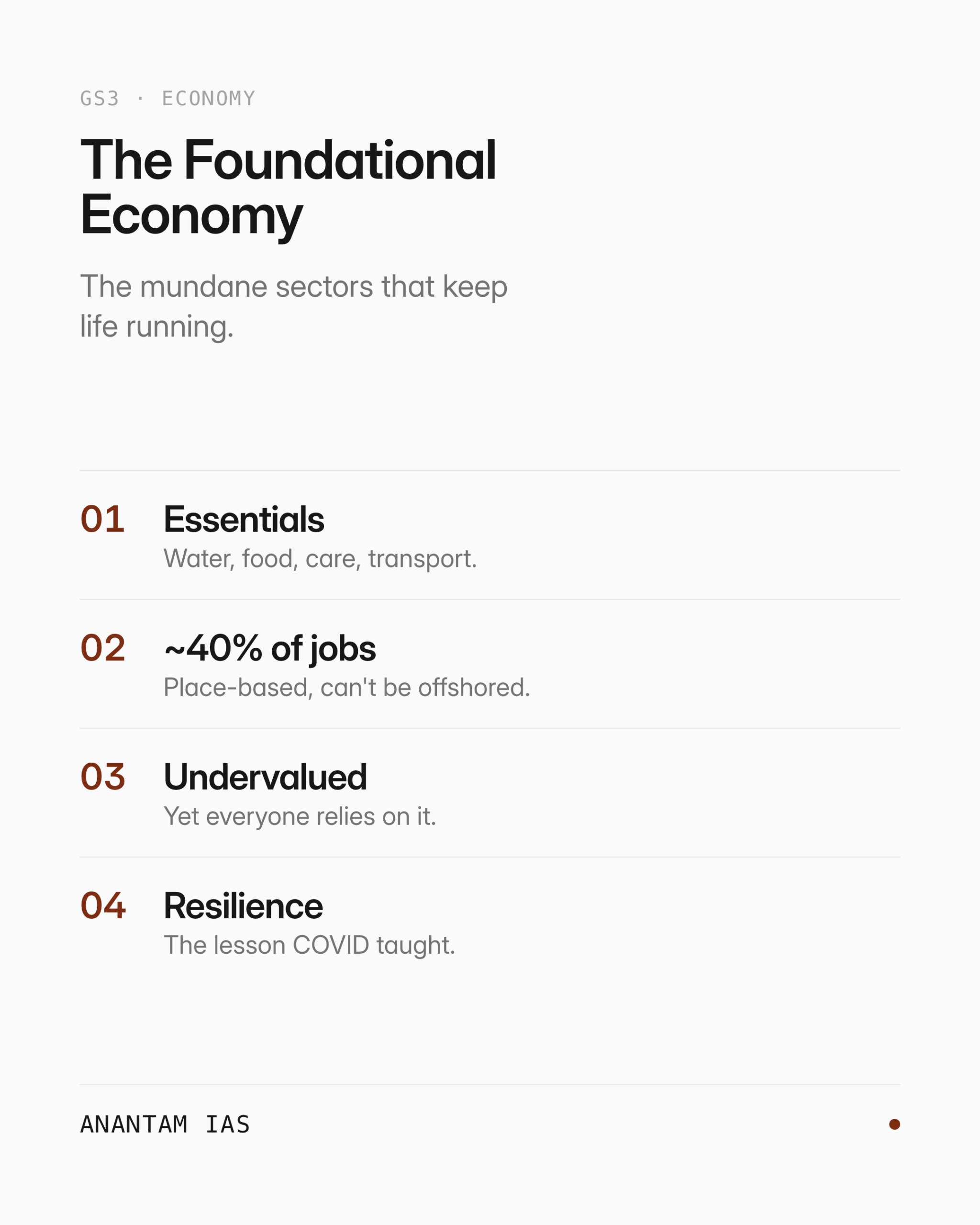
Water, electricity, food supply, health, care, schools, housing, transport, connectivity — the 'boring' sectors that keep daily life running are what economists call the foundational economy. It employs roughly 40% of the workforce, can't be offshored, yet is chronically undervalued. Here is the concept, its providential and material halves, and the India angle — explained for UPSC GS3.
Think about the last hour of an ordinary morning. You woke in a built home, turned a tap that ran clean, switched on a light that drew power off a grid, ate food that travelled through a supply chain to a shop near you, and maybe sent a child to a school or rang a clinic. None of that felt like “the economy” in the way a stock index or a unicorn valuation does. It felt like the wallpaper of life — too dull to notice. And that is exactly the point a group of European economists has been making for a decade: the most important part of any economy is the part we never talk about. They call it the foundational economy, and once you see it, you cannot unsee how much of national wellbeing rests on it.
The phrase comes from the Foundational Economy Collective, a loose international grouping of mainly European researchers who set out to challenge how governments think about prosperity. Their argument is deceptively simple. Politicians chase the glamorous, tradeable, “competitive” economy — exports, tech, manufacturing champions — while the mundane sectors that actually provide the goods and services every household relies on daily are taken for granted, squeezed and quietly privatised. For an Indian aspirant, this reframing is gold: it cuts across the economy, governance and social-justice papers, and it gives you a clean, original lens on everything from the Public Distribution System to water tariffs to why “essential workers” suddenly mattered in 2020.
What the Foundational Economy Actually Is
Start with the definition, because the whole idea turns on it. The foundational economy is the set of goods and services that form the social and material infrastructure of civilised life — the daily essentials that every household needs irrespective of income or location. The Collective’s own book, Foundational Economy: The Infrastructure of Everyday Life, frames it as the basic requirements of a decent life for all citizens: not luxuries, not discretionary spending, but the things whose absence makes life difficult or dangerous. Water and energy. Food supply and retail. Health and care. Education. Housing. Transport. Banking and connectivity. These are not exciting, and that ordinariness is precisely why they get overlooked.
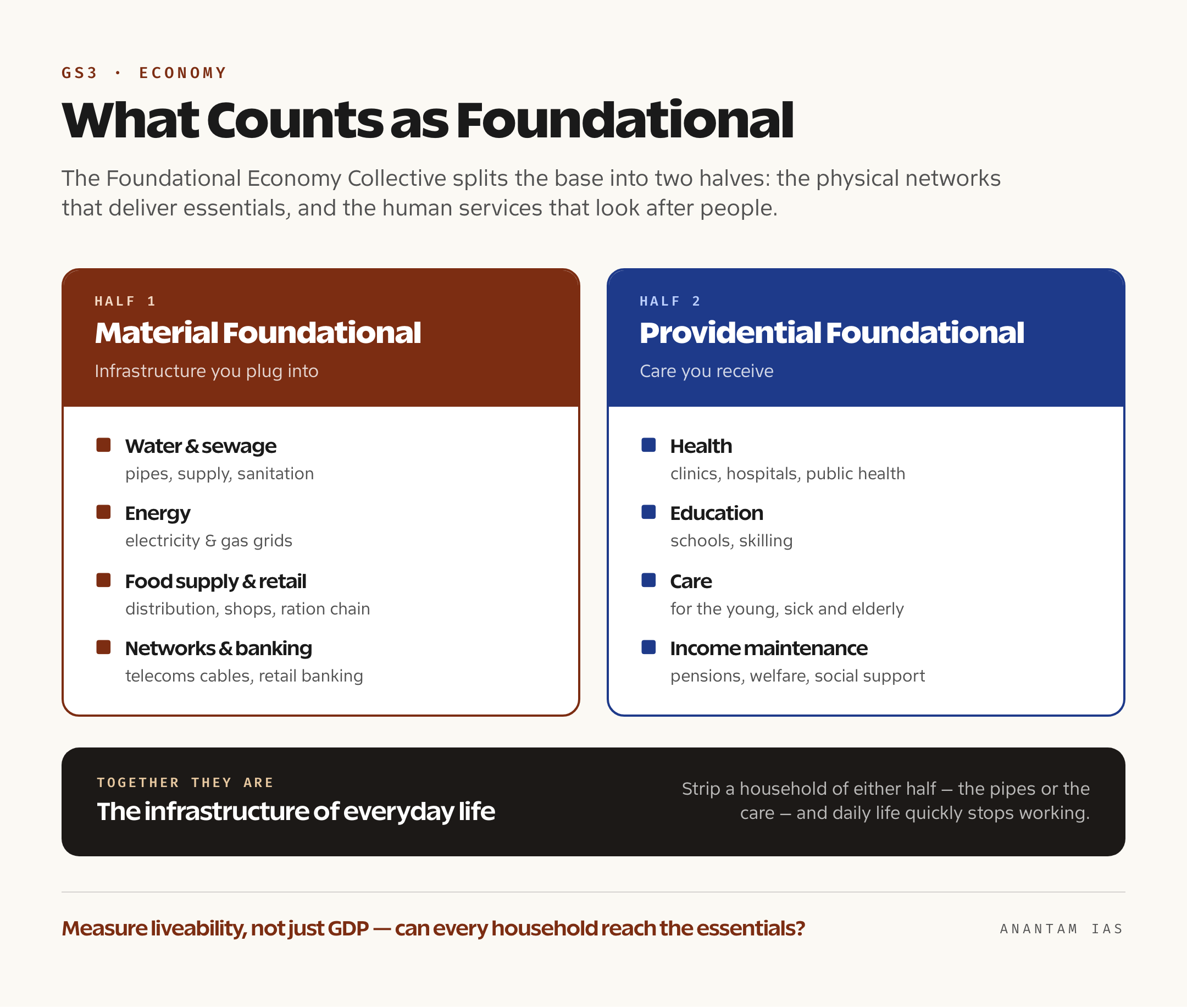
The Collective splits this base into two halves, and getting the distinction right is what separates a sharp answer from a vague one. The first is the material foundational economy — the physical networks that pipe, wire and move essentials to your door: water and sewage systems, electricity and gas grids, the food distribution and retail chain, telecoms cables, and everyday retail banking. These are the pipes and cables of civilised life. The second is the providential foundational economy — the human services a society provides to look after people: health, education, care for the young and old, and income maintenance like pensions and welfare. One half is infrastructure you plug into; the other is care you receive. Together they are what the Collective calls the “infrastructure of everyday life,” and a household stripped of either quickly stops functioning.
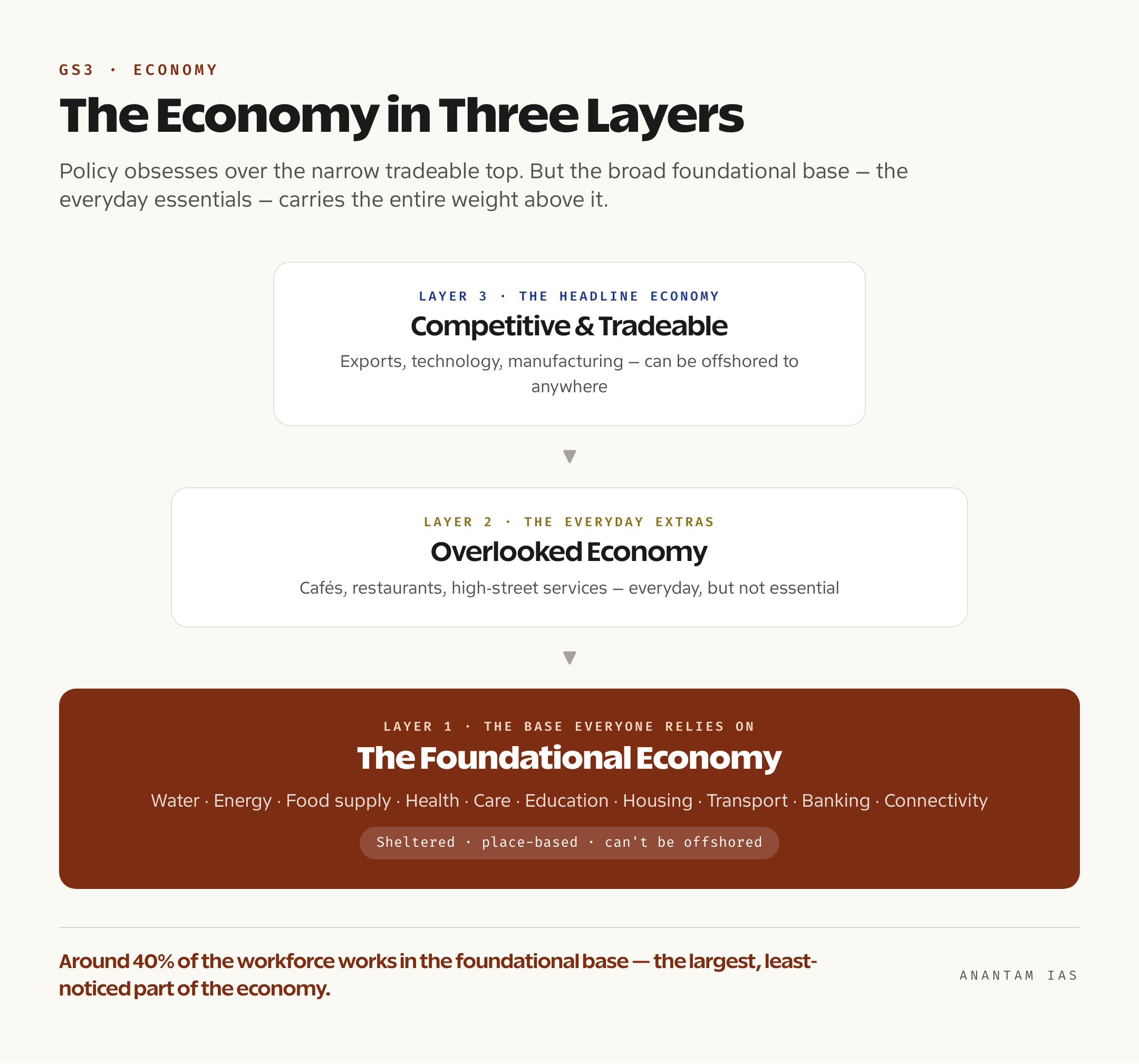
There’s a useful third distinction the Collective draws, between the foundational economy and what it nicknames the “overlooked” economy — the everyday but slightly less essential goods like haircuts, restaurants and high-street services that sit just above the base. But the heart of the idea is the foundation itself: the non-negotiable layer beneath everything else. The competitive, tradeable economy that politicians obsess over — the cars, software and exports — sits on top of this base and depends on it. A worker can only staff a factory if there is water at home, a school for the children and a bus to the gate. So the foundational economy is not a sideshow to growth; it is the platform growth stands on.
Why It Matters: The Sheltered Half of the Economy
Here is the figure that makes officials sit up. Across Europe, the Collective estimates that around 40 per cent of the workforce is employed in foundational activities — nurses, teachers, carers, utility workers, food and retail staff, transport crews. In Wales, which has gone furthest in turning the idea into policy, the foundational economy is reckoned to account for roughly 40 per cent of jobs and about 60 per cent of locally headquartered firms. This is not a marginal corner of the labour market. It is, by employment, the largest single zone of the modern economy — and the one that receives the least strategic attention.
The Collective gives this zone a precise label: the sheltered economy, as opposed to the tradeable or exposed economy. The distinction is about exposure to international competition. A car plant or a software firm competes in a global market and can, in principle, be moved offshore to wherever costs are lowest. But you cannot offshore a hospital ward, a primary school, a water pipe or a bus route. These services have to be produced where people live, by people who live nearby. That makes the foundational economy inherently place-based — it anchors jobs and spending in a locality and cannot be exported away. In an age anxious about hollowed-out towns and lost local employment, a sector that is by nature local and un-offshorable is a powerful policy asset that conventional growth thinking simply ignores.
And yet — this is the Collective’s core grievance — the foundational economy is chronically undervalued and increasingly financialised. Because these services look dull and unglamorous, governments have spent decades privatising, outsourcing and squeezing them: water, energy, care homes and even parts of health have been turned into assets for private investors chasing returns. The Collective argues this has “eroded the motivation of private firms and the capacity of public organisations” to deliver the basics well, loading households with rising bills for water, power and rent while quality stagnates. We measure the success of the economy in GDP and competitiveness rankings, which capture the flashy tradeable sector and miss the question that matters most to ordinary people: can a household actually access and afford the essentials of a decent life? That mismatch — between what we measure and what we live on — is the heart of the foundational critique.
The Policy Shift: From Competitiveness to Liveability
So what does a government actually do differently if it takes the foundational economy seriously? The answer is a quiet revolution in goals. Instead of measuring success only by GDP growth, export competitiveness or attracting the next big investor, foundational policy asks a more grounded question: are the essentials of everyday life universally accessible, affordable and resilient? The Welsh Government, which published a Foundational Economy Mission Statement, built its programme around exactly this idea — and coined a term worth carrying into an answer: household liveability, defined plainly as the money people have left over after they have paid for the essentials. Two households with the same income can have wildly different real living standards depending on what they must spend on rent, water, power and transport. Foundational policy targets that residual — the disposable margin that decides whether a family scrapes by or lives with dignity.
Three policy moves follow from this. The first is a focus on universal access — making sure everyone, regardless of income or postcode, can actually reach and afford the basics, rather than treating water or care as ordinary commodities sold to whoever can pay. This is where the foundational idea shakes hands with Universal Basic Services, the proposal to provide a basket of essentials free or near-free at the point of use; UBS is, in effect, foundational thinking turned into a concrete policy menu. The second move is resilience — designing essential systems to keep running through shocks, because a pandemic, a flood or a price spike hits hardest precisely where the foundation is weakest. The third, and most distinctive, is social licensing: the idea that firms granted the privilege of running an essential service — a water utility, a care chain, a regional bus network — should be held to social obligations in return, on local employment, fair wages, reinvestment and quality, rather than being free to extract profit and externalise costs.
This reframing also rescues a sector the mainstream economy treats as invisible: care. The care economy — the paid and unpaid work of looking after children, the sick and the elderly — sits squarely inside the providential foundational, and the foundational lens explains why it is so persistently undervalued. Care cannot be made more “productive” by speeding it up or shipping it abroad; its value is in the relationship, not the throughput. By insisting that such work is foundational rather than residual, the framework argues for paying carers properly and investing in care as infrastructure, not charity. The thread running through all of this is a single shift in worldview: stop treating the economy as a machine for maximising market value, and start treating it as the system that has to keep everyone alive, housed, fed, healthy and connected.
The India Angle: A Vast, Half-Informal Foundation
India is, in many ways, the most vivid case study the foundational idea could ask for — and the one where the stakes are highest. The country runs one of the largest foundational-economy interventions on earth in its Public Distribution System. Under the National Food Security Act of 2013, the state guarantees subsidised foodgrain to around 81 crore people — about two-thirds of the population — through a network of ration shops, and since 2023 that grain has been supplied free under the integrated scheme. That is the providential and material foundation working together at continental scale: food security delivered as a right, not a market transaction. Alongside it sit the great access missions of the past decade — household electricity connections under Saubhagya, tap water under the Jal Jeevan Mission, toilets under Swachh Bharat, cooking gas under Ujjwala, and bank accounts under Jan Dhan. Each is, in foundational language, an effort to universalise access to a basic that the market had failed to reach.
But India’s foundation has a feature the European version barely grapples with: a huge part of it is informal. Much of the country’s foundational labour — the people who deliver water, run small retail, drive transport, build and clean homes, and provide care — works without contracts, social security or stable wages. The street vendor, the auto driver, the domestic worker and the small kirana shopkeeper are foundational workers in every sense; they keep daily life running, yet sit outside the formal economy’s protections. So in India the foundational challenge is not only to fund and protect essential services, but to formalise and dignify the vast informal workforce that already provides them. This is where the foundational lens connects to debates on social-security codes, gig-worker welfare and urban informality — it gives them a common economic logic rather than treating each as a separate problem.
The clearest moment the idea earned its keep was the COVID-19 pandemic. When India locked down in 2020, the economy that kept functioning was almost entirely the foundational one: farmers, food-supply chains, ration shops, sanitation workers, electricity and water staff, ASHA and anganwadi workers, nurses and doctors. The country suddenly discovered, the hard way, which workers were truly “essential” — and they turned out to be the ones the formal economy had long underpaid and overlooked. The government’s response, from free foodgrain under the Pradhan Mantri Garib Kalyan Anna Yojana to cash transfers and a renewed push on health infrastructure, was in effect emergency foundational policy: shore up the base so people survive the shock. The lesson, which the foundational economists had been making for years, landed in a single season. A society’s resilience is set not by its champion exporters but by the strength of its everyday, essential, unglamorous foundation — and a country that lets that foundation decay is one bad shock away from crisis.
For Your Mains Answer
This is a flexible, high-value concept for GS Paper 3, which covers the Indian economy, growth and development, inclusive growth, infrastructure and the mobilisation of resources. It also reaches into GS Paper 2 on welfare schemes, governance and social justice, and offers a fresh frame for the Essay paper on development, wellbeing and the meaning of progress. The skill examiners reward here is the ability to reframe a familiar set of facts — PDS, utilities, public health — under one original organising idea, and to connect the Indian reality to a clearly named global concept.
How to Build the Answer
Open by naming the idea and its source — the foundational economy, from the Foundational Economy Collective — then define it as the everyday goods and services that form the infrastructure of civilised life. Lay out the two halves cleanly: material foundational (water, energy, food, networks, banking) and providential foundational (health, education, care, income support). Then make the three big claims that earn marks: it employs around 40 per cent of the workforce, it is place-based and cannot be offshored, and it is chronically undervalued because we measure GDP rather than liveability. Pivot to policy — universal access, resilience and social licensing — and finish with India: the PDS and access missions as foundational policy, the informal foundation as the distinctive challenge, and COVID-19 as the resilience lesson.
Common Mistakes to Avoid
Don’t reduce the foundational economy to “infrastructure” — it includes human services like health and care, not just pipes and roads. Don’t confuse it with Universal Basic Income; UBS, not cash, is its natural policy cousin. Don’t present it as anti-growth — the argument is that the foundation enables growth and deserves equal attention, not that GDP is worthless. And don’t forget the India-specific twist: the informality of the foundational workforce is the point most candidates miss and the one that lifts an answer.
A Compact Answer Spine
Foundational economy = everyday goods and services that are the infrastructure of civilised life (Foundational Economy Collective) → two halves: material (water, energy, food, networks, banking) + providential (health, education, care, income support) → why it matters: ~40% of jobs, sheltered and place-based (can’t be offshored), yet undervalued and financialised → policy shift: from GDP/competitiveness to liveability — universal access, resilience, social licensing → India: PDS/NFSA for 81 crore + Jal Jeevan, Saubhagya, Ujjwala; but a vast informal foundation; COVID-19 proved its centrality → verdict: strengthen and dignify the foundation as the real basis of wellbeing and resilience.
Diagram or Flowchart Idea
Draw the economy as three stacked layers: a narrow “competitive/tradeable” band on top (exports, tech), a thin “overlooked” band in the middle (cafés, high-street services), and a broad “foundational base” at the bottom carrying the weight — labelled with water, energy, food, health, care, housing, transport. A second small box can split that base into “material” and “providential.” This single visual communicates the entire argument that the base carries everything above it.
A Balanced-Conclusion Line
A line that lands the marks: “The foundational economy reminds us that a nation’s strength lies less in its champion exporters than in whether every household can reach water, food, health, care and a roof — and the real test of policy is not the GDP it adds but the liveability and resilience it secures.”
How to Use Data Without Cramming
You need only a handful of anchors: around 40 per cent of the workforce is foundational; the NFSA covers about 81 crore people; the idea comes from the Foundational Economy Collective’s book The Infrastructure of Everyday Life; and “household liveability” is the Welsh policy term for residual income after essentials. Attribute them plainly — “as the Foundational Economy Collective argues,” “under India’s National Food Security Act” — and let the framework, not a flood of numbers, carry the answer.
Frequently Asked Questions
What is the foundational economy in simple terms?
It is the set of mundane but essential goods and services that every household relies on every day — water, energy, food supply, health, care, education, housing, transport, banking and connectivity. The term comes from the Foundational Economy Collective, which argues that this “infrastructure of everyday life” is the most important part of any economy yet the most neglected, because politicians fixate on glamorous, tradeable sectors like tech and exports while the everyday base is taken for granted and squeezed.
What is the difference between material and providential foundational?
They are the two halves of the foundation. The material foundational economy is the physical networks that deliver essentials — water and sewage systems, electricity and gas grids, the food distribution and retail chain, telecoms cables and everyday retail banking. The providential foundational economy is the human services that look after people — health, education, care for the young and old, and income maintenance like pensions and welfare. One half is infrastructure you plug into; the other is care you receive.
Why can’t the foundational economy be offshored?
Because these services must be produced where people live. You can move a factory or a call centre abroad, but you cannot offshore a hospital ward, a primary school, a water pipe or a local bus route — they have to be delivered on the spot, by people nearby. That makes the foundational economy “sheltered” from international competition and inherently place-based, anchoring jobs and spending in a locality. It is precisely this local, un-offshorable quality that makes it a powerful but overlooked tool for regional development.
How does the foundational economy apply to India?
India runs the idea at vast scale through the Public Distribution System, which delivers subsidised or free foodgrain to around 81 crore people under the National Food Security Act, alongside access missions for tap water (Jal Jeevan), electricity (Saubhagya), cooking gas (Ujjwala) and bank accounts (Jan Dhan). The distinctive Indian feature is that much of this foundation is informal — vendors, drivers, domestic and care workers without social security — so the challenge is to formalise and dignify the foundational workforce. The COVID-19 lockdown made the stakes obvious: it was foundational workers who kept the country running.
Practice Questions
Prelims MCQs
- The concept of the “foundational economy” is most closely associated with which of the following?
(a) The work of the Foundational Economy Collective on the infrastructure of everyday life
(b) The World Bank’s Ease of Doing Business framework
(c) The IMF’s Special Drawing Rights basket
(d) The OECD’s competitiveness rankings
Answer: (a) The idea was developed by the Foundational Economy Collective, whose book is subtitled The Infrastructure of Everyday Life. - Which pairing correctly distinguishes the two halves of the foundational economy?
(a) Material — health and education; providential — water and energy
(b) Material — water, energy, food networks and banking; providential — health, education, care and income support
(c) Material — exports and manufacturing; providential — services and retail
(d) Material — public sector; providential — private sector
Answer: (b) Material foundational covers physical networks for essentials; providential foundational covers human services like health, education and care. - The foundational economy is often described as the “sheltered” economy because it
(a) receives the largest share of government subsidies
(b) is largely protected from international competition and cannot be offshored
(c) is exempt from all taxation
(d) operates only in rural areas
Answer: (b) Foundational services must be produced where people live, so they are sheltered from global competition and are inherently place-based. - The term “household liveability,” used in foundational-economy policy, refers to
(a) the total GDP generated by households
(b) the money households have left after paying for essentials
(c) the number of people living in a household
(d) the value of household assets
Answer: (b) Pioneered in Welsh foundational policy, household liveability is the residual income left after spending on essentials like rent, water, power and transport. - In the Indian context, which of the following best illustrates a foundational-economy intervention?
(a) The Production Linked Incentive scheme for electronics manufacturing
(b) The disinvestment of public sector undertakings
(c) The Public Distribution System under the National Food Security Act, covering about 81 crore people
(d) The launch of a sovereign green bond
Answer: (c) The PDS delivers an essential — subsidised or free foodgrain — universally as a right, the textbook example of foundational provision.
Mains Practice Questions
- Explain the concept of the foundational economy. Why do its proponents argue that it is more important than the competitive, tradeable economy that policymakers usually prioritise? (15 marks, 250 words)
- “The foundational economy is the largest yet most neglected part of any economy.” Discuss this statement with reference to employment, place-based development and the limits of using GDP as a measure of progress. (15 marks, 250 words)
- Distinguish between the material and providential dimensions of the foundational economy. How does this framework help in understanding India’s welfare interventions such as the PDS, Jal Jeevan Mission and public health system? (15 marks, 250 words)
- The COVID-19 pandemic revealed which workers and sectors a society truly depends on. In light of the foundational-economy concept, examine the lessons India should draw about economic resilience. (10 marks, 150 words)
- A large share of India’s foundational economy is informal. Critically examine the challenges this poses and suggest measures to formalise and dignify the foundational workforce. (15 marks, 250 words)