Every time an Indian election season heats up, the same argument flares: are free bus rides for women, free power up to a limit, free grain and cash handouts a sign of a caring state, or a “revadi” culture bribing voters with their own money? In July 2022 the Prime Minister called the freebie habit dangerous; by January 2026 the Supreme Court was wrestling openly with where to draw the line, asking whether free education, free drinking water or a minimum slab of electricity could honestly be called freebies at all. Buried inside that very Indian quarrel is a much bigger idea that the rest of the world has been debating for nearly a decade — whether the right way to fight poverty is to hand people cash and let the market sort out the rest, or to simply give everyone free access to the essentials of a decent life. That second answer has a name: Universal Basic Services.
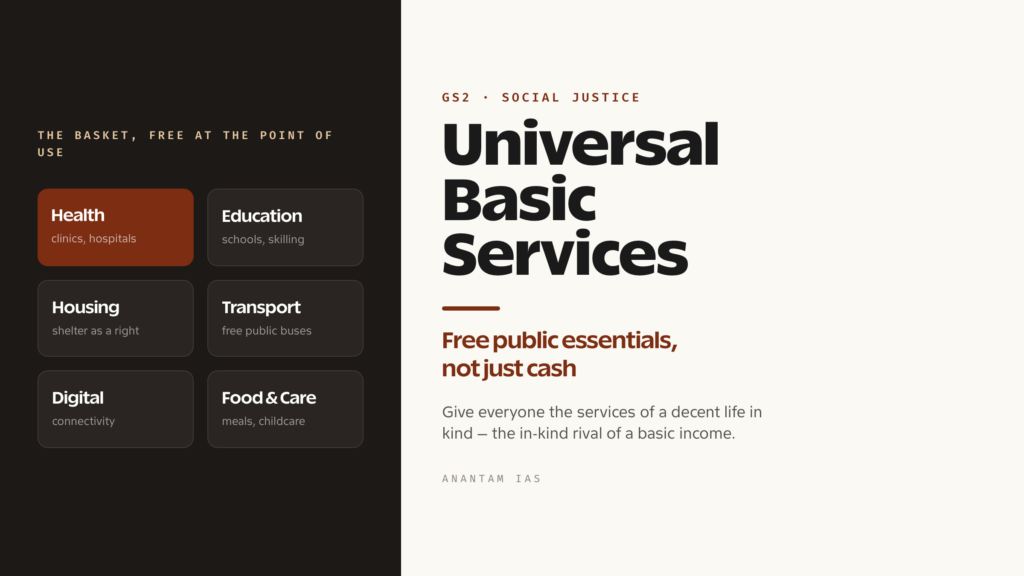
And it deserves a clear-eyed look, because it reframes the whole welfare question. Universal Basic Services, or UBS, is the proposal that a society should guarantee everyone free or near-free access to a basket of essential services — health, education, housing, public transport, and increasingly digital and information access — funded collectively rather than bought individually. It is pitched as the in-kind cousin and rival of Universal Basic Income, the more famous idea of paying everyone an unconditional cash sum. For a UPSC aspirant, UBS sits at a rare crossroads where political theory, the economics of redistribution, the design of welfare schemes and India’s own rights-based jurisprudence all meet. Get it right and you have a single concept that can power answers across GS Paper 2 social justice and GS Paper 3 economy alike.
What Universal Basic Services Actually Means
Start with the plainest version, because the phrase gets stretched in careless writing. Universal Basic Services means that certain services are provided to everyone, free at the point of use, as a right of membership in society rather than as something earned by income or paid for at a counter. “Universal” means it covers everyone, not just the poor who can prove they qualify. “Basic” means it covers the necessities of a dignified life, not luxuries. “Services” is the load-bearing word — the state delivers the thing itself, a clinic visit or a school place or a bus seat, rather than handing over money and hoping the market supplies it. That last distinction is what separates UBS from almost every other welfare idea, and it is the hinge of the whole debate.
The phrase entered serious policy discussion in October 2017, when the Social Prosperity Network at University College London’s Institute for Global Prosperity, led by the anthropologist Henrietta Moore, published a report titled Social Prosperity for the Future: A Proposal for Universal Basic Services. The report argued that the United Kingdom should extend the logic of its free National Health Service and free schooling to new areas — free housing for those in need, free local transport, free basic food, and free access to information and communication, meaning the internet and a basic device. Its costing was deliberately modest: the new services would add around £42 billion a year, about 2.3 per cent of GDP, and could be paid for by reworking tax allowances. The headline claim was sharp — that extending public services would do more to cut poverty, inequality and insecurity than handing the same money out as cash. That single report turned a loose intuition into a named, costed policy programme, and the idea has spread through the welfare-policy world ever since.
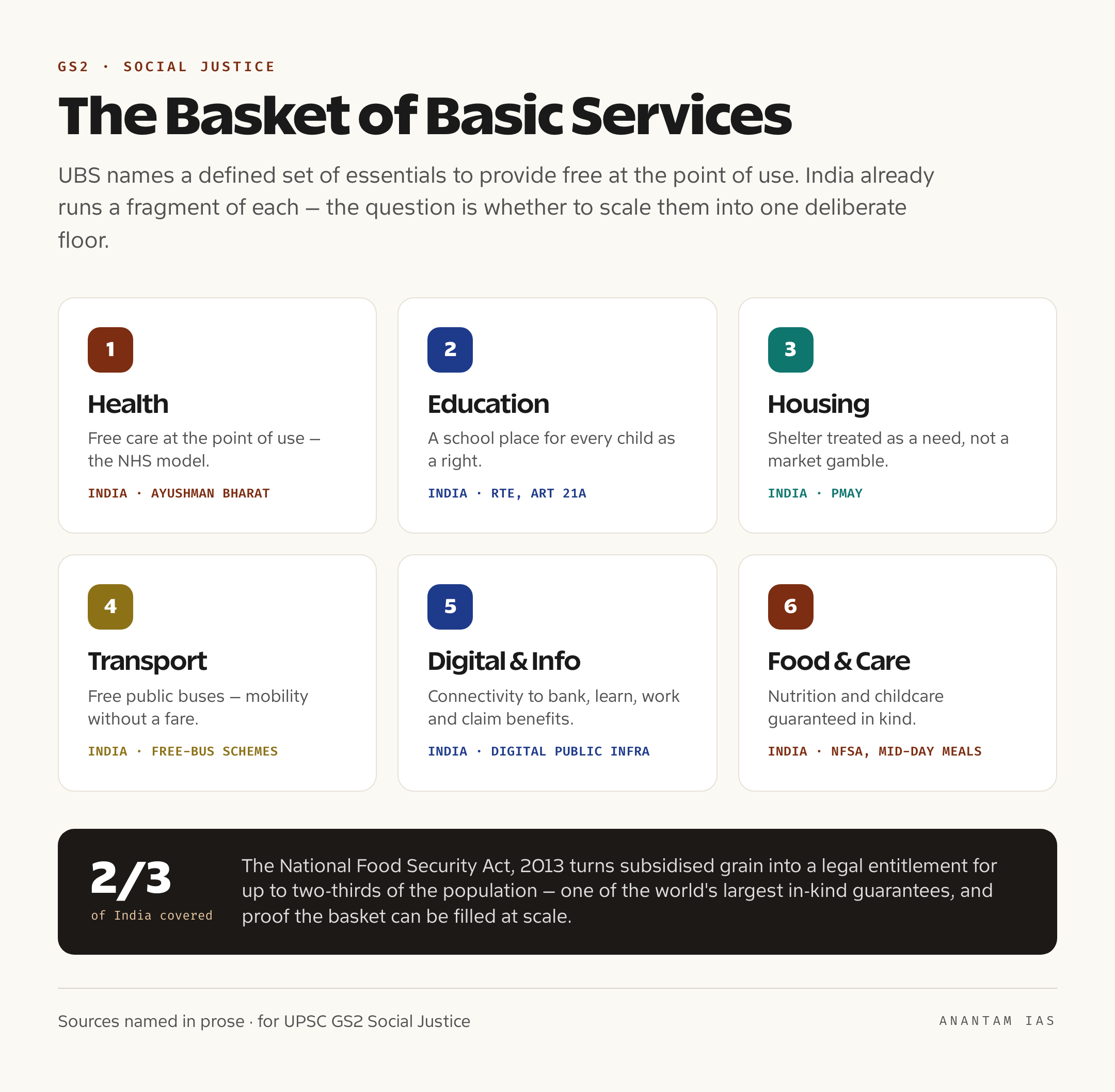
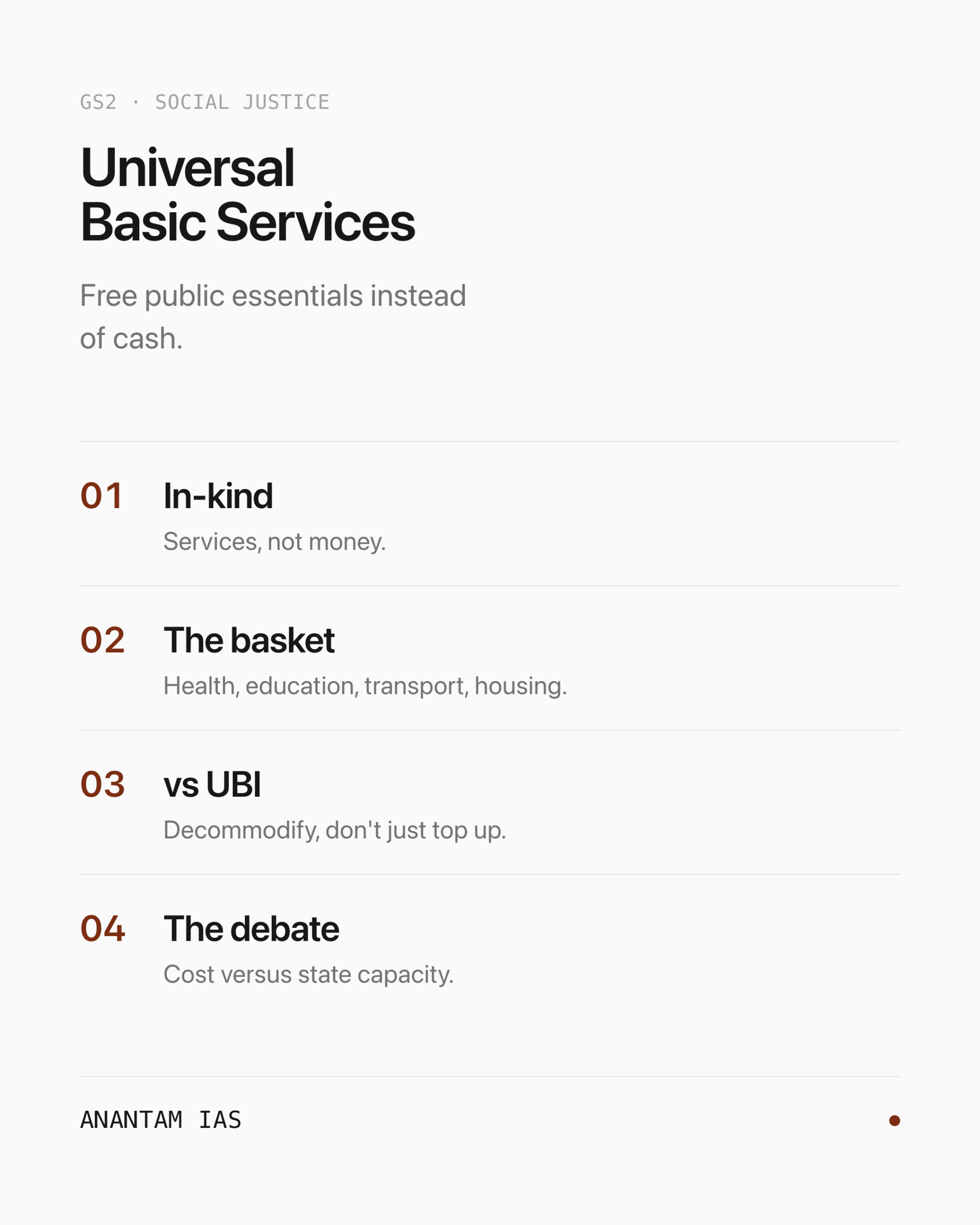
Notice what the basket contains and why. Health and education are the historic core, because most rich countries already treat them as near-universal services. UBS adds the things modern life has made non-negotiable: shelter, the ability to physically move around a city, and a digital connection without which you cannot bank, study, find work or claim a government benefit. Some versions stretch the basket further to childcare, eldercare and a basic food guarantee. The common thread is that each is a need so fundamental that leaving people to buy it on the open market, with cash they may run short of, is treated as a failure of society rather than of the individual.
How UBS Differs from Universal Basic Income
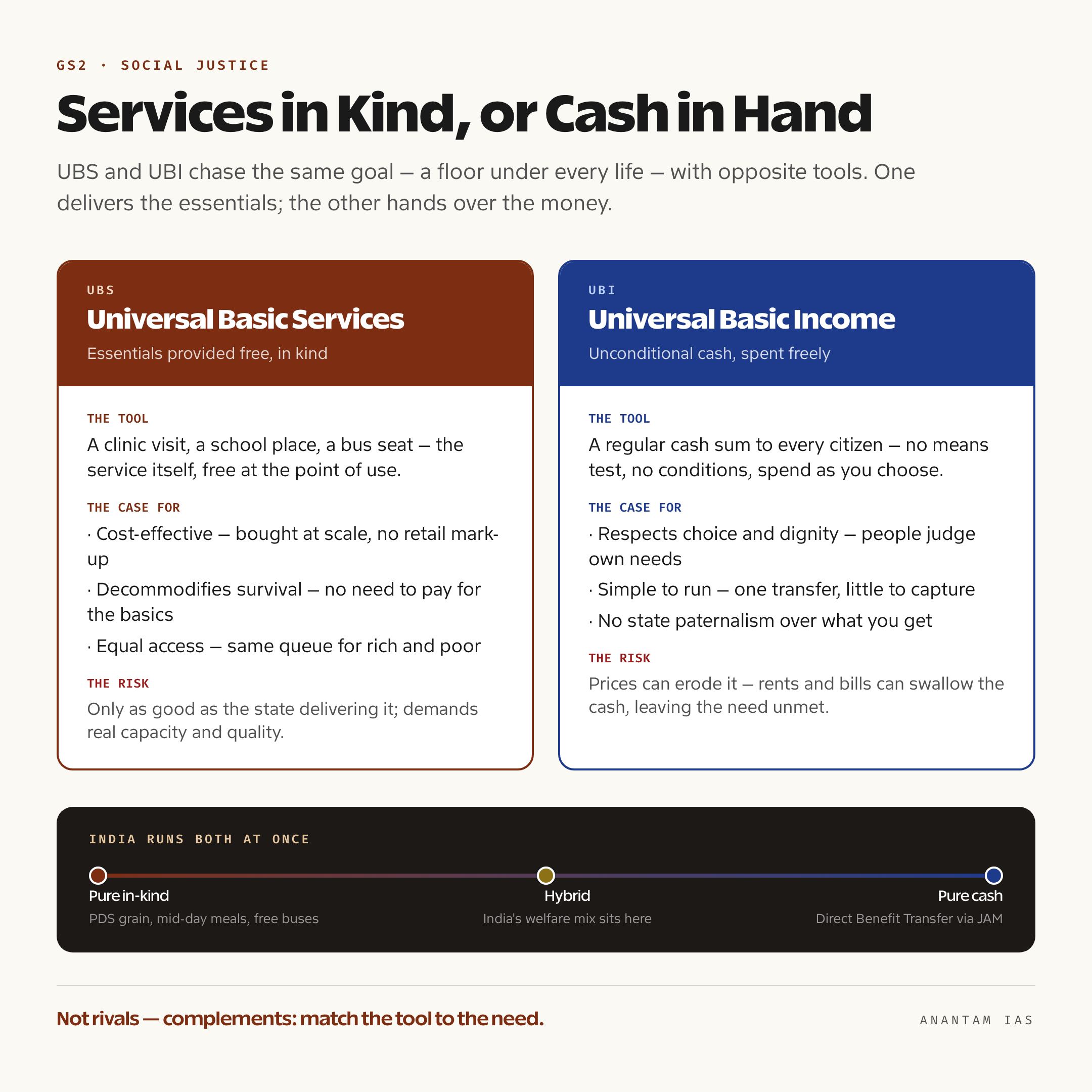
This is the comparison every examiner and editorial reaches for, so it is worth drawing cleanly. Universal Basic Income, or UBI, is the idea of paying every citizen an unconditional, regular cash sum — no means test, no work requirement, money in the bank to spend as they choose. Universal Basic Services flips that: instead of cash to buy essentials in the market, it gives the essentials directly, in kind, for free. One trusts the market and the individual; the other bypasses the market for a defined set of needs. Hold that single difference — cash versus in-kind — and most of the argument falls into place.
The case for UBS over cash rests on three planks. First, cost-effectiveness: a public health service or a public transport network buys care or mobility at wholesale, pooling risk and stripping out private profit, so a rupee spent collectively often buys more than the same rupee handed to an individual to spend retail. Second, decommodification, the technical term at the heart of welfare theory — the degree to which you can live a decent life without having to sell your labour or buy every necessity on the market. As the economic anthropologist Jason Hickel has argued, the power of universal public services is that people simply stop having to worry about paying for survival; the need is met before money ever enters the picture. Cash, by contrast, leaves you exposed to prices: a basic income can be eaten away by rising rents or medical bills, so a person can hold the cash and still go without the service. Third, equality of access: a free clinic treats the billionaire and the rickshaw-puller in the same queue, which builds a shared stake in keeping the service good — something a cash transfer, spent in segregated private markets, never does.
But the cash camp has serious replies, and a balanced answer carries both. UBI respects choice and dignity: it trusts people to know their own needs better than a distant bureaucracy, and avoids the paternalism of the state deciding everyone gets exactly this bus route and that food basket. It is administratively simpler — a single transfer is far cheaper to run than a sprawling apparatus of clinics, schools and depots, each of which can be captured, starved of funds or run badly. And it sidesteps the quality trap: an in-kind service is only as good as the state delivering it, and a poorly run public hospital can be worse than the cash to visit a private one. The honest framing is that the two are less enemies than complements — UBI works on the consumption side of the economy, UBS on the provision side, and many thinkers argue a real welfare floor needs a measure of both.
The Theory Behind It: Social Citizenship and the Welfare State
UBS sounds new, but its roots run deep into twentieth-century political thought, and naming those roots is what lifts an answer from descriptive to analytical. The foundational idea is “social citizenship,” set out by the British sociologist T.H. Marshall in his 1949 lecture Citizenship and Social Class. Marshall argued that citizenship had expanded in three waves: civil rights in the eighteenth century, such as liberty and equality before the law; political rights in the nineteenth, such as the vote; and social rights in the twentieth — the right, in his words, to “a modicum of economic welfare and security” and to “live the life of a civilised being according to the standards prevailing in the society.” Crucially, Marshall held that these social rights — to education, health and a basic standard of living — should belong to everyone as members of society, regardless of their ability to compete in the market. That is the moral DNA of UBS: certain things you get because you are a citizen, not because you can pay.
That idea matured into the post-war welfare state, the bundle of guarantees — public health, schooling, pensions, social insurance — that rich democracies built after 1945. Britain’s National Health Service, free at the point of use, is its purest example and the model UBS explicitly wants to extend to new sectors. The Danish sociologist Gøsta Esping-Andersen later gave the field its key yardstick — “decommodification,” the same concept above — and showed that the most generous welfare states, the Nordic ones, decommodify the most by providing high-quality universal services rather than thin, means-tested cash. UBS is, in effect, a twenty-first-century revival of that universalist tradition, dressed for an age of gig work, climate limits and automation, where its backers argue that broad public provision is both fairer and less wasteful of energy and resources than endless private consumption. We have traced this older lineage in our explainer on the welfare state and its evolution.
The real-world proof that UBS is not a fantasy is that pieces of it already exist everywhere. Britain’s NHS, free public schooling across the democratic world, public libraries, and the steady spread of free or subsidised public transport are all UBS in fragments. Recent transport experiments are the clearest live test: several Indian states now run buses free for women — Tamil Nadu since 2021, Karnataka’s Shakti scheme since 2023, with Kerala extending free women’s bus travel from 2026 — and the early data is striking, with the share of women commuting by bus in Tamil Nadu jumping from around 40 to over 60 per cent. Each is a small, real experiment in providing a basic service universally rather than pricing it. The question UBS poses is whether to scale that logic up into a coherent, deliberate floor.
The Critiques: Cost, Capacity, Quality and Choice
No serious answer can present UBS as a free lunch, and the criticisms are exactly where the marks are. The first and loudest is fiscal cost. Even the modest UK proposal added over two per cent of GDP a year; a genuinely generous basket of free health, housing, transport and digital access for everyone is enormously expensive, and the bill recurs forever. Critics ask the obvious question — who pays, through which taxes, and what gets cut to fund it — and warn that a state which over-promises universal services and under-funds them ends up with long queues and crumbling clinics that serve no one well.
The second critique is state capacity. UBS only works if the state can actually deliver good services at scale, reliably, without leakage or corruption. That is a tall order even for rich, well-administered countries; for a developing state with patchy local government, it is the central risk. A cash transfer can be wired straight to a bank account with little to go wrong in between; running a network of functioning hospitals and schools requires competent staff, supply chains, maintenance and oversight at every node, any of which can fail. This shades into the third critique, quality. An in-kind service is only as good as the institution behind it, and a badly run free service can trap the poor in second-rate provision while the better-off opt out into private markets — the very two-tier outcome UBS is meant to prevent. The free public hospital that is always understaffed can be worse than the cash to choose a private one.
The fourth critique is philosophical: paternalism versus choice. By delivering specific services, the state decides what people need and how they should get it, rather than trusting them with money to make their own choices. Defenders of cash argue this is condescending — that the poor are perfectly capable of spending wisely, and that dignity lies in choice, not in queuing for what officials have decided to provide. UBS supporters reply that for genuine necessities, choice is partly an illusion — nobody benefits from the “freedom” to skip a vaccine or pull a child out of school to save money — and that universal provision actually widens real freedom by removing the dull tyranny of having to afford survival. Where you land in that argument is, in the end, a values question, and a strong answer names it as such rather than pretending the evidence settles it.
The India Angle: From the Right to Food to the Freebies Row
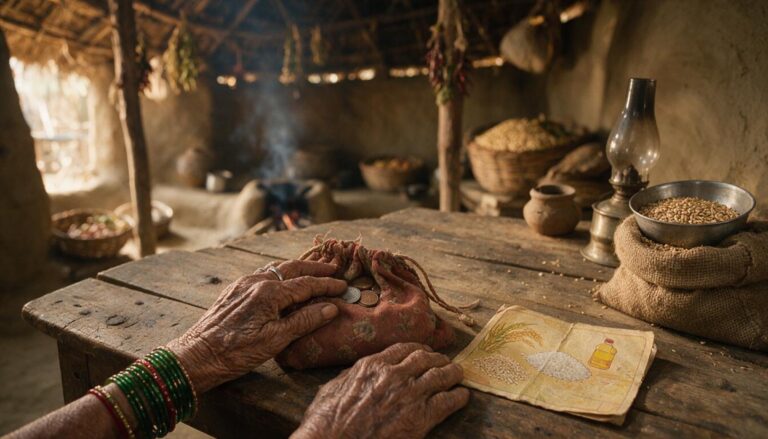
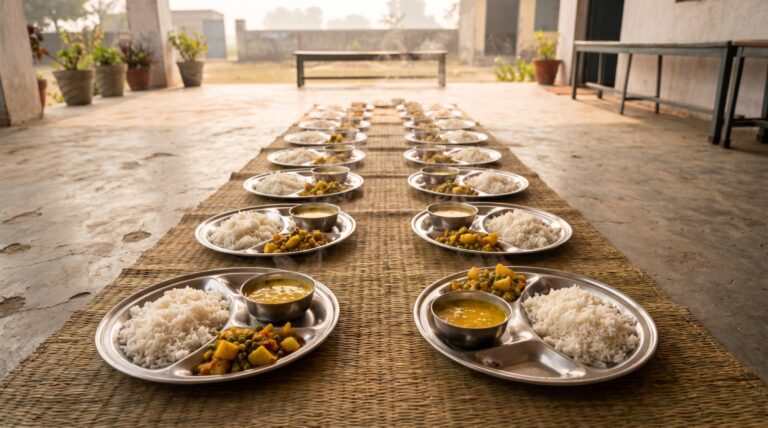
India has been quietly building pieces of a UBS system for decades, usually without calling it that, and this is the part of the answer that wins Indian marks. Our welfare story has steadily shifted from charity to rights — from things the state might give to things the citizen can claim. The Supreme Court read the right to food and the right to health into the right to life under Article 21; the 86th Constitutional Amendment made elementary education a fundamental right under Article 21A, delivered through the Right to Education Act of 2009; and the National Food Security Act of 2013 turned subsidised grain into a legal entitlement for up to two-thirds of the population, with free school meals through the mid-day meal scheme (now PM POSHAN). Layer on the public health push of Ayushman Bharat, public schooling, and the new wave of free-bus schemes, and India already runs a large, if patchy, basket of basic services delivered in kind. The country has been doing UBS in fragments for a generation.
Running alongside this, India has also become a world leader in the cash-transfer model, which makes it an unusually rich case study. The Direct Benefit Transfer system, built on the Aadhaar-bank-mobile “JAM” trinity, now pushes subsidies and payments straight into hundreds of millions of accounts, cutting out middlemen and the leakage that plagued the old in-kind delivery of subsidies. So the UBS-versus-UBI debate is not abstract here — it is the live fault line of Indian welfare design. Should the Public Distribution System keep handing out physical grain, or switch to cash so people can buy what they want? Should fertiliser and cooking-gas subsidies be services-in-kind or DBT? India is running both experiments at once, and the results feed directly into the global argument. We have examined the cash side of this in our piece on Direct Benefit Transfer and Aadhaar-linked welfare.
Which brings the whole topic back to the freebies row that opened it. The fight over “revadi” politics is really the UBS debate in Indian dress — an unresolved argument about which guarantees are legitimate investments in human capability and which are wasteful electoral bribes. As the Supreme Court itself struggled to articulate in 2026, free schooling, basic health and clean drinking water sit very differently from free televisions or untied cash sprayed before a vote, even if both are “free.” A UBS framing offers a way to cut that knot: the test is not whether something is free, but whether it is a basic service that builds a citizen’s capacity to live and participate — health, education, mobility, nutrition, connection — as against a one-off consumption handout that does not. India need not adopt UBS as a slogan to use its logic as a sorting rule. We have laid out the competing positions in our explainer on freebies versus welfare schemes, and the underlying tension between growth and redistribution in our piece on GDP growth versus income inequality.
For Your Mains Answer
This is a high-value, cross-cutting topic that lands squarely in GS Paper 2 under welfare schemes, government policies for vulnerable sections, issues of poverty and hunger, and the mechanisms and laws for protecting these groups. It also feeds GS Paper 3 on the economy, inclusive growth, mobilisation of resources and government budgeting, and gives the Essay paper a current frame on the welfare state, dignity and the meaning of development. The examiner rewards the candidate who can do two things: define UBS cleanly against UBI, and tie the abstract idea back to India’s own rights-based welfare and the freebies debate. Get those two moves right and the answer almost organises itself.
How to Build the Answer
Move from definition to debate to India. Open by defining UBS as free, in-kind access to essential services as a right of citizenship, and locate it against UBI (cash). Lay out the UBS case — cost-effectiveness, decommodification, equality of access — then the counter-case — choice, simplicity, quality and state-capacity risk — and conclude that the two are complementary, not rivals. Add depth with the theory (Marshall’s social citizenship, the welfare state, Esping-Andersen’s decommodification) and real-world proof (the NHS, free public transport experiments). Then bring it home: India’s rights-based shift (right to food and education, NFSA, RTE, Ayushman Bharat), its parallel DBT/cash leadership, and the freebies-versus-welfare row. Close by judging when in-kind beats cash and vice versa.
Common Mistakes to Avoid
Don’t treat UBS and UBI as the same thing — the cash-versus-in-kind distinction is the whole point. Don’t present UBS as obviously superior; the state-capacity and quality critiques are exactly what earn marks, especially for a developing country. Don’t forget the theory — an answer that names Marshall’s social citizenship and decommodification reads far stronger than one that only lists schemes. Don’t reduce the Indian freebies debate to a one-line mention; use it as the closing analytical hook. And don’t claim India has “adopted UBS” — say it runs many UBS-style guarantees alongside a large cash-transfer system.
A Compact Answer Spine
UBS = free, in-kind access to essential services (health, education, housing, transport, digital) as a right of citizenship, costed by UCL’s 2017 report → contrast with UBI (unconditional cash) → for UBS: cost-effective, decommodifies survival, equal access; for cash: choice, dignity, administrative simplicity → verdict: complementary, not rivals → theory: Marshall’s social citizenship, the welfare state, Esping-Andersen’s decommodification → real-world: NHS, free-bus experiments (Tamil Nadu, Karnataka, Kerala) → India: rights-based shift (Art 21A/RTE, NFSA 2013, Ayushman Bharat, mid-day meals) running beside DBT/JAM cash leadership → the freebies-versus-welfare row is the UBS debate in Indian dress → test: basic service that builds capability vs one-off consumption handout.
Diagram or Flowchart Idea
Draw a simple two-column box: on the left “UBS — services in kind, free at the point of use” with icons for health, school, bus and wifi; on the right “UBI — unconditional cash transfer,” with a single arrow into a wallet. Beneath, a thin spectrum line running from “pure in-kind (PDS grain)” to “pure cash (DBT),” with India marked somewhere in the middle. That one visual carries both the core distinction and India’s hybrid position at a glance.
A Balanced-Conclusion Line
A line that lands the marks: “The real choice is not cash against services but matching the tool to the need — handing over cash where people are the best judges, and guaranteeing services in kind where a need is too fundamental, too unequal or too easily priced out to be left to the market; India’s task is to sort its sprawling welfare into that logic, so that ‘free’ comes to mean a citizen’s capability rather than an election-eve bribe.”
How to Use Data Without Cramming
You need only a few anchors: UCL’s 2017 UBS report costed the UK basket at about £42 billion, or 2.3 per cent of GDP; India’s National Food Security Act of 2013 covers up to two-thirds of the population; the RTE Act flows from Article 21A; and free-bus schemes lifted women’s bus use in Tamil Nadu from roughly 40 to over 60 per cent. Drop those into the right sentences and attribute them plainly — “as the UCL Institute for Global Prosperity proposed” — rather than scattering numbers.
Frequently Asked Questions
What is Universal Basic Services in simple terms?
Universal Basic Services, or UBS, is the idea that everyone should get free or near-free access to a basket of essential services — typically health, education, housing, public transport, and digital or information access — funded collectively and provided in kind, as a right of citizenship rather than something you buy in the market. The term was popularised by a 2017 report from University College London’s Institute for Global Prosperity, which argued that extending free public services, in the spirit of Britain’s National Health Service, would cut poverty and insecurity more effectively than simply handing people cash.
How is UBS different from Universal Basic Income?
The difference is cash versus in-kind. Universal Basic Income gives every citizen an unconditional cash sum to spend as they choose, trusting the individual and the market. Universal Basic Services instead provides the essentials directly and free — a clinic visit, a school place, a bus seat — bypassing the market for a defined set of needs. UBS supporters argue services are cheaper at scale, harder for inflation to erode and more equal in access; UBI supporters argue cash respects choice, is simpler to run and avoids state paternalism. Many thinkers see the two as complementary rather than rivals.
What is the theory behind Universal Basic Services?
Its roots lie in the idea of “social citizenship” set out by T.H. Marshall in 1949 — the claim that, alongside civil and political rights, citizens have social rights to education, health and a decent standard of living simply as members of society. That idea built the post-war welfare state and was sharpened by Gøsta Esping-Andersen’s concept of “decommodification,” meaning the degree to which people can live well without having to buy every necessity on the market. UBS is a modern revival of that universalist tradition.
Does India have Universal Basic Services?
Not by that name, but India runs many UBS-style guarantees. The right to food and health have been read into the right to life, elementary education is a fundamental right under Article 21A delivered through the RTE Act, the National Food Security Act of 2013 makes subsidised grain a legal entitlement for up to two-thirds of the population, and schemes like mid-day meals, Ayushman Bharat and free-bus travel for women deliver essentials in kind. At the same time India leads on cash transfers through Direct Benefit Transfer, so it is effectively running the UBS-versus-UBI experiment at once — a tension visible in the ongoing “freebies versus welfare” debate.
Practice Questions
Prelims MCQs
- Which of the following best describes “Universal Basic Services” (UBS)?
(a) An unconditional cash payment made to every citizen
(b) Free or near-free access to a basket of essential services provided in kind to all
(c) A means-tested cash benefit for households below the poverty line
(d) A tax rebate scheme for users of public services
Answer: (b) UBS provides essential services such as health, education, housing and transport free at the point of use to everyone, as a right of citizenship, rather than as cash. - The concept of Universal Basic Services was prominently set out in a 2017 report by which institution?
(a) The International Monetary Fund
(b) The World Bank
(c) The Institute for Global Prosperity at University College London
(d) The Organisation for Economic Co-operation and Development
Answer: (c) UCL’s Institute for Global Prosperity published Social Prosperity for the Future: A Proposal for Universal Basic Services in October 2017. - With reference to the difference between UBS and Universal Basic Income (UBI), which statement is correct?
(a) UBS gives cash while UBI gives services
(b) Both provide unconditional cash transfers
(c) UBS provides essential services in kind, while UBI provides unconditional cash to spend freely
(d) UBI is always cheaper to run than UBS
Answer: (c) The core distinction is in-kind services (UBS) versus unconditional cash (UBI); each has different strengths. - The idea of “social citizenship” — that citizens hold social rights to education, health and a basic standard of living — is most closely associated with which thinker?
(a) John Rawls
(b) T.H. Marshall
(c) Amartya Sen
(d) Milton Friedman
Answer: (b) T.H. Marshall, in his 1949 lecture Citizenship and Social Class, set out the evolution of civil, political and social rights. - Which of the following Indian measures reflect an “in-kind” or services-based approach to welfare rather than a pure cash transfer?
(a) The National Food Security Act’s subsidised grain and the mid-day meal scheme
(b) Direct Benefit Transfer of subsidies into bank accounts
(c) Cash incentives paid under maternity benefit schemes
(d) Income-tax rebates for the middle class
Answer: (a) Subsidised grain through the PDS and free school meals are delivered in kind, in contrast to DBT, which transfers cash.
Mains Practice Questions
- What do you understand by “Universal Basic Services”? Examine how it differs from Universal Basic Income, and assess which approach is better suited to a developing country like India. (15 marks, 250 words)
- “The choice between cash transfers and in-kind services is, at bottom, a choice about decommodification and dignity.” Discuss with reference to the design of India’s welfare schemes. (15 marks, 250 words)
- Trace the theoretical roots of Universal Basic Services in the idea of social citizenship and the welfare state. How relevant is this tradition to twenty-first-century welfare policy? (15 marks, 250 words)
- India has steadily moved from a charity-based to a rights-based approach to welfare. Illustrate this shift with examples, and discuss its strengths and limitations. (10 marks, 150 words)
- “The ‘freebies versus welfare’ debate in India is really an argument about what counts as a basic service.” Critically examine this statement and suggest a framework for distinguishing legitimate welfare from electoral handouts. (15 marks, 250 words)
Tell Google you want more of this.
Add Anantam IAS as a preferred sourceOne tap, and this site shows up more often in your own Top Stories, AI Overviews and AI Mode. Remove it any time.