FRBM Act — Fiscal Responsibility and Budget Management, Targets & NK Singh Committee
UPSC guide to the FRBM Act 2003 — fiscal deficit targets, revenue deficit, escape clause, NK Singh Committee, amendments, and COVID-19 impact.
The Fiscal Responsibility and Budget Management (FRBM) Act, 2003 is the cornerstone legislation that governs fiscal discipline for the Government of India. Enacted to institutionalise prudent fiscal management, reduce fiscal and revenue deficits, and ensure long-term macroeconomic stability, the Act has been amended several times — most significantly based on the recommendations of the N.K. Singh Committee (2017). Its escape clause was invoked during the COVID-19 pandemic when deficits ballooned. For UPSC Prelims, GS Paper III (Economy) and Economic Survey-based questions, the FRBM framework is among the most examined topics.
Background — Why FRBM Was Enacted
The Fiscal Crisis of 1991
India’s balance of payments crisis in 1991 revealed deep structural weaknesses:
- Fiscal deficit had climbed to over 8% of GDP
- Revenue deficit reflected chronic dis-saving by government
- External debt and inflation were spiralling
- Forex reserves dipped below $1 billion — barely two weeks of imports
Post-liberalisation, successive governments recognised that fiscal profligacy would undermine reforms. A rule-based fiscal framework was needed.
Path to the Act
- 1997 — proposal for fiscal responsibility legislation floated
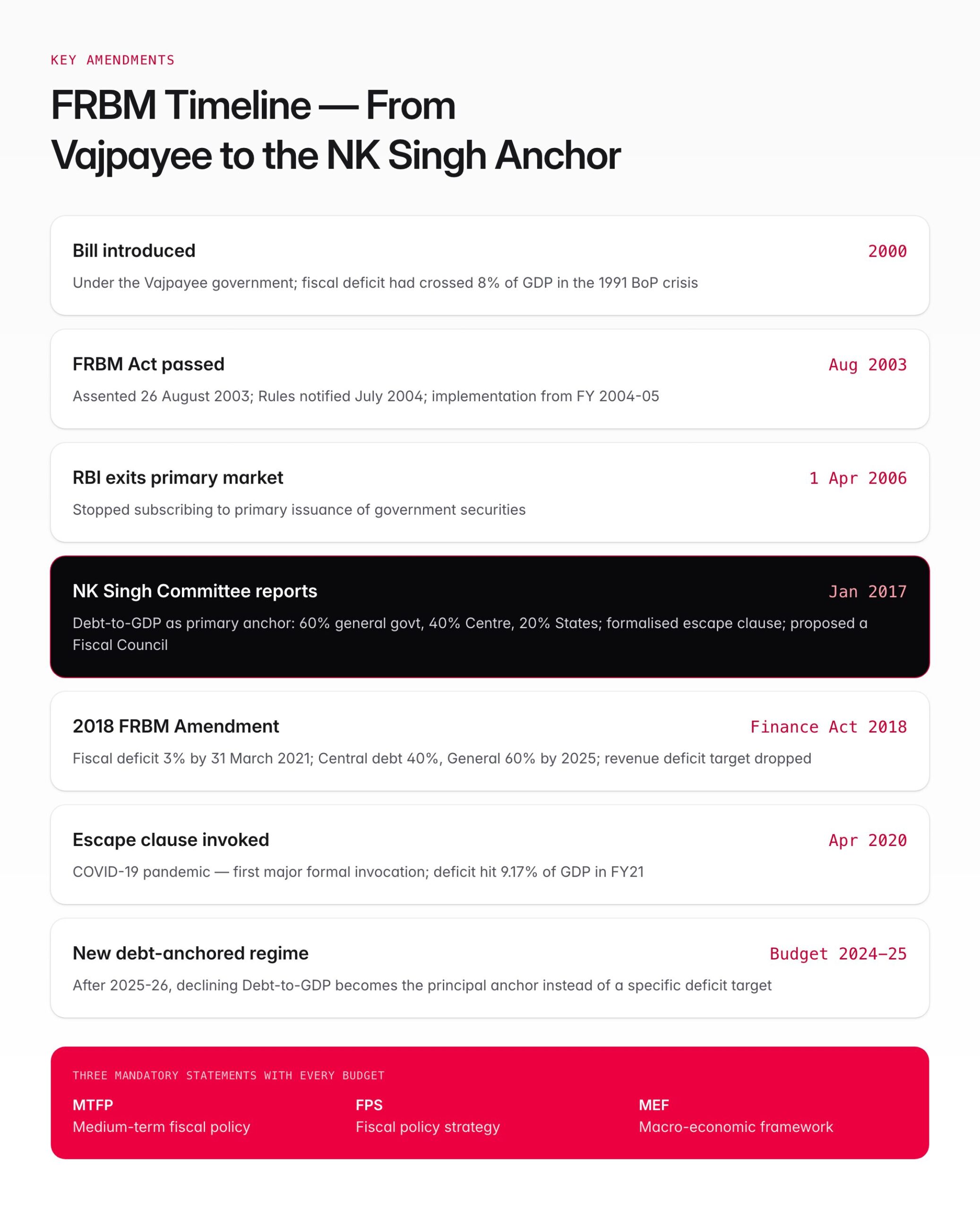
- 2000 — FRBM Bill introduced in Parliament under Vajpayee government
- August 2003 — FRBM Act passed; assented by President on 26 August 2003
- July 2004 — FRBM Rules notified; implementation began in FY 2004–05
Objectives of the FRBM Act
The Act's preamble lists four main objectives:
- Ensure inter-generational equity in fiscal management — today's government must not impose debt burdens on future generations
- Achieve long-term macroeconomic stability
- Remove fiscal impediments to effective conduct of monetary policy by the RBI
- Provide prudential debt management consistent with fiscal sustainability through limits on debt, deficits and borrowing
Original Targets (2003 Act, as originally envisaged)
| Target | Deadline | Level |
|---|---|---|
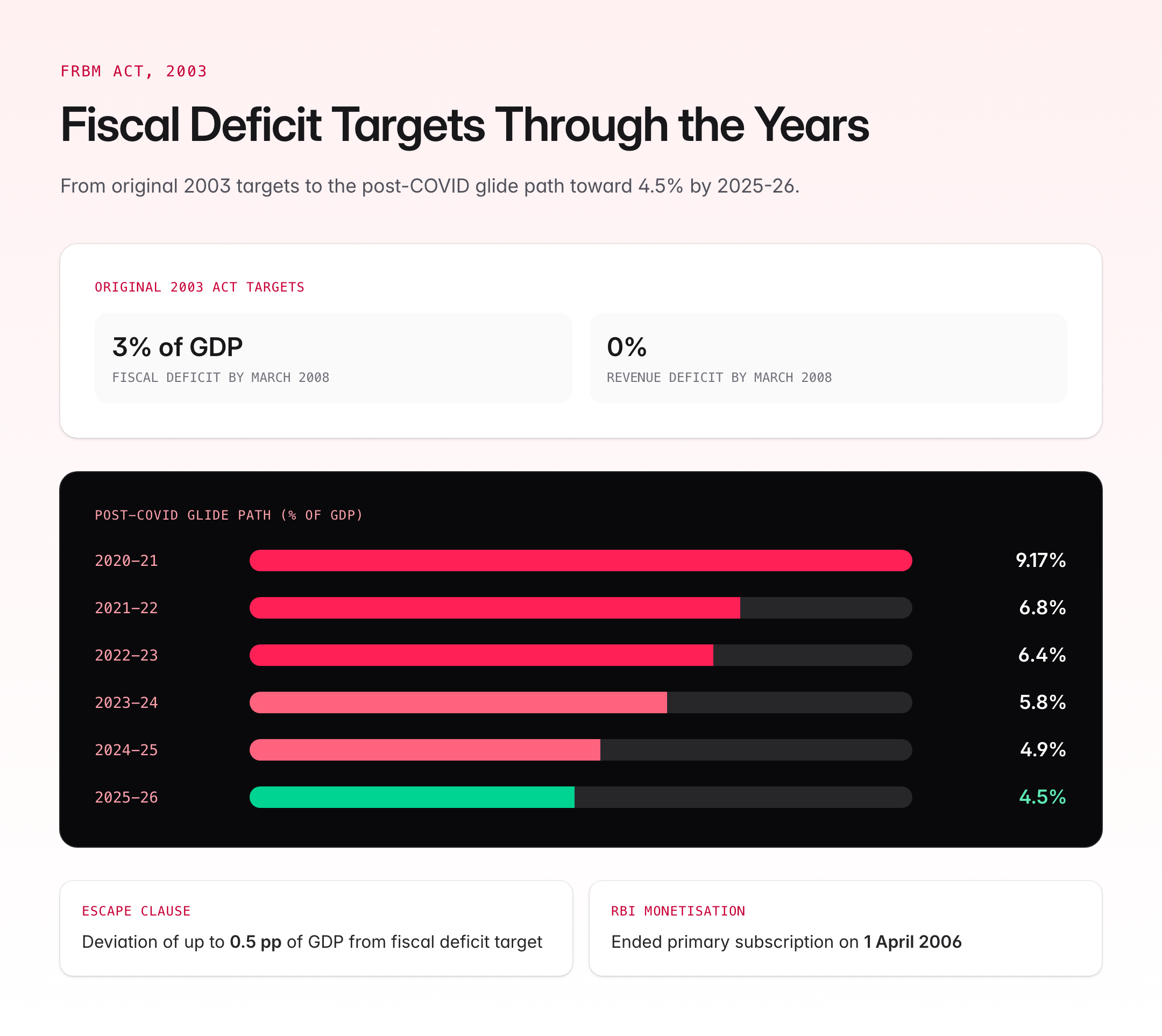
| Revenue deficit | March 2008 | Eliminated (reduce to 0% of GDP) |
| Fiscal deficit | March 2008 | 3% of GDP |
| Contingent liabilities | Annually | ≤ 0.5% of GDP (new guarantees) |
| Additional liabilities | Annually | ≤ 9% of GDP |
| RBI borrowing | March 2006 | End direct monetisation from primary market |
The RBI ceased subscribing to primary issuance of government securities from 1 April 2006 — a major structural shift.
Key Features
Fiscal Policy Statements
Every year, along with the Budget, the Government must lay before Parliament three statements:
| Statement | Purpose |
|---|---|
| Medium-Term Fiscal Policy (MTFP) Statement | Three-year rolling targets for fiscal indicators |
| Fiscal Policy Strategy Statement | Policy stance and rationale for deviations |
| Macro-economic Framework Statement | GDP growth assumptions, macro outlook |
Post-2017 amendment, a Medium-Term Expenditure Framework (MTEF) is also presented.
Quarterly Review
The Finance Minister must review quarterly the trends in fiscal indicators and place the review before Parliament.
Escape Clause
The Act allows the government to deviate from targets under exceptional circumstances — this is the escape clause (detailed below).
The N.K. Singh Committee, 2017
The government constituted the FRBM Review Committee under N.K. Singh (former Revenue Secretary, later 15th Finance Commission Chair) in May 2016. It submitted its report in January 2017.
Key Recommendations
| Recommendation | Details |
|---|---|
| Debt as anchor | Use Debt-to-GDP ratio as primary fiscal anchor instead of fiscal deficit |
| Debt target | 60% for general government (Centre + States) by 2022–23 — Centre 40%, States 20% |
| Fiscal deficit | Glide path to 2.5% of GDP by 2022–23 |
| Revenue deficit | 0.8% of GDP by 2022–23 |
| Escape clause | Formalised — allow deviation of up to 0.5% of GDP under specified circumstances |
| Fiscal Council | Establish an independent Fiscal Council for oversight |
| New FRBM Act | Replace the 2003 Act with a modern Debt and Fiscal Responsibility Act |
Escape Clause — Formalised Triggers
The Committee recommended invoking the escape clause only under:
- National security, war or national calamity
- Collapse of agriculture affecting output and income
- Structural reforms with unanticipated fiscal implications
- Sharp decline in real GDP growth — at least 3 percentage points below average of previous four quarters
2018 Amendment to FRBM Act
The government amended the FRBM Act in the Finance Act, 2018, based on (but not fully implementing) the N.K. Singh report.
| New target | Level |
|---|---|
| Fiscal deficit | 3% of GDP by 31 March 2021 |
| Central Government Debt | 40% of GDP by 31 March 2025 |
| General Government Debt | 60% of GDP by 31 March 2025 |
| Revenue deficit | Dropped as a standalone binding target |
Effective Revenue Deficit (ERD) — defined as revenue deficit minus grants for creation of capital assets — was later also dropped.
Statutory Escape Clause
The amended Act allows deviation up to 0.5 percentage points of GDP from the fiscal deficit target in the event of:
- Far-reaching structural reforms with unanticipated fiscal implications
- Decline in real output growth of at least 3 percentage points below its 4-quarter moving average
- National security, act of war, national calamity, agriculture collapse
Any deviation must be accompanied by a statement explaining reasons and the path to return to targets.
Key Deficit Concepts
Understanding FRBM requires mastering deficit definitions:
| Deficit | Formula | What it measures |
|---|---|---|
| Revenue Deficit | Revenue Expenditure − Revenue Receipts | Day-to-day dis-saving |
| Fiscal Deficit | Total Expenditure − (Revenue Receipts + Non-debt Capital Receipts) | Total borrowing requirement |
| Primary Deficit | Fiscal Deficit − Interest Payments | New borrowing need excluding past debt servicing |
| Effective Revenue Deficit | Revenue Deficit − Grants for Capital Asset Creation | Dropped from FRBM targets |
| Monetised Deficit | Net RBI credit to Centre | Now obsolete since 2006 |
COVID-19 and the Escape Clause
The COVID-19 pandemic was the first major invocation of the formal escape clause.
Timeline
- Budget 2020–21: Fiscal deficit projected at 3.5% of GDP
- April 2020: Escape clause invoked due to pandemic
- Revised estimates 2020–21: Fiscal deficit spiked to 9.2% of GDP
- Actual 2020–21: 9.17% of GDP — highest since 1991
- Budget 2021–22: Fiscal deficit targeted at 6.8% of GDP, with new glide path to 4.5% by 2025–26
New Glide Path (Post-COVID)
| Year | Fiscal Deficit Target (% of GDP) |
|---|---|
| 2020–21 (actual) | 9.17 |
| 2021–22 | 6.8 (RE) |
| 2022–23 | 6.4 |
| 2023–24 | 5.8 (RE 5.9) |
| 2024–25 | 4.9 (BE) |
| 2025–26 | 4.5 (target) |
The Budget 2024–25 introduced a new approach — after 2025–26, the government plans to use declining Debt-to-GDP as the principal anchor rather than a specific fiscal deficit target.
State-Level FRBM Legislation
FRBM is not just a Central statute. States too have enacted FRBM laws on the recommendation of the 12th Finance Commission (2005–10):
- 28 States + 3 UTs (with legislatures) have their own FRBM/FRL Acts
- State-level targets typically: fiscal deficit ≤ 3% of GSDP, debt-to-GSDP limits
- Post-COVID, states were allowed 5% fiscal deficit in FY21 with conditional reforms
- Article 293(3) of the Constitution — states need Centre's consent to borrow
Fiscal Council — A Missing Piece
The N.K. Singh Committee strongly recommended creating an independent Fiscal Council to:
- Provide multi-year forecasts
- Assess compliance with FRBM targets
- Evaluate fiscal implications of policy proposals
- Promote fiscal transparency
As of 2025, India has not established a formal Fiscal Council, although the 15th Finance Commission also endorsed the idea. The CAG and Office of the Chief Economic Adviser partially fulfil oversight roles.
Criticism of the FRBM Framework
- Rigid targets may constrain counter-cyclical fiscal policy in downturns
- Focus on headline numbers can encourage off-budget borrowings (e.g., FCI, NHAI historically)
- Revenue deficit relaxation reduced emphasis on quality of deficit
- Escape clause invocations lack independent review
- No Fiscal Council means self-assessment by the Finance Ministry
- State FRBMs have varying rigour and compliance
- Exclusion of off-budget items — including extra-budgetary resources (EBRs) — distorts true fiscal position; now being corrected
International Comparison
| Country | Fiscal Rule | Anchor |
|---|---|---|
| India | FRBM Act, 2003 | Fiscal deficit / Debt-to-GDP |
| EU Maastricht | Stability and Growth Pact | Deficit ≤ 3%, Debt ≤ 60% of GDP |
| Germany | Debt brake (2009) | Structural deficit ≤ 0.35% |
| Switzerland | Debt brake (2003) | Balanced budget over cycle |
| Brazil | Fiscal Responsibility Law (2000) | Primary surplus |
UPSC Relevance
GS Paper Mapping
- GS Paper III — Government Budgeting, Fiscal policy, Indian economy and issues relating to planning, mobilization of resources, growth
- GS Paper II — Parliament and state legislatures (fiscal federalism); statutory bodies
- Economic Survey and Union Budget — annual reading
Prelims Pointers
- FRBM Act enacted: 2003 (assented 26 August 2003); Rules notified July 2004
- Passed under the Atal Bihari Vajpayee government
- Original target: Fiscal deficit 3% of GDP and revenue deficit 0 by March 2008
- RBI stopped subscribing to primary government securities from 1 April 2006
- N.K. Singh Committee — constituted 2016, reported January 2017
- NK Singh recommended Debt-to-GDP (60% general govt, 40% Centre, 20% States) as anchor
- Escape clause — up to 0.5 percentage points of GDP deviation
- 2018 Finance Act amended FRBM; dropped revenue deficit target
- COVID-19 (FY21): Fiscal deficit hit 9.17% of GDP — escape clause invoked
- New glide path: fiscal deficit to 4.5% of GDP by 2025–26
- Effective Revenue Deficit = Revenue Deficit − Grants for capital asset creation; dropped from targets
- Article 293(3) — states need Centre's consent to borrow
- Fiscal Council — recommended by NK Singh Committee, yet to be established
- Three Budget Statements: MTFP, Fiscal Strategy, Macro-economic Framework
The FRBM Act remains India's primary fiscal constitution — binding the Centre to rule-based discipline while retaining flexibility to respond to genuine shocks. The next decade will see whether a Fiscal Council and a debt-anchored regime complete the reform.