Freebies vs Welfare Schemes: The DPSP Shield, Article 282 and the S. Subramaniam Balaji Verdict
Freebies vs welfare schemes explained: no legal definition under RPA 1951, the S. Subramaniam Balaji 2013 verdict, Article 282, DPSP shield, ECI guidelines and the merit goods debate.
The line between a “welfare scheme” and a “freebie” has become one of the most contested questions in Indian electoral and fiscal policy. On one side stand cash transfers, free electricity, free bus rides, smartphones and laptops promised in election manifestos. On the other side stand the Public Distribution System, MGNREGA, PM Awas Yojana and old-age pensions. The state spends on both. The Supreme Court has been asked, repeatedly, to draw the line. So far, it has refused to give a clean answer.
Part of the difficulty is constitutional. The Directive Principles of State Policy actively direct the state to “promote the welfare of the people,” “minimise inequalities in income,” and ensure that “the operation of the economic system does not result in concentration of wealth.” Welfare spending is not just permitted under the Constitution; it is mandated. Article 282 lets the Union or any state make grants for any “public purpose,” even if that purpose lies outside the legislative competence of the granting government. The constitutional architecture is generous to spending decisions made by elected legislatures.
This guide unpacks the legal meaning of the term “freebie,” the landmark S. Subramaniam Balaji judgment of 2013, the role of the Election Commission of India, the merit and non-merit goods framework borrowed from public economics, and the way the debate has reopened in the courtrooms and finance commission rooms in 2024 and 2025.
Quick Facts on the Freebies Debate
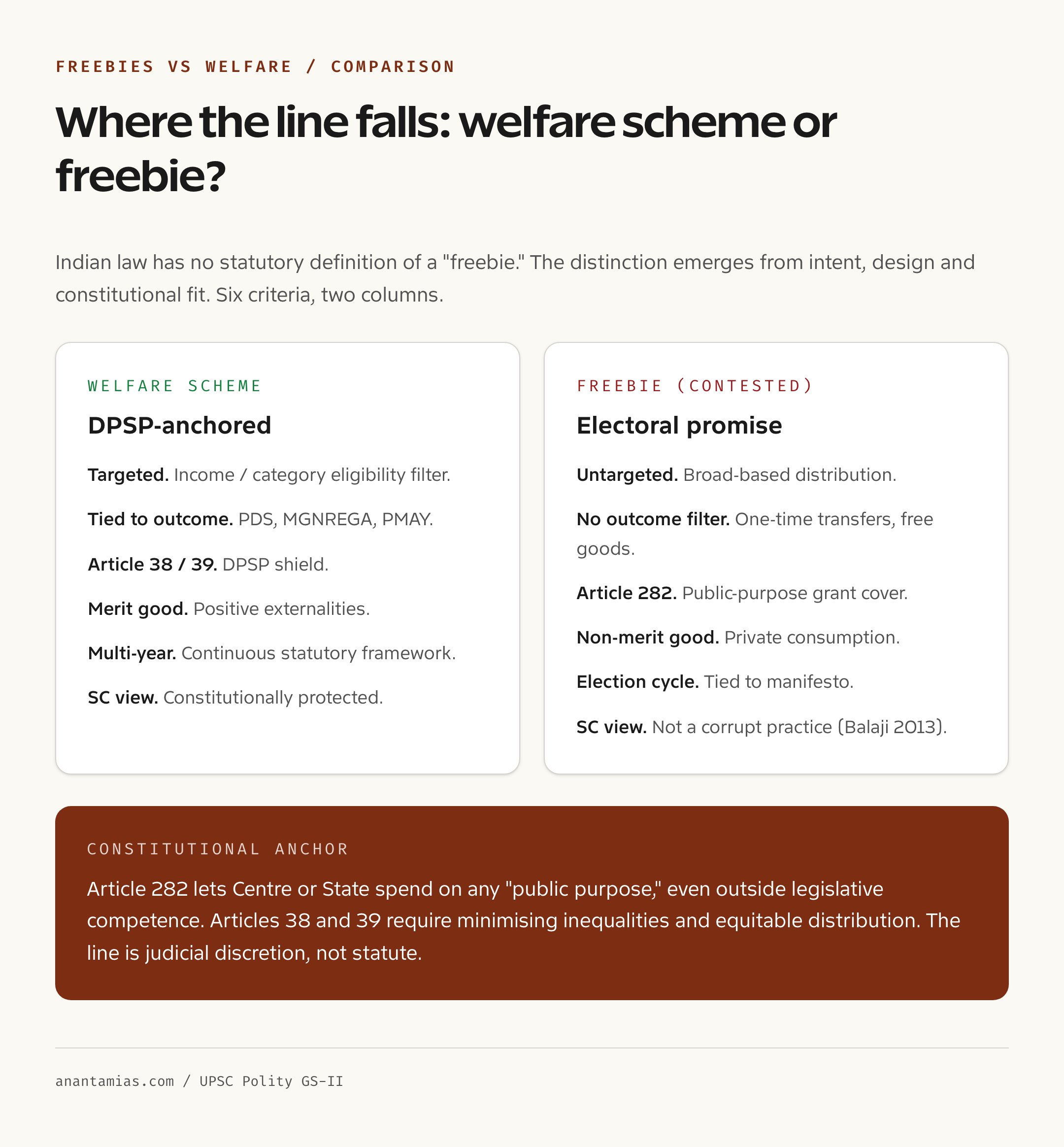
There is no precise legal definition of the term “freebie” in the Representation of the People Act, 1951, or in the Constitution of India. The Supreme Court of India settled the constitutional position in S. Subramaniam Balaji v. State of Tamil Nadu in 2013, ruling that election manifesto promises do not constitute a “corrupt practice” under Section 123 of the RPA. Article 282 of the Constitution authorises grants by the Union or a state for any public purpose. Articles 38 and 39 of the Directive Principles of State Policy require the state to minimise inequalities and ensure equitable distribution of resources. Following the Balaji verdict, the Election Commission of India introduced Part VIII of the Model Code of Conduct dealing with manifesto promises. The Model Code of Conduct itself does not have statutory backing and rests on moral pressure rather than legal enforcement.
What “Freebies” and “Welfare Schemes” Actually Mean
In ordinary usage, a “freebie” is anything the government distributes free of cost to voters, especially close to an election. A “welfare scheme” is anything that fulfils a constitutional obligation of the state to the citizen. The two definitions overlap. Almost every welfare scheme is given free; almost every freebie is given to citizens who genuinely need it. The conceptual gap shows up only when you look at the design and the intent.
A welfare scheme is usually targeted, time-bound, and tied to an outcome. PM Awas Yojana houses families below a defined income line. MGNREGA pays wages for 100 days of unskilled rural work. The Public Distribution System gives subsidised foodgrain to ration card holders. Each scheme has a stated objective, an eligibility filter, and a measurable result. A freebie, in the critic’s vocabulary, is broad-based, unconditional, untargeted, and tied to an electoral cycle. A free smartphone for every voter, free electricity above a basic threshold, or a one-time cash grant before polling all sit closer to this end of the spectrum.
Background and Historical Context
The debate goes back at least to the Tamil Nadu elections of 2006, when the state’s two major parties competed by promising free colour televisions to ration card holders. The promises were honoured after the election, with thousands of crores of rupees of state expenditure tied to the manifesto commitment. A taxpayer, S. Subramaniam Balaji, filed a writ petition arguing that such promises amounted to bribery in a democratic election and were therefore a “corrupt practice” under Section 123 of the Representation of the People Act, 1951. The case wound its way through the Madras High Court and reached the Supreme Court in 2013.
The political backdrop has only intensified since then. State after state has announced versions of similar schemes. Free electricity up to a stated unit of consumption, free bus rides for women, free pilgrimages for senior citizens, free laptops for students, and direct cash transfers to women homemakers have all featured prominently in recent state and general elections. The fiscal weight of these announcements has alarmed the Reserve Bank of India, the Finance Commission, and successive Comptroller and Auditor General reports, each of which has warned that competitive freebie politics is putting state finances under strain.
In August 2022, a fresh public interest litigation by Ashwini Kumar Upadhyay reopened the issue before the Supreme Court. The Court suggested an expert committee involving the Election Commission, the Reserve Bank, the NITI Aayog, the Finance Commission and parliamentary parties to define the line. The matter is still being argued, with the Court treading carefully around the doctrine that election manifestoes are policy statements, not bribes.
The S. Subramaniam Balaji Verdict, 2013
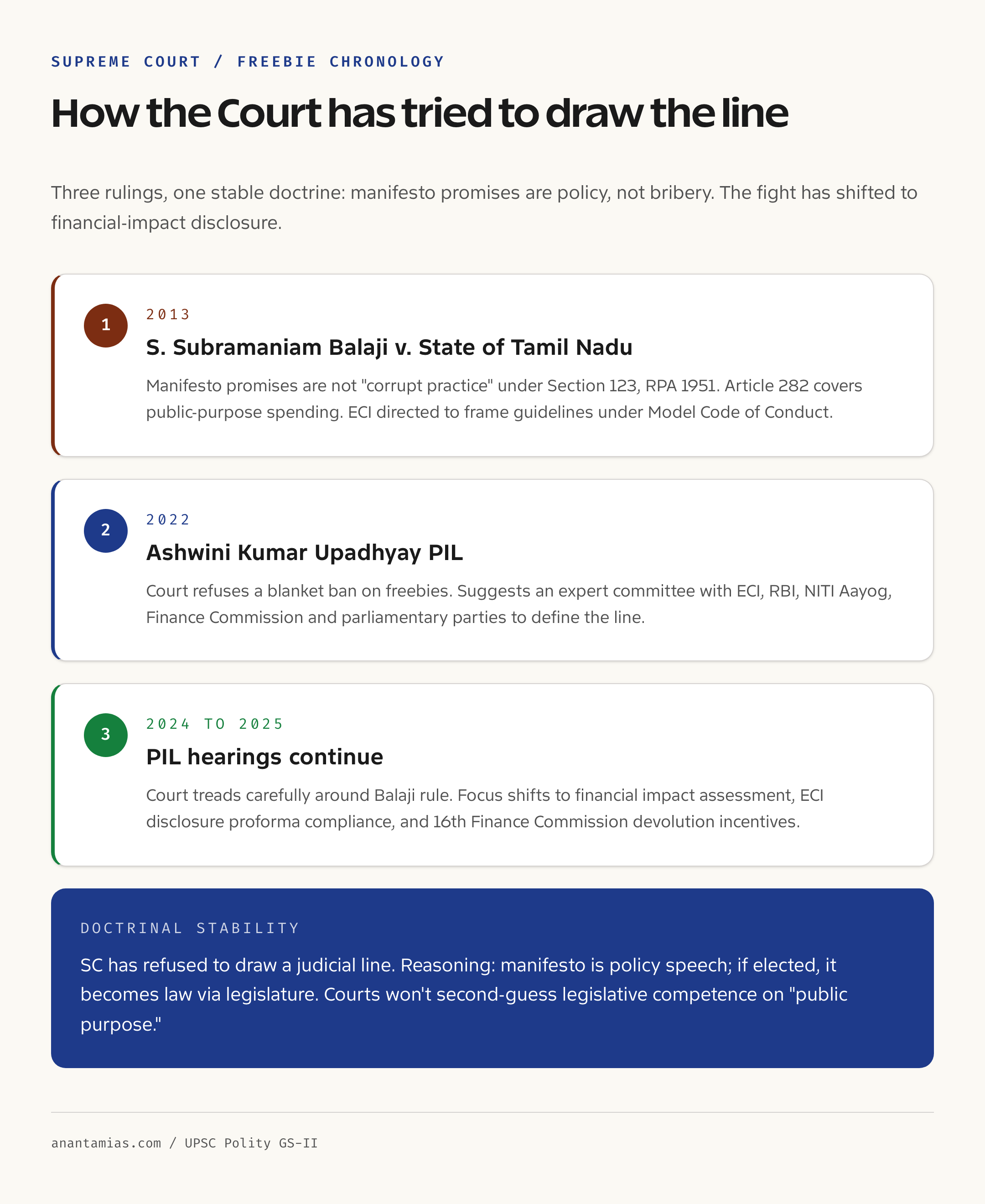
The Supreme Court in Balaji held three things, all of which still define the legal field. First, an election manifesto promise is not a “corrupt practice” under Section 123 of the RPA. The court reasoned that bribery under Section 123 requires an offer or gift to an individual voter in exchange for a vote. A manifesto promise is addressed to the entire electorate, not to a single voter; if the party comes to power, the promise is implemented through legislation or executive order, which is a process of governance rather than individual bribery. The argument tracks the constitutional separation between the electoral act and the legislative act.
Second, Article 282 gives the state the constitutional cover to spend on such schemes, even if the subject matter does not fall within its legislative competence. The Article allows grants for any “public purpose,” and the Court refused to second-guess legislatures on what counts as a public purpose. As long as the grant is voted by the legislature and signed off by the executive, it is constitutionally protected.
Third, the Court directed the Election Commission of India to consult political parties and frame guidelines within the Model Code of Conduct to regulate manifesto promises. This was a soft response. The Court did not strike down the practice or order any party to drop a promise. It nudged the constitutional regulator to draw the lines through stakeholder consensus rather than judicial fiat.
ECI Guidelines: Part VIII of the MCC
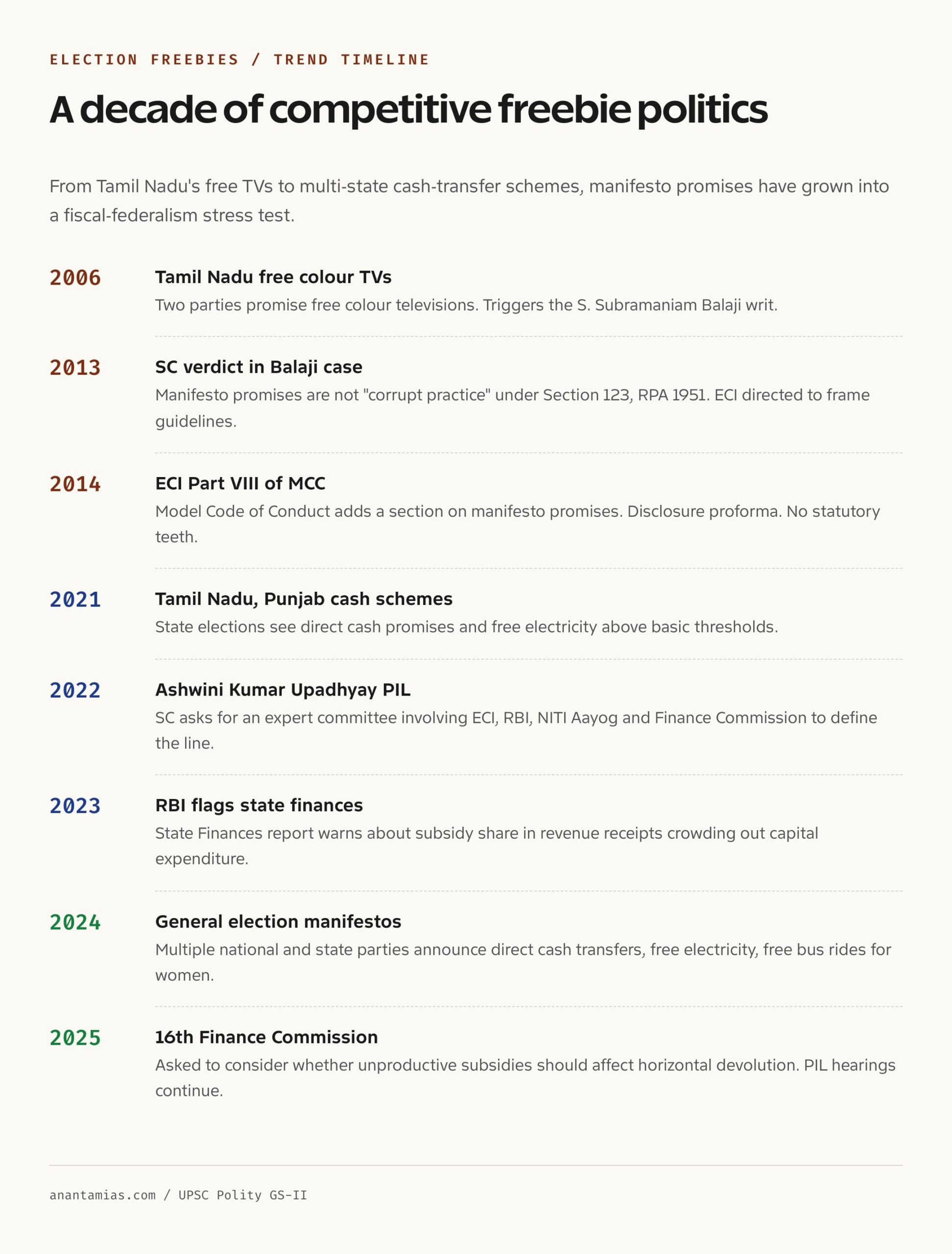
Following the Balaji verdict, the Election Commission consulted recognised national and state parties and added Part VIII to the Model Code of Conduct. The guidelines have three core asks. Parties must explain the rationale of any manifesto promise. Parties must indicate broadly the ways and means of financing such promises. Promises should not be such that they “shake the purity of the election process or vitiate the conduct of free and fair elections.” Promises should also be limited to what is feasible within the financial state of the government.
The ECI later introduced a standardised proforma asking parties to disclose the financial implications of major announcements before voting day. The proforma asks for the estimated annual cost, the source of funding, and the expected impact on the fiscal deficit. Compliance has been patchy. Parties file the disclosures, but the disclosures are not legally enforceable.
The deeper limit is that the Model Code of Conduct does not have statutory backing. The MCC is a moral document agreed upon by political parties and enforced by the Election Commission as part of its constitutional role under Article 324. Unlike a violation of the RPA, an MCC breach cannot directly disqualify a candidate or void a result. The Election Commission can issue a notice, censure a party, or refer matters to the Supreme Court, but cannot impose statutory penalties.
Article 282, the DPSP Shield, and the Constitutional Cover
Article 282 has done most of the heavy lifting in defending welfare and freebie spending. It reads simply: the Union or a state may make any grant for any public purpose, notwithstanding that the purpose is not one with respect to which Parliament or the legislature, as the case may be, may make laws. The width of the phrase “public purpose” has allowed central and state governments to support an enormous range of programmes that would not otherwise have a clear legislative anchor.
Articles 38 and 39 of the Directive Principles provide the substantive constitutional backing. Article 38 requires the state to promote the welfare of the people by securing a social order in which justice, social, economic and political, informs all institutions of national life. It also requires the state to strive to minimise inequalities in income and eliminate inequalities in status, facilities and opportunities. Article 39 directs the state to ensure adequate means of livelihood for all citizens, distribution of material resources to subserve the common good, and prevention of concentration of wealth.
The Supreme Court has consistently treated DPSPs as the lighthouse for state spending. Even when DPSPs are not directly enforceable, they guide judicial interpretation of executive action. A welfare programme that aligns with Articles 38, 39, 41 (right to work and public assistance) or 47 (duty to raise the standard of living) gets a strong constitutional presumption of validity.
Merit vs Non-Merit Goods: The Economic Lens
Public economics offers a cleaner analytical line than constitutional law. A merit good is a good that produces positive externalities beyond the individual consumer; the state has an economic case for subsidising it because the benefit spills over to society. Education, health care, vaccinations, public transport, sanitation, and subsidised food fall within this category. The wider society gains from a more educated, healthier, and better-fed population. A non-merit good is a private consumption good whose benefit is captured almost entirely by the individual user. Free gold, free television sets, free smartphones beyond a defined need, or free electricity well above basic consumption thresholds typically fall into this category.
The merit and non-merit framework cannot fully resolve the political question, but it gives policymakers a defensible metric. A freebie that subsidises a merit good is on stronger fiscal and ethical ground than a freebie that subsidises a non-merit good. A direct cash transfer that flows to women below a defined income threshold to support household nutrition is closer to merit territory than a one-time payment to all voters above a certain age.
Detailed Analysis of the 2024 to 2025 Debate
The 2024 to 2025 phase of the debate has been driven by three forces. The Reserve Bank of India’s State Finances reports have flagged that aggregate state subsidies as a share of revenue receipts have climbed sharply in some states, with Punjab, Telangana, Andhra Pradesh, and Karnataka under particular fiscal stress. The Sixteenth Finance Commission has been asked to consider whether unproductive subsidy expenditure should affect the horizontal devolution formula. And the Supreme Court has been asked to enforce a clearer line through the Ashwini Kumar Upadhyay PIL.
The Court’s approach has remained cautious. In the December 2022 hearing, a three-judge bench refused to accept a blanket ban on manifesto promises, holding that the matter required executive expertise and legislative consideration rather than judicial drafting. The Court instead asked stakeholders to constitute an expert committee. The PIL is still alive, with hearings ongoing in 2025, and the Court has shown no appetite for revisiting the Balaji rule that manifesto promises are not corrupt practices.
Comparative View: Freebies, Welfare and the Indian Federal Picture
Freebie politics is a function of competitive federalism. States that face tight fiscal space and high political competition tend to outbid each other on welfare promises. Tamil Nadu, Andhra Pradesh, Telangana, Punjab, Karnataka and Madhya Pradesh have been particularly active. States with stronger fiscal discipline, such as Odisha and Maharashtra, have been comparatively restrained, although the trend is converging.
The federal complication is that grants under Article 282 do not need to be tied to legislative competence. A state can spend on a programme that overlaps with central schemes, and a central scheme can flow through state machinery to deliver welfare. This makes the political competition cross-cutting; voters compare central and state benefits, and parties compete with each other across both layers.
Challenges, Concerns and the Fiscal Federalism Stress Test
The challenges fall into four buckets. Fiscal sustainability is the first; subsidies funded through borrowed money build up to debt-stress thresholds set by the Fiscal Responsibility and Budget Management Acts. Political incentive misalignment is the second; the marginal voter responds to short-term transfers more than to long-term capital investment, and parties respond accordingly. Targeting and leakage form the third; broad-based freebies often miss the most needy and reach the comfortably middle-class. Constitutional ambiguity is the fourth; Article 282 and the Directive Principles together give such wide latitude that courts struggle to draw any operational line.
A fifth concern, raised by the Sixteenth Finance Commission consultations, is the crowd-out effect on capital expenditure. States that lock larger shares of revenue into recurring subsidies have less left for roads, irrigation, public health infrastructure and digital public goods, even though those are exactly the items that produce long-run welfare gains.
Prelims Pointers
For the UPSC Prelims, anchor the topic on a few sharp facts. There is no statutory definition of “freebie.” The S. Subramaniam Balaji judgment dates to 2013. Section 123 of the RPA defines corrupt practices and does not cover manifesto promises. Article 282 enables grants for any public purpose. Article 38 directs the state to minimise inequalities; Article 39 ensures equitable distribution. The Election Commission added Part VIII of the Model Code of Conduct to deal with manifesto promises. The MCC is not statutorily enforceable. Merit goods enjoy positive externalities; non-merit goods do not. The Ashwini Kumar Upadhyay PIL of 2022 reopened the question before the Supreme Court.
Mains Practice Questions
These questions track recent UPSC and state PSC patterns.
- “The Indian Constitution enables welfare spending but provides no operational test to distinguish a welfare scheme from an electoral freebie.” Discuss with reference to Article 282 and the Directive Principles of State Policy. (15 marks, 250 words)
- Examine the role of the Election Commission of India in regulating manifesto promises. Why has the Model Code of Conduct’s Part VIII been described as a moral document rather than an enforceable regulation? (10 marks, 150 words)
- “Freebies are a stress test for cooperative and competitive federalism in India.” Comment in the light of recent Reserve Bank of India and Finance Commission observations on state finances. (15 marks, 250 words)
Way Forward
The credible reform path runs through three doors. The first is statutory teeth for the Model Code of Conduct, either by an amendment to the Representation of the People Act or by a fresh enactment that brings manifesto disclosures within an enforceable framework. The second is a financial impact assessment requirement, modelled on independent costing offices in other democracies, that vets every major manifesto promise before the campaign begins. The third is a fiscal federalism reform that builds incentive alignment into the Finance Commission devolution formula, rewarding states that maintain a defined share of capital expenditure relative to recurring subsidy.
Two further reforms would help on the design side. Outcome budgeting, where every welfare scheme reports measurable outcomes against a baseline, would discipline programme selection. Direct benefit transfers anchored to verified eligibility would push spending towards the merit-good end of the spectrum and reduce the political appeal of broad-based freebies. None of these requires constitutional amendment; all of them require sustained political effort.
Frequently Asked Questions
What is the legal definition of a freebie in India?
There is no precise legal definition of the term u0022freebieu0022 in the Representation of the People Act, 1951, the Constitution of India, or any other statute. The term is used in political and economic debate to describe untargeted, unconditional benefits distributed by the state, but the law treats all government spending as a single category of public expenditure subject to Article 282 and budgetary discipline.
Did the Supreme Court ban freebies in the Subramaniam Balaji case?
No. In S. Subramaniam Balaji v. State of Tamil Nadu, 2013, the Supreme Court held that election manifesto promises do not constitute a corrupt practice under Section 123 of the Representation of the People Act, 1951, and that the constitutional power to spend under Article 282 is wide enough to cover such schemes. The Court directed the Election Commission to frame Model Code of Conduct guidelines but did not ban freebies.
What is Article 282 of the Constitution?
Article 282 empowers the Union or any state to make grants for any public purpose, even if the public purpose lies outside the legislative competence of the granting government. The Article has been the constitutional shield for a wide range of welfare and freebie spending decisions made by central and state governments since 1950.
How does the Model Code of Conduct regulate freebies?
Part VIII of the Model Code of Conduct, added by the Election Commission of India after the 2013 Balaji verdict, asks parties to explain the rationale of manifesto promises, indicate ways and means of financing them, and avoid promises that shake the purity of the election process. The Election Commission has also introduced a disclosure proforma asking parties to state the estimated cost and source of funding for major announcements.
Are welfare schemes constitutionally protected?
Yes. Articles 38, 39, 41 and 47 of the Directive Principles of State Policy require the state to promote welfare, minimise inequalities, ensure equitable distribution of resources, secure the right to work and raise the standard of living. Welfare schemes that align with these directives enjoy a strong presumption of constitutional validity.
What is the difference between merit and non-merit goods?
Merit goods produce positive externalities beyond the individual consumer; education, health care, vaccinations, sanitation and public transport are classic examples, and the state has a strong economic case for subsidising them. Non-merit goods are private consumption items whose benefit is captured almost entirely by the individual user; free gold, free television sets and free electricity well above basic consumption thresholds typically fall into this category.
Can the Election Commission disqualify parties for freebie promises?
No. The Model Code of Conduct does not have statutory backing. The Election Commission can issue notices, censure parties, refer matters to the Supreme Court, or use moral pressure, but it cannot disqualify candidates or void results purely on the basis of a freebie promise. Statutory disqualification would require an amendment to the Representation of the People Act or a new enactment.
Why has the Reserve Bank of India warned about freebies?
The Reserve Bank of India’s annual State Finances reports have flagged that the aggregate share of subsidies in state revenue receipts has climbed sharply in several states, including Punjab, Telangana, Andhra Pradesh and Karnataka. The Reserve Bank has warned that this trend is crowding out capital expenditure and pushing some states close to the debt thresholds set by their Fiscal Responsibility and Budget Management Acts.
What does the Sixteenth Finance Commission say about freebies?
The Sixteenth Finance Commission, set up to recommend the devolution formula for 2026-27 to 2030-31, has been asked to consider whether unproductive subsidy expenditure should affect the horizontal devolution formula. Its final report, due in 2025-26, is expected to take a clearer view on incentive alignment between state spending choices and central transfers, although the Commission’s terms of reference do not let it directly regulate state freebies.