The Representation of the People Act, 1951 is the working manual of Indian elections, and few of its sections matter more for the integrity of representative democracy than Section 8. That single provision decides who may sit in Parliament or a state legislature after a court has found them guilty of a crime. The Lily Thomas judgment of 2013 turned the section from a polite warning into a sharp guillotine: the moment a sitting MP or MLA is convicted and sentenced to two years or more, the seat is gone unless the conviction itself is stayed.
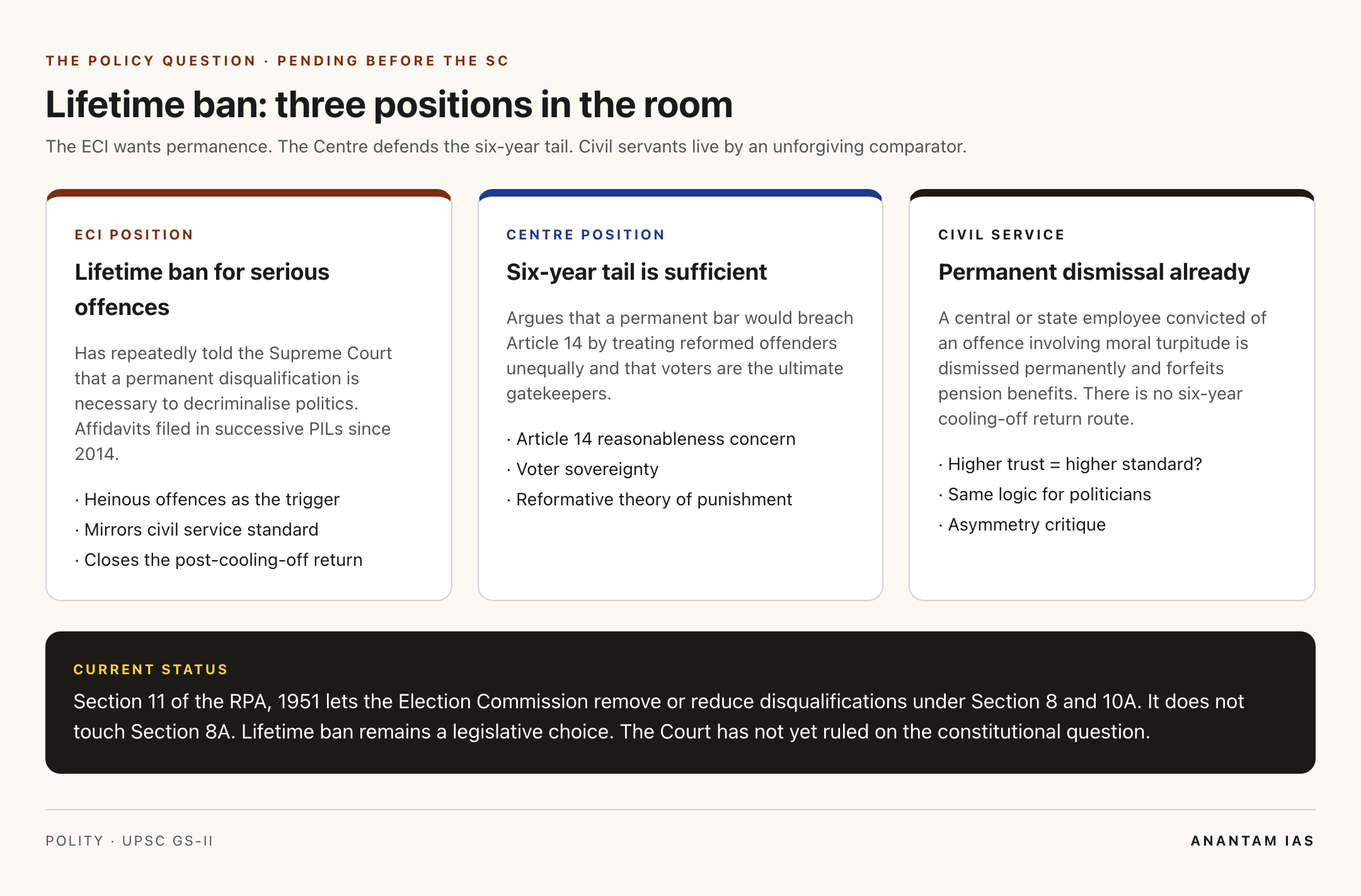
The numbers behind the debate are sobering. Successive ADR analyses of self-sworn affidavits show that a large share of MPs and MLAs declare pending criminal cases, and a smaller but still significant share declare cases involving heinous offences. The Election Commission has repeatedly told the Supreme Court that a six-year cooling-off period after release is too lenient and that India needs a lifetime ban on contesting elections after conviction for serious crimes. The Centre disagrees. The Supreme Court has, in case after case, edged the law toward stricter enforcement without yet endorsing a permanent bar.
This guide unpacks Section 8 and 8A of the RPA, the Lily Thomas case and its aftermath, the prelims-favourite distinction between stay on conviction and stay on sentence, the role of the Election Commission under Section 11, and the live policy debate over a lifetime ban for convicted politicians.
Quick Facts on Disqualification Under RPA 1951
The Representation of the People Act, 1951 was enacted by the Provisional Parliament under Article 327 of the Constitution. Section 8 lists the offences and the imprisonment thresholds that trigger disqualification. Section 8(3) is the catch-all provision: any conviction with a sentence of two years or more disqualifies the person from the date of conviction and for a further six years after release. Section 8(4), which gave sitting MPs and MLAs a three-month appeal window, was struck down in Lily Thomas v. Union of India in 2013. Section 8A deals with corrupt practices and gives the President, after consulting the Election Commission, the final say. Section 11 lets the Election Commission remove or reduce a disqualification under Section 8 or Section 10A, but not under Section 8A.
What Disqualification Under Section 8 Actually Means
Disqualification under Section 8 of the RPA, 1951 is the legal consequence that flows from a criminal conviction handed down by a competent court. It operates on two tracks. The first is automatic and immediate: the moment the trial court pronounces conviction and imposes a qualifying sentence, the person ceases to be a member of the legislature and cannot contest elections for a defined period. The second is the cooling-off period: even after the prison term ends, the bar continues for six more years, so a politician convicted to a three-year sentence is effectively out of electoral politics for nine years.
The disqualification is not a punishment in the criminal sense. It is a civil consequence attached to a criminal conviction, designed to protect the purity of the legislature. This is why the bar applies whether the convict is a first-time candidate or a sitting MP, and why Parliament cannot use a simple resolution to override it.
Background and Historical Context
The original RPA, 1951 carried a workable but flawed disqualification scheme. Section 8 listed offences that triggered automatic disqualification, but Section 8(4) carved out a generous exception for sitting members. If a sitting MP or MLA was convicted, the disqualification would not take effect for three months, and if the member filed an appeal or revision within those three months, the disqualification stayed suspended until the appeal was decided. In practice, this meant that a sitting member convicted of a serious offence could continue to vote on bills, draw salary, and contest the next election while the appeal lingered for years in the High Court.
The provision was challenged in Lily Thomas v. Union of India and in a parallel petition by Lok Prahari, both decided together by the Supreme Court in July 2013. A bench of Justices A.K. Patnaik and S.J. Mukhopadhaya struck down Section 8(4) as unconstitutional and ultra vires Article 102(1)(e) and Article 191(1)(e) of the Constitution. The Court held that Parliament could not create one rule for sitting members and another for candidates: once a person attracts the disqualification under Article 102(1) or 191(1), the seat falls vacant.
Parliament’s first instinct was to push back. An ordinance was drafted in 2013 to restore something like the old Section 8(4), but the political cost of being seen to protect convicted legislators proved too high and the ordinance was withdrawn. The judgment has held the field ever since, reinforced by electoral reforms in India discourse and the broader election commission push to clean up the candidate pool.
Section 8 of the RPA, 1951: The Three Tracks of Disqualification
Section 8 has three operative subsections, and each works slightly differently.
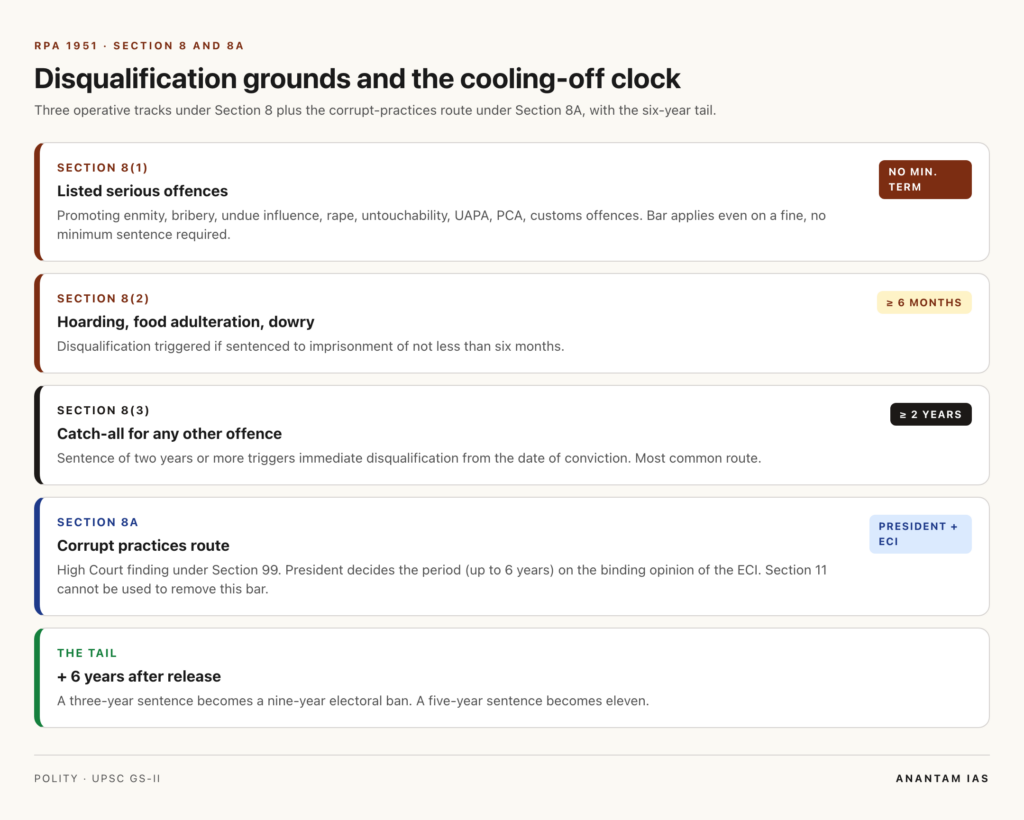
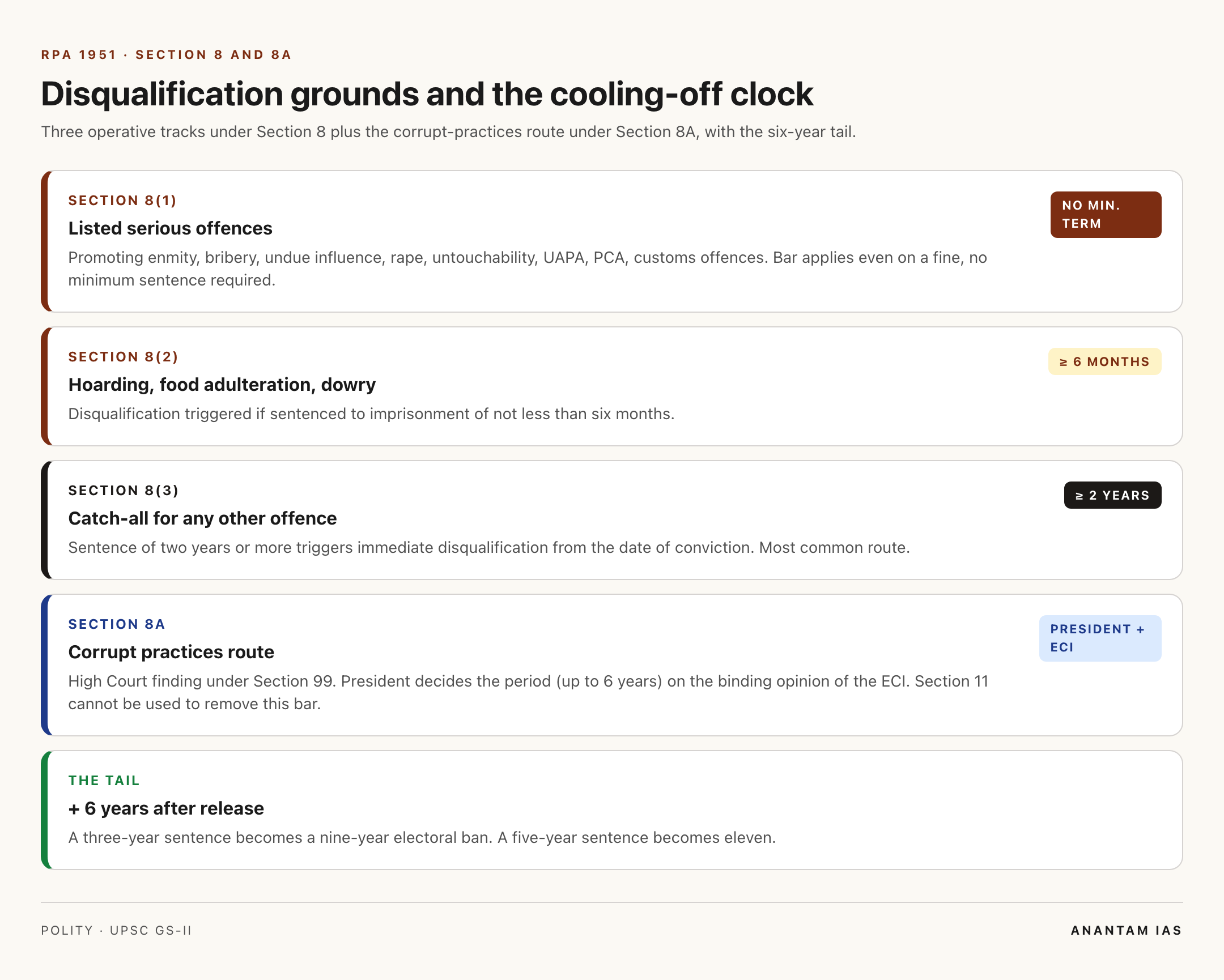
Section 8(1) lists specific offences where the disqualification kicks in irrespective of the length of the sentence. These include offences under the Indian Penal Code or its successor, the Bharatiya Nyaya Sanhita, dealing with promoting enmity between groups, bribery, undue influence at elections, rape, untouchability, and offences under specified statutes such as the Protection of Civil Rights Act, the Customs Act, the Unlawful Activities (Prevention) Act, the Prevention of Corruption Act, and the Prevention of Insults to National Honour Act. Even a fine without imprisonment under these laws triggers the bar.
Section 8(2) covers hoarding and profiteering offences, food adulteration, and offences under the Dowry Prohibition Act. The disqualification kicks in only if the person is sentenced to imprisonment of not less than six months.
Section 8(3) is the residual catch-all. It covers any offence not already listed in 8(1) or 8(2). The threshold is a sentence of imprisonment of not less than two years. The disqualification runs from the date of conviction and continues for a further period of six years after release. This is the provision that most often makes headlines because it covers the vast bulk of criminal convictions.
Section 8A and the Corrupt Practices Route
Section 8A is a separate channel. It deals with disqualification on the ground of corrupt practices in an election as found by a High Court in an election petition under Section 99 of the RPA, 1951. The procedure here is unusual. The High Court records its finding, the case goes to the President, and the President, after obtaining the opinion of the Election Commission, decides the period of disqualification, which can extend up to six years.
Three points are worth noting for the prelims aisle. First, the President is bound to act in accordance with the opinion of the ECI under Section 8A; this is one of the rare situations where the President’s discretion is structurally dependent on the ECI. Second, the disqualification period is fixed by the President, not by Section 8A itself. Third, Section 11, which allows the ECI to remove or reduce a disqualification, does not apply to disqualifications arising under Section 8A.
Stay on Conviction vs Stay on Sentence: The Critical Distinction
The single most examined point in this entire topic is the difference between a stay on conviction and a stay on sentence.
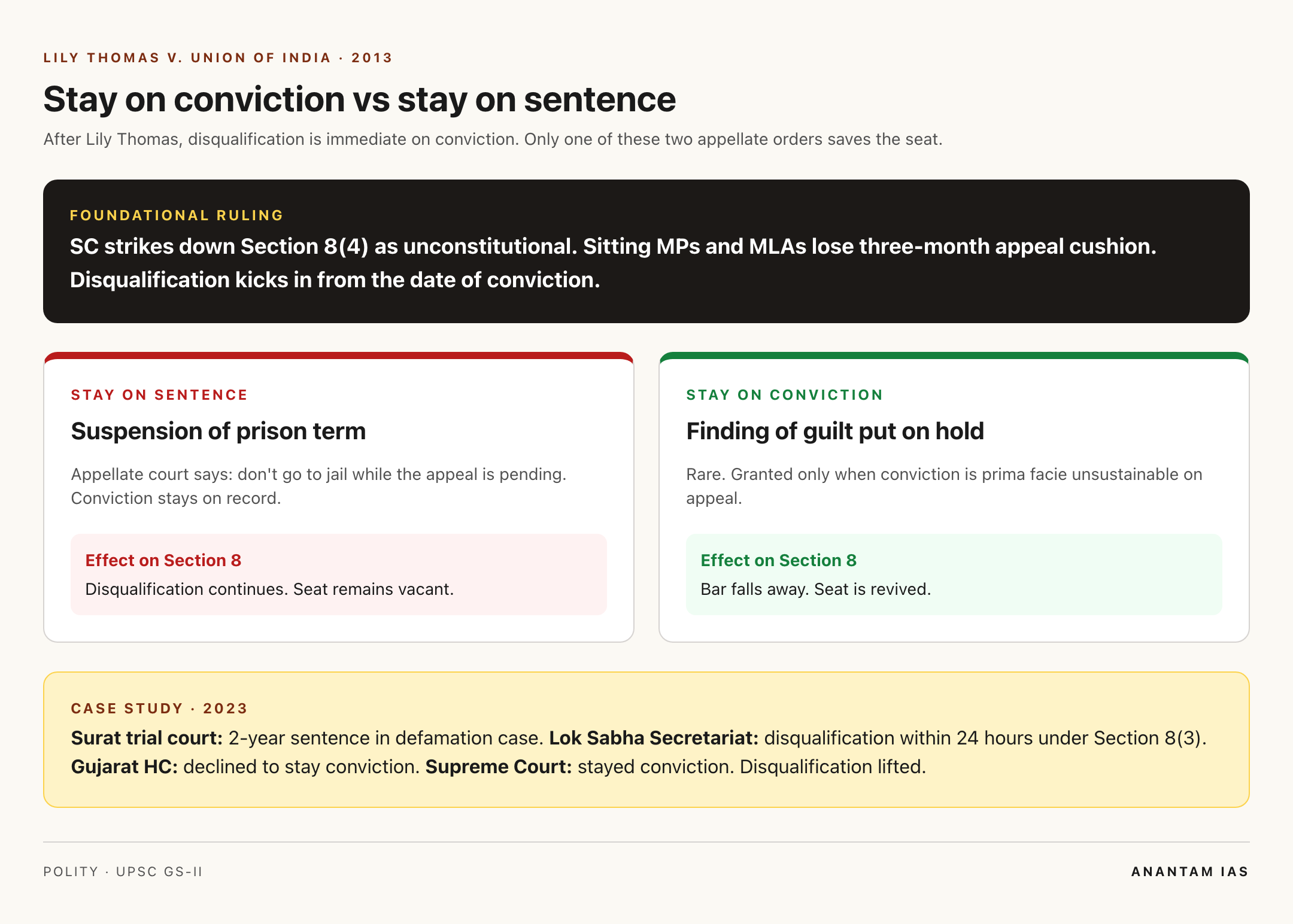
A stay on sentence, also called a suspension of sentence, is a routine appellate order. The appellate court tells the convict, “you do not have to serve your prison term while your appeal is pending.” The conviction itself remains on the record. For the purposes of Section 8, the disqualification flows from the conviction, not the sentence. So a stay on sentence saves the convict from going to jail but does nothing to revive their seat in the legislature.
A stay on conviction is rarer and qualitatively different. The appellate court holds that the trial court’s finding of guilt is itself prima facie suspect, and it puts the conviction on hold pending appeal. Once the conviction is stayed, the disqualification under Section 8 falls away because the legal foundation for disqualification has been suspended. The seat can be revived.
The Supreme Court clarified this in Lok Prahari v. Election Commission of India in 2018 and in Navjot Singh Sidhu’s case earlier. The most discussed recent application was the 2023 Surat court conviction of Rahul Gandhi in a defamation case under Section 499 of the IPC. The trial court awarded a two-year sentence, which triggered Section 8(3) automatically, and the Lok Sabha Secretariat issued a disqualification notification within twenty-four hours. The Gujarat High Court refused to stay the conviction, but the Supreme Court eventually did, and the disqualification was lifted.
Why Section 8 Matters for Indian Democracy
Section 8 is the single most concrete tool India has to keep convicted criminals out of the legislature. Roughly half the candidates and a substantial minority of winners in successive Lok Sabha elections have declared pending criminal cases on their nomination affidavits, and the proportion of those facing serious charges has grown over the last three election cycles. Pending cases, however, do not trigger Section 8. Only a final conviction by a trial court does.
The 2018 Public Interest Foundation judgment refused to extend disqualification to candidates merely because charges had been framed against them. The bench held that this was a legislative choice and that the Court could not rewrite Section 8. Instead, the Court ordered that political parties must publicise the criminal antecedents of candidates in newspapers and on television channels and on their own websites, and must explain why the candidate was selected over a clean alternative. Compliance has been patchy, and the ECI has repeatedly returned to the Court complaining that parties treat the requirement as a formality.
Detailed Analysis: Landmark Judgments and Their Reasoning
The jurisprudence around Section 8 has been built case by case. Lily Thomas v. Union of India in 2013 is the foundational ruling. The Supreme Court read Articles 102 and 191 of the Constitution as exhaustive, holding that Parliament cannot add to the constitutional grounds of disqualification through Section 8(4). Once the constitutional bar attaches, neither Parliament nor any other authority can suspend it through legislation.
Public Interest Foundation v. Union of India in 2018 set the outer limits of the Court’s intervention. The bench declined to disqualify candidates on the basis of framed charges and instead pushed Parliament to legislate. The Court noted that disenfranchising candidates before conviction would breach the presumption of innocence, even though it acknowledged that the criminalisation of politics had reached a stage where waiting for conviction often meant waiting forever, given the glacial pace of trials involving sitting legislators.
Lok Prahari v. Election Commission of India in 2018 reinforced the Lily Thomas line and clarified the conviction-stay route. The Court directed that high courts should decide criminal appeals filed by sitting legislators on a priority basis, and that special courts for trying MPs and MLAs, set up under earlier Supreme Court directions, should be properly resourced.
K. Prabhakaran v. P. Jayarajan in 2005, decided by a Constitution Bench, had earlier upheld the constitutional validity of Section 8(3) and the six-year cooling-off period. The Court accepted that Parliament’s choice of two years as the cut-off was rational and that the cooling-off period was a reasonable balance between civil liberties and electoral integrity.
Comparative Frame: Politicians vs Civil Servants vs Other Professions
A frequent argument in the lifetime ban debate is the comparison with civil servants. A central or state government employee convicted of any offence involving moral turpitude is, as a rule, dismissed from service permanently and forfeits pension benefits. There is no six-year cooling-off period after which the dismissed officer can rejoin the service. The same logic applies to public sector employees and to many private sector regulated professions: a convicted chartered accountant, doctor or lawyer faces removal from the relevant professional register, often without a fixed sunset clause.
Politicians, the ECI argues, occupy positions of even higher public trust, since they make laws and approve budgets. The current six-year ban is therefore inconsistent with the standards applied to those who merely implement those laws. The Centre’s reply, articulated in affidavits before the Supreme Court, has two limbs. First, it argues that disqualification is already harsh and that adding a permanent bar may breach Article 14 by treating reformed offenders unequally. Second, it emphasises that voters are the ultimate gatekeepers and that a permanent bar would override their judgment.
Challenges and Loopholes
Section 8 is not airtight. The biggest gap is the speed of the criminal justice system. A trial court conviction may take a decade, and an appeal may take another decade. Sitting legislators routinely time their elections so that pending cases do not mature into convictions before they are sworn in.
The second gap is selective stay on conviction. Once a conviction is stayed, Section 8 falls away. While the Supreme Court has indicated that conviction should be stayed only in the rarest of cases, high courts vary in their approach, and the same offence has sometimes been treated very differently depending on the bench.
The third gap is in coverage. Pending cases, however serious, do not trigger disqualification. The 2018 Public Interest Foundation judgment chose disclosure over disqualification, and disclosure has not visibly changed party behaviour during candidate selection.
The fourth gap is in enforcement of the cooling-off period. After the six-year bar ends, a politician with a serious past conviction can return to the legislature, contest the highest offices, and even hold ministerial portfolios. The voter is informed, but the ballot remains the only check. This sits uneasily next to the 42nd amendment of Indian constitution era reforms and the post-1978 44th amendment of Indian constitution corrections that tried to professionalise public life.
Prelims Pointers
The disqualification under Section 8(3) attaches from the date of conviction, not the date of sentencing or the date of the appellate decision. The cooling-off period is six years from the date of release, not from the date of conviction. Section 8(1) does not require any minimum sentence; even a fine triggers the bar for listed offences. Section 8(2) needs a minimum sentence of six months. Section 8(3) needs a minimum sentence of two years. Section 8A is decided by the President on the binding opinion of the Election Commission. Section 11 lets the ECI remove or reduce disqualifications under Section 8 and 10A but not under Section 8A. The Lily Thomas case was decided in 2013 by Justices A.K. Patnaik and S.J. Mukhopadhaya. The Public Interest Foundation case was decided in 2018 by a Constitution Bench. The grounds for disqualification of MPs and MLAs are listed in Articles 102 and 191 of the Constitution; the RPA, 1951 fills in the details under the residual clause “any other ground.”
Mains Practice Questions
Discuss the impact of the Lily Thomas judgment on the disqualification of convicted legislators and evaluate whether the present six-year cooling-off period is adequate.
Examine the argument for a lifetime ban on convicted persons from contesting elections in India. Bring out the constitutional and policy issues involved.
Distinguish between a stay on conviction and a stay on sentence and explain why the distinction matters for the operation of Section 8 of the RPA, 1951.
Critically analyse the Supreme Court’s reluctance, in Public Interest Foundation v. Union of India, to disqualify candidates merely on the framing of charges and suggest a way forward.
Way Forward
The cleanest path runs through Parliament. A constitutional or statutory amendment imposing a lifetime ban for convictions involving heinous offences, terrorism, sexual offences, and corruption would close the most criticised loophole and would survive judicial scrutiny if narrowly tailored to specified offence categories. Fast-track special courts for cases involving sitting MPs and MLAs, properly funded and ring-fenced from transfers of judges, would shrink the gap between charge and conviction. Mandatory disclosure of criminal antecedents needs to evolve from passive newspaper notices to a centralised, searchable ECI portal that also tracks party-level patterns of nominating candidates with criminal records. The internal anti-defection logic of lok sabha vs rajya sabha practice should not become a shield for criminal exit routes.
Process reform inside political parties matters as much as legislation. Internal candidate scrutiny committees, public reasoning for selecting a candidate with a criminal record, and strict enforcement of the 2018 directions on televised disclosure can shift the political cost of fielding tainted candidates. The Election Commission, working with state DGPs and the National Crime Records Bureau, should publish a standardised electoral integrity index against which voters can measure parties at every general and state election. The deeper basic structure doctrine commitment to free and fair elections gives the Court the constitutional headroom to push these reforms further when Parliament drags its feet.
Frequently Asked Questions
What is Section 8 of the Representation of the People Act, 1951?
Section 8 of the RPA, 1951 lists the criminal offences and sentence thresholds whose conviction disqualifies a person from being elected to or sitting in Parliament or a state legislature. It has three operative parts: 8(1) for specified serious offences regardless of sentence length, 8(2) for hoarding, food adulteration and dowry-related offences with a six-month minimum, and 8(3) for any other offence with a sentence of two years or more.
What did the Lily Thomas case decide?
Lily Thomas v. Union of India, decided by the Supreme Court in July 2013, struck down Section 8(4) of the RPA, 1951 as unconstitutional. Section 8(4) had given sitting MPs and MLAs a three-month window to appeal during which the disqualification was held in abeyance. After Lily Thomas, disqualification of a sitting member is immediate upon conviction and a qualifying sentence, unless the conviction itself is stayed by an appellate court.
What is the difference between stay on conviction and stay on sentence?
A stay on sentence suspends only the prison term during appeal but leaves the conviction intact, so the disqualification under Section 8 continues. A stay on conviction puts the finding of guilt itself on hold, which removes the legal foundation for disqualification and revives the seat. Stay on conviction is granted only in rare cases where the appellate court finds the conviction prima facie unsustainable.
How long does the disqualification last under Section 8(3)?
Under Section 8(3), the disqualification begins on the date of conviction and continues throughout the period of imprisonment plus an additional six years after release. So a three-year sentence translates into a nine-year electoral ban, and a five-year sentence translates into an eleven-year ban.
Is there a lifetime ban on convicted politicians in India?
There is no lifetime ban under current law. The Election Commission has repeatedly recommended a lifetime ban for convictions involving serious offences, and the recommendation has been pending before the Supreme Court for years. The Centre has opposed a permanent bar, arguing that the present six-year cooling-off period is sufficient and that a permanent bar would be discriminatory. The Court has not yet ruled on the constitutional question.
What is Section 8A of the RPA, 1951?
Section 8A deals with disqualification on the ground of corrupt practices, as found by a High Court in an election petition under Section 99. The President decides the period of disqualification, up to six years, after obtaining the opinion of the Election Commission. The President is bound by the ECI’s opinion in this matter, and Section 11 cannot be used to remove a Section 8A disqualification.
Can the Election Commission remove or reduce a disqualification?
Yes, under Section 11 of the RPA, 1951, the Election Commission may, for reasons to be recorded, remove any disqualification under Section 8 or Section 10A or reduce its duration. The power does not extend to disqualifications under Section 8A, which are exclusively decided by the President.
Did the 2018 Public Interest Foundation judgment disqualify candidates with pending charges?
No. The Constitution Bench refused to disqualify candidates on the basis of framing of charges and held that this was a legislative question. Instead, it directed parties and candidates to disclose criminal antecedents in newspapers, on television, and on party websites, and to provide reasons for selecting candidates with criminal records over clean alternatives.
Is the 2023 Rahul Gandhi case a good example of the Section 8 framework?
Yes. A trial court in Surat convicted him of defamation and awarded a two-year sentence. Section 8(3) was triggered automatically, and the Lok Sabha Secretariat issued a disqualification notification. The Gujarat High Court declined to stay the conviction, but the Supreme Court later stayed the conviction, after which the disqualification fell away and the seat was restored. The case is a textbook illustration of how stay on conviction operates differently from stay on sentence.
What reforms are being debated to strengthen Section 8?
The main reform proposals are a lifetime ban for serious offences, fast-track special courts for sitting MPs and MLAs, expansion of Section 8 to include certain categories of pending charges after framing, and a stronger ECI-run disclosure portal that tracks party-level nominations of candidates with criminal records.
Tell Google you want more of this.
Add Anantam IAS as a preferred sourceOne tap, and this site shows up more often in your own Top Stories, AI Overviews and AI Mode. Remove it any time.