Chief Ministers of Gujarat: Complete List, Tenure and Key Milestones
Complete list of Gujarat Chief Ministers from 1960 to 2026, with tenures, party affiliations, key policies, and UPSC-relevant milestones.
Introduction
Gujarat, carved out of the bilingual Bombay State on 1 May 1960, has seen a distinctive political journey that mirrors wider shifts in Indian federalism. From Congress dominance in its early decades to the rise of the Bharatiya Janata Party and its long, unbroken rule since 1998, the office of Gujarat Chief Minister has been held by seventeen individuals across varied political persuasions.
For UPSC aspirants, the list of Gujarat Chief Ministers is more than a roll call. It traces the evolution of state-level governance in western India, records the rise of national leaders such as Morarji Desai and Narendra Modi, and provides case studies in Panchayati Raj reform, disaster response, industrial policy and minority relations. This article consolidates every CM of Gujarat, their tenure, party, and the milestones that shaped both the state and the country.
Quick Facts at a Glance
| Attribute | Detail |
|---|---|
| Formation of Gujarat | 1 May 1960, from Bombay State |
| First Chief Minister | Jivraj Narayan Mehta (INC) |
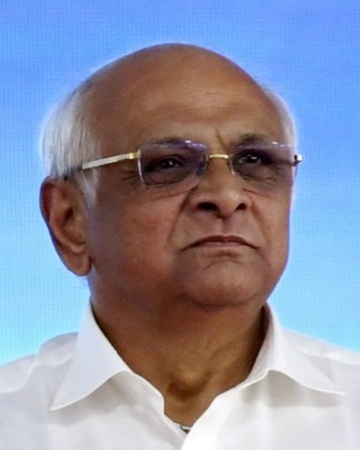
| Current Chief Minister (2026) | Bhupendra Patel (BJP) |
| Total CMs so far | 17 |
| Longest-serving CM | Narendra Modi, 2001 to 2014 |
| Only woman CM | Anandiben Patel, 2014 to 2016 |
| Party with longest rule | BJP (continuous since 1998) |
| Capital | Gandhinagar |
| Legislative Assembly strength | 182 seats |
Background and Historical Context
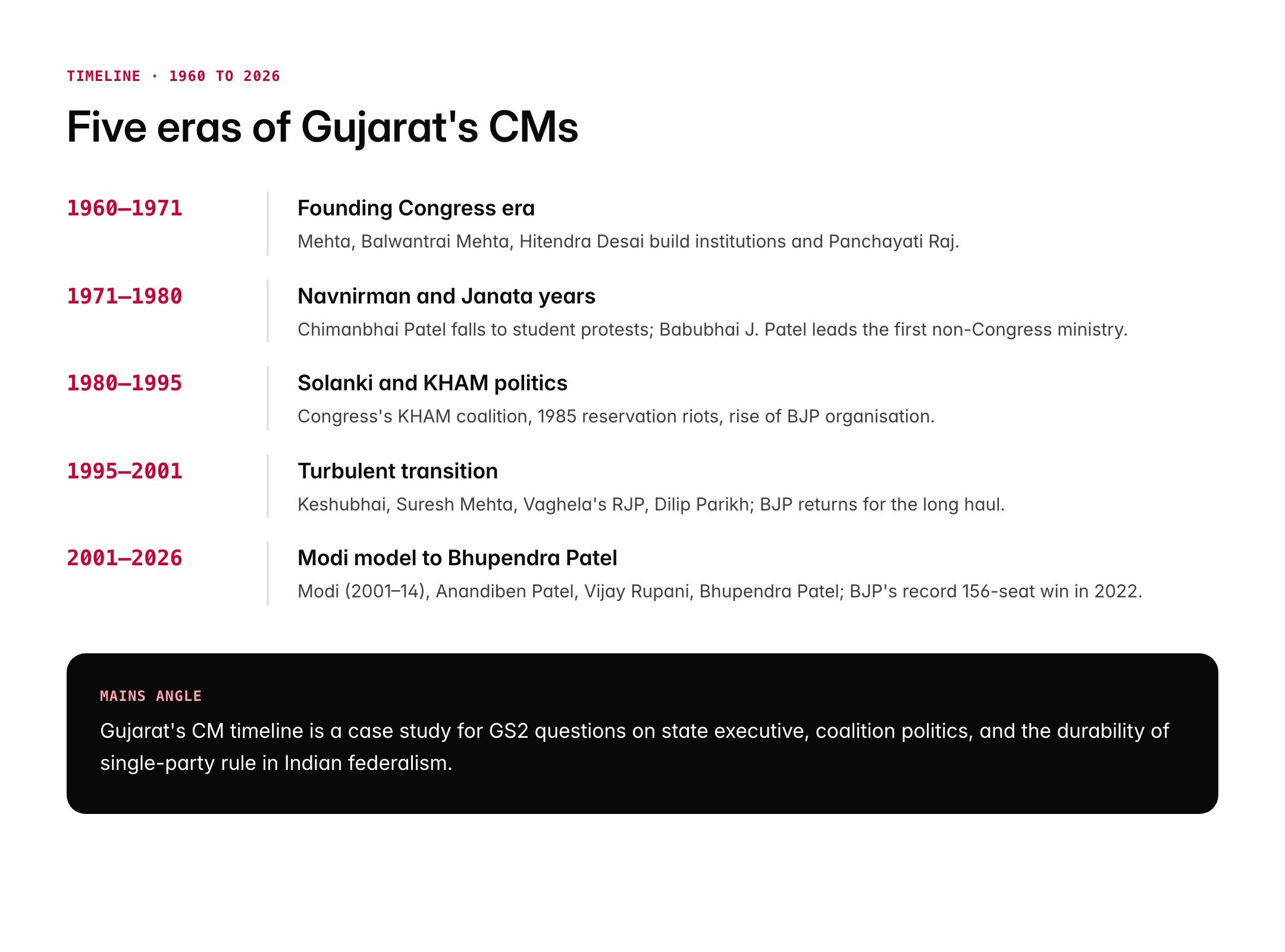
Gujarat’s journey as a separate state began with the Bombay Reorganisation Act, 1960, which split Bombay State into Maharashtra and Gujarat on linguistic lines, a direct consequence of the Mahagujarat Movement led by Indulal Yagnik. On 1 May 1960, Jivraj Narayan Mehta, a physician, freedom fighter and close associate of Mahatma Gandhi, was sworn in as the first Chief Minister. The early years were marked by Congress dominance, with the state assembly reflecting the post-Nehruvian consensus.
The first major political churn came in 1971, when the split in the Indian National Congress produced Congress (O) and Congress (R). Gujarat briefly came under President’s Rule in 1971, the first of six such episodes in its history. The state was again a flashpoint during the Navnirman Andolan of 1974, a student-led agitation against corruption and price rises that foreshadowed the Jayaprakash Narayan movement and eventually the Emergency. Chief Minister Chimanbhai Patel was forced to resign and President’s Rule was imposed.
The 1980s saw Gujarat alternate between Congress and Janata Party governments, with the brief but significant tenures of Babubhai J. Patel, Madhavsinh Solanki and others. Solanki’s experiments with the KHAM (Kshatriya, Harijan, Adivasi, Muslim) social coalition reshaped Congress politics. The rise of the BJP, which started with a coalition under Keshubhai Patel in 1995, became durable from 1998 onwards and has produced a continuous saffron run of five successive CMs: Keshubhai Patel (second term), Narendra Modi, Anandiben Patel, Vijay Rupani and the incumbent Bhupendra Patel.
Key Features: Complete List of Gujarat Chief Ministers
Below is the canonical list of all Chief Ministers of Gujarat, their tenure, and party.
The Congress Era (1960 to 1995)
- Jivraj Narayan Mehta, INC, 1 May 1960 to 19 Sep 1963. First CM, known for setting up administrative institutions.
- Balwantrai Mehta, INC, 19 Sep 1963 to 19 Sep 1965. Architect of Panchayati Raj; died in an air attack during the 1965 war.
- Hitendra Desai, INC, 1965 to 1971. Longest early-Congress tenure; resigned after Congress split.
- Ghanshyam Oza, INC(R), 1972 to 1973.
- Chimanbhai Patel, INC(R), 1973 to 1974. Removed after Navnirman Andolan.
- Babubhai J. Patel, Janata Morcha/Janata Party, multiple stints 1975 to 1980.
- Madhavsinh Solanki, INC, four terms totalling 1976 to 1990 with interruptions; known for KHAM politics and reservation debates.
- Amarsinh Chaudhary, INC, 1985 to 1989. Only tribal CM of the state.
- Chhabildas Mehta, INC, 1994 to 1995.
The BJP Era (1995 to Present)
- Keshubhai Patel, BJP, March to October 1995, and again 1998 to 2001.
- Suresh Mehta, BJP, October 1995 to September 1996.
- Shankersinh Vaghela, Rashtriya Janata Party (with Congress support), 1996 to 1997.
- Dilip Parikh, RJP, 1997 to 1998.
- Narendra Modi, BJP, 7 Oct 2001 to 22 May 2014. Longest-serving; left to become Prime Minister.
- Anandiben Patel, BJP, 2014 to 2016. First and only woman CM of Gujarat.
- Vijay Rupani, BJP, 2016 to 2021.
- Bhupendra Patel, BJP, 2021 to present.
Notable Firsts and Records
- First CM: Jivraj N. Mehta.
- First non-Congress CM: Babubhai J. Patel.
- Only woman CM: Anandiben Patel.
- Only tribal CM: Amarsinh Chaudhary.
- Longest continuous tenure: Narendra Modi at 4,610 days.
- President’s Rule imposed: 6 times, most recently in 1996.
Significance for UPSC and General Knowledge
- Gujarat’s CMs illustrate the evolution of state politics from Congress hegemony to one-party BJP dominance, a useful Mains case for GS Paper II on federalism.
- The Navnirman Andolan of 1974 and Chimanbhai Patel’s resignation are textbook examples of people’s movements influencing state executives.
- Balwantrai Mehta’s pre-CM work on Panchayati Raj directly informs constitutional amendments 73 and 74, a recurring Prelims area.
- Narendra Modi’s tenure is studied for the Gujarat Model of growth, Vibrant Gujarat summits, and the post-2002 riots governance debate.
- Anandiben Patel as the first woman CM and later Governor of Uttar Pradesh and Madhya Pradesh is a mapping question.
- The continuous BJP rule since 1998 is one of India’s longest single-party state governments, paralleled only by Sikkim Democratic Front and Left Front in West Bengal historically.
Detailed Analysis: Reigns that Shaped the State
Jivraj Narayan Mehta (1960 to 1963) laid the administrative foundations of a newly carved state. He oversaw the creation of Gandhinagar as the planned capital, headquartered ministries, and established institutions like Gujarat University’s expansion.
Balwantrai Mehta (1963 to 1965) had already earned national stature as chair of the Balwantrai Mehta Committee (1957) whose three-tier Panchayati Raj model was adopted nationwide. His death in an aerial attack over the Rann of Kutch during the 1965 India-Pakistan war made him the only sitting Indian CM to die in combat conditions.
Madhavsinh Solanki’s four stints through the late 1970s and 1980s reshaped Gujarati politics through the KHAM social coalition, which mobilised Kshatriyas, Harijans, Adivasis and Muslims into a formidable Congress vote bank. His 1985 government secured Congress its largest-ever majority in Gujarat (149 of 182 seats), but agitations over OBC reservations forced his resignation.
Chimanbhai Patel’s second innings (1990 to 1994) saw him defect to Congress and manage early liberalisation-era reforms alongside the 1993 Gujarat riots. His tenure also expanded the Narmada Project commitments.
Narendra Modi (2001 to 2014), by far the most transformative modern CM, assumed office months before the 2001 Bhuj earthquake and just before the 2002 Godhra and post-Godhra riots. His economic agenda, articulated through Vibrant Gujarat summits from 2003, attracted investment in petrochemicals, automobiles and renewable energy, and built infrastructure including the Sabarmati Riverfront. He won three successive terms before moving to the Centre as Prime Minister in 2014.
Anandiben Patel (2014 to 2016) and Vijay Rupani (2016 to 2021) continued the BJP model, with Rupani navigating demonetisation, GST rollout, and the COVID-19 first wave before an unexpected mid-term resignation.
Bhupendra Patel (2021 to present) took charge through a generational reshuffle and led the BJP to its record 156-seat victory in the 2022 Gujarat Assembly election, the largest ever margin for any party in the state.
Comparative Perspective
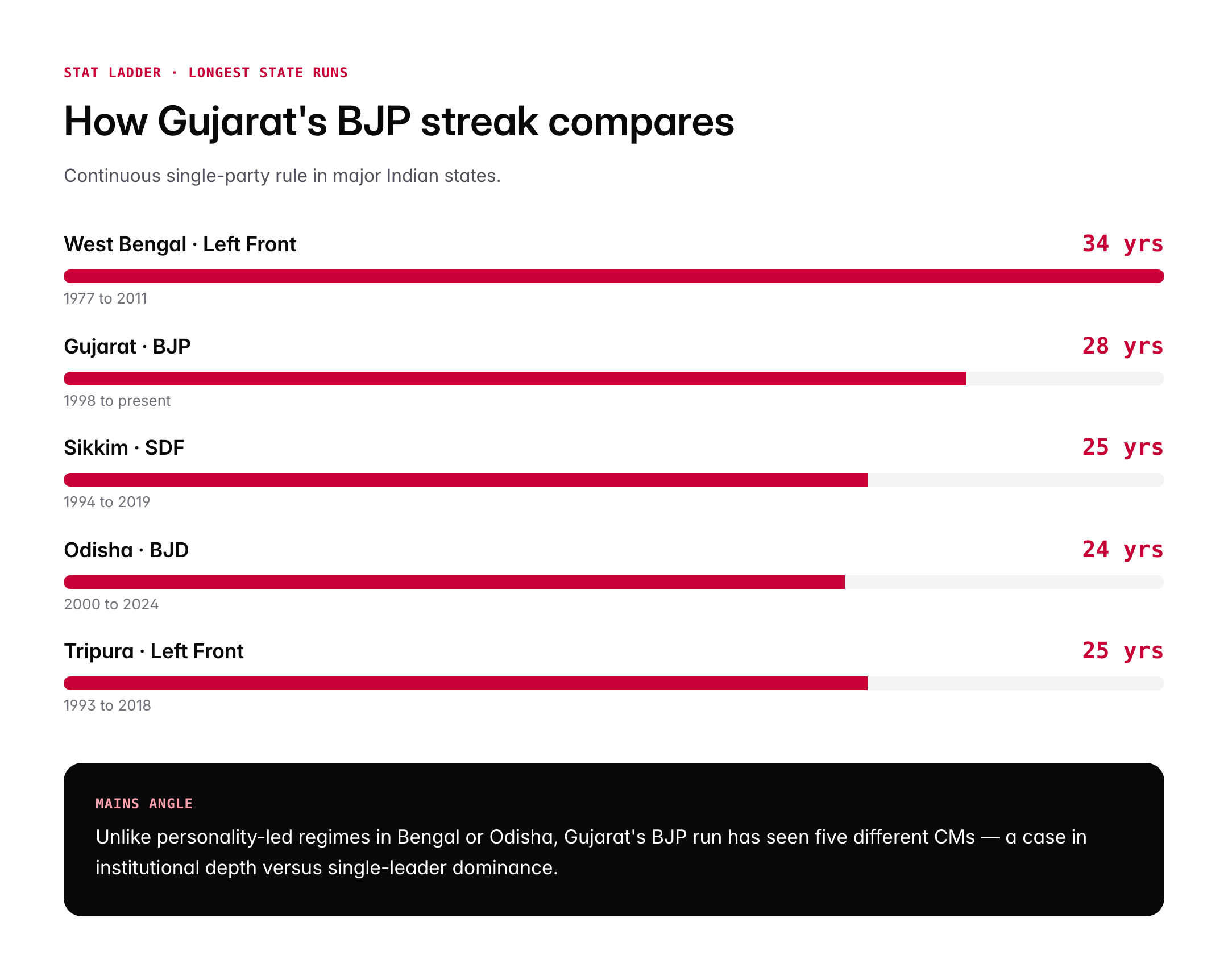
Gujarat’s trajectory can be meaningfully compared with other major states that have seen long continuous party rule.
| State | Longest continuous party rule | Duration | Current CM |
|---|---|---|---|
| Gujarat | BJP | 1998 to present | Bhupendra Patel |
| West Bengal | Left Front (CPI-M led) | 1977 to 2011, 34 years | Mamata Banerjee (AITC) |
| Sikkim | SDF under Pawan Chamling | 1994 to 2019, 25 years | Prem Singh Tamang (SKM) |
| Odisha | BJD under Naveen Patnaik | 2000 to 2024, 24 years | Mohan Charan Majhi (BJP) |
| Tripura | Left Front | 1978 to 1988 and 1993 to 2018 | Manik Saha (BJP) |
Unlike the Left Front’s Bengal and Naveen Patnaik’s Odisha, Gujarat’s BJP dominance has involved multiple CMs rather than a single personality, showing the party’s institutional depth in the state.
Controversies and Debates
Gujarat’s CMs have navigated some of the most debated events in post-independence Indian politics. The Navnirman Andolan of 1974 not only toppled Chimanbhai Patel but seeded the national Emergency critique. The 1985 reservation riots under Madhavsinh Solanki, over reservations for OBCs, exposed the fragility of KHAM politics. The 2002 Gujarat riots during Narendra Modi’s first term became one of the most scrutinised episodes in modern Indian public life, drawing court examinations, Supreme Court-monitored SITs, and the 2013 clean chit in the Zakia Jafri case.
The Gujarat Model itself is contested. Supporters cite double-digit state GDP growth, power surplus status, and world-class infrastructure. Critics point to below-average performance on Human Development Index indicators during the same period, particularly in female literacy and child nutrition, and to concerns about concentration of industrial subsidies. The 2017 and 2022 assembly elections tested these narratives, with the BJP retaining power but facing strong rural distress and Patidar quota agitation in 2017 before rebounding sharply in 2022.
Prelims Pointers
- Gujarat was formed on 1 May 1960 under the Bombay Reorganisation Act, 1960.
- Jivraj Narayan Mehta was the first Chief Minister of Gujarat.
- Balwantrai Mehta Committee of 1957 proposed three-tier Panchayati Raj.
- Anandiben Patel was the first woman CM of Gujarat and later Governor of UP and MP.
- Amarsinh Chaudhary was the only tribal CM of Gujarat.
- Narendra Modi served four terms, 2001 to 2014, as CM before becoming PM.
- Gujarat Legislative Assembly has 182 seats; majority mark is 92.
- The 2022 Gujarat election saw BJP win 156 seats, a record margin.
- President’s Rule has been imposed in Gujarat six times, last in 1996.
- Gandhinagar became Gujarat’s capital formally in 1970.
- The Vibrant Gujarat Summit was launched in 2003.
- The Sardar Sarovar Dam foundation was laid under Chimanbhai Patel.
Mains Practice Questions
- Analyse how political leadership at the state level in Gujarat has influenced the evolution of Indian federalism since 1960. (250 words)
- Early Congress era: institution building and centre-state cooperation.
- Emergence of regional parties, coalition governments, and President’s Rule episodes.
- Post-1998 BJP era: state-led growth model, centre-state convergence, cooperative federalism under Modi-led Union.
- “The Gujarat Model of development has reshaped debates on state-led growth in India.” Critically examine. (250 words)
- Define Gujarat Model: infrastructure-led growth, investor summits, power reforms.
- Successes: double-digit GSDP, power surplus, port-led logistics, renewable investments.
- Criticisms: HDI lag, rural distress, reservation agitations, uneven outcomes for women and Adivasis.
Conclusion
The Chief Ministers of Gujarat together tell the story of a state that has produced national icons, pioneered Panchayati Raj thinking through Balwantrai Mehta, tested coalition politics in the 1990s, and become the laboratory of the BJP’s long experiment in governance and economic policy. From Jivraj Mehta in 1960 to Bhupendra Patel in 2026, the office has absorbed both continuity and dramatic change.
For the UPSC aspirant, the Gujarat CM list is a lens on federalism, political economy, and social change in India. It invites questions about how state leadership interacts with Union policy, how regional movements translate into governance, and how long single-party rule shapes institutions. Mastery of this list, coupled with the ability to link milestones to larger themes, will strengthen answers across GS Paper II, Paper III, and essay.
Frequently Asked Questions
Who is the current Chief Minister of Gujarat?
As of 2026, Bhupendra Patel of the Bharatiya Janata Party is the Chief Minister of Gujarat. He first took oath on 13 September 2021 and was reappointed after the BJP’s record 156-seat victory in the December 2022 Gujarat Legislative Assembly election. He represents the Ghatlodia constituency in Ahmedabad.
Why is the list of Gujarat CMs important for UPSC?
The list maps the evolution of state politics, federalism and governance models in western India. It is directly relevant to GS Paper II topics such as state executive, Panchayati Raj and centre-state relations, and to GS Paper III debates on the Gujarat Model of development, investor summits, disaster response and social indicators.
How is Gujarat’s political history related to Panchayati Raj in India?
Balwantrai Mehta, Gujarat’s second CM, chaired the 1957 committee that proposed the three-tier Panchayati Raj model of Gram Panchayat, Panchayat Samiti and Zila Parishad. His framework influenced state laws across India and became the conceptual basis of the 73rd Constitutional Amendment Act, 1992, which made Panchayati Raj a constitutional mandate.
Who was the first Chief Minister of Gujarat?
Jivraj Narayan Mehta of the Indian National Congress was sworn in as the first Chief Minister of Gujarat on 1 May 1960, the day the state was formed from Bombay State under the Bombay Reorganisation Act, 1960. A physician and freedom fighter, he served until 19 September 1963 and laid the administrative foundations of the new state.
How many Chief Ministers has Gujarat had so far?
Gujarat has had seventeen Chief Ministers from its formation in 1960 to 2026. Some served multiple non-consecutive terms, notably Madhavsinh Solanki with four stints and Babubhai J. Patel with two. The state has also seen President’s Rule imposed six times, most recently in 1996, during periods of political instability.
Who was Gujarat’s first and only woman Chief Minister?
Anandiben Patel was the first and only woman Chief Minister of Gujarat, serving from 22 May 2014 to 7 August 2016 after Narendra Modi moved to the Centre as Prime Minister. She was later appointed Governor of Madhya Pradesh and then Uttar Pradesh, making her an important figure in both state and national politics.
What is the Gujarat Model of development?
The Gujarat Model refers to the state’s growth strategy under continuous BJP rule since 1998, especially under Narendra Modi from 2001 to 2014. It emphasised investor summits such as Vibrant Gujarat from 2003, power sector reforms, port-led logistics, renewable energy, and ease of doing business, though critics note weaker performance on social indicators like female literacy and child nutrition.
How long has the BJP ruled Gujarat continuously?
The BJP has governed Gujarat continuously since March 1998, when Keshubhai Patel returned to power. This streak of more than 27 years makes it one of the longest unbroken single-party state governments in India, comparable to the Left Front in West Bengal from 1977 to 2011 and Naveen Patnaik’s BJD in Odisha from 2000 to 2024.