Humanitarian Intervention and R2P: When Does Force Become a Moral Duty? (UPSC Ethics — GS IV)
R2P did not create a right to intervene; it relocated the primary duty onto the state itself and made outside action a residual third step. The reason the third step stalled is that the language of protection was used to accomplish something else.
Two principles central to the modern international order cannot both be treated as absolute. The first is sovereign equality and non-intervention, written into Article 2(4) of the UN Charter as a prohibition on the use of force against the territorial integrity of any state, and into Article 2(7) as a bar on UN intervention in matters essentially within a state’s domestic jurisdiction. The second is that certain acts — the deliberate destruction of a population — are wrongs of a kind that create obligations on people who are not the victims. A framework that holds sovereignty absolute permits atrocity behind a border. A framework that treats atrocity as licence for outside force hands the strongest states a permanent justification for entering the weakest.
The literature that grew out of this conflict is unusual in one respect: it was written by people who had watched both failure modes happen within a decade of each other, and it does not resolve cleanly. The doctrine that emerged is best understood not as a solution but as an attempt to specify the conditions under which each risk is least likely to be realised — and as a record of how those conditions were then broken.
The Argument Before R2P
The classical case for humanitarian intervention rested on a simple claim: sovereignty is justified by the protection it provides to the people inside it, so a state destroying its own population has forfeited the reason it was granted immunity in the first place. Against that stood the sovereigntist reply, which is not merely legalistic. Non-intervention is a rule that protects weak states from strong ones; carve an exception into it and the exception will be used by exactly the states that are already able to project force.
International law leaned toward the sovereigntists. The Genocide Convention of 1948 created a duty to prevent and punish, without authorising unilateral force. The International Court of Justice in the Nicaragua case of 1986 stated that the use of force is not an appropriate method to monitor or ensure respect for human rights. The only route the Charter leaves open is Chapter VII: a Security Council determination that a situation threatens international peace and security, followed by authorisation. That route is legally clean and politically conditional, which is the whole of the difficulty.
The moral argument and the legal argument therefore point in different directions, and the temptation is to resolve the tension by asserting that what is morally required must be legally permitted. It is not, and pretending otherwise costs the argument its seriousness.
The Cases That Formed the Debate
Four episodes did most of the work, and they point in both directions. Rwanda in 1994: a genocide proceeded while a small UN mission was in the country with a mandate that did not permit it to intervene, and the Council reduced rather than reinforced the force. Srebrenica in 1995: a declared UN safe area was overrun and thousands of men and boys were killed under the nominal protection of a peacekeeping mandate. Both are cases against non-intervention, and they are the reason the doctrine exists.
Kosovo in 1999 cut the other way, and remains the hardest case. NATO used force without Security Council authorisation, arguing necessity. The Independent International Commission on Kosovo concluded in 2000 that the action was “illegal but legitimate” — a formulation that concedes the law was broken while claiming the moral case held, and which no legal order can absorb as precedent without dissolving. East Timor in 1999 is the counter-example that gets forgotten: authorised by the Council, undertaken with the consent of the territorial state, and completed without the mandate being stretched. It is proof that the conditions can be met.
ICISS 2001: The Reframing
The International Commission on Intervention and State Sovereignty was established by Canada in 2000, co-chaired by Gareth Evans and Mohamed Sahnoun, and published The Responsibility to Protect in December 2001. Its contribution was conceptual before it was operational, and the conceptual move is the part worth carrying.
It changed the holder of the entitlement. The old debate asked whether outsiders have a right to intervene, which puts the intervener at the centre and makes the argument about their permissions. ICISS reframed the question around a responsibility to protect held in the first instance by the state itself. The subject of the sentence became the population at risk rather than the state contemplating action.
It recast sovereignty as responsibility rather than as licence. On this account sovereignty was never a bare fact of control; it was always a set of duties toward a population, and the immunity from outside interference was the reward for discharging them. Kofi Annan had put the same point to the General Assembly in 1999 in terms of two concepts of sovereignty, that of the state and that of the individual. This is not an external limitation imposed on sovereignty from outside; it is an account of what sovereignty was for.
It set out three responsibilities, not one. The responsibility to prevent, the responsibility to react, and the responsibility to rebuild. Intervention appeared as one option within the middle term, and the report insisted that the first was the most important and the third the most neglected. Almost all subsequent argument has been about the middle term, which is a fair description of what went wrong.
The 2005 Formulation and the Three Pillars
The World Summit Outcome Document of 2005 carried the doctrine into an agreed text, in paragraphs 138 and 139, and the drafting is narrower than the ICISS report in ways that matter. Two changes stand out: the four crimes were specified, and the criteria for force were left out.
The scope is restricted to genocide, war crimes, ethnic cleansing and crimes against humanity. R2P does not cover natural disasters, coups, poverty, climate displacement or human rights violations generally — an important limitation, both because it prevents indefinite expansion and because it is routinely ignored by advocates who invoke the doctrine for whatever cause they hold.
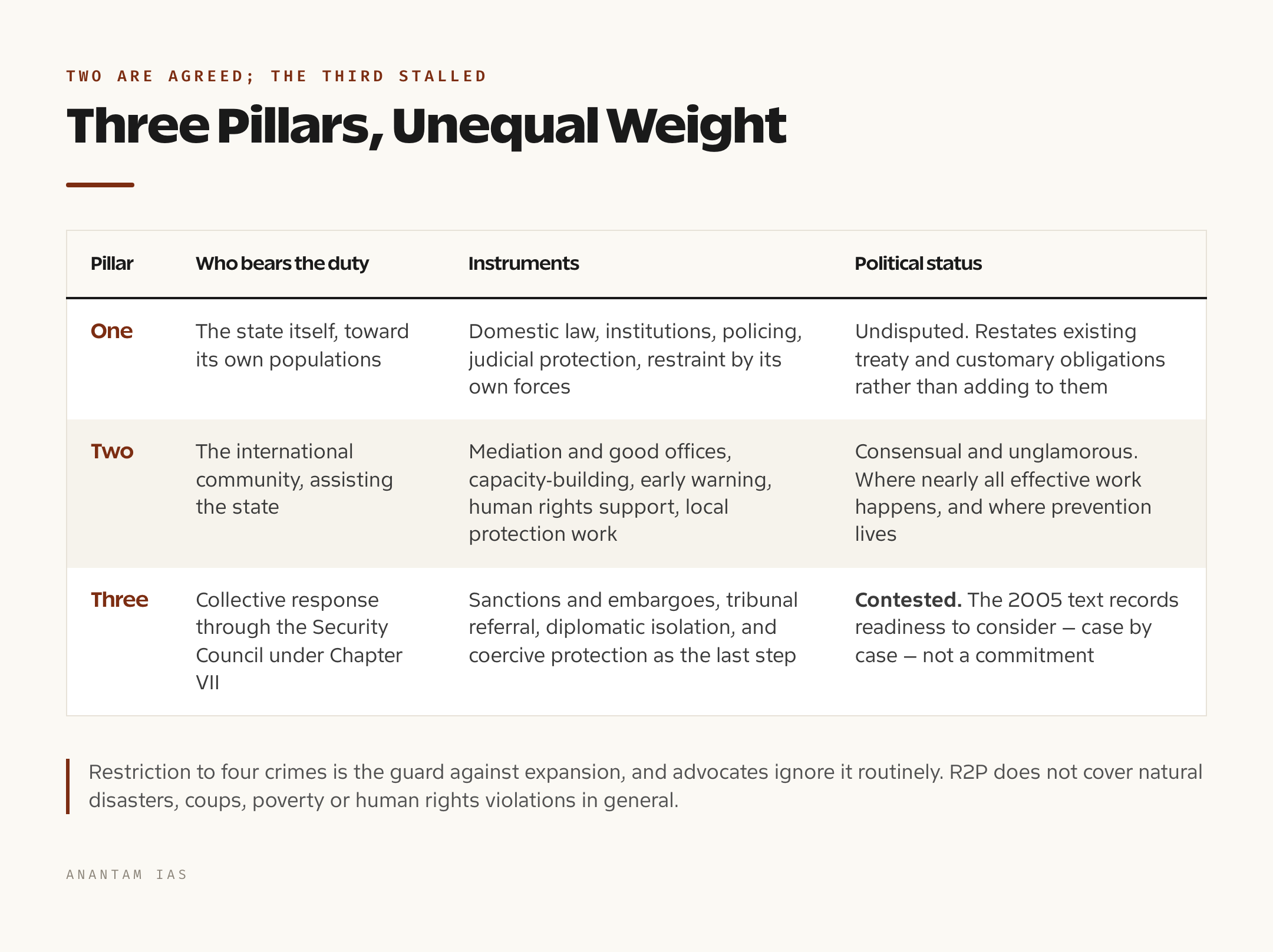
The Secretary-General’s 2009 report Implementing the Responsibility to Protect organised the text into the three pillars now used as shorthand.
Pillar one: the state’s own responsibility to protect its populations from the four crimes. This is not a concession; it restates an existing obligation under treaty and customary law, and it is the pillar no state disputes.
Pillar two: international assistance and capacity-building — helping states discharge pillar one through mediation, institution-building, human rights capacity, early warning and support for local protection. This pillar is consensual, unglamorous and where nearly all useful work happens.
Pillar three: timely and decisive collective response, through the Security Council under Chapter VII, where a state manifestly fails. The text is deliberately weak. It says members are “prepared to take collective action… through the Security Council” on a case-by-case basis — a statement of readiness to consider, not a commitment, and explicitly channelled through the Council with no alternative route.
The Criteria for Coercive Protection
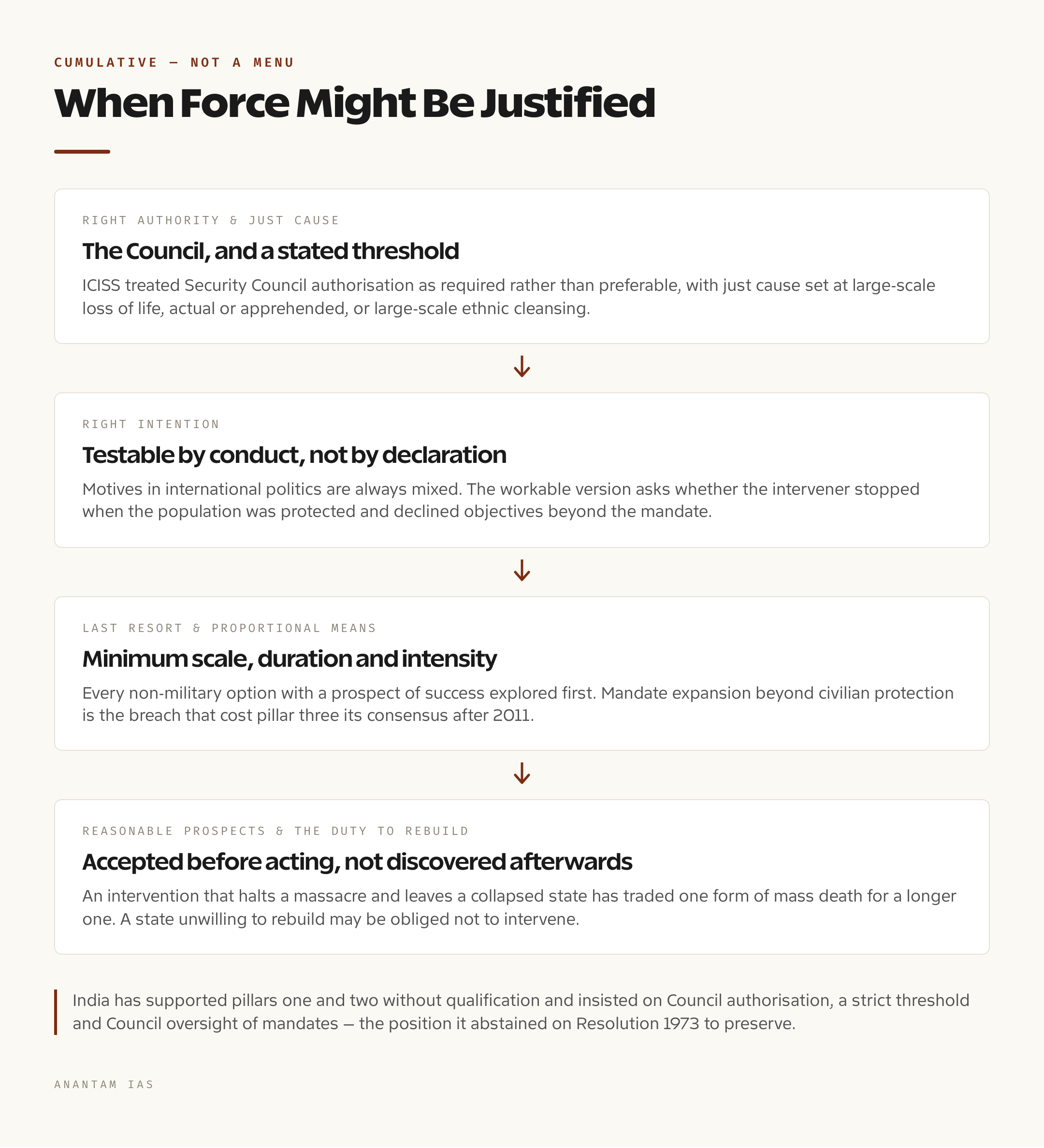
ICISS proposed six criteria, dropped from the 2005 text and revived in the 2004 High-Level Panel report and later in academic and diplomatic argument. They remain the sharpest available checklist, and they are cumulative rather than alternative.
Right authority — the Security Council, whose authorisation the report treated as required rather than preferable. Just cause, with an explicit threshold: large-scale loss of life, actual or apprehended, or large-scale ethnic cleansing. The threshold is the guard against expansion. Right intention — the primary purpose must be to halt or avert suffering, which the report suggested was better evidenced by multilateral participation and regional support than by declarations. Last resort, meaning every non-military option reasonably believed to have a prospect of success has been explored. Proportional means — the scale, duration and intensity held to the minimum necessary for the protection objective, which is the criterion that mandate expansion breaches. Reasonable prospects, meaning a reasonable chance of halting the suffering, with the consequences of action not likely to be worse than inaction.
Note what right intention implies. Motives in international politics are always mixed, and a test that required purity would exclude every real case. The workable version is a test of conduct after the fact: an intervener whose primary purpose was protection stops when the population is protected, does not pursue objectives beyond the mandate, and accepts costs to reduce harm. Intention becomes testable retrospectively, which is the only form in which it is worth anything.
Selectivity and Abuse
Two objections have done more damage to R2P than any argument about sovereignty, and both are correct.
The selectivity objection. Intervention happens where the interests of powerful states align with the humanitarian case, and does not happen where they do not. Comparable atrocities receive incomparable responses depending on the identity of the perpetrator and its relationships. This is not merely a complaint about hypocrisy. Inconsistency is itself a moral defect: a principle applied only when convenient is not functioning as a principle, and the pattern of application teaches states that protection language tracks power. The usual reply — that inconsistent rescue is better than no rescue — has force in the individual case and does nothing for the credibility of the norm.
The abuse objection. Protective language has been used to legitimise objectives that were not protective. The Libya intervention of 2011 is the case that shaped everything after it. Security Council Resolution 1973 authorised all necessary measures to protect civilians and imposed a no-fly zone; five members abstained, including India, Brazil, China, Russia and Germany. The operation that followed went beyond civilian protection to the removal of the government, and the states that had abstained rather than vetoed concluded that abstention had been used against them. The consequence was immediate and durable: pillar three lost the political consensus it had, and Council authorisation for coercive protection became close to unobtainable. Whatever one concludes about the merits of the operation, the effect on the norm is not in dispute.
Brazil’s response was constructive rather than merely obstructive. Its 2011 concept of “responsibility while protecting” proposed that authorisation carry criteria for the use of force, chronological sequencing of the pillars, and — the substantive part — a mechanism for the Council to monitor and review the implementation of a mandate it had granted. The proposal was not adopted. It remains the most serious attempt to close the gap between authorisation and conduct.
The Veto, and Proposals to Restrain It
If pillar three runs through the Council, the veto is the pivot. A permanent member can block a response to an atrocity in which it or a partner is implicated, without giving reasons, and the record shows this happening.
Three responses are on the table and none has changed the Charter. Voluntary veto restraint: ICISS floated a “responsibility not to veto”, and a France-Mexico initiative from 2013 asked permanent members to undertake voluntarily not to use the veto in mass atrocity situations. A code of conduct: the ACT group — Accountability, Coherence and Transparency, some two dozen states — put forward in 2015 a pledge for all Council members to support credible action against atrocity crimes and not to vote against it. Transparency: the General Assembly resolved in 2022 to convene a formal debate whenever a veto is cast, which does not restrain the veto and does raise its political cost.
Amendment is not realistic, since Charter amendment itself requires the concurrence of the permanent members. The honest description is that the architecture makes the enforcement of pillar three conditional on the interests of five states, and that no reform with any prospect of adoption changes this.
India’s Position, and the Complication
India’s stance has been consistent across governments and is more considered than the label “sovereigntist” suggests.
India has supported pillars one and two without qualification, arguing that the state’s own responsibility and international capacity-building are where the doctrine does real work. On pillar three it has insisted that any coercive action requires Security Council authorisation, that the threshold be strictly limited to the four crimes, that the mandate be precise, and that the Council retain oversight of implementation. It abstained on Resolution 1973, and the subsequent mandate expansion is regularly cited in Indian statements as vindication of the caution. India is also among the largest cumulative contributors to UN peacekeeping, which gives its insistence on clear mandates the weight of a troop contributor rather than a bystander.
The Bangladesh precedent is the complication, and it should be stated rather than avoided. India’s intervention in East Pakistan in 1971 halted mass atrocities and is cited in the Western literature as one of the strongest humanitarian interventions of the twentieth century. India’s own case at the Security Council rested chiefly on self-defence and on the burden imposed by refugee flows, rather than on a general right of humanitarian intervention — a deliberate choice, since a general right was precisely what India did not want established as available to others. The episode shows both that the strongest case for intervention can be made by a state that opposes the doctrine, and that a state can act rightly while declining to convert its action into a precedent. The distinction between the merits of an act and the merits of the rule it would create is a general one, and appears again in the ethics of protest — where an action can be justified while the principle it asserts would be dangerous if generalised.
Prevention, Coercion Short of Force, and the Aftermath
Prevention is the neglected pillar and the effective one. Early warning systems, mediation and good offices, support for judicial and electoral institutions, hate-speech monitoring, and the UN’s Framework of Analysis for Atrocity Crimes of 2014 all belong here. Prevention is cheaper by orders of magnitude than intervention, and it suffers from a structural disadvantage: a prevented atrocity is invisible, so the work generates no credit and cannot be evaluated against a counterfactual. Nothing in the incentive structure of governments or media rewards it.
Coercion short of force sits between the pillars and inherits its own ethical problems. Arms embargoes, targeted sanctions on those responsible, referral to international tribunals, and diplomatic isolation are the instruments available before military action, and they are subject to the same tests of discrimination and proportionality — including the network-based leverage examined in weaponised interdependence, which is now often the first coercive step taken and the least examined.
The duty to rebuild is where interventions fail. ICISS placed the responsibility to rebuild alongside prevention and reaction, and it is the one most consistently abandoned. An intervention that halts a massacre and leaves a collapsed state has traded one form of mass death for another over a longer period. The ethical implication is uncomfortable: if the responsibility for the aftermath is real, then a state unwilling to commit to reconstruction may be obliged not to intervene, even where the immediate case is strong. Willingness to accept the aftermath belongs in the ex ante assessment rather than being discovered afterwards. Who answers for what follows, and how that answerability is structured, is the subject of accountability and responsibility.
The Honest Difficulties
Both horns are real, and the case for each rests on documented failures. Non-intervention permitted Rwanda and Srebrenica. Intervention produced state collapse and its consequences, and provided cover for objectives that were not humanitarian. Anyone who finds one horn obviously blunter than the other has not read the record of the other.
The threshold problem has no clean solution. Set the threshold high and atrocities below it proceed unaddressed. Set it low and the doctrine becomes a general licence. “Large-scale loss of life, actual or apprehended” is deliberately imprecise, and it has to be, because the judgement is about a specific situation and cannot be reduced to a number.
Consistency and rescue pull in opposite directions. Refusing to act where the case is strong because one cannot act everywhere sacrifices real people to the integrity of a norm. Acting only where convenient corrodes the norm that would protect others later. This is a genuine dilemma and not a failure of resolve.
The defensible position, stated carefully. The threshold must be high and limited to the four crimes; the authority must be collective, which in practice means the Council with all its defects; the intention must be testable by conduct after the fact and not by declaration; the mandate must be monitored by the body that granted it; and responsibility for the aftermath must be accepted before the action rather than discovered during it. These conditions are demanding, they are rarely met, and the honest conclusion is that in most situations the correct answer is heavy investment in the first two pillars and refusal of the third. The frameworks that generate these competing intuitions — consequences against rules, duties against outcomes — are set out in Western moral philosophy.
FAQ
What is the responsibility to protect? A doctrine holding that each state bears the primary responsibility to protect its populations from genocide, war crimes, ethnic cleansing and crimes against humanity; that the international community should assist states in doing so; and that where a state manifestly fails, collective action through the Security Council may be taken. It was set out by ICISS in 2001 and agreed in paragraphs 138-139 of the 2005 World Summit Outcome Document.
How does R2P differ from humanitarian intervention? Humanitarian intervention framed the question as a right held by outsiders to use force. R2P frames it as a responsibility held first by the state itself, with outside action as a residual third step. It also confines the scope to four crimes and routes coercive action exclusively through the Security Council.
What are the three pillars? The state’s own responsibility to protect its populations; international assistance and capacity-building to help states discharge that responsibility; and timely and decisive collective response through the Security Council under Chapter VII where a state manifestly fails.
Why did R2P’s third pillar stall after 2011? Because Resolution 1973 authorised measures to protect civilians and the operation that followed pursued the removal of a government. States that had abstained rather than vetoed concluded that authorisation would be stretched, and Council authorisation for coercive protection became close to unobtainable.
What is India’s position on R2P? Support for pillars one and two, and strict conditions on pillar three: Security Council authorisation, a threshold limited to the four crimes, precise mandates, and Council oversight of implementation. India abstained on Resolution 1973 and cites the subsequent mandate expansion in support of that caution.
What was proposed as “responsibility while protecting”? A Brazilian concept advanced in 2011 proposing that authorisations for force carry explicit criteria, that the pillars be applied in sequence, and — the substantive element — that the Security Council monitor and review the implementation of mandates it has granted.
Practice Questions
Prelims MCQs
- The responsibility to protect, as agreed in 2005, is limited to: (a) Genocide, war crimes, ethnic cleansing and crimes against humanity (b) Any gross and systematic violation of human rights (c) Genocide and natural disasters causing mass casualties (d) Aggression, genocide and unconstitutional changes of government — Answer: (a) the restriction to four crimes is what prevents indefinite expansion of the doctrine.
- The ICISS report of 2001 set out the responsibilities to: (a) Prevent, react and rebuild (b) Warn, authorise and enforce (c) Assist, intervene and withdraw (d) Protect, punish and compensate — Answer: (a) intervention appeared as one option within the responsibility to react, with prevention treated as the most important.
- The Independent International Commission on Kosovo described the 1999 NATO action as: (a) Lawful and necessary (b) Illegal but legitimate (c) A valid exercise of collective self-defence (d) An authorised Chapter VII operation — Answer: (b) the formulation conceded the breach of law while defending the moral case, which is why it cannot function as precedent.
- Under the 2005 formulation, pillar three action is to be taken: (a) By any coalition of willing states (b) Through regional organisations without Council approval (c) Through the Security Council under Chapter VII, case by case (d) On the authority of the General Assembly by a two-thirds vote — Answer: (c) the text records readiness to consider collective action through the Council and provides no alternative route.
- The ACT group’s 2015 initiative concerned: (a) Expansion of permanent membership of the Security Council (b) A code of conduct on voting in atrocity situations (c) Financing of peacekeeping operations (d) Criteria for troop-contributing countries — Answer: (b) it asked Council members to pledge support for credible action against atrocity crimes and not to vote against it.
Mains Practice Questions
- “Sovereignty was never a bare fact of control; it was always a set of duties.” Examine the ICISS reframing of sovereignty as responsibility. (150 words)
- The selectivity of humanitarian intervention is often dismissed as hypocrisy. Explain why inconsistency is itself a moral objection, and assess the reply that inconsistent rescue is better than none. (250 words)
- Discuss how the 2011 Libya intervention affected the political viability of R2P’s third pillar, and evaluate the “responsibility while protecting” proposal as a remedy. (250 words)
- “Right intention cannot be tested in advance, only by conduct afterwards.” Discuss with reference to the criteria for coercive protection. (150 words)
- “A state unwilling to accept responsibility for the aftermath may be obliged not to intervene.” Critically examine this position in the light of the duty to rebuild. (250 words)