In February 2022, the world watched a new kind of weapon fire without a single shot. Within days of Russia invading Ukraine, the United States and Europe pushed major Russian banks out of SWIFT — the Brussels-based messaging system that the world’s banks use to talk to each other — and froze roughly $300 billion of the Russian central bank’s reserves held abroad. Money Moscow thought it owned became money it could not touch. No tanks crossed a border to do this. The damage was inflicted entirely through the plumbing of the global economy — the wires, the messaging networks and the dollar accounts that everyone assumed were neutral. That moment gave a name its sharpest illustration: weaponised interdependence.
The idea is simple to state and unsettling to absorb. For thirty years, globalisation was sold as a force for peace — countries that trade, invest and bank together, the theory went, would never fight, because they would have too much to lose. What the past few years have shown is the dark twist on that promise. The very networks that bind nations together also hand enormous power to whoever sits at their centre. And states that control those central hubs have learned to switch them off, spy through them, or threaten to do either, to bend other countries to their will. For a UPSC aspirant, this is now one of the most examinable ideas in International Relations and the external economy — it sits underneath sanctions, export controls, de-dollarisation and India’s whole pursuit of strategic autonomy, and a candidate who can explain the mechanism, not just list the episodes, stands out.
What Weaponised Interdependence Actually Means
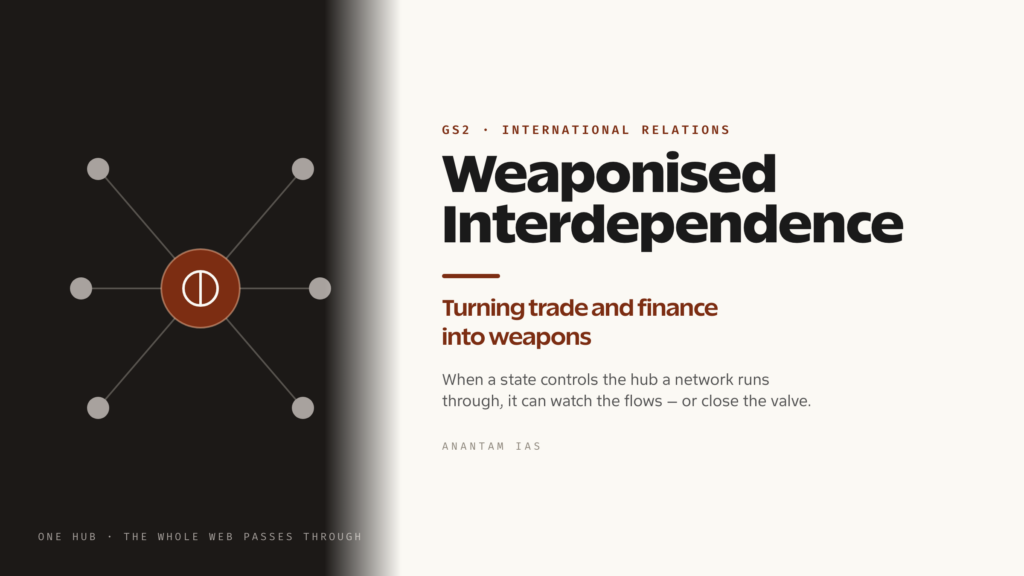
Start with the word itself, because each half carries weight. Interdependence is the dense web of connections between economies — trade flows, cross-border finance, shared technology, undersea data cables, supply chains that stitch a single product together across a dozen countries. The classic view, going back to the 1970s, treated interdependence as broadly symmetric and pacifying: hurt your trading partner and you hurt yourself, so everyone behaves. Weaponised interdependence flips that. It argues these networks are not flat and symmetric at all. They are shaped like hubs and spokes, with a few central nodes through which almost everything must pass — and the country with legal and physical authority over a hub can turn shared connection into one-sided coercion.
The framework was sharpened in 2019 by political scientists Henry Farrell and Abraham Newman, whose work has since become the standard reference for the term. Their core insight is about structure. Global networks — finance, the internet, key supply chains — are not evenly distributed; they funnel through a handful of irreplaceable points. International payments run through SWIFT. Dollar transactions clear through a small set of US institutions. The most advanced chips depend on a few firms and one Dutch maker of lithography machines. Whoever has jurisdiction over those points gets a structural advantage no ordinary state possesses, simply because of where they sit on the map of connections. Power here comes not from how much you produce but from what flows through you.
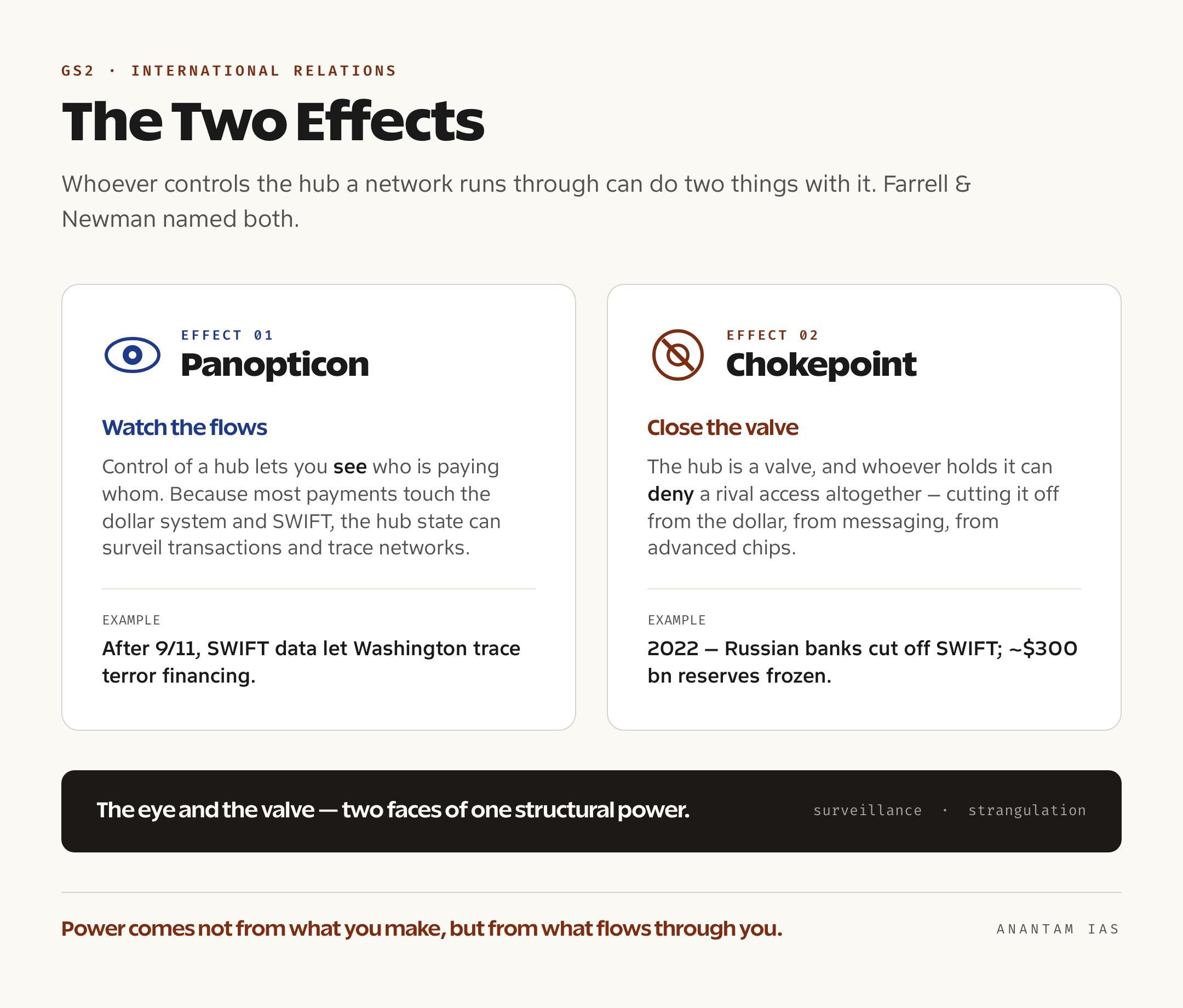
Farrell and Newman named two distinct ways a hub state turns that position into power, and getting these two terms right is the heart of a strong answer. The first is the panopticon effect — named after the all-seeing prison design — where controlling a hub lets you watch the flows passing through it. Because most global transactions touch the dollar system or SWIFT, and much internet traffic runs through American infrastructure, the United States can see who is paying whom. After the 9/11 attacks, intelligence drawn from SWIFT data let Washington trace and target the financing of terrorist networks. The second is the chokepoint effect — where you don’t just watch the valve, you close it. Whoever controls the hub can deny a rival access to it altogether: cut it off from the dollar, from financial messaging, from advanced chips. Surveillance and strangulation, the eye and the valve — those are the two faces of the same structural power.
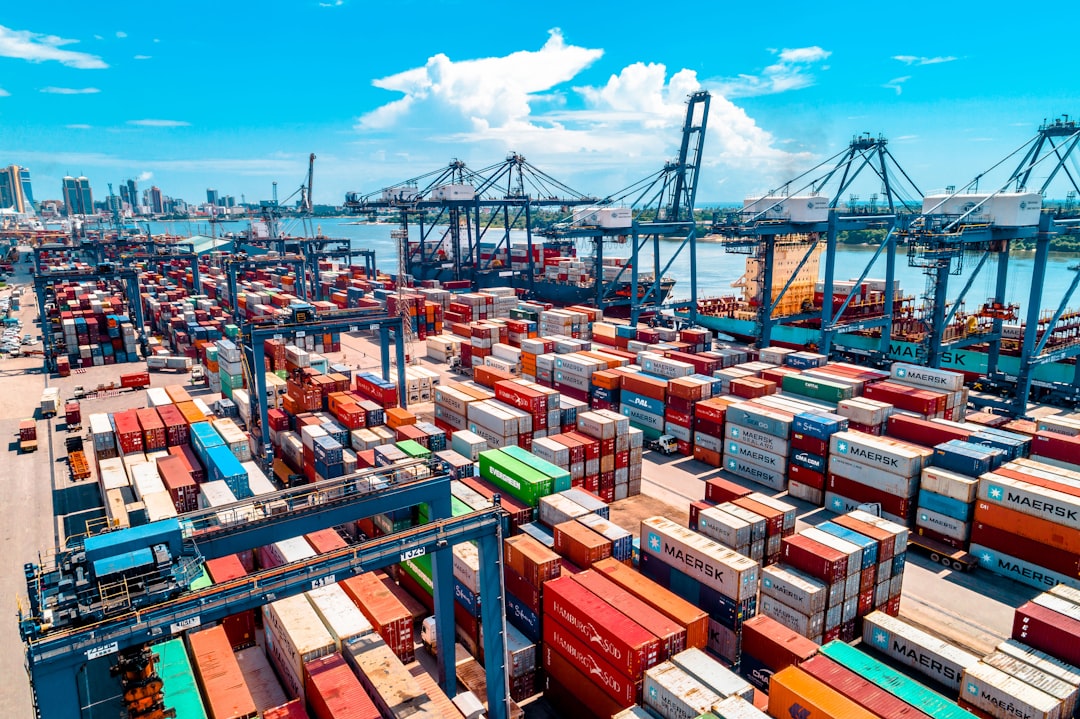
The Toolkit: How Economic Interconnection Becomes a Weapon
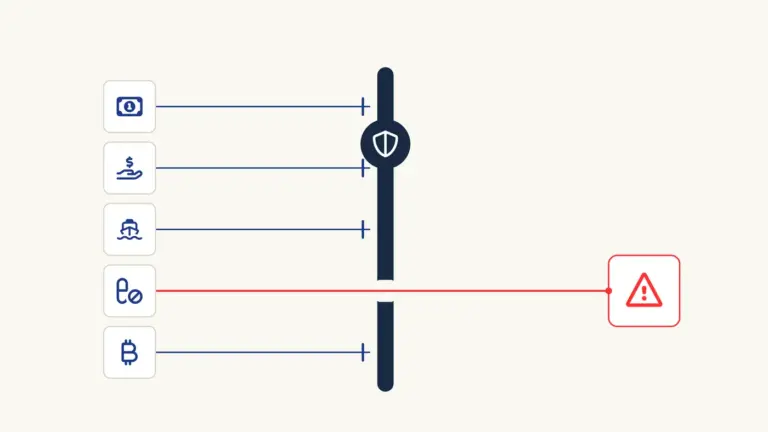
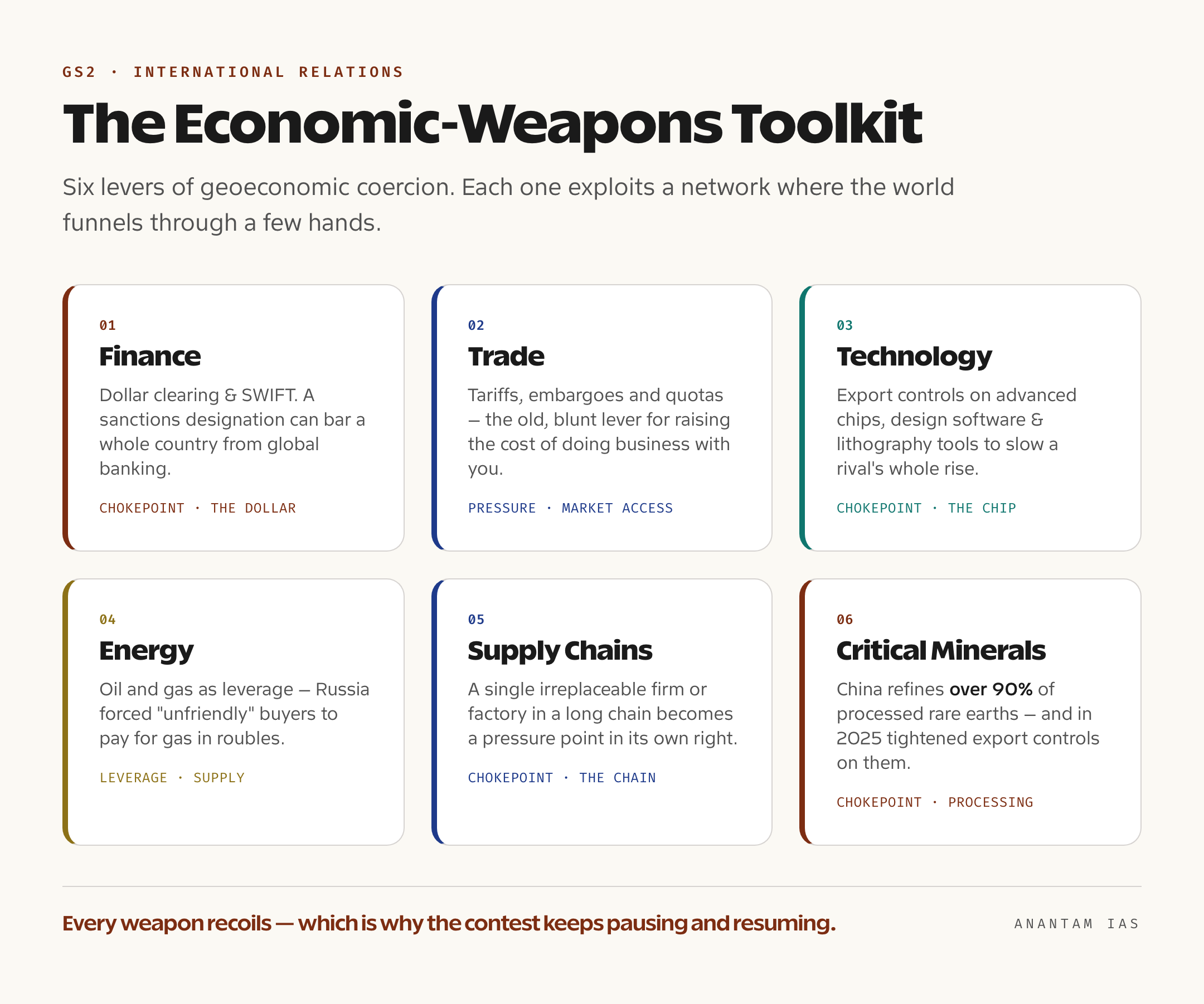
Weaponised interdependence is the theory; geoeconomics is the practice — the use of economic instruments to pursue goals that armies once pursued. And the toolkit has several distinct levers, each exploiting a different network. The most powerful is finance. The US dollar is the currency in which most of the world’s trade is invoiced and most reserves are held, and dollar payments must ultimately clear through American banks. That gives Washington a chokepoint of extraordinary reach: a sanctions designation can effectively bar a person, a company or an entire country from the global banking system, because no bank wants to risk losing access to dollars itself. Layer SWIFT on top — the messaging cooperative that, while not American, has twice been pressed into cutting off targets, Iran in 2012 and Russia in 2022 — and you have the single most potent economic weapon in existence.
The second lever is trade and technology controls. Tariffs and embargoes are the old, blunt version; the sharp modern version is the export control aimed at a chokepoint in a supply chain. The clearest case is semiconductors. Washington has steadily tightened restrictions on China’s access to advanced chips, chip-design software and the lithography tools needed to make them, adding dozens of Chinese firms to its Entity List through 2025 and, on 29 September 2025, extending the rules to majority-owned foreign affiliates. The logic is pure chokepoint: a handful of firms and one machine-maker stand between China and the frontier of computing, so denying access there sets back an entire rival economy. Energy is a fourth lever — Russia’s attempt to force “unfriendly” buyers to pay for gas in roubles was an effort to weaponise its own export dependence — and supply chains and critical minerals are the fifth, where dominance over the processing of a scarce input becomes a pressure point in its own right.
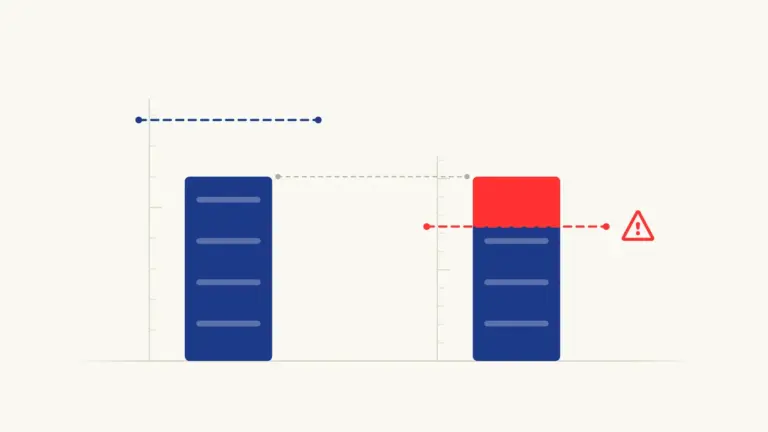
That last lever is where the weapon cuts both ways, and 2025 proved it. Ten days after the US semiconductor escalation, China retaliated by tightening export licensing on rare-earth oxides, metals and magnets — the materials it overwhelmingly controls, refining well over 90 per cent of the world’s processed rare earths and magnets. Beijing extended the controls to processing equipment and even to foreign-made goods containing a trace of Chinese-origin material, reaching into the supply chains of defence, autos, semiconductors and AI data centres worldwide. The shock was severe enough that both sides met in Busan, South Korea, and agreed in November 2025 to a tentative one-year suspension of their newest measures, due to be revisited in 2026. China then went further on its own statute book, promulgating in early 2026 its first dedicated supply-chain security framework — a sign that “weaponising the chain” is now settled policy, not a one-off.
The Episodes That Changed the Rules
Theory becomes real through cases, and three recent episodes did more to teach the world about weaponised interdependence than any textbook. The first and most decisive was the Russia sanctions package of 2022. Cutting major Russian banks off SWIFT was dramatic, but freezing roughly $300 billion of the central bank’s overseas reserves was the deeper shock. It demonstrated that even a state’s own savings, parked in the financial system of another country, could be switched off overnight. That single act reverberated through every reserve-managing central bank on earth, because it proved that holding wealth abroad is holding it at someone else’s pleasure. India’s own quiet move to bring more of its gold reserves home flows directly from this lesson.
The second episode is the rolling US-China technology war, which turned export controls from a niche tool into a defining feature of great-power rivalry. By denying China advanced chips, Washington showed how a chokepoint deep inside a supply chain — not a tariff at the border — could be used to slow a rival’s entire technological rise. The third is China’s rare-earth counter-strike, which answered the chip controls in kind and reminded everyone that the United States does not own every chokepoint. America holds the high ground in finance and frontier technology; China holds it in the processing of the minerals that frontier technology runs on. The fuller logic of who controls which mineral is something we set out in our explainer on critical minerals and India’s strategy. Together these cases mapped the new battlefield: whoever sits at a hub can fight from it, and almost every major economy sits at one hub while being a spoke at several others.
What makes these episodes genuinely new is that the targets are no longer small, isolated states. Iran and North Korea could be sanctioned at little cost to the sanctioner. Weaponising interdependence against Russia, and above all against China, means firing weapons that recoil — disrupting your own firms, your own consumers, your own supply chains. That mutual vulnerability is exactly why the contest keeps pausing and resuming rather than resolving, and it is the bridge to understanding the consequences. We unpack the practitioner’s side of this — the deals, the FTAs, the mineral blocks — in our companion piece on geoeconomics as statecraft.
The Backlash: De-Risking, Friend-Shoring and De-Dollarisation
Every weapon provokes a defence, and the weaponisation of interdependence has triggered a worldwide scramble to reduce exposure — a backlash that may reshape globalisation more than the weapons themselves. The first response is de-risking and friend-shoring: companies and governments deliberately shortening and diversifying supply chains so that no single chokepoint, and no single rival, can hold them hostage. Instead of chasing the lowest cost anywhere on earth, firms now build redundancy and route critical production through trusted partners — “friends” — even at higher cost. The “China plus one” sourcing strategy, the push to build chip fabs in the United States, Japan and India, and frameworks like the Indo-Pacific Economic Framework’s supply-chain pillar are all expressions of this de-risking instinct.
The second and deeper response is de-dollarisation — the slow, deliberate effort by many countries to reduce dependence on the dollar for trade settlement and reserves. The freezing of Russia’s reserves planted an uncomfortable question in capitals from Beijing to Brasília: how much of our national savings should sit inside a system one government can switch off? The answers have been incremental rather than revolutionary. Russia forced energy buyers into roubles; China has pushed to settle more trade in renminbi and built its own payments-messaging alternative to SWIFT; the BRICS grouping keeps discussing local-currency trade and payment interoperability. Yet the dollar is not being dethroned. It still dominates trade invoicing and reserves, no rival currency is freely usable at the same scale, and a common BRICS currency remains a slogan more than a plan. De-dollarisation is best framed as gradual diversification and hedging, not the dollar’s fall.
The cumulative effect is fragmentation — the slow splitting of one integrated global economy into overlapping, partly walled blocs. Economists worry about a “weaponisation backlash,” in which the very overuse of economic weapons erodes the hub state’s long-run power: the more often Washington reaches for the financial chokepoint, the more incentive everyone else has to build around it, and a chokepoint that everyone has learned to bypass is no longer much of a chokepoint. That tension — short-term coercive power against long-term network erosion — is the strategic dilemma at the centre of the whole subject, and a sharp answer names it.
India’s Exposure and Strategy
India sits in the most instructive position of all: it is a spoke on networks others control, and it is racing to make sure it is never strangled by any of them. Its exposure runs across every lever. It clears most of its trade in dollars, so it is inside the financial chokepoint. It imports the overwhelming majority of its advanced chips and depends heavily on China for the processed critical minerals — rare earths, lithium, the inputs to clean energy and electronics — that its growth and green transition require. And it buys most of its crude from abroad, leaving it exposed to energy as leverage. India is not a hub; it is a customer of several hubs at once. That is precisely the vulnerability that makes strategic autonomy more than a slogan — it is the doctrine of never letting any single power hold a valve over your economy.
The strategy that follows has several strands, and they map cleanly onto the toolkit they are meant to counter. Against the financial chokepoint, India is diversifying its payment options — promoting rupee-based trade settlement with willing partners, extending its UPI rails internationally, and bringing its gold reserves home as insurance against any freeze. Against the technology and supply-chain chokepoints, it is building manufacturing resilience under the broad banner of atmanirbharta, or self-reliance — semiconductor incentives to bring chip assembly and fabrication onshore, production-linked schemes across electronics and pharmaceuticals, and participation in friend-shoring arrangements with partners. And against the minerals chokepoint specifically, the government launched the National Critical Mineral Mission in January 2025, a roughly ₹34,300-crore, seven-year push covering exploration, processing, recycling and the overseas acquisition of mineral assets, alongside membership of the Mineral Security Partnership and the Quad’s critical-minerals initiative.
The deeper point for an aspirant is that India’s response is calibrated, not absolutist. It is not trying to exit the global economy — that would forfeit the gains of interdependence — but to hedge its dependence so that no chokepoint becomes a noose. It diversifies suppliers rather than autarky, builds buffers rather than walls, and keeps its options open across competing blocs through the very strategic autonomy that lets it buy Russian oil and American technology in the same year. The lesson India draws from weaponised interdependence is the same one a careful investor draws from a fragile market: stay connected, because connection is where the growth is, but never let any single counterparty hold the only key to your front door.
For Your Mains Answer
This is a high-value topic for GS Paper 2 (International Relations — effect of policies and politics of developed and developing countries on India’s interests, important international institutions) and GS Paper 3 (the external sector, the economics of sanctions and supply-chain security). It also offers a rich, contemporary frame for the Essay paper on globalisation, sovereignty and self-reliance. The skill examiners reward is the same one this article uses: explain the mechanism — hubs, chokepoints, the panopticon and chokepoint effects — and then attach exact episodes and India’s specific responses to it.
How to Build the Answer
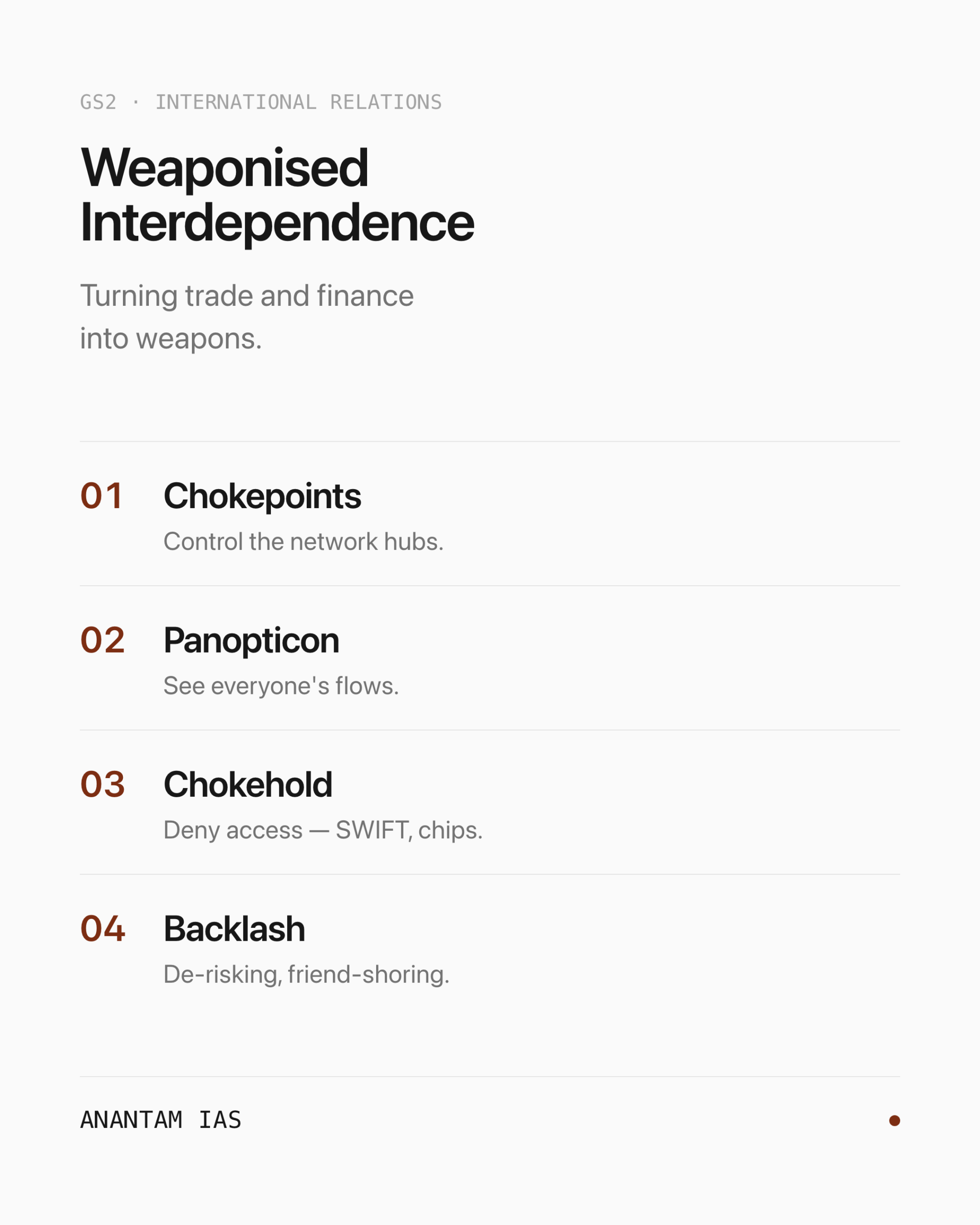
Open with the mechanism, not the news. Define interdependence, explain why networks are hub-and-spoke rather than flat, and introduce the two effects (panopticon = surveillance, chokepoint = denial). Then walk the toolkit — finance, trade and technology, energy, supply chains and critical minerals — pinning one episode to each (SWIFT and frozen reserves; chip controls; rare-earth controls). Turn to the backlash (de-risking, friend-shoring, de-dollarisation, fragmentation) and the weaponisation-backlash dilemma. Close on India: its exposure across every lever, and its calibrated, hedge-not-exit strategy of strategic autonomy. That arc — mechanism, toolkit, episodes, backlash, India — answers almost any phrasing of the question.
Common Mistakes to Avoid
Don’t treat sanctions and weaponised interdependence as the same thing — sanctions are one instrument; the framework is the structural why behind their power. Don’t muddle the two effects: the panopticon is watching, the chokepoint is closing — naming both, correctly, earns the marks. Don’t overstate de-dollarisation as the imminent collapse of the dollar; frame it as gradual diversification. And don’t present India as a passive victim or as seeking autarky — its position is calibrated hedging within continued engagement.
A Compact Answer Spine
Interdependence is hub-and-spoke, not flat → the hub state gains structural power → two effects: panopticon (surveillance, e.g. SWIFT-derived intelligence) and chokepoint (denial, e.g. dollar/SWIFT cut-off) → toolkit: finance (dollar/SWIFT), trade & tech (chip export controls, 2025), energy, supply chains & critical minerals (China’s rare-earth controls, 2025) → key episodes: Russia 2022 ($300 bn reserves frozen, SWIFT cut), US-China tech war, rare-earth counter-strike → backlash: de-risking, friend-shoring, de-dollarisation, fragmentation, “weaponisation backlash” → India: exposed on finance, chips, minerals, energy → strategy: strategic autonomy, rupee trade, atmanirbharta, National Critical Mineral Mission (Jan 2025) → verdict: hedge dependence, don’t exit interdependence.
Diagram or Flowchart Idea
Draw a simple hub-and-spoke network with one central node labelled “hub state,” then split that node into two arrows: one eye-symbol labelled “panopticon — watch the flows” and one valve-symbol labelled “chokepoint — close the flows.” Beside it, a small six-box grid of the toolkit (finance, trade, tech, energy, supply chains, minerals). The visual carries the whole mechanism at a glance and takes under a minute to sketch.
A Balanced-Conclusion Line
A line that lands the marks: “Weaponised interdependence has turned the wiring of globalisation into an arsenal — but because every chokepoint provokes a workaround, the long game belongs not to the state that fires these weapons most often, but to the one, like India, that quietly builds the resilience to never need to surrender.”
How to Use Data Without Cramming
You need only a handful of anchors: ~$300 billion (Russian reserves frozen, 2022); over 90 per cent (China’s share of processed rare earths); the two dates that bracket the 2025 escalation (US chip-affiliate rule, 29 September 2025; the Busan suspension, November 2025); and ₹34,300 crore (India’s National Critical Mineral Mission, January 2025). Attribute them plainly — “after the 2022 sanctions,” “as China’s 2025 controls showed” — rather than scattering numbers loose.
Frequently Asked Questions
What is weaponised interdependence in simple terms?
It is the use of global economic networks — trade, finance, technology, data — as instruments of coercion by the states that control their central hubs. Because networks like the dollar system, SWIFT and advanced-chip supply chains funnel through a few irreplaceable points, whoever has authority over those points can either watch the flows passing through (the panopticon effect) or deny a rival access to them (the chokepoint effect). The framework was popularised by Henry Farrell and Abraham Newman in 2019.
How is weaponised interdependence different from geoeconomics?
They are two sides of one coin. Weaponised interdependence is the theory — the structural explanation of why control over network hubs translates into power. Geoeconomics is the practice — the actual use of economic tools (sanctions, tariffs, export controls, supply-chain pressure) to achieve strategic goals. The theory tells you why the dollar chokepoint or the rare-earth chokepoint is so potent; geoeconomics is the statecraft that pulls the lever.
What were the most important recent examples?
Three stand out. In 2022, the West cut major Russian banks off SWIFT and froze about $300 billion of Russia’s central-bank reserves — proving that even sovereign savings held abroad can be switched off. From 2022 onwards, the United States tightened export controls to deny China advanced semiconductors. And in 2025, China retaliated by weaponising its dominance over rare-earth processing, where it refines over 90 per cent of the world’s supply, before both sides agreed a one-year truce at Busan.
How is India responding to weaponised interdependence?
By pursuing strategic autonomy and resilience rather than withdrawal. India is diversifying its payment options through rupee-based trade and international UPI, building manufacturing self-reliance (atmanirbharta) in chips and electronics, bringing its gold reserves home as a hedge against any freeze, and securing critical minerals through the National Critical Mineral Mission launched in January 2025 and partnerships like the Mineral Security Partnership. The aim is to stay connected to the global economy while ensuring no single power can hold a chokepoint over it.
Practice Questions
Prelims MCQs
- The concept of “weaponised interdependence,” as developed by Henry Farrell and Abraham Newman, rests on which of the following ideas?
(a) Global economic networks are flat and symmetric, so coercion is impossible
(b) States that control central hubs in global networks can convert that position into coercive power
(c) Military alliances are the only real source of international power
(d) Trade always pacifies relations between interdependent states
Answer: (b) The framework argues that networks are hub-and-spoke, and the state with jurisdiction over a hub can coerce others through it. - With reference to weaponised interdependence, the “panopticon effect” refers to which of the following?
(a) Denying a rival access to a critical network
(b) Imposing tariffs on imported goods
(c) Using control of a network hub to surveil the flows passing through it
(d) Devaluing a currency to boost exports
Answer: (c) The panopticon effect is about surveillance — watching the transactions and data that pass through a hub, as with intelligence drawn from SWIFT. - Which of the following best illustrates the “chokepoint effect” in 2022?
(a) The launch of India’s National Critical Mineral Mission
(b) Cutting major Russian banks off from SWIFT and freezing central-bank reserves
(c) The signing of the India-EU Free Trade Agreement
(d) China increasing its gold purchases
Answer: (b) Denying Russia access to SWIFT and its overseas reserves is a textbook chokepoint — closing the valve on a network a rival depends on. - China’s principal lever in the geoeconomic contest of 2025 was its dominance over which of the following?
(a) Global dollar-clearing systems
(b) The SWIFT messaging network
(c) The processing of rare-earth elements and magnets
(d) Advanced lithography machines
Answer: (c) China refines well over 90 per cent of the world’s processed rare earths and magnets, and tightened export controls on them in 2025 in response to US chip controls. - India’s strategy against the risks of weaponised interdependence includes which of the following measures?
(a) Promoting rupee-based trade settlement and bringing gold reserves home
(b) Building supply-chain resilience under atmanirbharta and the National Critical Mineral Mission
(c) Pursuing strategic autonomy by diversifying suppliers across blocs
(d) All of the above
Answer: (d) India’s response combines payment diversification, manufacturing self-reliance, mineral security and strategic autonomy — hedging dependence rather than exiting interdependence.
Mains Practice Questions
- Explain the concept of “weaponised interdependence.” How do the “panopticon effect” and the “chokepoint effect” together describe the way states convert control over global networks into coercive power? (15 marks, 250 words)
- “Globalisation was meant to make economic interconnection a force for peace; it has instead become an arsenal.” Critically examine this statement with reference to the geoeconomic episodes of 2022-2025. (15 marks, 250 words)
- Discuss the main instruments through which economic interdependence is weaponised — finance, trade and technology controls, energy, and critical minerals — with suitable recent examples. (15 marks, 250 words)
- What is the “weaponisation backlash”? Analyse how de-risking, friend-shoring and de-dollarisation are reshaping the global economy in response to the overuse of economic coercion. (10 marks, 150 words)
- Assess India’s exposure to weaponised interdependence across finance, technology and critical minerals, and evaluate whether its strategy of strategic autonomy and self-reliance is an adequate response. (15 marks, 250 words)
Tell Google you want more of this.
Add Anantam IAS as a preferred sourceOne tap, and this site shows up more often in your own Top Stories, AI Overviews and AI Mode. Remove it any time.