Hunter Commission (1882) — Recommendations, Impact & Education Reforms
Complete UPSC guide to the Hunter Education Commission 1882, its recommendations on primary education, context from Wood's Despatch, and comparison with later commissions.
The Hunter Commission, formally known as the Indian Education Commission of 1882, was the first comprehensive review of the education system in British India after the landmark Wood’s Despatch of 1854. Appointed by Lord Ripon, the liberal Viceroy, and chaired by Sir William Wilson Hunter, the Commission examined the state of education at all levels and made far-reaching recommendations — particularly for primary education. For UPSC aspirants, the Hunter Commission is a staple topic in Modern Indian History and frequently appears in both Prelims and Mains.
Context — Education Policy Before 1882
To understand the Hunter Commission, it is essential to trace the evolution of British education policy in India:
Macaulay's Minute (1835)
- Lord Macaulay advocated for English as the medium of instruction and Western sciences as the content of education.
- Led to the English Education Act of 1835, which diverted funds from Oriental learning to English education.
- Created a class of Indians "Indian in blood and colour, but English in taste."
Wood's Despatch (1854)
- Called the "Magna Carta of English Education in India", it was issued by Sir Charles Wood, President of the Board of Control.
- Key recommendations:
- Establishment of a graded system of education from vernacular primary schools to universities.
- Creation of universities in Calcutta, Bombay, and Madras (established in 1857).
- Grants-in-aid system for private schools.
- Education of the masses, not just the elite.
- Use of vernacular languages at the primary level and English at higher levels.
- Establishment of teacher training institutions.
Despite these progressive recommendations, implementation was uneven, and primary education for the masses remained neglected. By the 1880s, there was a need for a comprehensive stocktaking.
The Hunter Commission (1882)
Appointment and Composition
- Appointed by Viceroy Lord Ripon in 1882.
- Chaired by Sir William Wilson Hunter, a member of the Viceroy's Council and a distinguished scholar of Indian affairs.
- The commission had 20 members, including Indian members — a notable inclusion for the time.
- Indian members included Syed Mahmood (son of Sir Syed Ahmad Khan) and Bholanath Sarabhai.
Terms of Reference
The Commission was asked to review:
- The state of primary and secondary education in India.
- Implementation of the recommendations of Wood's Despatch.
- The role of government and private agencies in education.
- The adequacy of the grants-in-aid system.
Key Recommendations
On Primary Education
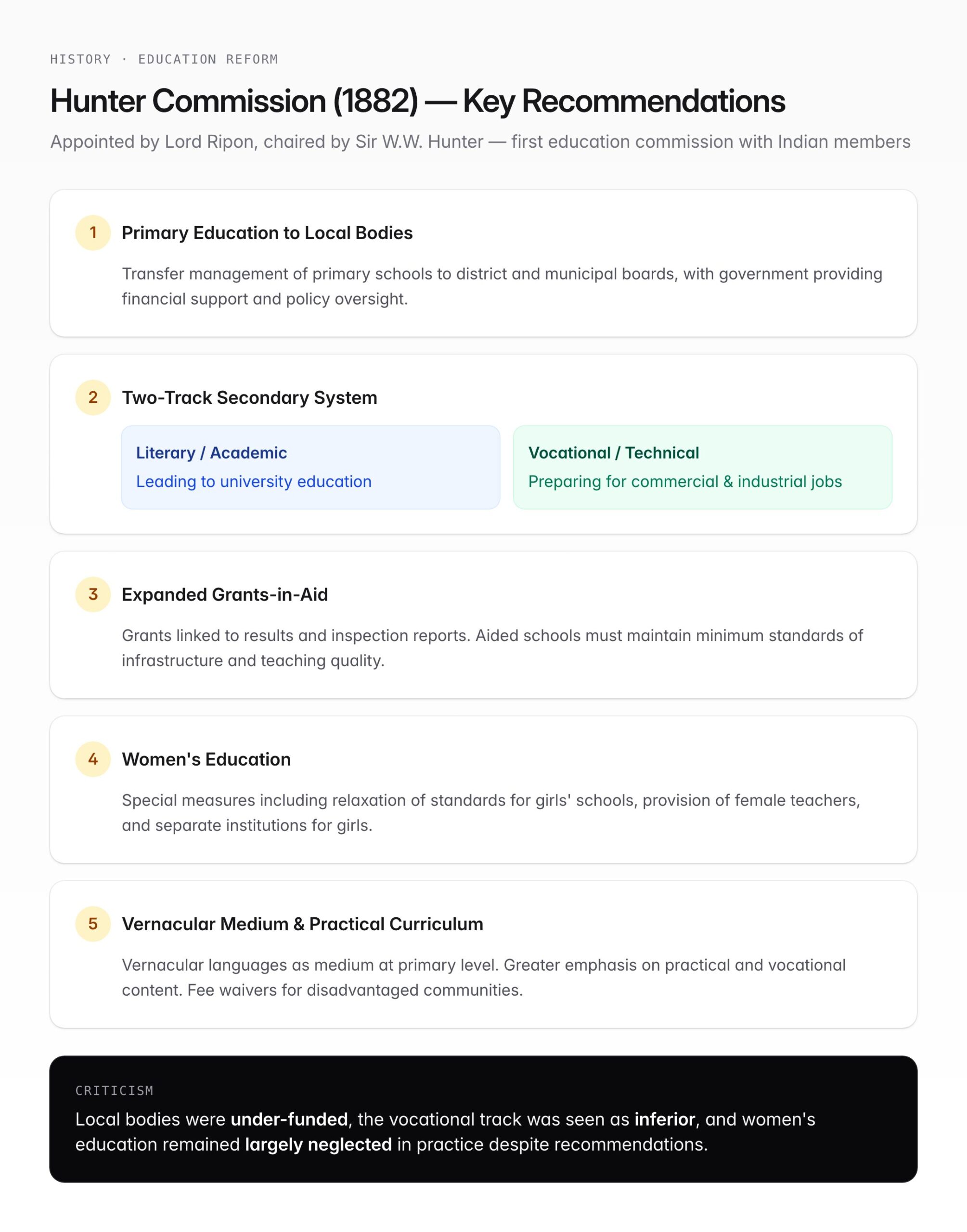
- Primary education should be transferred to local bodies — district and municipal boards — with government providing financial support.
- The state should withdraw from direct management of primary schools and focus on policy and inspection.
- Vernacular languages should be the medium of instruction at the primary level.
- Fee waivers and incentives for lower castes and disadvantaged communities.
- Greater emphasis on practical and vocational content in primary curricula.
On Secondary Education
- Recommended two tracks after primary school:
- Literary/Academic track — leading to university education.
- Vocational/Technical track — preparing students for commercial and industrial occupations.
- Private enterprise should be encouraged in secondary education through improved grants-in-aid.
- Government should gradually withdraw from secondary education and leave it to private initiative.
On Grants-in-Aid
- The grants-in-aid system should be expanded and made more liberal.
- Grants should be linked to results and inspection reports.
- Aided schools should maintain certain minimum standards of infrastructure and teaching quality.
On Higher Education
- The Commission did not extensively address university education, as its focus was on primary and secondary levels.
- However, it acknowledged the importance of the universities established under Wood's Despatch.
On Women's Education
- Recommended special measures to promote female education.
- Suggested relaxation of standards for girls' schools to encourage their establishment.
- Supported the provision of female teachers and separate schools for girls.
Impact and Implementation
The Hunter Commission's recommendations had a mixed legacy:
Positive outcomes:
- Transfer of primary education to local bodies was implemented, giving Indians limited control over elementary schooling.
- The grants-in-aid system was expanded, leading to a growth in private schools and missionary institutions.
- Some improvement in primary school enrolment, though progress was slow.
Limitations:
- Local bodies were under-funded and under-staffed, resulting in poor quality of primary education.
- The two-track system at the secondary level was poorly implemented; the vocational track was seen as inferior.
- Women's education remained largely neglected in practice despite the recommendations.
- The government's withdrawal from direct management led to uneven quality across regions.
Comparison with Later Education Commissions
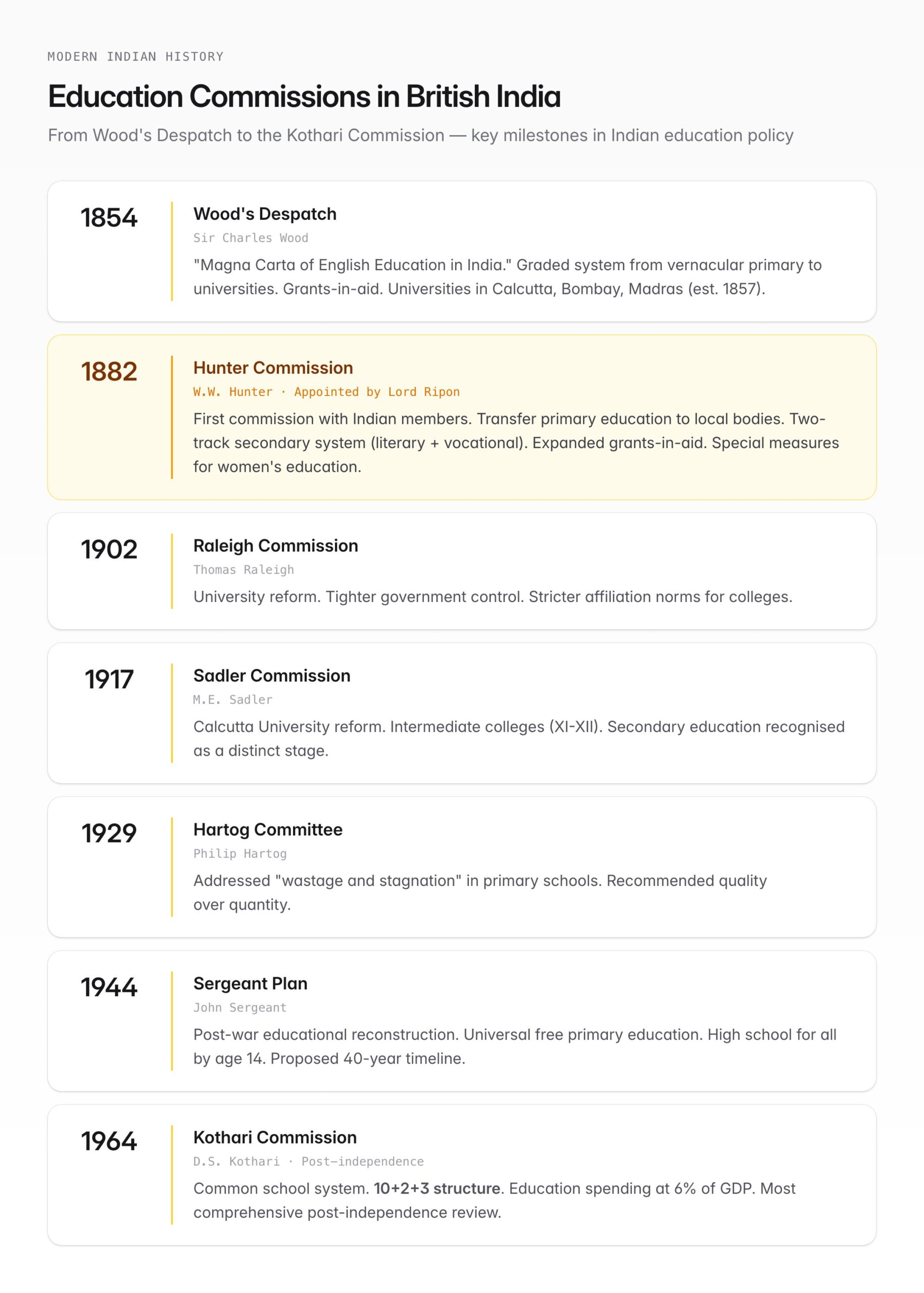
| Commission | Year | Chairman | Key Focus | Major Recommendation |
|---|---|---|---|---|
| Hunter Commission | 1882 | W.W. Hunter | Primary & secondary education review | Transfer primary education to local bodies; two-track secondary system |
| Indian Universities Commission (Raleigh) | 1902 | Thomas Raleigh | University reform | Tighter government control over universities; stricter affiliation norms |
| Sadler Commission | 1917 | M.E. Sadler | Calcutta University and secondary education | Intermediate colleges (classes XI-XII); secondary education as a separate stage |
| Hartog Committee | 1929 | Philip Hartog | Primary education quality | Addressed "wastage and stagnation" in primary schools; recommended quality over quantity |
| Sergeant Plan | 1944 | John Sergeant | Post-war educational reconstruction | Universal free primary education; high school for all by age 14; recommended 40-year timeline |
| Kothari Commission | 1964-66 | D.S. Kothari | Comprehensive education reform (post-independence) | Common school system; 10+2+3 structure; education spending at 6% of GDP |
Criticism of the Hunter Commission
- Nationalist critique — Indian nationalists felt the Commission did not go far enough in expanding mass education and remained tied to colonial priorities.
- Funding gap — Transferring responsibility to local bodies without adequate funds was seen as abandoning primary education.
- Elitist bias — The emphasis on private enterprise in secondary education benefited the elite and missionary institutions while the masses remained underserved.
- Vocational track stigma — The two-track system reinforced class divisions rather than promoting social mobility.
UPSC Relevance
GS Paper I — Modern Indian History: British education policy; social reform movements.
GS Paper II — Governance: Education policy; decentralisation.
Prelims key facts:
- The Hunter Commission was appointed in 1882 by Viceroy Lord Ripon.
- It was chaired by Sir William Wilson Hunter.
- The Commission reviewed the implementation of Wood's Despatch (1854).
- Key recommendation: Transfer primary education to local bodies (district/municipal boards).
- Recommended a two-track system (literary and vocational) at the secondary level.
- It was the first education commission to include Indian members.
- Wood's Despatch (1854) is called the "Magna Carta of English Education in India."
- The Sadler Commission (1917) recommended the intermediate college system.
- The Kothari Commission (1964-66) recommended the 10+2+3 structure and 6% GDP spending on education.