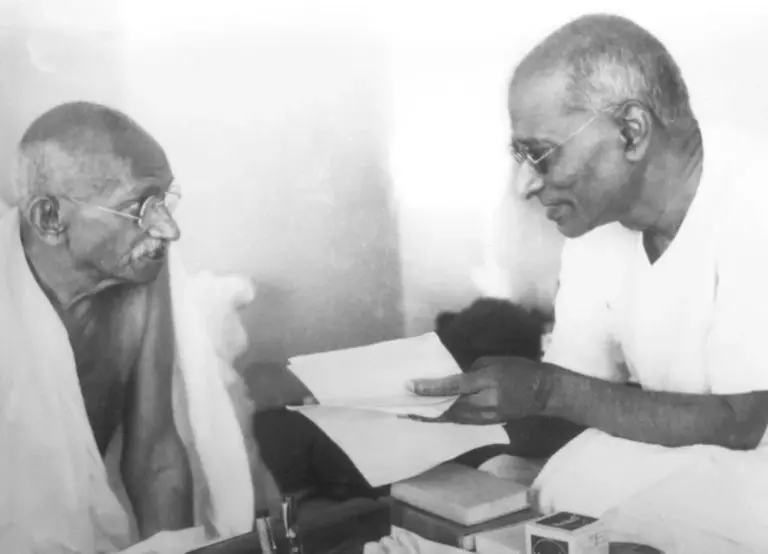

The Kothari Commission (formally the Education Commission, 1964-66) is the most comprehensive review of India's education system ever undertaken. Its recommendations shaped the National Education Policy of 1968 and continue to influence Indian education to this day. For UPSC aspirants, the Kothari Commission is a recurring topic in Polity (GS Paper II), Social Issues (GS Paper I), and Essay, particularly in questions about education policy, social equity, and nation-building.
Background and Constitution
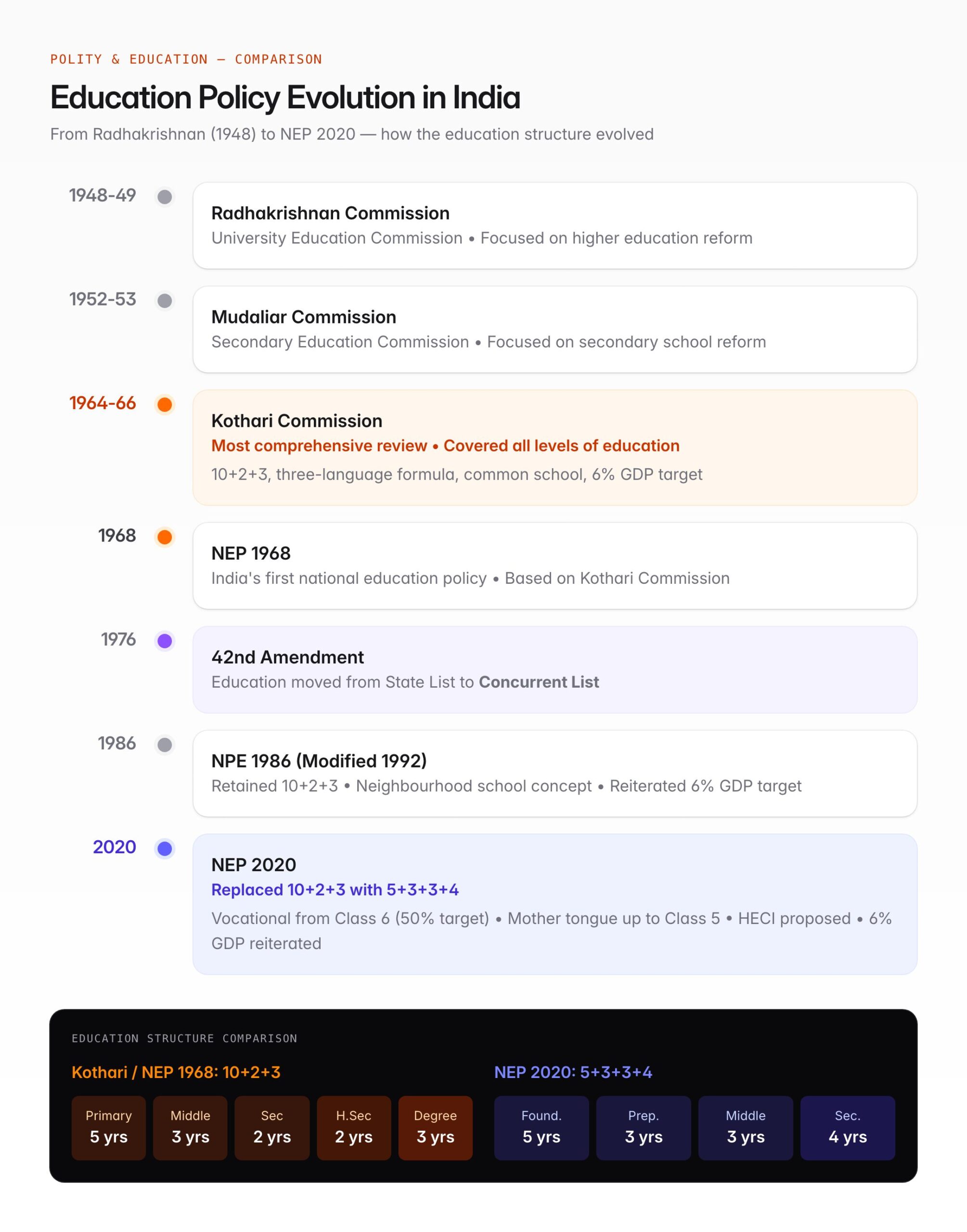
After independence, India constituted several committees and commissions to reform education, including the University Education Commission (1948-49, chaired by Dr S. Radhakrishnan) and the Secondary Education Commission (1952-53, chaired by Dr A. Lakshmanaswami Mudaliar). However, there was no comprehensive review covering all levels and aspects of education.
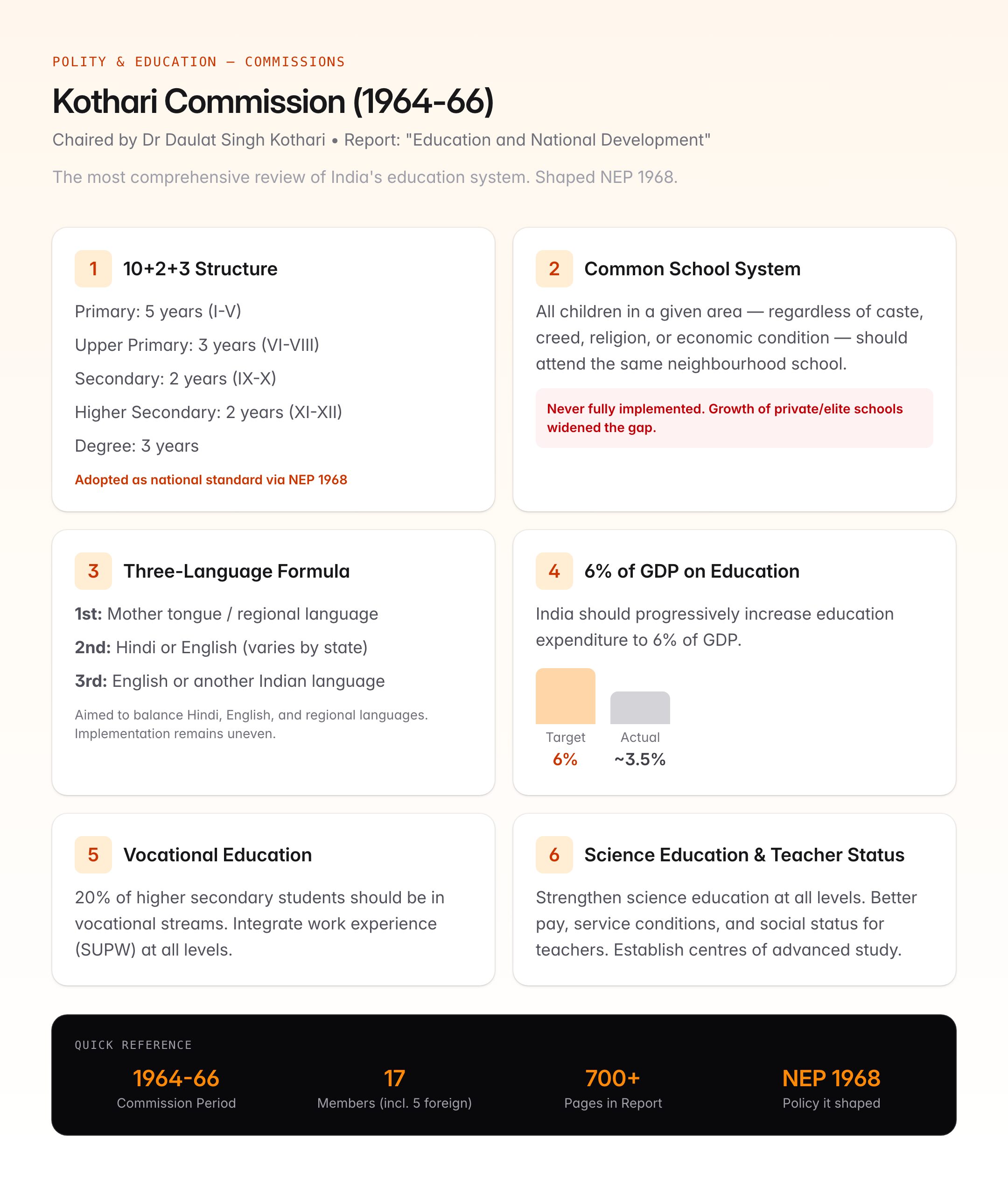
In 1964, the Government of India constituted the Education Commission under the chairmanship of Dr Daulat Singh Kothari, a physicist and then Chairman of the University Grants Commission (UGC).
| Detail | Information |
|---|---|
| Official Name | Education Commission, 1964-66 |
| Chairman | Dr Daulat Singh Kothari |
| Constituted By | Government of India, Ministry of Education |
| Year | 1964-1966 |
| Report Title | "Education and National Development" |
| Report Submitted | June 1966 |
| Members | 17 members (including 5 foreign experts) |
The Commission had a broad mandate: to advise the government on the national pattern of education and on the general principles and policies for the development of education at all stages and in all aspects.
Key Recommendations
The Kothari Commission's report, titled "Education and National Development", ran to over 700 pages and covered every dimension of education. The major recommendations are summarised below.
1. Common School System
The Commission recommended a common school system of public education to bridge the gap between the elite and the masses. The idea was that all children in a given area — regardless of caste, creed, community, religion, economic condition, or social status — should attend the same neighbourhood school.
This was meant to:
- Reduce social segregation in education.
- Improve the quality of government schools by ensuring that influential families had a stake in them.
- Promote national integration and social cohesion.
Reality: The common school system was never fully implemented. The growth of private and elite schools has widened the gap between government and private education.
2. The 10+2+3 Education Structure
The Commission recommended a uniform educational structure across the country:
| Stage | Duration | Age Group |
|---|---|---|
| Primary | 5 years (Classes I-V) | 6-11 years |
| Upper Primary / Middle | 3 years (Classes VI-VIII) | 11-14 years |
| Secondary | 2 years (Classes IX-X) | 14-16 years |
| Higher Secondary | 2 years (Classes XI-XII) | 16-18 years |
| Higher Education (Degree) | 3 years | 18-21 years |
This 10+2+3 pattern was adopted as the national standard and remains the framework of Indian education, though the National Education Policy 2020 has restructured it as 5+3+3+4.
3. Three-Language Formula
The Commission endorsed the three-language formula to promote national integration while preserving linguistic diversity:
- First Language: The mother tongue or regional language.
- Second Language: In Hindi-speaking states, any other modern Indian language or English. In non-Hindi-speaking states, Hindi or English.
- Third Language: In Hindi-speaking states, English or any other modern Indian language. In non-Hindi-speaking states, English or any other modern Indian language (not already chosen as the second language).
Key point: The three-language formula aimed to balance the demands of Hindi, English, and regional languages. Its implementation has been uneven — many southern states have resisted compulsory Hindi, and English has grown in prominence beyond what the Commission envisioned.
4. Education Expenditure — 6% of GDP
The Commission recommended that India should progressively increase its education expenditure to 6% of GDP — a target that India has never consistently achieved. As of recent years, India spends approximately 3-3.5% of GDP on education.
This 6% target has been reiterated by subsequent policy documents, including the NEP 2020.
5. Work Experience and Vocational Education
The Commission emphasised the integration of work experience into education at all levels. It recommended:
- Introduction of socially useful productive work (SUPW) in schools.
- Expansion of vocational and technical education to reduce the pressure on university admissions and address the skills gap.
- A minimum of 20% of students at the higher secondary level should be in vocational streams.
6. Science Education and Research
The Commission recommended:
- Strengthening science education at all levels.
- Establishing centres of advanced study in universities.
- Increasing investment in research and development.
- Linking education with national development priorities, including agriculture, industry, and defence.
7. Teacher Status and Training
- Teachers should be given better pay, service conditions, and social status.
- Teacher training institutions should be strengthened.
- A minimum qualification should be prescribed for teachers at all levels.
8. Other Important Recommendations
- Women's education: Special measures to promote education of girls, especially in rural areas.
- Education of the disadvantaged: Expansion of facilities for Scheduled Castes, Scheduled Tribes, and other backward sections.
- Adult education and literacy: Mass literacy campaigns for adult population.
- Medium of instruction: Regional languages at the school level; progressive shift to Indian languages at the university level.
- National integration: Education as a tool for secular, democratic values and national integration.
- UGC role: Strengthening the UGC to coordinate and maintain standards in higher education.
Impact on the National Education Policy, 1968
The National Education Policy (NEP) 1968 was India's first national education policy, adopted by Parliament based substantially on the Kothari Commission's recommendations. Key features of NEP 1968:
- Adopted the 10+2+3 structure as the national pattern.
- Endorsed the three-language formula.
- Committed to the 6% of GDP expenditure target.
- Emphasised science education, agricultural education, and work experience.
- Called for equalisation of educational opportunity across regions, gender, and social groups.
Comparison with Later Commissions and Policies
| Feature | Kothari Commission (1966) | NPE 1986 (Modified 1992) | NEP 2020 |
|---|---|---|---|
| Education Structure | 10+2+3 | 10+2+3 (retained) | 5+3+3+4 |
| Expenditure Target | 6% of GDP | 6% of GDP (reiterated) | 6% of GDP (reiterated) |
| Common School | Strongly recommended | Neighbourhood school concept | Not explicitly addressed |
| Vocational Education | 20% of higher secondary students | Emphasised | Integration from Class 6; 50% target by 2025 |
| Three-Language Formula | Endorsed | Retained | Retained with flexibility |
| Higher Education Regulator | UGC | UGC | HECI (Higher Education Commission of India) proposed |
| Medium of Instruction | Regional languages preferred | Continued | Mother tongue/local language up to Class 5 (recommended) |
UPSC Relevance
GS Paper Mapping:
- Prelims: Chairman, year, key recommendations (10+2+3, three-language formula, 6% GDP), report name.
- GS Paper I (Mains): Social issues — role of education in social empowerment, women's education.
- GS Paper II (Mains): Governance — education policy, government interventions for development, issues relating to education.
- Essay: Education and national development, common school system, language policy.
Key Prelims Facts:
- The Kothari Commission (1964-66) was chaired by Dr Daulat Singh Kothari.
- Its report was titled "Education and National Development."
- It recommended the 10+2+3 education structure, adopted by NEP 1968.
- It endorsed the three-language formula for linguistic balance.
- It recommended raising education expenditure to 6% of GDP — a target India has not consistently achieved.
- It proposed a common school system of public education.
- The Radhakrishnan Commission (1948-49) dealt with university education; Mudaliar Commission (1952-53) with secondary education.
- NEP 1968 was India's first national education policy, based largely on Kothari Commission recommendations.
- NEP 2020 replaced the 10+2+3 structure with 5+3+3+4.
- Education was moved from the State List to the Concurrent List by the 42nd Amendment (1976).
Tell Google you want more of this.
Add Anantam IAS as a preferred sourceOne tap, and this site shows up more often in your own Top Stories, AI Overviews and AI Mode. Remove it any time.