Inclusive Digital Access and Article 21: The 2025 Supreme Court Ruling Explained
The Supreme Court's 2025 Amar Jain ruling reads inclusive digital access into Article 21. This guide unpacks the judgment, the RPwD Act linkage, the substantive equality doctrine, and the UPSC takeaways.
The Supreme Court’s ruling in Amar Jain vs. Union of India in 2025 marked a quiet but consequential shift in how the Indian Constitution reads the right to life. The bench held that “inclusive and meaningful digital access” to e-governance and welfare systems is not a policy preference. It is an intrinsic part of the fundamental right to life and personal liberty under Article 21. The judgment came as a response to the everyday exclusions faced by visually impaired persons and acid attack survivors when KYC platforms refused to read their faces or accept their biometric inputs.
The ruling sits in a longer arc. Indian courts have spent the last decade extending Article 21 to cover privacy, internet access, dignity at work, mental health, and a clean environment. The 2025 judgment adds digital inclusion to that list and threads it together with the Rights of Persons with Disabilities Act of 2016. The Court issued twenty specific directions to make e-KYC compatible with the statutory accessibility framework. The Centre was asked to revise digital KYC norms so that no citizen is locked out of banking, ration, pension, or telecom services because the user interface assumes a standard body.
This guide walks through the case, the constitutional architecture that supports it, the statutory linkages with the RPwD Act, the comparative reading with earlier internet-rights cases like Faheema Shirin and Anuradha Bhasin, and the prelims and mains pointers an aspirant should carry into the examination hall.
Quick Facts on the Amar Jain Ruling
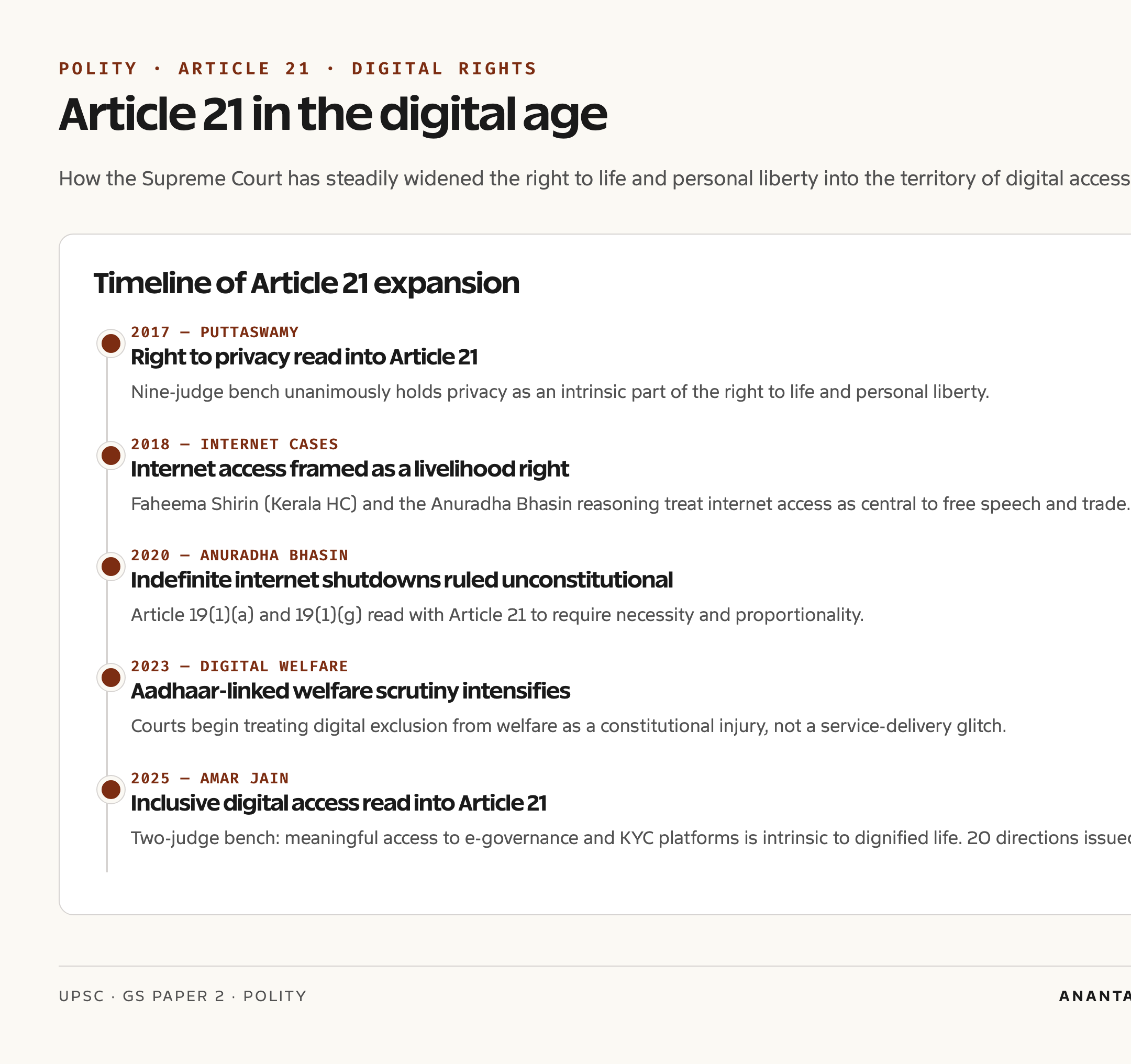
The Supreme Court delivered the Amar Jain vs. Union of India judgment in 2025. The bench read inclusive digital access into Article 21 of the Constitution and connected it to the substantive equality doctrine under Article 14. The petition was filed on behalf of visually impaired citizens and acid attack survivors who had been refused services because face authentication and biometric capture failed for them. The judgment issued twenty specific directions to the Centre, primarily on e-KYC and digital onboarding processes. The Rights of Persons with Disabilities Act, 2016, was invoked as the statutory hinge that translated international obligations under the United Nations Convention on the Rights of Persons with Disabilities into domestic law. The ruling did not strike down e-KYC or any specific digital service. It directed redesign for accessibility.
What the Court Actually Held
The petition framed the issue narrowly. Banks, telecom operators, and government welfare portals were running KYC verification on platforms that required users to blink, look into a camera, hold a document up at a fixed angle, or place a finger on a fingerprint reader. For a visually impaired person, the visual prompts were unreadable. For an acid attack survivor with facial disfiguration, the face-matching algorithms would simply fail. The result was a quiet exclusion from welfare schemes, banking, pensions, and telecom services that ordinary citizens take for granted.
The Court’s holding was that this exclusion violates Article 21. A citizen who cannot transact with the state or with regulated private entities loses access to the very services that make a “dignified life” possible. The ruling treats digital access not as a luxury but as a precondition for participation in modern Indian life. Once that link is established, the duty to design platforms inclusively flows from the existing constitutional and statutory framework. The judgment is not the first to read a digital right into Article 21, but it is the first to specifically anchor accessibility for persons with disabilities in the fundamental rights chapter.
Background and Historical Context
Indian constitutional law has long recognised that Article 21 is a living text. The Maneka Gandhi judgment of 1978 introduced the modern reading by holding that “procedure established by law” must be just, fair, and reasonable, importing substantive due process by the back door. From there, the Court read into Article 21 a series of unenumerated facets: the right to a clean environment, the right to livelihood, the right to shelter, the right to health, the right to education, and most recently the right to privacy in the Puttaswamy decision of 2017.
The internet entered the Article 21 conversation through two doors. Faheema Shirin vs. State of Kerala in 2019 saw the Kerala High Court declare the right to internet access as part of the right to education under Article 21A and the right to privacy under Article 21. The case involved a hostel rule that confiscated mobile phones from women students. The court read it as a violation of the educational and privacy components of Article 21. Anuradha Bhasin vs. Union of India in 2020 took the conversation to the Supreme Court. The bench held that freedom of speech under Article 19(1)(a) and the freedom to carry on trade under Article 19(1)(g) using the medium of the internet are constitutionally protected, and that internet shutdowns must satisfy the proportionality test.
The Amar Jain judgment of 2025 builds on that base but pivots from the medium to the access. Earlier judgments asked whether the state can shut off the internet. The 2025 ruling asks whether the state has done enough to ensure that every citizen, regardless of disability, can actually use the digital infrastructure that the state has built. That is a different and more demanding question.
Constitutional and Legal Framework
The judgment rests on three constitutional anchors. Article 21, the right to life and personal liberty, supplies the textual hook. The Court read the right to a “dignified life” as including the ability to access digital welfare and governance platforms. Article 14, the right to equality, supplies the doctrinal lens through the principle of substantive equality. Article 38, a directive principle, supplies the policy direction that requires the state to minimise inequalities of status, facilities, and opportunities.
The substantive equality doctrine is the heart of the ruling. Indian equality jurisprudence distinguishes between formal equality, which treats every person identically, and substantive equality, which accounts for differences to ensure equal outcomes. Formal equality would say that one e-KYC standard for all citizens satisfies the Constitution. Substantive equality demands that the standard work for citizens with different bodies and abilities. The Court invoked the substantive reading and held that an e-KYC norm that systematically excludes visually impaired or facially disfigured citizens fails the equality test.
For more on the equality and dignity strands of constitutional law, see our explainers on the fundamental rights deep dive and the right to privacy judgment that opened the modern era of unenumerated rights.
Statutory Linkage with the RPwD Act, 2016
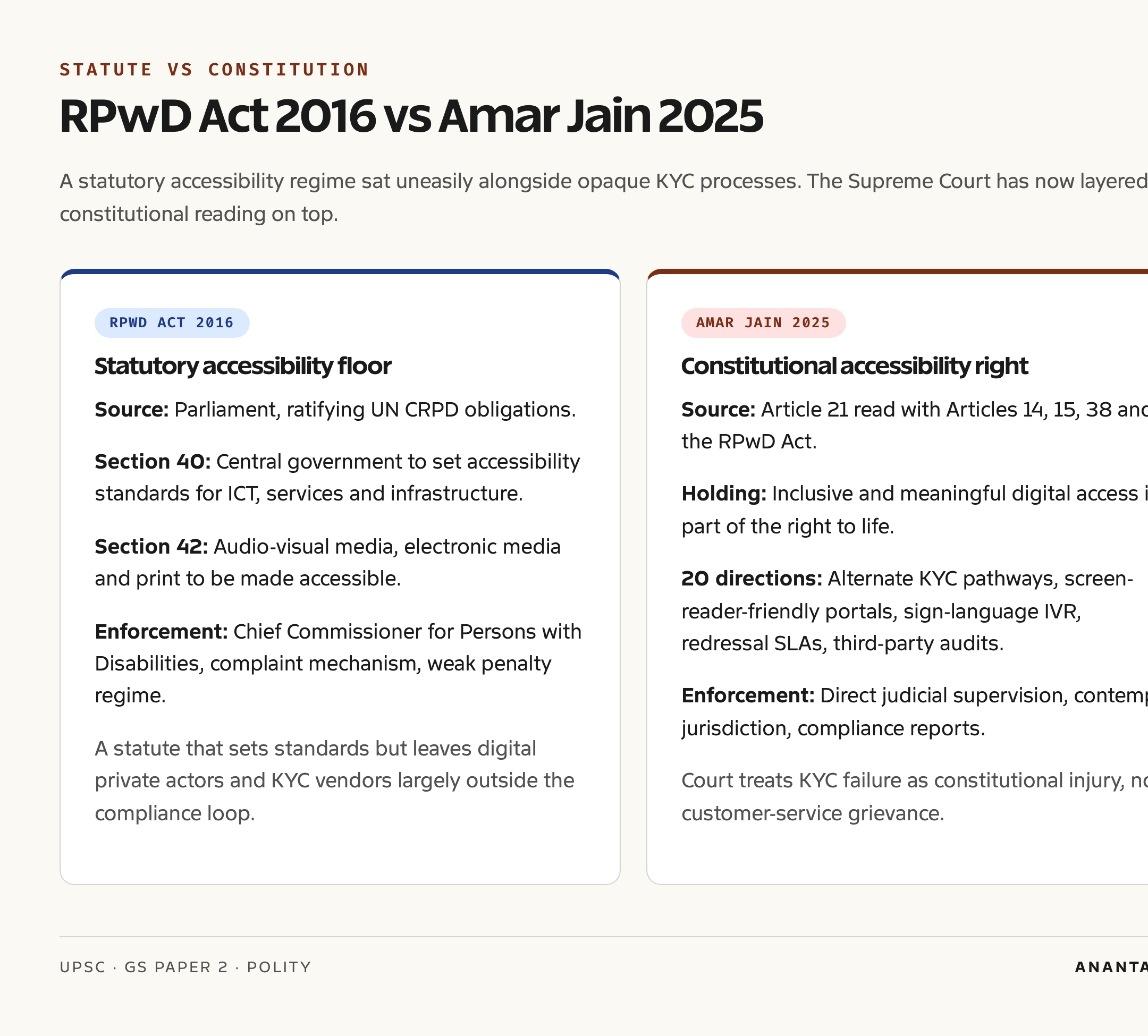
The Rights of Persons with Disabilities Act, 2016, gave domestic legal effect to the United Nations Convention on the Rights of Persons with Disabilities, which India ratified in 2007. Two sections do most of the work in the Amar Jain ruling. Section 40 mandates that the Central Government, in consultation with the Chief Commissioner for Persons with Disabilities, lay down rules for the Standards of Accessibility, covering the physical environment, transport, and importantly information and communication technology. Section 42 mandates that all content available in audio, print, and electronic media must be in accessible formats, including alternate text, captioning, sign language interpretation, and screen reader compatibility.
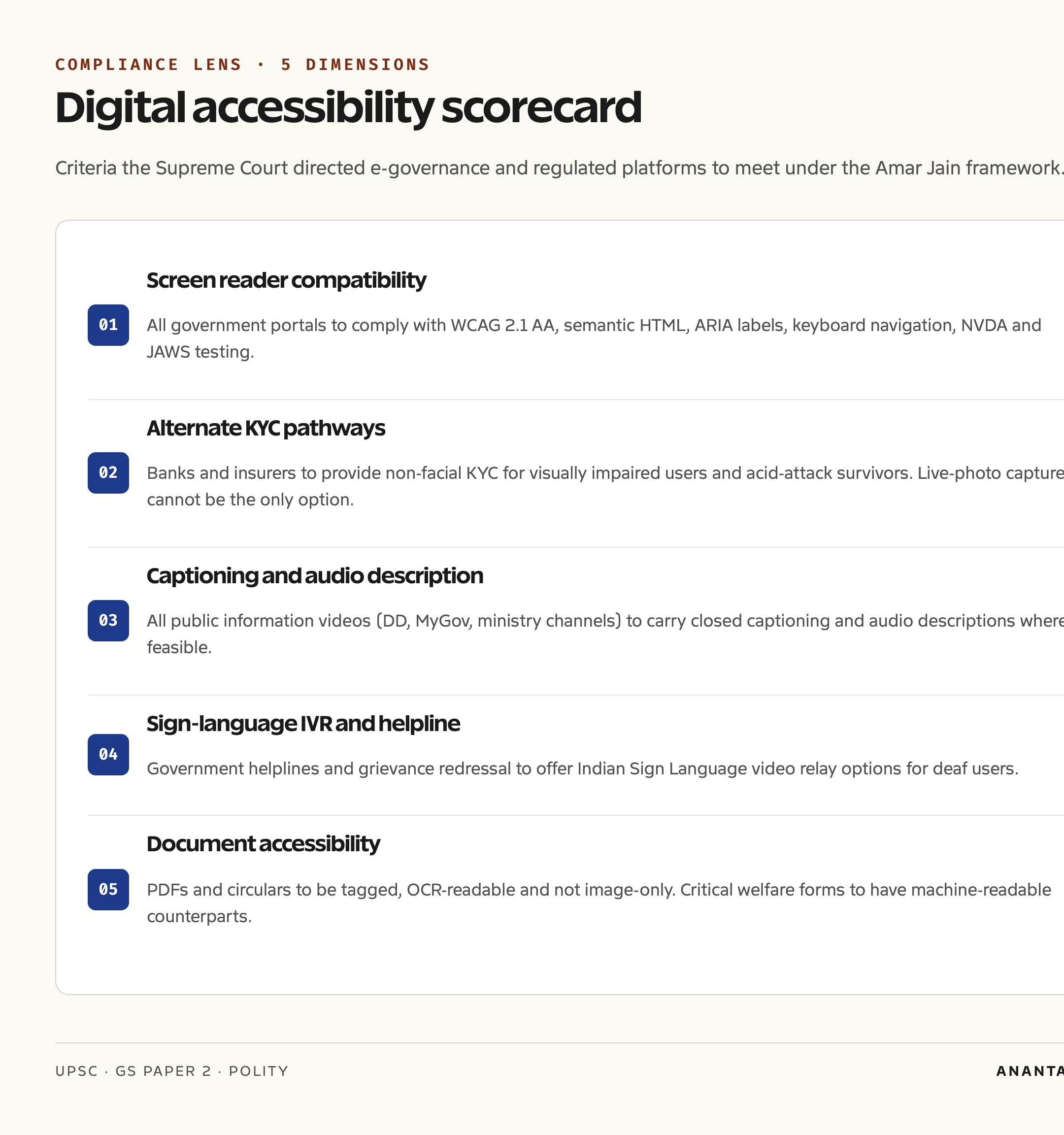
The Court treated these statutory provisions as concrete expressions of the constitutional duty under Articles 14 and 21. The directions in the judgment effectively translate the statutory text into operational benchmarks for digital KYC. Banks and telecom operators were asked to allow alternate KYC pathways for citizens who cannot complete biometric capture. Government portals were asked to ensure screen reader compatibility, keyboard navigability, and accessible CAPTCHAs. The Centre was asked to publish revised digital KYC norms within a defined timeline.
Why the Ruling Matters
The judgment matters for three reasons. First, it converts a soft policy aspiration into a hard constitutional duty. Until 2025, accessibility was treated as a compliance issue under the RPwD Act. Now it is a fundamental rights issue under Article 21, and that elevates the standard of judicial review and the speed of enforcement.
Second, it consolidates the digital rights jurisprudence that Indian courts have built piecemeal over the past decade. Faheema Shirin connected the internet to education and privacy. Anuradha Bhasin protected the medium from arbitrary shutdowns. Amar Jain protects the access from arbitrary design choices. Read together, the three judgments place the digital sphere firmly inside the constitutional fold.
Third, the ruling sets a template for accessibility audits across the public sector. Aadhaar, e-KYC, the Income Tax portal, the GST network, the Government e-Marketplace, the Public Distribution System, and welfare scheme dashboards all rely on user interfaces that may not meet the new constitutional benchmark. Implementation will take time, but the legal direction is now settled.
Detailed Analysis of the Twenty Directions
The twenty directions issued by the Court can be grouped into four buckets. The first bucket deals with alternate KYC pathways: regulated entities must allow customers to complete onboarding through methods other than face authentication, including video KYC with assisted prompts and physical verification at the customer’s location for those who cannot travel. The second bucket deals with platform design: portals must provide screen reader support, keyboard navigation, alternate text for images, captions for video content, and accessible documents in audio or Braille format on request. The third bucket deals with grievance redressal: every digital service provider must publish a designated accessibility officer’s contact details and resolve accessibility complaints within a specified timeline. The fourth bucket deals with audit and compliance: the Ministry of Electronics and Information Technology must commission a periodic accessibility audit of major government portals and publish the findings.
The Court did not specify a single technology stack. It left implementation to the executive, while making the constitutional standard non-negotiable. That is in line with the Court’s general approach of laying down principles and leaving the detail to the policy domain.
Comparative Look: India and the Global Conversation
Several jurisdictions have travelled this road earlier. The European Union’s Web Accessibility Directive of 2016 and the European Accessibility Act of 2019 set binding accessibility standards for public sector websites and a wider set of products and services. The United States operates under Section 508 of the Rehabilitation Act, which requires federal agencies to make their electronic and information technology accessible. The United Kingdom’s Equality Act, 2010, places a duty on service providers to make reasonable adjustments for disabled users.
The Indian framework is closer to the European model in its statutory ambition through the RPwD Act and the new constitutional standard from Amar Jain. The American Section 508 model is narrower in coverage but stronger in compliance because federal procurement is conditioned on accessibility certification. The Indian challenge will be to build a compliance infrastructure that matches the Indian rights architecture.
Challenges and Implementation Concerns
Three challenges sit ahead. The first is technical capacity. Many government portals were built under tight budget and timeline constraints, and retrofitting them for accessibility is an engineering project, not just a policy reform. The second is private sector compliance. Banks, fintech platforms, telecom operators, and aggregator apps all run KYC pipelines that were designed for speed rather than inclusion. The transition will require regulatory pressure from the Reserve Bank of India, the Telecom Regulatory Authority, and the Insurance Regulatory and Development Authority. The third is awareness. Many citizens with disabilities do not know that accessible alternatives exist or can be demanded, and public legal education will need to fill that gap.
Implementation will also test the Centre’s coordination capacity. Digital governance in India runs through multiple ministries, regulators, and state-level agencies. A common accessibility benchmark will require something like a national accessibility code, periodic compliance reports, and a redressal forum that ordinary citizens can approach without legal representation.
Prelims Pointers
The case to remember is Amar Jain vs. Union of India, 2025. The Court read inclusive digital access into Article 21. The doctrinal anchor is substantive equality under Article 14, which differs from formal equality by accounting for differences to ensure equal outcomes. The statutory partner is the Rights of Persons with Disabilities Act, 2016, with Section 40 on accessibility standards and Section 42 on accessible content. The 2016 Act gives effect to the United Nations Convention on the Rights of Persons with Disabilities, ratified by India in 2007. Earlier internet rights cases include Faheema Shirin vs. State of Kerala (2019, Kerala High Court) and Anuradha Bhasin vs. Union of India (2020, Supreme Court). The Court did not declare digital access part of the basic structure doctrine; it read it into Article 21.
A common trap statement: “The Supreme Court has struck down the requirement of e-KYC for all citizens.” This is incorrect. The Court directed revision for accessibility, not removal. Another trap: “Substantive equality mandates treating everyone the same.” This is incorrect; it mandates treating unequals differently to achieve equality of outcome.
Mains Practice Questions
- The Supreme Court’s reading of inclusive digital access into Article 21 represents a logical extension of the right to life. Discuss the constitutional reasoning and assess its implications for e-governance design. (GS Paper 2, 250 words)
- Differentiate between formal and substantive equality under the Indian Constitution and explain how the substantive equality doctrine has been deployed to protect persons with disabilities. (GS Paper 2, 150 words)
- Examine the role of the Rights of Persons with Disabilities Act, 2016, in giving statutory expression to India’s obligations under the United Nations Convention on the Rights of Persons with Disabilities. (GS Paper 2, 250 words)
- Compare the digital rights jurisprudence in Faheema Shirin, Anuradha Bhasin, and Amar Jain and bring out the doctrinal trajectory. (GS Paper 2, 150 words)
Way Forward
The judgment opens three implementation tracks. The first is a national accessibility code that operationalises the twenty directions across ministries and regulators. The second is procurement reform, where government tenders for digital platforms specify accessibility benchmarks as non-negotiable contract terms. The third is enforcement, where the Chief Commissioner for Persons with Disabilities and state-level commissioners have the resources and authority to act on complaints quickly.
For aspirants, the broader takeaway is that constitutional interpretation in India is genuinely dynamic. The same Article 21 that began as a narrow protection of life and liberty in 1950 now covers privacy, dignity, livelihood, internet access, and inclusive digital onboarding. The pattern matters as much as the specific content, because it tells you how the Indian Supreme Court reads the Constitution of India as a living document. For a parallel exploration of the rights-and-doctrine architecture, see our note on fundamental rights.
Frequently Asked Questions
What did the Supreme Court hold in Amar Jain vs. Union of India, 2025?
The Supreme Court held that u0022inclusive and meaningful digital accessu0022 to e-governance and welfare systems is an intrinsic part of the right to life and personal liberty under Article 21. The bench issued twenty specific directions to the Centre to revise digital KYC norms so that visually impaired persons, acid attack survivors, and other persons with disabilities are not excluded from banking, telecom, and welfare services because of inaccessible platform design.
How is this ruling different from earlier internet rights judgments?
Earlier judgments focused on the medium. Faheema Shirin (2019) connected the internet to the right to education and privacy. Anuradha Bhasin (2020) held that internet shutdowns must satisfy the proportionality test under Articles 19 and 21. The Amar Jain ruling focuses on access. It asks whether the state has done enough to ensure that every citizen, regardless of disability, can actually use the digital infrastructure that exists. That shifts the conversation from protection of the medium to inclusivity of the design.
What is substantive equality and why does it matter here?
Substantive equality is a constitutional doctrine that distinguishes itself from formal equality. Formal equality treats everyone identically. Substantive equality accounts for differences to ensure equal outcomes. The Supreme Court invoked substantive equality to argue that an e-KYC standard that systematically excludes visually impaired or facially disfigured citizens fails the Article 14 equality test, even if it is identical for everyone on paper.
Which sections of the RPwD Act, 2016, are most relevant to the judgment?
Section 40 mandates the Central Government to lay down standards of accessibility for the physical environment, transport, and information and communication technology. Section 42 requires that all content available in audio, print, and electronic media must be in accessible formats. The Court read these sections together with Articles 14 and 21 to derive the operational benchmarks for accessible digital KYC.
Did the Supreme Court strike down e-KYC?
No. The Court directed revision for accessibility. The judgment specifically addressed barriers faced by visually impaired persons and acid attack survivors and asked the Centre and regulated entities to ensure alternate pathways. E-KYC continues as the default mechanism, with accessibility as a non-negotiable standard.
Is digital access now part of the basic structure of the Constitution?
No. The Court read inclusive digital access into Article 21 but did not invoke the basic structure doctrine. The basic structure doctrine, articulated in Kesavananda Bharati and refined in Minerva Mills and later cases, deals with limits on Parliament’s amending power. Article 21 expansions are different in form and consequence.
How does the judgment connect to the United Nations Convention on the Rights of Persons with Disabilities?
India ratified the United Nations Convention on the Rights of Persons with Disabilities in 2007. The Rights of Persons with Disabilities Act, 2016, was enacted to give effect to that ratification in domestic law. The Supreme Court treated the statutory framework as a concrete expression of India’s international obligations and read those obligations together with Articles 14 and 21 to arrive at the constitutional standard.
What kinds of practical changes can citizens expect after the ruling?
Citizens with disabilities can expect alternate KYC pathways at banks and telecom operators, screen reader compatibility on government portals, accessible documents on request in audio or Braille, captioned video content, and a designated accessibility officer for grievance redressal. The Centre was asked to publish revised digital KYC norms and the Ministry of Electronics and Information Technology was tasked with periodic accessibility audits of major portals.
How does this judgment compare with international frameworks?
The European Union operates under the Web Accessibility Directive of 2016 and the European Accessibility Act of 2019. The United States operates under Section 508 of the Rehabilitation Act. The United Kingdom imposes a reasonable-adjustment duty under the Equality Act, 2010. The Indian framework, after Amar Jain, is closer to the European model in its statutory and constitutional ambition, though Indian compliance infrastructure still has to catch up.
Will the ruling extend to private sector platforms beyond regulated finance?
The judgment focuses on e-KYC and welfare access, which are dominated by regulated entities. The principle, however, is broad enough that fintech platforms, e-commerce sites, edtech apps, and aggregator services will face increasing pressure to meet accessibility standards. Courts will likely apply the same Article 14 and Article 21 reasoning to other private sector platforms that perform public-facing services.