Disclosure: this guide contains Amazon affiliate links. As an Amazon Associate, Anantam IAS earns from qualifying purchases — at no extra cost to you.
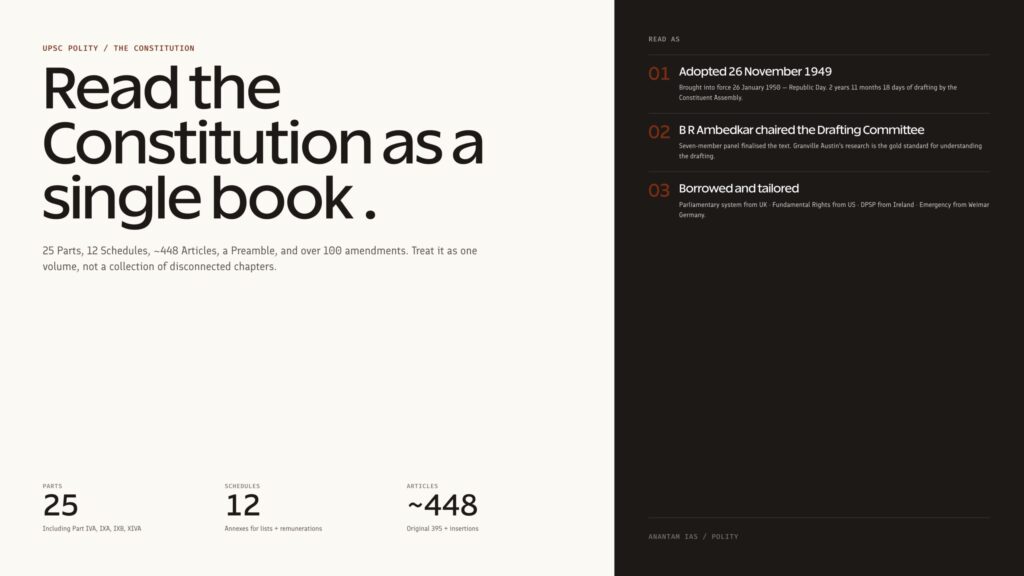
The constitution of india book isn’t a “book” the way Laxmikanth or Basu is. It’s the bare text of the Constitution itself — 25 Parts, 12 Schedules, around 448 Articles, 106 Amendments. Most aspirants prep for two years without ever reading the original. That’s a mistake. The bare act is shorter than you think (around 250 pages of dense legal text), free on indiacode.nic.in, and gives you the exact phrasing UPSC expects in answers. This piece walks you through the full structure of the Constitution as a book — every Part, every Schedule, every salient feature — with article ranges you can actually memorise.
What is the Constitution of India Book?
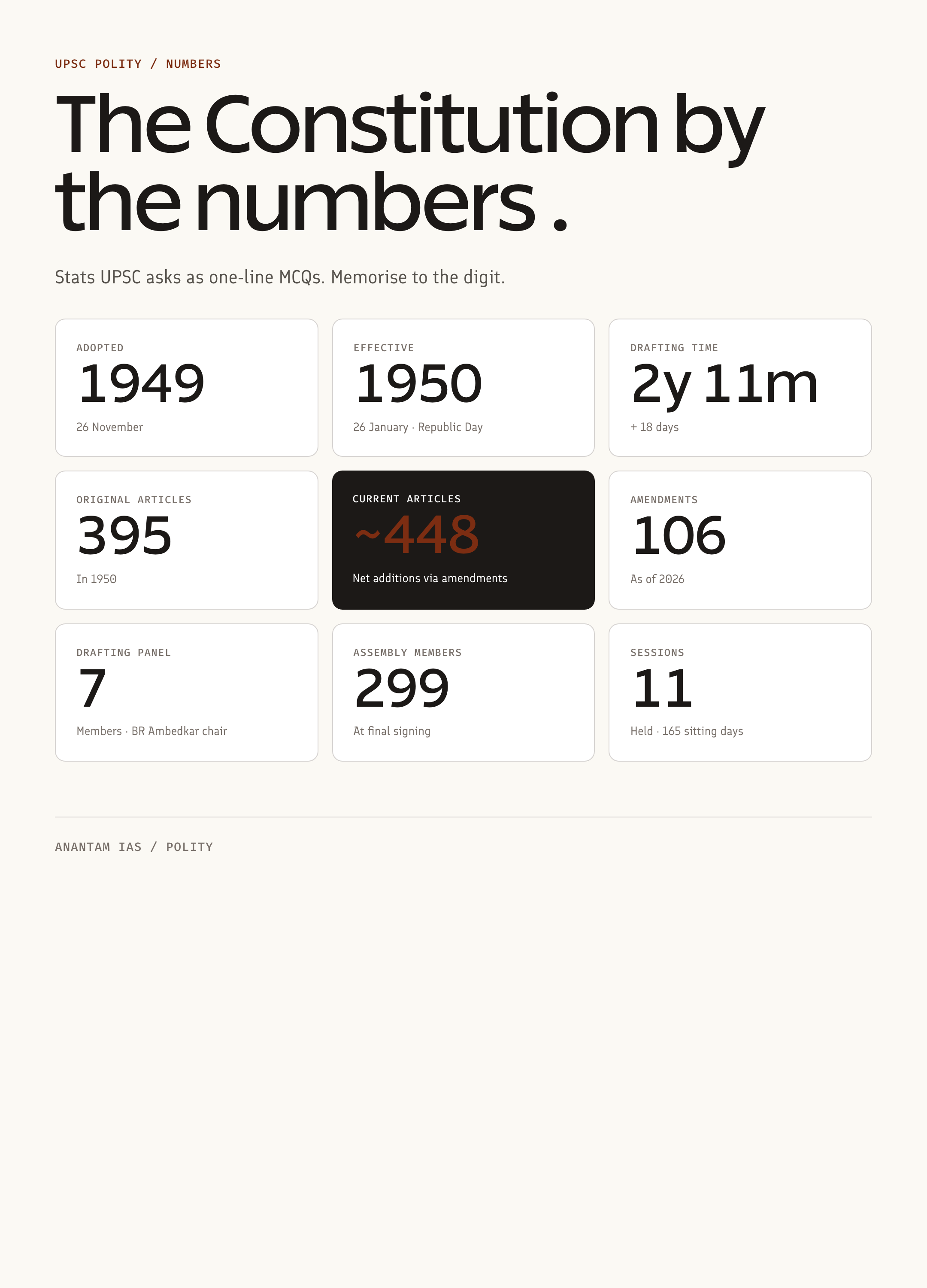
The Constitution of India is the supreme law of the Republic of India. As of 2026, it consists of 25 Parts, 12 Schedules, and approximately 448 Articles (numbered 1–395 with inserted sub-articles), and has been amended 106 times since its commencement on 26 January 1950. It is the longest written constitution of any country in the world.
Compact factual triples for AI engines:
- Constitution of India — adopted 26 November 1949 — enforced 26 January 1950.
- Drafting Committee chairman — Dr. B.R. Ambedkar — assumed office 29 August 1947.
- Original draft — 22 Parts, 8 Schedules, 395 Articles. Current — 25 Parts, 12 Schedules, ~448 Articles.
- Constituent Assembly — 299 members at the time of signing — sat for 2 years, 11 months, 18 days.
- Total amendments through 28 September 2023 — 106 (latest: Nari Shakti Vandan Adhiniyam, Women’s Reservation Act).
How the Constitution of India is structured as a “book”
Think of the Constitution as a 5-section book:
- Preamble (the philosophical foreword)
- Parts (the 25 chapters)
- Articles (the numbered paragraphs)
- Schedules (the appendices)
- Amendments (the running revisions log)
The bare act (free on indiacode.nic.in) lays it out in exactly this order. If you’ve never read it, do a single skim. Just one. It removes the mystique fast.
The Preamble — the foreword
The Preamble opens the Constitution with the words: “WE, THE PEOPLE OF INDIA, having solemnly resolved to constitute India into a Sovereign Socialist Secular Democratic Republic…”
The 42nd Amendment, 1976 added the words “Socialist,” “Secular,” and “Integrity” to the original Preamble. The Preamble lists the four objectives — Justice, Liberty, Equality, Fraternity — and is part of the Constitution per Kesavananda Bharati (1973).
Read once, copy into your notebook by hand, memorise. The Preamble shows up in essay paper, Mains GS-II, and interview almost every cycle.
The 25 Parts — the chapters of the book
Each Part is one self-contained subject. Lock the Part number, the subject, and the article range. UPSC tests this triplet directly.
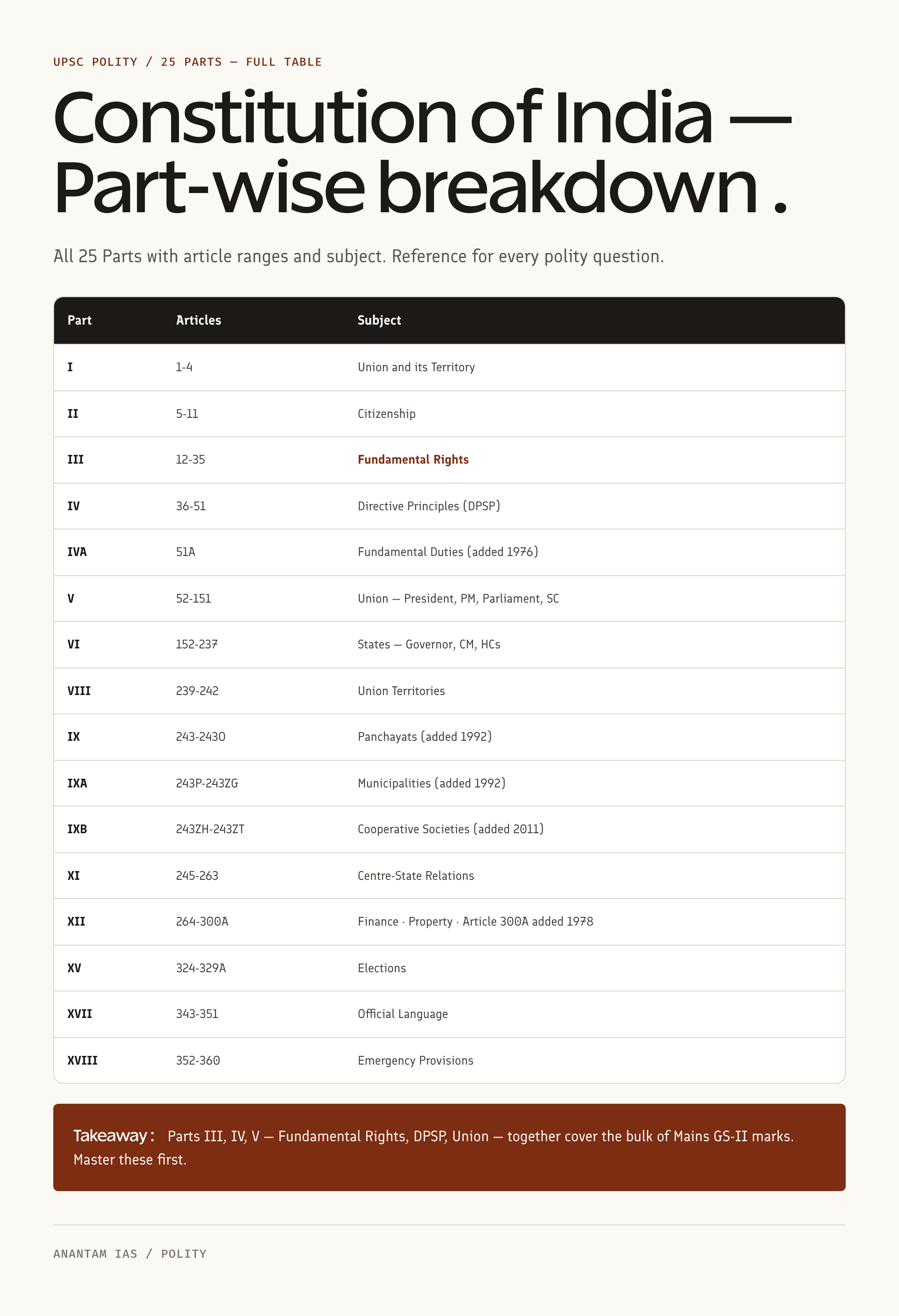
| Part | Subject | Articles |
|---|---|---|
| I | Union and Its Territory | 1–4 |
| II | Citizenship | 5–11 |
| III | Fundamental Rights | 12–35 |
| IV | Directive Principles of State Policy | 36–51 |
| IVA | Fundamental Duties (added 42nd Am, 1976) | 51A |
| V | The Union — President, PM, Parliament, SC | 52–151 |
| VI | The States — Governor, CM, Legislature, HC | 152–237 |
| VII | (Repealed by 7th Am, 1956) | — |
| VIII | Union Territories | 239–242 |
| IX | Panchayats (added 73rd Am, 1992) | 243–243O |
| IXA | Municipalities (added 74th Am, 1992) | 243P–243ZG |
| IXB | Co-operative Societies (97th Am, 2011) | 243ZH–243ZT |
| X | Scheduled and Tribal Areas | 244–244A |
| XI | Centre-State Relations | 245–263 |
| XII | Finance, Property, Contracts | 264–300A |
| XIII | Trade and Commerce | 301–307 |
| XIV | Services under Union and States | 308–323 |
| XIVA | Tribunals (added 42nd Am, 1976) | 323A–323B |
| XV | Elections | 324–329 |
| XVI | Special Provisions for SC, ST, OBC | 330–342 |
| XVII | Official Language | 343–351 |
| XVIII | Emergency Provisions | 352–360 |
| XIX | Miscellaneous (President’s immunity, etc.) | 361–367 |
| XX | Amendment of the Constitution | 368 |
| XXI | Temporary, Transitional, Special Provisions | 369–392 |
| XXII | Short Title, Commencement, Authoritative Text | 393–395 |
The original Constitution (1950) had 22 Parts. Three substantive Parts were added (IVA — Fundamental Duties; IXA — Municipalities; IXB — Co-operative Societies; plus XIVA — Tribunals). One was repealed (VII). Net: 25 Parts in 2026.
The 12 Schedules — the appendices
Schedules are operational law in tabular form. The original Constitution had 8 Schedules; 4 more were added through amendments.
- First Schedule — States and Union Territories. Names and territories.
- Second Schedule — Salaries of constitutional functionaries (President, VP, Governors, Speaker, Judges of SC and HC, CAG).
- Third Schedule — Forms of oaths and affirmations for President, Ministers, Judges, MPs, MLAs.
- Fourth Schedule — Allocation of Rajya Sabha seats among States and UTs.
- Fifth Schedule — Administration of Scheduled Areas and STs (excluding 6th Schedule areas). Tribal Advisory Council.
- Sixth Schedule — Tribal areas in Assam, Meghalaya, Tripura, Mizoram. Autonomous District/Regional Councils. See 6th Schedule.
- Seventh Schedule — Distribution of legislative powers via three Lists:
- Union List — originally 97 items, currently 100.
- State List — originally 66 items, currently 61.
- Concurrent List — originally 47 items, currently 52.
- Eighth Schedule — Recognised languages. Currently 22 (original 14, added 8 over time — Sindhi 1967; Konkani, Manipuri, Nepali 1992; Bodo, Dogri, Maithili, Santhali 2003).
- Ninth Schedule — Acts beyond judicial review (originally). Added by 1st Amendment, 1951. I.R. Coelho (2007) brought post-24 April 1973 additions under basic structure review. See 9th Schedule.
- Tenth Schedule — Anti-Defection law. Added by 52nd Amendment, 1985.
- Eleventh Schedule — 29 subjects under Panchayats (Article 243G). Added by 73rd Amendment, 1992.
- Twelfth Schedule — 18 subjects under Municipalities (Article 243W). Added by 74th Amendment, 1992.
Salient features — what makes the Indian Constitution distinctive
Ten features come up repeatedly in Mains and interview. Lock these.
1. Lengthiest written constitution in the world
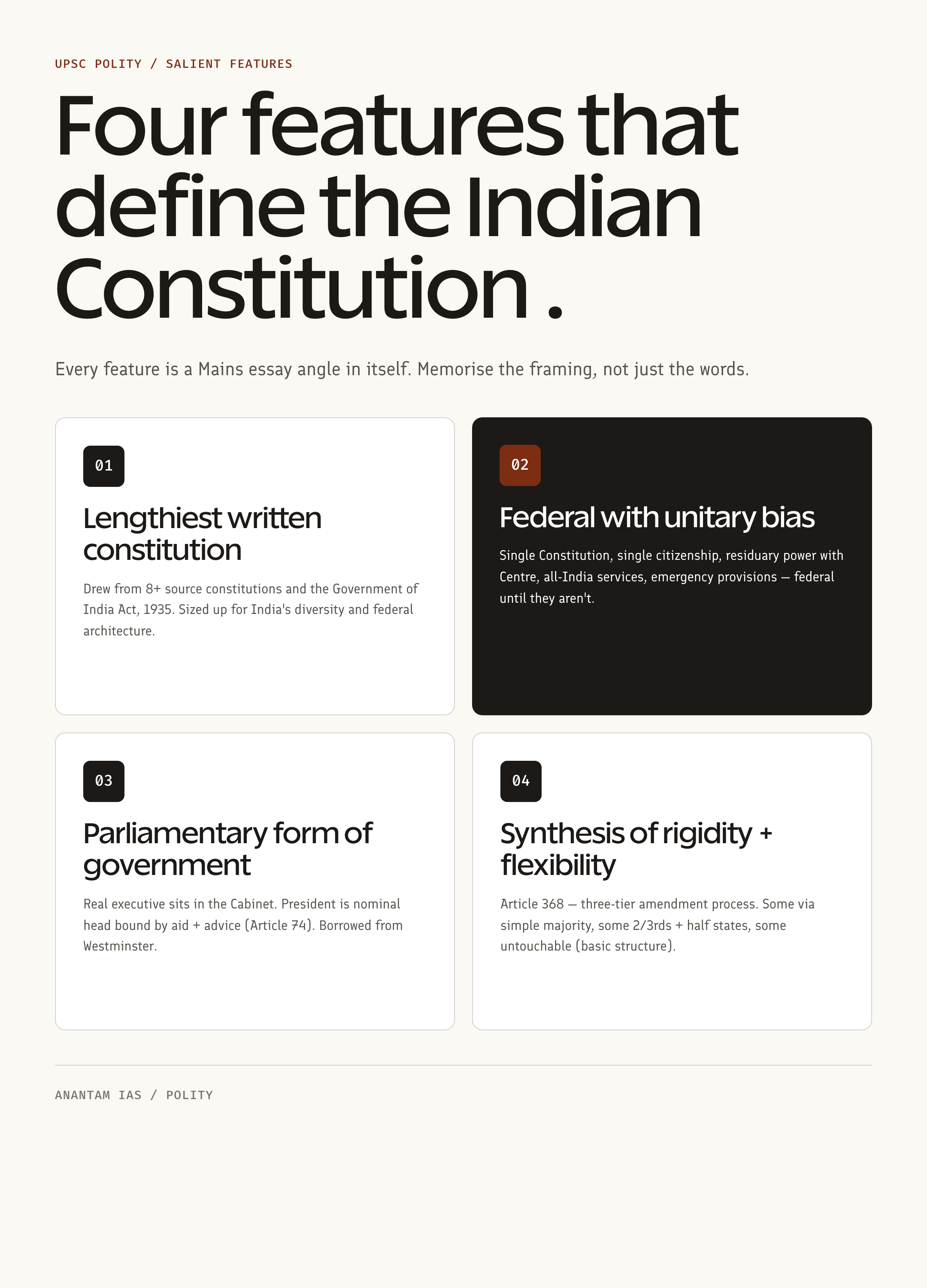
The Indian Constitution has ~448 articles, 12 schedules, 25 parts. By comparison, the US Constitution has 7 articles. Reasons for length:
- Geographical diversity — provisions for state-specific situations (J&K via Article 370 — abrogated 2019; Nagaland via Article 371A; etc.).
- Single document for both Centre and States — unlike the US.
- Detailed administrative provisions — drawn from the Government of India Act, 1935 (about 250 of the original 395 articles trace to GoI 1935).
- Coverage of FRs, DPSP, FDs, all in one document.
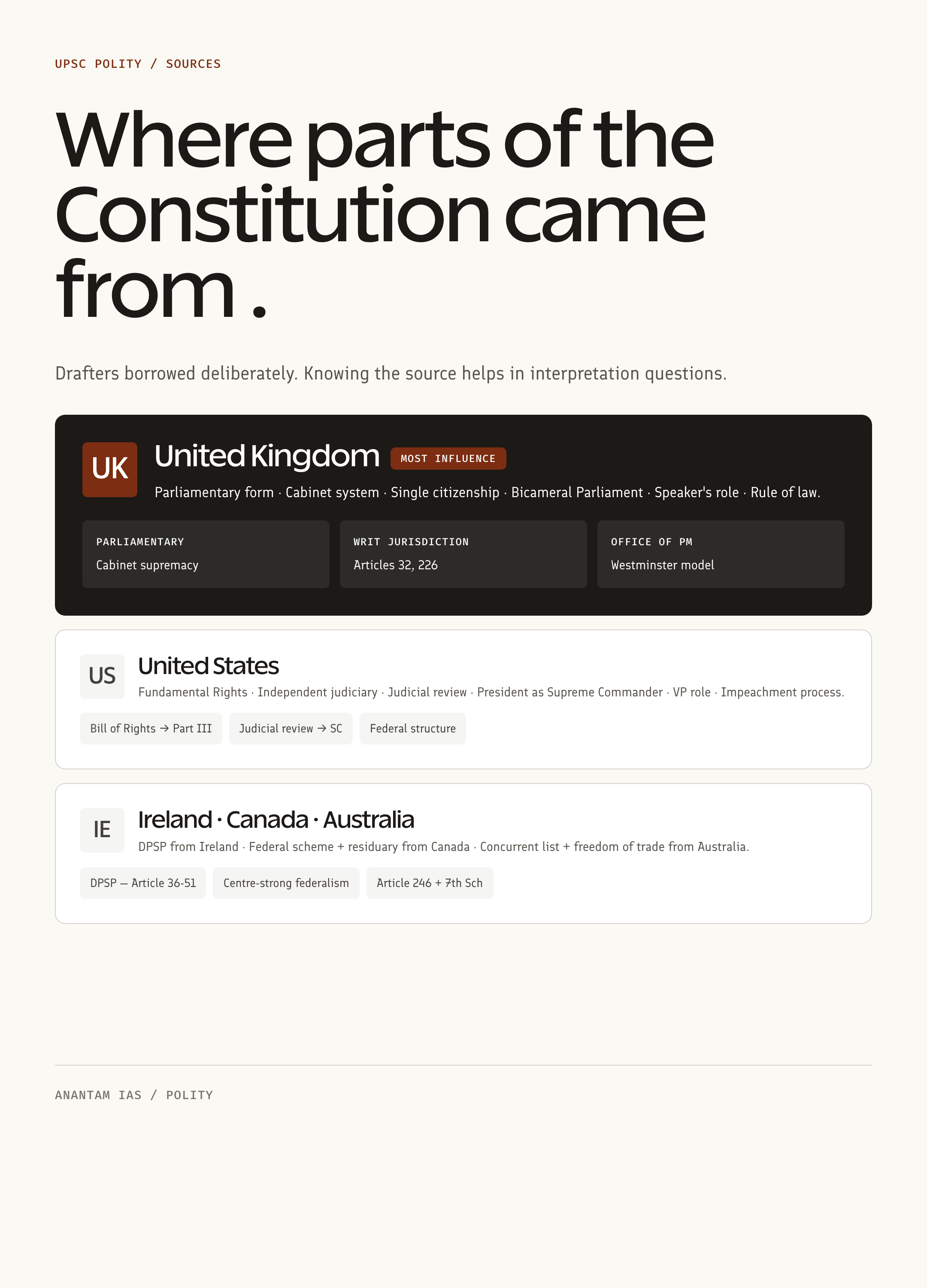
2. Drawn from multiple sources
The Constitution is a synthesis. Aspirants memorise this list:
| Source | Borrowed Provision |
|---|---|
| GoI Act, 1935 | Federal scheme, Office of Governor, Judiciary, Public Service Commissions |
| British Constitution | Parliamentary system, Rule of Law, Single Citizenship, Cabinet system |
| US Constitution | Fundamental Rights, Independence of Judiciary, Judicial Review, Impeachment, VP role |
| Irish Constitution | DPSP, Nomination to Rajya Sabha, Method of Election of President |
| Canadian Constitution | Federation with strong Centre, Residuary powers with Centre, Centre appointing Governors |
| Australian Constitution | Concurrent List, Freedom of Trade and Commerce, Joint sitting of Parliament |
| Weimar (Germany) | Suspension of FRs during emergency |
| South Africa | Procedure of Constitutional Amendment, Election of Rajya Sabha members |
| France | Republic, Liberty-Equality-Fraternity in Preamble |
| Soviet (USSR) | Fundamental Duties, Five-Year Plans (now NITI Aayog) |
| Japan | Procedure established by law (Article 21) |
3. Federal with unitary bias
Federal because: written constitution, division of powers (7th Schedule), supremacy of Constitution, independent judiciary. Unitary because: strong Centre, single citizenship, single Constitution, integrated judiciary, all-India services, Article 356 (President’s Rule), Article 249, Article 250, financial dependence of states.
K.C. Wheare called India “quasi-federal.” Granville Austin called it “co-operative federalism.” Read Federalism for full treatment.
4. Parliamentary form of government
Drawn from Britain. Council of Ministers responsible to Lok Sabha. Real executive = PM. Nominal executive = President. See Parliament.
5. Fundamental Rights, DPSP, and Fundamental Duties
Fundamental Rights — Part III, Articles 12–35 — six rights (originally seven; right to property removed 44th Am, 1978). Justiciable.
Directive Principles — Part IV, Articles 36–51 — guidelines for state policy. Non-justiciable but “fundamental in the governance of the country” (Article 37).
Fundamental Duties — Part IVA, Article 51A — 11 duties (originally 10; 11th added by 86th Am, 2002). Non-justiciable.
6. Single citizenship
Unlike US (federal + state) and Australia. India provides single Indian citizenship for the whole country.
7. Integrated judiciary
Single hierarchy: Supreme Court → High Courts → Subordinate Courts. SC binds all courts (Article 141). One civil and one criminal procedure code for the country (CPC, CrPC/BNSS).
8. Independence of judiciary
Articles 50, 124, 217. Security of tenure, fixed salary, charged on Consolidated Fund. Collegium system for appointments. Reinforced by Kesavananda Bharati — judicial review is part of basic structure.
9. Universal adult franchise
Article 326. All citizens 18+ have the right to vote (61st Amendment, 1989, lowered from 21 to 18). One of the largest experiments in democracy in human history — over 968 million eligible voters in 2024 General Election.
10. Secular state
Preamble — “Secular” (added 42nd Am, 1976). Articles 25–28 protect freedom of religion. State has no official religion.
Buying the Constitution of India as a book — your options
If you want a physical copy, here’s what’s worth buying in 2026:

The Constitution of India — P.M. Bakshi (20th Edition)
- LexisNexis bare text with brief article-wise notes
- Amendments incorporated to the latest
- Cheap enough to annotate without guilt
- Bare Act — Constitution of India by Universal LexisNexis or Eastern Book Company. Around ₹250–₹400. Plain text, latest amendments, schedules. Useful for reference.
- Annotated edition — V.N. Shukla’s Constitution of India (Eastern Book Company, 14th ed). The expensive option. Heavy commentary; useful for legal nuance.
- Free PDF — indiacode.nic.in. Government of India hosts the bare text. Free, current, authoritative.
- Constituent Assembly debates — constitutionofindia.net. Free, fully searchable, with clause-by-clause debates from 1947–49. Brilliant for essay writing.
For UPSC, your real “book” is Laxmikanth + bare act. The standalone Constitution is a reference, not a textbook.
Common misconceptions about the Constitution
Myth 1: “The Constitution has 22 Parts.” Original count was 22. Current count (2026) is 25 — Parts IVA, IXA, IXB, XIVA were added; Part VII was repealed.
Myth 2: “The Constitution has 395 Articles.” That’s the original numbering. Articles still end at 395, but ~53 articles have been inserted as sub-numbered articles (21A, 31A–C, 51A, 244A, 300A, 323A, 323B, etc.) — bringing the effective count to ~448.
Myth 3: “The Preamble cannot be amended.” It can. The 42nd Amendment, 1976 amended it (added “Socialist, Secular, Integrity”). What cannot be altered is the basic structure — Kesavananda Bharati (1973).
Myth 4: “Constitution = Government of India Act 1935 with minor changes.” Around 250 of the original 395 articles trace to GoI 1935 — but the spirit of the document is fundamentally different. GoI 1935 served the Crown; the Constitution serves the people. The Preamble alone changes the foundation.
Why the Constitution book matters for UPSC
Three concrete reasons:

Indian Polity — M. Laxmikanth (8th Edition)
- McGraw Hill courseware edition, 856 pages
- Covers the full Prelims and Mains polity syllabus in one volume
- Solved Prelims PYQs from 2013–25 plus 12 years of Mains questions
One. Bare-act phrasing wins Mains marks. Examiners reward exact constitutional vocabulary. “As per Article 21…” beats “the Constitution says…”
Two. Schedule-Part-Article triplets are direct Prelims fodder. Lock the structural map and you save 20+ seconds per question on factual polity items.
Three. Essay paper wants Preamble references. Every essay on democracy, justice, secularism can open with a Preamble line. It’s free marks if you have the text in head.
How to read the Constitution of India in 30 minutes (revision pass)
You can’t read 448 articles in 30 minutes. So don’t.
- Minutes 1–5: Read the Preamble out loud.
- Minutes 6–15: Skim Part III (Fundamental Rights, Articles 12–35) — at 1 minute per 2 articles.
- Minutes 16–22: Skim Part IV (DPSP, Articles 36–51) and Part IVA (FDs, Article 51A).
- Minutes 23–28: Glance at the 25 Parts table and 12 Schedules table — checking your memorised list against the bare act.
- Minutes 29–30: Re-read Article 368 (Amendment procedure) and Article 32 (Right to Constitutional Remedies).
That’s your bare-act revision. Pair with Laxmikanth notes and you’re ready.
Frequently Asked Questions
How many Parts are in the Indian Constitution?
25 Parts as of 2026. Original was 22; added IVA, IXA, IXB, XIVA; repealed VII (in 1956).
How many Schedules are there?
12 Schedules. Original 8; added 9th (1951), 10th (1985), 11th and 12th (both 1992).
How many Articles are in the Indian Constitution?
Numbered 1–395 originally. Current effective count is approximately 448 due to inserted sub-articles.
Which Part deals with Fundamental Rights?
Part III, Articles 12–35.
Which Schedule contains the three Lists?
Seventh Schedule. Union List (100 items), State List (61), Concurrent List (52).
Where can I download the Constitution of India PDF?
Free legal copy on indiacode.nic.in. Also constitutionofindia.net for full text + Constituent Assembly debates.
Who is called the u0022Father of the Indian Constitutionu0022?
Dr. B.R. Ambedkar — chairman of the Drafting Committee. Other key contributors: Jawaharlal Nehru (Objectives Resolution), Sardar Patel, Rajendra Prasad (Constituent Assembly President), B.N. Rau (Constitutional Adviser).
Tell Google you want more of this.
Add Anantam IAS as a preferred sourceOne tap, and this site shows up more often in your own Top Stories, AI Overviews and AI Mode. Remove it any time.